Episode 485: His last night on Earth as himself

Mad scientists Julia Hoffman (Grayson Hall) and Eric Lang (Addison Powell) are conferring in Lang’s lab. Lang is putting the finishing touches on a Frankenstein’s monster into which he plans to transfer the “life force” of recovering vampire Barnabas Collins. Julia, Barnabas’ best friend, has been opposed to this experiment, but now has accepted that she can’t stop Barnabas and Lang from going through with it. She volunteers to assist.

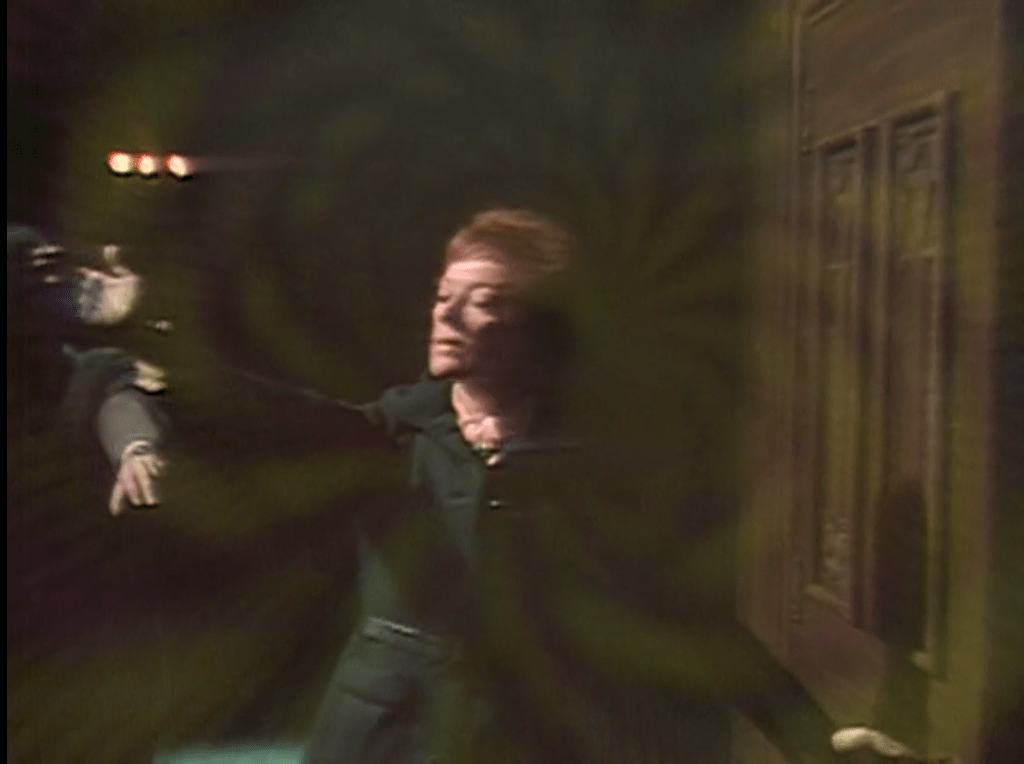
Lang is having trouble concentrating because of a nightmare he had last night. Unknown to him, the nightmare was part of the Dream Curse, a dead end storyline about wicked witch Angelique sending a dream that each of a series of people will have. When the last person has the dream, Barnabas is supposed to revert to full-on vampirism.

Lang tells Julia about his nightmare. He says that she was in it. When he tells her that she did not speak, she smiles comfortably and says that that was proof that it was a dream. This is not only a genuinely funny line as Grayson Hall delivers it, but it is an extraordinary moment of self-awareness from Julia, a character who usually exists at the outer edge of heightened melodrama. It’s a shame that Addison Powell doesn’t know how to get out of Hall’s way for the half second it would take for it really to land with the audience.

Barnabas and his ex-blood thrall Willie are at home in the Old House on the great estate of Collinwood. Willie is smirking and Barnabas is rigid with embarrassment while the dogs howl outdoors. Willie laughs a little as he makes a remark about how Barnabas hasn’t changed as much as he thought he had. This exchange reminds us of the moment in #346 when Julia and well-meaning governess Vicki noticed that some fresh flowers Barnabas touched had died and shriveled up. Like the howling of the dogs when Barnabas feels bloodlust, the shriveling of the flowers was a consequence of his vampirism, effectively a bodily function that he cannot control. He squirmed when Julia and Vicki looked at him then, and he is stiff and flustered when Willie laughs at him now.

Willie is amused by Barnabas’ incontinence. Screenshot by Dark Shadows Before I Die.

Barnabas orders Willie to take a letter to matriarch Liz at the great house on the estate. It will explain that he is going away on a long trip, and that Adam Collins, a young cousin from England, will be coming to stay in the Old House. Willie is alarmed by this.

Willie asks what Barnabas will do if Liz won’t let him stay in the Old House when he is in the form of Adam. Barnabas is sure she will, and dismisses Willie’s doubts. This is an interesting sequence to regular viewers. The show has never made it clear whether Liz still owns the house or has signed it over to Barnabas. A whole year ago, in #223, Liz was talking to strange and troubled boy David as if the Old House and its contents were Barnabas’ legal property. Since then, there have been moments that tend to confirm that impression, as when Barnabas takes Liz’ keys to the house away from David and does not give them back to her, and other moments that conflict with it. Willie’s question and Barnabas’ response would seem to prove that the house still belongs to Liz.

Another question we might ask is why Barnabas doesn’t go to Liz himself. Certainly she will be unhappy that he went away without saying goodbye to her. Moreover, when he showed up at the great house in April 1967, Barnabas told Liz that he was the only survivor of the English branch of the family. Liz will be skeptical if another member of this imaginary branch presents himself and expects to take possession of a big mansion on her property. She has had unpleasant experiences with Willie, so much so that a letter he delivers seems unlikely to allay that skepticism.

When Willie gets to the great house, Angelique herself opens the door. She is living there under the name Cassandra. She has cast a spell on Liz’ brother, sarcastic dandy Roger, and married him so that she will have a residence at Collinwood while she works to restore Barnabas’ curse to its full potency. Showing his typical degree of strategic ability, Barnabas has not bothered to tell Willie about any of this.

Angelique/ Cassandra ushers Willie into the drawing room, sits him down, and chats with him. Willie answers her questions about Barnabas, not realizing that he has any more reason to be discreet with her than with anyone else. He tells her that Barnabas has been spending his days with Lang. Angelique/ Cassandra already knows that it was Lang who gave Barnabas the treatments that put his vampirism into remission and that Lang is preparing further treatments for him. Barnabas should know that she knows this, since she went to Lang’s house and tried to kill him. Willie also tells her that sometimes Barnabas doesn’t seem to have changed as much as you might expect. Angelique/ Cassandra’s reaction makes it clear this is new information to her, and that it might help her in her efforts.

The scene raises yet another question. Barnabas had expressed the hope that once the experiment was complete, Angelique would see that his old body was dead, would assume that meant that he no longer existed in any form, and that she would then go away and leave him alone. But he knows that she knows about Lang, and now he is planning to come back to Collinwood, where she lives, as another “cousin from England.” The question is this- how dumb does Barnabas think Angelique is?

Back in the lab, Lang and Julia are preparing for the experiment. Barnabas shows up. When he talks with the doctors, his face is reflected in the mirror above Lang’s creature. Not only does this suggest the idea of his personality moving into the creature’s body, it also reminds us that until Lang gave him his first course of treatment, Barnabas did not cast a reflection. The whole idea of Barnabas’ reflection will remind longtime viewers of #288, when Julia first confirmed her suspicion that Barnabas was a vampire by peeking at the mirror in her compact and not seeing him. That draws a contrast between Lang, whose initial success with Barnabas appears to be leading to disaster because his impersonal, hyper-masculine approach leaves him unable to recognize the threat Angelique poses, and Julia, whose own attempts to cure Barnabas of vampirism did not match Lang’s spectacular results, but whose femininity, as symbolized by the compact, represents a fighting chance against the forces that really govern this universe.
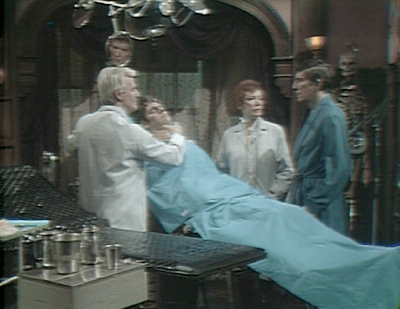
Barnabas reflected above Adam. Screenshot by Dark Shadows Before I Die.

Barnabas takes his place on a bed. He tells Julia he is glad she is with him, and she smiles at him with the sad tenderness of someone saying a final farewell to a loved one. As with her self-deprecating joke in the opening part of the episode, this smile shows a new side of Julia. For a time in October 1967 she tried to launch a romance with Barnabas, and he rejected her. Hall played Julia’s unrequited love in the same larger-than-life style that the rest of her action called for. Her feelings seemed to be an outgrowth of despair- she was by that point so deeply entangled with Barnabas that there was little hope she could ever make a life with anyone else, so even though he was an active vampire, she had little to lose by committing herself to him. But this sweet little exchange is played so gently that it opens a window on a more complex inner life for Julia.

As Lang starts the experiment, we cut to Angelique in the drawing room at Collinwood. She is talking to a clay figure, calling it “Dr Lang,” and saying that it cannot overcome her powers, for they were a gift to her from the Devil himself. She jabs at the clay figure. In the lab, Lang writhes in pain, interrupting the experiment.

It was not until #450 that Dark Shadows let on that there might be anything to Christianity. In that episode, good witch Bathia Mapes held Barnabas at bay by showing him a cross. Up to that point, Barnabas had many times strolled comfortably through the old cemetery north of town, where half the grave markers are in the shape of the cross, and they hadn’t bothered him a bit. The only representatives of the faith who figured in the story were repressed spinster Abigail Collins and fanatical witchfinder the Rev’d Mr Trask, both of whom were fools whom Angelique easily twisted to her own purposes. Now we have a character named Adam, a New Adam through whom a resurrection is supposed to take place, and he is wearing a headpiece that is photographed to look like a crown of thorns. Angelique’s reference to the Devil suggests that she can be defeated only through the aid of a being more powerful than the Devil, and since we haven’t heard about Ahura-Mazda or any other non-Christian deities who represented a supreme principle of good pitted against an otherwise irresistible evil, it looks like we’re drifting Jesus-ward.

The New Adam, in whom all are made alive, wears his crown. Screenshot by Dark Shadows Before I Die.

It is daring to take that direction, even if it is only for a little bit. Vampire legends are pretty obviously an inversion of the Christian story, in which a man comes back from the dead, not having destroyed the power of death once and for all, but only to die again every time the sun rises. While Jesus feeds us with his body and blood in the Eucharist and thereby invites us to share in his eternal life, the vampire feeds himself on our blood and thereby subjects us to his endlessly repeated death. That’s why Bram Stoker’s Dracula has all those crosses and communion wafers, because it is a religious story of the triumph of the promise of resurrection in Christ over the parody of that resurrection that the vampire has settled for. It also explains why Dark Shadows so studiously avoided Christian imagery for so long. Christianity is such a powerful part of the culture that once you let any of it in, it tends to take over the whole story.

There are many reasons the makers of the show would want to avoid that fate. Not least is the tendency of religions to fracture and stories based on their teachings to become sectarian. Dracula itself is an example of that; the vampire is a Hungarian nobleman from Transylvania, connected with the Szekely clan. There really was such a clan, and like other Hungarian nobles in Transylvania its members were Calvinists, supporters of the same version of Christianity that Abigail and Trask represented. Stoker was a Roman Catholic from Ireland, a country where most Protestants are Presbyterians, a tradition that grew out of Calvinism, and so his depiction of the vampire is clearly driven by sectarian animus. The Collinses have an Irish surname, settled in New England when that region was officially Calvinist, and did very well there. So it would be easy to present their troubles as a cautionary tale about Calvinism. That would seem to be a surefire way to shrink the audience drastically. Not only are there millions of Calvinists whom it would offend, there are billions of people to whom Calvinism means nothing at all, and they would be utterly bored by a denunciation of it.

The episode is daring in several other ways as well. When Barnabas and Willie were first on the show, ABC-TV’s office of Standards and Practices kept worrying that viewers might interpret their relationship, which was founded on Barnabas’ habit of sucking on Willie and swallowing his bodily fluids, as somehow homosexual. Not only is the scene between them at the Old House reminiscent of the scenes that attracted memos from that office in the spring and summer of 1967, but the whole idea of Barnabas draining his “life force” into the body of Adam would seem to invite the same concerns.

The experiment scene would only intensify such concerns. The experiment is a medical procedure that is supposed to bring a new life into the world, which by 1968 was how Americans usually thought of the process of birth. Barnabas is the patient, he is lying down, and the doctors sedate him. Thus he takes on all the medicalized marks of a mother-to-be. Julia asked Lang if the process would be painful for Barnabas; he does not disappoint, but ends the episode screaming in response to labor pains. Not only does turning Barnabas into Adam’s mother invert the expected gender performance, but it also introduces a homosexual side to Barnabas’ relationship with Lang, who is Adam’s other parent.

Somebody ought to be there telling Barnabas he’s doing great and urging him to push. Screenshot by Dark Shadows Before I Die.

Christian imagery and gender-nonconformity would have been rather a queasy combination for most Americans in 1968. That’s unusual, in historical terms. Before modern times, Christians didn’t hesitate to discuss ways that familiar gender roles break down in the relationship of humans to Christ. The “Fathers of the Church,” the prominent Christian intellectuals of the fourth and fifth centuries, talked about that all the time, going into depth not just with the image of the Church as the Bride of Christ but of each human soul, whether male or female, as one of Jesus’ wives, and of the physical contact between humans and Jesus in the Eucharist as a consummation of their marriage.

For their part, Calvinists tended to be skeptical of the physical aspect of the sacraments, but that didn’t mean that they shied away from conjugal metaphors to describe the relationship between the soul and Jesus. John Donne, like most priests in the Church of England in the 16th and early 17th centuries, was basically a Calvinist, yet his sonnet “Batter my heart, three-person’d God” is one of the most vivid and uncompromising statements of the ancient idea of an erotic dimension to Christian life that transcends the binaries between masculine and feminine, male and female. That tradition makes today’s conjunction of Christian and homoerotic themes all the bolder- imagine if Dark Shadows wrote itself into a corner where they had no choice but to explain nuptial imagery and mystical eroticism in the writings of Saint Ambrose. The whole audience could fit into a seminar room.

Closing Miscellany

Lang and Julia wear white lab coats. This is the first time Julia has worn a white coat. Her previous lab coat was light blue, which looks white on the black and white TV sets most households had in 1968, but now that the show is being produced in color they are buying costumes and props for color televisions.

The idea of a machine that would cause a person to go to sleep in one body and wake up in another was a big deal on TV in the 1960s. Just today I saw this screenshot from The Avengers on Tumblr:

This episode marks the first appearance of Robert Rodan. When Adam was a nameless heap of flesh under a blanket, he was played by a stand-in named Duane Morris. Rodan had a few small parts on TV shows in 1963 and 1964 and was in a couple of commercials between 1964 and 1968. Adam was his first, and last, recurring role on a series. In 1969, he appeared in a little-seen feature film called The Minx, then spent the rest of his life selling real estate in Southern California.

Episode 484: Not so much for you as for me

Recovering vampire Barnabas Collins has brought his former blood thrall Willie Loomis home to the Old House on the great estate of Collinwood. Willie had been confined to a mental hospital during the several months that have passed since Barnabas framed him for crimes he himself committed against Maggie Evans, The Nicest Girl in Town. The chief of the mental hospital, mad scientist Julia Hoffman, is now Barnabas’ best friend, and he talked her into releasing Willie to him.

Today, Barnabas tells Willie he is going to send him back to the hospital for the rest of his life. Barnabas is furious that the first thing Willie did after promising not to leave the Old House without him was to sneak off and go to Maggie’s house. Barnabas found out about this when Maggie’s boyfriend Joe came to the Old House and told him about it. Joe also told Barnabas that he would kill Willie if he ever again saw him anywhere near Maggie.

Yesterday, it was impossible to tell what was going on in Willie’s mind. At one point he seemed to be in a childlike state, remembering nothing of his time with Barnabas and believing that they had been friends. When he went to Maggie he seemed to have reverted to the way he was when Barnabas was holding Maggie prisoner in the Old House and Willie was desperately trying to spare her the worst. At the end of the episode he pointed an unloaded rifle at Joe and squeezed the trigger, grinning maniacally when he heard the click. Perhaps two of those attitudes were fakes meant to cover the third, or perhaps his personality really is unstable and was fluctuating as the episode went on.

Barnabas has concluded that Willie’s childlike friendliness is a fake and that he is exactly the same as he was when he lived with him. So he gets impatient with Willie when he doesn’t seem to remember that he was a vampire. He talks to Willie as if he remembers everything. He tells him that he can go around in the daytime now, but that he is not really free of the curse yet. He persuaded Julia to release him so that he could help with an experiment that will complete the cure.

Julia enters in time to hear that, and reacts angrily. The experiment is the work of another mad scientist, Eric Lang. Julia is opposed to the experiment and had no idea Barnabas was planning to use Willie to further it. She and Barnabas stand on either side of Willie and argue. At the end of their argument, Willie says he will do whatever Barnabas and Lang say.

Barnabas and Julia fight over Willie.

Lang comes to the Old House. Julia tells him that Willie was Barnabas’ victim, and says he has hidden resentments against Barnabas that will likely surface and prompt him to sabotage the experiment. This is interesting as an explanation of Willie’s visit to Maggie, which was after all one of the most self-destructive things he could possibly have done. However much damage Willie did to himself by going to Maggie’s house, he also subjected Barnabas to considerable embarrassment and inconvenience. So maybe Willie’s puzzling behavior yesterday was the result of a neurotic complex, unconscious hostilities towards Barnabas combined with feelings of guilt that drove him to actions he himself couldn’t have explained. On this interpretation, Barnabas is accidentally functioning as Willie’s therapist. By modeling the conversations they used to have when Barnabas was a vampire and Willie was his blood thrall, Barnabas is helping Willie recover his memory.

The rest of the episode is taken up with a dead end story called the Dream Curse. This consists of frequent repetitions of an acting exercise that gives each cast member an opportunity to show what they can do when they don’t have many lines and just have to emote. Unfortunately, this time it is Lang’s turn to run through the exercise, and Addison Powell’s abilities as an actor were severely limited. He’s pretty nearly unbearable.

There are two things going on while Powell is shouting and stumbling around that I want to mention. Julia appears to him at the beginning of the sequence, and she makes a series of delightful little balletic movements with her arms. There is no apparent reason in the story for her to turn into a ballerina, but those movements are more worth watching than anything we’ve seen from
Powell.

At the end of the sequence, Lang opens a door and is greeted by a headless body with a turtleneck sweater. The men in the segments of Dark Shadows set in the 1960s all wear either neckties or turtlenecks, and lately the turtlenecks have been getting ever more prominent. I suppose it was just a matter of time before a character appeared whose turtleneck replaced his head altogether.

Not sure what this guy’s deal will turn out to be, but he’s already more appealing than Lang.

Episode 483: The three faces of Willie

In April 1967, dangerously unstable ruffian Willie Loomis inadvertently freed vampire Barnabas Collins to prey upon the living. Barnabas made Willie his blood thrall, and reduced him to a sorely bedraggled state. As spring turned to summer, Barnabas added Maggie Evans, The Nicest Girl in Town, to his diet. When Barnabas first held her captive in his house, Maggie was dazed and submissive, but as he tried to brainwash her so that her personality would disappear and that of his lost love Josette would take its place, she began to rebel. Maggie and Willie formed a strange friendship as he did what he could to protect her from Barnabas. Eventually she escaped, and mad scientist Julia Hoffman erased her memory of what Barnabas did to her. When Willie tried to warn Maggie that Barnabas might attack her again, the police jumped to the conclusion that it was he who had abducted her. They shot him. He was declared insane and sent to Windcliff, a mental hospital of which Julia is the director.

A few weeks ago, another mad scientist, Eric Lang, gave Barnabas a treatment that put the symptoms of his vampirism into remission. At the time he was feeding on two women, heiress Carolyn and well-meaning governess Vicki. When Barnabas gained the ability to go around in the sunlight, cast a reflection, and eat solid food, Carolyn and Vicki’s bite marks disappeared. It is unclear whether either of them remembers that Barnabas was a vampire, but their personalities certainly went back to what they were before he bit them. That leaves us wondering about Willie. When Barnabas responded to Lang’s treatment, did Willie revert to the violent personality he had in his first full week on the show, when on Tuesday he menaced Maggie in a barroom, on Wednesday he cornered Vicki in the study at Collinwood, and on Thursday would have raped Carolyn if she hadn’t drawn a gun on him? Did he become some version of the deeply troubled young man who was desperate to help Maggie but powerless to resist Barnabas? Or did he become something else entirely?

Today, in furtherance of Lang’s evil plans, Barnabas wants to free Willie from Windcliff and bring him back to his house on the great estate of Collinwood. Julia has become Barnabas’ best friend, but she is firmly opposed to his association with Lang. So Barnabas lies and tells her that he wants to free Willie because his conscience is plaguing him. Julia knows that isn’t true, and points out that he never visited Willie at Windcliff. Barnabas replies that when he was in the full grip of the curse, he could move about only after dark, and says that he could hardly show up at the hospital to visit Willie in the middle of the night. Julia says that she would have arranged it had he asked. He doesn’t have an answer to this, and she doesn’t fall for any of Barnabas’ other fabrications. But she can’t figure out what he really is doing. She plays along with him, and the two of them go to see Willie at Windcliff.

This is the first time we have seen Barnabas outside of a little orbit composed of Collinwood, the village of Collinsport, and the cemetery north of town. Not only was Barnabas’ ability to travel limited while the symptoms of the curse were manifest, he often lost interest in people when they left the area. So in the fall of 1967 he was obsessively hostile to strange and troubled boy David and obsessively indecisive about Vicki until the two of them went to Boston, at which point he seemed to forget they existed. It’s too bad the set representing the waiting area at Windcliff isn’t more visually striking- Barnabas’ first trip out of the Collinsport area marks a significant change in the character’s possibilities, and it would be good if it came with an image that would stick with us.

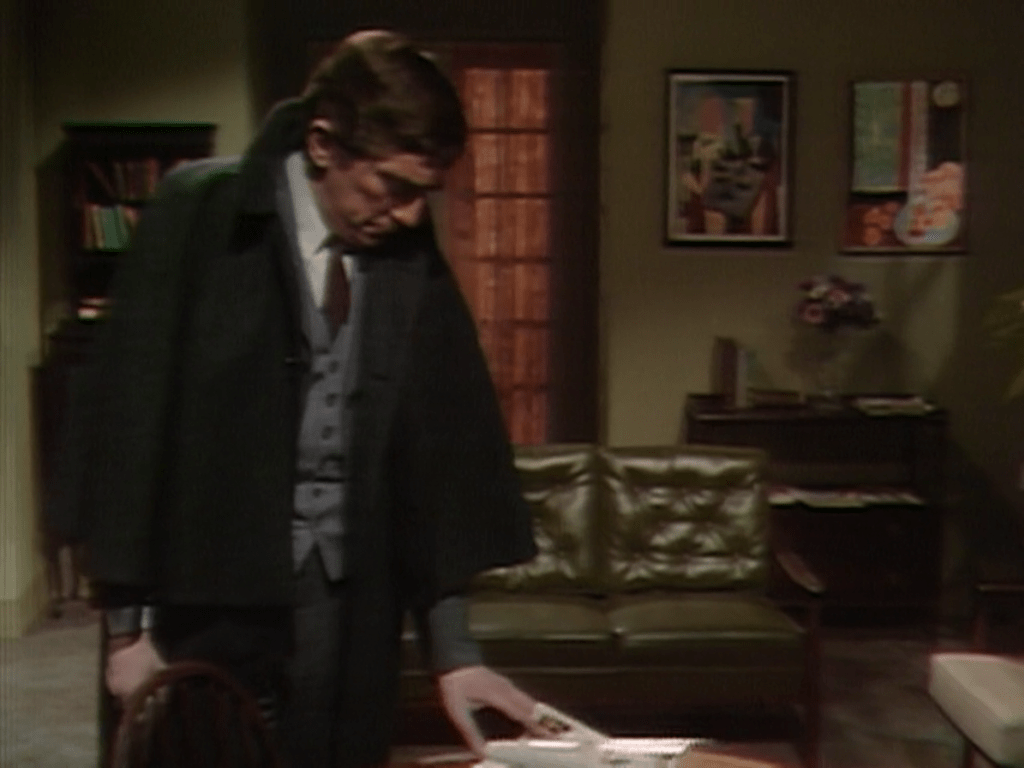
While Barnabas waits, a glossy magazine catches his attention. He picks it up and leafs through it. Since we are about to see Willie for the first time in several months, there is a good chance that this little bit of stage business will remind regular viewers of a peculiar remark Barnabas made shortly before the last time we saw Willie. Shifting the blame for his own crimes onto Willie, Barnabas planted Maggie’s ring in Willie’s room. When he came up with this plan, Barnabas remarked that the cheaper sort of tabloids say that criminals sometimes hold onto morbid mementos of their crimes, prompting us to picture Barnabas reading a cheap tabloid. That incongruous image comes to life here:

Julia joins Barnabas in the waiting room. They talk for a moment, then a nurse ushers Willie in.

At first, Willie is silent, a confused look on his face. He walks slowly towards Barnabas. Barnabas asks Willie if he recognizes him. In this moment we pick up exactly where we left off in #329, when Willie was a patient in another hospital and did not remember who Barnabas was.

This time Willie does recognize Barnabas. But as he did at the end of #329, he seems happy and untroubled. He is positively childlike in his eagerness to go back to Barnabas’ house and work for him again. He says that he and Barnabas were friends and that he always enjoyed their time together, a statement that dumbfounds Julia, as it dumbfounds anyone who remembers the show from April to September 1967. Even when Barnabas wasn’t bashing Willie across the face with his cane, Willie was miserable beyond words and hated everything Barnabas forced him to do.

Julia sends Willie back to his room, and Barnabas proclaims that Willie is entirely cured. Julia sarcastically thanks him for his diagnosis, calling him “DOCTOR Collins!” This too harks back to #329, which ended with Willie asking Barnabas if he were a doctor, to which Barnabas replied, “That’s right. I am a doctor!”

Barnabas takes Willie back to his house and tells him that for the time being, he must not so much as go outside by himself. Willie accepts Barnabas’ explanation that many people in the area will have to be prepared for his return before they see him. Willie gladly agrees to stay in the house. Barnabas leaves him alone, and he immediately slips out. He is heading for Maggie’s place.

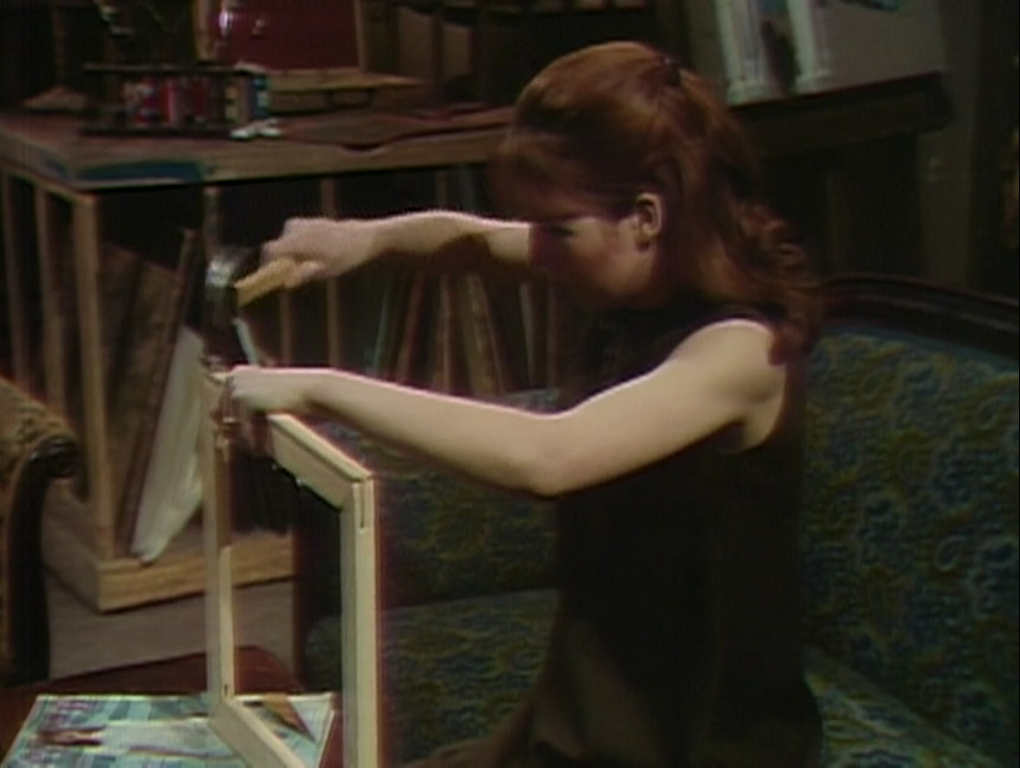
Maggie’s father Sam is a painter, a fact advertised by the canvases around the cottage they share. When we cut to the cottage, she is making a frame. This is rather an obvious visual metaphor. The last time Willie came to the cottage, he inadvertently framed himself for Barnabas’ crimes against Maggie.

Of course Maggie is horrified to see Willie at the door; of course she demands he leave; of course she threatens him with her hammer when he insists on staying and telling her he is innocent; of course she cries for help when her boyfriend Joe comes to the door; of course Willie runs off when Joe enters. Willie puts himself in the frame again, this time as an ongoing threat to Maggie and all the women of Collinsport.

Joe goes to Barnabas’ house and demands to see Willie. At first Barnabas plays dumb, but Joe doesn’t give an inch. Barnabas then admits that he persuaded Julia to let Willie out of the hospital, but assures Joe that Willie is no longer dangerous and tells him that he will see to it that Willie behaves himself. Joe says that Barnabas has already failed in his responsibility, since Willie just went to Maggie’s house and scared her. Joe says that he will kill Willie if he goes near Maggie again. He repeats that assurance, and his voice is pure steel.

Joe exits the house. We see him outside, walking away. Willie emerges from the shadows with a rifle. He takes aim at Joe and squeezes the trigger. The gun isn’t loaded, so Willie makes nothing more than a click. Apparently that was enough for him. He grins maniacally.

On their Dark Shadows Every Day, John and Christine Scoleri point out that the the gleeful face Willie flashes after he clicks his rifle at Joe is the same expression he showed in the frenzied crimes he committed before he came under Barnabas’ power. They back this observation up with a pair of screenshots, one of Willie immediately after he pretended to kill Joe, one from his last moment before he released Barnabas and lost his freedom:

Indeed, the whole episode replays Willie’s character arc from April to September in reverse. He starts as the crushed little thing we had seen at the end of #329, becomes Maggie’s tormented and misunderstood would-be protector, then ends as the dangerously unstable ruffian who followed seagoing con man Jason McGuire to town. If the episode were a few minutes longer, John Karlen might have had to take a break and let James Hall play the last scene. This recapitulation heightens the initial suspense generated by the question of how Willie would be after Barnabas had lost his vampire powers. Whatever effect the change in Barnabas has had on Willie has certainly not made him less complex or more predictable. We can’t tell when he is being sincere and when he is faking. Based on what we see today, it’s possible he is being sincere the whole time, but that he is just extremely impulsive, and equally possible that everything he does and says is a fake meant to cover up something we don’t yet know enough to guess at.

The actors are uniformly excellent today. John Karlen has to recreate the three faces of Willie in quick succession, and executes each of them clearly and memorably. Almost all of Grayson Hall’s dialogue is expository, but while delivering it she shows us all of Julia’s complicated feelings about Barnabas and lets us into her attempt to solve the riddle of his plans for Willie. Kathryn Leigh Scott is only on screen for a few minutes, beginning with her absorbed in carpentry and proceeding directly to screaming and running around and clutching at her male scene partners, but still makes it clear that Maggie is a strong and level-headed person who has been forced into frantic behavior by circumstances no one should have to face.

In the confrontation with Barnabas, Joel Crothers shows us a new side of Joe. Always loyal, always honest, always hardworking, Joe has up to this point been soft-spoken and self-effacing, deferential towards members of the ancient and esteemed Collins family. The only time he broke that deference was when he spoke some harsh words to matriarch Liz in #33, and he had to get thoroughly drunk to manage that. There is no trace of drink in him now, and he does not regard himself as anything less than Barnabas’ equal. For the first time since Burke Devlin lost his connection with the plot and shriveled so drastically that he ceased to be Mitch Ryan and became Anthony George, Dark Shadows has a plausible action hero in its cast.

The part of Barnabas is especially challenging today; he tries and fails to fool Julia in the beginning and Joe at the end, and in between may or may not have fooled Willie. So Jonathan Frid must show us what it looks like when Barnabas does an unsuccessful job of acting. He chooses to do that by having Barnabas overact. My wife, Mrs Acilius, pointed out that Frid’s own performance in the role of a man who is severely overacting is in fact exceptionally restrained and precise. Frid bobbles his lines as he usually does, but never makes a wrong physical move, and not for one second does he miss the perfect tone for Barnabas’ lines. The result is simply outstanding.