
In yesterday’s episode, inveterate prankster Carl Collins told his brother, the rakishly handsome Quentin, that their distant cousin Barnabas was a vampire. Quentin has problems of his own, and he is counting on Barnabas to help him. So he locked Carl up in Barnabas’ hiding place, expecting that when night came Barnabas would prune one more branch off the Collins family tree.
Today, Quentin finds that Carl has escaped. He goes to Barnabas and tells him what has happened. Carl’s practical jokes annoy Barnabas intensely, and Barnabas has never bothered to conceal his disdain for him. He reacts to Quentin’s news with fury and a lot of orders. When Quentin later finds Barnabas standing by Carl’s corpse in the drawing room of the great house of Collinwood, he is really torn up about his brother’s death for almost a whole minute.
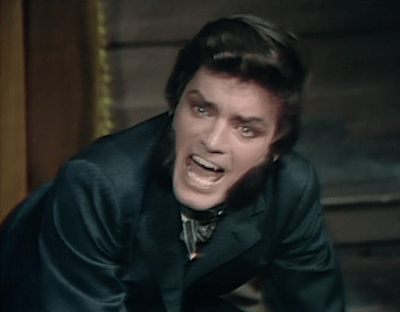
A knock comes at the door; it is the oppressively evil Rev’d Gregory Trask. Quentin keeps Trask in the foyer for a bit while Barnabas hides Carl’s body. When Trask forces his way into the drawing room, Barnabas is gone. Carl’s body is cunningly hidden… behind the curtains, propped upright. Of course it falls out almost immediately. Earlier in the episode, Carl took Trask to Barnabas’ hiding place, and we saw that Barnabas had single-handedly lugged his coffin and the structure on which it rests some distance away. If he is strong enough to do that, surely he could have tossed Carl’s body out the window. And regular viewers know that there is a secret panel in this room, of which Barnabas has repeatedly shown that he is well aware. They would probably have expected him to hide the body there. That he just stashes it behind the curtains where it is certain to come into Trask’s view suggests that he isn’t even trying to get away with this particular murder.
Closing Miscellany
John Karlen is breathing pretty deeply during Carl’s big closeup as a corpse. It’s really confusing, I thought they were telling us he wasn’t dead yet.
I don’t know what the writers planned for Carl in the flimsies they sketched out six months before this episode was made, though there is so little room for him in subsequent plot-lines that I suspect he was supposed to die at about this point in the story. Still, his death was accelerated because Karlen had other things to do. He won’t be back on the show until #956, in February of next year.
The creaky little waltz that Quentin listens to obsessively was released as a single in June of 1969 and would hit #13 on the Billboard Hot 100 in August. Regular viewers may be sick of it already, and the characters certainly wish Quentin would get another record. It’s Trask’s turn to complain about it today, giving him something in common with Barnabas.
Trask wears a cross which he uses as a weapon against Barnabas. The show is oddly inconsistent about the effect of the cross on vampires. We’ve seen other characters use crosses against them, and at one point it was said that a cross inside the lid of Barnabas’ coffin immobilized him. But his hiding place is in the middle of a cemetery full of grave markers in the shape of huge crosses, and we see several of them today. Barnabas just walks right past those with no problem. You might think that since the show was made in the USA, where sincerity is so highly regarded, that the cross might be effective against him only if it is wielded by the pure of heart. But Trask is every bit as evil as are Barnabas and Quentin, and it works for him. It’s a puzzlement.
In a long comment on Danny Horn’s post about this episode at Dark Shadows Every Day, I responded to a discussion about whether there is a point in thinking of Barnabas as someone possessed by demons:
I think of the climax of the Iliad. As Achilles moves in to kill Hector, Athena takes hold of his spear and drives it in, delivering the fatal wound herself.
For modern readers, this may ruin the story. The whole poem has been leading up to this moment; we’ve spent a lot of time with Achilles, listening to him try to figure out what it would mean for him to kill Hector. So why have the goddess take over at the last minute? Isn’t it an evasion of Achilles’ responsibility for his actions, and a cheat for us as we’ve been observing his psychological development?
For the original audience, it was not. They actually believed in their gods. Athena really existed, as far as they were concerned. When an event was important enough, they took a interest. If it was really huge, they would get involved. Moreover, the gods worked closely with each other. So much so that you didn’t pray to one at a time, but always to groups of them. When Athena joins Achilles in his fight, it isn’t her pushing him aside- it’s him doing something so important it blurs the boundary between human and divine.
Something like that is at work in the traditional, pre-modern, conception of demonic possession. To say that a person is possessed is a way of looking at behavior that is reducible neither to moralistic judgment nor to psychological analysis. It isn’t individualistic in the way that those modes of discourse are. Rather, it suggests that the boundaries between the person and the spiritual forces of darkness have broken down. Perhaps the person is partly to blame for that breakdown, but the whole point is that s/he is no longer a distinct being, but is merging into those supernatural forces.
So, imagine a version of Dark Shadows where Elizabeth Collins Stoddard really was the main character. Her whole approach to life is denial. So, you could have had a story with a beginning, middle, and end. In the beginning, we see the lengths she has gone to in her quest to keep from ever having to have an embarrassing conversation. In the middle, we see various horrors take place around her, each worse than the one before, each more obvious than the one before, and each time she finds a way to convince herself it doesn’t exist. At the end, a couple of innocent characters go to her in the drawing room of Collinwood to rescue her from the monsters who are running rampant there. She looks at them placidly and tells them she sees nothing wrong. Why ever do they think she would want to leave her home? All the while leathery-winged demons are fluttering about her head. She doesn’t see them, and they have no choice but to flee.
Comment left 10 November 2020 by “Acilius” on “Episode 780: The Establishment Vampire,” posted 2 December 2015 by Danny Horn at Dark Shadows Every Day
 Dark Shadows Commentary