Episode 25: A neat way of managing people

The episode revolves around a letter to Victoria from the Hammond Foundling Home. The letter reports that no one connected with the Home had ever heard of the Elizabeth Collins Stoddard or any of the other Collinses before the letter came offering Vicki the job as David’s governess. This letter has set Elizabeth into a panic, since it exposes as a lie her story that Roger was friends with someone connected to the Home and that that person had recommended her. It sets David into an even more extreme panic, since he is terrified that his father will send him away to some kind of institution where children are kept and the Hammond Foundling Home is such an institution.

In her panic, Elizabeth demands that Roger sit down with Vicki and corroborate her lie. Roger is worried that Burke, who has hired private investigators to look into Vicki’s background, will discover some piece of information that will damage the family, and wants Elizabeth to confide in him. He is insistent enough about this to raise the audience’s hopes that in some future episode, we will get answers about Vicki through dialogue between the two of them. For now, she shuts him down by threatening to throw him out of the house unless he obeys her.

When Roger does talk with Vicki, she reminds him that she had asked him if she knew anything about her or about the reason she was hired when they first met. He had said no, and in every way showed bafflement about how Elizabeth heard of her. He tries to explain that away by saying that he was distracted by worry about Burke, and tries to deflect further questions by saying that his contact is a donor who wishes to remain anonymous.

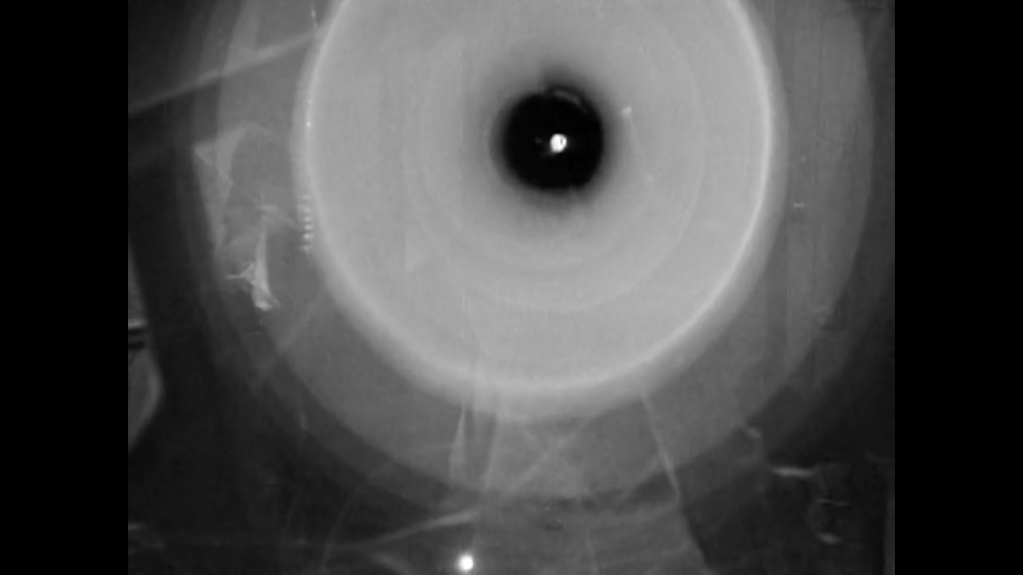
Vicki is obviously unconvinced. Alexandra Moltke Isles has strabismus, and in her closeups during the scene with Roger she turns this to her advantage. Her eyes seem to be moving independently of each other, a more polite expression than eye-rolling, but just as effective at communicating disbelief. Marc Masse captured the effect quite well in this still image, on his Dark Shadows from the Beginning:

Roger’s remark to Elizabeth in this line, that she has “a neat way of managing people,” applies equally well to Vicki in her scene with him. At the end of the conversation, she knows that he was lying, and he knows that she knows. She also knows that he is under his sister’s thumb, not a threat to her position no matter how uncomfortable he may find her presence on the staff, and he knows that she knows that.

David’s panic leads him to take a less devious path than does his aunt, but ultimately an even more disastrous one. He steals the letter from Vicki. His father catches him with it and returns it to her.

Vicki herself is less concerned with the letter than with a thought we saw take shape in the back of her mind at the end of episode 23. She asks David about the magazines on auto mechanics he likes to read, about how he learns to put things together and take them apart. David responds with a denial that he sabotaged his father’s car; Vicki calmly replies that she hadn’t accused him of that.

Vicki comes into the drawing room and tells Elizabeth that David has been acting strangely ever since his father’s car went off the road, that when the sheriff came he was overwhelmed with the thought that he would be arrested, etc. Elizabeth dismisses the topic brusquely, seeing no significance in it. Vicki persists in the topic, reminding her that the sheriff said they should try to think of someone other than Burke who might want to kill Roger. Elizabeth declares “There is no one else”; at that, Roger sashays into the room and declares “Except my loving son, of course.”

Elizabeth has even less patience with this remark from Roger than with whatever it is Vicki is saying, and moves along so that Roger can tell Vicki the lie she has ordained. In the course of that conversation, she again says that they don’t actually know that Burke was the saboteur, a point that is no more meaningful to Roger than it had been to his sister.

Afterward, she goes back to her room and finds that David has stolen the letter again. She goes to his room to look for it. She doesn’t find it. Instead, she finds the bleeder valve, evidence that her suspicions are correct.

Episode 24: Have you ever sat on a wrench?

The entire episode is set in the Collinsport Inn- the lobby, the restaurant, and Burke’s room.

In episode 21, Vicki took Liz in hand as if she were Plato’s Socrates and Liz were some pompous Athenian aristocrat, leading her through a series of simple, seemingly innocent questions to a most uncomfortable conclusion. That took place in the drawing room at Collinwood, while Carolyn watched. In episode 24, Carolyn joins Burke and the sheriff in Burke’s room. It’s Burke’s turn to play Socrates, Carolyn’s to answer the questions, and the sheriff’s to be an audience. Burke’s questioning is not only effective at raising doubts in the sheriff’s mind, but also prompts regular viewers to bracket Vicki and Burke together and see them as a likely, indeed inevitable, romantic pair.

The scenes in Burke’s room also highlight Roger’s bizarre folly in telling Burke his evidence against him before going to the police. We saw Vicki try to talk Roger out of this in two episodes, and the sheriff commented on it later. Watching the well-prepared Burke cross-examine Carolyn as effectively as any defense attorney, it is all the clearer that Roger’s behavior was driven not by any rational calculation, but by some wild impulse he cannot entirely control.

The scenes in the lobby and the restaurant show us a quiet rewriting of some characterizations laid out in episode 1. In that episode, Burke stood in the lobby and refused to admit that he so much as knew the name of Mr Wells, the hotel clerk, simply because Wells was from the town from which he was sent to prison ten years before. Now he stands on the same set, warmly greets one of the policemen who made the case against him, and repeatedly tries to persuade him to join him for lunch. Also in episode 1, Maggie stood behind the counter of the restaurant and told Vicki that she considers her, as a member of the staff of Collinwood, to be a “jerk” practically as bad as the family that owns the house. In this one, Carolyn herself comes into the restaurant and she and Maggie have a warm, cozy chat, like old friends.

I suppose it was inevitable that they would retcon Burke into a hail-fellow-well-met and Maggie into a friend of at least some of the Collinses. After all, soap operas consist mostly of conversation, so characters who aren’t on speaking terms with each other are dead weight. Placing these scenes on the same sets used in episode 1 is an emphatic way to make it clear to viewers who remember that episode that the change is intentional and permanent.

The videography is also as ambitious as we ever see it in this show. The camera tracks fluidly through the lobby, showing us more of that set than we see in any other episode, ending in a low angle shot of the sheriff that makes him look ominous. Some of those tracking shots are too much for Michael Currie, the actor playing the sheriff- during his scene alone with Burke, he bumps into one camera, stumbles into a piece of furniture, and then the other camera hits him in the back of the head. After that, he stands with his back to Burke and his elbows bent in front of him, looking for all the world like he is urinating on the floor:

Currie is so physically awkward that when Burke asks the sheriff the rhetorical question “Have you ever sat on a wrench?,” it seems to be a pretty near certainty that the answer is yes.

Currie has a rough time in this episode with his lines as well as with his movement. Perhaps the single funniest blooper comes when he declares that a good memory “is what I’m paid for,” then forgets his next line. It’s also interesting when he calls Burke “Burt.” Bloopers are after all one of the things Dark Shadows is known for, so we can’t be too annoyed with him for those. Worse is what happens when he does remember his lines. He intones them all as if he were leading the Pledge of Allegiance.

In the months after Mark Allen left the show, the standard of acting on it was remarkably high. Every actor other than Currie consistently turns in performances so strong that watching an episode feels like a fine evening at the theater. And bad as he is, even Currie doesn’t keep his scene partners from delivering good performances. He just wasn’t ready for professional acting. So I don’t have the same need to complain about him as about Allen, but he does deliver the series’ first laugh-out-loud moments of incompetence, and it is a relief when he is replaced.

Episode 23: The dignity of my badge

Roger has finally deigned to notify the police of his suspicion that Burke Devlin tampered with his brakes in an attempt to kill him. In story time, that was twelve hours ago. In the interim, both Roger and Bill Malloy have gone to Burke’s room and told him everything they know and think they know. Roger presented Burke with Vicki and her testimony. The newspaper has run a front-page story about it.

The sheriff is peeved that Roger is bringing him into it only now. Roger explains that his goal in giving Burke all the evidence in advance of any investigation was to persuade him to leave town, but that he never had the opportunity to present that idea to Burke.

Upstairs, Vicki is trying to teach David a lesson about the history of Maine. Considering that we learned in episode 13 that Vicki has never heard of Augusta, the capital of the state, it’s difficult to be optimistic about that instruction. But every scene between David and Vicki in his room is worth watching. No matter what lines they may be required to say, David Henesy and Alexandra Moltke Isles always use body language, facial expression, tone of voice, and spatial position to convey the emotions appropriate to their characters. As episode follows episode, those emotions shift from wild hostility on David’s part and patient solicitude on Vicki’s to genuine affection and trust. It’s the one story-line that really works in the first 42 weeks of the show.

David made some incriminating remarks to Vicki and his aunt the night of his father’s wreck; they both thought he was simply expressing his guilt over his hostility to his father. In this one, he asks Vicki if she ever tried to kill anyone. She tells a story of some fist-fighting she did at the Hammond Foundling Home, and says that’s as close as she got. She looks happy telling David that story, not because it’s a happy story, but because it’s a chance to make a connection.

She isn’t happy at the end of the episode- when David grabs at the bleeder valve and the other adults ignore his action, we see it dawn on her that he is the culprit.

I had a lot to say about this episode in the comments section of John and Christine Scoleri’s Dark Shadows Before I Die. Here it is:

I don’t agree that Constable Carter seems intelligent. He greets David by asking his name. If a cop has been on the job for over ten years in Collinsport, a town under the shadow of a big house called Collinwood, home of the the Collins Cannery and the Collins Fishing Fleet, and he still doesn’t know the four members of the Collins family, he’s an idiot.

Of course, he is sensible when he’s demanding to know why Roger waited twelve hours before coming to him and expressing incredulity at Roger’s visit to Devlin. Characters in soaps and suchlike productions are always declaring they have to do their own investigations before they can go to the police, and often this is treated in the story as if it were a reasonable thing to do. But every step of the way they’ve lampshaded the preposterousness of it. Vicki kept telling him it was a bad idea before he did it, last episode Sam reacted scornfully when he told him what he repeats to the constable here, that he wanted to give Devlin a chance to leave town and never come back. And the constable shows the same scorn for the idea today.

Those scenes make Vicki, Sam, and the constable look smarter than Roger, but we’ve seen enough of Roger to know that he isn’t a fool. Something is clouding his judgment, something more complicated and slipperier than the stories that have been suggested to us so far. Roger is hiding more than one thing, and he doesn’t trust himself with his own secrets.

David looks at the camera again today, when he’s eavesdropping on the conversation with the constable. An effective tactic- we the audience know what he knows, and he seems to be pleading with us to keep quiet.

Another meaningful look at the end of the episode. When the constable, who is an idiot, says cheerfully that now we’ll know how David’s fingerprints got on the wrench, Vicki gives David a grim little glance. Just for a second- but not only is it the last moment of the episode and therefore emphatic, it is also the second time we’ve seen her give David that look. The first time was in his room, when he was betraying himself with some remarks about how terrible it would be to go to prison. We can see a terrible idea starting to form in the back of Vicki’s mind.

Episode 22: I only run from enemies

This episode doesn’t intercut scenes as Art Wallace likes to do. Instead, we have four distinct scenes in succession, to only one of which do we cut back. First, Maggie and Burke at the Evans cottage; second, Sam and Roger at the restaurant; third, Sam, Maggie, and Burke at the Evans cottage; fourth, Carolyn and Roger at Collinwood; then, a reprise of Sam, Maggie, and Burke at the Evans cottage.

The first two scenes don’t give new information. Burke and Maggie do some recapping for the audience, then Roger and Sam reenact the exchanges they had in week one about the danger Burke represents to them both.

When Sam joins Maggie and Burke at the cottage, he jumps to the conclusion that Maggie has told Burke the secrets of the Evans family. Looking at the lines, I guess this was supposed to show that the tough facade he maintained in the face of Roger’s menacing crumbles when he finds Burke in his house, but since Mark Allen’s portrayal of Sam consists entirely of bellowing his lines it doesn’t really come off.

Burke offers Sam $1000 to paint a portrait of him that will fit on the walls of Collinwood, of a size and style that will fit with those of the Collins ancestors. In episode 11, Burke had asked Roger if Liz would want to sell the house or the business; Roger reflexively responded “You know she wouldn’t!” Asked what the “business deal” was he wanted to discuss with Roger at the Blue Whale the night of Roger’s crash, he claims that he wanted to talk further about buying the cannery. Now we have indications that his plan, whatever it is, will leave him in control of the house.

Roger and Carolyn discuss Burke. Carolyn says that she doubts Burke’s guilt, Roger loses his temper and says that he doesn’t care whether Burke is guilty or not. He then apologizes, explaining that he didn’t mean to say such a thing.

Usually the other actors manage to do a good job despite Mark Allen, but Mitch Ryan has a lot of trouble in this episode with the level of his voice. Even before Allen enters, he’s alternately too loud and too soft in the two-scene between Burke and Maggie, and from the time Allen enters his voice is never at a well-modulated level. I can only surmise that Allen bellowed his way through rehearsal as badly as he does through the finished episode, and that Ryan was trying to figure out how he was going to fight his way through the problem.

Episode 21: “Carolyn’s mother is a witch.”

In the teaser, Carolyn asks Vicki what’s on her mind. “The meaning of life?” “No, just the opposite- death.” Exchanges like that go a long way towards explaining the appeal the show has to depressives. Casting makes a difference, too- actresses Nancy Barrett and Alexandra Moltke Isles seem to be far from death-obsessed, so they can deliver the most preposterously gloomy lines without boring the audience.

After the first break, Vicki and Carolyn are having breakfast in the kitchen. As it always does, that set creates an intimate atmosphere which makes it seem natural that the characters should share confidences. Carolyn confesses her feelings of guilt at having brought Burke to the house; Vicki confesses that she doesn’t believe Burke tampered with Roger’s brakes. For some reason, Vicki tells Carolyn that when she was six years old, an attendant at the foundling home played a prank and told her that her birth parents would be coming for her. All of Vicki’s stories about her childhood are like that, it’s no wonder she feels at home in Collinwood.

There’s a scene between Bill Malloy and Burke in Burke’s room. It’s always interesting to see actors as talented as Mitch Ryan and Frank Schofield playing off each other. It is puzzling that a Collins family retainer as loyal and intelligent as Bill would go to Burke before the police have a chance to question him or search his room and tell him everything he knows and suspects about the crime. But Roger has already tipped his hand to Burke, so another indiscretion isn’t going to damage the prospects of the prosecution by much. This scene, in which Burke is eating breakfast while Bill is confronting him with his suspicions, is intercut with the scene in which Vicki and Carolyn are eating breakfast and consoling each other. So, opposite extremes- former friends in a hostile setting, new friends in a nurturing setting.

Carolyn tells Liz that Vicki doesn’t think Burke is guilty. Liz responds that she doesn’t “care what Miss Winters thinks.” Liz then collapses into pity for Carolyn and guilt about herself as a mother. She remembers that when Carolyn was a child, she would come home from school crying because the other children taunted her, saying that “Carolyn’s mother is a witch.”

That’s an interesting story, because it implies that Carolyn went to the school in town. How did she get there? It’s much too far to walk. Did a school bus come up the hill to Collinwood to pick her up and drop her off? That’s a bit hard to imagine. Liz doesn’t want anyone around the place. Sooner or later, some adventurous child would slip off the bus with Carolyn and go exploring the grounds, no doubt finding a way into the house itself. Roger didn’t live there until recently, and Liz has never set foot outside the grounds since Carolyn’s birth. The only servant on the estate is Matthew, and he and Carolyn are not at all close, not as they would be if he’d taken her to and from school every day in her childhood.

That leaves Bill Malloy. He comes to the house more or less daily to go over business with Liz- perhaps he used to combine those visits with picking Carolyn up for school and dropping her off afterward. He is very close to her, calling her “Princess.” He’d have to pick her up very early in the morning, since his responsibilities involve supervision of the fishing boats. She might still have been in her pajamas. She’d have needed to get dressed and have breakfast at Bill’s house. We learn later that he has a housekeeper who has been with him many years; much, much later, that housekeeper will reminisce with Carolyn about brushing her hair for her when she was a little girl. So maybe that was it…

Vicki talks with Liz and Carolyn about the private investigator Burke has hired to look into her background. Liz doesn’t want to talk about anything that touches on how she heard about Vicki and what she knows about her, but by a skillful line of Socratic questioning, Vicki leads Liz to the conclusion that something about her origins might be embarrassing to someone associated with Collinwood. Liz walks out of the room, as Euthyphro walks out when Plato’s Socrates springs a similar trap for him, and we can see how smart and determined Vicki is.

Scenes that focus on the question of Vicki’s origins tend not to get much attention from fandom, perhaps because the whole story-line ultimately fizzled out with no resolution. But watching it forward, not thinking about what comes later, we can see some strong scenes devoted to it.

Episode 20: A mockery to the future

In episode 18, Roger (Louis Edmonds) had demanded Vicki (Alexandra Moltke Isles) come with him to Burke’s hotel room, where they will tell Burke (Mitch Ryan) about all the evidence they have connecting him to Roger’s car wreck. Vicki repeatedly protests in that episode that it would be better to take this information to the police. In this one, they arrive at the hotel, and again Vicki objects that they really should be going to the police. Roger, however, is a man obsessed. He asks Vicki to wait in the restaurant while he goes to Burke’s room, telling her that it may not be necessary for her to join him.

Sam (Mark Allen) comes to the restaurant looking for his daughter Maggie. Finding that Maggie isn’t at work, he invites himself to Vicki’s table. Their previous encounter had been a strange and frightening one on the top of Widow’s Hill; Vicki is no more comfortable with Sam now than she had been then. He bellows at her, she reacts with quietly frosty disdain. These attitudes may have less to do with the script or the direction than with Mark Allen’s limitations as an actor; he bellows all of his lines in this episode, and quiet frostiness is as effective a technique as any other for holding onto the audience while sharing a scene with an incompetent loudmouth.

There’s no incompetence in the scenes in Burke’s room. Louis Edmonds and Mitch Ryan were first-rate stage actors, and their confrontation is a terrific fireworks display. When Roger brings Vicki up to tell Burke what she saw him do in the garage, she again plays the scene quietly, an effective counterpoint to the artillery blasts the men have been letting loose.

In the Evans cottage, Sam finds that Maggie (Kathryn Leigh Scott) has been home all this time. When Allen bellows at her, Scott bellows back at him, a far less effective tactic than the quiet intensity Mrs Isles had used earlier. The scene has some potential- the situation is that an alcoholic finds that his adult daughter has been checking up on him, he resents it, and they have a fight about all of the ways in which she has been forced to take on the parental role in their relationship. But as a shouting match, it might as well be about anything, or about nothing.

Returning home after their confrontation with Devlin, Roger and Vicki say goodnight in the foyer. Time and again in these early episodes, people have urged Vicki to leave Collinsport while she still can. Even in this episode, Burke had told her that. But as they part ways for the night, Vicki to her bedroom and Roger to the brandy bottle, Roger tells her that as a witness, “you can’t leave now.”

That line is effective enough, but if the scene between Sam and Maggie had worked it would have been very powerful. The Evanses, father and daughter, are a case of two people who are trapped, trapped in Collinsport, trapped with each other, trapped with his alcoholism and her sense of obligation to keep him alive. As written, the scene could have brought all that out, and induced a claustrophobic sense in the audience that would have made Roger’s line feel like a death sentence. As ruined by Mark Allen, it just leaves us with the sense that we’re watching a show that needs some recasting.

Episode 19: If it isn’t Burke Devlin, it’s somebody else

Most of this one consists of people worrying about each other’s attitudes towards Burke. Bill and Sam see each other, first in the Blue Whale, later in the restaurant, and in each place they share beverages while Bill needles Sam about Burke. In between these scenes, Joe and Carolyn are alone in the restaurant- completely alone, Joe apparently has to go behind the counter and prepare their meal himself- and they quarrel about Carolyn’s bold approaches to Burke before and during their date. At the end, Carolyn goes home, where her mother tells her about Roger’s wreck and about why she oughtn’t to be friendly with Burke.

Burke himself doesn’t appear in the episode, and none of the characters who do appear know as much about him as they think they do. What we get is a portrait of an isolated, gossipy little town, where rumors can start rapidly and grow in any direction. To the extent that “soap operas are approximately 90% information management,” as Danny Horn says, the typical setting of the gossipy little town, and its outgrowth, the false accusation, are the heart of the genre. As we watch these characters gossip and jump to conclusions, suspense forms as to how justice might miscarry if it isn’t stopped soon enough.

Episode 18: Strange sounds and lonely echoes

Only three characters in this one- Roger, Vicki, and David. In the previous episode, Roger learned that his crash was no accident, that someone tampered with his brakes. Now he wants Vicki to tell him what she can that will help him prove that Burke Devlin was the one responsible. Which is a great deal- she saw him in the garage, with a wrench, next to Roger’s car. She had gone into the garage after hearing what she thought was a car door slam. She admits that the slam could have been the hood over the engine compartment, and since the car door next to Devlin was open, this seems likely. Since the reason Roger was on the road was that Devlin had invited him to town to discuss “business,” and the two of them do not seem to have any business together at all, the case against Devlin seems quite strong.

David will place rather a substantial difficulty in the way of Roger’s hope of sending Devlin back to prison. As the audience knows, it was he, not Devlin, who removed the valve from the braking system on his father’s car. We even see him handling the valve in this episode. In episode 17, he nearly confessed to his Aunt Elizabeth, and this time he makes an incriminating statement to Vicki. Both women had assumed he was merely expressing guilt for his hostility to his father, and tried to reassure him that his feelings and thoughts didn’t mean that he was to blame for what happened on the road. David even tries to talk to his father in this one, and Roger icily dismisses him. But we’ve seen enough mystery stories, including inverted mysteries where the audience knows who done it before the detective does, to be sure that Roger will learn the truth when he least expects it.

Roger not only has reason to suspect that Burke is responsible for his crash; he also has deep, complex, ungovernable feelings where Burke is concerned. Some of those feelings have to do with the testimony he gave at the trial ten years before which sent Burke to prison. Some go back before that, and have to do with the friendship that existed between them before that trial. All of them are deeply secret.

This show was being made in 1966, when Freudianism reigned supreme in much of American intellectual life, and the most respected of respectable novels was Proust’s À la recherche du temps perdu. All of the cast and much of the production staff comes from Broadway, where at that time Tennessee Williams was the undisputed king of serious playwrights. And the part of Roger was played by Louis Edmonds, who came out of the closet as a gay man as soon as it was possible to do so, and who was never in the closet as far as his friends and colleagues were concerned. So it seems likely that the secrets Roger is so desperate to conceal include some kind of homoerotic connection with Burke. This episode lampshades some standard soap opera craziness in order to call our attention to the irrational nature of Roger’s attitude towards Burke, and I think a mid-1960s audience would be likely to suspect that a repressed sexuality is driving that irrationality.

Here’s how I put it in a comment on John and Christine Scoleri’s Dark Shadows Before I Die:

When Vicki tells Roger what she saw Devlin doing in the garage, Roger asks her to come with him to confront Devlin at the hotel. That’s a typical soap opera character idea. What isn’t so typical is Vicki’s response, that it would be better to go to the police. She sticks with that rational idea until Roger tells her of his urgent need to see Devlin’s face. That picks up on Roger’s frantic behavior in Week One and sets him up for the whole saga of Where Burke Devlin’s Pen Is, in which we see that Roger’s attitude towards Burke is rooted in some deep and complicated emotions.

Episode 17: Such a strange question

Another of the diptych episodes in which Art Wallace excels. This time we have two pair of contrasting scenes.

David, thinking he has succeeded in his attempt to murder his father by tampering with the brakes on his car, awakes from a nightmare and walk out through a feature no nine-year-old boy’s bedroom should be without, a full window that opens on a ledge above a two hundred foot drop to the sea. Elizabeth stops him before he can jump. David is hysterical, Elizabeth frantic to console him.

Juxtaposed with the wrenching scene between David and Elizabeth is a very light scene between Roger and his doctor. Roger is in the doctor’s office, pitying himself for his minor injuries. The doctor is overly friendly and relentlessly makes little jokes at which he himself seems to be quite amused. Roger is annoyed with the doctor’s manner and impatient with his work. The self-contained, self-satisfied, ultimately trivial Roger seems to live in a different world than the one where his son is suffering so grievously.

Then we have two scenes of teacher and student. Bill Malloy explains hydraulic braking systems to Roger and a scene in the drawing room where Elizabeth tells stories from family history to David. Since Malloy’s explanation advances the mystery story that is the main thread of the show at the moment, it is fascinating, and since the early history of the family is not (yet!) relevant, Elizabeth’s stories are intentionally presented as tedious. Here’s how I put it in the comments on John and Christine Scoleri’s Dark Shadows Before I Die:

Bill Malloy was a talented guy. His explanation of a hydraulic braking system, supplemented by that admirably drawn schematic, was not only crystal clear, but genuinely interesting.

There’s a structural justification for it- Liz’s lecture to David about Isaac Collins in front of Isaac’s portrait is deliberately presented as boring. So including another lecture supported by a single illustration and making it urgently interesting shows that what’s boring isn’t the format, but the relevance of the content to the story.

That venture into educational programming is a fine example of the freewheeling experimentation the series was doing in these early weeks. Some of those experiments come up again. The final 2 seconds of the episode is the first time a character looks directly into the camera, a trick they will use to advantage many times down the line.

Also, the date 1690 is interesting, not only because the portrait is ludicrously anachronistic- the man is wearing clothes from and is painted in a style that date from 200 years after that date- but also because we will hear about that period again, near the end of the series. Most likely that’s a coincidence, but I suppose it’s possible someone connected to the show in its final months remembered that the 1690s were supposed to be important in the history of the family.

Episode 16: This is no place for young people

Dark Shadows begins its first mystery story as the characters try to figure out who tampered with Roger’s brakes, sending his car off the road but causing him only minor injuries. It is an inverted mystery, of the type that would a few years later be stamped with the name of Columbo. The audience knows who committed the crime, the suspense comes from wondering how and when the perpetrator will be caught.

In this case the would-be killer is the victim’s nine year old son David, a boy whose father openly tells him that he hates him and who is frantic with terror that he will be “sent away,” which to him brings up something frightening and unexplained about his mother. David removed the distributor valve from the brake system of his father’s car so that the brakes would fail at the moment when the car approached a particularly dangerous turn on the side of the steep hill leading down from the house.

David has kept the valve, intending to use it to frame someone else for his crime. His first choice of patsy is his governess, the point of view character for this part of the series, Victoria Winters. That plan was foiled when Vicki caught him trying to plant the valve in her underwear drawer. Later, David will try to plant the valve on someone else, but for now he is stuck keeping it in his possession.

I made some remarks about this episode on John and Christine Scoleri’s Dark Shadows Before I Die:

A few disconnected thoughts:

1. The dancers at the Blue Whale are so bizarre in this one it really feels like watching footage from an alien world. Considering that so many members of the cast came from Broadway or were on their way to Broadway, it is baffling that the extras defined “dancing” as something you do by violently jerking your shoulders from side to side while wearing a huge grin. A few years before, aspiring Broadway players might have assumed teenagers dancing to rock ‘n’ roll in a Maine fishing village would look like that, but by 1966 there were enough people in the New York theater world taking pop music seriously that it’s hard to explain what we see in the background of these scenes as anything but sincere ineptitude.

2. Carolyn’s fantasy about being hit over the head and dragged out of Collinwood goes a long way towards explaining the men she gets involved with later in the series…

3. This is only the second appearance of the kitchen/ dining area that was introduced in episode 5. I think we see more of it in this episode than in any other. Between Mrs Stoddard’s comings and goings, Vicki’s business with the tea things, and the scenes with Matthew, it’s established as a substantial space.