Much of the first 39 weeks of Dark Shadows consisted of characters telling each other that strange and troubled boy David Collins was a “very imaginative child.” In fact, David showed remarkably little imagination. He simply gave accurate reports concerning ghosts and other topics the adults around him didn’t want to think about.
Today, David Collins sneaks into the Old House on the grounds of the estate of Collinwood. For a long time, the Old House was the stronghold of his friend, the ghost of Josette Collins, and he often went there to visit her. Now, his distant cousin Barnabas is residing there. Unknown to David and the rest of the family, Barnabas is a vampire. Barnabas has somehow stripped Josette of much of her power, and he is holding Maggie Evans, The Nicest Girl in Town, and trying to brainwash her into thinking she is Josette.
David thinks he sees Josette’s ghost in the front parlor, but it is actually Maggie, wearing Josette’s dress and dazedly answering to her name. David hasn’t seen Maggie as often as he has seen Josette, but he’s met her several times and she’s been in the news since she disappeared from the hospital a number of days ago. Granted, he expects to see Josette, and Maggie is using a different voice than she used when she was slinging hash at the restaurant in the Collinsport Inn. But it is a bit odd that he doesn’t at least notice that Josette and Maggie look a lot alike. Perhaps he is finally showing the vivid imagination we heard about for so long, and is so carried away by the atmosphere that he overlooks the obvious.
David studies Maggie’s face
David is delighted by the encounter, since he hasn’t sensed Josette’s presence since Barnabas moved in. After a few minutes, he remarks that it is the longest conversation they’ve ever had. He sees the portrait of Barnabas that Maggie’s father, artist Sam Evans, had been painting, and mentions Sam’s name. That triggers something in Maggie’s memory, and Barnabas’ name triggers something else.
Maggie’s reaction to the name “Evans” does not suggest anything to David
A knock comes at the door. David’s father, high-born ne’er-do-well Roger Collins, and his governess, the well-meaning Vicki, call his name. Maggie slips away. Roger and Vicki scold David for intruding in Barnabas’ house. Roger asks David if he went there looking for Josette. David denies it, and also denies that he did see her. Vicki knows Josette well, a fact which she apparently forgot for the duration of Friday’s episode, but her memory is restored today. She detects the scent of Josette’s perfume, and knows that David is lying.
The three of them are still there when Barnabas comes in. He is irked, and Roger is terribly embarrassed. They scurry back to the great house, where Roger tells Vicki to have David copy the word “honesty” and its definition fifty times in tomorrow’s lesson.
Before David goes to his room, Vicki asks him to tell her the truth about Josette. She listens carefully. He mentions that Josette had a music box, to which Vicki reacts visibly. She has seen the music box and the perfume jar in Josette’s restored bedroom upstairs at the Old House, and looks like she is trying to find the connection. She promises to keep the story between them. This glimpse of Smart Vicki, after Friday’s excruciating Dumb Vicki, revives our hope that someday, something will happen on the show.
Back in the Old House, Barnabas is sitting with Maggie and giving her instructions. She only repeats his words in a quizzical inflection, often just the last word he speaks. She hadn’t known who she was when she was talking to David, but she participated in the conversation so much more actively than this that we might wonder if she is putting on an act to keep distance between herself and Barnabas. At the end of the episode, she wanders back downstairs and calls “Little boy! I need you!”
Vampire Barnabas Collins has taken up residence in the long-abandoned Old House on the grounds of the great estate of Collinwood and restored two rooms, leaving the rest of the mansion a shambling ruin. That image captures the current state of Dark Shadows. This episode, like many others we’ve seen recently, contains some scenes that are all right by themselves, but that do not contribute to any structure. The result is continual frustration and disappointment.
From its introduction in #70 until Barnabas claimed it in #212, the Old House was the stronghold of the ghost of Josette Collins and the playground of Josette’s darling, strange and troubled boy David Collins. We’ve seen Josette appear several times, and characters including David, well-meaning governess Vicki, and artist Sam Evans have interacted with her. Now, Barnabas not only seems to have silenced Josette’s ghost, but is holding Sam’s daughter Maggie and trying to turn her into a resurrected Josette by following the procedures Boris Karloff’s character Imhotep demonstrated in the 1932 film The Mummy. Regular viewers are growing impatient to see Josette emerge from her portrait and lead the battle against Barnabas, as she led the successful battles against crazed handyman Matthew Morgan in #122-#126 and against blonde fire witch Laura Murdoch Collins in #126-#191.
Today, David reflects our impatience. We see him at the Old House, knocking on the door, then peeping through the window. He sees a veiled figure in Josette’s white dress walking down the stairs. He returns to the door, which opens for him. No one is in sight.
We have assumed that the woman in white was Maggie wearing the dress Barnabas gave her, but the fact that she was out of sight by the time the door opened suggests that it might have been Josette’s ghost after all. David calls to Josette. When she does not answer, he goes upstairs to look for her.
David finds Josette’s restored bedroom, where her portrait now hangs. He talks to the portrait, not in the easy conversational tone he had used with it in #102, but in awkward shouts. He pleads and protests that he can’t sense her presence. When he came to the house in #223 and saw that the portrait was not in its old place above the mantle in the front parlor, he had wandered around whining that the portrait is lost and Josette is lost with it. Now that he has found the portrait, his perplexity deepens- she is still nowhere near.
Barnabas enters, and demands to know what David is doing deep in his house. After a moment, he sits and talks with the boy. He tries to present the idea of ghosts as absurd on its face, but David has seen too much to find that convincing. When Barnabas tells him that the door probably opened because of the warping of the wood, we know that it must have been the work of a paranormal being- a villain cannot say something so plausible unless it is false. Even if the figure David saw was Maggie, there is definitely some spectral presence in the house that Barnabas does not know about and cannot control.
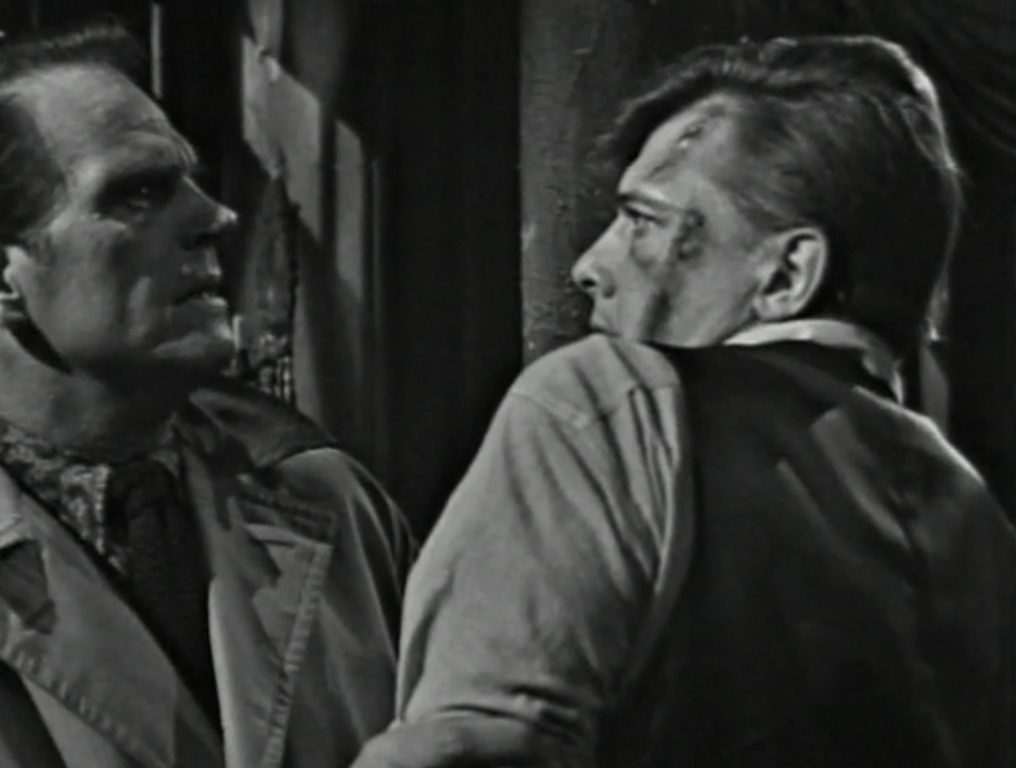
Barnabas and David have a man-to-man talk, or should I say ghoul-to-boy.
Barnabas finally tells David to take a long, deep look at the portrait, and asks him if he still feels that Josette is there. David says that he does not have that feeling. Barnabas triumphantly declares that Josette is really gone.
Now, at last, we expect everything will start to come together. David will talk to Vicki, they will compare notes about their encounters with Josette, and will try to figure out how and why she has changed. There will be images building on the ambiguity about who David really saw through the window and who really opened the door for him. David’s father, high-born ne’er-do-well Roger, will try to revert to his usual denials that anything peculiar is going on, but will grudgingly admit that the events of the last several months have proven that Josette’s ghost is real, and will not be able to resist wondering what is going on with it now. That in turn will lead to a new understanding between Roger and Vicki, allowing Roger’s relationships with both her and David to become more dynamic. Barnabas will realize that, even if he can keep Josette from manifesting herself again, she has already revealed enough to the characters about the supernatural back-world behind the settings in which they operate that she has created a dangerous situation for him, and he will have to scramble to keep them from discovering that he is a vampire.
The script brings us right up to the brink of every one of those events, only to whisk us away and instead show us something dull and pointless. David does tell Vicki that he saw Josette’s ghost, that Josette is in some way he cannot explain different than she was when he saw her before, and that he could not feel Josette’s presence in her portrait. But Vicki does not draw on her many experiences with Josette and join David in trying to unriddle these mysteries. Instead, she behaves as she did in the first twelve weeks of the show, and treats David as if he is having a neurotic episode.
David tells Vicki that Josette’s face, as he saw it through Barnabas’ window, was “exactly the same” as it was when he saw her ghost before. We don’t see the face at all today, and when we’ve seen Josette before, the only look we had at her face were brief glimpses in #149, #165, and #184. In each of those episodes, she was played by stand-in Rosemary McNamara. Today, the performer wearing the dress is Dorrie Kavanaugh. Casting Miss McNamara and letting a bit of her face peep out for a fraction of a second would seem to be way of building on the ambiguity, especially since she resembles Kathryn Leigh Scott strongly enough that she could easily be taken for Maggie.
Though Miss Scott played Josette’s ghost in #70 and #126, this is the first we’ve heard that Maggie resembles Josette. Perhaps Barnabas chose Maggie, not only because she is an attractive young woman who works late and often has to walk home alone after dark, but because she really does look like Josette. If so, the parallel with The Mummy is stronger- Helen Grosvenor looked just like the Princess Ankh-esen-amun, and the movie hints that Imhotep may have been right to believe that she was her reincarnation.
Vicki doesn’t react at all to David’s observation. She simply grows more exasperated with him for his persistence in believing in ghosts and intruding on Barnabas’ privacy, and warns him that “your father and I” will have to become stricter with him if his behavior does not improve.
Meanwhile, Barnabas and Roger are talking in the drawing room. Roger speculates that David has gone back to his preoccupation with ghosts because everyone is so worried about the missing Maggie, then remarks that it is strange that the boy’s behavior should have created a connection between Maggie and the portrait of Josette. This line doesn’t make any sense in the script as written, but if we could believe that Roger remembers what he recently knew to be true about Josette’s ghost, its powers, and its connection to Maggie’s father, it would be a sign that he is on his way to making a crucial discovery. In that situation, Barnabas’ mounting dread as he listens to Roger would carry considerable dramatic force, as opposed to the meaningless throwaway it in fact is.
Barnabas absorbing what Roger has said
Vicki’s amnesia is especially depressing, because the only story that consistently worked in the first 39 weeks of the show was the relationship between Vicki and David. At first David hated Vicki and wanted to kill her. After he found out she’d seen a ghost, David proclaimed his love for Vicki, but that was a love that might quickly transform itself into a violent hostility. Gradually, a true friendship grew between them. The Laura arc was the climax of that story, ending with David turning away from the biological mother who wanted to kill him and embracing Vicki as a more acceptable mother figure.
Once David had adopted Vicki as his new mother, their story was complete. Alexandra Moltke Isles and David Henesy made so much of Vicki and David’s scenes together, often in spite of very bad writing, that we are eager to see a sequel to that story that will give us more victories over the stuff that dribbled out of the typewriters of Ron Sproat and Malcolm Marmorstein. One possible sequel would have been an arc in which Vicki and David have to work together to defeat the vampire. If Vicki has forgotten everything that’s happened on the show since October of 1966, when she saw the ghost of Bill Malloy in #85, she won’t be able to do that, or much of anything else for that matter. The show has been primarily a supernatural thriller for months now, and if Vicki is excluded from the supernatural stories her future on it is very limited indeed.
A possible non-supernatural storyline might have been a romance between Vicki and Roger. After all, if Vicki is acting as David’s mother and she lives in the same house as his father, it only makes sense that the two of them should become a couple. And indeed, there are moments today when that seems to have happened. She hesitates for a fraction of a second while delivering the line about “your father and I,” which does sound so much like something an impatient mother would say. She then goes on to have a quarrel with Roger about how to discipline David and what emotions it is proper to display in front of him, sounding like they’ve been married for years. After a lot of raised voices, they apologize to each other and leave together.
We’ve seen Vicki and Roger in date-like situations a few times, for example in #78 and #96, and each time it has immediately become clear that the two of them are wrong for each other. Besides, Roger has been turning into the actor who plays him, the obviously gay Louis Edmonds. So a relationship between Vicki and Roger would be doomed from the start.
Still, it would reactivate some dead storylines. The series started with Vicki on a quest to learn who her parents were, a theme that went nowhere. They’ve been hinting very heavily that Roger’s sister, reclusive matriarch Liz, is Vicki’s mother, so that an engagement between Vicki and Roger would put Liz in a position where she could hardly keep that secret any longer. Moreover, Vicki has gone on some dates with dashing action hero Burke Devlin, who is not directly connected to any ongoing storylines. Burke hates Roger and is attracted to Vicki, so a love triangle involving the three of them might bring him back into the show. But that fizzles out just as the other potentially interesting situations do, leaving us without much to look forward to.
Vampire Barnabas Collins is taking a page from the 1932 Universal Pictures film The Mummy. Boris Karloff plays Imhotep, who rises from the dead and decides that a young lady named Helen Grosvenor is actually the reincarnation of his lost love, Princess Ankh-esen-amun. He abducts Helen, tells her she is Ankh-esen-amun, and tries to kill her so that she can come back to life as that lady. Likewise, Barnabas has abducted Maggie Evans, The Nicest Girl in Town, and set about brainwashing her into thinking she is his lost love Josette. He has made it clear to the audience, if not to the other characters, that he will kill her so that she can rise as a vampiric Josette.
Today, Barnabas and Maggie are having dinner. Maggie seems to be in a daze, and only repeats what Barnabas says to her. Still, she is smiling at him and answering to the name Josette. We can’t quite tell if she is succumbing to his lunatic plan or is simply playing along with him.
Maggie’s father Sam and boyfriend Joe knock on the door. When Barnabas’ sorely-bedraggled blood-thrall Willie Loomis mentions Joe’s name, Maggie’s head jerks to the side and her eyes open. At that, we know that she was falling under Barnabas’ spell, because we can see her coming out of it.
Maggie recognizes Joe’s name
That it is Joe’s name that breaks Barnabas’ hold over Maggie echoes another of Barnabas’ sources, Bram Stoker’s Dracula. In that novel, Professor Van Helsing is delighted to hear that the vampire’s victim Lucy Westenra is receiving blood from Arthur Holmwood, because Arthur “is the lover of her!” The vampire represents, among other things, a travesty of a sexual relationship, so that real sexuality is a weapon against him.
Willie hustles Maggie upstairs to Josette’s bedroom, which Barnabas has restored complete with hairbrush, perfume, jewelry, and a portrait of the lady herself. Included among these items is a mirror, which will be of no use to Maggie once she becomes a vampire, but which, like the other things, is among the standard appointments of an ancient Egyptian lady’s tomb. Maggie can hear her father and Joe talking in the parlor below, and their voices bring her back to herself. Willie tries to keep her quiet, and does succeed in preventing her from letting Sam and Joe know that she is there, but Barnabas hears enough to know that she is trying to escape.
Sam is an artist. Before Barnabas abducted Maggie, Sam had been coming to Barnabas’ house to paint a portrait of him. He tells Barnabas that with Maggie missing, he can’t concentrate on painting. Barnabas says that of course he wouldn’t dream of asking him to work at such a time. Sam offers to take the painting home and work on it there, but Barnabas insists it stay at the house.
It has been strange that Barnabas wanted Sam to paint at his house. Barnabas only exists at night, and his house has no electricity, so conditions couldn’t be worse for painting. Moreover, he wants to get close to Maggie, and working at the Evans cottage would mean seeing her every night. Perhaps there is some magical quality that will inhere in the painting if it is done in Barnabas’ house. We’ve already seen a number of portraits act as gateways to the supernatural. The ghost of Josette has emerged from her portrait several times. And a few months ago, Josette’s ghost went to the Evans cottage and possessed Sam to literally paint a picture of what blonde fire witch Laura Murdoch Collins was up to. So Barnabas may be leery of letting the portrait out of his sight, lest Josette or some other paranormal adversary of his take control of Sam and use it to reveal his horrible secrets.
In his scenes with Maggie at the dinner table, Jonathan Frid manages to convince us that Barnabas sincerely believes that his plan will benefit her, so much so that here would be no point in trying to appeal to his conscience. It is a tribute to his success that it is startling when the episode ends with Barnabas closing in on Maggie with the intention of doing her some kind of violence. We know that he is a vampire, we know that he has attacked Maggie and other women off-screen, and we’ve seen him beat Willie savagely. But it is still chilling to see his earnest sweetness give way to violent abuse.
Well-meaning governess Vicki goes to the front door of the great house of Collinwood and brings in an afternoon paper dated 16 April 1967. There is the headline on the front page: “Pfizer Dropping Its Patent Suits on Tetracycline.” Right next to it, “Factory Labor Costs Reached Five Year High Relative to Output in October, Agency Says.” The New York papers had these stories on 24 November 1966, and ran them in the business sections. Apparently Collinsport’s afternoon paper doesn’t believe in rushing into print. There’s also some stuff there about the disappearance of Maggie Evans, The Nicest Girl in Town.
The Collinsport Star, 16 April 1967
Vicki looks directly at the paper for less than four seconds, yet when reclusive matriarch Liz asks her if the articles about Maggie provide any new information, she says no. Speed reading courses were a big fad in the 1960s, evidently Vicki must have taken one. Liz forbids Vicki or flighty heiress Carolyn to go out after dark until Maggie is found.
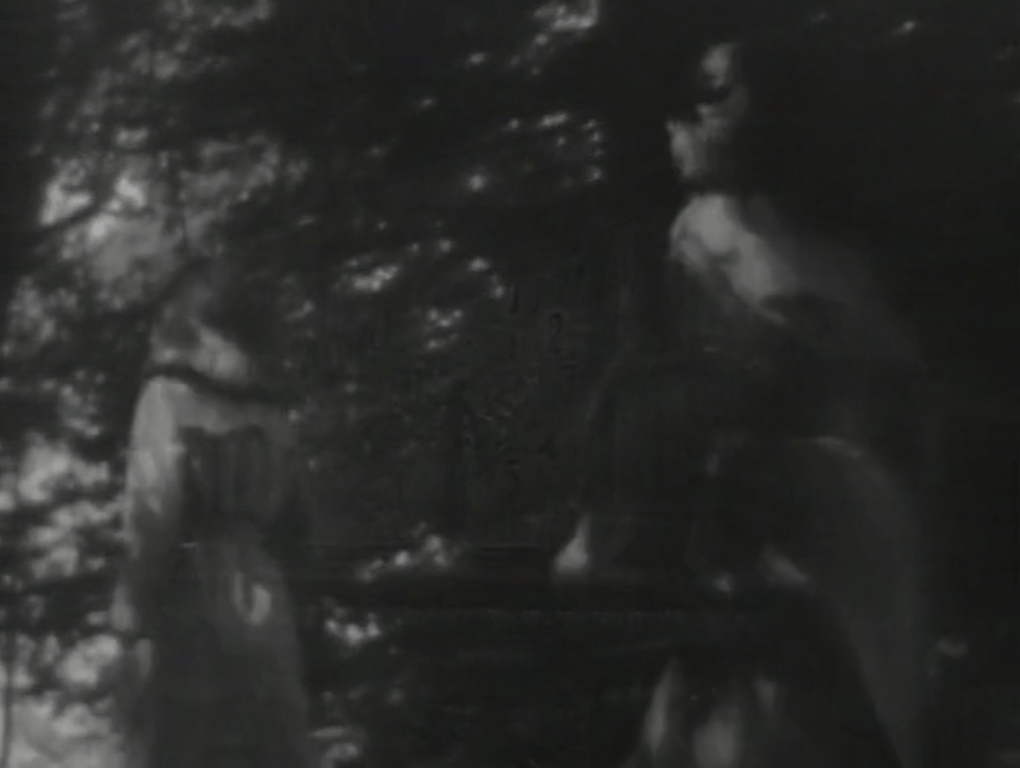
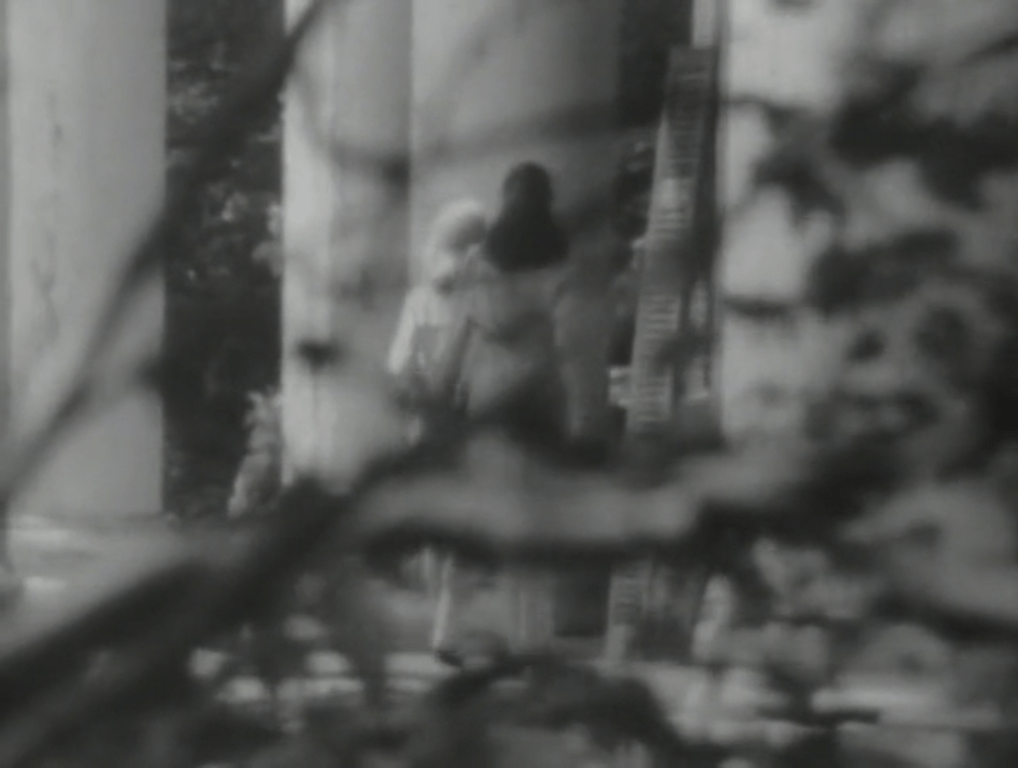
As soon as Liz leaves the room, Vicki suggests to Carolyn that they go for a walk to the Old House on the grounds of the estate. She wants Carolyn to see the restoration work that has been done since the courtly Barnabas Collins and his irritable servant Willie Loomis have moved in. Carolyn reluctantly agrees. We see a video insert of the women walking through the woods towards the house, with audio of their voices dubbed over it. I believe this is the first new exterior footage we have seen since #174, and the first to include actors since #130.
We see the women from an increasing distance, so that they appear to shrink; then through foliage, so that they appear to be in a trap; and finally from a high angle, as if they are small and weak. Since we know that Barnabas is a vampire and they are on their way to enter his lair, this is effective visual storytelling. In fact, it is the only good scene in the episode.
The beginning of the walk- Carolyn and Vicki at their largestApproaching the house, they reach their smallest sizeOn the porch, behind the branchesAt the bottom
Carolyn says that it is much colder around the Old House than it is at the great house, and Vicki mentions that they are closer to the ocean. This is something of a retcon. When strange and troubled boy David first took Vicki through the woods to the Old House in #70, not only was it news to her that the place existed, but the trek was a long one, suggesting it was far inland, deep into the grounds of the estate. That impression was reinforced a number of times, and Vicki’s remark is the first to contradict it. Apparently the writers are planning some story point that will require the Old House to be by the shore.
Vicki knocks on the door several times without an answer. As she and Carolyn turn to go, we see the doorknob turn and the door open. When the women see that no one is in the front part of the house, Vicki guesses that her knocking loosened the door. What we saw of the doorknob tells us that some agency opened it. It is still daylight, so Barnabas’ powers are unlikely to be at work, and it doesn’t seem that he would want people wandering into his house.
The Old House has also been the abode of the benevolent ghost of Josette Collins, and it is possible Josette might want Vicki and Carolyn to figure out what Barnabas is up to. But nothing they do today gives them a clue about him, and since it is almost nightfall it is extremely dangerous for them to be there. Josette would be unlikely to put them in that situation without good reason.
That leaves us wondering what other supernatural beings might be operating in and around the Old House. The first time Dark Shadows told a story that was modeled on Bram Stoker’s Dracula, it centered on blonde fire witch Laura Murdoch Collins. In the first weeks of that arc, it seemed that Laura was not simply a single physical body, but that she was a whole complex of material and immaterial presences, some of them working at cross-purposes to each other.
Now we are using another set of ideas from the same book. Barnabas is more dynamic than Laura was in those early days, but he too seems to have brought company with him, perhaps including companions he does not know about and whom he does not control. This is most obvious when he is planning some evil deed and the dogs start howling. Occasionally the dog-noise helps him by intimidating his victims or scaring away their would-be protectors, but more often it gets in his way by acting as a warning that trouble is brewing. If an unknown force that upsets the dogs emerged when Barnabas rose from his tomb, then perhaps still another force has appeared that is fiddling with the doors to the Old House.
Over Carolyn’s objections, Vicki insists on exploring the Old House. Carolyn protests that this is trespassing. They have been confusing about the legal status of the place. In #220, they said explicitly that Liz would continue to own it and would let Barnabas stay there. There hasn’t been any indication since that Barnabas has paid Liz anything or that she has done any paperwork. If the house belongs to Liz, Carolyn, as Liz’ daughter and heir, would be speaking figuratively when she uses the word “trespassing.” But in #223, Liz talked about the house as if it and its contents were Barnabas’ property. So who knows, maybe she signed the place over to him when the show was busy with a day of recapping.
Whether Barnabas is the proprietor of the house or a guest there, Vicki and Carolyn are certainly intruding on his privacy when they go upstairs and examine the bedrooms. Carolyn at least has the presence of mind to point this out, but Vicki just keeps repeating that Barnabas once told her she was welcome to come over any time and she interprets this to mean that she can go anywhere in the house whether he’s there or not. This is one of the most sustained, and most bizarre, of all the Dumb Vicki moments we’ve seen so far. Alexandra Moltke Isles usually tries to find something to put behind her eyes during these scenes to suggest Vicki has a thought we will find out about if we keep watching, but Vicki’s behavior today is so senseless Mrs Isles just grins and looks off into the middle distance like a crazy person. Who can blame her, really.
They find the bedroom of Josette all appointed as if Josette herself were living there, complete with jasmine-scented perfume. The door mysteriously closes, trapping them inside. Again, no one we have met, either living or ghostly, would have any motive to do this. After a moment, Willie comes to the door and demands to know why they are there. Vicki asks about the room and complains about Willie’s manners, as if she had a right to be there.
Downstairs, Vicki asks Willie to tell Barnabas how impressed she and Carolyn are with all the work that has been done. Barnabas shows up and is extremely gracious to the women. After they leave, he scolds Willie for his unfriendliness to them. Maybe he does want visitors letting themselves in and roaming freely about the house while he’s resting in his coffin and keeping a girl prisoner, who knows. That would seem foolish, but no more so than Vicki’s activities today. It was the 1960s and people’s blood had a lot of lead in it. Maybe that’s getting to Barnabas.
Vicki and Carolyn go back to the great house and tell Liz what they saw at Barnabas’. Liz is annoyed that they went to a place where they were likely to see Willie, whom she remembers from his pre-blood thrall days, when he was dangerously unstable ruffian Willie Loomis. She wonders why Barnabas has chosen to restore Josette’s room.
We return to the Old House, where the episode ends with its only scene not including Vicki. Barnabas stands before a small table in the parlor. It is set for a dinner for two. There are two plates, and two glasses. Barnabas has appeared to drink coffee at the restaurant in the Collinsport Inn, Amontillado in the study at the great house, and some kind of booze at The Blue Whale tavern. These glasses also seem to hold something other than human blood, indicating that Barnabas is not sticking strictly to the diet of his people. He tells Willie to bring their guest. Maggie enters, wearing Josette’s bridal gown and offering her hand when Barnabas addresses her as Josette.
It is by no means clear where Maggie has been up to this point. She wasn’t in Josette’s room, and doesn’t seem to be coming from the basement. The secret chamber behind the bookcase is no secret anymore, least of all from Vicki, who was held prisoner there by crazed handyman Matthew Morgan. Perhaps we are to think that her entrance, along with Barnabas’ insouciant attitude towards unexpected visitors, implies that there are spaces in the house only Barnabas can find.
Maggie Evans, The Nicest Girl in Town, has gone missing. The audience knows that she is in the keeping of vampire Barnabas Collins and Barnabas’ sorely bedraggled blood thrall Willie Loomis, but the show isn’t ready for any of the characters to get suspicious of Barnabas. So today is taken up with people bemoaning their ignorance of Maggie’s whereabouts.
To keep from stumbling upon information that might advance the plot, the sheriff and the doctor have to be idiots, and they both get particularly embarrassing scenes today. Not only does a frequently caustic commentator like Danny Horn mock them, but even the recap on the Dark Shadows wiki takes some potshots at their stupidity. It cites, as the sheriff’s most brilliant insight, that if Maggie is no longer where she was last seen, she “either got out… herself or was taken out by someone.” And it points out that the doctor goes on at length about the absolutely unique nature of Maggie’s ongoing illness, only to be reminded that Willie exhibited exactly the same symptoms a few weeks before.
Our point of view character in the first months of Dark Shadows was well-meaning governess Vicki. The other day Vicki received a phone call about Maggie from Willie, with whom she had spoken minutes before and who was not disguising his voice in any way. Somehow she failed to recognize him. They bring this up again today. They don’t replay the call, and she says that the voice was “muffled,” so people watching for the first time may not bracket her with the sheriff or the doctor among the show’s dum-dums. Regular viewers, however, will see further reason to despair that the characters will learn enough any time soon to get the story going again.
Seagoing con man Jason McGuire goes to Barnabas’ house and calls on Willie, who was originally his henchman. Jason is worried that Willie is attracting official attention, something which cannot be good for his own nefarious purposes. He refers to Barnabas as “His Nibs,” a phrase indiscreet housekeeper Mrs Johnson had applied to Jason himself in #185, and demands Willie leave town. Willie tells him he can’t do that. Willie threatens Jason with a hammer. Jason disarms Willie and beats him to the floor. As Jason leaves the house, he is surrounded by howling dogs and looks frightened.
Maggie Evans, The Nicest Girl in Town, has vanished from her hospital bed. We start with a long succession of characters talking about this fact with Maggie’s father Sam. Had David Ford played Sam as effectively as he did in his first weeks on the show, one such exchange might have made for a good scene. But Ford is overacting today, and the first part of the episode drags on and on.
We cut to the Old House on the great estate of Collinwood, where Maggie’s boyfriend Joe and dashing action hero Burke Devlin have gone. Vampire Barnabas Collins resides in the Old House along with his sorely bedraggled blood thrall, Willie Loomis. Joe and Burke have no clue there is anything odd about Barnabas, but they don’t like Willie and suspect he may know what happened to Maggie.
Barnabas lets Joe and Burke in the house and explains that he sent Willie to run some errands for him out of town. When they tell him about the evidence that has led them to think Willie might be connected with Maggie’s disappearance, he persuades them that there is nothing to their suspicions. Once they are gone, he calls out “It’s all right, they’ve gone. You’re safe here- safe here with me.” Maggie walks into the room.
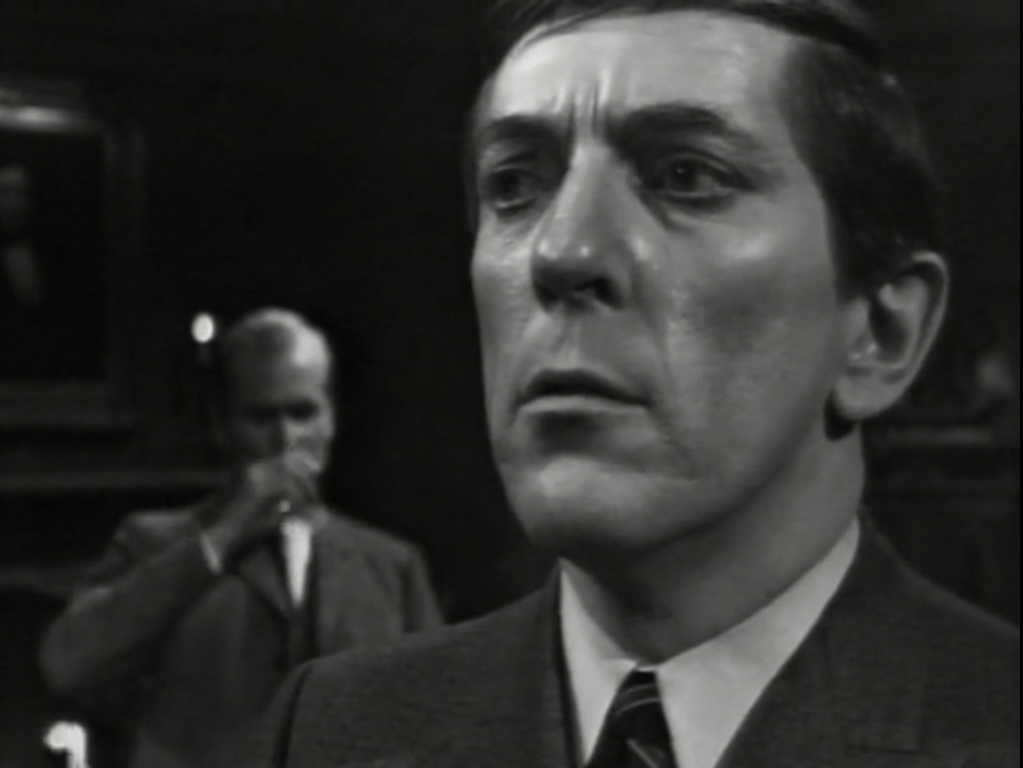
Barnabas talking to Burke
This scene is very good. Barnabas is made up to look much more like The Vampire than he has been in previous encounters with characters he was trying to fool into thinking he was a harmless eccentric recently arrived from overseas. He is polite enough to Joe and Burke that they can chalk his appearance up to the lateness of the hour, but as the audience watches him extract information from them point by point, until he knows exactly what they do and don’t know, we can see him calculating when and how he will have to kill them. It is as good a scene as Jonathan Frid has had since he debuted as Barnabas.
Frid’s performance in this scene benefits from his flawless line delivery. Not so, unfortunately, the scene that follows. His bobbles are not especially bad by Dark Shadows standards, but his task is far more fragile than any he has taken on before. We’ve seen him pretending to be the Collins family’s mild-mannered cousin from England; in those moments, Barnabas himself is taking on a challenging acting job, and Frid’s difficulties sometimes dovetail with troubles we might expect Barnabas to have in his performance. We’ve seen him abusing Willie; in those moments, we might expect him to sputter a bit, and Frid can hide some of his memory lapses in that mannerism. But now, he is telling Maggie what his plans are for her. As he does so, we realize he is a crazy man spilling out his deepest and sickest obsession. That context leaves nowhere to conceal even the slightest flub. As a sign of triumphant psychosis, the lines have to flow without interruption. Every time Frid stumbles for a fraction of a second, he breaks character.
Nor can Kathryn Leigh Scott bail him out. As Maggie, her part is to wander around in a stupor and occasionally repeat the last word or two of whatever is said to her. She makes that a lot more interesting to watch than you might expect, but there’s only so far it can take you.
Barnabas’ plan takes us outside the themes we are familiar with from vampire fiction. He wants to brainwash Maggie into thinking that she is Josette Collins, who has now been retconned into the woman Barnabas loved in his human days. His goal is that Maggie Evans will cease to exist, and that in her body Josette will live again.
Dracula never wanted to do anything like that, though after Dark Shadows has a hit with this storyline it will become part of vampire lore. Prince Mamuwalde, the menace in the 1972 film Blacula, kidnapped the heroine and tried to turn her into his long-dead love. Another undead fictional man from Africa had tried the same thing in 1932, when Imhotep, played by Boris Karloff, had spent the bulk of The Mummytrying to turn the heroine into a revived form of his adored Princess Ankh-esen-amun. Frid’s face and coloring were somewhat similar to those of Bela Lugosi, a fact often remarked in connection with his casting as a vampire. But his voice and movements are strongly reminiscent of Boris Karloff, and as a mashup of Dracula and Imhotep he is a synthesis of these two actors.
Barnabas gives Maggie a music box that he had intended to give Josette. He says that he bought it for Josette in his travels in “the Orient,” intending to give it to her “on a very special day,” and “this is that day.” This leaves us wondering why the day never came when he could give it to Josette. Did he become a vampire before he returned from his travels? Did he come back from his travels to find that she was no longer available to him? Or was it supposed to be a present at their wedding, a wedding that never occurred?
Barnabas also produces Josette’s wedding dress and tells Maggie that she, as the new Josette, will wear it. When Imhotep produces Ankh-esen-amun’s clothing and jewelry, we remember that royal personages in ancient Egypt were buried with their possessions and assume that he has retrieved them from her tomb. The show did lead us to wonder if the Collinses once had a similar practice. Willie released Barnabas because he had heard a story that some of the Collinses were buried with expensive jewelry and so was trying to rob a grave. The story of the buried jewels was framed as an echo of the Gothic romances that inspired the first weeks of Dark Shadows, but has now become an anticipation of the show’s journey into Universal Pictures’ back catalogue of horror movies.
If Barnabas does manage to somehow erase Maggie and bring Josette back to life in her body, it won’t be the first time Miss Scott has played Josette. In #70, Miss Scott was the ghost who emerged from Josette’s portrait and danced outside the Old House. Miss Scott put Josette’s veil on again in #126 when she led the ghosts who scared maniacal handyman Matthew Morgan to death before he could murder well-meaning governess Vicki. In that one, she delivered a few lines as Josette. Miss Scott’s name did not appear in the credits as Josette in either of those episodes, and the only time we caught a glimpse of Josette’s face was in #149, when she was played by stand-in Rosemary McNamara. But if by any odd chance a viewer does know that Miss Scott has played Josette before, the final dissolve from a closeup of Miss Scott to one of Josette’s portrait suggests a definite possibility that Barnabas’ plan, nonsensical though it seems, will somehow succeed.
Danny Horn’s post about this episode on his Dark Shadows Every Dayis particularly good. He compares its visual strategy to that of the one surviving contemporary segment of General Hospital, and praises the ambitious approach director Lela Swift took to composing images. I should also mention Patrick McCray’s Dark Shadows Daybook post, in which he analyzes the way the story alienates us from our rooting interest in Maggie’s safety by promising a more exciting story if Barnabas has his way with her for an extended period.
Maggie Evans, The Nicest Girl in Town, is in the hospital with a mysterious ailment that may kill her at any moment. Her father Sam and her boyfriend Joe visit her there. Sam’s alcoholism and its effect on Maggie was a story element for the first 40 weeks of the show. Lately Sam has somehow become a social drinker, and early in today’s episode he shows zero interest when offered a drink. Still, when Maggie asks from her sickbed that he abstain from alcohol, he says “I’ll go on the wagon. I promise this time!”
The doctor tells Sam and Joe they have to leave the room to let Maggie sleep. The two of them stay in the hospital, sitting in a lounge, where Sam reminisces that he sat on that very spot waiting for Maggie to be born. Joe tries to reassure Sam that everything will be all right, but can’t conceal his own fears. As Sam, David Ford usually underacts. When he has gone big before, as he did especially in his first weeks on the show, he has been very effective. In his scene with Joe in the hospital lounge, he overacts for the first time, and it is pretty bad.
Sam starts crying, while Joe reacts with the embarrassment of a true New EnglanderSam asks Joe his opinion
This utterly typical soap opera material occurs in the context of a story no other daytime serial has told before, the attacks of a vampire. It is the undead Barnabas Collins who is the cause of Maggie’s illness. Most of the characters we see today think Dark Shadows is still a conventional soap of the period, and are at a loss to explain what is going on with Maggie.
Twice, the doctor seems to be forming a suspicion that might carry him in the direction of the truth. Before the ambulance comes to take Maggie from her house to the hospital, he says he has an idea that’s “too wild.” Well-meaning governess Vicki, who the other day suggested that Maggie’s condition and other events that the audience knows to have been caused by the vampire might have a supernatural origin, perks up and asks him to explain.
Vicki thinks the doctor might have something interesting to say.
The doctor then speculates that the wounds on Maggie’s neck may have been produced by an animal. Vicki allows that she heard some dogs outside the window before Maggie sustained her latest injury.
At the hospital, the doctor instructs his nurse that she is under no circumstances to open the window to Maggie’s room, and under no circumstances to leave her alone for an instant. She asks him to explain why he is giving these instructions, and he declines to do so. Evidently he can’t come up with a scientific-sounding explanation.
Maggie wakes up and pleads with the nurse to open the window. Within seconds, she gives in. Shortly afterward, Maggie codes. The nurse dashes out of the room, closing the door behind her to ensure Maggie will be out of view. When the doctor comes, they go into the room together. Maggie is gone, the window is wide open, and a hound is howling nearby.
In the early part of the episode, when Maggie was still at home, the doctor himself had closed the door to her bedroom when she was alone in there. That was a bit less exasperating than it is when the nurse closes the door. First, the audience knows nothing is going to happen to Maggie in the first ten minutes of the episode, but in the last three she is in extreme danger. Second, while the doctor has several times this week ordered Sam never to leave Maggie alone, we don’t hear him talk about that today until he gives the same order to the nurse. So when he closes Maggie’s door, it is insulting to the intelligence only of people who watch the show every day, and frankly how smart can anyone be who does that. But nursing is a most distinguished profession, and we should all object when a nurse is represented as a big dummy.
We open with the sight of sorely bedraggled blood thrall Willie Loomis broken and crumpled on the floor of the Old House on the estate of Collinwood. He is under the heavy cane which vampire Barnabas Collins carries and which he uses to beat Willie. Barnabas demands Willie confess that he played a part in preventing him from taking full possession of Maggie Evans, The Nicest Girl in Town. Willie at first tries to deny his responsibility, but finally swears that he won’t disobey Barnabas again. Barnabas gives him some orders and dismisses him.
At the Evans cottage, Maggie is sick in bed. When her friend, well-meaning governess Vicki, comes to sit with her, she makes Vicki promise she won’t leave her alone no matter what she says or does. She won’t even let Vicki go as far as the kitchen to fetch her a glass of milk- she doesn’t dare spend one second by herself.
Maggie’s father, artist Sam, has called Vicki because he himself has had to go to the Old House to work on the portrait he is painting of Barnabas. He is working on some problems in the background, and encourages Barnabas to take a walk. While Barnabas is away, Willie comes into the room and asks Sam where he is. Sam is concentrating hard on his work and responds to Willie’s questions with irritated grunts.
When Willie asks Sam how his daughter is doing, Sam turns to him and angrily snaps “Don’t mention her name!” He didn’t mention her name, but he was very rude to Maggie more than once in the days before he met Barnabas, when he was still dangerously unstable ruffian Willie Loomis. In #207, Willie was so crass in his behavior towards Maggie and Sam in The Blue Whale tavern that dashing action hero Burke Devlin had to beat him up and order him to leave town, the incident that prompted Willie to launch the grave-robbing expedition that released Barnabas. Sam was unhappy to see Willie again at the end of #222. By #225/226, he was willing to tell Burke that Willie had reformed, but that doesn’t mean he wants him to have anything to do with Maggie.
Of course, Maggie has already become Willie’s colleague, Barnabas’ second blood thrall. That’s the point of showing us the results of the beatings Barnabas inflicts on Willie. We’ve known Maggie for over 46 weeks and have liked her the whole time, so the idea that she is on her way to suffer that kind of abuse horrifies us. Willie’s determination to help Maggie, asking Sam about her even after the beatings, shows us how much he wants to spare Maggie the fate that has befallen him.
Back in the Evans cottage, Maggie has had another mood swing. These are familiar to readers of Bram Stoker’s Dracula, where the vampire’s victims Lucy and Mina are at one moment desperate to be rescued from him and at the next equally desperate to go to him. Maggie has been displaying these swings for several days now, and it is only because Kathryn Leigh Scott is a highly trained actress with a big bag of tricks that the scene where she demands Vicki leave is not painfully repetitious. My wife, Mrs Acilius, was particularly impressed with the way Maggie enunciates the word “leave” in her commands to Vicki.
Dogs make alarming noises near the french windows, sending Vicki into a state of panic. Maggie denies that she hears them at all. When the windows rattle and it seems that a pack of fierce dogs are about to burst in, Vicki runs to the next room to telephone Burke. When she is out, the door to Maggie’s room slams shut and Vicki finds that she is unable to open it.
Some wonder why Vicki goes to the next room to make her call when there is a telephone next to Maggie’s bed. Maggie used it to make a call in #225/226, and it was prominently featured in several shots in #231. I think it makes sense, though. Maggie is between Vicki and that telephone, and she is being extremely uncooperative. Vicki doesn’t want to take the time to fight her, she wants to call for help at once. Besides, Vicki is so terrified that we wouldn’t expect her to look around, and she has used the telephone in the other room before.
Others might wonder why she calls Burke rather than calling the police. Considering what we have seen of the Collinsport sheriff’s office, I don’t think this is a difficult decision to defend. Vicki tried to call the sheriff from the Evans cottage the other day, and no one was there to answer the phone. Nor have they managed to solve any of the crimes that have been committed on the show so far, even though the perpetrators left so much evidence lying around that Vicki herself, while going about her business, has accidentally stumbled on the solutions to one murder and two attempted murders.
The final shot of the episode, with Vicki banging on Maggie’s door and pleading with her, is not very compelling, and brings a wince to the faces of viewers who remember #84-#87, when Vicki was locked in a room in an abandoned part of the great house of Collinwood and spent several hundred hours of screen time* banging on the door and calling for help. Today’s ending isn’t exactly a Dumb Vicki moment, but it certainly isn’t an interesting moment, and we hope there aren’t any more like it.
*An approximation. It seemed like at least a thousand hours, but since the whole story played out in three and a half episodes lasting 22 minutes each I don’t suppose it could actually have been quite that long.
Well-meaning governess Vicki and flighty heiress Carolyn are in the drawing room of the great house of Collinwood talking about how nervous the electrical storm outside is making them. Vicki describes her reactions while driving a car a few moments before. This deepens a mystery that opened yesterday- what car? They’ve so often made a point of having Vicki ask to borrow Carolyn’s car, or accepting rides from people, or catching the bus, or walking much further than people thought was sensible that you’d expect them to have mentioned something if she got a car of her own.
The lights go out, and the women get even more nervous. A figure appears in the doorway and frightens them. They are relieved to discover that it’s just cousin Barnabas. Barnabas is getting to be such a familiar presence that one suspects they might have been relieved to see him even if they knew he is a vampire.
Barnabas looks out the window at the storm and talks about how fierce the storms are on the hilltop Collinwood occupies. He mentions something we haven’t heard about for months, the “Widows’ Wail.” The wind makes a peculiar sound as it blows over Widows’ Hill, and there is a legend that it is really the disembodied voices of the widows whose menfolk died on the fishing boats of the cruel Collins family. We heard the sound effect several times in the first ten weeks of the show, and the legend often came up in those days.
Barnabas then goes on at great length about a woman who leapt to her death from the cliff on Widow’s Hill well over a century before. He makes it clear that the woman was alone with her lover, then describes particular words and gestures in such detail and with such feeling that only the lover himself could provide them. He assures the women that “every word” of his account is true, including the parts about the woman unable to face a future in which she would be transformed into something she found intolerable, the lover putting his lips on the woman’s neck, her growing faint as a result, her finding a last burst of energy to fling herself to death on the rocks below, and her body found bloodless, but with a look of serenity on her face.*
Carolyn was on edge to start with, and the story deepens her anxiety. She excuses herself to go to bed. Vicki was even more anxious than Carolyn before Barnabas started his tale, but as he goes on her fear vanishes. She tells Barnabas that she wonders if there is a connection between the “bloodless” body and the recent incidents of blood loss involving cows, Barnabas’ servant Willie, and Maggie Evans, the Nicest Girl in Town. Barnabas reminds her that his story took place in an earlier century. She says she knows that, but that she is thinking that the ordinary logic of the natural world may not be enough to solve the ongoing mysteries. Regular viewers will remember that Vicki has had extensive experience with the paranormal, and have been expecting her to be the first to consider the possibility that Willie, Maggie, and the cows have encountered something that is not subject to the same laws that describe ordinary phenomena.
Barnabas squirms, and at one point drops his “cousin from England” mask altogether. As Vicki is explaining her thinking, he says in a bland voice that she is a “very clever girl” and should be careful lest the same thing happen to her that happened to Willie, Maggie, and the cows. Then he looks up and starts to walk away from her, leading to an ominous music sting and a commercial break.
After the break, we see that Barnabas is still in the drawing room with Vicki. She looks startled, and asks him what he meant by his remark. He says that he merely meant that whatever happened to them might happen to anyone. If that is intended to retroactively veil his unveiled threat, it fails miserably- it sounds even more menacing.
Among the representatives of the show’s supernatural back-world whom Vicki has already met, none is more important than the ghost of Josette Collins. The woman Barnabas is describing threw herself to her death off Widow’s Hill in a previous century while wearing a white dress, as Josette did. Other women have jumped from there in the years since, but Josette is still the most famous. When Maggie’s father, artist Sam Evans, saw the portrait of Josette in #185, he asked if she was the lady who went over the cliff. Vicki’s excited reaction to the story suggests that she thinks Barnabas might be talking about Josette.
If he is, it is a major retcon. When we first saw Barnabas in the Old House in #212, he told strange and troubled boy David Collins that she was “our ancestor,” meaning a forebear both of David’s branch of the family and of “the original Barnabas Collins,” that is, himself. After David left, he told the portrait that the house was his now, and that the spirits of his father Joshua and of Josette have no more power there. When he refers to Josette as his ancestor and brackets her with his father, he implies that she sided with his father against him. Since we know that Joshua’s wife, Barnabas’ mother, was named Naomi, and that Josette’s husband was named Jeremiah Collins, the likeliest explanation of these lines would be that Josette was Barnabas’ grandmother. Just a few weeks later, they seem to have reinvented her as his lover.
Barnabas’ story is also a bit of a departure from the usual depiction of vampires. Bram Stoker’s Dracula may have been a revenant form of Vlad III of Wallachia, but he doesn’t mope around obsessing over the good old days in the fifteenth century when he could stay up all day impaling people to his heart’s content. He is entirely focused on the task before him. Dracula’s colleagues in film and on stage had likewise tended to be killing machines, not given to nostalgia or introspection.
Barnabas’ claims to be a devotee of the late eighteenth century have so far been a technique for shifting the conversation from current events, of which he is after all comprehensively ignorant, to the deep past, in discussion of which he can show that he knows so much about the Collins family that he must be a member of it. Even when he gets carried away, as in #214 when he was telling Vicki about the construction of the Old House and started laughing maniacally about the word “death,” it’s a reminder that the events he is talking about seem quite recent to him, since he emerged from his coffin not long ago. But today, he seems to be brooding over the past in a way that has less to do with previous vampires than it does with the character Boris Karloff played in The Mummy (1932). Indeed, Jonathan Frid’s voice and movements are so strongly reminiscent of Karloff that one wonders if Barnabas will turn out to be a merger of Dracula with Imhotep.
Seagoing con man Jason McGuire enters. Vicki hates Jason, who is flagrantly blackmailing reclusive matriarch Liz. She likes Barnabas, but the encounter with him is getting extremely awkward. She quickly excuses herself to go to bed. When Barnabas says that he too must be going, Jason insists that he stay.
Barnabas’ reaction to Jason is pretty funny. When Jason says he wants to discuss something with him, Barnabas tenses and rolls his eyes. Suddenly the drawing room is the scene of a drawing room comedy, and Barnabas is the classic snob forced to deal with an uncouth bounder. For regular viewers, their scene is not just a well-played, if not particularly well-written, specimen of this genre. Barnabas is the latest of the supernatural beings who have been driving the action of the show for six months, while Jason is a throwback to the days when Dark Shadows was a noir-ish crime drama centered on the search for Burke Devlin’s fountain pen. Barnabas’ disdain for Jason mirrors our lack of interest in reviving that phase of the show.
Jason reveals to Barnabas that he had seen Willie earlier that night, that he suspects Willie is involved somehow in the troubles afflicting Maggie, and that he knows Willie has been visiting Eagle Hill cemetery. All of this is unsettling to Barnabas. He goes home to the Old House on the estate, shouts “Willie!,” and raises the cane he had earlier used to give Willie a severe beating.
Maggie Evans, The Nicest Girl in Town, has been sick in bed. As long as the sun is up, she is very weak, has no memory of what’s been going on, and can sleep. When darkness comes on, she has wild mood swings and has to be physically restrained from running out into the night.
Moreover, the people who have spent the most time trying to help Maggie have no idea what is wrong with her and don’t seem to be making any progress towards finding out. Her doctor is as ignorant of medicine as are the writers, which is to say completely. The parts assigned to her father Sam and her boyfriend Joe consist of variations on the theme of helplessness.
As this episode begins, Maggie is still in bed, Joe is still sitting with her, and they are still at a loss to understand the situation or develop any plans. After yesterday’s episode, in which the actors labored mightily to inject three minutes of nonverbal storytelling into the half hour window Dark Shadows filled, things are looking pretty grim for the audience.
But then we get a sign of hope. Joe calls well-meaning governess Vicki and asks her to sit with Maggie. At the end of #229, Vicki realized that Maggie’s condition is the same as that which befell the luckless Willie Loomis a few weeks back. Moreover, Vicki is our point-of-view character, and she has consistently been the first to catch on to information after it has been shown to the audience. In the storyline centering on blonde fire witch Laura Murdoch Collins, Vicki led the team that opposed Laura’s attempt to burn her son David to death, and ultimately rescued David as Laura vanished in the flames. So if a battle is going to be waged for Maggie’s sake, we expect Vicki to be a central figure in it.
When Vicki takes Joe’s call, she is in the foyer of the great house of Collinwood. Seagoing con man Jason McGuire is in the same space, and asks her about Maggie. Vicki hates Jason, who is flagrantly blackmailing reclusive matriarch Liz. Vicki keeps trying to excuse herself without answering his questions, and won’t make eye contact with him. But Jason insists, and she tells him enough that he, too, recognizes that Maggie is suffering from the same thing that happened to Willie.
If we remember the ending of #229, this is a poignant moment. If Vicki and Jason could work together, they could solve the puzzle and discover that the mysterious Barnabas Collins is in fact a vampire who has enslaved Willie and is preying on Maggie. But Vicki’s eminently justified loathing of Jason, combined with Jason’s own shortcomings, makes this impossible. As a result, Barnabas is free to go on wreaking havoc.
While Vicki makes her way to Maggie’s house,* Jason goes to the Old House on the grounds of Collinwood to call on Willie. He finds that his onetime henchman’s face is badly bruised and scraped. Regular viewers know that Barnabas used his heavy cane to give Willie a beating the other day, and these disfigurements confirm that Barnabas is quite uninhibited in his use of violence.
Jason discovers Willie’s wounds
Jason reminds Willie that he has found him a couple of times in Eagle Hill cemetery.** After one of those visits, Willie turned up very sick, with two little punctures in his skin and a great loss of blood. Though he was desperately weak during the day, at night he gained strength and ran out. Now, Maggie Evans has been found wandering in the same cemetery, and she exhibits the same symptoms.
Jason tells Willie that he won’t tolerate anything that might bring the police to Collinwood, and demands to know what is behind the troubles he and Maggie have had. Willie tells him it isn’t wise to probe into that matter. When Jason says that sounds like a threat, Willie replies that it is simply a warning. “Threat or warning, I don’t need either from you!” Willie has a strange faraway look as he replies “OK… but, at the moment, it’s all I have to give.” Willie then says “You’ll have to excuse me, but Mr Collins doesn’t like my entertaining guests.”
The reluctant host
The dialogue between Jason and Willie in this scene is spare and elegant, without a wasted word. The actors match it, giving delicate performances of a sort the scripts rarely support.*** As Willie, John Karlen begins it trying to conceal his wounds from Jason and scampering about the set looking for a place to hide. As Jason, Dennis Patrick begins in a stern but solicitous manner. When Jason cannot get Willie to tell him how his face was hurt, Jason finally declares “I’m not going to concern myself with what happened to you.” He then becomes more directly menacing, but with a faint undercurrent of panic as his fear that whatever is happening with Willie will upset his own plans grows. He loses his advantage, and Willie stops trying to hide. By the time the scene ends, Willie is in control. Jason promises to find out what Willie is up to, and Willie replies “Fortunately, you’re not a man who keeps his promises. Fortunately for you, that is.”
The scene is not only an improvement over the repetitious jabbering we heard in the episode Malcolm Marmorstein wrote yesterday, but such a departure from the usual standards of the show in this period that it’s hard to believe it was actually written by Ron Sproat, as the credits say it was. Joe Caldwell has been making uncredited contributions to the scripts for months now, and I believe this scene must have been one of his.
Vicki doesn’t know about Willie’s connection to Eagle Hill. She also doesn’t know that it was Willie who called to tell her where to find Maggie, something Jason figures out in his scene with Willie. Again, if it were possible for Vicki and Jason to pool their knowledge, things would start moving very quickly.
Back in the Evans cottage, Joe tells Vicki that Maggie is not herself. “I was in that room with her most of the day. I never missed her so much in my life.” I think that line was also one of Caldwell’s. Sproat was capable of writing the occasional lapidary epigram, as indeed was Marmorstein, but neither of them had much feeling for what the actors could do. So few people could deliver that line in as natural a tone as Joel Crothers achieves that it must have come from a writer who had Crothers’ voice in his head.
When Maggie was alone with Joe, she yelled at him to go away and never come back. Then, she sounded like a sick person who didn’t know what she was saying. With Vicki, she says very calmly that she and Joe must never see each other again as long as she lives. It leaves no doubt that she is protecting him, wanting him to stay away from her as she is absorbed into Barnabas’ world of the undead. That was clear enough to the audience yesterday, when she found herself receiving a transfusion of Joe’s blood and screamed that she didn’t want anyone’s blood, especially not his. If Vicki were able to add Jason’s information about Willie to what she already knows, she might begin to suspect something like it.
The thunder roars, the french windows swing open, and an ominous silhouette appears in the lightning. It is the figure of a man in a cape, holding a cane in his left hand.**** Vicki stifles a scream. The lightning illuminates the night again, and the figure is gone. Vicki rushes to close the windows, ignoring Maggie’s plea to leave them open.
Now you see himNow you don’t
After closing the windows, Vicki turns to Maggie, bends over, and creaks out in a frightened voice “Ma-a-aggie!” Maggie responds “It’s all right… it’s all right now… it’s all right.” We cut to the closing credits, wondering just how wrong Maggie’s version of “all right” has become.
*How, I’d like to know? It’s unlikely she walked- Collinwood is miles from town, it’s a dark and stormy night, and several local women have been attacked by an assailant who is still unidentified and at large. But she doesn’t ask anyone to lend her a car, as she always has when she has wanted to go anywhere in previous episodes. Joe doesn’t say anything about coming to get her. And there hasn’t been any indication that she herself has acquired a car, or a bicycle, or a pogo stick.
**The show is still equivocating on the name of the cemetery. When it was first mentioned in #209, it was called “Eagle’s Hill.” Vicki and Sam still call it that, but the other characters who have mentioned it call it “Eagle Hill.” Eventually that latter form will become usual.
***John Karlen uses a vaguely Southern accent at some moments today. The first Willie Loomis, James Hall, is from Mississippi, and Karlen sometimes tries to make his version of the character sound like he also came from that part of the world. Eventually he will give up on that, and Willie, like Karlen, will be a native of Brooklyn.
****As a private joke,amusing only to me, I think of this as “Barnabas Collins #4.” Before the part was cast, producer Robert Costello was the model in the first stages of the painting of the portrait of Barnabas. Then stand-in Timothy Gordon played the hand that darts out of Barnabas’ coffin and grabs Willie’s throat in #210. Jonathan Frid first appeared in #211, making him Barnabas Collins #3. Today, stand-in Alfred Dillay becomes Barnabas Collins #4.











 Dark Shadows Commentary