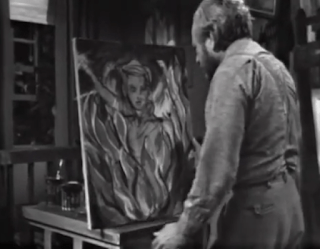
Episode 184: It’s been my life

Parapsychologist Dr Guthrie visits blonde fire witch Laura Murdoch Collins in her cottage on the grounds of the estate of Collinwood. He tells her that his researches have led him to the conclusion that she is “The Undead” and that she poses a danger to her son, strange and troubled boy David. She replies that he is being preposterous, but she doesn’t deny anything he says.

Guthrie says that she is probably wondering why he has told her these things. The audience certainly is- Laura has already tried to cast a paralyzing spell on Guthrie, and can hardly be expected to grow more benevolent towards him now that she knows that he has figured out her nature and has told her he is “closing in on” her.

Guthrie explains to Laura that their meeting marks a significant moment in the history of the world- a scientist has come face to face with a being who has died and returned to walk the earth. He wants to learn from her, and offers to help her if she will stop trying to claim David. He tells her that an effort to bring science to bear on cases like hers “has been my life.” “What an interesting way to put it,” Laura responds, in her unforgettable sardonic tone. She dismisses his offer, and tells him he is powerless.

In a way, it’s too bad Laura doesn’t take an interest in what Guthrie might be able to do for her. That’s quite an idea, a scientist trying to help an undead being and to explore the realm of the supernatural thereby. It suggests the 1945 Universal movie The House of Dracula, in which a blood specialist treats Dracula for vampirism, with apparent success. That doctor then encounters the Wolf Man and Frankenstein’s monster. He attempts to treat them also, but things eventually go awry. The House of Dracula runs for 67 minutes; it might be interesting to develop a story like that in a daytime serial, where you have as much time as the audience and the network are willing to give you.

Guthrie is trying to organize a séance to contact Laura’s chief adversary, the ghost of Josette Collins. He tells hardworking young fisherman Joe* that they will have to recruit drunken artist Sam Evans to join them at the séance. Joe laughs at the thought of how Sam will react to such an invitation. Sam’s daughter, Maggie, is Joe’s girlfriend; Joe stops laughing and is a little bit scared when he thinks of Maggie’s likely reaction. But Guthrie insists that Sam’s participation is essential. Josette took possession of Sam to paint pictures that gave them some of their first and clearest warnings of what Laura might do to David, so he has already been one of her most powerful mediums. Joe agrees to ask him.

At the Evans cottage, Joe pitches Sam and Maggie on the séance. Sam at first finds the notion hard to take seriously. The more he thinks about it, the more convinced he becomes that Guthrie’s theories are correct and that it is his duty to participate. Maggie is dead set against her father having anything to do with Collinwood or the supernatural. She has worked on getting him to forget the paintings he made under Josette’s influence and his belief that Laura was responsible for the fire that injured his hands shortly after he painted them. As an Adult Child of an Alcoholic, Maggie is in the habit of heading Sam off when he’s on his way to do something weird. Usually Joe is her most reliable ally and greatest help in looking after her father. Today, she reluctantly gives in when Sam and Joe both think the séance is a good idea.

In the drawing room of the great house at Collinwood, Dr Guthrie is studying some documents. We see Laura staring into the fire in her cottage. Her eyes are superimposed over the image of Guthrie as he becomes ill.

Joe comes in and sees that Guthrie is struggling for breath. He asks Guthrie if he is all right. Guthrie complains of the heat. Since Joe is still wearing his heavy coat and looks perfectly comfortable, he ought to know that isn’t much of an explanation. He mentions that he has completed some tasks Guthrie asked him to perform. Guthrie has no idea what he’s talking about. When Laura attacked Guthrie in episodes 175 and 176, it was through a spell that hit him while he was in this same room. Then also, he had difficulty breathing during the attack and a gap in his memory afterward.

That time, well-meaning governess Vicki came into the drawing room and saw Guthrie suffering the effects of the attack. The attack abruptly ended. While Guthrie was recovering, David came back to the house and told him and Vicki that he had interrupted Laura a few minutes before while she was staring into the fire at her cottage. After David gave Vicki and Guthrie a full account of the incident, they sent him off to have dinner followed by two desserts- cake and ice cream.

That day, Vicki recognized the symptoms of Guthrie’s attack as the same those reclusive matriarch Liz exhibited after a confrontation with Laura and before she lapsed into a catatonic state from which she has not yet recovered. From this, Vicki concluded that David must have stopped Laura while she was in the process of casting the same spell on Guthrie that she earlier cast on Liz. Guthrie agreed with Vicki’s analysis, but was confident he could defend himself against any further spells Laura might cast. He never explained what his defense would be.

Whatever protection Guthrie thought he could give himself against Laura’s powers obviously isn’t working, at least not while he is alone. After Joe goes away, Laura resumes casting her spell.

Featuring Laura, as Egg-Fu

While Guthrie struggles in the drawing room, David strolls into the foyer. The ghost of Josette manifests on the staircase above. She takes a few steps down towards him and points to the drawing room doors.

Josette sends David to rescue Dr Guthrie

David realizes Josette is telling him to go into that room at once. He obeys, and finds Dr Guthrie on the floor by the fireplace, apparently near death.

*Who is evidently fishing again. Months ago, Joe got a white-collar position in the offices of the cannery, a position he accepted only in order to make enough money to buy his own boat. Today David asks him when he will take him along on the boats, and Maggie mentions that he’d recently lost his watch in a mackerel net. They never told us that he’d gone back out, and indeed he was carrying papers back and forth from the office as recently as #174.

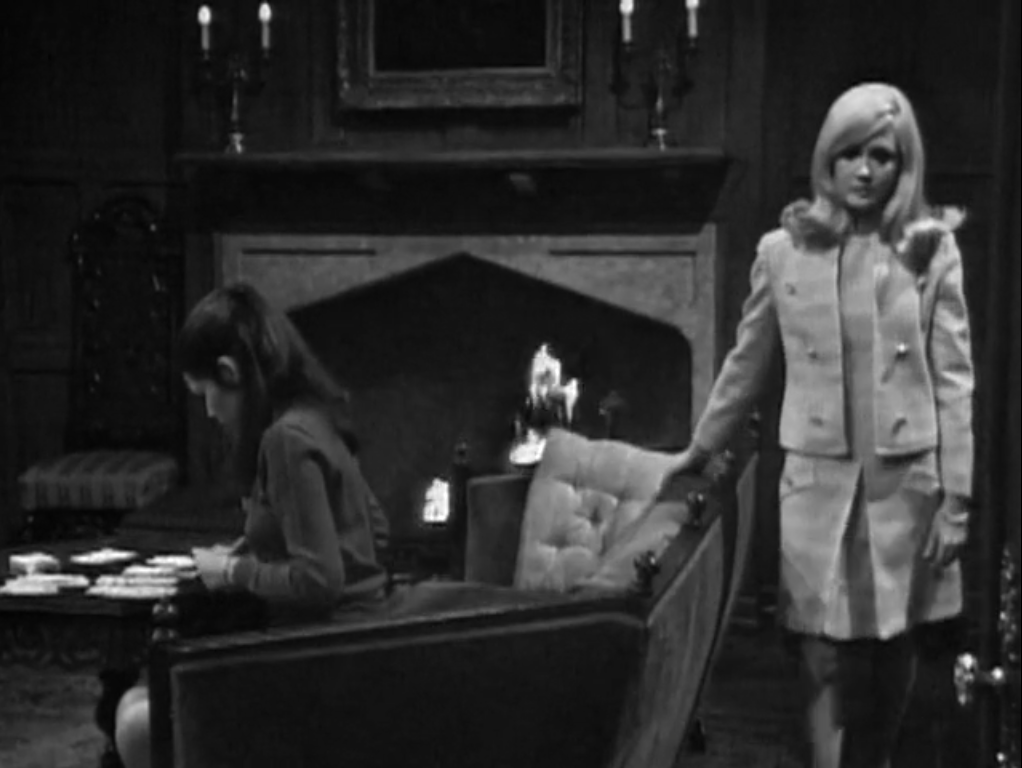
Episode 177: The glare of our scientific era

Maggie Evans, The Nicest Girl in Town, is at her job running the restaurant in the Collinsport Inn. Not that she’s working, exactly. There are no customers; the only other person there is her boyfriend, hardworking young fisherman Joe.

They’re hugging and kissing, and Joe is bringing up the idea of marriage. Maggie doesn’t think they can get married, since she has to look after her father, drunken artist Sam. Joe doesn’t think that is much of a problem. In previous episodes, we’ve seen that Joe likes Sam and doesn’t mind helping Maggie with him. He does say that he would rather Sam not come along on their honeymoon, and suggests that Sam might be ready to cut back on his drinking. Maggie isn’t getting her hopes up.

Flighty heiress Carolyn comes into the restaurant and asks to speak with Joe privately. Carolyn is Joe’s ex and Maggie is worried the two of them will get back together, but since she only wants to go to a table where they will be in Maggie’s line of sight she goes along with the idea. We do see Maggie looking vigilantly at them while they talk.

Maggie watching Joe and Carolyn

As it happens, Carolyn isn’t trying to win Joe back. She wants him to help Dr Peter Guthrie, visiting parapsychologist, in his efforts to determine whether her aunt, Laura Murdoch Collins, is the reincarnation of two women who died by fire in 1767 and 1867. Guthrie hasn’t told Carolyn what exactly he is planning to do, but he has said he needs the help of a strong young man and that what he is going to do is “not strictly legal.”

Carolyn leads off by telling Joe that she is going to ask him to do something to help her mother, reclusive matriarch Liz, who is in the hospital with a mysterious ailment. Joe immediately agrees to do anything that will help Liz. When she starts explaining that she wants him to work with Guthrie, and that Guthrie is a parapsychologist, Joe is incredulous. At length, he reluctantly agrees to go, and to keep what he will do secret from everyone, even Maggie.

When he tells Maggie that they have to cancel their date so that he can go to Carolyn’s house, she is dismayed. He assures her that he is not getting back together with Carolyn, but that Carolyn made him promise to keep it a secret just what he will be doing. Maggie vows to fight if Carolyn does try to take him back.

This scene is the current phase of Dark Shadows in a nutshell. It appears to be a more-or-less typical daytime soap opera of the sort you would see on American television in February of 1967, where good-looking young people in wholesome, everyday settings struggle about who will have a conspicuously chaste romance with whom. That’s what Maggie thinks she is watching when she keeps her eyes on Joe and Carolyn.

But in fact the series is heading towards becoming a full-time supernatural thriller, and stories like those are going to be tossed out and left by the roadside before long. That development doesn’t bode well for Joe and Maggie. Joe tells her today that their relationship is “the simplest thing in the world”- he loves her, she loves him, that’s all you need. Of course, a couple is only allowed to be on screen in a soap opera if they are participants in a conflict of some kind, and are only the main figures in a storyline if they are in conflict with each other. But the show Maggie thinks she’s on might supply them with conflicts that would make sense to the sensible, practical-minded people she and Joe are written to be.

When they start dealing with ghosts and fire witches and who knows what else, Maggie and Joe will have a limited amount of time to show us how level-headed real-world people might react to supernatural crises. Once they’ve exhausted that theme, they will have either to adapt to their new surroundings and become different sorts of people or to leave the show. The prospect of reconceiving the characters might be good news to the actors Kathryn Leigh Scott and Joel Crothers. But Maggie and Joe would be appalled to hear that they will have to discard their personalities and invent new ones, and Joe’s alarmed reaction when Carolyn starts talking about parapsychology is a foretaste of what the characters will be going through as this comes upon them.

As the show’s representatives of Collinsport’s working class, Joe and Maggie are the designated representatives of daylight sanity. From the first week of Dark Shadows, we’ve known that Carolyn and the other residents of the great house of Collinwood are in too close proximity to the supernatural back-world of ghosts and ghoulies for that kind of attitude to be possible.

That contrast is dramatized in three moments in today’s show. In the opening portion, Carolyn and Dr Guthrie spend approximately 500 hours* in the drawing room of the great house recapping all the uncanny elements of the current storyline. When Guthrie asks Carolyn if she has considered the idea of reincarnation, she says that she has considered it and dismissed it. When he starts in with an explanation of how the idea of reincarnation connects to their conflict with Laura, Carolyn is all in.

When Carolyn is in the restaurant telling Joe about Guthrie the parapsychologist, Joe says he is surprised she is taking this sort of thing seriously. “I always thought you were a level-headed girl.” Regular viewers may be startled by this comment. In the last few weeks, Carolyn has had to take over her mother’s duties as head of the household and of the family business, and has shown some maturity in discharging them. But the whole time Joe and Carolyn were a couple, she was fickle and irresponsible to the point of madness. In this context, where Joe is conscious of Maggie’s eyes on him and is trying to project a particular image of himself, he rewrites the history of his relationship with Carolyn. He isn’t the sort of fellow who would spend years chasing after a flighty heiress- he is a sensible man who would only ever be involved with an equally sensible woman. That self-image is going to take a beating as he participates in the kinds of stories we’re going to see from now on.

In the last scene, Joe is in the drawing room and Guthrie puts the same question to him that he had earlier put to Carolyn- has he thought about the idea of reincarnation? Joe says he’s never thought about it, and flatly refuses to entertain the notion. Finally he absorbs Guthrie’s request that he help open the graves of the previous Laura Murdochs, but he never says he believes in reincarnation, and he never shows the enthusiasm that Carolyn has for Guthrie’s theories. Carolyn can afford to be enthusiastic- she’s lived in the great house all her life, and so has never been more than one step away from the unearthly. But Joe is giving up a substantial part of his identity by even being in the same shot as Guthrie, and once he shows up with a shovel in a graveyard at night, the Joe we’ve known will be on his way out.

*The counter on my computer says the scene between Carolyn and Guthrie in the drawing room lasts only 6 minutes and 44 seconds, but I’m sticking with my estimate of 500 hours.

Episode 166: The most harmful thing of all

Every episode of Dark Shadows begins with a voiceover narration. This is how today’s goes:

My name is Victoria Winters. The brightness of the morning cannot mask the fact that the night has been marked by a restless, fitful sleep, especially for one young woman who has been disturbed by strange premonitions and events that she does not fully understand.

We then see the drawing room of the great house at Collinwood, where two young women are both showing signs of disturbance. There’s no way of telling which one the narration is referring to. Flighty heiress Carolyn is pacing and talking, while well-meaning governess Vicki is clenched tight playing solitaire. This sloppy mismatch is the first sign that we’re dealing with a script by Malcolm Marmorstein, the worst writer on Dark Shadows.

Disturbed by strange premonitions and events

Vicki and Carolyn are worried about strange and troubled boy David. David has spent the night with his mother, blonde fire witch Laura, and is not back yet. They are convinced that Laura is dangerous, but cannot be sure how or to whom. Marmorstein’s awkward dialogue stumbles up to a climax in which Vicki tells Carolyn that visiting parapsychologist Dr Peter Guthrie had said he was inclined to organize a séance. Considering that he first discussed that idea in a conversation with the two of them yesterday, Vicki’s announcement of this as news and Carolyn’s incredulous reaction will leave returning viewers mystified.

David comes home. He’s fine. He tells Vicki that he sensed the presence of the ghost of Josette Collins watching over him in his mother’s cottage, and that he knows he is safe wherever Josette is. What the audience knows, but neither Vicki nor David does, is that Laura and Josette had a confrontation while he was sleeping, and that Josette retreated. Josette is not strong enough to defeat Laura by herself. When David goes to sit by the fire and stare at it in a trance-like state, as his mother habitually does, we wonder how Vicki and the others will put together a strong enough force to help Josette save David. That’s a suspenseful sequence, effectively realized.

Hardworking young fisherman Joe comes to the house on a business matter. He and Carolyn have a conversation about their defunct romance. Carolyn says that she has matured since those days, and that she is free to give it another try. Joe says he is not free. For a show with so many ghosts and ghoulies, it’s surprising that Dark Shadows inspires the greatest fear in its fans when they threaten to bore us yet again with a tedious dead-end storyline like the Carolyn/ Joe relationship. It’s certainly a relief when Joe is so firm as to leave no doubt that we’re finally done with that.

Joe has transferred his affections to Maggie Evans, The Nicest Girl in Town. We dissolve to an extreme closeup of the laughing mouth of Maggie’s father, drunken artist Sam Evans. Sam is in the local tavern, The Blue Whale, with a drink in his hand, a crony on either side of him, and some music we haven’t heard before on the jukebox.

Glad Sam

Maggie and Joe are at a table, where he is trying to make her jealous by telling her of Carolyn’s interest in him, and she can’t stop watching her father and fretting about his drinking. The two of them talk a bit about how Sam’s drinking has reversed the roles of parent and child. That’s the big theme of Maggie in the first 42 weeks of the show, that she is an Adult Child of an Alcoholic. It’s because she’s had to cope with Sam’s addiction that Maggie is so nice to everyone, and also because of it that she has a habit of starting her lines with a little laugh that doesn’t always make sense in context. As the show goes on, Sam drinks a lot less and Maggie gets involved in a wider variety of stories, but that weird little laugh, the union card of many an ACoA, stays with the character to the end of her time on the the series.

Maggie leaves Joe alone at the table while she confronts Sam. She doesn’t stop him drinking, but she does manage to wreck the good mood he and his buddies had going. In the course of their talk, they recap the conversation Sam had with Dr Guthrie Thursday.

Dashing action hero Burke Devlin comes in and sits down with Joe while Maggie is scolding Sam. The two of them have been at odds over Carolyn, and now discover that neither of them is interested in her any longer. Joe seems irritated that his list of reasons to dislike Burke has grown shorter.

When Maggie returns to the table, Burke exchanges a few friendly words with her. He then goes to the bar to buy Sam a drink. Maggie voices her dismay at this plan, and even Bob the bartender gives a dark look at the idea of serving Sam yet more booze. But Burke ignores them both.

Burke wants to know about the conversation Sam had with Dr Guthrie. They recap the conversation Sam had with Maggie a few minutes before. Burke is in love with Laura, and may be under her influence. This conversation raises the prospect that Burke will be an ally of Laura’s against Vicki and her team. Its similarity to the conversation Maggie and Sam had so shortly before suggests that the Evanses may also make themselves more useful to Laura than to the good guys. The repetition grates hard enough on the audience that it is an inefficient way of making that point, but the point itself does add to the suspense.

Most episodes of Dark Shadows have only five credited actors and no extras. This one has seven credited actors and a bunch of extras, including featured background player Bob O’Connell as the bartender. There have been several episodes the last couple of weeks with only four actors; apparently they’ve been saving up to splurge on this one. It is by no means the dullest installment of this period of the show, but neither are there any of the thrills or major story developments you would expect from a high-budget episode. Frankly, it’s rather worrying that this is what they lay out the big bucks for now. Is this as exciting as the show is going to get?

Episode 146: Laura Collins exists mostly in your imagination

At the end of yesterday’s episode, Maggie Evans, The Nicest Girl in Town, and her boyfriend, hardworking young fisherman Joe Haskell, had gone out to look for Maggie’s father, drunken artist Sam Evans. Maggie and Joe wound up carrying Sam home from the tavern.

Joe left the Evans cottage, Maggie went to the kitchen to brew up some coffee, and Sam lit a cigarette and passed out. The cigarette fell on some newspapers and started a fire.

While the fire began, the face of blonde fire witch Laura Collins was superimposed on the image of Sam. Some mysterious force has compelled Sam to paint pictures of Laura naked and in flames. Laura objects to these portraits. She came to the Evans cottage the afternoon before the fire and told Sam she would find a way to stop him painting any more of them. Her face appearing over the fire, along with spooky music and everything else the show has told us about Laura, demonstrates that she is casting a spell on Sam with the intention of making good her threat.

Today, Sam regains consciousness and sees the fire. He tries to put it out with his hands, burning them badly. Maggie comes running and beats the flames out with a rug.

The current storyline hinges on the idea that Laura’s supernatural powers make her a deadly threat to her son, strange and troubled boy David Collins, and perhaps to others as well. The outcome of this spell creates suspense as the audience wonders if Laura is mighty enough to keep the narrative arc going. After all, causing Sam to pass out and mess himself does not take much. There’s no suggestion that any magical abilities reside in Bob the bartender, yet he manages to do that just about every night, and he collects a paycheck for it to boot. For all we know, Laura’s spell might have been a total failure- it might be a sheer coincidence that she was trying to make him pass out and drop a lit cigarette when that’s what he was going to do anyway.

Maggie scolds Sam for his drinking. To Maggie’s exasperation, he raves that Laura started the fire. As he goes on and on about an unnamed power that has been controlling his behavior, Maggie responds “I think they call it alcohol.” Yesterday, Maggie was talking to Joe about laying aside her role enabling her father’s alcoholism and leaving the town of Collinsport altogether. Regular viewers will remember that conversation today, when she tells Sam that she is approaching the limit of what she will take from him. Sam loves Maggie more than anything, and he desperately tries to convince her that he is telling the truth. She sees his desperation, and we see her struggle to make herself say that nothing can convince her of a story like the one he is telling her.

As the voice of correction, Maggie is perfectly reasonable, perfectly justified, and perfectly mistaken. Sam is indeed the plaything of uncanny powers. A couple of weeks ago, they gave us scene after scene full of sound and fury, repeating the point that some spiritual force was making Sam paint Laura’s picture. We see today how little of that was necessary- Laura’s likeness and the theremin music are plenty to show us that the fire is in line with a spell she is casting. But Maggie, while she has often said that she wants to avoid the estate of Collinwood because she believes the stories that ghosts and ghouls haunt it, refuses to entertain the idea that there is anything unearthly at the root of Sam’s troubles. She says that she has to have evidence she can look at out in the open, and that she isn’t going to listen to Sam’s talk about unseen and unknowable powers. Although we know that Sam is right and Maggie is wrong about the particulars of this incident, to the extent that Maggie is speaking to her father as an adult child of an alcoholic she is the voice of the audience.

Meanwhile, Laura is sitting by the hearth in the drawing room at the great house of Collinwood. She is casting her spell on Sam. Reclusive matriarch Liz enters and tries to get Laura’s attention. When Laura finally looks up, her face is contorted in an unattractive expression. Liz remarks on it, and Laura asks if she looked ugly. Liz says yes, then for a fraction of a second looks embarrassed when she realizes that she told another woman that she was ugly. She quickly makes some meaningless remarks in a courteous voice. It is a small moment, but Joan Bennett extracts the jewel of comedy from it quite deftly.

Laura interrupted in mid-casting. Screenshot by Dark Shadows Before I Die

Laura has come to Collinwood to re-establish a relationship with David. After years away, she wants to take David and leave. David’s father, high-born ne’er-do-well Roger, is all for this plan, but Liz is determined to thwart it. As the only male of his generation in the family, David represents the sole hope that the name of Collins will continue. As the custodian of the family’s past and future, Liz wants to be the chief maternal presence in David’s life. Besides, she never leaves the estate, so she needs all the company she can get.

Liz tells Laura that, while she had agreed that Laura could take David if their relationship were to make the right sort of progress, she is not at all satisfied that such is happening. Her objections don’t make much sense, and if the audience hadn’t been informed that Laura is an uncanny being whose plans will likely lead to David’s death we would probably be appalled at how unfair she is.

Roger shows up and takes Laura’s side. While the two of them stand firm against Liz’ wispy arguments, a knock comes at the front door. It is Maggie. Laura is shocked to see her- apparently she had expected her spell to do enough damage to the Evans cottage that Maggie would be unable to go visiting tonight. Laura’s reaction is dramatic enough, and the music behind it is overstated enough, that we may think Laura expected to kill Maggie. Again, the indications of Laura’s failure lead us to wonder if she is enough of a witch to deliver the supernatural thriller we have been led to expect.

Maggie wants to tell Laura about Sam’s accident, and to lament that Sam’s obsession with Laura has led him to the idea that she somehow caused it. Roger is indignant that Sam would say such things about his estranged wife, and storms off to the Evans cottage to give Sam a piece of his mind. Liz, on the other hand, is intrigued by Sam’s ideas and wants Maggie to give as many details as possible about Laura’s visit to the cottage earlier that day.

When we were watching the episode, Mrs Acilius wondered if Liz’ interest in Maggie’s story was a sign that she had noticed something eerie about Laura during their previous acquaintance. My interpretation was that Liz is so desperate to find information she can use to present Laura as an unfit mother that she is ready to listen when the town drunk claims she cast a spell on him. As reasonable, justified, and wrong as Maggie was in her scolding of Sam, so unreasonable, unjustified, and right is Liz in her conversation with Laura.

When Maggie says that Laura had threatened to stop Sam painting pictures of her naked and in flames, Liz asks what threat she made. Laura answers that all she said was that she would find a way to stop him. With a look of suspicion on her face, Liz asks what she was planning to do when she said that. “Just what I did do,” Laura answers. After a pause, she specifies, “Turn the matter over to Roger.”

In the Evans cottage, Roger reads the Riot Act to Sam. Louis Edmonds was a master of sarcastic dialogue, and Roger’s lines in this scene give him many chances to shine. Indeed, he and David Ford have a blast playing Roger and Sam’s mutual hatred. When Roger ridicules his claim to be subject to mystic powers, Sam replies in a taunting voice that Roger is in as much trouble as he is. The two men jeer contemptuously at each other, and it is a wonder to behold.

Mrs Acilius was particularly impressed by the contrast between the opening scene with Maggie scolding Sam and the closing scene with Roger railing at him. Sam’s two interlocutors make the same basic point, but the differences between them as individuals and between their respective relationships to Sam tell us entirely different things. Sam hates Roger almost as much as he loves Maggie, and their hostility is as explosive as Sam’s scene with Maggie is poignant. Maggie’s lovable, down-to-earth persona makes her the polar opposite of Roger with his haughty manner, sharp tongue, and utterly debased moral stature. In her scene, Maggie was to an extent the voice of the audience; insofar as Roger is continuing the lesson Maggie began teaching Sam, he is taking over in that capacity. It is quite a different thing for us to relate to The Nicest Girl in Town as our voice than it is for us to see a virtueless snob like Roger in that capacity, and so Roger’s first moments berating Sam in the Evans cottage whip us around fast.

Sam confirms that he has been driven to paint another picture of Laura, and Roger announces that he will destroy it. Sam doesn’t object. When Roger goes over to the painting, he sees that most of it has already been burned away. Sam is shocked to see this- the fire was on the other side of the room, and nothing in the several feet between a burned spot on the carpet and the painting has been touched by the flames. With this, the suspense is resolved- we know that Laura’s fire magic did achieve a result that Sam’s drinking could not. So the show will have a story to tell after all.

The script is credited to Malcolm Marmorstein, who was by far the worst writer on Dark Shadows. It is difficult for me to believe that someone who delivered so many low points wrote a script this good all by himself. Joe Caldwell was making uncredited contributions to the writing by this time, and he was so much better than Marmorstein that I am inclined to suspect that he wrote this one.

I suppose Marmorstein might just have been having a good day. There don’t seem to be any surviving documents identifying those contributors to the writing whose names didn’t appear in the on-screen credits for any given episode, so we can only guess which ones Caldwell worked on in his first several months on the show. But the structure, dialogue, and pacing of this one feel a lot more like the ones with his name on them than they do like the general run of Marmorstein’s work.

Episode 129: Woman in flames

Maggie Evans, The Nicest Girl in Town, is worried about her father, drunken artist Sam. Maggie’s boyfriend, hardworking young fisherman Joe, is with Maggie at the Evans Cottage, waiting for Sam to come back from his current binge.

Maggie is particularly worried about Sam’s attitude towards a mysterious woman who has recently returned to town. Maggie doesn’t know who the woman is, but yesterday, Sam and the audience found out. She is Laura Collins, estranged wife of high-born ne’er-do-well Roger Collins. Laura is the other witness to an incident ten years ago that Roger paid Sam not to tell the police about. It was his guilt about that bribe that started Sam drinking in the first place, and he is terrified that his secret will come out. As Maggie and Joe talk about Sam, Sam is in the tavern with Roger, trying to figure out why Laura has come back to town.

Roger goes home to the great house of Collinwood and tells his sister, reclusive matriarch Liz, that Laura has come back to town. Liz wonders why Roger is afraid of Laura. Roger denies being afraid of her, and Liz loses interest in the question. She wonders what Laura wants. At the thought that Laura might want to see strange and troubled boy David, the son she shares with Roger, Liz expresses emphatic opposition. Liz thinks of Laura as a severely disturbed woman, and is convinced that seeing his mother would only harm David.

Sam returns to the Evans Cottage. Joe sees that he is massively drunk, and whispers an offer to Maggie to help her take care of him. She declines, saying that she has plenty of experience. Sam insists on starting a painting. Maggie can’t stop him, and goes to bed.

Sam lights a cigarette and stares raptly into the flame, as we saw Laura do yesterday. He then goes to the canvas and makes painterly motions with great rapidity.

Drawn to the flame. Screenshot by Dark Shadows Before I Die

The following morning, Maggie wakes Sam up. He lies passed out on the couch, a liquor bottle that had been mostly full the night before empty on the floor beside him. In response to his protests, she refuses to leave for work with him unconscious. On her way to make coffee for him, she sees the painting he did the night before. She remarks that it is not in any style she’s ever seen him use before, and he doesn’t remember a thing about it. It depicts a woman in flames. He reacts to the painting with horror.

A woman in flames. Screenshot by Dark Shadows Before I Die.

Dark Shadows has already shown us portraits as powerful objects, even as a locus for the natural and supernatural. Just on Monday, the ghost of Josette Collins (which, like Maggie Evans, is played by Kathryn Leigh Scott) emerged from the portrait of Josette in the Old House and brought about the climax of a story arc that began in episode 38. Now we see where these eerie portraits come from.

We will see more portraits created by possessed artists in the years to come. Something else happens in this episode for the first time, but not the last. The bartender at The Blue Whale, who has been addressed variously as “Bill,” “Joe,” “Mike,” “Andy,” and “Punchy,” today answers to “Bob.” That’s the name they settle on, perhaps because the actor’s name is Bob O’Connell.

Episode 20: A mockery to the future

In episode 18, Roger (Louis Edmonds) had demanded Vicki (Alexandra Moltke Isles) come with him to Burke’s hotel room, where they will tell Burke (Mitch Ryan) about all the evidence they have connecting him to Roger’s car wreck. Vicki repeatedly protests in that episode that it would be better to take this information to the police. In this one, they arrive at the hotel, and again Vicki objects that they really should be going to the police. Roger, however, is a man obsessed. He asks Vicki to wait in the restaurant while he goes to Burke’s room, telling her that it may not be necessary for her to join him.

Sam (Mark Allen) comes to the restaurant looking for his daughter Maggie. Finding that Maggie isn’t at work, he invites himself to Vicki’s table. Their previous encounter had been a strange and frightening one on the top of Widow’s Hill; Vicki is no more comfortable with Sam now than she had been then. He bellows at her, she reacts with quietly frosty disdain. These attitudes may have less to do with the script or the direction than with Mark Allen’s limitations as an actor; he bellows all of his lines in this episode, and quiet frostiness is as effective a technique as any other for holding onto the audience while sharing a scene with an incompetent loudmouth.

There’s no incompetence in the scenes in Burke’s room. Louis Edmonds and Mitch Ryan were first-rate stage actors, and their confrontation is a terrific fireworks display. When Roger brings Vicki up to tell Burke what she saw him do in the garage, she again plays the scene quietly, an effective counterpoint to the artillery blasts the men have been letting loose.

In the Evans cottage, Sam finds that Maggie (Kathryn Leigh Scott) has been home all this time. When Allen bellows at her, Scott bellows back at him, a far less effective tactic than the quiet intensity Mrs Isles had used earlier. The scene has some potential- the situation is that an alcoholic finds that his adult daughter has been checking up on him, he resents it, and they have a fight about all of the ways in which she has been forced to take on the parental role in their relationship. But as a shouting match, it might as well be about anything, or about nothing.

Returning home after their confrontation with Devlin, Roger and Vicki say goodnight in the foyer. Time and again in these early episodes, people have urged Vicki to leave Collinsport while she still can. Even in this episode, Burke had told her that. But as they part ways for the night, Vicki to her bedroom and Roger to the brandy bottle, Roger tells her that as a witness, “you can’t leave now.”

That line is effective enough, but if the scene between Sam and Maggie had worked it would have been very powerful. The Evanses, father and daughter, are a case of two people who are trapped, trapped in Collinsport, trapped with each other, trapped with his alcoholism and her sense of obligation to keep him alive. As written, the scene could have brought all that out, and induced a claustrophobic sense in the audience that would have made Roger’s line feel like a death sentence. As ruined by Mark Allen, it just leaves us with the sense that we’re watching a show that needs some recasting.