Episode 864: Shipwreck Point

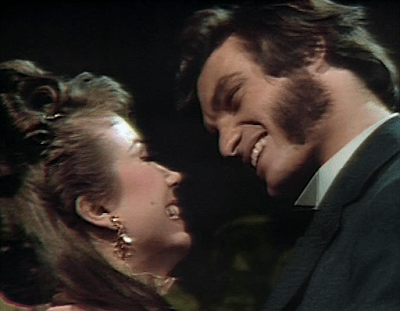
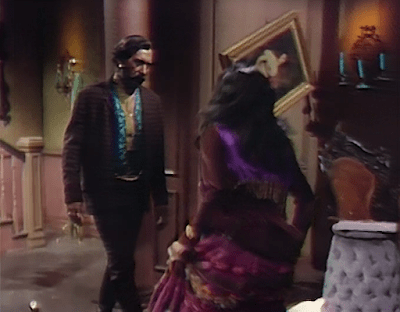
Sorcerer Count Petofi is currently occupying the body of rakish Quentin Collins. When he is in this form, I refer to him as Q-Petofi.
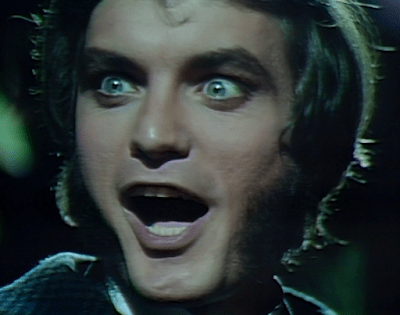
Q-Petofi. Screenshot by Dark Shadows Before I Die.

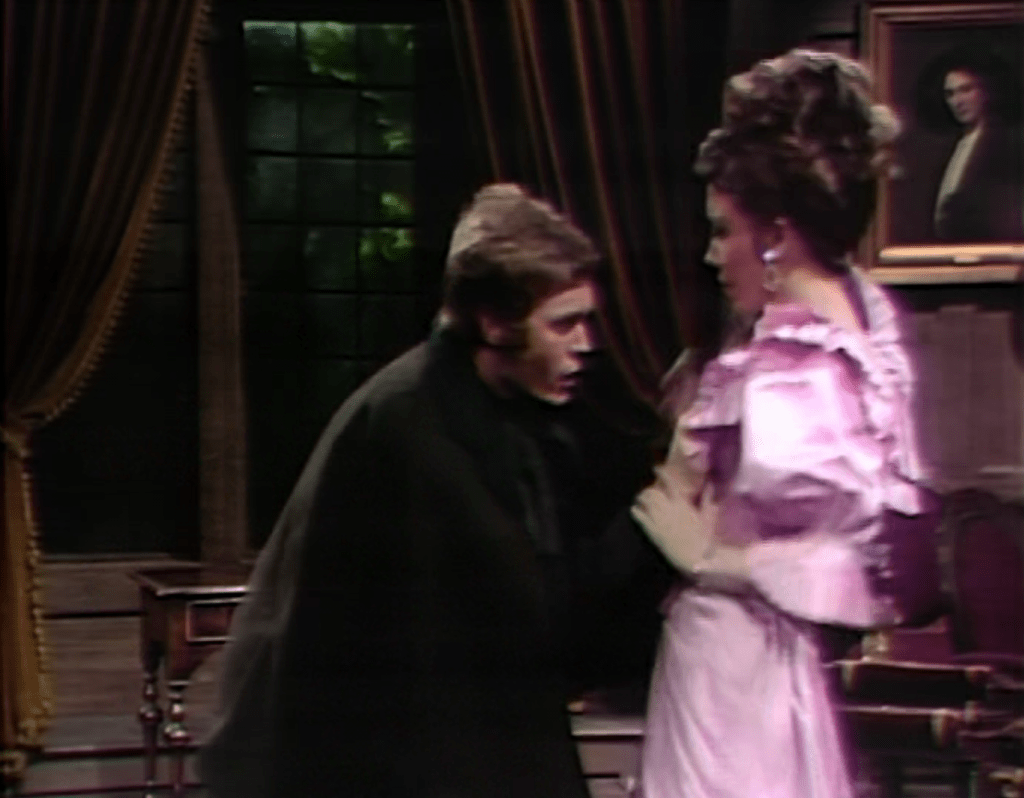
Lawyer/ Satanist Evan Hanley has displeased Q-Petofi. Q-Petofi has put the zap on Evan and made him dig his own grave. Evan begs for his life, but does so in a stilted, robotic voice that suggests he is struggling against Q-Petofi’s power. It is a neat job of acting by Humbert Allen Astredo.

Evan points out that it would raise suspicions if Q-Petofi were seen with his servant Aristide, especially inside the great house of Collinwood. Evan himself, however, is the Collins family’s attorney, trusted by everyone in the house. If anyone there has suspicions about Q-Petofi, they will confide in him. Q-Petofi decides that he may as well let Evan live, and orders him to keep tabs on wicked witch Angelique.

We cut to the foyer of Collinwood, where Angelique is staying. She is on the telephone trying to reach the local pharmacy, and is annoyed that the meds she wants are not yet available. Another houseguest, Cockney showgirl/ mentalist Pansy Faye, enters. Angelique hurriedly ends the call. Pansy taunts Angelique for the end of her engagement to Quentin. After Pansy exits, Angelique gets back on the phone and resumes talking to the pharmacist. Q-Petofi enters, and Angelique pretends she is talking to someone else, then hangs up.

Returning viewers know that Angelique is carrying on a medical intervention designed by time-traveling mad scientist Julia Hoffman, MD. Julia’s friend, vampire Barnabas Collins, made his way from 1969 to 1897, and she followed him. Julia had recreated an experimental treatment that put Barnabas’ vampirism into abeyance for a little while early in 1968 when she snapped back to her own time, vanishing from 1897. Shortly before Julia disappeared, Angelique agreed to complete the procedure and turn Barnabas into a real boy.

Angelique seems less powerful than usual today. Her dealings with the pharmacy are a logical consequence of her agreement to take over Julia’s plan, but she doesn’t usually have to get exasperated with people over the telephone, and not since her early days as a witch in the 1790s has she been so vulnerable to discovery by random passersby. Later, she goes to Barnabas’ hiding place, and Evan follows her. There have been times when Angelique could materialize and dematerialize at will, and it was impossible for any mere mortal to keep track of her whereabouts, but evidently she doesn’t feel up to that today. She does tell Q-Petofi she has a headache, maybe that’s true.

Pansy has a scene in the studio of artist Charles Delaware Tate. She tells Tate she wants to buy one of his paintings; he tells her that everything is for sale, but that his prices are high. She picks out a portrait of the lovely and mysterious Amanda Harris; he throws a tantrum and doesn’t want to sell it to her. When she reminds him that he said all the paintings are for sale, he names the ridiculously high price of $5000. That would be well over $150,000 in 2025. Without missing a beat, Pansy pulls out a few large-denomination bills and fans them under Tate’s nose.

Pansy’s only source of income was a cabaret act she recently did at the Blue Whale, a tavern in the village of Collinsport. We saw her there the other day shortly before nine PM, when she was the only person in the barroom. So it doesn’t seem likely she could have earned that quantity of cash there. Nor is there any apparent reason why Pansy would want a portrait of Amanda, whom she saw as a rival for Quentin’s affections. It seems likely that someone else put her up to buying it.

The obvious candidate would be Judith Collins Trask, owner of Collinwood and all the Collins family businesses. Judith is married to the odious Gregory Trask, whose late daughter Charity provided the host body through which Pansy, who died in #771, has been interacting with the world of the living since Petofi erased Charity’s personality in #819. Judith has persuaded Pansy to move back into Collinwood. Judith has herself recently returned to the great house after Trask had her confined to a mental hospital for a period of more than thirteen weeks. Her stuffy but lovable brother Edward told Judith that Trask spent much of that time trying to seduce Amanda, and Judith wants to get the facts about what went on in her absence.

Closing Miscellany

Director Henry Kaplan was not in good form in this one. In the opening, studio lights are clearly visible right in the middle of the screen, between Evan and Q-Petofi. The same thing happened in yesterday’s episode. The other directors might have made a mistake like that once, but I don’t think any of them would have done it two days in a row.

The camera is also frequently out of focus, as is typical of Kaplan’s shows, and it moves unsteadily. He must have been trying to get the camera operators to do something he hadn’t prepared them for, it looks really bad.

There are a couple of notable bloopers that aren’t particularly Kaplan’s fault. When Angelique makes a remark about Q-Petofi’s attitude towards brandy, David Selby says “Don’t you think it’s possible for one’s…change…or one’s taste to change in brandy?” That is followed by a silent beat, as both he and Lara Parker are stunned by the nonsense that just came out of his mouth.

When Tate lets Pansy into his studio, the shade falls out of the window. He looks at it for a second, then the scene goes on. It is one of the all-time great goofs.

Episode 851: Common cause

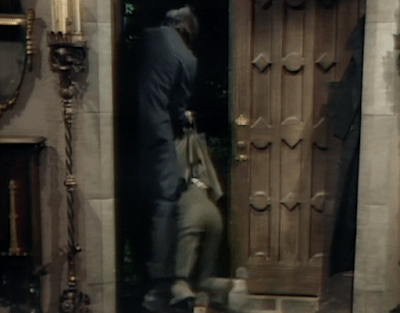
Rakish libertine Quentin Collins races to the train station to meet his fiancée, the lovely and mysterious Amanda Harris. He thinks he sees her, but it is actually another young woman wearing a remarkably similar outfit. She tells him the train to New York City left a few minutes ago; Quentin knows Amanda was on it, and that she thinks his absence means that their relationship is over. The young woman was quite miffed when Quentin first approached her, but by the time he offers his second apology her look has gone from indignant to concerned to yearning. The guy’s got game, you have to grant him that.

It’s been less than a minute since he made a bad first impression on her, and she’s ready to run off with him. Screenshot by Dark Shadows Before I Die.

Quentin was detained by a fistfight with a repulsive little man called Charles Delaware Tate. Tate is an artist whose works sometimes have magical powers. His portrait of Quentin, for example, keeps Quentin from turning into a werewolf and ensures him against physical harm. Since Tate is obsessed with Amanda, he stole the portrait from Quentin when he learned Amanda was planning to leave with him. Quentin dared not leave without it, and went to Tate’s studio to demand its return. He very satisfyingly beat Tate senseless, but he did not find the portrait, and now he fears he has lost Amanda forever.

We cut to Tate’s studio. Tate is lying on the floor where he fell when Quentin finished hitting him. Unfortunately, he gets up. Sorcerer Count Petofi, who granted Tate the power to make magical artworks some years ago, enters. He tells Tate that it was stupid to steal Quentin’s portrait. Tate pretends not to know what Petofi is talking about, irritating him and us. Petofi says that he will have to be punished. After he forces Tate to draw a sketch of a pretty woman, he squeezes his wrists, helps himself to Quentin’s portrait, and says what sounds very much like a final goodbye. He exits, and Tate sits down with his pad and pencil. He discovers that he is no longer able to draw, not even a straight line.

These days, Dark Shadows is a costume drama set in 1897. Most of the time between 1966 and 1968, it took place in a contemporary setting. In those days, the set now used as Tate’s studio was the Evans cottage, home to artist Sam Evans, a drunken sad sack, and his daughter Maggie, The Nicest Girl in Town. In December of 1966 and January of 1967, the ghost of the gracious Josette compelled Sam to paint alarming images of Laura Murdoch Collins.

It turned out Josette was doing this because she knew the characters were not all that bright and she had to literally paint them a picture to explain that Laura was an undead fire witch bent on incinerating her young son David. Laura tried to thwart Josette’s plan by harming Sam. In #146, Laura caused a fire at the Evans cottage that burned Sam’s hands, temporarily depriving him of the ability to paint. Petofi’s disabling of Tate on the same set will bring this incident back to longtime viewers. Especially so, since Josette is in the air at this point in the show. In #844, a character named Kitty joined the cast. She keeps having mental flashbacks to things only Josette would remember, and Josette’s music box appeared on Kitty’s table at a time when Josette’s ghost seemed to be the likeliest agency to have put it there. Perhaps she will insert herself into Tate’s story for some reason.

When we were watching the scene between Tate and Petofi, my wife, Mrs Acilius, said that she very much wished someone else were playing Tate. Violet Welles’ script gives whoever is playing Tate a lot of opportunity to show what he can do in that scene. Roger Davis is a highly trained actor who has a long list of stage and screen credits, but he is almost always very unpleasant to watch on Dark Shadows, and he wastes the potentially fascinating dialogue Welles gave him. When Mr Davis is particularly trying, I usually try to make the scenes bearable by imagining what Frederic Forrest, who was a featured background player in #137, would have done in his place. But the echo of the story about Sam makes me wonder what David Ford would have done as Tate. Ford was in his forties, smallish and pudgy, so a David Ford Tate could not believably have had a fistfight with a character played by the very tall and fit 28 year old David Selby. But he might have been a subtle enough villain that such an exchange would not have been called for. Moreover, the incestuous undertone of Tate’s desire for Amanda, who is the product of one of his magical paintings and therefore a kind of daughter to him, would have been all the more disturbing had Tate been played by the man we knew as Maggie’s father in the 1960s and, when the show was set in the 1790s, as Josette’s.

Back home at the great house of Collinwood, Quentin receives a visit from Tim Shaw, Amanda’s ex and a would-be sleazy operator. He demands Tim tell him what he knows about Amanda’s life in New York before they came to Collinwood. Tim declares he will tell him nothing, to which Quentin responds by choking him and flinging him to the floor. Tim then burbles out everything he knows, which turns out to be nothing of the slightest use. Quentin picks Tim up and throws him out the front door in the most humiliating possible way. We cheer this on almost as joyously as we cheered Quentin’s beating of Tate Friday, but for the opposite reason. Mr Davis is a genuinely disagreeable person who ruins episode after episode, and it was him we were angry with. We chanted at the screen, not “Quen-tin! Quen-tin! Quen-tin!,” but “Da-vid! Da-vid! Da-vid!” hoping Mr Selby would pay him back for all his on-screen assaults on the women and children in the cast. But Don Briscoe was as nice a guy as Tim has become despicable, and he and Mr Selby enjoyed working together. You can see Briscoe’s joy in performance in the way he holds on to a little yellow piece of paper representing a note from Amanda all through the beating Quentin administers. Even the shot of Quentin shoving Tim out with his buttocks prominent is the product of Briscoe’s enthusiastic use of his body to demonstrate Tim’s total defeat.

Quentin throws Tim’s sorry ass out the door. Screenshot by Dark Shadows Before I Die.

Quentin’s other fiancée, wicked witch Angelique, comes downstairs to ask what the ruckus was about. Quentin makes up a transparent lie about having a financial interest in some firm in Boston, and says that he and Tim were quarreling about the details of it. Angelique lets him go on with this for a while and to say that he is leaving for Boston, then insists that they set a date for their wedding. He begs off, claiming not to know how long he will be away.

Petofi enters, and tells Angelique about Quentin’s plan to go to New York and look for Amanda. He also tells her that they now have a common cause, and proposes an alliance. Each of them is so powerful, and so evil, that this is a sobering prospect.

When Quentin returns to the foyer, it is his turn to be alone with Petofi. Quentin knows that Petofi gave Tate both the power to create the portrait that freed him of his curse and the commission to do so, and that he is therefore beholden to Petofi for his continued humanity. Part of his motivation for fleeing to New York with Amanda was his hope that he could escape the slavery Petofi has imposed on him as the price of that benefice. When Petofi tells Quentin he has come to see him before he goes, Quentin is momentarily stunned, and then makes a brave little noise to the effect that Petofi can’t stop him. Petofi assures him that he does not want to stop him. It doesn’t matter in the least to him where Quentin is- he can control him from anywhere.

Petofi calls on Tim at his room in the inn. He deepens Tim’s misery by pretending he doesn’t believe what Tim told him about Tate’s magical powers. As he leaves, he takes a brooch that belonged to Amanda.

Quentin is at the train station. Angelique appears there, and tells him not to go. He says that he doesn’t care if she kills him. It will be consolation enough to have died walking away from her. She says that she will not harm him in any way. This causes him to open his eyes wide in terror as it dawns on him what she means. She produces Amanda’s brooch and a doll. She positions the pin of the brooch over the doll’s chest and says that no matter where Amanda is, she will die a horrible death when the pin impales the doll.

Closing Miscellany

The actress who plays the young woman Quentin meets at the train station is billed in the credits as “Amy Yaekerson,” the only person known to Google ever to be called “Yaekerson” and known only for this appearance. But in a comment on Danny Horn’s post about the episode at his great Dark Shadows Every Day, a commenter known as “miles” pointed out that there are lots of people named “Yakerson.” He went on to identify an Amy Yakerson born in New York City on 1 April 1946, and to find a 1966 notice of a play featuring an actress of that name and probably of that age in the New York Daily News. I followed that up with some Googling of my own; the only Amy Yakerson I can find who is online today was born in Connecticut in 1954, so I don’t know where Amy Yakerson, star of stage and screen, is now.

We saw some of Sam’s paintings in Tate’s studio Friday and today, twenty-some years before Sam was born. Tate hides the portrait of Quentin behind one of Sam’s seascapes, and Sam’s portrait of Maggie’s mother is on the floor next to him when we see him lying there in the aftermath of the fight. John and Christine Scoleri have the details in their post about Friday’s episode at Dark Shadows Before I Die.

Episode 850: That’s your train, lady

In June 1966, Dark Shadows opened with a train carrying well-meaning governess Victoria Winters and dashing action hero Burke Devlin from New York City to Collinsport, Maine. Vicki and Burke first met at the train station in Collinsport. When she found that no one was waiting to take her to the great house of Collinwood, Burke volunteered to drive her there. We haven’t seen the train station since, and all subsequent references to mass transit to and from Collinsport in the 1960s have been about buses. That is to some extent an adjustment to real-world history. In our universe, passenger train service to central Maine had already stopped by 1966.

Now, the show is set in 1897. Devastatingly handsome reprobate Quentin Collins has talked the lovely and mysterious Amanda Harris into joining him on the 6 PM train from Collinsport to NYC. Amanda and Quentin will remind viewers who have been with the show from the beginning of Vicki and Burke. Quentin is no hero, but he serves the plot function Burke did in those early days, antagonizing all the authority figures and fascinating all the women and children. Amanda takes part in some sleazy schemes, while Vicki was eventually forced to be an impossibly stainless model of virtue. But as Vicki was on a quest to learn the truth about her biological parents and felt she could know nothing about herself until she found out who they were, Amanda is tormented that she has no memories and no information about herself dating beyond two years into the past. And as in the first week Vicki was a savvy New York street kid who could keep smiling while she fended off the indecent advances of the lecherous Roger Collins, so Amanda sees right through the equally lecherous but toweringly hypocritical Rev’d Mr Gregory Trask.

Quentin and Amanda agree to meet at the train station. Amanda has to hide from Trask and from a repulsive little man named Charles Delaware Tate, and so she will spend the afternoon in a vacant house on Pine Road where a friend of Quentin’s is squatting. Quentin will settle his affairs at Collinwood. When they made this plan, my wife, Mrs Acilius, said that Dark Shadows has so consistently shown that when its characters leave separately they do not meet each other at their intended destination that it would be a surprise if they get on the train together. Indeed, from the time Amanda leaves Collinwood the suspense is not about whether their reunion will be thwarted, but how.

Tate steals a portrait of Quentin. He knows that the portrait has magical powers and is of the utmost importance to Quentin. Quentin discovers that the portrait is missing. He writes a note saying that he may not be able to get to the train station by 6 PM and asks his nine year old niece, Nora Collins, to take it to Amanda at the house on Pine Road. Nora agrees to do so.

Quentin goes to Tate’s and demands he give the portrait back. They get into a fistfight. Quentin knocks Tate out and searches the house.

Trask catches Nora on her way to the house on Pine Road. He forces her to give him the note. He reads it, and goes to the house himself. He and Amanda have a confrontation. She tells Trask that she first approached him as part of a con game she was ashamed to take part in, but when she saw him leering at her she decided that he deserved to be cheated. He furiously denies being a lecher and she calls him a liar. Trask can intimidate most people into silence, so much so that his scenes are often suffocating to watch, and it is glorious to see Amanda dump the whole truth on him and not back down.

Trask does get in one more lie. He claims that he just saw Quentin getting ready to go out on a date with his other fiancée, Angelique. Amanda doesn’t believe him but she does know about Angelique. She also told Quentin that she wasn’t convinced she was right for him, and that if he didn’t show up she would understand that he had decided they didn’t have a future together after all. So when at the conclusion the conductor sees Amanda standing on the platform by herself and tells her that it’s time to get on the train, we are to assume that she thinks it is over between her and Quentin.

All aboard. Screenshot by Dark Shadows Before I Die.

Episode 848: You have no mortality

The year is 1897, and the mythological world described by the ancient Greeks seems very far away. The story of Pygmalion, the sculptor who loved a statue he had made depicting an imaginary woman so intensely that it came to life, answered to the name “Galatea,” and returned his affections, is no exception to that feeling of distance. But here is the lovely Amanda Harris, who used to wonder why she had total amnesia, but now knows that the reason she cannot remember anything prior to two years ago is that she didn’t exist before then. She popped into being when a painter named Charles Delaware Tate made a portrait of his ideal woman.

Tate told her about this and told her that he loved her, but Amanda, unlike Galatea, has no desire for her creator. Perhaps this is because his personality is absolutely intolerable, a common attribute of characters played by Roger Davis. Nor is she interested in Tim Shaw, who brought her to Collinsport to take part in a scam he wanted to run on his old enemies and abandoned her in Tate’s house once he learned of Tate’s powers and thought he saw a way to make more money than his original plan was likely to yield. Instead, she is in love with rakish libertine Quentin Collins. Quentin has asked Amanda to run away with him and get married, and she agrees.

Quentin is trying to control Amanda too, but at least he isn’t a total jerk about it like those other two guys. Screenshot by Dark Shadows Before I Die.

Tim and Tate take turns intruding into Amanda’s room and telling her ugly things. Tate snarls at her that she belongs to him because he created her. This claim of ownership would be nasty however it was made, but Mr Davis’ gratingly unpleasant voice makes it truly nauseating to hear. Tim tells her that she isn’t really human, because if she is like another person Tate created she might die if someone shoots her. By that standard humans are extremely rare, but Tim goes on to explain that the man Tate created and then gunned down in cold blood while Tim watched vanished into thin air as soon as he died. So what he means is that Amanda will never be a corpse. In the context of Dark Shadows, a show that is so largely about the reanimation of the dead, this actually makes sense.

Quentin was cursed to be a werewolf, but was freed of the effects of that curse when Tate painted his portrait. When the Moon is full nowadays, the portrait changes, while Quentin himself stays the same. To extort Quentin into leaving Amanda to him, Tate steals the portrait. He tells himself that, if need be, he will destroy the portrait. If Quentin and Amanda stick with their plan of running as far away as possible very soon, they will know nothing about what Tate has done until the night of the next full Moon, when Quentin will turn into the werewolf, kill Amanda, and wake up covered in her blood. I suppose that would meet Tate’s objective of punishing Quentin, but it doesn’t fit very well with his professed belief that he loves Amanda.

Episode 844: Some clean, fresh air

Adventurer Tim Shaw is in his hotel room with an apparently mute man, trying to get him to speak. The man is struggling to make a sound when artist Charles Delaware Tate enters and produces a revolver. Tate proclaims that the man will never speak. He fires, and the man falls dead to the floor.

The man’s body glows, then vanishes. Tim knows that Tate created the man earlier in the evening. Tate has a magical power that enables him to cause objects and people to pop into existence just by drawing them. Tim says that he ought to call the police, since Tate just murdered a man in cold blood in front of him. But there is no body, and the only other person who has seen the man is Tim’s traveling companion and occasional accomplice Amanda Harris, who turns out to be another of Tate’s creations. So instead Tim pours a drink, and Tate tells him all about how he gained his powers as the result of a bargain he struck with sorcerer Count Petofi.

Petofi is aware of several magical abilities he gave Tate, but does not know that he can bring his creations to life. Tim calls Petofi to his room and brings him up to date. He believes that this report will somehow establish a partnership between himself and Petofi. Since Tate made it clear that his powers are the result of Petofi’s own interventions, it is unclear why Tim would expect even a finder’s fee for this information. It certainly does not provide the basis for an ongoing relationship of any kind.

Meanwhile, a visitor is arriving at the great house of Collinwood. Her face is familiar to longtime viewers- she is played by Kathryn Leigh Scott, who has been in the cast from #1 as Maggie Evans, wisecracking waitress turned The Nicest Girl in Town. When from November 1967 to March 1968 the show was a costume drama set in the 1790s, Miss Scott played the gracious Josette; she had already played Josette’s ghost in some of the episodes in contemporary dress, and in the spring and summer of 1967 vampire Barnabas Collins had tried to brainwash Maggie into becoming Josette. We last saw Miss Scott from March to June in the first part of the still-ongoing segment set in 1897, when she was neurotic intellectual Rachel Drummond.

Before we know the name of this new character, we see that she is wearing widow’s weeds. There is also a first- we hear her thoughts in an interior monologue before she interacts with another character. Whoever she is, the widow is telling herself that she has come to her big moment and she shouldn’t chicken out now. “No one will know,” she assures herself.

Neither Maggie, Josette, or Rachel ever used that facial expression.

The unknown widow knocks, and rakish libertine Quentin Collins lets her in. He appreciates her beauty and asks who in the house is fortunate enough to know her. She says that she and her late husband were friends of the stuffy Edward Collins. Quentin says that Edward is away, and identifies himself as his brother. “Quentin or Carl?” asks the widow. Quentin says, with a sad note, that Carl is dead. This is the first time anyone other than his onetime fiancée Pansy Faye has mentioned Carl’s name in the three months since his death.

The widow finally identifies herself as Kitty Soames, Countess to the late Earl of Hampshire. She says that she is an American, and that after her husband’s death she felt that she was a stranger in England and ought to return home. Quentin invites her to stay in the house.

Kitty is alone in the foyer when Petofi enters. She is horrified to see him. It becomes clear that her husband’s death was a suicide, and that Petofi’s threats prompted it. She goes out to take a walk in the woods.

Along the way, she meets Barnabas, who has traveled back in time from 1969. They have a brief talk. When she exits, he says that she is Josette, returned to him at last.

Back in the great house, Quentin finds Kitty looking at the spot on the wall next to the front door where Barnabas’ portrait has long hung. Some weeks ago, Edward learned that Barnabas was a vampire and ordered the portrait removed. There is a mirror there now, the same mirror that hung in that spot in #195, when the ABC art department was painting Barnabas’ portrait and another portrait was reflected in it. Kitty asks Quentin why Barnabas’ portrait was removed. Since she has never been in the house before, this question perplexes him. He asks how she knows about the portrait and how she knows of Barnabas. At first she is amused by the idea that she would not know of him, but a second later she returns to herself. She insists she has never met anyone named Barnabas and has no idea what Quentin is talking about. Perhaps this time, Barnabas is right- maybe Kitty really is a revenant of Josette.

Miss Scott was one of the biggest stars on the show. She tells a story nowadays about a trip she and her then-husband took to Africa in the late 1960s, when they were on a photo safari deep in the bush. Some people happened by, took one look at her, and all started saying excitedly “Maggie Evans!” So it is inexplicable that today’s closing credits misspell her name as “Kathryn Lee Scott.”

Episode 843: The meaning of shadows

Beth and Petofi

This night in 1897, Beth Chavez has lost both her job as a maid in the great house on the estate of Collinwood and her hopes of marrying rakish libertine Quentin Collins. She goes to the lair of sorcerer Count Petofi and volunteers to work for him. Petofi makes it clear that the position Beth is applying for is that of slave. She accepts without hesitation, and he has her do some mumbo-jumbo on his behalf.

This story point would make sense if Beth were a deeply dependent person who couldn’t imagine life without Quentin or her old job. But we’ve known Beth for months and months, and this is the first we’ve heard that she is like that. Terrayne Crawford’s acting ability was limited to embodying one feeling at a time, and in no scene was she assigned to demonstrate “corrosive sense of personal incompleteness.” So we know she is hung up on Quentin and we know she likes her job, but we also know that as one event follows another she responds with the emotion we would expect a level-headed person to have. Even when she got carried away the other day and tried to shoot Quentin, it didn’t seem to be a sign of mental breakdown. After Petofi showed up and stopped her, he pointed out that the way Quentin treats women, it is a marvel that none of them had tried to kill him before. If anything, her attempt on Quentin’s life suggested Beth has enough strength of character to leave Collinsport and make a fresh start.

Tate and the Creatures

For much of 1968, when Dark Shadows was in a contemporary setting, Roger Davis played a man named Peter Bradford who very loudly insisted that everyone call him Jeff Clark. Peter/ Jeff had no memory of his life more than a year or two before the present. Well-meaning governess Vicki knew that Peter/ Jeff had lived in the 1790s, and his shouting about his preferred name often came in response to Vicki’s attempts to tell him what she knew. Peter/ Jeff was convinced that if there were something supernatural about him, he would be incapable of loving anyone or of being loved.

Peter/ Jeff spent most of 1968 entangled with the story of Frankenstein’s monster Adam. Peter/ Jeff had assisted mad scientist Eric Lang in digging up the corpses from which Lang assembled Adam’s body. After Lang’s death, another mad scientist, Julia Hoffman, completed his work, attaching the body of recovering vampire Barnabas Collins to the body to provide the “life force.”

Mad scientists and vampires are two metaphors for extreme selfishness, so it was no surprise that Julia and Barnabas were the worst parents the newborn Adam could possibly have had. Within an hour of Adam’s awakening, Barnabas had loaded a gun and was on his way to kill him. When he relented from that plan, he and Julia took Adam to the prison cell in the basement of Barnabas’ house, where they locked his ankle in a fetter chained to the wall. They kept him within the blank walls of that cell for weeks on end, giving him nothing to play with, nothing to learn from, and nothing soft to touch. Nor did they ever allow him human contact for more than a few minutes at a time. They delegated Adam’s feeding to Barnabas’ servant Willie, who taunted him cruelly. Unsurprisingly, when Adam escaped from the cell he was rough with everyone he met, and when he found someone he liked he abducted her and found a place to lock her up. That was the only form of human interaction the big guy had ever known.

Now, the show is set in 1897, and Mr Davis plays artist Charles Delaware Tate. Tate combines the most disagreeable elements of all the characters involved in the story of Adam. Like Lang and Julia, he has the power to bring people to life without the usual processes of reproduction and growth. In his case, he simply draws or paints someone, and they pop into existence. He did that two years ago, in 1895, with a beautiful young woman he had imagined. He made a sketch and then a painting, and suddenly there she was, walking along a sidewalk in New York City. She took the name Amanda Harris, and has recently made her way to Collinsport.

Tate wasn’t there to see Amanda’s instantiation. But he recognized her when he did see her, and he has since drawn some inanimate objects that he saw come into being. So he figured out what Amanda’s origin must have been, and he has been shouting at her about it for a while. As Peter/ Jeff did not want to believe Vicki when she told him he was not native to the twentieth century, so Amanda does not want to believe Tate when he tells her that she came into being in the way that, in Greek myth, Pygmalion brought the lovely Galatea to life. But yesterday Amanda went to Tate’s studio, and he drew an imaginary man. That man appeared while Amanda watched.

We open today in Tate’s studio. Amanda is gone, and Tate is screaming at the man and declaring that he will kill him. The man is just standing there- he is fully grown, apparently in his mid-twenties, but in reality he is only a few minutes old. He doesn’t seem to be able to talk. He reacts to Tate’s extreme hostility with bafflement.

Tate rips up the drawing, and is disappointed the man does not die. A knock comes at the door. He shoves the man in the closet and locks him in there. Within moments, he reenacts Barnabas’ attempt to shoot Adam and his confinement of Adam to the cell. Tate had not been written as especially evil before this, but now he takes his place among Dark Shadows‘ cruelest villains. We may wonder if the character would have been developed differently had he not been played by the bombastic Mr Davis. Perhaps if the writers had been scripting a role for a more pleasant actor, they could have let Tate be a relatively nice guy.

Tate opens the door. Amanda is there, standing behind her traveling companion and sometime partner-in-crime, adventurer Tim Shaw. Amanda has told Tim what Tate did, and Tim demands to see the man. Tim sees the closet doorknob turning, and insists Tate unlock it. Tate at first denies that he has a key, but Tim pulls a gun and forces him to comply. In his post about the episode on his great Dark Shadows Every Day, Danny Horn has a funny bit about this moment:

Now, if life was like a Tex Avery cartoon, and I think we can all agree that it should be, then Tate’s next move would be to grab his sketchpad and draw an even bigger gun. Then Tim would reach into his pocket and pull out a machine gun, and Tate would draw a rocket launcher, and we could go back and forth like that until somebody pushes down on a plunger detonator, and there’s an explosion that cracks the Earth in two. That would be a good scene.

Danny Horn, “Episode 843: I Can Make You a Man,” posted to Dark Shadows Every Day, 19 March 2016.

As it is, Tate just hands over the key. Tim unlocks the door, finds the man, and loses all interest in Amanda. He tells Tate that he is sure he will take good care of Amanda as he leaves with the man.

Tim is delighted with his new toy. Screenshot by Dark Shadows Before I Die.

Tate shouts at Amanda and grabs various parts of her body, adjusting their position as if she were an action figure. He’s hollering something about love when she pulls away from him and declares that, as an unnatural creature, she can neither love nor be loved. Again, longtime viewers remember Mr Davis as Peter/ Jeff, yelling the same sentiment. But Amanda goes further than Peter/ Jeff ever did with the affable Vicki. She says that can hate, and that she hates him very cordially indeed.

In his hotel room, Tim is trying to coax the man Tate created into speaking. The man tries to make a sound, but fails. Tate himself comes barging in. He has a gun, and points it at the camera. He announces that the man will never speak, because he is going to murder him forthwith.

In the comments section of Danny’s post, I left a long comment which is I suppose a first draft of this post. You can read it there.

Episode 842: Some kind of an unnatural creature

Mad scientist Julia Hoffman has traveled back in time to the year 1897 to help her friend, vampire Barnabas Collins. Julia has fallen into the clutches of sorcerer Count Petofi and is bound and gagged in Petofi’s lair. A loaded revolver is tied to the doorknob, rigged to fire a round through her heart when the door opens.

Barnabas has learned where Julia is, but not about the death-trap in which she is ensconced. He storms into the building, turns the doorknob, and thereby discharges the gun. He sees Julia slumped over in her chair, and shouts at Petofi’s henchman that he will kill him. He then goes to Julia and finds that she is alive. There is a bullet-hole through the back of her chair, but she herself is unharmed.

Julia declares that there is only one explanation for this phenomenon that makes sense. Considering the kinds of stories that play out on Dark Shadows, we would think that an explanation that makes sense would be the one we could discard immediately, but Julia plows ahead. When she traveled back in time, only her “astral body” made the trip. Her physical body is still in 1969. For his part, Barnabas had a body in 1897, trapped in a sealed coffin. That body is hosting his personality, which is why he is subject to physical injury. But Julia is in no danger. When she later says that she can disregard Petofi’s threats, Barnabas says that if he finds out the truth, Petofi will just find another way to immobilize her, so she has to lie low.

Petofi is so powerful that Barnabas does not believe that he and Julia can fight him by themselves. So he tells Julia to summon wicked witch Angelique. Barnabas and Angelique have been enemies for centuries, but he thinks they have a common cause now. Angelique is determined to marry his cousin Quentin, whom he has befriended and Petofi has enslaved. So Barnabas expects she will agree to help fight Petofi.

Angelique does come in response to Julia’s message. She remembers Julia from time she herself spent in the 1960s, and is shocked to find her in 1897. Julia refuses to explain how she made her way back in time. She says that if Angelique can come to 1897 from 1968, she oughtn’t to be surprised she has come there from 1969. Angelique responds that Julia is not like herself and Barnabas. “I’m human,” says Julia. Since she is separated from her proper body, she isn’t fully human, not at the moment, but she still takes evident satisfaction in applying the label to herself. This marks a contrast with Angelique, who was offended earlier in the episode when Petofi laughed and taunted her for being “so human.” Julia and Angelique then snipe at each other about their respective relationships to Barnabas.

Julia says that it is essential Barnabas should “complete his mission” and solve the problems they were facing in 1969. Angelique responds that he will never be able to do that, because he has changed history too much in the time he has spent in 1897. This remark is intriguing for regular viewers. Barnabas’ six months of bungling around, picking fights, and committing murders must have had major consequences for what came after. That gives the show two ways forward. When Barnabas and Julia go back to a contemporary setting, they might meet an entirely different cast of characters and have to find a place for themselves in an alternate universe. Or they might do what they did when the show’s first time-travel story ended in March 1968, and dramatize the force of the Collins family’s propensity for denial. The head of the family in the 1790s decided to compel everyone in and around the village of Collinsport to pretend that none of the events we had seen had ever taken place, and when the costume drama segment ended we found that he had made that pretense stick ever since.

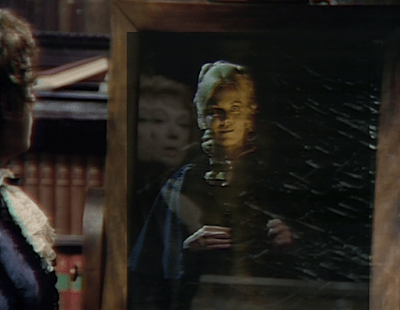
After Julia points out that it is to her advantage to emancipate Quentin from his bondage to Petofi, Angelique agrees to help. She still will not answer Julia’s questions. After she leaves the room, Julia looks in the mirror, sees an image of Angelique, and says that now she understands what she is going to do and believes it will work. That puts her one up on the audience.

Julia looks for an image of herself, and finds Angelique. Screenshot by Dark Shadows Before I Die.

The scene pairs Julia and Angelique as two women whose lives have been shaped by their pursuit of Barnabas. Their bickering makes this similarity explicit. When Julia looks in the mirror and sees Angelique, they put very heavy emphasis on the similarity. In a brilliant, but now inaccessible, post on the great Collinsport Historical Society,* Wallace McBride wrote that “On Dark Shadows, your reflection always tells the truth.” He demonstrated that on the show, reflections are very strongly coded as true, so much so that they must be making a serious statement when they give us an image like this one. They are committing to the idea that Julia is, in some important way, the same as Angelique.

There are also a couple of scenes featuring the repulsive Roger Davis as artist Charles Delaware Tate. Mr Davis is especially hard to take in a scene with Donna McKechnie as the mysterious Amanda Harris. Miss McKechnie had already done outstanding work on Broadway as a singer and dancer by this time, but she felt herself to be a beginner as an actress, and she could not conceal her discomfort when Mr Davis shouted his lines. The 4:3 aspect ratio of old-time American television meant that the performers spent much of their time only a few inches from each other, and when Mr Davis yells in Miss McKechnie’s ear, she winces. He clutches at her arm, and she recoils; before she can relax from that invasion of her space, he slams down on a table, making a loud noise and causing her to jump.

Mr Davis’ incessant shouting will bring back memories for viewers who have been with the show from the beginning. The scene takes place on a set which is known in the parts of Dark Shadows set in the 1960s as the Evans Cottage. The Evans Cottage was home to drunken sad-sack Sam Evans and his daughter Maggie, The Nicest Girl in Town. Sam, like Tate, was an artist, and the artworks scattered around the set in the 1897 segment remind us of the cottage’s iconography.

The first seven times we saw Sam, between #5 and #22, he was played by an actor called Mark Allen. Like Mr Davis, Allen had considerable training as an actor and a long resume of stage and screen appearances. Also like him, he is just terrible. Mr Davis did have extensive skills and could on occasion give nuanced performances, though he rarely chose to do so. He much preferred spending his time roughing up the women and children in the cast.

But Allen never once did a good job of acting. In each of his episodes, he either shouted every line with the same ear-splitting bellow, or whined every line in the same putrid snivel. Allen didn’t assault his scene partners on camera, as Mr Davis routinely did, though Kathryn Leigh Scott, who played Maggie, has made it clear that she did not feel safe in scenes where they embraced. Moreover, in some corners of fandom there are persistent rumors about abusive behavior off-camera that led to Allen’s dismissal. People claim to have heard remarks cast members and others associated with the show let drop at Dark Shadows conventions over the years, and from those remarks they come to some alarming conclusions about what Allen did behind the scenes. Who knows if those conclusions are correct, or if the people who report the remarks even heard them clearly, but Allen was so unpleasant as a screen presence that it is tempting to believe the worst about him.

The point of Tate’s scene with Amanda is that she does not want to believe that she is an artificial being who came to life when he painted a portrait that looked like her. Tate’s success as an artist is the result of magic powers Petofi gave him; he just recently learned that he can make things pop into existence by drawing or painting them. To convince Amanda that he has this power, Tate sketches an imaginary man. She screams, and we see her looking at the man who has come into being.

This seems like a bad choice on Tate’s part. Why not draw an inanimate object instead? If he’d drawn a hat or a gold bar or a gemstone, he could just have given it to Amanda with his compliments. But now he has a 25 year old man whom he is obligated to help make his way in the world. If an inanimate object wasn’t a striking enough image to send the episode out with a dash of spectacle, then Tate could have created a farm animal, such as a donkey or a goat. If Amanda didn’t want such an animal, Tate could just shoo it outside and be confident someone would claim it- Collinsport is supposed to be a tiny town in the middle of a rural area, after all. But for all the irresponsible behavior we’ve come to accept from characters on Dark Shadows, we are not going to be able simply to forget about this human being. They are going to have to do something to account for him.

*A site which has now been taken over by a “crypto-based casino” outfit! You’d be safer at Collinwood.

Episode 840: A man who has betrayed a friend

Artist Charles Delaware Tate goes to the great house of Collinwood, where he interrupts a passionate kiss between handsome rake Quentin Collins and mystery woman Amanda Harris. Quentin is getting pretty serious about Amanda. That is to say, one of his two fiancées tried to kill him the other day, so that engagement is off, leaving him with some free time.

Tate has been commissioned to paint a portrait of Amanda, and he leverages that fact to bully Quentin into leaving him alone with her. Tate goes on a lunatic rant, claiming that he caused Amanda to exist by painting a picture of her two and a half years before, in the spring of 1895. As returning viewers know, this happens to be true, but it sounds preposterous and Tate has no way of getting past Amanda’s instant rejection of it. He doesn’t help his cause when he keeps pawing at her and shouting in her face.

Unclear how much of the reaction is Amanda thinking Tate is a crazy man and how much of it is Donna McKechnie shocked that Roger Davis is groping her breasts on camera. Screenshot by Dark Shadows Before I Die.

Amanda runs out of the room. She passes Quentin on the staircase. He asks what Tate did to her; she refuses to talk about it and keeps running. Quentin confronts Tate, who tells him that he will know all about it soon enough, since he, like Tate, is now under the thumb of sorcerer Count Petofi.

Petofi is staying in an abandoned mill nearby. This was originally a hiding place, but virtually everyone on the show has visited him there by now. He may as well move someplace more comfortable. We saw in #813 that the Collinsport Inn already houses the restaurant which was often featured in the first year of the show, when it was set in contemporary times; if he stayed there, at least he’d be able to get something to eat.

Tate calls on Petofi at the old mill. He tests him, and finds that even though Petofi gave him his skills as an artist he does not realize that he conjured up Amanda and that he can do the same with inanimate objects. Regular viewers have already heard Petofi admit to his henchman Aristide that he does not fully understand his own magical powers, and we have seen him attempt tricks that have not worked very well. So, while Petofi is mighty indeed, his powers have some very definite limits. Perhaps Tate will draw Petofi helpless before one of his enemies.

The enemies Petofi most fears are the Rroma people, to whom he always refers as “Gypsies.” He narrowly escaped death at the hands of Rroma chieftain/ New England crime boss King Johnny Romana in #827 and #828. King Johnny had caught up to Petofi and was about to use his sacred scimitar on him when Aristide threw a knife and got him in the back. With his dying breath, King Johnny told Petofi that another Rroma would be along soon.

Petofi thinks he has hit upon the perfect means of escaping from the Rroma. He has learned that vampire Barnabas Collins traveled to 1897 from the year 1969, and now Barnabas’ friend, mad scientist Julia Hoffman, has followed him. Petofi is convinced Barnabas must have known what he was doing, and that he must have a means of returning to the future. But regular viewers know that Barnabas never knows what he is doing. He stumbled into the past while trying to do something else, and hasn’t the faintest clue how to get back to the 1960s. He has told Petofi as much, and Petofi flatly refused to believe him.

Petofi has Julia in custody. He forces her to tell him that she and Barnabas both traveled back in time using the I Ching. Barnabas cast a particular hexagram, meditated on it, and found himself in 1897. The wands were still in place some time later, and Julia meditated on them with the same result.

Petofi goes to Collinwood and visits Quentin in his room. He knows that Quentin has a set of I Ching wands, the very set Barnabas and Julia used to make their journeys, and he wants to borrow them on the assumption that while meditating on them he will be able to will himself into the 1960s.

Quentin is unhappy to see Petofi. As Tate said, Quentin is under Petofi’s control. Petofi forced him to reveal Barnabas’ hiding place; that’s how he was able to abduct Julia. Quentin rails against the injustice of all this, and declares that he won’t do any more favors for Petofi. But Petofi tells him that he is his slave now. Petofi gloats that while Quentin hasn’t always been a slave, he himself has always been a master. Quentin winds up telling him where the wands are.

Back in the old mill, Julia gives Petofi some pointers about the I Ching. She reads from the Book of Changes, and when she gets to a part that makes it clear it is not a tool that can be used to gain control of anything, he angrily orders her to stop. He casts the wands, meditates on them, and his “astral body” passes through a door. The door leads to a chamber where he sees a hand raising the scimitar King Johnny had wielded.

Episode 834: Gentlemanly greetings

Stuffy Edward Collins arrives at the cottage in the village of Collinsport which artist Charles Delaware Tate is currently occupying. He has come in response to an invitation apparently from Tate.

Tate lets Edward into the cottage, but he cannot explain what occasioned the invitation. Another man enters and says that it was he, not Tate who sent the invitation. Edward is visibly displeased.

Edward once knew the man as Victor Fenn-Gibbon, friend of the English aristocracy, but subsequently learned that he was actually Count Andreas Petofi, Hungarian nobleman and reputed sorcerer. When Edward tells Petofi that his brother Quentin Collins told him that he was the cause of the spells that have recently been cast on many members of the Collins family, including himself and his son, Petofi asks him if he believes everything Quentin says. That earns him a hearing.

Petoi tells Edward that he knows the greatest threat to the Collinses is one of their own number- Barnabas Collins. Edward insists on playing dumb, and Petofi has to say out loud that Barnabas is a vampire. We see Tate eavesdropping on this conversation, and wonder what effect it will have on the story that he now knows Barnabas’ secret.

Edward agrees to work with Petofi to find and destroy Barnabas. Meanwhile, we see that Barnabas is hiding out under Edward’s own roof, in the great house of Collinwood. He and broad ethnic stereotype Magda Rákóczi are in Quentin’s room. They know that Quentin is a werewolf, Quentin and Magda know that Barnabas is a vampire, and all of them are working together to frustrate justice and keep the show fun.

Barnabas and Magda see a portrait that Tate painted of Quentin. There is a full Moon tonight; Quentin did not change. But the portrait did. The year is 1897, and The Picture of Dorian Gray has been in the bookstores for seven years. Moreover, Barnabas is a time traveler from the 1960s, so he had even more opportunity to read it. He catches on right away, and explains to Magda that from now on it will be the portrait that changes, while Quentin remains the same.

Barnabas made his voyage from 1969 by accident. Collinwood was uninhabitable because Quentin’s ghost was haunting it so aggressively that everyone was dying. Barnabas went to Quentin’s old room, and found some I Ching wands. Under the guidance of occult expert Timothy Eliot Stokes, he cast the wands, meditated on them, and his “astral body” found itself animating the physical body that lay in a hidden, sealed coffin in 1897. Now Barnabas looks through the room again, searching for the wands. He finds them, and with Magda goes to the basement of the Old House on the estate. He explains that this is where he did his thing in 1969, and that he will do the same thing on the same spot in order to contact Quentin’s ghost in 1969 and ask him what’s going to happen next. He also says that his physical person will be sitting there motionless, perhaps for several days. Since Edward and Petofi are on their way, and they both know that the basement of the Old House is Barnabas’ very favorite hangout, this would seem to be rather a hazardous plan.

Barnabas settles in for a nice long sit. Screenshot by Dark Shadows Before I Die.

Episode 820: The music and the mirror

Help Me Return to the World of the Living

In Dark Shadows #1, set in 1966, two people came to Collinsport, Maine. They were the well-meaning Vicki Winters and dashing action hero Burke Devlin. Vicki had taken a job as the governess in the great house of Collinwood, hoping that she would find the answers to questions she had about her own mysterious origins. Those questions had left her feeling that she knew nothing about herself.

Burke was a working class boy from Collinsport who had gone to New York City five years before, fresh out of prison and penniless. By 1966 he was a corporate raider, a millionaire many times over. He came back to his hometown because he wanted revenge on high-born ne’er-do-well Roger Collins, who used Burke’s car to kill someone while Burke was passed out drunk in the backseat, then persuaded the court that Burke was solely responsible for the homicide. Burke and Vicki ultimately became a couple, but for some months Burke strung Roger’s niece Carolyn along and used her to cause trouble for the Collinses.

Now the show is set in 1897, and Burke and Vicki are both long gone. Carolyn and Roger are waiting for us when the show returns to contemporary dress, and the actors who play them are in the cast in other roles. But we’ve been reminded of Burke recently. Tim Shaw is a working class boy from Collinsport who, after spending time as a teacher at a miserable boarding school run by the evil Rev’d Gregory Trask, was chosen by Trask to take the fall for the murder of his wife, Minerva Trask. As Burke was physically present but mentally compromised at the killing for which he went to prison, so Tim was present at the killing of Minerva, but not in his right mind. The show is about the supernatural now, so it was a magic spell, not booze, that kept Tim from knowing what was going on when he poisoned Minerva. And the pace is too fast for arrests and trials, so Trask’s plan went wrong and he had to tell the police Tim wasn’t guilty after all. So Tim went straight to New York, and just a few weeks later came back to Collinsport, very rich and out for revenge.

Like Burke, Tim arrives in Collinsport with a woman. Unlike Vicki, Amanda Harris knew Tim before they got on the train. But we learn today that Amanda, like Vicki, is tormented by her ignorance of her own background. Again, the starker palette in which the show draws its stories at this period means that instead of not knowing who her birth parents were, Amanda has no memories at all prior to two years ago.

Amanda first appeared as a hardboiled operator who was attached, not to Tim, but to his money, and who gave him expert assistance in the con game he was running on Trask. As Tim was an elaboration on Don Briscoe’s W. C. Fields’ imitation, Amanda was a nod to Mae West. But the show has decided to make Amanda a long-term addition to the cast, and they already have an all-villain cast. So they soften Amanda’s edges. We see her packing her bags and telling Tim she is going to leave because he doesn’t really care about her and she can’t stand what she is doing with Trask. When she complains that Tim is just using her, she echoes speeches Carolyn made after her bitter realization about Burke’s true intentions. Now that her relationship to Tim mirrors both Vicki and Carolyn’s relationships to Burke, Amanda can inherit the goodwill longtime viewers have towards both of those characters.

To Have Something I Can Believe In

Tim’s sudden wealth came from his possession of a magical object, The Hand of Count Petofi. When Amanda first heard of the Hand, she asked if it was a piece of jewelry or some other kind of artifact. It did not occur to her that it was literally the severed hand of a Hungarian nobleman. This gruesome thing had been cut a century before, in 1797, by nine Rroma men, and had ever since been in the custody of the leader of their tribe.

In #778, broad ethnic stereotype Magda Rákóczi returned to her home in the Old House on the grounds of Collinwood. She had gone to Boston, where King Johnny Romana, possessor of the Hand, was staying with his caravan. She had pleaded with King Johnny to help her remove a curse she had placed that made rakish libertine Quentin Collins and all his male descendants into werewolves. Magda had not known when she placed the curse that Quentin was the father of her sister Jenny’s children. She hoped that King Johnny would take pity on the Rroma children and use the Hand to end the curse. When he did not, she stole it, intending to use its powers herself. Magda soon found that the Hand did no one’s bidding. It helped some people, hurt others, and was stolen by each of a long series of scheming characters.

After Tim brought the Hand back to Collinsport, it was stolen again. This time, the thief turned out to be none other than Count Petofi himself, 150 years old and on the point of death. Once he had the Hand back, it reattached itself to his wrist and he regained his health.

Petofi has some sort of plans for Quentin. He has retained one of his minions, nationally renowned artist Charles Delaware Tate, to paint a portrait of Quentin. That project is finished, but Tate is still living in a cottage he has rented in Collinsport. Today Petofi visits Tate there.

Petofi finds Tate sketching an imaginary woman, one he has been obsessively drawing and painting for about two years. Petofi sets himself up as Tate’s analyst. “Only little boys invent ideal women,” says he. He has a plan to relieve Tate’s childish fixation. It is another project. If Tate had seen A Chorus Line, he might appreciate Petofi’s theory of work as therapy, as explained in the lyric “Give me a job and you instantly get me involved, if you give me a job then the rest of the crap will get solved.” But that show won’t premiere for another 78 years, so Tate resists.

It doesn’t help that the job Petofi has in mind involves another severed hand. The Rroma are on their way, and they want the Hand back. Petofi, whose magical powers were formidable even when he was one-handed, is much mightier now, but the thought of the Rroma agitates him violently. Evidently they know about some weakness of his that enables them to defeat him. King Johnny and his men don’t know that Petofi is in Collinsport. He has cast a spell to silence Magda, but they won’t leave the area without the Hand. Several people know about Petofi and have no reason to protect him. If the Rroma start asking questions, it won’t be long before they close in. So Petofi has exhumed a recently deceased local man, cut off his right hand, and brought it to Tate for detailing.

Tate owes his talents, and his life, to Petofi, so the outcome of their meeting is never really in doubt. His next encounter does involve a surprise. Amanda comes to Petofi’s hiding place, sent by Tim, and asks for his help. Petofi tells Amanda that Tim has a poor strategic sense. Indeed, Petofi has already told Tim that, lovely as Amanda is, he has no use for her at the present time. But when he sees her face to face, Petofi recognizes her as the imaginary woman in Tate’s pictures.

Returning viewers already know that Tate’s portrait of Quentin takes on the features of a wolf when the Moon is full, so it is no surprise that his works, like several other portraits we have seen on Dark Shadows, have magical powers. When we learn that Tate first painted Amanda two years ago and she has no history prior to that time, we figure out that he inadvertently used those powers to conjure her into being.

Tate is played by Roger Davis, an unpleasant man who figured as Vicki’s love interest in her last, woefully ill-conceived storyline. In that arc, made and set in 1968, Mr Davis’ part was variously known as Peter Bradford and Jeff Clark. He had amnesia, and Vicki kept trying to help him recover memories which would prove to him that he has no roots in the 1960s, but that he is an uncanny being who was brought to life by an adventure she had outside the bounds of space and time. Once we recognize what they are suggesting about Amanda’s origin, longtime viewers might expect an inversion of that story, with Mr Davis playing the person trying to persuade his lover that he accidentally created her by a magical process he himself did not understand.

Somebody to Dance For

While all of this action is taking place downstream of Count Petofi, the person who set in motion the events that first brought Petofi to town is in big trouble. Magda comes home to find King Johnny himself waiting for her. He menaces her, calls her names, and twice hits her in the face very hard.

King Johnny closes in on Magda. Screenshot by Dark Shadows Before I Die.

Ever since Violet Welles joined the writing staff, men have been slapping women quite a bit on Dark Shadows. Welles was by far the best writer of dialogue on the show, but I for one could do without the slapping. Fortunately King Johnny is played by Paul Michael, a well-trained actor; no matter how brutally King Johnny abuses Magda, Grayson Hall is in no danger. One could never say the same of Mr Davis’ screen partners.

King Johnny tells Magda that he will take her back to his caravan in Boston to stand trial for the death of Julianka, a Rroma maiden whom he sent to kill her some weeks ago. Since Magda cannot say Petofi’s name, she cannot tell King Johnny that it was he who killed Julianka. Magda is terrified of the trial, and King Johnny tells her that there is a way she can avoid it. If she does not give him the Hand, he will slit her throat immediately.

King Johnny searches the house, and does not find the Hand. He is about to carry out his promise to kill Magda when he sees the wooden box in which the Hand was long kept lying on the floor. He opens it. What he sees inside resembles the Hand closely enough to convince him, and keep Magda alive for another day. Clever as she has been so far, we may wonder how many days are left for her. There doesn’t seem to be anyone around to throw Magda a rope to grab onto.