Episode 835: A past that runs parallel to our present

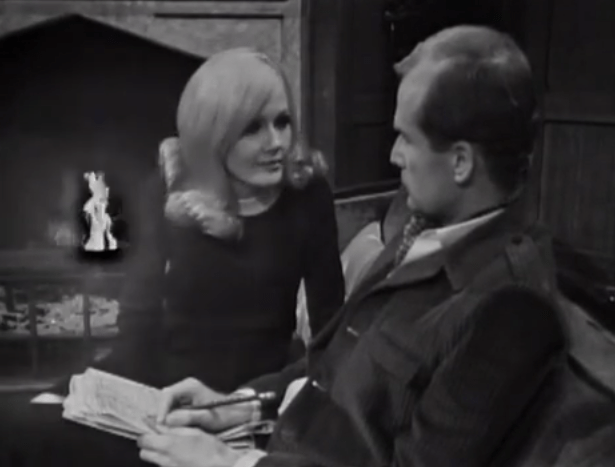
Stuffy Edward Collins was under a spell for several weeks that prevented him from keeping up with what has been happening on the estate of Collinwood in 1897. He knows that his distant cousin Barnabas is a vampire who originally died in the 1790s and has come back to prey on the living. From this, he has drawn the eminently logical conclusion that he is a character in a horror story, and that it is his responsibility to be the hero who destroys the undead ghoul.

Barnabas is beside himself. Screenshot by Dark Shadows Before I Die.

In fact, Dark Shadows stopped being that kind of show long ago. Others know that it is chiefly about time travel now. That point is made when we flash forward to the year 1969, from which Barnabas has traveled to prevent a disaster that had its roots in 1897. Barnabas’ friends Julia Hoffman and Timothy Eliot Stokes talk about the intersection of past and present, so that the events of 5 September 1897 are somehow also taking place on 5 September 1969. The show has been using anniversaries as substitutes for natural laws in this way since #157, broadcast and set in January 1967, and they spin this out much further today. In his post about the episode at his great Dark Shadows Every Day, Danny Horn writes a big prose poem about the weirdness of the show’s conception of time at this point, it’s well worth reading.

When Barnabas first came on in the spring of 1967, it was set in contemporary times and the writers had a lot of fun with characters who mistook the genre of show they were on. Dangerously unstable ruffian Willie Loomis heard the plot of Daphne du Maurier’s Frenchman’s Creek, concluded he was part of a Gothic romance, and wound up freeing Barnabas and becoming his blood thrall. That mistake continued to shape Willie’s character. Willie was forced to be Barnabas’ accomplice in the abduction and attempted brainwashing of Maggie Evans, The Nicest Girl in Town. Willie listened to Barnabas’ own rantings about his motive being an attempt to recreate his lost love Josette, and kept imagining that he would somehow overcome Barnabas to rescue Maggie and become her lover. Willie also harbored a deep hostility towards Burke Devlin, who was left over from a period when the show really was inspired by Gothic romance.

Willie’s sometime friend Jason McGuire made a similar mistake, believing that the show was still the noir crime drama it was when it spent weeks on the question of where Burke’s fountain pen had got to. So he sleuthed out signs of where Willie went when no one was looking and where Barnabas got his money. All that Barnabas could contribute to that kind of story was murder, and so he unceremoniously strangled Jason in #275.

Local physician Dr Dave Woodard thought he was on the usual daytime dramas of the period. Actor Robert Gerringer had a lot of fun playing Woodard as if he were on The Guiding Light. There were whole episodes built around that conceit- for example, we spend #235 in the Collinsport Hospital, where everyone acts just as you would expect them to on any other soap, except for Maggie, who is there being treated for vampire bites. Woodard notices that his friend Julia is growing close to Barnabas, and in #324 comes to the logical daytime conclusion- they are having an affair. Eventually Woodard finds out that he has misidentified the genre of the show, but it is too late- Barnabas and Julia murder him in #341.

Today, that is to say 5 September 1897, Edward catches Barnabas and locks him in the prison cell in the basement of the Old House at Collinwood. Barnabas kept Maggie in that cell when she was his prisoner, and the ghost of his little sister Sarah helped Maggie find a secret panel that led to a tunnel to the beach. In #260, Maggie escaped through that tunnel at the last minute before Barnabas could kill her, and Barnabas himself later used the same tunnel to escape from the cell in #616. In #781, Edward made it clear that he knew all about the tunnel and expected everyone else at Collinwood to know about it as well. So it is no surprise when he tells Barnabas that he has blocked it off. In fact, he says that he has blocked “all” of the secret passages- we may wonder just how many escape routes there are.

Edward leaves Barnabas alone in the cell, saying he will be back before dawn. There is a writing desk in the cell; Barnabas remembers that Willie moved that desk to the front parlor for him in 1967, and so he describes his predicament in a letter to Julia and closes it in a secret compartment of the desk.

In 1969, nine year old Amy Jennings is in the parlor, playing with her dolls. One of the dolls is named “Amanda”; this will catch the attention of returning viewers. The 1897 story features a character named Amanda, who is an oil painting come to life. If artist Charles Delaware Tate could make his paintings come to life, as in Greek myth the sculptor Pygmalion made a statue come to life as a woman named Galatea, then perhaps we should find out who made Amy’s doll before we let it out of our sight.

Amy first came on the show in November 1968, at the beginning of the story that led from contemporary dress to the 1897 segment. Her very first night at Collinwood, Amy went straight to the room where the magic objects were hidden that would trigger that story. She often delivers her lines directly into the camera, as if she knows perfectly well where the audience is. Amy is at the opposite pole from Edward and such earlier characters as Willie, Jason, and Woodard- she not only knows what genre the show is, she’s read the flimsies for next month’s episodes and is getting a head start on them.

Amy looks in the desk for a book to read to her dolls, and inadvertently opens the secret compartment. She eventually gives the letter to Julia; this is what prompts Julia and Stokes to have their talk about the ontological status of past events and what philosophers call “the reality of tense.” They know all about the time travel aspect of the show; Julia, in fact, has for some time been the closest thing the audience has in the parts of Dark Shadows set in the 1960s to a point of view character, one who knows everything we do. She was certainly the first one to know that the show was transitioning from vampire horror to quasi-science fiction. She surprised Barnabas in #291 with a proposal to develop a medical treatment that might put his vampirism into abeyance.

In the letter, Barnabas refers to his “secret.” Stokes does not know what this is, and is not satisfied with Julia’s lame attempts to answer his questions about it. This makes sense to regular viewers; shortly after Stokes arrived in Collinsport, another mad scientist got hold of Barnabas and succeeded where Julia had failed in putting the symptoms of the vampire curse into remission. For all the time he has known Barnabas, Stokes has seen him moving about in the day, casting reflections in mirrors, eating food not derived from human blood, etc. In 1968 and 1969, his ignorance of his Barnabas’ past vampirism is not much more serious than his ignorance of the details of the automobile accident that killed Mr Hanson in 1956. But the vampirism came back in full force when Barnabas went to the past, so Stokes is at a loss as to what the letter means.

Julia decides that she will try to travel into the past using the same mumbo-jumbo that transported Barnabas there. While Stokes reads up on that, Julia and Amy make a stop at the great house on the estate, which is impenetrably haunted by the ghost of Quentin Collins. That errand seems to be going sideways when the episode ends.
Episode 493: What horrors we commit

Recovering vampire Barnabas Collins and mad scientist Julia Hoffman brought a Frankenstein’s monster to life the other day. They named him Adam, and are keeping him locked up in the prison cell hidden in the basement of Barnabas’ house. They leave Barnabas’ servant Willie in charge of Adam.

The first two days of the Adam story had their humorous moments as we saw Barnabas and Julia’s farcically total incompetence before the demands of parenthood. Today, Robert Rodan plays Adam as a 6’6″ newborn who is looking for affection and mental stimulation and finds only hostile people and brick walls. Rodan’s commitment to the part is so pure and his face is so expressive that he weighs us down with sorrow for a cruelly neglected child. Moreover, Dark Shadows is so high-concept right now with all of the monsters and black magic and mad science and dream sequences and so on that it is hard to see how it can take a pain that is so raw and make it meaningful for us in a way that will justify showing it.

There are just a couple of moments I want to remark on. In the cell with Adam, Willie smokes a cigarette. He blows smoke in Adam’s face, leading him to freak out, knock Willie unconscious, and flee from the cell to the grounds of the estate of Collinwood.

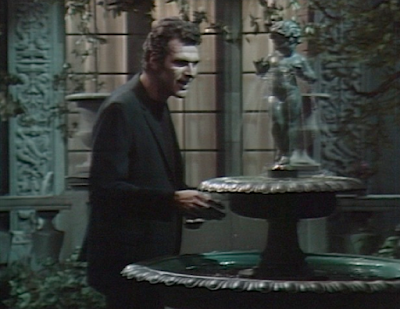
Outside the great house of Collinwood, Adam finds a toy to play with. Screenshot by Dark Shadows Before I Die.

This isn’t the first time Willie’s smoking has got him in trouble. Willie scattered cigarettes in #210, when he was trying to rob a grave in the old Collins family mausoleum. To his surprise, the coffin he opened held, not the jewels he was looking for, but Barnabas, who seized him by the throat and didn’t let him go until he had bitten and enslaved him. A few days later, in #215, Willie’s old partner in crime, seagoing con man Jason McGuire, asked Willie what he had been doing in the mausoleum. Terrified that Jason might discover Barnabas’ secret and bring the vampire’s wrath down on him, Willie denied he had been there. Jason replied that Willie had a habit of leaving cigarette butts on the edges of things. The same vice that brought Willie to the brink of disaster on that occasion has now caused Adam to panic, and Adam is clearly strong enough to kill a man with a single blow. Smoking is even more hazardous for Willie than it is for the rest of us.

In the great house of Collinwood, housekeeper Mrs Johnson is struggling with her part in “the Dream Curse.” In this curse, a person has a nightmare, is terribly distressed until they can tell a particular person about the nightmare, the person they’ve told then has the same nightmare, and the process repeats until the writers can come up with a less tedious way to fill the time on slow days. Mrs Johnson knows that it will be bad to tell the dream to the next person, and is trying not to. Julia knows all about the Dream Curse, and is herself the person who passed it on to Mrs Johnson.

Julia also has a nearly unlimited power to erase people’s memories with hypnosis, yet she doesn’t try to hypnotize Mrs Johnson into forgetting the dream. The Dream Curse is the product of a spell cast by wicked witch Angelique. Another of Angelique’s spells made Barnabas a vampire. Julia was able to hypnotize Maggie Evans, The Nicest Girl in Town, into forgetting weeks and weeks of vampiric abuse Barnabas inflicted on her, and Maggie has been her old self ever since. So, if Julia can wipe away one kind of trauma arising from Angelique’s curses, why not another? It seems like it would be worth a try.

Also, Julia is in charge of a mental hospital called Windcliff. She has used Windcliff to stash Barnabas’ victims Maggie and Willie where they wouldn’t attract the attention of the authorities. Regular viewers can hardly fail to wonder why she doesn’t think to commit Adam to Windcliff. If we must have him on the show, it would be easy enough to write a couple of lines of dialogue explaining why it would be impossible to send him away. That they don’t take the trouble to do even that is an insult to the intelligence of the audience and another reason to find the Adam storyline depressing.

Episode 491: What we do with him now is up to us

Vampires and mad scientists are both metaphors for extreme selfishness. The vampire exists only to feed on humans, gaining a night’s nourishment for himself at infinite cost to them; the mad scientist takes skills and equipment that could bring great boons to humanity and uses them only to further some perverse private whim. The Frankenstein’s monster emerges as the logical synthesis of these metaphors. As a botched resurrection and a parody of the Christian story, the Frankenstein’s monster evokes the vampire; as the helpless product of the mad scientist’s hubris, he is a child neglected and abused by a narcissistic parent, bringing home the real-world stakes of the issues raised in stories of uncanny horrors.

Mad scientist Julia Hoffman and vampire Barnabas Collins have finally got round to creating a Frankenstein’s monster of their own. His name is Adam. Julia and Barnabas had expected Barnabas to die and his “life force,” what the opening voiceover today refers to as his “spirit,” to animate Adam. They are surprised that the experiment has ended with Barnabas and Adam both alive. They are entirely bewildered about what to do with this 6′ 6″ newborn. Julia goes to her usual default, and injects him with a sedative.

Matriarch Liz comes from the great house of Collinwood to the house where Julia and Barnabas are working. She brings some information about the B plot. Barnabas makes it clear that he and Julia are deeply involved in an experiment begun by the house’s previous owner, the late Dr Lang. Liz is mystified by Barnabas’ new interest in science. She and Julia go to Collinwood, while Barnabas stays downstairs in Lang’s old consulting room. He is waiting for the dawn, wondering if the process of creating Adam cured him of the symptoms of vampirism or if he will crumble into dust when the sun rises.

In the lab upstairs, Adam regains consciousness. He plays with some of the shiny objects around him. It’s rather an odd playpen for a baby, with its electrical equipment spraying sparks, vials of boiling acid, loaded gun, and medical sharps. But he seems delighted with everything until he grabs a scalpel by the wrong end. Then he starts smashing things.

What newborn wouldn’t love that? Screenshot by Dark Shadows Before I Die

By that point, Julia is back, the sun is up, and Barnabas has learned he is human again. Julia and Barnabas hear the crashing sounds from upstairs. They try to stop Adam. He flings them aside. The episode ends with him sticking his arm out the door while they press it shut. Grayson Hall and Jonathan Frid do such a good job of playing Julia and Barnabas as farcically clueless that the sequence left me and Mrs Acilius roaring with laughter.

There is a bit of self-reference in this one. The first person Adam sees when he opens his eyes is Barnabas. When he can see Barnabas, he is calm. When he cannot, he becomes agitated and dangerous. Most of the people watching Dark Shadows at this point first tuned in because they were curious about Barnabas, and have stayed with the show because they are fascinated with him. The viewer mail whenever Barnabas was not getting enough of the spotlight to please his fans must have been unpleasant for the writing staff to read, and might have made them apprehensive of the crowds that gathered every weekday outside the studio at 442 West 54th Street. Perhaps Adam’s rampage was their nightmare dramatized.

Episode 151: Finishing my puzzle

There isn’t really any structure to this episode, certainly no suspense. It’s a collection of scenes in various moods, each exploring some familiar themes, all taking place in the great house of Collinwood.

Reclusive matriarch Liz wakes her nephew, strange and troubled boy David. She is glad to find that David is cheerful, but disturbed to hear that his mother, the mysterious and long-absent Laura, visited him in his room last night. Liz says that Laura couldn’t have been in the house last night. David proves that she was there by showing Liz the handkerchief she gave him.

Liz is puzzled how Laura got in and out of the house without being seen. Friday, she learned that there had been strong evidence of supernatural activity in the house yesterday. As she questions David about the details of Laura’s visit, it looks like she might be trying to rule out a supernatural explanation of Laura’s visit. That’s a bit of a dead end- Liz is committed to covering up anything that will make the family look weird, so if she is thinking along those lines she certainly won’t be talking about it with anyone. But she had a confrontation yesterday with Laura, in the course of which each implied that she had sufficient willpower to defeat the other. So Liz’ unsettled reaction might explain why Laura left the handkerchief. She wants Liz to know that she is not dealing with any ordinary antagonist.

We then see Liz and her brother, high-born ne’er-do-well Roger Collins, having breakfast in the kitchen. Roger is delighted by the prospect that his wife Laura will divorce him and go away with their son David. He promises Liz he will think fondly of David when David is a distant memory. Liz is exasperated with Roger’s narcissism. She reminds him that he lives as a guest in her house, and that it was for David’s sake she took him in. He studiously ignores the implication that if David goes away, he will have to find a place to live and pay his own bills.

Liz and Roger in the kitchen. Screenshot by Dark Shadows Before I Die

Liz’ daughter, flighty heiress Carolyn, comes into the kitchen as Roger is leaving. She informs Liz that Laura has been seeing the family’s arch-nemesis, dashing action hero Burke Devlin. Before Laura came back, Burke had been leading Carolyn on, and she has been bitterly disappointed that no romance will be blossoming between them. She leads Liz to the idea that after Roger and Laura are divorced, Laura will deliver David to Burke. “The last of the Collins! The only hope our name will continue!” exclaims Liz. Fearing Burke’s intentions, she vows to keep Laura away from David.

While she may not have forgotten what she heard Friday about the indications of supernatural doings, Liz has not grasped the message the ghosts are trying to send. While Burke may want David to forget Roger, think of him as his father, and change his name from Collins to Devlin, the ghosts have been telling anyone they can reach that he won’t get the chance. If David goes to Laura, she will change far more about him than his last name. Perhaps she will kill him, perhaps she will turn him into some kind of otherworldly creature, but whatever her plans are, Burke should be the least of Liz’ worries.

Roger was among those who saw and heard the signs of the ghosts on Thursday. On Friday, he flatly declared to well-meaning governess Vicki that he refused to think about them any more. While Carolyn is in the kitchen giving Liz the news about Burke and Laura, Roger goes to David’s room to try to talk him into spending more time with his mother.

When he hears Roger at the door, David is sitting on his bed, playing with toy soldiers on a chessboard. He hastily shoves the soldiers and the edge of the board under his pillow and picks up a textbook.

Everything Roger says seems to bewilder David. When Roger tells David that he has done something to please him, David replies “I have?” David continues to answer all of Roger’s statements in that wise until Roger protests that David is using “two-word questions” only to annoy him. He talks about how important it is for a boy to spend time with his mother, that he ought to ask Liz if he can go on a long trip with his mother, etc. At the end of their talk, Roger tells David “You can be a very intelligent little fella when you want to be.” David continues to give him a mystified look.

Since David has already had several scenes where he angrily told Roger that he knew Roger was trying to send him away with his mother because he wants to get rid of him, regular viewers are likely to take this scene as an indication that David is changing his approach to Roger. He’s tried confronting his father with the ugly truth, screaming at him, and threatening him. Last summer, when Laura was still an unseen, half-remembered figure David would call to while standing at the window, he tried murdering him. None of those tactics got him anywhere, so now he is just deflecting him with a show of incomprehension.

There is another possible explanation for David’s change. The most shocking of David’s recent behavior came when the ghost of Josette Collins was making her most intense efforts to get through to him about the danger his mother represented. That process manifested itself in nightmares and a frightening painting that threw David’s mind into an uproar. Now, Laura has appeared to him in the night, blocking the nightmares, and Roger has burned the painting. Josette is temporarily silenced. David is not afraid of his mother, and may not be enraged with his father.

Those who have been watching closely all along will find another interesting note in Roger’s attempt to manipulate David. In #68, Roger had been eager to get rid of well-meaning governess Vicki. In those days, David saw Vicki as an enemy. Roger sits with David in the drawing room and talks very calmly about the fact that David hates him. He asks if he doesn’t hate Vicki even more. David doesn’t deny it, and expresses extreme hostility. This was only a few weeks after Roger found out that David had tried to kill him, so it is rather chilling when he tells David that he will leave it entirely up to him to solve the problem of Vicki.

In that scene of horrifying child abuse, David was helpless as his father deliberately set about warping his mind so that he would attempt a murder. By contrast, this scene is a comedy in which David Henesy and Louis Edmonds get real laughs, and David Collins is certainly no worse off at the end than he was a the beginning.

David is playing with his toy soldiers again when he hears someone else at the door. Again, he stuffs the soldiers under his pillow. It is his cousin Carolyn. He tells her that with so many visitors to his room, he is having trouble studying. Carolyn takes the soldiers from under the pillow and says she can see how hard he’s been studying. He asks “Secret?” She replies “Secret!”

As far as I can recall, this is the first time we’ve seen Carolyn in David’s room. The “Secret?” “Secret!” exchange is certainly the first time we’ve seen them so friendly. It’s a relief- Carolyn’s over-the-top denunciations of David as a “little monster” were getting monotonous, and each of these characters needs more people to talk to.

After she and David have talked about Laura for a while, Carolyn goes back downstairs to talk to her Uncle Roger. Roger is lounging on the couch doing the crossword puzzle. He is quite annoyed that Carolyn is interrupting him in this most important task of his day. This is a bit of mirroring- as David is more concerned with his toy soldiers than with his studies, so Roger is more concerned with his puzzle than with any of the responsibilities you might suppose would attach themselves to a grown man who is nominally employed as an executive at his sister’s business.

Carolyn brings up Burke and Laura. Roger says that she needn’t worry about that- until their divorce is final, Laura won’t dare do anything to alienate the Collinses. Carolyn asks what will happen after the divorce, when David is living with Laura and Laura is available to Burke. It seems to dawn on Roger that it might be bad for the Collinses if the family’s only male heir is the stepson of their deadliest enemy, and so he says he’ll do something about it. Carolyn so adores her uncle and so resents Laura and Burke’s relationship that not even his crossword puzzle can keep her from blinding herself to his complete ineffectiveness. She is gleeful at the thought that Burke and Laura will now get their comeuppance at his hands.

Carolyn and Roger on the couch. Screenshot by Dark Shadows Before I Die

Like Roger, Carolyn was among those who saw and heard the signs of Josette’s presence Thursday. She knows all about David’s nightmare and about the painting in which she warned that Laura would set fire to herself and David. Yet she has inherited the family’s tradition of denial. She will not see what is in front of her, and cannot shift her focus from her thwarted desire for Burke to the grave danger impending over David.