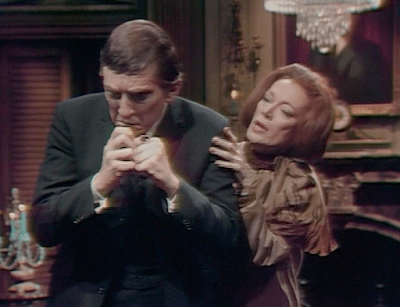
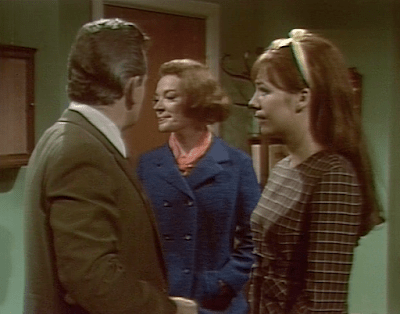
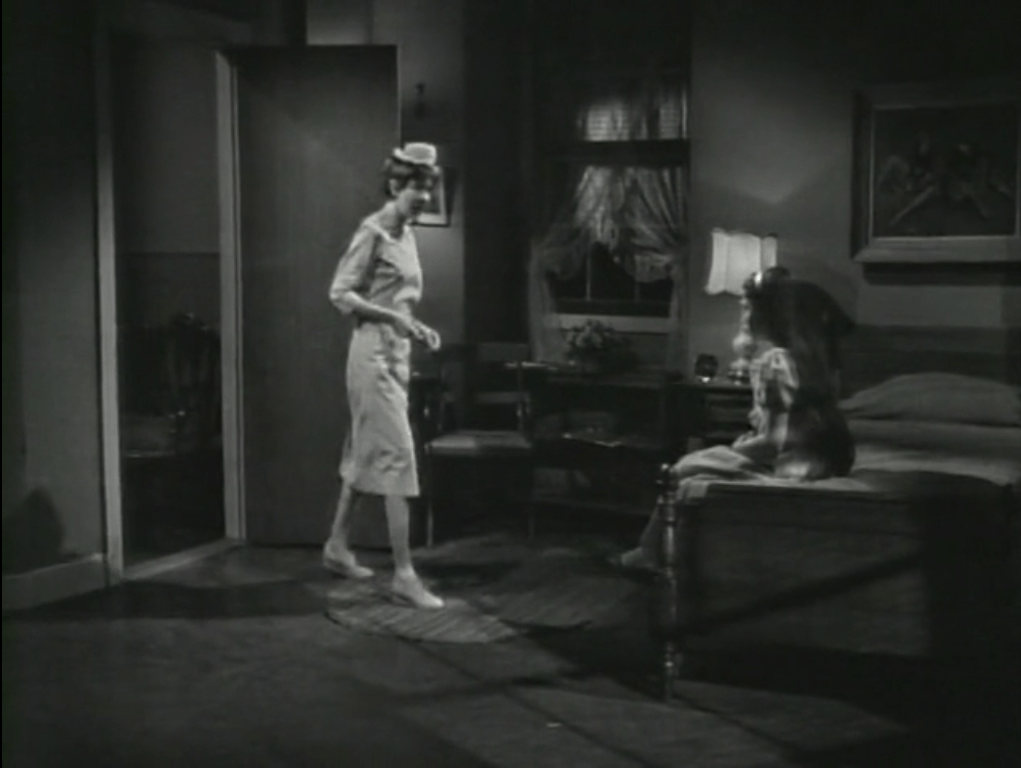
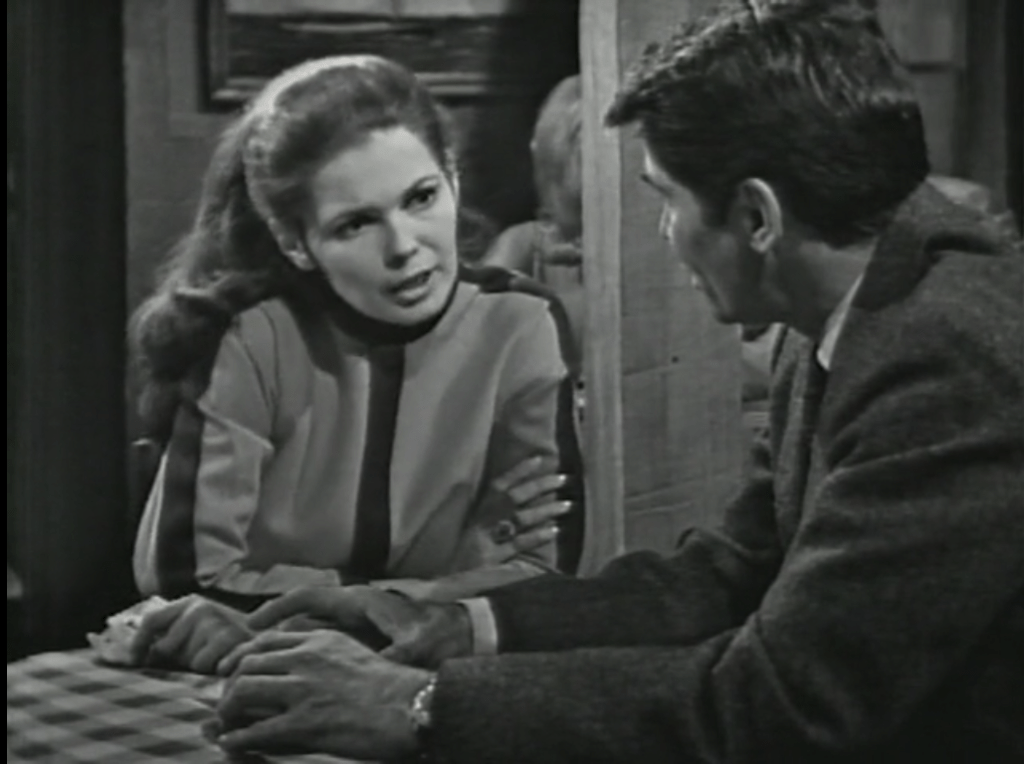
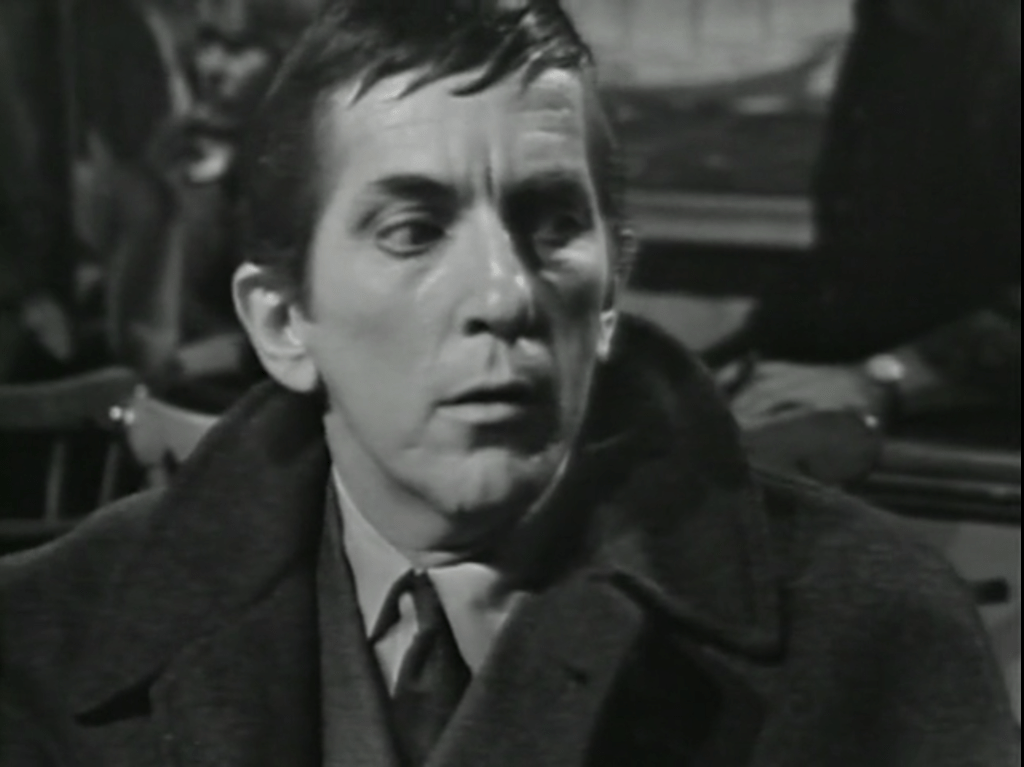
Episode 325: Such pretty flowers

Strange and troubled boy David Collins was, for the first 39 weeks of Dark Shadows, the character most intimately connected to the supernatural back-world of ghosts and uncanny phenomena that would occasionally peek through the main action of the show. That changed in #191, when he chose life with well-meaning governess Vicki over death with his mother, humanoid Phoenix Laura Murdoch Collins. After that, he had little memory of his mother, and none at all of the paranormal experiences he had during her time with him on the great estate of Collinwood.

Not that David lost his connection to the supernatural all at once. When he first met his cousin Barnabas in #212, he cheerfully asked him if he was a ghost, and was disappointed to hear that he wasn’t. In #288, he speculated that his friend, mysterious little girl Sarah, might be a ghost, and he has taken it in his stride every time he has seen Sarah do something only a ghost could do. In #310, he took out his crystal ball, a gift he had received in #48 and hadn’t used since #82, and peered into it to try to find Sarah. He did see her in it, too.

Yet David seems to be resisting the idea that Sarah is a ghost, and indeed to be shying away from the whole concept of the supernatural. When she led him to the secret chamber in the Collins mausoleum in #306, she told him that the empty coffin there once had a body in it, but that the body got up and left. David objected that the dead don’t walk away, and was incredulous when she assured him that sometimes, they do. When David was trapped in the chamber in #315, Sarah materialized there and showed him how to get out. He had called on her to come, and was facing away from the only door when he did so, indicating that he knew she could pass through the walls. Yet when she did, he demanded a naturalistic explanation for her entrance, and when she vanished he asserted that she must be hiding in the chamber somewhere.

Now, David is terrified of Barnabas, much to the puzzlement of the adults he lives with. In the opening scenes, he is staring at the portrait of Barnabas in the foyer of the great house, and we hear Barnabas in voiceover, delivering the lines with which he frightened David in #315. He screams with terror, bringing his aunt Liz. She sees that David is upset, but he hurries away from her, upstairs to his bedroom.

There, we hear his thoughts in another voiceover. He remembers the events of #310, when he discovered that Barnabas and his servant Willie knew about the secret chamber in the mausoleum. In his agitation, he calls out to Sarah. He hasn’t admitted to himself that Sarah is a ghost, but evidently he expects her to materialize out of thin air. Sarah doesn’t come, but Vicki does, asking who he was talking to.

After David says he wants to work on his stamp collection, Vicki goes downstairs and finds Liz putting her coat on. She says that David is afraid of Barnabas for some reason, and that she is going to Barnabas’ house to ask him to help put the boy’s fears to rest. She says that David is more disturbed than he has been since his mother Laura was around; this is the first direct reference to Laura in months.

There is a knock on the front door. It is Barnabas, saving Liz the trip. Liz and Vicki explain how fearful David is, and Barnabas offers to have a talk with him.

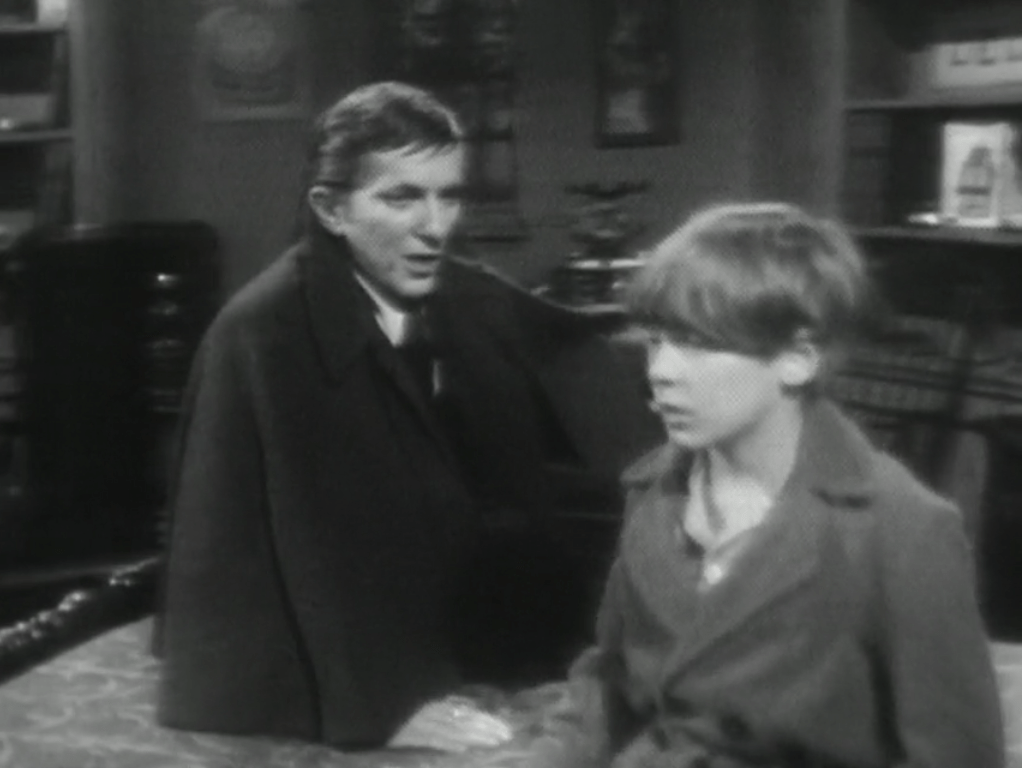
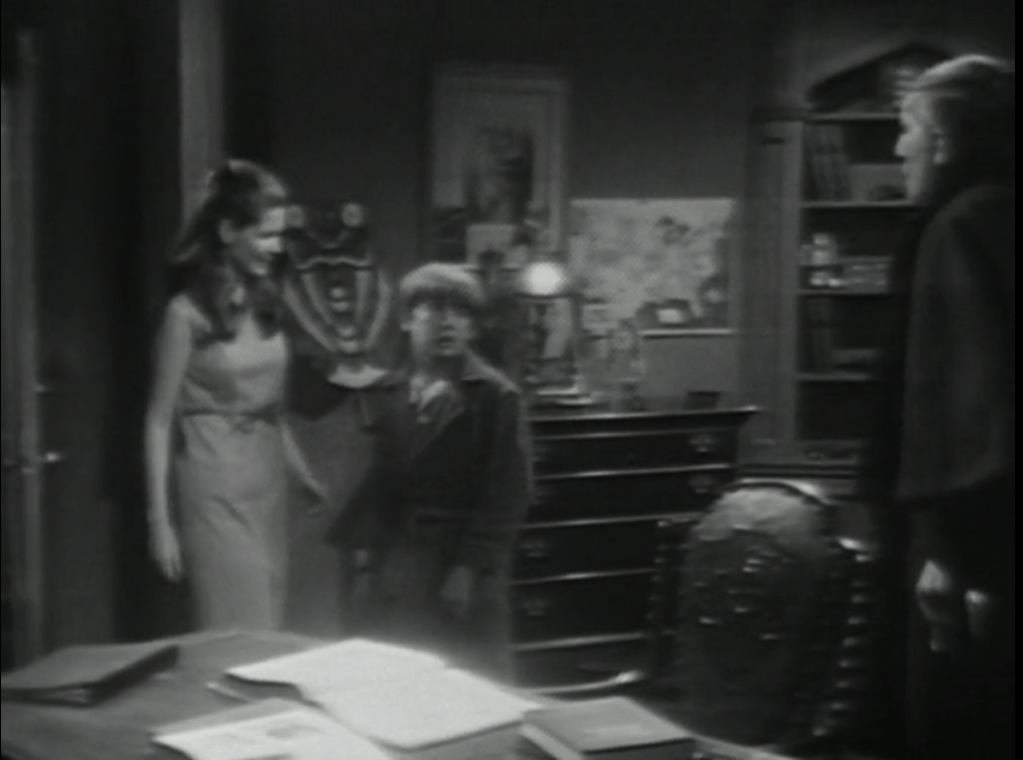
Liz ushers Barnabas into David’s room. Once the door is closed on the two of them, Barnabas questions David aggressively about Sarah and the secret chamber in the mausoleum. He asks him if Sarah told him about her family, twice mentioning her brother. When David says that Sarah hasn’t told him anything about herself, Barnabas accuses him of lying. He sits next to David on his bed. David doesn’t know that Barnabas is a vampire, but if he did he couldn’t look much more uncomfortable than he does when Barnabas assumes this position.

Barnabas sitting with David on his bed.

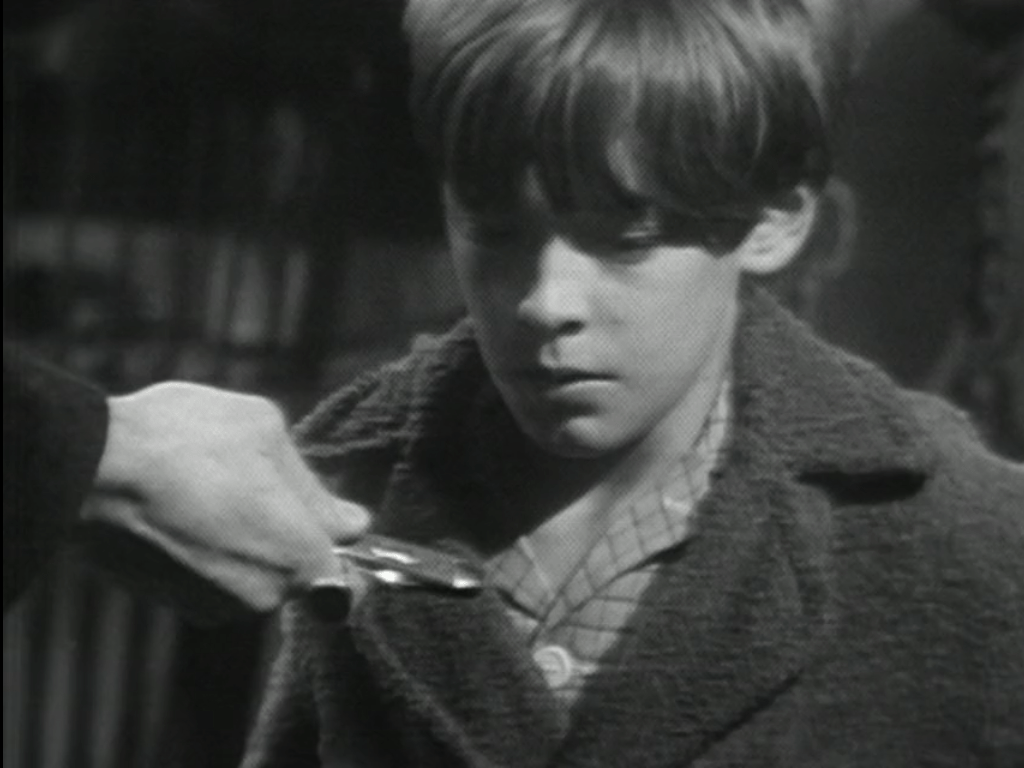
Barnabas tells David repeatedly that he knows he was in the secret chamber. David denies it, Barnabas again tells him he is lying, and to prove it shows him the knife he left there.

Barnabas confronts David with his knife

A knock comes at the door. It is Vicki. Vicki adores Barnabas, and the smile she wears when she enters the room shows her certainty that a heart-to-heart talk with him will have relieved David’s anxiety.

Smiling Vicki, sure everything will be all right

Vicki sees that David is still frightened, and her smile gives way to a look of confusion. Vicki was originally the audience’s point-of-view character; the audience is now composed chiefly of people who have tuned in wanting to see how they were going to fit a vampire into a daytime soap opera, and so of course she has to be Barnabas’ biggest fan at Collinwood. She and Barnabas leave David’s room together, and Barnabas wishes David “Pleasant dreams…”

We see David tossing in bed. He is talking in his sleep, calling out to Sarah. In yet another voiceover, we hear his dream. It is a bit of conversation from #306, when Sarah told him about the empty coffin.

We then see the beginning of another dream. It takes place amid a composite of decorations from the cemetery set and from the set representing Barnabas’ basement. David at first appears in a corridor like the ones we saw in the basement in #260.

The fog machine is working hard today.

He then encounters a faceless woman whom regular viewers will recognize as Barnabas’ co-conspirator, mad scientist Julia Hoffman.

David sees the faceless woman.

We see that she is wearing Julia’s wig and frock and holding the jeweled medallion she uses to hypnotize people:

Julia’s identifying marks.

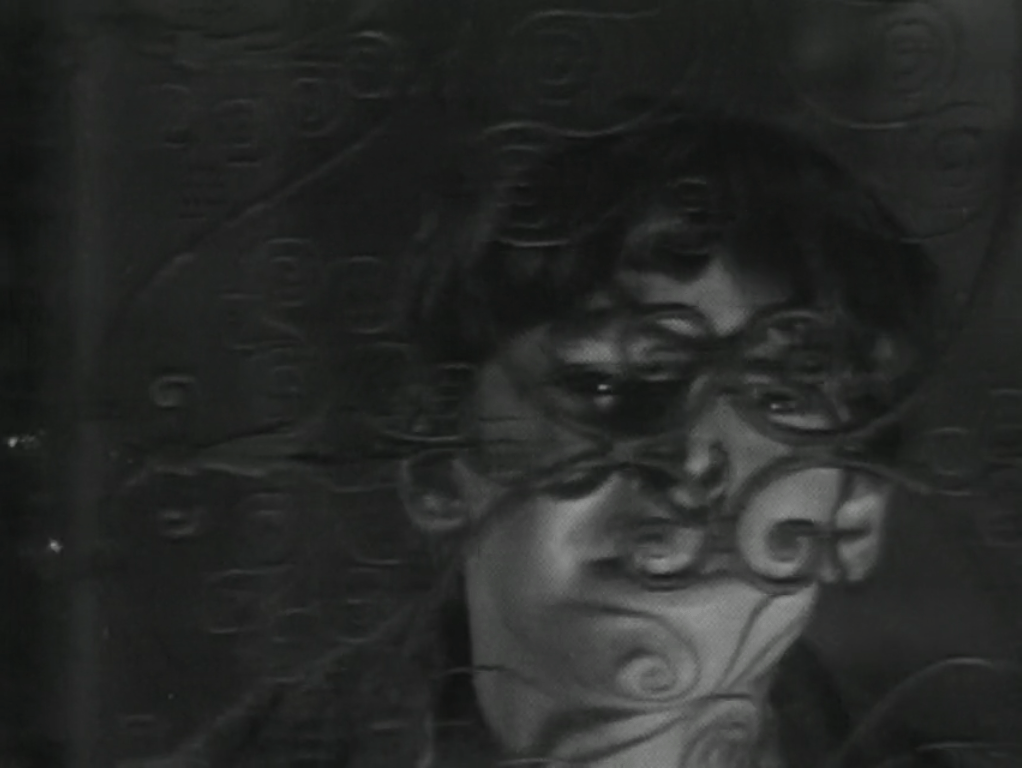
David flees from the faceless woman, saying he has to find Sarah. He finds himself behind a grating like the one on the door to the Collins mausoleum:

Entering the tomb

He walks up a few stairs, and sees Sarah.

David finds Sarah

When David tells Sarah that she is hard to find, she denies it, saying that she is easy to find if you know where she is. David does not respond to this characteristically cryptic remark, but complains that she won’t tell him anything about herself. She asks what he wants to know, and says he wants to know who she is and where she comes from. She tells him:

Sarah: That’s easy. I was born the same place you were. I lived in a house on a hill until I was nine years old. Then I got very sick. Everyone came to see me, and they were very sad.

David: Because you were sick?

Sarah: No, because I died. I died, and everyone brought such pretty flowers.

“I died that time. I died, and everyone brought such pretty flowers.”

When David asks why she is around now if she died then, she tells him she doesn’t really know. All she knows is that she is looking for someone. David asks who that might be, and Sarah says she will show him. Suddenly he becomes frightened and does not want to go with her. She insists. She takes his hand and leads him.

Sarah leading David to her secret

The camera follows the children on their journey across the set. At first Sarah takes David down some stairs, leading him from depths to depths:

Sarah leads David down into the depths

The set is now unmistakably Barnabas’ basement, though with more candelabra casting more intricate shadows on the walls than we have seen there:

Vergil and Dante, junior edition

At last Sarah stops and looks straight ahead. They have reached their destination.

David is bewildered by the sight.

They see a coffin. David asks if this coffin is empty, as was the one in the secret chamber. Sarah tells him no. This one has a body in it. The lid starts to open. David points in astonishment, while Sarah looks on serenely.

The lid begins to open.

Barnabas rises from the coffin.

Barnabas rises.

David recognizes Barnabas and is stunned. Sarah has eyes only for her big brother.

David stunned.

Barnabas stands. He turns, and sees Sarah. He is glad to see her.

David watches Sarah’s reunion with Barnabas.

Barnabas notices David. He turns to follow him.

Barnabas blocks David from our view and from Sarah’s.

As Barnabas follows David, Sarah simply watches.

Sarah watching big brother.

Barnabas follows David through another corridor. The shadows on the wall and floor form a design suggesting David is caught in a web. Readers of Gold Key comics’ Dark Shadows series will recognize the bend of Barnabas’ knees and the angle of his cane in this shot as their usual depiction of him:

David caught in Barnabas’ web.

David’s back is to the wall and Barnabas closes in on him.

Cornered.

Barnabas raises the cane he used to block David’s escape in #315 and which regular viewers several times saw him use to beat Willie. We zoom in on the wall, where we see the cane’s shadow rise and fall while we hear David cry out in distress.

Sarah’s fixation on Barnabas and her passivity when Barnabas follows David mark a pivotal moment in her development. She looks and sounds like a friendly little girl, and we have seen her rescue people from danger. She usually seems like a cross between Caspar the Friendly Ghost and the Powerpuff Girls. But she is not that at all. She is a symptom of the same curse that has brought Barnabas forth to prey upon the living, and she is leading David ever deeper into a world where only the dead belong. The show has given us no reason at all to think that she can bring him back to the realm of the living.

Even if Sarah wants to save David, she may still represent a deadly threat to him. We saw this in the Laura story. When Laura tried to lure David into the flames, she told him that he, like her, would rise from the ashes and live again. We had heard her say things like this before, and she may well have believed it to be true. But unknown to her, we saw a séance in which David spoke with the voice of a son Laura had in one of her previous incarnations. She had burned him with her, but while she gained a new life in the flames, he had become one of the unquiet spirits of the dead. Perhaps Sarah, too, is unwittingly leading David to his death.

Closing Miscellany

When Liz leads Barnabas into David’s room, she tells David that “Unc- Cousin Barnabas” wants to have a man-to-man talk with him. In later years, Jonathan Frid would refer to his character as “Uncle Barnabas” when he talked with interviewers about how the Collinses responded to him. I wonder if Joan Bennett’s blooper is a sign that he was already calling him that at this time.

There is a slight puzzle in Sarah telling David she was “born in the same place” he was. We’d heard in the early episodes that Laura and Roger never spent a night together in Collinwood as man and wife- the day of their wedding, they went to their new home in Augusta, Maine, and David was born a few months later. Perhaps Sarah’s remark is a retcon, and we are now to think of David as having been born at Collinwood. Or perhaps Sarah really was born where Augusta would stand- we know that her birth year was 1786, and that was the year the settlement that would become Augusta saw the establishment of its first public whipping post. Maybe her parents wanted to go there to celebrate the occasion.

When Sarah tells David she lived on the hill until she was nine, she interrupts herself and shouts “Ten!” This is an odd little blooper. Just a few days ago, David told Barnabas that Sarah was ten, and Barnabas jumped down his throat asking if she wasn’t “almost ten?” Now Sharon Smyth has been on the show long enough to have celebrated a birthday, and they aren’t done with Sarah yet. So they are retconning Sarah as having made it to ten.

Episode 323: Partly responsible

Maggie Evans, The Nicest Girl in Town, has amnesia and can’t remember who abducted her in episode #235 and held her prisoner until #260. So the police started a rumor that her memory was returning, camped out in her yard, shot the first guy who strayed into it, and declared him to be the guilty party.

The man with five bullets in his back is Willie Loomis, servant to Old World gentleman Barnabas Collins. Sheriff Patterson tells Maggie, her father Sam, and her boyfriend Joe that he will be going to visit Barnabas and break the news to him about Willie. Maggie expresses sympathy for “poor Barnabas,” who will no doubt be heartbroken to hear ill-tidings about Willie. Sam is sorry to hear the sheriff will have to blight the dear fellow’s night, but the sheriff says Barnabas must be told. Willie lives in Barnabas’ house and, so far as anyone knows, has no access to any other building. So if he held Maggie prisoner for five weeks, you’d think the sheriff would have more to do on a visit to Barnabas’ place than simply deliver a message.

As it happens, Barnabas is the one responsible for Maggie’s plight. Willie was trying to get to Maggie to warn her that Barnabas had heard that her memory was coming back and was on his way to kill her. When the sheriff gets to Barnabas’ house, he finds him with his co-conspirator, mad scientist Julia Hoffman. Julia explains that she just came to the house to borrow a book. It’s four o’clock in the morning, by the way, but the sheriff takes that in stride and tells them what happened to Willie. He apologizes for disturbing them and says he can come back later if they would like. Barnabas says he wishes he could talk to Maggie, and the sheriff offers to take him and Julia to the Evans cottage. They accept this offer, and the sheriff goes outside to wait for them. Barnabas has long since cleaned up the evidence left over from Maggie’s weeks in his dungeon, so he doesn’t have to spend the time the sheriff so thoughtfully provides in tidying up. He and Julia can devote all of it to further conspiring.

Screenshot by Dark Shadows Before I Die.

Only Julia knows that Barnabas was the one who abducted Maggie in May, and only she knows that he has been planning to kill her ever since. But the sheriff and the Evanses drift into their own odd little conspiracy to shelter Barnabas from accountability.

Barnabas tells Maggie that he can’t help but “feel partly responsible” for what happened to her. She and Sam fall over themselves assuring him that he has nothing to feel bad about, that it was wonderful of him to try to rehabilitate Willie and that everyone was very impressed with how far he seemed to have got with that project.

Barnabas goes home. Julia accompanies him. She assures him that Willie will probably die, and urges him to relax, because he is “completely in the clear.” He bids her goodnight, by which I mean he grabs her throat and threatens to kill her if she is wrong. Once he is alone in the house, he thinks of the various people who might be able to bring his secrets to light. He settles on his ten year old cousin David, and resolves that “something must be done to keep him from exposing me, and it must be done soon!”

There is a touch of social satire in the deference everyone pays Barnabas. In #26, high-born ne’er-do-well Roger Collins wanted a particular service from Sheriff Patterson’s predecessor, the hapless Constable Jonas Carter. He told Carter that “My family is responsible for over half the jobs in this town,” and made a dark reference to an upcoming election. In #32, Carter went along with the Collins family’s cover-up of a case involving David, and in #272 and #273 Sheriff Patterson himself showed a mind-bending amount of solicitude to matriarch Elizabeth Collins Stoddard when she called to report that she had murdered her husband and that his body was buried in her basement.

Among the jobs for which the town has the Collinses to thank was an important one of Sam’s. In #222, Barnabas commissioned Sam to paint his portrait. When he offered to pay $1000, Sam and Maggie’s electrified reactions showed that this was more money than they had seen in a long time. They have good reason to think as highly of Barnabas as they possibly can.

Not only is Barnabas a member of the Collins family of Collinsport, but he is, again unknown to any of his protectors but Julia, a vampire. As such, he is a symbol both of extreme selfishness and of the dead past holding back people who want to make a new future. Dark Shadows does not often explore political themes in depth, to put it mildly. But today it does give us a glimpse of the way working people can find themselves defending the position and privileges of their very deadliest enemies.

Closing Miscellany

Barnabas looks at a “portrait” of his little sister Sarah, who died in 1796. We’ve seen this “portrait” many times, but usually it was at something of a distance from the camera, often at an oblique angle, and rarely shown for more than a brief moment. The typical TV set in 1967 would have allowed the viewer to believe it was a painting. But this time it fills the screen and is stationary for several seconds. Even though this episode only survives in an especially low-quality kinescope, it is impossible to overlook the fact that it is a photograph of Sharon Smyth, the child actress who plays Sarah’s ghost, taken at least 30 years before Joseph Nicéphore Niépce built his first camera.

Sarah Collins, d. 1796

This episode has an unusually large cast. In addition to the six regular actors, three of Sheriff Patterson’s deputies appear. None of them is credited, but the Dark Shadows wiki names them as Ed Crowley, Ted Beniades, and Dennis Johnson.

Episode 308: Master of the evasive answer

Artist Sam Evans is at home with his daughter Maggie, The Nicest Girl in Town. Sam is wearing a coat and tie while painting. I suppose that could be called “professional attire,” and Sam is a professional painter.

Professional attire.

Maggie’s main occupation these days is an important one on a soap opera. She is the resident amnesia sufferer. She can’t remember anything about the weeks she was missing and in the custody of a person or persons unknown to the non-villain characters on Dark Shadows. The only clue Sam, Maggie, and Maggie’s fiancé Joe have as to who abducted Maggie is that a mysterious little girl named Sarah has turned up and shared important information at key moments in Maggie’s travails. So they are desperate to find Sarah.

As the three of them talk about how elusive Sarah is, Maggie says that she seems to be able to disappear at will. Joe dismisses this idea out of hand. Regular viewers might find that a bit odd. During the storyline centered on undead fire witch Laura Murdoch Collins, both Joe and Sam had definite encounters with supernatural beings, Joe with the ghost of Josette Collins in #179 and Sam with the same spirit on the several occasions she compelled him to paint pictures explaining the danger Laura represented. Sam has also seen Sarah appear in and disappear from a locked room. So we would expect at least one of the two men to hesitate for a moment before rejecting the idea that Sarah might be a ghost.

Sam and Joe decide that because strange and troubled boy David Collins has seen Sarah more often than anyone else, they should go visit him at the great house of Collinwood and ask him to lead them to Sarah. David is happy to talk about Sarah, but he tells them that he has no idea how to contact her. He also warns them that if they do get in touch with her, they will likely find that nothing she says makes much sense. David and his cousin Carolyn continue with their plans to take a bus trip to the nearby town of Bangor, Maine, while Sam and Joe search the grounds of the estate hoping to find Sarah in one of the spots David mentioned that he had run into her.

David doesn’t have the answers. Screenshot by Dark Shadows Before I Die.

They see a swing moving in the breeze and jump to the conclusion that Sarah had been in it moments before. If they could hear the background music, they would know they were right- Sarah’s “London Bridge” cue is playing. Lacking this ability, they conclude that they have found nothing. They decide to go ahead and visit the Old House on the estate, home to courtly gentleman Barnabas Collins and Barnabas’ servant Willie. They hope that one of them will be able to tell them something about Sarah.

They find that neither Barnabas nor Willie is at home, but someone they know is there. Dr Julia Hoffman answers the door. When Sam followed Sarah’s directions and found Maggie at the end of her ordeal, she was in a terrible state, drained of blood and in a state of total mental collapse. Maggie was treated at a hospital overseen by Julia, who is qualified as a specialist in both hematology and psychiatry. Now Julia is settled in at Collinwood, masquerading as an historian writing a book about the old families of New England.

Sam wants to know why Julia is keeping up this imposture. He delivers a speech full of courteous words thanking her for spending so much time on Maggie’s case without remuneration, but his tone and body language prepare us for his angry response when Julia refuses to give him any specifics. He tells Julia that he has decided he doesn’t believe her. He gives her a piece of his mind, then storms off.

Joe stays behind and apologizes for Sam. Julia assures Joe she isn’t upset, and asks him to tell Sam that she is doing everything she can. After the two men are both out of earshot, Julia smiles and repeats “I am doing everything I can!” Without that mustache-twirling line, first time viewers might not have caught on that Julia is a Villain.

Julia twirling her mustache. Screenshot by Dark Shadows Before I Die.

Sam and Joe go back to the Evans cottage. It is night time, Maggie isn’t in the parlor, and her bedroom door is closed. Sam goes up to the door and shouts her name repeatedly. When she answers in a groggy voice, he apologizes, saying he didn’t mean to wake her.

Maggie comes out of her bedroom holding a wooden doll in eighteenth century garb. The doll wasn’t there when she went to sleep, and is the sort of thing Sarah would have, so she concludes that Sarah must have been in her room while she slept. Returning viewers will recall that when Sarah visited Maggie in #297 and found that she couldn’t remember her, she became upset and took away the doll she had previously given Maggie. This is a different doll, but it does confirm that Sarah is still watching over Maggie.

Closing Miscellany

This is one of only two episodes in which Nancy Barrett and David Ford share a scene. In #85, Miss Barrett’s Carolyn and Ford’s Sam were in the Blue Whale tavern at the same time; today, Carolyn, Sam, Joe, and David stand in the foyer of the great house talking about Sarah. It’s interesting that the two actors worked together so seldom, because from 1967 to 1969, Miss Barrett was known socially as Mrs David Ford.

At the climax of his scene with Julia, Sam tells her that she “should have been a member of the diplomatic corps…because you’re a master of the evasive answer!” So far as I’m concerned, the Foreign Service is one of the most honorable professions there is, and this is a shameful swipe at one of the most selfless, patriotic, and often heroic groups of people our country is blessed to produce. Writer Malcolm Marmorstein often cranks out mediocre scripts, but this smear marks a new low even for him.

Episode 295: A special kind of music

Maggie Evans, The Nicest Girl in Town, has come back to Collinsport. This is a surprise to everyone. Months ago, Maggie had escaped from an unknown captor who drained her blood and deranged her mind. Maggie’s family doctor, addled quack Dave Woodard, had persuaded her father and her fiancé to join him in telling everyone that she was dead and to lock her up in a mental hospital a hundred miles north of town. Evidently, Woodard thought that if the captor believed he had got away with his crimes, he would turn into a solid citizen and a good neighbor.

The mental hospital where Woodard sent Maggie was administered by Dr Julia Hoffman, an MD whose specialties in psychiatry and hematology made her seem like the perfect person to oversee Maggie’s care. Unfortunately for Maggie, Julia is also a mad scientist. She has for years dreamed of finding a vampire on whom she can try an experimental treatment that will turn him back into a human. Julia quickly recognized Maggie’s condition as a symptom of vampire attacks, and eventually identified Barnabas Collins as the vampire who held Maggie prisoner. She has now met Barnabas and promised to keep Maggie in a state of amnesia so long as he cooperates with her experiments.

Yesterday, the ghost of Barnabas’ nine year old sister Sarah liberated Maggie from Julia’s hospital and transported her back to Collinsport. This had such a great effect on everyone that the show is now in color.

Barnabas goes to the great house of Collinwood and tells Julia that Maggie has come back. He declares that he will have to kill her. Julia forbids him to kill Maggie, on the grounds that doing so would ruin years of her work. Talented a liar as Julia is, she comes up with this so quickly and in such a tense situation that it is hard to believe it is not her true reason for wanting to leave Maggie alive.

Barnabas clarifies the matter further when he says that he will kill Julia first. He follows Julia around the drawing room, apparently thinking of strangling her then and there. She keeps talking, and he can’t resist responding. The telephone rings, and she answers. It is Woodard, calling her to come to his office and take over treatment of Maggie. Julia triumphantly assures Barnabas that once she has done her work, Maggie will never remember what he did to her.

In Woodard’s office, Maggie’s memory is rushing back. She tells her friend Vicki that when she was being held prisoner she spent time in a special room where she smelled a sweet, powerful fragrance and heard a special kind of music. She had told Julia about those sense impressions in a session in #282, and when in #289 Vicki told Julia about a special room in Barnabas’ house where there was a jar of jasmine perfume and an antique music box, Julia had reconstructed Barnabas’ entire plan. When she hinted to Vicki that Barnabas was trying to recreate the late Josette Collins, Vicki had become defensive and stormed off, indicating that Julia is casting an unflattering light on something Vicki has been looking at through a romantic lens.

The camera is tight on Vicki’s face when Maggie mentions the room, the fragrance, and the music. Vicki’s face darkens in response to each point, a little bit more each time. She seizes on the key word of each statement, rephrasing it as a question- “Special room?… Special scent?… Special music?” So far on Dark Shadows, every plot has come to its climax as a result of Vicki figuring out what’s going on. So each of these reactions generates its own little jolt of suspense.

Special room?
Special scent?
Special music?

By the time Julia gets there, Maggie is saying that she remembers everything. Julia hustles Woodard out of the room, and is alone with Maggie when Maggie says that Barnabas Collins was her captor. She describes him as a creature from the world of the dead. She allows that this description is difficult to believe, but Julia assures her that she believes everything she tells her. Julia then tells her that they must stabilize her memory so that she will not regress to the miserable state she was in when first they met. She takes out a jeweled medallion and hypnotizes Maggie.

Woodard waits outside his office while Julia works on Maggie. Finally, Julia opens the door and asks if he would like to see the change in her. Woodard eagerly goes into his office.

He asks Maggie how she is. As she answers, she sounds just like she did before she fell into Barnabas’ clutches. She has regained her Adult Child of an Alcoholic habits of advertising her happiness by starting every utterance with a laugh in her voice and putting exaggerated stress on almost every syllable with a rising pitch. She tells him that “Apparently, there was something wrong with my memory, but I’m fine now.” He asks what happened to her when she was gone, and she has no idea what he means. She remembers falling asleep in her own bed, and then she found herself here with Dr Hoffman. If he could just tell her what happened in between, she’s sure she will be just fine.

Woodard is shocked, but Julia flashes a look of glee. She does remember to put on her worried face after Woodard looks at her, but the smile never really leaves her eyes.

Julia suppressing a cackle. Screeenshot by Dark Shadows Before I Die.
Julia concerned. Screenshot by Dark Shadows Before I Die.

That Julia was able to achieve so precise and extensive a mutilation of Maggie’s memory in so short a time would suggest that she spent the whole period Maggie was under her care laying the groundwork for it. That would in turn tend to confirm that her only interest in Maggie is as a tool to gain access to Barnabas as a subject for her experiment.

Closing Miscellany

As the opening title sequence begins, an ABC staff announcer says he brings “Good news! This program, Dark Shadows, is now being presented in color.”

Opinions may vary as to how good this news was. In the 1960s and 1970s, most television sets in the USA did not receive in color. So even programming that was made in color had to be composed first to look good in black and white. It took a big budget and a relaxed production schedule to make a show that would also benefit from color, and Dark Shadows never had either of those things. When a sense of atmosphere is especially important, as it usually is early in a storyline, it is best to watch the show with the color turned off.

Still, directors Lela Swift and John Sedwick were ambitious visual artists, and before long there will be some moments when they find ways to turn the muddy, cruddy TV colors of the era to their advantage. The camera operators will learn their craft even more quickly. Today, only a few closeups really meet broadcast standards, while every other shot is badly out of focus. There aren’t many other episodes like that, at least not until the woeful Henry Kaplan becomes one of the directors in December 1968.

This is not only the first color episode, but also the first one where the words “Dark Shadows” swoop and swirl around on the screen during the opening titles. I’m sure that was a very impressive effect in 1967.

When we saw Julia hypnotize Maggie in their sessions in the hospital, she shone a penlight in her eyes. This is the first time she uses the medallion. That is an example of the use of color- the medallion wouldn’t have been anything special in black and white.

Julia’s medallion. Screenshot by Dark Shadows Before I Die.

Episode 294: The same way I got out

Maggie Evans, The Nicest Girl in Town, is a patient in a mental hospital run by a mad scientist who is in league with the vampire who kept her prisoner. So there are bars on the windows of her room, and a lock on the outside of the door. The vampire, Barnabas Collins, scrambled her memories before she escaped from him, and the mad scientist, Julia Hoffman, intends to keep her in her amnesiac state.

We see Maggie at the barred window, begging for someone to help her go home. At that, her friend, the ghost of nine year old Sarah Collins, materializes in the room. Maggie hugs Sarah, and Sarah apologizes for taking so long to find her. Sarah assures Maggie that she can help her get home, but tells her she will have to do what she says.

Sarah apologizes for taking so long to come

At Sarah’s direction, Maggie stands in the corner behind the door and calls the nurse while Sarah sits on the bed. The nurse opens the door and sees Sarah, but not Maggie. Maggie slips out and closes the door behind her, locking Sarah and the nurse in the room. The nurse tries the door, looks back, and sees that Sarah is nowhere to be found. The camera stays with her for a long moment as she looks around in bewilderment. As Nurse Jackson, Alice Drummond does a great job with this stage business.

Meanwhile, back in Collinsport, there is a misdemeanor in progress. Well-meaning governess Vicki, her depressing boyfriend Burke, and Barnabas are sneaking into an old vacant house that has captured Vicki’s fancy. Barnabas astounds Burke with his ability to see in the dark as he describes the “No Trespassing” sign, and refers to the same ability as he volunteers to explore the upper storey of the house while Burke and Vicki stand around on the ground floor.

Burke has taken Vicki’s interest in the house as a marriage proposal, and keeps talking about how they should furnish it when they live there together. The only thing he says that gets much of a reaction from her is a disparaging remark about Barnabas, which elicits flash of anger. Yesterday’s episode included a couple of clues that Vicki’s infatuation with “the house by the sea” might lead her, not to Burke and irrelevance, but to Barnabas and the center of the action. Her forceful response to Burke’s Barnabas-bashing renews those hopes.

Burke has spoken ill of Barnabas

Barnabas comes back from the upstairs with a handkerchief bearing the initials “F. McA. C.” He makes a present of it to Vicki. When she objects to this act of theft, he assures her that whoever it belonged to would want her to have it. That too picks up on hints from yesterday, when Barnabas indicated by his typical slips of the tongue that he had a connection to the house that he didn’t want the other characters to know about. We haven’t yet heard of anyone living or dead with the initials “F. McA. C.,” so presumably we are supposed to start waiting to hear a fresh story about Barnabas’ earlier existence.

Somewhere to the north, Maggie and Sarah are sitting in the woods. In recent days, we have heard several times that the mental hospital is a hundred miles from Maggie’s home in Collinsport, so if they are going to walk the whole way and take breaks it will be a while before they get back.

Maggie asks Sarah how she got into her room. “Do you really want to know?” Maggie says she does. “The same way I got out.” How did she get out? “The same way I got in!” At that, Maggie laughs. Sarah first met Maggie when she was Barnabas’ prisoner, and she remarks that this is the first time she has heard her laugh. She tells her she ought to do it all the time.

Apparently, an early draft of the script called for a truck driver to pick Maggie up and take her back to town. But that couldn’t be. How will Sarah get Maggie to Collinsport from the hospital? The same way she got to the hospital from Collinsport, of course.

In Collinsport, Vicki, Burke, and Barnabas are sitting at a table in the Blue Whale tavern. While Barnabas gets the drinks, Vicki tells Burke that he and Barnabas are extraordinarily unalike. Burke says he takes that as a compliment, a remark to which Vicki reacts with displeasure.

Burke has repeated his offense

We can sympathize- sure, Barnabas is a vampire, and that is sub-optimal in a potential husband. But it doesn’t make him the opposite of Burke, who has been draining the life out of Vicki lately with his demands that she steer clear of anything that might be interesting to the audience and become as dull as he is. The real difference between Burke and Barnabas is that Barnabas drives one exciting plot point after another, while Burke makes nothing happen.

Barnabas comes back to the table, and the conversation returns to the “house by the sea.” Burke is about to propose marriage to Vicki. Suddenly, the jukebox stops playing and everyone falls silent. It is as if something has entered the room that everyone can feel but no one can see. The door opens, and in walks Maggie.

Vicki is the first to see her. She calls her name. Barnabas reacts with alarm. Maggie walks slowly towards their table. She approaches Barnabas, who tries to remain very still. She takes a long look at him, walking around to get the best angle. She touches her head, calls out “No!,” and faints. And that is what you call a “cliffhanger ending.”

Closing Miscellany

In a long comment on Danny Horn’s post about this episode on his Dark Shadows Every Day, I connected Sarah’s doings today with her overall development up to her final appearance. I won’t reproduce it here, it’s full of spoilers.

It was in that post of Danny’s that I learned about the draft including the truck driver. He read about it in a self-published book by Jim Pierson.

This is the final episode of Dark Shadows shot in black and white. Maggie’s collapse sends the first part of the series out on a bang.

Episode 283: The shock of recognition

Four and a half weeks ago, Maggie Evans, The Nicest Girl in Town, escaped from vampire Barnabas Collins. Barnabas managed to scramble Maggie’s brains sufficiently that she has amnesia covering her time as his victim and much of the rest of her life as well. She is now a patient at a mental hospital called Windcliff, where her care is supervised by Dr Julia Hoffman.

Maggie’s family doctor, addled quack Dave Woodard, is an old friend of Julia’s. He had recommended Maggie be sent to Windcliff. He had also come up with a cockamamie scheme to protect her from her captor by hiding her there and telling everyone in and around the town of Collinsport that she was dead. If he had known that the captor was a vampire, this might have made some kind of sense- no character on Dark Shadows has ever heard of Dracula, so they don’t know how to fight against vampires. But he doesn’t know that, so his plan is just a way for the writers to stall while they try to come up with more plot points.

Today we open with Woodard in Julia’s office, complaining that she isn’t communicating with him about Maggie’s case. She tells him that there have been no developments worth reporting. Returning viewers know that this is a lie, because in a session we saw yesterday Maggie remembered a lot of sense impressions from her time of captivity and Julia told her that they represented tremendous progress. Woodard tells Julia that a lack of new information is no excuse for her failure to return any of his last six phone calls. He says that she seems to be intent on hoarding any information she may glean from Maggie as her own private possession, an impression he describes as frightening.

Julia responds to this characterization with a display of offense, and Woodard apologizes. She then brings up an idea that occurred to her at the end of yesterday’s episode. She says that Maggie’s memory might improve if she takes her to visit Eagle Hill Cemetery, where she was found wandering early in her illness. Woodard objects strongly that Maggie’s condition, as Julia has described it, is so delicate that such a visit might do her permanent harm. Julia retreats and promises she won’t actually take Maggie to the cemetery. This is such a flagrant lie that the camera momentarily goes haywire, focusing on Woodard’s chair rather than his face.

Woodard leaves, and Julia calls Maggie in. She’s already wearing her coat. She asks where Julia is going to take her, and she tells her not to worry about that.

On the great estate of Collinwood, well-meaning governess Vicki is staring vacantly into space while listening to an antique music box Barnabas gave her as part of his plan to subject her to the same treatment he inflicted on Maggie. A knock comes at the door. Vicki closes the music box and goes to answer it. It is her boyfriend, fake Shemp Burke Devlin.

Burke is waging a determined battle against the story, and he is fighting dirty. He doesn’t want Vicki to have anything to do with Barnabas, or with the ghost of Josette Collins. When Vicki says she wants to lay flowers on Josette’s grave in the cemetery, where we know she will cross paths with Maggie and Julia, he resists furiously. When she reminds him that she has had dealings with Josette’s ghost, he says “Or you think you have.” In previous episodes, including yesterday’s and Monday’s, he knew she had, and in an earlier period of the show he knew that several other characters, including some of the most level-headed ones, had also encountered Josette’s ghost. When he starts belittling Vicki for believing in “the spooks of Collinwood,” it therefore comes off as an especially crude instance of gaslighting. The Mrs and I aren’t much for profanity, but we both cussed at the screen when Burke was disgracing himself this way.

Julia and Maggie are in the cemetery. I believe it is the first time we’ve seen the set in a daylight scene. You can see the shadows of the foliage on the soundstage walls, and the corners where the walls meet. I can’t believe the director meant for us to see those things, but I kind of like it- the situation needs a touch of unreality, and the obvious falsity gives it the feeling of a black box theater.

Some of the shadows on the wall that Art Wallace spoke of
Corner of the soundstage

Maggie is agitated. Julia tells her to calm down and that everything is all right. I’m no expert, but I kind of doubt that talk therapy involves a lot of “Calm down!” and “Everything is all right!” It reminded me of this Saturday Night Live sketch from the 90s, in which Patrick Stewart plays “Phil McCracken, Scottish Therapist,” a psychologist who won’t stand for any emotionalism from his patients.

Vicki and Burke see Julia and Maggie in the distance. When Maggie turns to face them, Vicki recognizes her. Julia whisks her away before Burke can see her. When Vicki tells Burke she saw Maggie, he immediately unloads on her with the same garbage he handed her at Collinwood. He declares that Maggie is dead, that Vicki knows she’s dead, that she can’t possibly have seen her, that “there is a resemblance, THAT’S! ALL!” When he asks “What’s wrong with you?” I stopped the streaming and shouted at the screen “She’s wasting her time with you, you ******* ********, that’s what’s wrong with her!” To that, Mrs Acilius said that we should just restart the show and get through the scene.

Part of what makes Burke’s behavior so infuriating is the writer’s fault. A first-time viewer, unaware that what Burke is telling Vicki are delusions that suggest she is crazy are in fact things he knows to be true, might think that he is being reasonable in dismissing ideas about ghosts and the like. But even that viewer will realize that a person ought to be nicer about it. When Vicki says she saw Maggie, Burke could easily have suggested that they go up to the woman and introduce themselves, thinking that a closer look will disabuse her of the notion. But actor Anthony George must also bear part of the blame.

George C. Scott famously told Gene Siskel that there are three things to consider in evaluating an actor’s performance: first is to make the audience believe that the person they are looking at is the sort of person who might do the things the character does. This is in turn dependent on casting- put the wrong person in the part, and all is lost. Second are the choices the actor makes in the key emotional moments. Performers have any number of options as to how they will use their faces, voices, and limbs to show a character’s feelings, and those who make a lasting impression are those who make choices that are at once totally unexpected and perfectly logical. Third is the zest of performance, the actor’s joy in the opportunity to create a character. If that doesn’t come through, nothing else is worth much.

As Burke, Anthony George fails all three of these tests. Burke would have been a difficult part for anyone to take over, both because the originator of the role, Mitch Ryan, was so memorable, and because the character had lost all connection to any ongoing storylines by the time Ryan left. And by his own admission, George knew nothing about soap operas and had no idea how to play a romantic interest on one when he joined Dark Shadows. That’s where he fails the casting part of the believability test.

As for the skill part, George has something going for him. He is always mindful of his physicality, moving only those parts of his body he needs to show us who he is and keeping the rest of himself admirably still. He also keeps his voice remarkably consistent, both by holding a steady level of volume and maintaining a simple, precise pitch. In these and other ways, he shows impressive levels of technical proficiency as an actor, but the result is a mannered, unconvincing performance. His Burke doesn’t seem to be a real person. As a cardboard figure, he becomes an abstract symbol of whatever he’s doing, and when he’s doing something bad he’s hard not to hate.

Since he makes one choice for each resource available to him and sticks with it unvaryingly throughout the episode, he doesn’t give the audience any surprises. Nor does he yield anything to his scene-mates. They always know exactly what’s coming from him. George’s eyes are always watching another actor intently, as he watches Alexandra Moltke Isles intently today, but nothing in her performance can divert him from his plan, not in the smallest particular. When Burke isn’t listening to the other character, as he isn’t listening to Vicki, George’s disconnection from the other actors makes Burke seem like an irredeemable jackass.

Nor does George show any zest for the part. He covers his discomfort with soap acting by plastering on a smile whenever the script allows it, but he is stiff when Burke ought to be loose, cool when he ought to be warm, and loud when he ought to speak with a quiet, nuanced voice. The result is just sad and awkward. When Burke is being pleasant, we can feel sorry for George, but when he has to play the scenes like the ones Burke gets today we just want him to get off the screen and leave us alone.

Compare George’s Burke with Grayson Hall’s Julia, and you will see how an actor can determine an audience’s reaction to a character. Julia is a terrible therapist. She lies repeatedly to Woodard in the beginning, denying the severe breach of ethics and disturbing disregard of public safety involved in covering up what she knows and suspects about Maggie’s experiences and running an unconscionable risk with Maggie’s mental health by taking her to the cemetery. She lies again to Maggie at the end, promising that they will duck into the Tomb of the Collinses only for a moment and then refusing to let her leave there when she starts to show a violent emotional reaction. Her methods are so unorthodox and so harsh that we suspect she is not interested in helping Maggie at all. Because we have known Maggie since episode #1, and Kathryn Leigh Scott’s performance as Maggie renews our fondness for her every time she appears, we ought to feel deep hostility towards Julia.

But we don’t. In fact, Julia quickly becomes (almost) every Dark Shadows fan’s favorite character. The George C. Scott tests tell us why. Hall’s manner is so intense that we can believe her as a mad scientist; her uninhibited use of every facial muscle, of the full range of her vocal output, and of subtle tricks of movement she learned from choreographers when she appeared in musicals may have produced a style that no acting teacher could recommend as a model, but they do mean that every moment she is on screen she is doing something we wouldn’t have predicted; and she’s clearly having a blast. She can do things vastly worse than what makes us hate Burke today, and we will still want her to come back again and again.

Closing Miscellany

The opening voiceovers aren’t usually the best-written parts of the show, but there is a particularly bad bit in today’s: “Hidden deep in the cliffs of Collinwood, the majestic, ancient rocks that separate the Earth from the sea, there is a tiny cove carved by a long-ago sea. No one at Collinwood has seen it, and no one will ever see it.” If no one ever will see it, why bother telling us about it? The narrator tells us that it is because “the Earth knows how to hide its secrets well. Sometimes men, too, must hide secrets.” Does this mean that “no one ever will” discover the secrets the characters are hiding from each other? That isn’t a very promising thing to tell the audience of a soap opera, a genre which is all about unsuccessful attempts to keep secrets and their aftermath.

Maggie tells Julia that she doesn’t recognize the name Collins. She has lived her whole life in the town of Collinsport, where most people are employed by Collins Enterprises, which is owned by the Collins family who live at Collinwood. That’s some pretty widespread amnesia she has.

The show has been going back and forth on the dates when Barnabas and Josette Collins originally lived and died. Today we get a long look at Josette’s tombstone, giving her dates as 1800-1822, and another at the plaque on Barnabas’ little sister Sarah’s resting place in the mausoleum, with the dates 1786-1796. Those dates fit with a remark Barnabas made to his sorely bedraggled blood thrall Willie in #271, that Sarah lived long before he met Josette, but not with his remark in #281 that Josette had been dead for “almost 200 years,” much less with a book we saw in #52 that gave her dates as 1810-1834.

Josette’s tombstone
Sarah’s marker

Episode 280: To the past

Vampire Barnabas Collins is giving a costume party using clothes that belonged to members of his family in the century when he was alive. It isn’t exactly a wild evening. Barnabas doesn’t appear to have planned any activities beyond mutual admiration of the costumes and a guided tour of his house. Moreover, four of the five guests live together and the fifth is fake Shemp Burke Devlin.

My wife, Mrs Acilius, said that the first time we watched the episode it was enough for her to see the actors dressed in antique clothes. But this time, she couldn’t help but notice their awkward pauses as they sit around with nothing to do.

There are some red herrings that particularly bothered her. For example, when the other guests left for the party while well-meaning governess Vicki waited for Burke, the show dwelt on Vicki for quite some time, leading us to expect that her separation from the group would cause something dramatic to happen. When Vicki and Burke arrive shortly after the other guests, Barnabas is startled by the sight of Burke in his costume. For a moment it seems that this might be the dramatic thing we were led to expect, but Barnabas recovers his composure right away and Burke doesn’t seem to be offended. Everyone forgets about it instantly. Vicki and Burke might as well have come with everyone else.

Amid the boredom, the guests start to notice cold spots in the room and other traditional indications of ghostly presences. Roger Collins gets a bright idea. There is no electricity and are therefore no light bulbs in Barnabas’ house, so the idea is represented by a candle above his head.

Roger has an idea

Roger suggests they hold a séance to contact any ghosts who might be in the room. Everyone is reluctant, especially Barnabas, but Roger gets his way. After a lot of grumbling from around the table, well-meaning governess Vicki goes into a trance. Roger announces that a visitor from the world of the dead is about to deliver a message. The closing credits roll.

Closing Miscellany

This episode was taped on the Fourth of July. I can’t help but suspect that the characters’ impatience with Barnabas’ snoozer of a party may reflect the cast’s frustration at having to work on a holiday.

As the party begins, a bell tower strikes eleven. We’ve heard this chiming in Barnabas’ house before. Barnabas identifies it as the bells of “the chapel in the valley,” and matriarch Liz remarks that she hadn’t realized you could hear it so clearly in his house.

So much emphasis is placed on Liz’ resemblance to Barnabas’ mother and Vicki’s to Josette Collins that we wonder if Joan Bennett and Alexandra Moltke Isles will play their ghosts in upcoming episodes. Barnabas mentions that Roger doesn’t look as much like his father as Liz looks like his mother, so any plans they did have along those lines evidently did not include Louis Edmonds.

This is the third séance we’ve seen on Dark Shadows. In #170 and #171, the ghost of Josette spoke through Vicki, and in #186 someone named David Radcliffe spoke through strange and troubled boy David Collins. Roger had been a staunch opponent of those earlier séances, a fact he acknowledges in passing as he begins his pitch today.

Episode 279: That night must go nothing wrong

The living members of the ancient and esteemed Collins family have been invited to a party hosted by their not-so-living cousin, Barnabas Collins the vampire.* It will be a costume party, in which each adult Collins will dress as a counterpart from the era when Barnabas was human.

The show has been hinting from episode #1 that well-meaning governess Vicki is the illegitimate daughter of matriarch Liz, and today Liz’ daughter Carolyn tells her she “deserves to be a Collins.” From what we’ve seen of the Collinses, that’s hardly a compliment, but she is going to the party dressed as the legendary Josette Collins, to whom she refers as one of “our ancestors.”

Vicki and Carolyn confide in each other that they feel strange wearing the dresses. Vicki gets a strong sense of déjà vu when she wears Josette’s dress, and when Carolyn puts on Millicent’s she feels like an intruder.

Vicki’s boyfriend, fake Shemp Burke Devlin, shows up. Vicki tells him about the party. He expresses unease at the idea of her dressing as Josette. He brings up the séance in #170, when Josette spoke through Vicki. That was one of a great many contacts Vicki had with Josette’s ghost between episodes #126 and #192, but Vicki seems startled when Burke brings the matter up.

Vicki suggests that she might go to Barnabas and wangle an invitation to the party for him. He jovially responds that he would be out of place at a Collins family party. He makes it clear that he is not at all bothered to be left out, but Vicki insists. He drives her across the estate to Barnabas’ house and waits in his car while she goes inside.

Vicki lies to Barnabas, claiming she had a previous commitment to go out with Burke. This is only the second time Vicki has successfully told a lie. The first time, in #228, she told Liz something she so desperately wanted to believe that she ignored the fact that Vicki couldn’t look at her, or stand still, or maintain a normal conversational tone of voice. Now, she tells her lie smoothly and easily. Perhaps Carolyn was right, and Vicki has indeed earned the right to be a Collins.

Barnabas is initially disappointed that Vicki wants to bring a date, but brightens when he thinks of a role for Burke to play. Burke can wear the clothing of Jeremiah Collins. After Vicki leaves, Barnabas tells sorely-bedraggled blood thrall Willie that he hated Jeremiah and wanted to “destroy him.” He smiles and says that perhaps he will have that opportunity at the party. My wife, Mrs Acilius, was impressed with Jonathan Frid’s expression as he delivers that line. “Man, he knows how to do evil-face!”

Barnabas shows us his E-face. Screenshot by Dark Shadows Before I Die.

Barnabas had told Willie that he expected the party to be “the most important night of [his] life,” and now he thinks it might present him with opportunities to “destroy” the guests. I’ll admit that there have been times when I had unrealistic hopes for a party I was planning, but I can’t say I’ve ever raised my expectations quite to that level.

On his blog Dark Shadows Every Day, Danny Horn pokes fun at Barnabas for setting the bar so high. In a long comment, I tried to figure out what the writers might have been getting at by giving Barnabas these lines. I won’t copy it here, in part because it goes over material I’ve discussed repeatedly in earlier posts and in part includes spoilers for people who haven’t seen the rest of the series.

Closing Miscellany

Carolyn talks about the ancestors they will be impersonating as people who lived “over 130 years ago” and talks about “nineteenth century” styles. That fits with some references in the early months of the show to Josette having lived in the 1830s, and to the great house of Collinwood having been built in that decade by Josette’s husband Jeremiah Collins. The other day Barnabas said that his sister Sarah, whose ghost we have seen a number of times, lived long before he met Josette, and her dates have been established as 1786-1796. Apparently Barnabas and Sarah were both children when she died, and Barnabas was in his 40s when he knew Josette. Actor Jonathan Frid was in his early 40s when Dark Shadows was in production, so that would be plausible as the age at which Barnabas is frozen. Also, today a portrait of a man wearing a suit from the 1840s is identified as Joshua Collins, Barnabas’ father and a contemporary of Josette and Jeremiah.

This portrait usually hangs in the foyer, and I usually think of it as James K. Polk Collins. In #59, it was identified as Benjamin Collins, but today Vicki says it is Joshua. Screenshot by Dark Shadows Before I Die

At other times Jeremiah and Josette have been placed earlier, in the eighteenth century. It is unclear whether they have decided to stick with the 1830s as the time when Barnabas originally became a vampire, or if the date will shift again.

Burke asks Carolyn if her interest in motorcycling is a thing of the past. She says it is. This is the last reference we will hear to her onetime fiancé, biker dude Buzz. Buzz was hilariously out of place on Dark Shadows, and he will be missed as a source of comic relief.

When Burke was introduced in #1, he was a self-made millionaire planning to use his great wealth to take revenge on the Collinses. He gave up on his revenge in #201, and we haven’t seen much sign of his wealth lately. The last time a financial question was attached to him was in #267, when he was heartbroken because he had lost a dime in a pay phone. Today he shows up wearing a jacket that we’ve seen working class characters like Willie and hardworking young fisherman Joe wear. It might make the audience wonder if they are thinking of retconning his wealth away for some reason.

*They have no idea Barnabas is a vampire. They chalk his eccentricities up to being English.

Episode 270: That’s where I’ll go for my honeymoon.

Carolyn Collins Stoddard is moping at the bar in the Blue Whale tavern. Bob the Bartender tells her she’s had enough to drink and suggests she go home. Ignoring the suggestion, she plays a Tijuana Brass-style number on the jukebox, then stands in the middle of the floor as if she were about to dance.

Bob is the second person to try to throw Carolyn out of a place today. In the opening, seagoing con man Jason McGuire caught her going through his things in search of a clue as to what he is using to blackmail her mother, matriarch Liz, into marrying him. He told her that after the wedding this evening, he will expect her to move out of what will then be his house.

Carolyn is the only customer in the Blue Whale until her ex-boyfriend, hardworking young fisherman Joe, comes in. She tells Joe she is waiting for her fiancé, motorcycle enthusiast Buzz. The last time we saw Buzz, in #262, he seemed to be losing all patience with Carolyn, and he never does show up at the tavern. It’s starting to seem as if Carolyn will soon find herself with absolutely nowhere to go.

When Joe tells her that she can’t fight McGuire, Carolyn seems to get an idea. She says that maybe she won’t marry Buzz after all. When Joe insists on driving her home, she agrees, with a flourish. We then see her back in the mansion, taking a pistol from a drawer and putting it in her purse.

The wedding is to take place in the drawing room of the mansion. When the judge asks Liz if she will take Jason to be her lawful wedded husband, she declares that she cannot. In a beautiful piece of choreography, four actors fall into place behind her so smoothly that it looks natural for people to line up and look at each other’s backs while talking. Director Lela Swift deserves a lot of credit for finding a perfectly logical way to get people into this perfectly absurd position.

Lineup. Screenshot by Dark Shadows Before I Die

As the guests are absorbing Liz’ statement that she cannot marry Jason, she points at him and declares “I killed Paul Stoddard, and that man was my accomplice.”

Closing Miscellany

We see Jason’s initials on some shoe-brushes in his room.

Jason’s shoe brushes

We’ve seen Bob the Bartender mouthing words in the background in many of the 36 episodes he has appeared in so far, but his refusal to serve Carolyn is only the fourth time he has spoken on camera, after #3, #156, and #186.

Episode 267: No one has clearly defined death

Reclusive matriarch Liz is standing on the edge of a cliff, staring out to sea. Her distant cousin, Barnabas the vampire, comes up stealthily behind her. He grabs her, and she screams.

The vampire approaches the lady. Screenshot by Dark Shadows Before I Die

For months, Liz has been stuck in a go-nowhere storyline about blackmail. So it is exciting to see the beginning of a new story where she is under Barnabas’ power. Or it would be, if that were what was happening. Instead, we come back from the opening credits to find that Barnabas approached Liz that way only because he was afraid she might go over the cliff if he made a noise and startled her.*

As a result of the blackmail arc, Liz is suicidal. Barnabas fears that she may be trying to jump, and tries to cheer her up by spending several minutes delivering a semi-coherent oration about how wonderful it is to be dead.

The scene started with a disappointment, and the dialogue doesn’t make much sense, but it is always fun to see Jonathan Frid and Joan Bennett work together. Frid’s acting style was a bit of a throwback to the nineteenth century, which made him an ideal scene partner for a daughter of Richard Bennett.

In #264, Barnabas had made some remarks to Liz’ brother Roger about the importance of family. Barnabas had then gone on to bluster uselessly at Liz’ blackmailer, seagoing con man Jason. He later told his sorely bedraggled blood-thrall Willie that he might kill Jason soon. As a vampire, Barnabas is a metaphor for extreme selfishness, and his hostility to Jason fits into that- Jason does represent a possible inconvenience for him. But today, we see a hint that Barnabas might actually have some measure of concern for Liz and the rest of the Collinses. After he walks Liz home, he confides in the perpetually well-meaning Vicki that he was afraid Liz would jump off the cliff. He tells Vicki that she seems to be the person most able to help Liz.

Yesterday, housekeeper Mrs Johnson had grabbed Liz as she was about to plunge off the same cliff, and had told Vicki of the incident. But Mrs Johnson just thought Liz was fainting. Vicki had noticed yesterday that Liz was deeply depressed, but she is shocked and disbelieving when Barnabas breaks the news that she seems to be suicidal.

On his way into the house with Liz, Barnabas had seen strange and troubled boy David Collins. David had seen Liz, but Liz neither saw nor heard him- she walked silently away from him, even though he twice called out “Aunt Elizabeth!”

In #256, David had met a little girl wearing eighteenth century dress hanging around outside Barnabas’ house. Unknown to anyone but the audience, the little girl is the ghost of Barnabas’ sister Sarah. David told Willie about Sarah, and Willie himself saw her in #264 and told Barnabas about her. Today, Barnabas tells David that if he sees Sarah again he should tell her to stay away from his property.

Barnabas’ message to Sarah and David

David denies that Sarah is his girlfriend, and says that her habit of singing “London Bridge” gets on his nerves. Barnabas is startled by the mention of “London Bridge.” David says that he isn’t likely to see Sarah near the Old House again, because “I’m not allowed to play at the Old House.” He delivers this line with a pungency that led us to laugh out loud. The whole scene is a lot of fun.

“I’m not allowed to play at the Old House.” Screenshot by Dark Shadows Before I Die

Barnabas had turned his creepy, anachronistic charm on at full force when talking to Vicki, and was obviously disappointed when she told him she had a date with fake Shemp Burke Devlin. He politely responded to this news by describing Burke as “a very interesting man.”

We then go to the Blue Whale tavern, where we see that “very interesting man” drinking and smoking by himself for a minute and a half. He wanders from his table to the bar to get another drink, passing some people whom first-time viewers will believe to be suffering from spastic disorders, but whom regular viewers will recognize as Collinsport residents who think they are dancing.

Notice her right hand- she has her guard up in case the convulsions spread to his arms

Burke goes to the pay phone to call Vicki. She enters, and he tries to get his dime back. He takes the receiver off the hook, replaces it, probes around in the coin return, bangs the side of the phone, explores the coin return again, and sadly tells Vicki that he has lost his dime. She tells him that if the purpose of calling was to get her to show up, he got his money’s worth. He agrees, but keeps looking back at the phone with longing.

Burke and Vicki dance. She tries to take his mind off the lost dime by recapping the last couple of episodes, but too little of interest has happened to refocus his attention. Vicki gives up and says she’s going home. We don’t see Burke resume his battle with the coin return slot, I guess they decided they had already given us our thrill for the day.

Back in the house, Liz is sitting in front of a table on which there is an open book. She is staring blankly into space. David enters the room. He greets her. She smiles vaguely, mumbles “Oh, David,” then gets up to leave. When Vicki comes in and says hello, Liz mutters “Hi, Vicki,” but doesn’t turn her head to look at her.

David calls Vicki’s attention to the book. It is the Collins family Bible, and was open to some plates that have been inserted bearing birth-dates for Liz and other members of the family. That’s the end of the episode. I must say, it’s quite an anti-climax after Burke’s attempt to retrieve his lost dime.

Closing Miscellany

Bob O’Connell is not on hand to play Bob the Bartender at the Blue Whale today. Instead, the bartender is Tom Gorman, who played the same role in #104 and will reprise it again in #607.

The birth-dates in the Collins family Bible are:

Roger Collins, 14 September 1925

Elizabeth Collins, 28 February 1917

Carolyn Stoddard, 16 July 1946

By comparison, the actual birth-dates of the actors were:

Louis Edmonds, 24 September 1923

Joan Bennett, 27 February 1910

Nancy Barrett, 5 October 1943

So it looks like they adjusted Edmonds’ and Bennett’s birth-dates by a few days plus a few years in setting their characters’ births, but ignored Miss Barrett’s actual birth-date in setting Carolyn’s. Maybe she refused to tell them what it was!

The show has been hinting heavily that Vicki is Liz’ biological daughter. A birth-date of 16 July 1946 for Carolyn would tend to pull against that- Vicki had apparently just turned 20 when the show started late in June 1966. Unless they were twins, one or the other of those characters is going to have to have her birth-date adjusted if they are going to resolve the question of Vicki’s origin that way.

*That’s a concern we’ve heard several times on this set- in #2, Roger introduced himself to Vicki by startling her as she stood at the edge of the cliff, and in #75 Vicki did the same thing to Roger. In #139, David was at the edge of the cliff when his mother, blonde fire witch Laura Murdoch Collins, surprised him; the episode ended with a literal cliffhanger after Laura made a move David wasn’t expecting. We’ve heard many times that the legendary Josette Collins was “the lady who went over the cliff,” as artist Sam Evans calls her in #185. It’s unclear why she did- maybe someone startled her.