Vampire Barnabas Collins has an idea that well-meaning governess Vicki Winters ought to be his next victim. Vicki has given him one opportunity after another to advance this goal, and he has failed to take advantage of any of them. Now Vicki’s depressing boyfriend Burke Devlin has proposed marriage to her, and she is considering it seriously.
As we open today, Barnabas is telling his sorely bedraggled blood thrall Willie that he plans to kill Burke immediately. Willie talks him out of this plan, explaining the many difficulties of getting away with that particular crime. I was hoping he would bring up one of my favorite fanfic ideas, that Barnabas could bite Burke and enslave him. That would not only allow Barnabas to use Burke’s money and shady connections to establish his identity more securely, but would also give Burke, who after all used to be a very important character, a memorable storyline before he is written out of the show.
Barnabas says that “Devlin is an obstacle” who “must be destroyed.” Burke is indeed an obstacle to narrative development. Even in the first year of Dark Shadows, when Burke was a dashing action hero played by the charismatic Mitch Ryan, none of his storylines really worked. The show gave up on the last of those storylines forty weeks ago, when Burke formally renounced his pursuit of revenge against the Collinses in #201. Since then he’s been altogether surplus to requirements, and when the woefully miscast Anthony George took over the part in #262 he went from dashing action hero to hopeless schlub.
In recent months, Burke has been unpleasantly sullen whenever Vicki tries to connect herself to the vampire story, gaslighting her with angry demands that she deny the existence of supernatural phenomena he himself formerly knew to be real and infantilizing her with assertions that her imagination will run wild if he doesn’t control her. He is a blocking figure in a plot that is already moving too slowly. As an abusive partner to Vicki, who is still our main point of view character, he is quickly earning the audience’s hatred. So Barnabas is mistaken in saying that Burke “must be destroyed”- the character Ryan created has already been destroyed.
Barnabas goes to the Blue Whale tavern, where Burke is buying drinks for two old drunks who are laughing at his jokes. He and Burke sit at a table and have a conversation in which they compare their relationship to a contest. Burke compares it to a card game played for high stakes, Barnabas to a saber duel.
In later years, Jonathan Frid cited this as his favorite scene in all of Dark Shadows. I always like to see The Blue Whale, I like the moment when Barnabas objects that “You make me sound so evil,” and I’m glad Frid had a good time. But George is too bland for the scene to have a real impact. He was a cold actor who could excel when his character was driving the scene and knew more than he was telling. That ability doesn’t help him here. Burke simply reacts to Barnabas with bewilderment, and George had no real flair for reacting to his scene-mates.
The old drunks leave, and Bob the bartender starts setting chairs up on tables. Burke observes that it’s closing time. Barnabas goes, but Burke stays behind. Apparently he lives in the tavern now. He picks up the pay phone and asks for the international operator. He wants to talk to an agent of his in London. He is going to check on Barnabas’ “cousin from England” story.
Well-meaning governess Vicki was the main character of Dark Shadows in its first 39 weeks, and themost interesting storyline was her relationship to her charge, strange and troubled boy David Collins. That story came to its climax when David chose life with Vicki over death with his mother, blonde fire witch Laura Murdoch Collins, in #191, and Vicki hasn’t had much to do since.
Yesterday, Vicki told her depressing boyfriend, fake Shemp Burke Devlin, about an old vacant house that excites her. Since Vicki’s work with David is compensated mainly with room and board, the only way her interest in an empty house could lead to anything happening on the show would be if she quit her job, married Burke, and moved there with him. Since Burke has even less connection to the ongoing narrative arc than Vicki does, and has been spending his time lately demanding that she stop trying to attach herself to the story and settle in with him in his dead end far away from the plot, that is a dismal prospect.
All the action on the show is centered on vampire Barnabas Collins. In the opening scene, Barnabas talked with his sorely bedraggled blood thrall Willie Loomis about two women. One was Vicki. Willie was agitated that Barnabas is planning to bite Vicki. This is an odd thing to worry about- Vicki has gone out of her way to make herself available to Barnabas for biting, even contriving to spend the night in his house. But she still has all her blood, and no foothold in the vampire story. When Barnabas tells Willie that he does not intend to harm Vicki in any way, those of us who hope she will stay relevant to Dark Shadows have a sinking feeling that he might be telling the truth.
The other woman Barnabas and Willie discuss is mad scientist Julia Hoffman. In contrast to his assurances that he means no harm to Vicki, Barnabas muses openly that he might have to kill Julia at any moment. Observing Willie’s reactions, Barnabas comments that it is interesting that Willie is so concerned about Vicki, but utterly indifferent to Julia. If we remember Willie as he was before Barnabas enslaved him, this may not be so odd.
Before he became sorely bedraggled blood thrall Willie Loomis, he was dangerously unstable ruffian Willie Loomis, menace to womankind. Willie tried to rape Vicki, among others, and his guilt over the use he made of his freedom when he had it is reflected in his solicitousness towards those whom he once used so ill. By the time he met Julia, he had been under Barnabas’ power for months, so he has made no choices concerning her that he can regret.
Barnabas shows up as Vicki and Burke are getting ready to visit “the house by the sea.” Barnabas slips a couple of times as he talks with them about it, revealing to the audience that he is familiar with the house. This raises our hopes- perhaps Vicki’s fascination with the house will lead her to Barnabas and relevance, not to Burke and oblivion. Vicki invites Barnabas to come along with her and Burke as they tour the house, and he agrees.
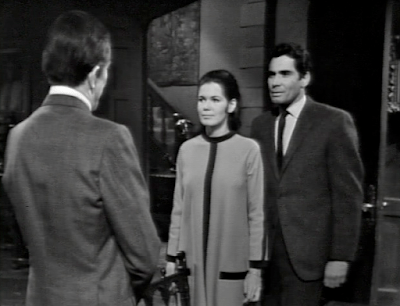
While Vicki is upstairs changing her clothes, Barnabas and Burke talk in the drawing room. Barnabas points out that little is known of how Burke became so rich so quickly in the years before he came back to Collinsport. Burke responds that far less is known of Barnabas than of him, that his entire life before this year is perfectly obscure to everyone. As Barnabas, Jonathan Frid plays this scene with more variety and subtlety of expression than any previous one, and as Burke, Anthony George gives a tight, forceful performance. It is the first time Dark Shadows viewers have glimpsed the reason George had such a long and busy career as an actor.
George was a cold actor who excelled at characters whose intelligence and determination were obvious, but whose feelings and intentions the audience could only guess at. That would have made him a fine choice for the part of Burke in the early months of the show, but these days he spends most of his time giving big reactions to bewildering news and the rest in passionate love scenes with Vicki. George was just awful at both of those. But in today’s duel with Barnabas, Burke is choosing his every word and gesture with care, putting him right in the center of George’s wheelhouse. Opposite the much warmer Jonathan Frid, the effect is electric.
It leaves me wondering what might have been. Mitch Ryan was compelling as Burke #1, but his hot style of acting pushed Burke’s emotions to the surface and took away some of the mystery that would have been needed to make the “Revenge of Burke Devlin” storyline a success. With George in the part, that story would probably still have fizzled, but it might have taken a bit longer to do so. And of course the part George has been struggling with, until this scene in vain, was written for Ryan. If the two had just traded places and the scripts had stayed the same, Burke #1 and Burke #2 might both have been strong characters.
Of course, they wouldn’t have stayed entirely the same. The writers watch the show and are influenced by what they see the actors doing. But they may not have changed as much as you might expect. Neither Ron Sproat nor Malcolm Marmorstein seemed to have much sense of what actors could do. It’s no wonder that George’s first good scene comes in the second episode credited to Gordon Russell. Perhaps if Russell had been with the show earlier, Burke #2 might have been more of a success.
The scene also brings up one of my favorite fanfic ideas. People are going to wonder about Barnabas’ background, and Burke needs to be written off the show. Why not solve both of those problems by having Barnabas enslave Burke, make Burke set up businesses in Barnabas’ name and use his shadier contacts to get Barnabas false identification papers, then kill Burke off once he has exhausted his resources? You could do that in such a way that the other characters would think Barnabas was a nice guy who was using his wealth to prop Burke up, consolidating his position in their eyes. You could also use it to connect Barnabas to the wider world beyond the estate, suggesting that he poses a menace not only to one family but to a whole community.
At length, Vicki comes back downstairs. Burke greets her first, but she barely acknowledges him. She has eyes only for Barnabas. Barnabas may not be in any hurry to bite Vicki, but she is bursting with readiness to get into the vampire story and back into the main action of the show.
Maggie Evans, The Nicest Girl in Town, has vanished from her hospital bed. We start with a long succession of characters talking about this fact with Maggie’s father Sam. Had David Ford played Sam as effectively as he did in his first weeks on the show, one such exchange might have made for a good scene. But Ford is overacting today, and the first part of the episode drags on and on.
We cut to the Old House on the great estate of Collinwood, where Maggie’s boyfriend Joe and dashing action hero Burke Devlin have gone. Vampire Barnabas Collins resides in the Old House along with his sorely bedraggled blood thrall, Willie Loomis. Joe and Burke have no clue there is anything odd about Barnabas, but they don’t like Willie and suspect he may know what happened to Maggie.
Barnabas lets Joe and Burke in the house and explains that he sent Willie to run some errands for him out of town. When they tell him about the evidence that has led them to think Willie might be connected with Maggie’s disappearance, he persuades them that there is nothing to their suspicions. Once they are gone, he calls out “It’s all right, they’ve gone. You’re safe here- safe here with me.” Maggie walks into the room.
Barnabas talking to Burke
This scene is very good. Barnabas is made up to look much more like The Vampire than he has been in previous encounters with characters he was trying to fool into thinking he was a harmless eccentric recently arrived from overseas. He is polite enough to Joe and Burke that they can chalk his appearance up to the lateness of the hour, but as the audience watches him extract information from them point by point, until he knows exactly what they do and don’t know, we can see him calculating when and how he will have to kill them. It is as good a scene as Jonathan Frid has had since he debuted as Barnabas.
Frid’s performance in this scene benefits from his flawless line delivery. Not so, unfortunately, the scene that follows. His bobbles are not especially bad by Dark Shadows standards, but his task is far more fragile than any he has taken on before. We’ve seen him pretending to be the Collins family’s mild-mannered cousin from England; in those moments, Barnabas himself is taking on a challenging acting job, and Frid’s difficulties sometimes dovetail with troubles we might expect Barnabas to have in his performance. We’ve seen him abusing Willie; in those moments, we might expect him to sputter a bit, and Frid can hide some of his memory lapses in that mannerism. But now, he is telling Maggie what his plans are for her. As he does so, we realize he is a crazy man spilling out his deepest and sickest obsession. That context leaves nowhere to conceal even the slightest flub. As a sign of triumphant psychosis, the lines have to flow without interruption. Every time Frid stumbles for a fraction of a second, he breaks character.
Nor can Kathryn Leigh Scott bail him out. As Maggie, her part is to wander around in a stupor and occasionally repeat the last word or two of whatever is said to her. She makes that a lot more interesting to watch than you might expect, but there’s only so far it can take you.
Barnabas’ plan takes us outside the themes we are familiar with from vampire fiction. He wants to brainwash Maggie into thinking that she is Josette Collins, who has now been retconned into the woman Barnabas loved in his human days. His goal is that Maggie Evans will cease to exist, and that in her body Josette will live again.
Dracula never wanted to do anything like that, though after Dark Shadows has a hit with this storyline it will become part of vampire lore. Prince Mamuwalde, the menace in the 1972 film Blacula, kidnapped the heroine and tried to turn her into his long-dead love. Another undead fictional man from Africa had tried the same thing in 1932, when Imhotep, played by Boris Karloff, had spent the bulk of The Mummytrying to turn the heroine into a revived form of his adored Princess Ankh-esen-amun. Frid’s face and coloring were somewhat similar to those of Bela Lugosi, a fact often remarked in connection with his casting as a vampire. But his voice and movements are strongly reminiscent of Boris Karloff, and as a mashup of Dracula and Imhotep he is a synthesis of these two actors.
Barnabas gives Maggie a music box that he had intended to give Josette. He says that he bought it for Josette in his travels in “the Orient,” intending to give it to her “on a very special day,” and “this is that day.” This leaves us wondering why the day never came when he could give it to Josette. Did he become a vampire before he returned from his travels? Did he come back from his travels to find that she was no longer available to him? Or was it supposed to be a present at their wedding, a wedding that never occurred?
Barnabas also produces Josette’s wedding dress and tells Maggie that she, as the new Josette, will wear it. When Imhotep produces Ankh-esen-amun’s clothing and jewelry, we remember that royal personages in ancient Egypt were buried with their possessions and assume that he has retrieved them from her tomb. The show did lead us to wonder if the Collinses once had a similar practice. Willie released Barnabas because he had heard a story that some of the Collinses were buried with expensive jewelry and so was trying to rob a grave. The story of the buried jewels was framed as an echo of the Gothic romances that inspired the first weeks of Dark Shadows, but has now become an anticipation of the show’s journey into Universal Pictures’ back catalogue of horror movies.
If Barnabas does manage to somehow erase Maggie and bring Josette back to life in her body, it won’t be the first time Miss Scott has played Josette. In #70, Miss Scott was the ghost who emerged from Josette’s portrait and danced outside the Old House. Miss Scott put Josette’s veil on again in #126 when she led the ghosts who scared maniacal handyman Matthew Morgan to death before he could murder well-meaning governess Vicki. In that one, she delivered a few lines as Josette. Miss Scott’s name did not appear in the credits as Josette in either of those episodes, and the only time we caught a glimpse of Josette’s face was in #149, when she was played by stand-in Rosemary McNamara. But if by any odd chance a viewer does know that Miss Scott has played Josette before, the final dissolve from a closeup of Miss Scott to one of Josette’s portrait suggests a definite possibility that Barnabas’ plan, nonsensical though it seems, will somehow succeed.
Danny Horn’s post about this episode on his Dark Shadows Every Dayis particularly good. He compares its visual strategy to that of the one surviving contemporary segment of General Hospital, and praises the ambitious approach director Lela Swift took to composing images. I should also mention Patrick McCray’s Dark Shadows Daybook post, in which he analyzes the way the story alienates us from our rooting interest in Maggie’s safety by promising a more exciting story if Barnabas has his way with her for an extended period.
Dark Shadows began with no happy couples. When the show started, reclusive matriarch Liz was legally married to a man named Paul Stoddard, whom neither she nor anyone else had seen in eighteen years. Liz’ brother, high-born ne’er do-well Roger Collins, was married to Laura Murdoch. Roger hadn’t seen Laura in years, and was quite happy with the idea he would never see her again. When she did show up, everyone learned that she was a murderous fire witch from beyond the grave, not at all the sort of person you can settle down with. Liz’ daughter, flighty heiress Carolyn, was dating hardworking young fisherman Joe, and the two of them were sick to death of each other. Everyone else was single.
Now, we’ve learned that the reason Liz hasn’t left the house since 1948 is that she’s afraid someone will dig up the basement and find Stoddard’s corpse. Laura is dead, more or less, and Roger has taken up life as a Confirmed Bachelor. Joe and Carolyn have gone their separate ways, and he is in a relationship with Maggie Evans, The Nicest Girl in Town. There are no obstacles to their happiness, so no reason for them to be on screen in a soap opera, and we’ve barely seen them. Except for Joe and Maggie, everyone is single.
When the narrative found seagoing con man Jason McGuire the day after Laura finally disappeared, we would occasionally glimpse him talking urgently on the telephone to someone whose name turned out to be “Willie.” The original plan had been that Jason would call this person “Chris,” leading the audience to suspect that he was trying to reassure a woman named Christine or Christabel or whatever of her part in his plans.
Willie would eventually show up. His chaotic behavior outraged most people and jeopardized Jason’s evil plans. No one had enough information to figure out the nature of Jason’s connection to Willie, certainly not the audience, but it was clear that they had known each other for years and were rarely apart for long in that time. Jason insisted that Liz keep Willie around the great house of Collinwood even when Willie was a grave inconvenience to him.
Now, their association is at an end. Unknown to Jason, a third party has disrupted their relationship. Willie has wakened a vampire and become his blood-thrall.
Today, Willie is getting out of bed, and he and Jason have a quarrel. Jason complains that he has asked Willie every question he can ask, and hasn’t got a single answer. He laments that they are “splitting up,” but he can’t see any alternative. Willie, dreading what the night holds, doesn’t protest.
If they had stuck with the name “Chris,” the audience might have reacted differently to these scenes. When we first saw that Chris was Christopher, we would have set aside the idea that Jason might be bringing a lover to town. But as the weeks pass and it never becomes any clearer what Jason wants from Willie, that thought might have come back to our minds as one of the possibilities we can’t quite exclude. Seeing how comfortable Jason is in and around Willie’s bed and hearing his lines about “splitting up” with him, we might wonder if the show is trying to tell us something.
Jason takes Willie downstairs to tell Liz that he is now leaving her house not to return. Willie wants to tell Liz something, but she doesn’t want to hear anything he has to say. He pleads that it is important, but she refuses to listen. He goes away sadly, and the audience assumes that he just lost the last moment of freedom when he could have spoken out against the vampire.
The vampire himself then comes to pay a call on Liz. He is her recently arrived cousin Barnabas Collins, ostensibly from England. He presents himself to Liz as a courtly, rather diffident gentleman. He has asked to live in the long-abandoned Old House on the grounds of the estate. She has thought it over, and is delighted to give him the keys.
Barnabas enters the Old House, leaving the door open behind him. He looks around. He turns to the door and says “What are you waiting for? Come in.” A defeated Willie enters.
Barnabas summons Willie into the Old House
Barnabas tells Willie that this will be their new home, and that he will have much work to do in the days to come. Willie says that is all right. He tells Willie that he knows what he has to do tonight. Willie reacts with horror and protests that he can’t do it. Barnabas tells him there is no longer any connection between what he wants and what he will do, and orders him to go forth.
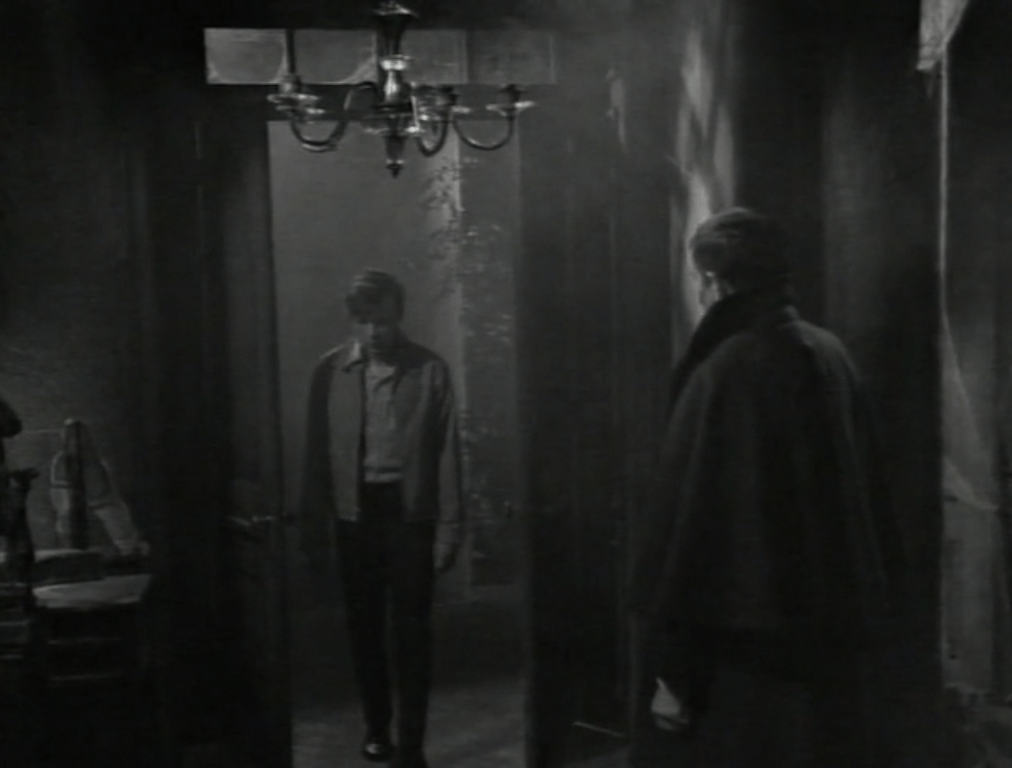
We saw Barnabas’ hand clutch Willie’s throat at the end of #210 (reprised at the beginning of #211.) We’ve seen Barnabas communicate with Willie several times through his portrait in the foyer at Collinwood. This is the first scene the two actors have together, and is also the first time we see Barnabas without his “cousin from England” shtick. After he made some remarks to well-meaning governess Vicki at the great house that sounded harmless to her and sinister to the audience (for example, “You cannot put a price on what I intend to do” in the Old House,) the sight of him without his mask carries a punch.
Three locations on the great estate of Collinwood have featured prominently in two or more storylines on Dark Shadows: the great house, the long-abandoned Old House, and the cottage. The great house is the only permanent set, and is the site of most of the action. The cottage has been vacant since blonde fire witch Laura left the show in March, and came to be so strongly associated with her that it will likely remain vacant until the audience doesn’t expect her to come back. As the abode of ghosts and ghouls, the Old House is likely to become central to the show as it takes its turn to the paranormal. And indeed, in his first full episode, the mysterious Barnabas Collins had gone to the Old House and announced to its invisible occupants that he was claiming it as his own.
The physical condition of the Old House evokes an extinct storyline. When the series began, the Collinses were running out of money, and their vengeful foe Burke Devlin had vowed to use his own great wealth to ruin them completely. Now Burke has lost interest in vengeance, and the business stories have vanished altogether. If we aren’t going to be hearing about the Collinses’ precarious financial position, we won’t be able to explain why they have let a huge mansion on their property go completely to ruin. Even if the locals are too afraid of the place to do any work there, a family rich enough to have a secure grip on the assets we hear about would be rich enough to hire an out-of-town crew to fix the place up, or tear it down, or at least clear it out and seal it off. So the Old House is going to have to be transformed to get the last of the narrative clutter left over from the first 39 weeks out of the way.
Today, Barnabas asks reclusive matriarch Liz and her brother, high-born ne-er-do-well Roger, if they will let him live in the Old House and use his own funds to rehabilitate it. Liz is stunned by the idea and doesn’t know what to say. When Barnabas offers to pay whatever rent they might wish to charge, Roger exclaims that they wouldn’t dream of charging him anything at all. At that, they cut to a startled reaction shot from Liz. Regular viewers will find this reaction hilarious. Liz owns the place; Roger owns nothing and is staying there as her guest. Liz is quite surprised at Roger’s generosity with her property.
Liz reacts to Roger’s generosity with her property
Jonathan Frid is excellent in this scene. Barnabas is at once faultlessly well-mannered and entirely relaxed, gentle with Liz’ unease and warm to Roger’s enthusiasm. Everything they can see suggests to Liz and Roger that Barnabas would be a valuable addition to any household.
We, of course, know that Barnabas is an undead creature released from a coffin to prey upon the living. Watching the scene with that knowledge, we are in suspense as to Barnabas’ intentions. It seems clear that he wants Liz and Roger to like him now and to voluntarily give him what he wants. We do not know if he will go on wanting that for any length of time, nor do we know how he will respond if they oppose him in any substantial way. Because Barnabas stays entirely in character as the human he is pretending to be, we have no clue as to how far the act he is putting on diverges from his true motives. For all we know, Liz and Roger’s oh-so-courtly, oh-so-amiable cousin may be planning their deaths at this very moment.
Before he leaves the house, Barnabas has a conversation with seagoing con man Jason McGuire. Jason is blackmailing Liz, and has forced her to accept him as her house-guest. He is a throwback to an earlier period of the show, an in-betweener brought on the day after Laura left to clear away the last non-paranormal plot elements and to help introduce Barnabas.
Jason is clueless that the show changed its genre from the noirish crime drama it more or less was in the fall of 1966 to the supernatural thriller/ horror story it has been since. That cluelessness was illustrated in the opening of the episode, when he has followed his friend and sometime henchman, the sorely bedraggled Willie Loomis, to the Tomb of the Collinses. He has figured out that Willie tried to rob the graves in the tomb, but cannot imagine what he actually found there. Today, Jason looks around the interior of the tomb, baffled that Willie seems to have disappeared, and wanders off helplessly. Barnabas then appears and watches him go, the future of the show seeing off an emissary from its past.
Jason wants to know more about the legends that Barnabas’ relatives were buried with their jewels, the legends that gave Willie the idea of robbing their graves and thereby led to Barnabas’ release from his coffin. Barnabas tells Jason those legends are false, and rehearses his whole “cousin from England” bit. Not much happens. Still, the conversation is fun to watch, because the actors are both on top of their game and the characters represent different directions Dark Shadows might have taken at different points in its development.
The opening voiceover complains about “a frightening and violent man.” We then see a fellow with a crazed look on his face trying to break into a coffin. Assuming that he is the frightening and violent man, a first time viewer might not be especially upset when a hand darts from the coffin and chokes him, even though something like that can’t be altogether a good sign.
At a mansion identified as the great house of Collinwood, an aristocratic lady is demanding that a man in a captain’s hat account for the whereabouts of someone called Willie. The man answers to the name of Jason and calls the lady Liz. Liz has had all she can take of Willie, whoever he might be, and is not at all happy that Willie’s things are still in her house. Jason does a lot of fast talking, but cannot satisfy Liz either that Willie is really leaving or that he himself does not know where Willie is.
Jason talks with the housekeeper, a woman named Mrs Johnson. He asks her a series of questions about what she knows about Willie and she asks why he wants to know. Even though Mrs Johnson was in the room when Liz was insisting that Jason find Willie and get rid of him, for some unaccountable reason he will not tell her that he is looking for Willie.
Despite Jason’s inexplicable reticence, Mrs Johnson does tell him that Willie was preoccupied with the portrait of an eighteenth century figure named Barnabas Collins, that he was also interested in a legend that another eighteenth century personage, someone named Naomi Collins, was buried with a fortune in jewels, that Naomi Collins is buried in a tomb in a cemetery five miles north of town, and that the night before she saw Willie hanging around the toolshed. Returning viewers will recall that in yesterday’s episode, well-meaning governess Vicki had also told Jason that she had seen Willie in the vicinity of the toolshed, carrying a bag. There doesn’t seem to be a television set in the house, so everyone spends the evenings looking out the windows at the toolshed.
We see a cemetery. It soon becomes clear that it is the same cemetery we saw in the opening teaser. The gate of the tomb in which the frightening and violent man did his sinister work is swinging in the breeze. An old man in a three piece suit and celluloid collar comes upon it. He shows alarm and mutters that he can feel evil in the air.
Jason arrives at the cemetery and meets the old man. Jason says that he is looking for a friend of his, a young man. The old man identifies himself as the caretaker of the cemetery and laments the fact that a young man meeting the description Jason gives was there last night and broke the lock on the gate to the tomb. A first-time viewer’s suspicion that Willie and the frightening and violent man from the teaser are one and the same finds confirmation.
The caretaker can’t believe that Jason is unable to sense the palpable evil that emanates from the tomb. Jason overcomes the caretaker’s attempts to keep him out and makes his way into the tomb. The caretaker keeps warning Jason of the perceptible evil and Jason keeps failing to perceive it. Jason does find a cigarette on the edge of a casket in the tomb, and in closeup gives a look that can only be his recognition of a trace of Willie’s presence.
Jason finds Willie’s cigarette
Jason returns to the great house. Liz is exasperated that he still can’t tell her where Willie is, and Mrs Johnson is irritated he doesn’t put his hat and coat where they belong. After Jason and Liz have left her alone in the foyer, Mrs Johnson takes Jason’s things to the coat closet.
We see Mrs Johnson fussing with the hat and coat from inside the coat closet, an unusual perspective that has in the past been used during shots when characters have stumbled onto important evidence about whatever mystery they were puzzling over at the moment. The shot goes on long enough to lead us to wonder if Mrs Johnson is about to find something important. My wife, Mrs Acilius, mentions that each time she has seen this shot she expected Mrs Johnson to find Willie’s cigarette in Jason’s pocket and to recognize it.
Mrs Johnson fussing with Jason’s coat
That expectation is thwarted when there comes a knock at the door. Mrs Johnson answers and greets the visitor.
The next shot is from the perspective of the visitor. We see a look of astonishment on Mrs Johnson’s face as a man in a fedora and an overcoat asks to be announced to “the mistress of this house, Mrs Elizabeth Collins Stoddard.” He identifies himself as Mrs Stoddard’s cousin from England. Mrs Johnson invites the man in. He hastens across the threshold.
We cut back to the interior, and see the man and Mrs Johnson facing each other. As she bustles up the stairs, the camera tracks around to show him standing next to the portrait of Barnabas Collins, a portrait he resembles strongly. He says, “Oh, madam! If you would, you may tell her that it is Barnabas Collins.”
For regular viewers, it is refreshing to see Jason on the defensive. Ten times in the first eight episodes where they appeared together, he and Liz had a conversation in which he made a demand of her, she resisted, he threatened to expose her terrible secret, and she capitulated. Today is the second episode in which they have interacted without reenacting this drab ritual. Liz is driving the action, Jason is thinking fast, and they are each in their element. For a first time viewer wondering about the hand that came out of the coffin, it’s a lot of filler, but for those of us who have been suffering through the tedium of the blackmail plot it is a fun change of pace.
Regular viewers will also be glad to see the return of the caretaker. He appeared four times* in the storyline of Laura Murdoch Collins, the humanoid Phoenix, and managed to be simultaneously eerie and funny. His catchphrases “Died by fire!” and “The dead must rest!” are all it takes to make Mrs Acilius laugh out loud. His return in #209 moved Patrick McCray to label him a refugee from the EC comics universe, and in my post about that episode I pointed to a shot that looks so much like a panel from an EC comic book that I wonder if the similarity might have been intentional.
While first time viewers may be confused or impatient with the caretaker’s oft-repeated attempts to alert Jason to the nimbus of evil that hangs in the air around him, regular viewers know that the caretaker is the one who understands the show he is on. Jason thinks that he’s on a noir crime drama, and indeed there had been a period when Dark Shadows just about met that description.
But for months now, all the action has been pointing towards the supernatural back-world behind the visible setting. Jason’s own storyline was introduced the very day Laura’s ended, and it is a means for wrapping up all the non-supernatural narrative elements still lying around. Jason’s insensibility to the evil in the tomb is not only a sign that he is himself too corrupt to tell the difference between a wholesome space and a cursed one, but also that he doesn’t fit into the genre where Dark Shadows will be from now on. The audience in 1967 wouldn’t have known that actor Dennis Patrick always insisted on fixing a date for his departure when he joined the cast of a daytime soap, but this scene should give them a strong indication that Jason McGuire is not to be with us indefinitely.
Patrick McCray’s commentary on this episode includes an analysis of director John Sedwick’s visual strategy in the last two shots, those in which Jonathan Frid first appears as Barnabas Collins. McCray confines himself to the first thing photography students are usually taught, the “Rule of Thirds.” But that’s all it takes to get us to look closely at the imagery and to see how Sedwick tells his story with pictures:
Two clear and subtly clever images with a bridge. His introduction comes from his own perspective, rather than Mrs. Johnson’s. It’s an exterior shot of the entrance, looking in.
The grid helps us divide the image. People in the west read from left to right, and tend to circle in our gaze back to the left. Sedwick uses this model of composition in all three shots. In image 1, we see someone — him? — through the eyes of Mrs. Johnson as the camera hangs over his shoulder, minimizing her (1.1). Why is she so transfixed? We follow her gaze up to the towering figure (1.2). Following the slope of his collar, we come back to Mrs. Johnson… specifically, her throat (1.3). After that, we circle back up to her gaze, even more worried. For what reason?
Then he enters with purpose, and we next see him again from the back, divesting himself of his cane and hat, getting a glimpse of his strangely antique cloak. His voice is rich with a uniquely tentative sense of authority. We still don’t see his face, just bits of his profile. These moments tease us, and yet they put us in the position of a confidant of the vampire’s. The composition mirrors what we saw outside. Within, Mrs. Johnson (2.1) is minimized, and the turn in the figure shows him looming, ready to pounce. Again, we begin with her, following her gaze from left to right. The mystery of what bedevils her, bedevils us, as well. The man towers (2.2) in the right, blocking the exit. Instead of following a sloping collar, we follow its larger, expanding offspring in the cape, which takes us circling to the left again where we stop on the poor, miniscule shield of his hat and then, like a wolf pulling her away, his feral looking cane (2.3).
Situated so close to the predator, with his gaze elsewhere, we have a strange safety. We don’t see him from the eyes of his prey. Instead, we are a quietly unacknowledged friend. Finally, as Mrs. Johnson goes to summon Elizabeth, the figure turns to face the portrait, rotating upstage to let us see him from profile to profile. As she exits, and we are alone with him, the chiseled face comes into focus from the side. It is alien. It is familiar. We think we know why, but then we see why. They are only face to face for a moment before the camera takes us away from him and uncomfortably close to the painting from 1795, cold and haughty and haggard and sad. He then steps even uncomfortably closer to it and spins to give his inevitable name. We see the two men in mutual relief.
The painting of Barnabas is a prisoner in a four-sided frame on the wall, disapproving and distant as the first thing our eyes rest on (3.1). Is the painting gazing at the man? No. The more we look, the more the painting is gazing at us, as if we’ve been caught looking. It’s natural to avert our eyes from this, and by comparison, section 3.2 is practically benevolent. His impossible doppelganger is standing before it in three dimensions on our 2D screen. Liberated, he smiles, and there is something optimistic about it. He’s gazing upward to the landing, yes, but it’s also to the future. Gazing left, he’s anticipating the next image rather than look for one that has passed. Subtly, our eyes wander down to 3.3, his medal, a subtle reminder that, despite his strange warmth, he’s a soldier as well, and a force to be reckoned with.





 Dark Shadows Commentary