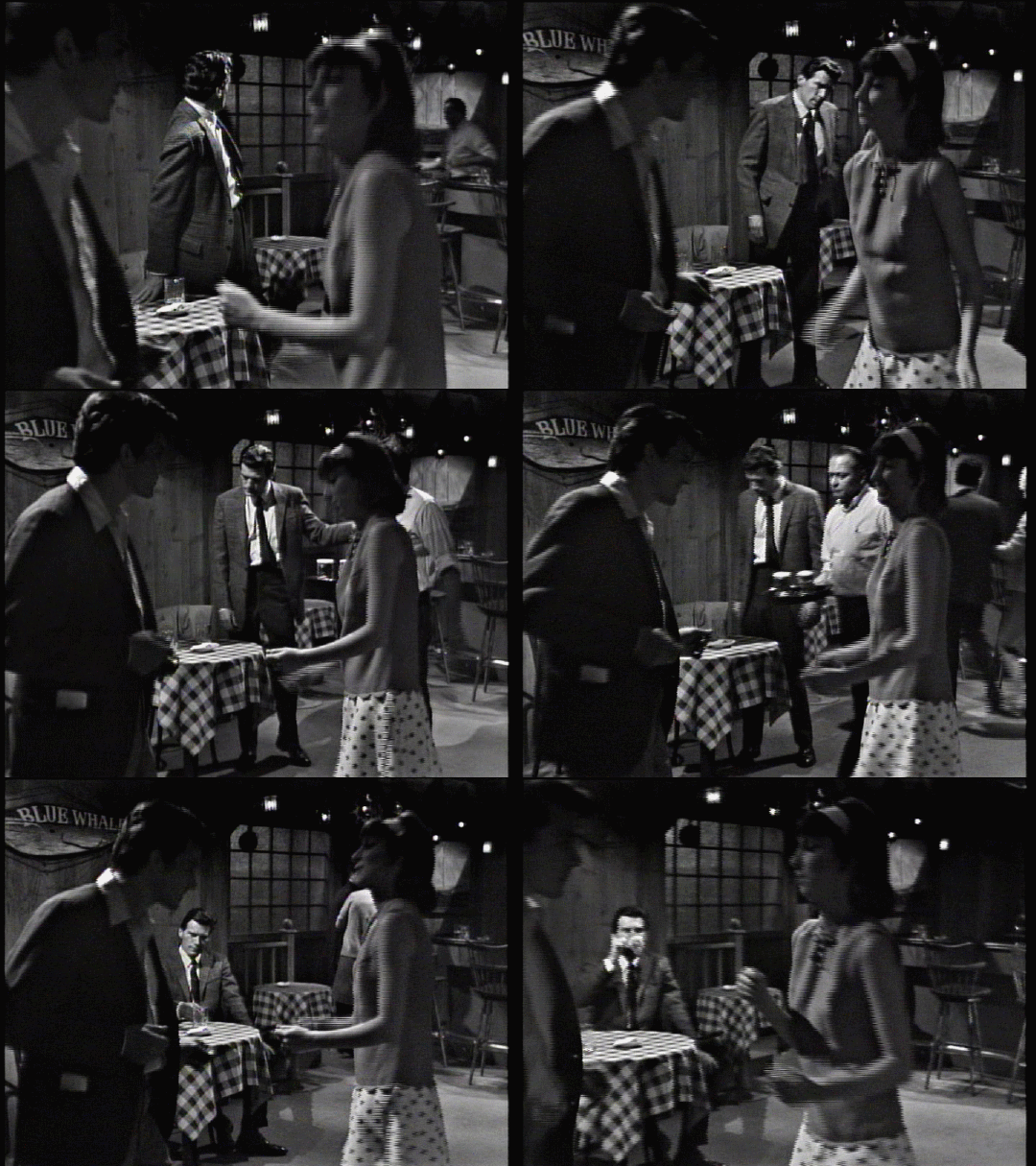
Maggie Evans, The Nicest Girl in Town, can’t stand being cooped up in her house all the time waiting for the person who abducted her and held her prisoner to be identified. Since she has amnesia covering the entire period of her captivity, her father Sam and her boyfriend Joe have to recap the whole storyline to her before they agree to go with her to the local tavern, The Blue Whale, where they can meet with other people who will help them recap the storyline that followed.
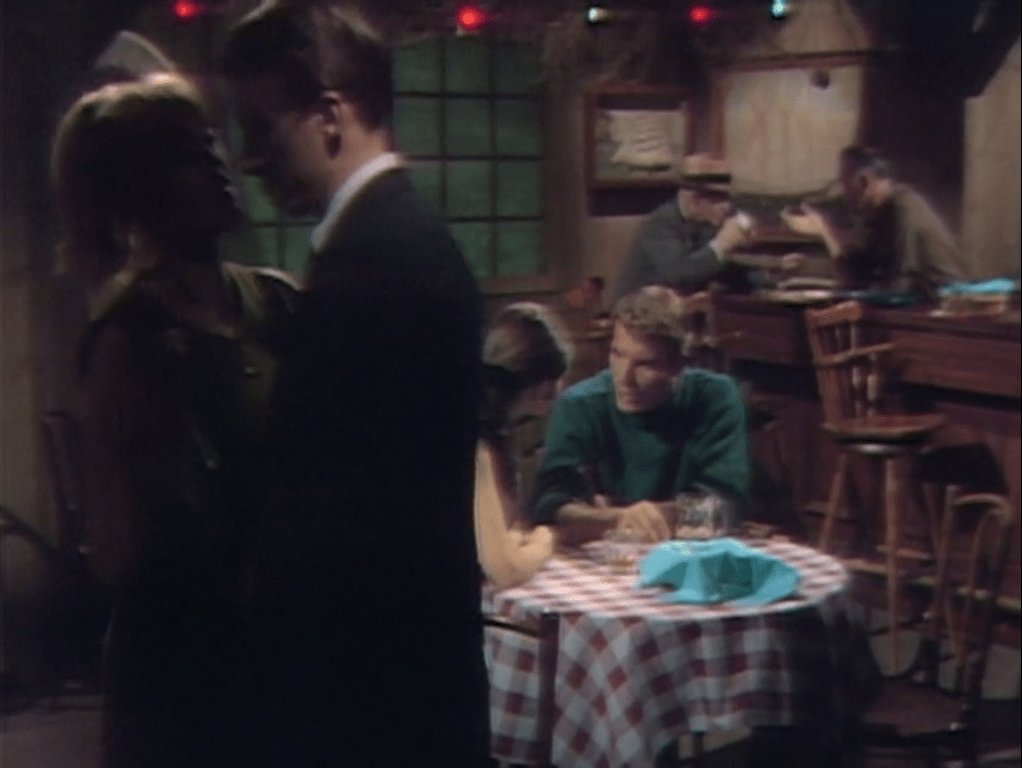
At the Blue Whale, a couple stands at the jukebox and play the theme from “A Man and a Woman.” We see that Bob the Bartender is back on duty. The other day, someone else was in his place, so it’s a relief to know that he’s still around.
At The Blue Whale.
Joe enters, and finds well-meaning governess Vicki alone at a table. He joins her, and she explains that she is waiting for her depressing fiancé Burke. Joe explains that he is waiting for Maggie and Sam. They start recapping while Bob brings them drinks and the couple dances. The couple must be out-of-towners- they aren’t good dancers, exactly, but neither are they doing the Collinsport Convulsion.
Unusually competent dancing.
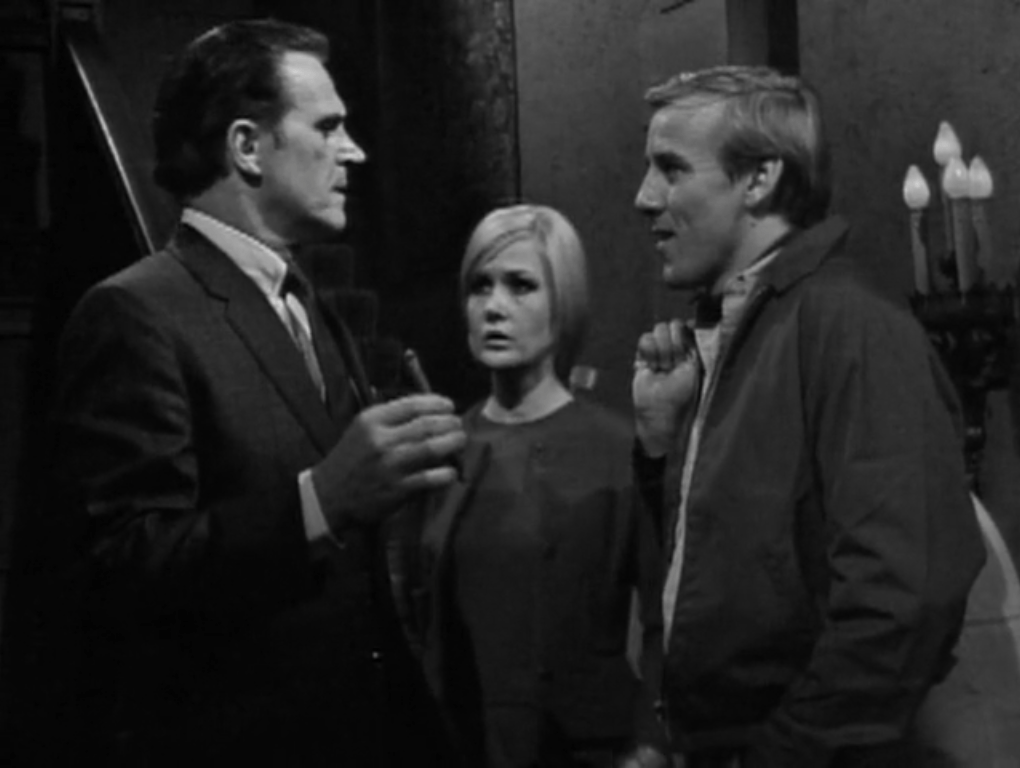
Maggie and Sam arrive. “A Man and a Woman” continues to play while everyone compares notes about a mysterious little girl named Sarah who seems to have had some connection with Maggie during the time she was missing. Everyone tells everything they know, except Vicki. This is odd- Vicki is the one who brought up the topic of the little girl and who keeps pressing it forward, but she does not mention that she saw Sarah at the top of the stairs in the house occupied by courtly gentleman Barnabas Collins.
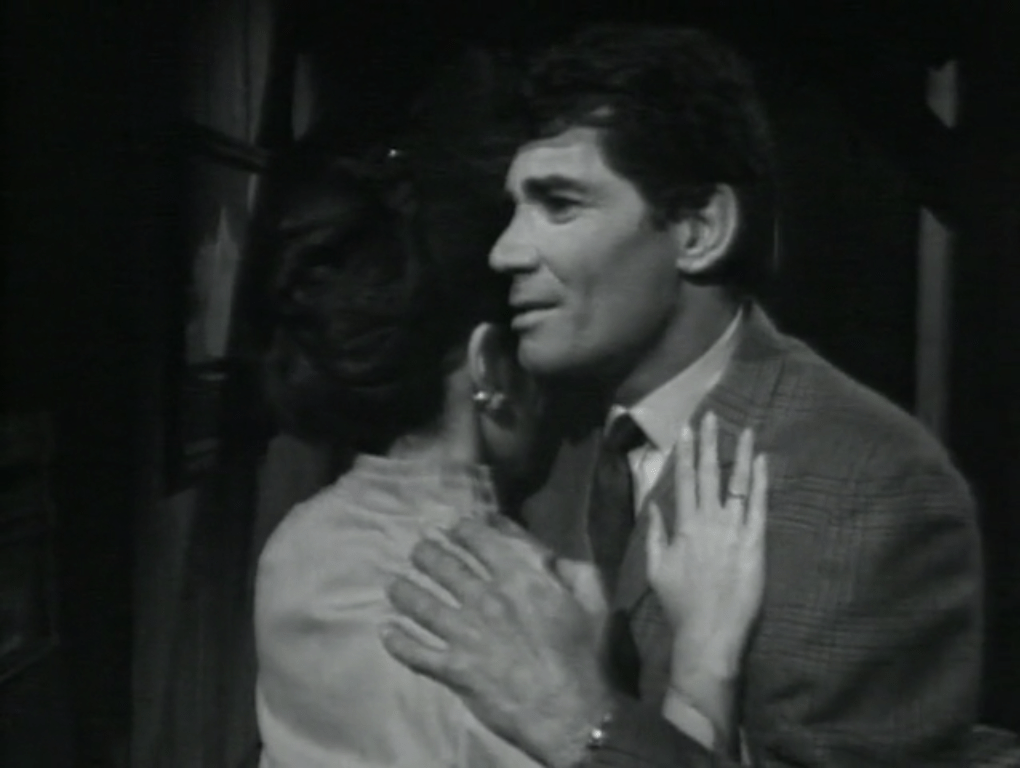
Burke enters. Maggie, Sam, and Joe excuse themselves. Burke has been so dreary in recent weeks that it’s hardly surprising Maggie would rather resume hiding in her house than be around him.
Vicki is upset with Burke. Barnabas complained to her yesterday that Burke was having him investigated. She demands that he shut the investigation down at once, issuing an ultimatum that she will end their engagement if he does not. Burke sounds smarter than he has in months as he explains his reasons for thinking there is something sinister about Barnabas. Unlike all the scenes where Burke was angrily asserting that Vicki was crazy for saying that she had seen and heard things we had also seen and heard, Vicki stands her ground. She won’t give an inch, and she immediately comes up with plausible explanations for all of Burke’s observations.
When Burke starts talking, the background music shifts from “A Man and a Woman” to “Brazil.” We have heard this tune behind Burke at the Blue Whale many times; it really is his theme song. When it plays, we know that we’re supposed to focus on him. When he starts talking about Maggie, it shifts again, to one of the “Blue Whale” dance tunes Robert Cobert wrote for the show. That tells us that Burke is no longer the subject- instead, we are paying attention to the overall story of Dark Shadows.
As it happens, returning viewers know that Burke is right about Barnabas and Vicki is wrong. We also know why Vicki didn’t volunteer that she saw Sarah at Barnabas’ house- she does not want to cast any suspicion on her friend. But we also know that the Dark Shadows has been fun since Barnabas joined the cast, and that no stories are going on that do not center on him. If Barnabas is caught, there won’t be a show for us to watch. Besides, it’s great to see Vicki finally standing up to Burke, even if it isn’t on one of the many occasions when he is wrong. Nor is Anthony George even struggling to play him. He is a cold actor who is at a loss when Burke is supposed to be reacting ferociously to provocations or exuding passion in love scenes, but this scene is right up his alley, with Burke cool, forceful, and intelligent. Alexandra Moltke Isles gets a real workout having to dominate the scene when George is in his wheelhouse, and she pulls it off admirably.
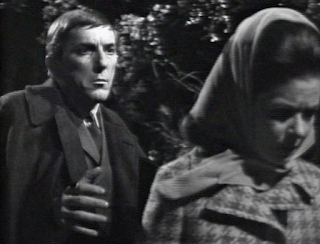
Reclusive matriarch Liz is standing on the edge of a cliff, staring out to sea. Her distant cousin, Barnabas the vampire, comes up stealthily behind her. He grabs her, and she screams.
For months, Liz has been stuck in a go-nowhere storyline about blackmail. So it is exciting to see the beginning of a new story where she is under Barnabas’ power. Or it would be, if that were what was happening. Instead, we come back from the opening credits to find that Barnabas approached Liz that way only because he was afraid she might go over the cliff if he made a noise and startled her.*
As a result of the blackmail arc, Liz is suicidal. Barnabas fears that she may be trying to jump, and tries to cheer her up by spending several minutes delivering a semi-coherent oration about how wonderful it is to be dead.
The scene started with a disappointment, and the dialogue doesn’t make much sense, but it is always fun to see Jonathan Frid and Joan Bennett work together. Frid’s acting style was a bit of a throwback to the nineteenth century, which made him an ideal scene partner for a daughter of Richard Bennett.
In #264, Barnabas had made some remarks to Liz’ brother Roger about the importance of family. Barnabas had then gone on to bluster uselessly at Liz’ blackmailer, seagoing con man Jason. He later told his sorely bedraggled blood-thrall Willie that he might kill Jason soon. As a vampire, Barnabas is a metaphor for extreme selfishness, and his hostility to Jason fits into that- Jason does represent a possible inconvenience for him. But today, we see a hint that Barnabas might actually have some measure of concern for Liz and the rest of the Collinses. After he walks Liz home, he confides in the perpetually well-meaning Vicki that he was afraid Liz would jump off the cliff. He tells Vicki that she seems to be the person most able to help Liz.
Yesterday, housekeeper Mrs Johnson had grabbed Liz as she was about to plunge off the same cliff, and had told Vicki of the incident. But Mrs Johnson just thought Liz was fainting. Vicki had noticed yesterday that Liz was deeply depressed, but she is shocked and disbelieving when Barnabas breaks the news that she seems to be suicidal.
On his way into the house with Liz, Barnabas had seen strange and troubled boy David Collins. David had seen Liz, but Liz neither saw nor heard him- she walked silently away from him, even though he twice called out “Aunt Elizabeth!”
In #256, David had met a little girl wearing eighteenth century dress hanging around outside Barnabas’ house. Unknown to anyone but the audience, the little girl is the ghost of Barnabas’ sister Sarah. David told Willie about Sarah, and Willie himself saw her in #264 and told Barnabas about her. Today, Barnabas tells David that if he sees Sarah again he should tell her to stay away from his property.
Barnabas’ message to Sarah and David
David denies that Sarah is his girlfriend, and says that her habit of singing “London Bridge” gets on his nerves. Barnabas is startled by the mention of “London Bridge.” David says that he isn’t likely to see Sarah near the Old House again, because “I’m not allowed to play at the Old House.” He delivers this line with a pungency that led us to laugh out loud. The whole scene is a lot of fun.
Barnabas had turned his creepy, anachronistic charm on at full force when talking to Vicki, and was obviously disappointed when she told him she had a date with fake Shemp Burke Devlin. He politely responded to this news by describing Burke as “a very interesting man.”
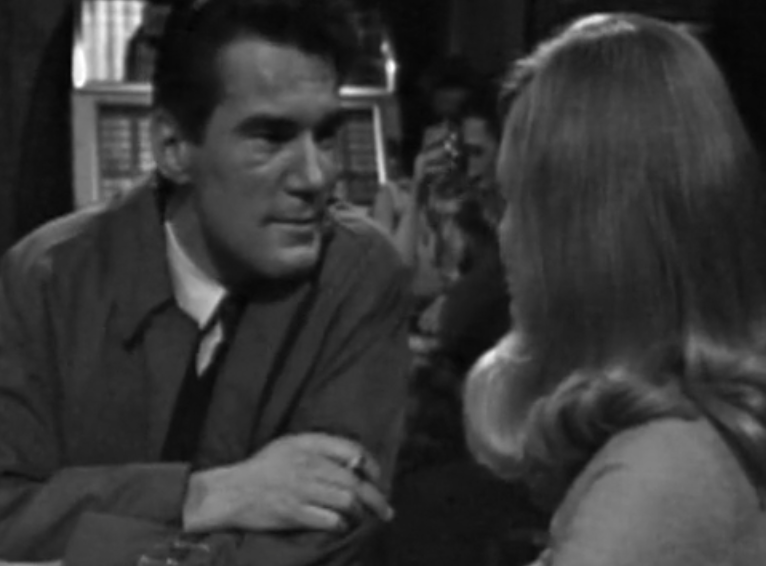
We then go to the Blue Whale tavern, where we see that “very interesting man” drinking and smoking by himself for a minute and a half. He wanders from his table to the bar to get another drink, passing some people whom first-time viewers will believe to be suffering from spastic disorders, but whom regular viewers will recognize as Collinsport residents who think they are dancing.
Notice her right hand- she has her guard up in case the convulsions spread to his arms
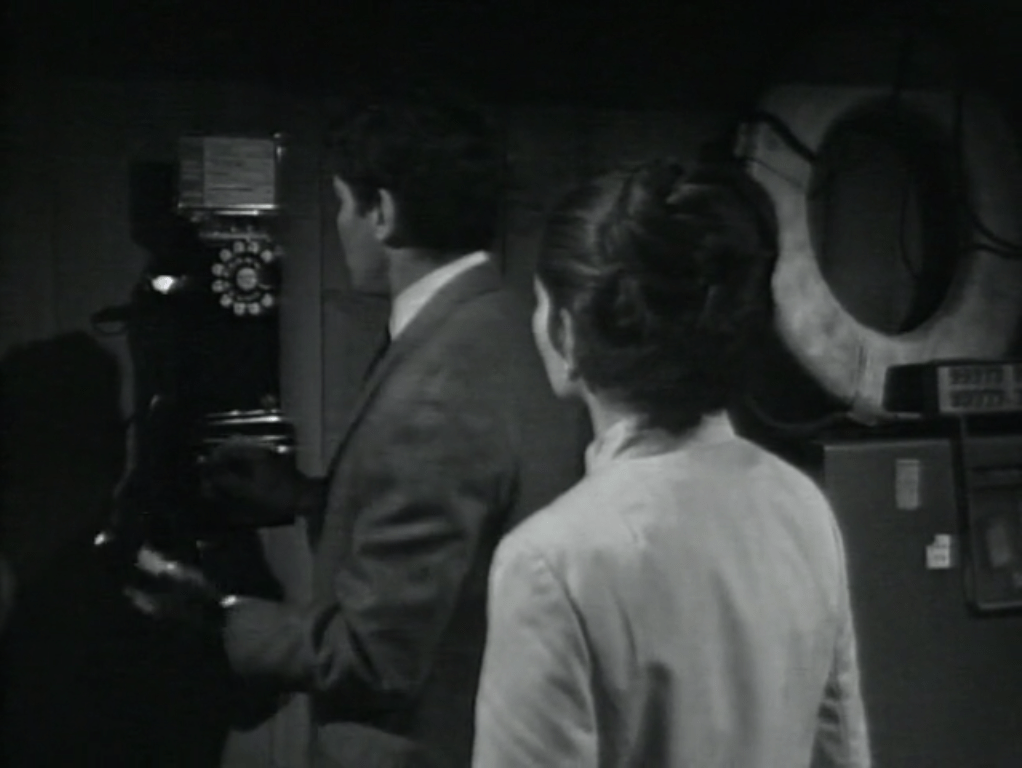
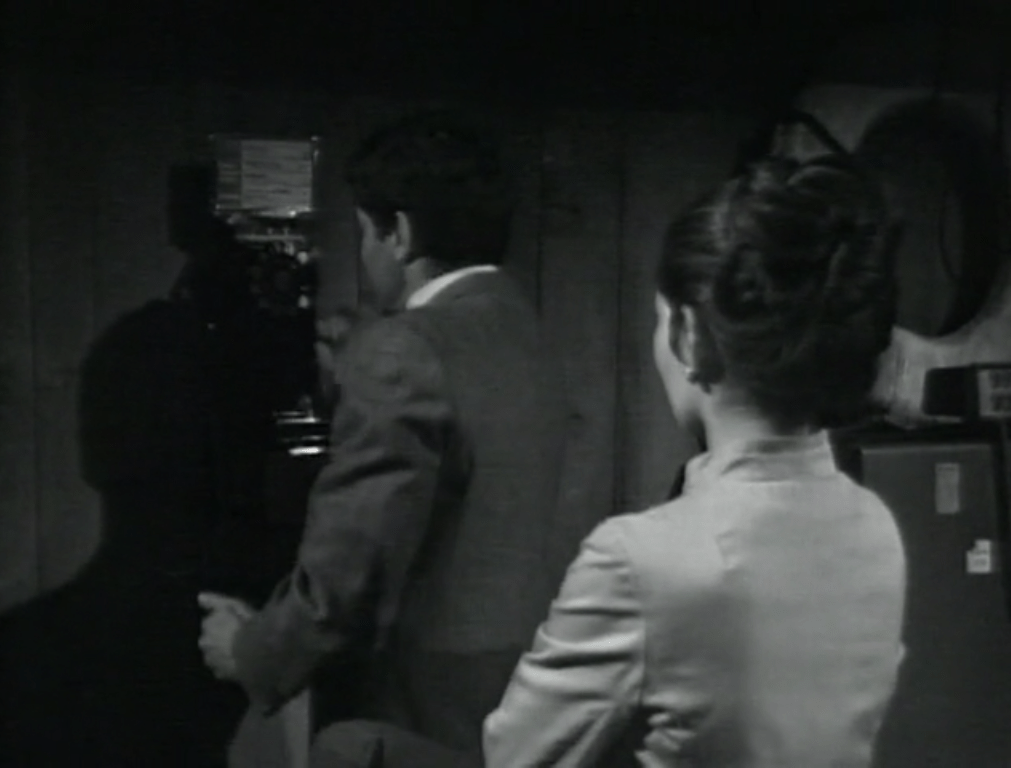
Burke goes to the pay phone to call Vicki. She enters, and he tries to get his dime back. He takes the receiver off the hook, replaces it, probes around in the coin return, bangs the side of the phone, explores the coin return again, and sadly tells Vicki that he has lost his dime. She tells him that if the purpose of calling was to get her to show up, he got his money’s worth. He agrees, but keeps looking back at the phone with longing.
Burke and Vicki dance. She tries to take his mind off the lost dime by recapping the last couple of episodes, but too little of interest has happened to refocus his attention. Vicki gives up and says she’s going home. We don’t see Burke resume his battle with the coin return slot, I guess they decided they had already given us our thrill for the day.
Back in the house, Liz is sitting in front of a table on which there is an open book. She is staring blankly into space. David enters the room. He greets her. She smiles vaguely, mumbles “Oh, David,” then gets up to leave. When Vicki comes in and says hello, Liz mutters “Hi, Vicki,” but doesn’t turn her head to look at her.
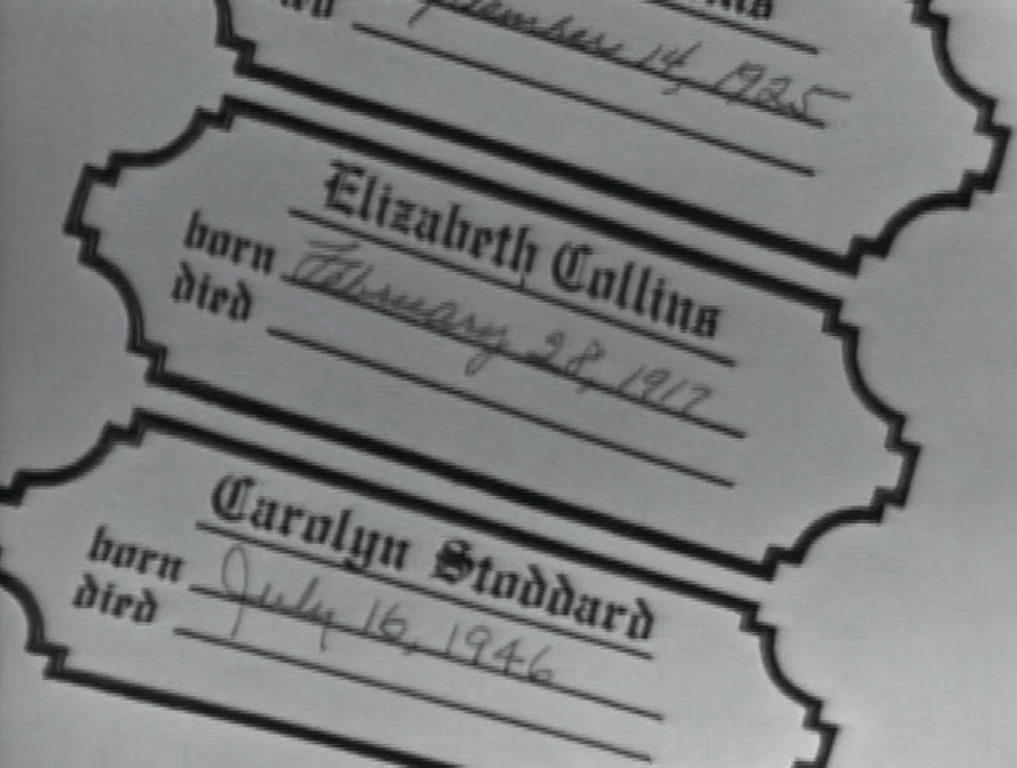
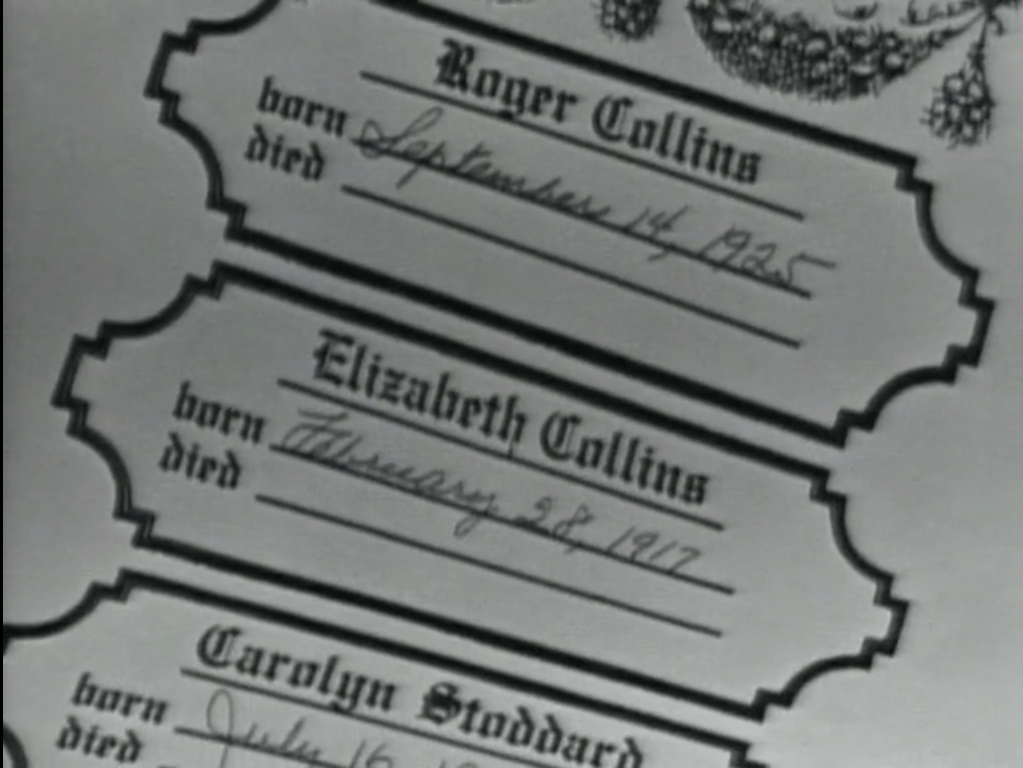
David calls Vicki’s attention to the book. It is the Collins family Bible, and was open to some plates that have been inserted bearing birth-dates for Liz and other members of the family. That’s the end of the episode. I must say, it’s quite an anti-climax after Burke’s attempt to retrieve his lost dime.
Closing Miscellany
Bob O’Connell is not on hand to play Bob the Bartender at the Blue Whale today. Instead, the bartender is Tom Gorman, who played the same role in #104 and will reprise it again in #607.
The birth-dates in the Collins family Bible are:
Roger Collins, 14 September 1925
Elizabeth Collins, 28 February 1917
Carolyn Stoddard, 16 July 1946
By comparison, the actual birth-dates of the actors were:
Louis Edmonds, 24 September 1923
Joan Bennett, 27 February 1910
Nancy Barrett, 5 October 1943
So it looks like they adjusted Edmonds’ and Bennett’s birth-dates by a few days plus a few years in setting their characters’ births, but ignored Miss Barrett’s actual birth-date in setting Carolyn’s. Maybe she refused to tell them what it was!
The show has been hinting heavily that Vicki is Liz’ biological daughter. A birth-date of 16 July 1946 for Carolyn would tend to pull against that- Vicki had apparently just turned 20 when the show started late in June 1966. Unless they were twins, one or the other of those characters is going to have to have her birth-date adjusted if they are going to resolve the question of Vicki’s origin that way.
*That’s a concern we’ve heard several times on this set- in #2, Roger introduced himself to Vicki by startling her as she stood at the edge of the cliff, and in #75 Vicki did the same thing to Roger. In #139, David was at the edge of the cliff when his mother, blonde fire witch Laura Murdoch Collins, surprised him; the episode ended with a literal cliffhanger after Laura made a move David wasn’t expecting. We’ve heard many times that the legendary Josette Collins was “the lady who went over the cliff,” as artist Sam Evans calls her in #185. It’s unclear why she did- maybe someone startled her.
For almost 13 weeks, seagoing con man Jason McGuire (Dennis Patrick) has been blackmailing reclusive matriarch Liz (Joan Bennett.) Time and again, Liz has capitulated to Jason’s demands lest he reveal that she murdered her husband Paul Stoddard 18 years ago and he buried Stoddard in the basement. When Liz gave in to Jason’s demand that she marry him, her daughter Carolyn (Nancy Barrett) vowed to prevent the marriage.
Today, it looks like Carolyn may have found a way to fulfill that vow. She has announced her engagement to motorcycle enthusiast Buzz (Michael Hadge,) whom Liz cannot stand. Liz considers going to the police to keep from gaining Buzz as a son-in-law.
We spend the first half of the episode in the great house of Collinwood. Buzz has come to see Carolyn. The opening sets up a charge of comic energy that raises our hopes for another installment as funny as Buzz’ first star turn in #254. Buzz knocks on the front door, Liz opens it, and greets him with a disgusted “Oh.” She closes the door in his face, then goes inside to tell Carolyn that he is there. Carolyn goes out to meet Buzz, who is smoking a large cigar.* They kiss, and Carolyn lets Buzz in. He takes a seat on the staircase.
Buzz on the stairs
Instead of building on the comic potential Buzz brings with him, we then grind to a halt with a Buzzless scene in the drawing room. Carolyn recites teen-rebel cliches at Liz, punctuating her dreary lines with a few random pokes at the piano. Nancy Barrett’s all-in style of acting often exposes values that another performer might have left buried in the script, but when the writing is as tired as this not even she can dig up anything interesting.
Carolyn chose Buzz to mock her mother’s relationship with Jason. She defies Liz to find a reason for regarding Buzz as an unsuitable partner for her that would not cut at least as strongly against Jason. Buzz mirrors Jason in another way so far as the audience is concerned. Dennis Patrick was a gifted comic actor, and Jason is appealing when he gets to be a comedy villain. But most of the time he is stuck repeating the same deadly dull threat to Liz time and again.
Buzz is a villain only in Liz’ imagination, but he is funny all the time. His incongruity with everything else on Dark Shadows automatically produces a laugh whenever he is on screen. Michael Hadge’s near-total incompetence as an actor limits Buzz’ future on the show sharply, but within those limits he’s irresistible.
Jason comes down the stairs and finds Buzz blocking his way. They have a little confrontation which Jason wins by threatening to break Buzz’ shin. Not even Dennis Patrick can make that funny.
We are subjected to a second Buzzless scene in the drawing room. Liz tells Jason that she has yielded to his demands because she was afraid the truth would ruin Carolyn’s life. If Carolyn’s life is going to be ruined anyway, there is no point- she will just go to the sheriff and have done with it. Joan Bennett does have a couple of moments in this scene when she seems like she is about to get some comedy going, but the somber Dark Shadows musical cues ring out and darken the mood before Patrick has a chance to respond.
Jason goes to Carolyn’s room to try to talk her out of marrying Buzz. Since Carolyn’s whole motivation is her hatred for Jason, we may wonder what influence he has that will enable him to do this. It quickly becomes clear that he has none. This is followed by another scene between Liz and Jason in the drawing room. Liz tells Jason that it was obvious to her all along that his talk with Carolyn would produce no results. That is to say, we have a scene the point of which is to explicitly acknowledge that the preceding scene was a waste of time.
The second half is set in the Blue Whale tavern. Buzz and Carolyn are there on a date, and Jason comes to try to bribe Buzz into leaving her. The musical score behind this part comes from the jukebox. That music is much more suitable for comedy than is the heavily melodramatic stuff we hear when the action is taking place at Collinwood.
When we get to the tavern, Carolyn and Buzz are dancing. As a true Collinsporter, Carolyn’s style of dance consists of thrashing about as if she’d had a brain injury. Buzz, by contrast, moves quite gracefully. He must be from out of town.
Carolyn does the Collinsport Convulsion, while Buzz executes a fine Beer Stein Shuffle
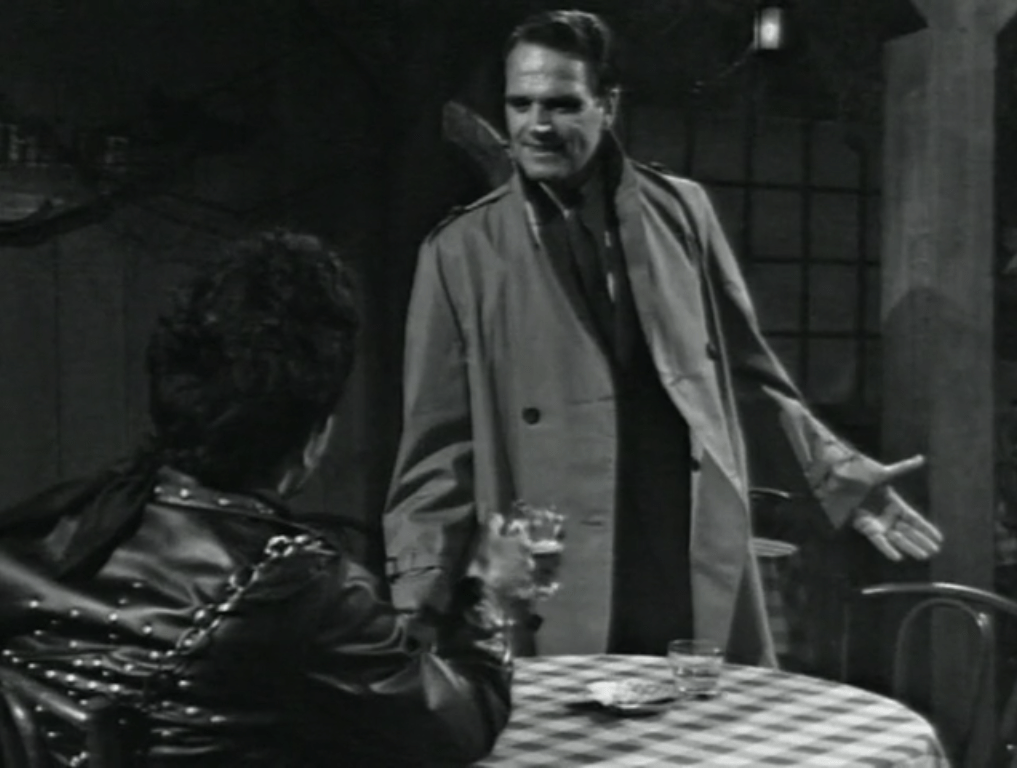
Carolyn is in the ladies’ room when Jason shows up. He asks to join Buzz at their table. Buzz replies with that rallying cry of the 60s counterculture, “If you feel it… sit it!” I can only wish that had been the title of a spinoff of Dark Shadows featuring Buzz, it would have been great.
Buzz’ back is to the camera while he delivers his immortal line
Buzz tells Jason that Carolyn is from a family that “makes a lot of noise,” while he is from a family that “makes a lot of money.” Then he laughs. Buzz was credited as “Buzz Hackett” in his first appearance in #252, and is credited that way again today; in #254, he was credited simply as “Buzz.” We never hear him called “Hackett.” In #223, we’d heard about an unscrupulous local businessman called Hackett, but Buzz made a laughing reference to his lifelong poverty in #252, so I don’t think we can suppose he really is from a family that makes a lot of money. In view of Buzz’ laugh, the likeliest explanation is that this is a joke of some kind. A confusing joke, poorly told, but considering that it is a line written by Malcolm Marmorstein and delivered by Michael Hadge, that is to be expected.
Jason tells Buzz that Carolyn is using him to get back at her mother. Buzz blandly replies that Carolyn has told him all about that, and he’s having a great time with her whatever her intentions. This is reminiscent of the relationship between Carolyn and dashing action hero Burke Devlin in the early months of the show. Carolyn continued seeing Burke even after he tacitly admitted that he was using her to pursue revenge on her family. After Burke renounced his revenge, they met at this same table and had a soulful conversation about what they had been to each other (#213.)
Jason offers to buy Buzz a new motorcycle if he will stop seeing Carolyn. Buzz flatly refuses the offer, declaring “I like the bike I got, and the chick I got!” Carolyn returns to the table, and Buzz tells her about Jason’s attempt to bribe him. They laugh at Jason and leave the tavern. He staggers into a corner, looking bitter.
Laughing at Jason
This also harks back to an incident involving Burke in the early days of the show. In #3, Burke met hardworking young fisherman Joe in the tavern. Joe was at that point dating Carolyn. Burke offered to buy a fishing boat for Joe if he would spy on her family. Joe refused, and reported the contact to Liz. While Buzz is Joe’s opposite in many ways, regular viewers will see that the two men are equally honest.
*It appears to be a robusto, though it could be a corona gorda.
Reclusive matriarch Liz and well-meaning governess Vicki are in the drawing room of the great house of Collinwood. Liz is depressed because her daughter Carolyn is dating motorcycle enthusiast Buzz. She asks Vicki if she has any idea how to break Carolyn and Buzz up, then answers her own question. Liz knows that Carolyn is protesting her engagement to seagoing con man Jason McGuire, and that only by breaking it off with Jason can she change things with Carolyn.
When Liz claims that she is marrying Jason because she wants to, Vicki says it’s none of her business. Vicki has seen abundant evidence that Jason is blackmailing Liz, and won’t pretend she hasn’t. She manages to be quite respectful to her employer without backing down an inch. Despite herself, Liz is impressed with Vicki’s firmness and diplomacy.
Alexandra Moltke Isles was cast as Vicki because she and Joan Bennett looked so much alike, and this is one of the scenes that uses their resemblance to show Vicki as a reflection of Liz. As Vicki is finding tactful ways to express her suspicions, she says things that we have heard Liz say and that we know she is thinking. Each time she does so, Joan Bennett does a quarter turn one direction from the shoulders and a quarter turn the other direction from the neck, as if she were being twisted open. When Liz tells Vicki to stop, she calls her “Victoria,” a name we haven’t heard her use since 1966, and when Vicki asks permission to leave the room she responds, in a near-whisper, with the usual “Vicki.” This alternation also suggests twisting, and to regular viewers who remember that Liz has a secret connected with the fact that “Her name is Victoria” it is another twisting open.
Meanwhile, Jason is entering the Blue Whale tavern with his former henchman, Willie Loomis. Jason wants to confront Willie with the fact that he saw him in town earlier in the day selling a piece of jewelry. Willie says that he was selling it on behalf of his employer, wealthy eccentric Barnabas Collins. Jason knows of Willie’s obsessive fascination with jewels and his tendency to steal them, and does not believe that Barnabas would entrust him with such a task. What Jason does not know is that Barnabas is a vampire and Willie is his sorely bedraggled blood-thrall. As such, Barnabas has a power over Willie that makes it rational to entrust the most remarkable tasks to him.
Carolyn and Buzz enter. They almost leave when Carolyn sees Jason and Willie. Jason and Willie rise and meet them at the door. Jason assures Carolyn that they were just going. Before they do, he taunts Carolyn with his engagement to Liz.
On Tuesday, Carolyn and Buzz started dancing together in the drawing room. Buzz made a few very graceful moves, saw Carolyn going into the Collinsport Convulsion, and sat down to observe. Today, Buzz sees two background players twitching awkwardly while the jukebox plays and declines Carolyn’s invitation to join her on the dance floor. He wants to stop drinking, saying that he is looking for something that will make him feel like he’s never lived before, while “drinking only makes you feel drunk.” It sounds a little bit like he’s going to offer Carolyn a drug stronger than alcohol, but by the end of the scene he just wants to get back on his bike. Liz’ fears to the contrary, Buzz seems pretty darned wholesome.
While Carolyn and Buzz are on their way out of the tavern, hardworking young fisherman Joe comes in. Carolyn asks Buzz to wait outside while she talks with Joe. Buzz reluctantly agrees to spend a few minutes alone with his bike.
Carolyn and Joe were dating when the show started, and there was a whole storyline about how they were tired of each other and couldn’t get themselves sufficiently organized to break up. Their scenes together reminded us that the 1960s were the decade in which Michelangelo Antonioni used the cinema to explore the nature and significance of boredom.
But they are far from boring today. After he and Carolyn finally called it quits, Joe started seeing Maggie Evans, The Nicest Girl in Town. Maggie is now missing and feared dead. Carolyn sits next to Joe at the bar and expresses her sympathies. When I say that Nancy Barrett’s acting style was to throw herself unreservedly into whatever the script gave her character to do that day, it may sound like I’m saying she was undisciplined or that she lacked subtlety. That is not at all what I mean, and in this scene she does one of the most delicate drunk acts I’ve ever seen. Carolyn sits a fraction of an inch too close to Joe, tilts her head back a fraction of a degree too far, opens her eyes the tiniest bit too wide, and speaks ever so slightly too slowly. No one of those signs would even be noticeable by itself, but together they make it very clear why Buzz was anxious that he and Carolyn should leave their drinks unfinished.
Back in the drawing room, Jason is badgering Liz into setting the date for their wedding. Carolyn and Buzz come back, and Jason tells them he and Liz will be married two weeks from tonight. Carolyn says that she and Buzz ought to get married the same night. Buzz is delighted when she first says this, and is still smiling when she insists she is being serious.
My wife, Mrs Acilius, urged me to call this one “A piece of that action,” something Jason says to Willie. Trekkie that she is, that seemed irresistible to her. But Joe’s line that Buzz seems to be “about as much fun as a bag of spiders” is the funniest of the many witty lines in today’s script, and when you remember that Dark Shadows has, since December of 1966, been basically a horror story, you have to think that in its terms a bag of spiders might be a lot of fun. So that had to be the title.
Today we’re in Collinsport’s night spot, The Blue Whale tavern. Seagoing con man Jason McGuire is at the bar, trying to convince his henchman, dangerously unstable Willie Loomis, to stop acting like he’s about to rape every woman he meets before they get thrown out of town.
A party comes in consisting of artist Sam Evans, Sam’s daughter Maggie, and Maggie’s boyfriend Joe. Dashing action hero Burke Devlin enters and joins Sam, Maggie, and Joe at their table. Burke has confronted Willie a couple of times, and Willie tells Jason that they are fated to have it out sooner or later. Jason tries to persuade him to abandon this idea, telling him that Burke would be a useful friend and a formidable enemy.
Jason delights Willie by telling him that Burke is an ex-convict. John Karlen brings such enormous joy to Willie’s reaction to this news that it lightens the whole atmosphere of the episode.
Jason buys Burke a drink and tells him that Willie is secretly a nice person. He and Burke find that they both have a high opinion of psychoanalysis, of all things, but their shared admiration of the Freudian school does not lead them to agree about Willie.
Sam goes to the bar, leaving Maggie and Joe to themselves. A bit later, Joe has to leave Maggie alone for a few minutes while he makes a telephone call to check in with a situation at work. He urges her to stay at the table and avoid Willie. She notices that Willie is talking to her father, and is alarmed. Joe tells her not to worry- from what they’ve seen, it appears that Willie only likes to hurt girls.
At first, Willie and Sam’s conversation is cheery enough. Willie is impressed with Sam’s beard, and even more impressed that Sam is a professional painter. For a moment, we catch a glimpse of Willie, not as an explosively violent felon, but as an awkward guy who is trying to make a friend. This passes when the idea of nude models pops into Willie’s head, and he asks again and again where Sam keeps the naked ladies. Sam tells Willie that he doesn’t use live models, at first politely, then with irritation. Willie responds with his usual vicious menace.
Maggie goes up to intercede. This would seem to be an odd choice. Jason is at the next table, and when Willie was harassing her and picking a fight with Joe last week she saw Jason rein Willie in. She knows that Jason is eager to smooth things over with the people Willie has already alienated, so it would be logical to appeal to him. Burke and Joe are nearby as well, and have both made it clear that they are ready to fight Willie. If either of them goes to Willie, he will be distracted and Sam will have a clear avenue of escape. And of course Bob the bartender really ought to have thrown Willie out of the tavern long ago. Maggie, on the other hand, will attract Willie’s leering attentions and complicate her father’s attempt to get away from Willie by making him feel he has to defend her.
From his first appearance in #5, Sam was a heavy-drinking sad-sack. Today, Sam seems to have become a social drinker. He’s gone out with friends for a couple of rounds, and is pleasant and calm the whole time. Soap operas are allowed to reinvent characters as often as they like. If Sam’s alcoholism isn’t story-productive anymore, they are free to forget about it.
The problem with this scene is that Maggie hasn’t forgotten. Maggie’s whole character is that of an Adult Child of an Alcoholic. It makes sense that an ACoA, seeing her father in trouble, would cast aside all rational calculations and rush up to protect him. But if Sam isn’t an alcoholic anymore, Maggie is just a very nice girl who laughs at inappropriate times.
Burke comes to Maggie and Sam’s rescue. Willie draws a knife on Burke, they circle, Burke disarms Willie and knocks him to the floor.
We’ve seen many couples move about on the floor of The Blue Whale while music was playing, and usually their movements have been so awkward and irregular that it is not clear that what they are doing ought to be called “dancing.” But Burke and Willie’s fight is a remarkably well-executed bit of choreography. At one point Willie brushes against the bar, and it wobbles, showing that it is a plywood construction that weighs about eight pounds. But it doesn’t wobble again, even though the fighters both make a lot of very dynamic movements within inches of it, and at the end of the fight Willie looks like he is being smashed into it.
After the fight, Willie and Jason meet in a back alley, the first time we have seen that set. Jason assures Willie that he will eventually get his cut of the proceeds of Jason’s evil scheme, but tells him he will have to leave town right away. Willie vows to kill Burke.
The jukebox at The Blue Whale plays throughout the episode. In addition to Robert Cobert’s usual “Blue Whale” compositions, we hear Les and Larry Elgart’s versions of a couple of Beatles tunes and of a Glenn Miller number.
There is only one ongoing story on Dark Shadows right now, and it doesn’t seem to have much of a future. Seagoing con man Jason McGuire is blackmailing reclusive matriarch Liz, threatening to reveal that she killed her husband Paul Stoddard eighteen years ago and that he buried Stoddard’s body in the basement of the great house of Collinwood. Not only was all of that clear when Liz and Jason had their first conversation several days ago, but yesterday we heard Jason on the telephone making it clear that he is bluffing. If Liz calls the police, he will get out of town as fast as he can. So whatever Liz does in response to Jason’s so-frequently repeated threat, the story can go only so far before it reaches a dead end.
Looking at Jason, audiences at the time would have recognized actor Dennis Patrick as a frequent guest star on prime time television shows and might have suspected that he was too big a name to stay on a daytime soap opera for very long. They would not have known that Patrick always made it a point to have an end date in place anytime he agreed to guest on a soap or that when he played Jason he did not have a contract, and was free to walk away any time he wanted. Seeing him share so many scenes with Joan Bennett, who had been a major movie star for a number of years, they might have thought it was possible he could stick around, but the show so quickly burned through what little story the two of them had that it wouldn’t have seemed likely.
So, what comes next? Alexandra Moltke Isles’ opening voiceover, delivered as always in character as well-meaning governess Vicki, gives us a hint:
My name is Victoria Winters. The foundations of Collinwood house a frightful secret, a secret that has lain dormant for eighteen years, a secret awakened by a stranger. But there is another stranger, one who is to awaken and unleash a force that will affect the lives of everyone.
This other stranger is Jason’s henchman, dangerously unstable ruffian Willie Loomis. At the beginning of this episode, Willie is drinking at the bar in Collinsport’s only night spot, The Blue Whale. There are three other customers in the tavern, an old man at the bar and a young couple in the background* bowing to each other at irregular intervals. If we assume, as I suppose we must, that these movements represent an attempt at dancing, we might wonder if the force Willie is destined to awaken and unleash is choreography.
Maggie Evans, The Nicest Girl in Town, enters. She looks around for a long moment, then slowly makes her way to a table. Willie tells Bob the bartender he wants to buy Maggie a drink. Bob goes to her table, and we see them have a conversation in the course of which Bob gestures to Willie and Maggie shakes her head no. When Bob returns to the bar, Willie tells him that “A good bartender wouldn’t have asked any questions!” Not even what kind of drink the lady would like, apparently. So maybe he’s going to awaken and unleash the force of unconsumed beverages.
Willie goes to Maggie’s table and sits down. When she protests that she’s waiting for someone, he sneers that no one tells him where to sit.** As Willie, James Hall is doing a great job of establishing himself as a clear and present danger to everyone he meets. Maybe Willie was right about one thing- a good bartender would notice Maggie’s discomfort and order Willie out of the bar. It’s obvious that Willie wants to awaken and unleash the force of sexual assault.
Maggie’s boyfriend, hardworking young fisherman Joe, enters. Willie refuses to leave the table and tells Joe to go wait at the bar. Joe squares up for a fight. He and Willie are about to start throwing punches when Jason comes into the bar and commands Willie to back off. At that, Willie awakens and unleashes the force of doing as he is told.
Jason apologizes to Maggie and Joe for Willie’s behavior and tells Bob he wants to treat everyone to a round of drinks. Joe mentions that Maggie’s father, drunken artist Sam, will be sad he missed a free drink. Maggie says that Sam won’t be drinking tonight, because New York art dealer Portia Fitzsimmons is pressing him for more paintings. Evidently Sam will be working more and drinking less now that he is no longer connected to any ongoing storyline.
At the bar, Willie complains to Jason that he’s come to help him, but hasn’t got any money out of the operation yet. Jason gives him some cash and tells him to be patient. The time has not yet come for Willie’s brawn to complement Jason’s brains.
Hall’s Willie does not spend any time processing his emotions or any energy concealing them. When he is getting ready to fight, he displays unfiltered rage; the instant he has to forgo the idea of beating up Joe and raping Maggie, he lowers his eyes and a look of deepest despair comes over him. Much as we hate Willie when he is menacing our friends, the transparency and intensity of his feelings makes it easy to watch him when he is feeling sorry for himself. Why is this strange, horrible man the way he is, and what will he do next? So when he awakens and unleashes the force of whining, it proves to be a strong enough force to keep us watching for a few minutes.
Those are good minutes for Dennis Patrick as well. Monotonous as Patrick’s scenes with Joan Bennett were, his scenes with other members of the cast usually had some element of unpredictability. We don’t know what is going on between Jason and Willie, and Jason himself doesn’t really know what Willie is going to do from one moment to the next. So it’s fun to watch Jason scramble to keep his associate in line. Also, we have a chance to root for Jason, at least for the duration of his two shots with Willie, since his control over Willie is what prevents violence against characters we care about.
Jason’s remark about Willie’s brawn raises the question of what exactly he wants Willie for. Liz is giving Jason everything she has, bit by bit, in response to his blackmail. If that is the whole plan, there doesn’t seem to be any need for brawn at all. Of course, Hall is a short, slender man, so much so that only his well-realized portrait of a violent felon keeps Willie’s confrontation with the substantially taller and more muscular Joe from looking ridiculous. Only Jason’s intervention prevented Willie from awakening and unleashing the force of badly losing a bar fight. Still, we keep wondering what the next phase of Jason’s evil plan will be.
Back at Collinwood, Jason is in the study, smoking a fine cigar. Flighty heiress Carolyn enters, and remarks that the cigar is one of her Uncle Roger’s favorites. Jason says that he knows of even finer cigars, and says that his whole philosophy of life is finding the good things and squeezing whatever he can out of them. Carolyn agrees that he has described himself well, neither hiding her disgust nor disturbing his complacent attitude.
Jason has identified himself as a friend of Carolyn’s father, the long-missing Paul Stoddard. Carolyn explains that she knows very little about her father, and asks Jason to tell her about him. He doesn’t really tell her anything she doesn’t already know, but does remark that “Paul Stoddard and I were very much alike.” He delivers that line in a way that suggests it might become significant. Once Carolyn gets up to go, Jason assures her that he does have stories about Stoddard to tell her some other time. Once she is gone and we are wondering if he really knew Stoddard at all, he steals three more of Roger’s cigars.
When we were watching this episode, my wife, Mrs Acilius, surmised that Carolyn asked Jason about her father less because she wanted to learn about him than because she wanted to figure Jason out. It is strange that she follows her obvious disapproval of Jason’s “philosophy of life” with “I never knew my father…,” unless it is a ploy to get Jason to talk about himself. And indeed, he does tell her far more about himself than about Stoddard. So that may well have been on Nancy Barrett’s mind when she was playing the scene.
A knock comes at the front door. Carolyn opens it to find Willie, identifying himself as a friend of Jason’s and announcing that he has decided to accept Jason’s invitation to stay at Collinwood. Jason is crestfallen to see that he has lost his control over Willie, and we are appalled to see Maggie’s would-be assailant moving into Carolyn’s house.
*This is the man in that couple. He would be a very familiar face on TV for a long time after this. He isn’t listed on either the Dark Shadows wiki or the imdb entry for this episode, and I can’t quite place him.
Hey look, it’s that guy! The one who was on those cop shows, you remember.
UPDATED 7 February 2024: I just spotted him in an episode of Columbo! His name is Paul Jenkins.
Paul R. Jenkins as Sergeant Douglas and Peter Falk as Lieutenant Columbo in The Most Dangerous Match (1973)
Jenkins appeared in a number of feature films, among them Rosemary’s Baby, Chinatown, and Network, and did guest spots on dozens of TV shows, among them the Dark Shadows-adjacent Falcon Crest. Evidently he was friends with Sidney Poitier, the two of them worked together on multiple projects, including Poitier’s 1992 film Sneakers. Most of the images of Jenkins I can find online come from a 1972 episode of M*A*S*H where he played an American NCO who keeps a Korean woman as a slave. This still from The Secrets of Isis illustrates his Wikipedia entry, and the civilian clothing from the 1970s is more typical of his on-screen appearance than was the 1950s Army uniform he wore on M*A*S*H:
Paul R. Jenkins, 1975.
**For some reason, Willie addresses Maggie as “Speedball.” “Listen, Speedball!” he commands. I wonder if Vladimir Nabokov considered Listen, Speedball as the title for a sequel to his Speak, Memory.
Drunken artist Sam Evans is slamming down the booze at Collinsport’s tavern, The Blue Whale. The sheriff asks him if he’s seen high-born ne’er-do-well Roger Collins. After the sheriff leaves, Sam goes to the pay phone and calls Roger at home, leaving us wondering why the sheriff didn’t think to do that. Sam asks Roger to come and meet him.
Before Roger can get to the tavern, dashing action hero Burke Devlin invites himself to sit at Sam’s table. Sam and Roger have a tense conversation about Roger’s recently returned wife, the mysterious and long-absent Laura. Roger comes, and he and Burke have another tense conversation about Laura and her plans. Later, Roger and Sam leave, and Roger’s niece, flighty heiress Carolyn, joins Burke at the table. They have a scattered and confused conversation about what Laura is up to.
The most important thing about all of these scenes at The Blue Whale is that one of the background players is future movie star Frederic Forrest, making his first screen appearance. He is in quite a few shots. The camera work is ambitious in this one, and Forrest’s face is one of the elements director Lela Swift and the camera operators work hardest to capitalize on. Indeed, after the episode opens with establishing shots of the exteriors of the mansion and the tavern, Forrest’s face is the first thing we see:
The first shot with actors.
As Sam makes his way to the telephone, he has to cut in on the dancing couple. As he does so, Forrest’s face is again emphasized:
Sam finds that the dancing couple is blocking his access to the pay phoneSam makes his way through the dancing couple
When Roger comes into the tavern, the couple is at first startled to see the biggest snob in town in such a place. When Roger seems uncomfortable, they play it cool. Their body language seen from behind conveys the startle, but it is on Forrest’s face that we see the pretended nonchalance:
Is that Collins of Collinsport!?We’re being casual.
We catch another glimpse of the couple. Burke has been staring off into space thinking about Roger and Laura while Carolyn struggles to get his attention. He takes a break from that and tries to be charming to Carolyn. As he does so, we see the couple in the background, showing what two people look like when they are actually interested in each other. Forrest keeps moving and changing expressions, while the woman holds a smile. It really is his face that sells the moment:
Frederic Forrest talking to his date
That so much emphasis was placed on a background player who later proved himself to be a remarkably capable screen actor makes it hard not to wonder what might have been. Well-meaning governess Vicki is in the early stages of a relationship with instantly forgettable young lawyer Frank. Conard Fowkes, the actor who played Frank, seems to have been a nice guy and all, but perhaps if Forrest had taken the part the character’s full name wouldn’t have started with “instantly forgettable.”
I think of the goofy sincerity Forrest brought to the part of Chef in Apocalypse Now, and I see the perfect companion to Vicki as she wanders into a world of ever-more bizarre supernatural beings. Vicki always seems very innocent at the beginning of a scene, but quite often in these early months she makes tart little remarks that remind us that she is supposed to have grown up as a street kid in NYC. Forrest would have been ideal to both emphasize Vicki’s sweetness and to set her up to show her incisive side. Maybe it’s just as well that didn’t happen- I suspect that if Forrest had played Frank, the Vicki/ Frank romance might have been popular enough that the show might never have got round to the wild experiments that eventually made it such a hit that it is still available today.
Forrest’s skill at playing quiet men who can explode into fury when provoked would have turned many characters we haven’t met yet into fan favorites. Elsewhere, I’ve mentioned Forrest as the actor who should have played Charles Delaware Tate; I suspect that if I keep this blog up through episode 1245, Forrest’s name will come up in connection with several more.
Also, this is the episode where we first learn that authorities in Phoenix, Arizona have identified a charred corpse as the remains of Laura Collins. Since we have by this time begun to suspect that Laura might be a ghost, or an inhuman impostor, or two separate beings, one of them a ghost and the other an inhuman impostor, this news seems less ridiculous to us than it does to the characters.
For the first months of the show, the set representing the foyer of Collinwood ended a few inches from the front door. When they expanded that, they at first decorated the wall with a metal device resembling a coat of arms. Today, we see a mirror there. Throughout the rest of the interior, portraits of Collins ancestors adorn spaces of comparable prominence. The metal thing looked cheap and silly compared to the portraits. The mirror looks better, serves an obvious practical purpose for the characters, and figures in several of the complicated shots Lela Swift and her crew pull off today. But still, there really ought to be a portrait there.
Indeed, this episode explicitly tells us that portraits are terribly important. Sam takes Roger to his home and shows him a portrait of Laura surrounded by flames that some mysterious force has possessed him to paint. Sam hates the painting, and Roger is appalled by it. So it would seem unlikely to be hung next to the front door of Collinwood, but we might suspect that a portrait will eventually land there that will be associated with some kind of weird power.
High-born ne’er-do-well Roger Collins talks on the phone with his sometime partner in crime, drunken artist Sam Evans. They agree to meet in Collinsport’s tavern, The Blue Whale. After Roger gets off the phone, well-meaning governess Vicki passes by. He invites her to come with him to the tavern. Up to this point Roger has often been quite unpleasant to Vicki and she has been wary of him. Also, he is a married man, and she has reason to suspect that he is her uncle. On the other hand, he is no longer a suspect in an active homicide investigation, and she hasn’t had a date in months. So she accepts.
Most of the episode takes place in the Blue Whale. Sam is there with his daughter, Maggie, The Nicest Girl in Town. Hardworking young fisherman Joe joins them, and they invent a drinking game. Every time someone mentions the name “Collins,” the table must drink a toast to “Collins of Collinsport!” Getting into a situation where you have to take a drink every time Sam wants one isn’t a particularly prudent thing to do, but Maggie and Joe are in a daring mood.
Maggie has clearly set her cap for Joe. She gives him a frankly aggressive look that is startling to see in the face of The Nicest Girl in Town. Startling, but most welcome- Joe is still trapped in a useless storyline where he is boyfriend to flighty heiress Carolyn. But when we see him having a good time with Maggie, we can finally see the light at the end of that tunnel.
Roger and Vicki show up. Roger and Sam go off and talk about something or other having to do with their dark doings. This conversation is meaningful only to the two of them. At this point, even the sheriff has lost interest in Roger and Sam’s little conspiracy. The actors are fun to watch- Louis Edmonds and David Ford always enjoyed playing off each other- but the audience certainly can’t be expected to keep track of whatever they’re talking about.
Vicki joins Maggie and Joe for some pleasant chatter about a couple of plot points the audience might want to keep in mind. Roger, frustrated by his talk with Sam, comes to the young people’s table and insults them. Joe, though he is an employee of the Collins family business, offers to fight Roger in defense of Maggie’s honor. Vicki and Sam break the fight up before Joe can throw his first punch. Roger announces that he has a headache and takes Vicki home.
Once there, Vicki thanks Roger for the evening, with no apparent sarcasm in her voice. He apologizes, and promises to take her out again. She sounds genuinely excited by the idea of another such outing. Who knows, next time maybe she will get something to eat, or a drink, or more than three minutes of conversation before she has to stop a fistfight and go home.
If Roger really is Vicki’s uncle- that is, if his sister, reclusive matriarch Liz, is secretly Vicki’s mother, as the show has been hinting pretty heavily- then a romance between Vicki and Roger would seem to be a soap opera cliche. Liz has struggled to keep Vicki from finding out anything about her origins. If Liz sees Vicki about to enter into an incestuous marriage, she might feel forced to stand up at the wedding when the minister asks if anyone present knows why these two may not be joined in lawful matrimony and to expose the secret.
The jukebox at the Blue Whale plays some music we haven’t heard before. The Dark Shadows wiki identifies it as a series of tracks from Les and Larry Elgart’s album “The New Elgart Touch.” It’s a step down from the tracks by Robert Cobert the jukebox has played so far, but it is a fitting accompaniment to the dancing of this guy. In most places he would be thought awkward, but by the standards of Collinsport he is indistinguishable from Fred Astaire:
At Collinwood, Liz tells Carolyn that David won’t be going away just because he tried to murder his father. “Things will go on just as before.” On the other hand, Carolyn should marry Joe and leave the house, because “You’re the only one of us who can have a sane, happy life.” I suppose we’ve all seen that in real life, someone swinging wildly between deep denial and exaggerated despair. Two forms of learned helplessness, I guess.
At the Blue Whale, Joe is getting well and truly sloshed. Burke joins him at his table, interrupting a conversation between Joe and his whiskey glass. Joe tells Burke that he doesn’t like him, expresses his frustration with Carolyn’s refusal to get married, then goes to Collinwood, roaring drunk, and tells Carolyn, Liz, and Vicki what he thinks of them.
One thing Joe thinks is that Carolyn is doomed to be a spinster. Considering that she’s supposed to be about seventeen, that does call to mind Barnabas’ line to Carolyn in the 2012 Dark Shadows movie, “Fifteen? And no husband?”
Marc Masse brings this point out well on his Dark Shadows from the Beginning, and argues that the depiction of Carolyn may be one of the things that sunk the show with young viewers between the end of the first month and the introduction of the vampire:
You have to wonder what kind of impression the character of Carolyn Stoddard would have made to young viewers in 1966. Here she is having grown up in a mansion with forty rooms and her only option in life is to be married off before her eighteenth birthday to a local fisherman, or else face a life of lonely spinsterhood. In that respect, Dark Shadows seems to belong to the sensibilities of previous decades.
This paragraph is part of an in-depth discussion of Dark Shadows’ place on ABC’s schedule, its ratings, the show that preceded it in its time-slot, and Art Wallace’s rather antiquated view of the world. It’s all very informative, highly recommended.
When Joe passes out on the couch, Vicki goes to town. She goes to the Blue Whale, where Burke asks if she’s looking for someone. “I just found him,” she replies. Obviously, she’s talking about Harvey Keitel, who is dancing a few feet away from her.
That Harvey Keitel was once an extra on Dark Shadows is pretty interesting. If he took that job, clearly he would have taken a speaking part. I gave some thought to parts I wish he had taken in comments on Danny Horn’s Dark Shadows Every Day four times: here (on episode 470,)here (on episode 769,) here (on episode 1057,) and here (on episode 1137.)
Dark Shadows begins its first mystery story as the characters try to figure out who tampered with Roger’s brakes, sending his car off the road but causing him only minor injuries. It is an inverted mystery, of the type that would a few years later be stamped with the name of Columbo. The audience knows who committed the crime, the suspense comes from wondering how and when the perpetrator will be caught.
In this case the would-be killer is the victim’s nine year old son David, a boy whose father openly tells him that he hates him and who is frantic with terror that he will be “sent away,” which to him brings up something frightening and unexplained about his mother. David removed the distributor valve from the brake system of his father’s car so that the brakes would fail at the moment when the car approached a particularly dangerous turn on the side of the steep hill leading down from the house.
David has kept the valve, intending to use it to frame someone else for his crime. His first choice of patsy is his governess, the point of view character for this part of the series, Victoria Winters. That plan was foiled when Vicki caught him trying to plant the valve in her underwear drawer. Later, David will try to plant the valve on someone else, but for now he is stuck keeping it in his possession.
1. The dancers at the Blue Whale are so bizarre in this one it really feels like watching footage from an alien world. Considering that so many members of the cast came from Broadway or were on their way to Broadway, it is baffling that the extras defined “dancing” as something you do by violently jerking your shoulders from side to side while wearing a huge grin. A few years before, aspiring Broadway players might have assumed teenagers dancing to rock ‘n’ roll in a Maine fishing village would look like that, but by 1966 there were enough people in the New York theater world taking pop music seriously that it’s hard to explain what we see in the background of these scenes as anything but sincere ineptitude.
2. Carolyn’s fantasy about being hit over the head and dragged out of Collinwood goes a long way towards explaining the men she gets involved with later in the series…
3. This is only the second appearance of the kitchen/ dining area that was introduced in episode 5. I think we see more of it in this episode than in any other. Between Mrs Stoddard’s comings and goings, Vicki’s business with the tea things, and the scenes with Matthew, it’s established as a substantial space.














 Dark Shadows Commentary