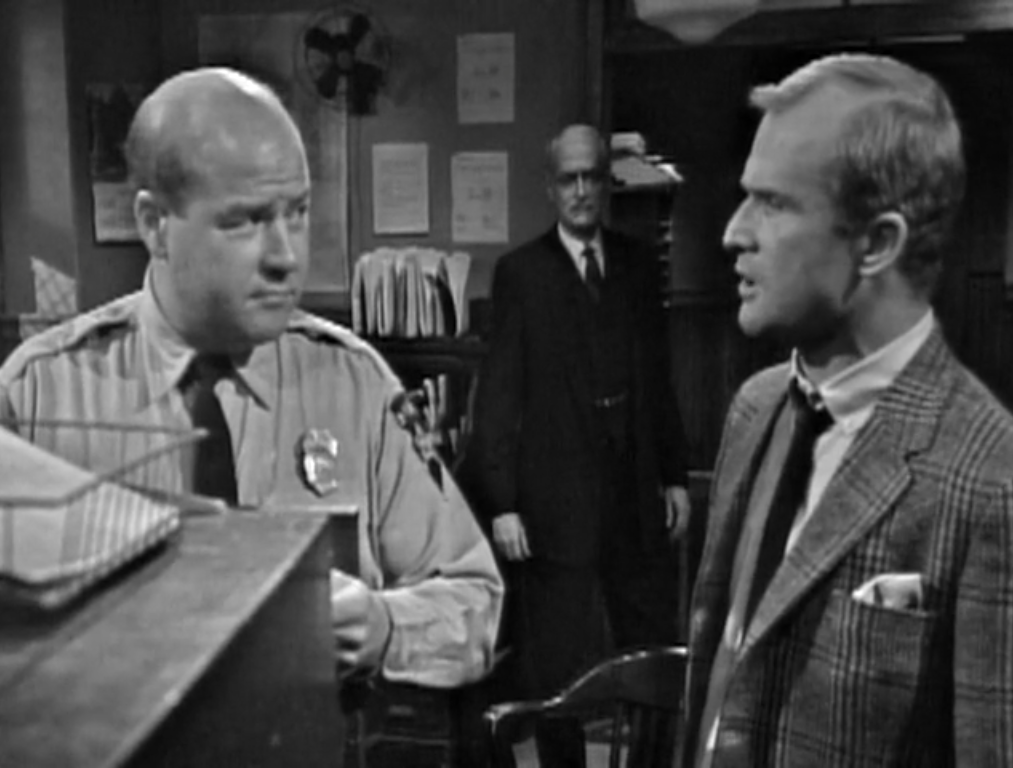
Episode 16: This is no place for young people

Dark Shadows begins its first mystery story as the characters try to figure out who tampered with Roger’s brakes, sending his car off the road but causing him only minor injuries. It is an inverted mystery, of the type that would a few years later be stamped with the name of Columbo. The audience knows who committed the crime, the suspense comes from wondering how and when the perpetrator will be caught.

In this case the would-be killer is the victim’s nine year old son David, a boy whose father openly tells him that he hates him and who is frantic with terror that he will be “sent away,” which to him brings up something frightening and unexplained about his mother. David removed the distributor valve from the brake system of his father’s car so that the brakes would fail at the moment when the car approached a particularly dangerous turn on the side of the steep hill leading down from the house.

David has kept the valve, intending to use it to frame someone else for his crime. His first choice of patsy is his governess, the point of view character for this part of the series, Victoria Winters. That plan was foiled when Vicki caught him trying to plant the valve in her underwear drawer. Later, David will try to plant the valve on someone else, but for now he is stuck keeping it in his possession.

I made some remarks about this episode on John and Christine Scoleri’s Dark Shadows Before I Die:

A few disconnected thoughts:

1. The dancers at the Blue Whale are so bizarre in this one it really feels like watching footage from an alien world. Considering that so many members of the cast came from Broadway or were on their way to Broadway, it is baffling that the extras defined “dancing” as something you do by violently jerking your shoulders from side to side while wearing a huge grin. A few years before, aspiring Broadway players might have assumed teenagers dancing to rock ‘n’ roll in a Maine fishing village would look like that, but by 1966 there were enough people in the New York theater world taking pop music seriously that it’s hard to explain what we see in the background of these scenes as anything but sincere ineptitude.

2. Carolyn’s fantasy about being hit over the head and dragged out of Collinwood goes a long way towards explaining the men she gets involved with later in the series…

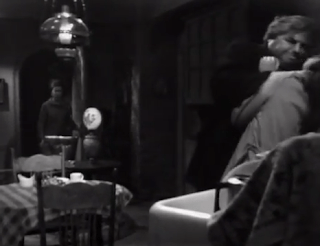
3. This is only the second appearance of the kitchen/ dining area that was introduced in episode 5. I think we see more of it in this episode than in any other. Between Mrs Stoddard’s comings and goings, Vicki’s business with the tea things, and the scenes with Matthew, it’s established as a substantial space.

Episode 15: I think he’s beginning to trust me

I left two comments about this episode on John and Christine Scoleri’s Dark Shadows Before I Die. A long one about its place in the overall development of the show’s stories:

This is a vitally important episode. The scene in David’s room is the first of many in which David Henesy and Alexandra Moltke Isles act their way out of weak writing to establish a relationship between two characters who can always make a connection with each other. Their body language, tones of voice, etc, triumph over some remarkably tedious dialogue to show us what people look like when they’re starting to trust each other. The growth of that relationship is really the only story that works in the first 42 weeks of the show. The big events involving characters we’ve only heard about or who will soon be recast matter insofar as they represent developments in that story, and other events don’t matter at all.

The scene that Liz and Roger play out in the drawing room while Vicki and David are talking upstairs is important in its own way. That these conversations are going on simultaneously is an example of the mirroring of Vicki and Liz that is such a strong motif in the first 42. Vicki is open and uncomplicated as she tries to talk David down from his superheated hostility to his father; Liz is guarded and double-minded as she tries to talk Roger back up to fear of Devlin. In the contrast between the two women, we see the difference between the innocent one with no past, and the frightened one with nothing but a past.

The contrast between father and son plays out in those scenes, and also in the two brief scenes between them. Roger’s narcissism renders him utterly childish, making no effort to take his son’s feelings into account or to understand Devlin’s motives. David’s fear and pain drive him to mimic adult behavior with absurd and indeed horrifying results. Liz tries to make Roger grow up, as Vicki tries to free David to be a child, but Roger’s inability to take anyone’s feelings but his own seriously dooms both efforts.

The moments between Liz and Vicki call for comment. Later on in the series, these characters will be stuck in many frustrating scenes where they inexplicably fail to pass on information that would resolve story points. At first glance, Vicki’s failure to tell Roger about Burke’s presence in the garage and Liz’s failure to pass the word of it on to him after Vicki tells her may seem to be the first of those failures. But Vicki has no reason to trust Roger, and very little to suspect Burke of wrongdoing. On what she’s seen of Roger so far, she can only assume that if she tells him what she saw he will jump to the most sinister possible conclusion and enlist her in his mad campaign against Burke. Liz seems relatively reasonable, at least on the topic of Burke Devlin, so by telling her Vicki is both satisfying an obligation and reducing the likelihood that she will be a party to slander. Indeed, Liz and Vicki tell each other quite a bit about themselves, much more than they will later on.

And a short one about a point that bothers many viewers:

Oh, and Liz’s failure to repeat Vicki’s news to Roger isn’t a problem. Liz is deeply preoccupied, and Vicki’s report wouldn’t be particularly interesting to anyone who hadn’t been watching the show.

Episode 11: “‘Straight from the bean to you!’ I wonder who writes that junk.”

One of the great challenges of writing a serial is fitting enough recap of previous story points into each installment that new viewers can catch up without putting so much in that you bore the regulars. A time will come when Dark Shadows gives up recapping altogether, but in these early weeks they are scrupulous about soapcraft.

In episode 11, much of the recapping takes place in a scene between innkeeper Mr Wells (Conrad Bain) and drunken artist Sam Evans (Mark Allen.) The story justification for Mr Wells telling Sam everything the audience might need to know about Burke Devlin and the Collinses is that Sam’s daughter Maggie, who runs the restaurant in the inn, is about to return to work, and Mr Wells doesn’t want her to see her father drunk. He knows that as long as Sam thinks he might have something new to tell him about Burke, he will sit there and drink coffee.

The scene between Mr Wells and Sam is an example of something that becomes ever more important to Dark Shadows as it goes on: good acting trumping not-so-good writing. And good acting trumping bad acting- while Mark Allen is the worst actor on the show, Conrad Bain is phenomenally good. He single-handedly takes what must have looked in the script to be a terribly dull scene and makes it completely absorbing. I can imagine a show entirely composed of him looking into the camera and telling stories, and that show would be great. No wonder he went on to have such a big career in television!

Episode 4: Frightening a new friend

Here’s the comment I left on the Scoleris’ Dark Shadows Before I Die blog entry about this episode:

Interesting how the early episodes tiptoe towards the supernatural. Burke, Roger, and Carolyn all use the word “ghost” metaphorically, to refer to unresolved conflicts from the past that are still causing problems in the present. Liz and Vicki, each in her turn, responds by saying there are no such things as literal ghosts, only to hear the first person assert that there absolutely are. Giving this same little conversation to both Liz and Vicki is one of the ways the show tries to establish Liz and Vicki as mirrors of each other, of presenting Liz’s current life as a possible future for Vicki and of Vicki as a revenant of Liz’s past.

The sobbing sounds Vicki hears in this one are the first occurrences that would have to be explained as the act either of a ghost or of someone trying to make Vicki believe there are ghosts. The next such moment will come in episode 14, and there will be several more in the weeks and months ahead. This tiptoeing is what the Dark Shadows wiki on fandom tracks as “Ghostwatch.”

In view of the near-sexlessness of the later years of the show, it’s striking how frank this one is. Roger’s aggressiveness towards Victoria is plainly sexual. Liz catches him trying to sneak into Victoria’s bedroom, he derides her attempt to regulate his “morals.” He offers Victoria a drink, they talk about pleasure and pain in words that so clearly about sex that they barely qualify as sens double. Indeed, that is the only moment in the whole series when Victoria seems like what she’s supposed to be, a street kid from NYC. And the flirtation between Uncle Roger and his niece Carolyn is so blatant that it’s a wonder how Louis Edmonds and Nancy Barrett keep the scene from making the audience either laugh or feel ill.

Episode 1: Who’s talking?

In 281 of the posts that follow, I link to comments I made on Danny Horn’s great blog Dark Shadows Every Day. Danny starts with episode 210 and makes only a handful of remarks, most of them highly disparaging, about the first 42 weeks of the show. As a particular fan of that period of the show, that distressed me when I first started reading him, but I found that it gave me an opportunity to make substantial contributions to the comment section. I could always find something in those early stories that gave extra depth to whatever was going on in the later installments.

Now, Mrs Acilius and I are watching the show through a second time, again starting with episode 1. I’d so much enjoyed commenting on Danny’s site when we were watching 210-1245 from March of 2020 to April of 2021 that I decided to start commenting on a blog that covered the first 42 weeks. So I’ve left many comments on John and Christine Scoleri’s Dark Shadows Before I Die.

The Scoleris haven’t assembled the kind of community that made Danny’s comment section a big party. I still get responses to comments I left on Danny’s site, almost a year and a half after his final post. I have yet to get a reaction to any of my comments on Dark Shadows Before I Die. So I’m thinking of just recording my thoughts here.

The Scoleris aren’t the only bloggers who discuss the first 42 weeks of the show. There’s also Marc Masse, a.k.a. Prisoner of the Night, whose (fiercely controversial) Dark Shadows from the Beginning is occasionally viewable, usually private. And of course Patrick McCray, whose Dark Shadows Daybook set the standard for online commentary on the show. Neither of those sites has an open comments section, which is why I’ve been contributing to the Scoleris. There are also podcasts, Facebook groups, Reddit threads, etc, but I’m not into any of those.

Asking who to talk to and how to get through to them brings episode 1 to mind. Vicki comes to an unfamiliar town, and the audience comes to an unfamiliar show. She’s a stranger looking for someone to talk with; we’re viewers of a daytime soap, a genre that consists almost entirely of conversation. Everyone Vicki meets is talkative enough, but most of their talk is about how they aren’t speaking. The lady sitting next to her on the train goes on about what a nasty place Collinsport is. The fellow who gives her a ride from the train station responds to the innkeeper’s warm greeting with an ostentatious refusal even to acknowledge that he knows him, let alone to engage in conversation. The server at the lunch counter announces to Vicki, before she’s had a chance to say two sentences, that she regards her as a “jerk.” The family she will be working for is represented by a lady who won’t answer her brother’s questions as to who Vicki is and why she hired her, a reticence that is made all the more ominous when a private investigator reports on their strange, unfriendly ways. Dark Shadows fandom is far less forbidding than the situation Vicki faced!