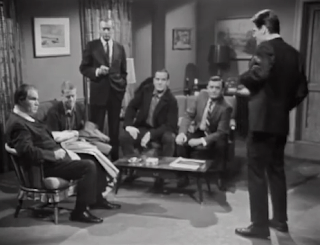
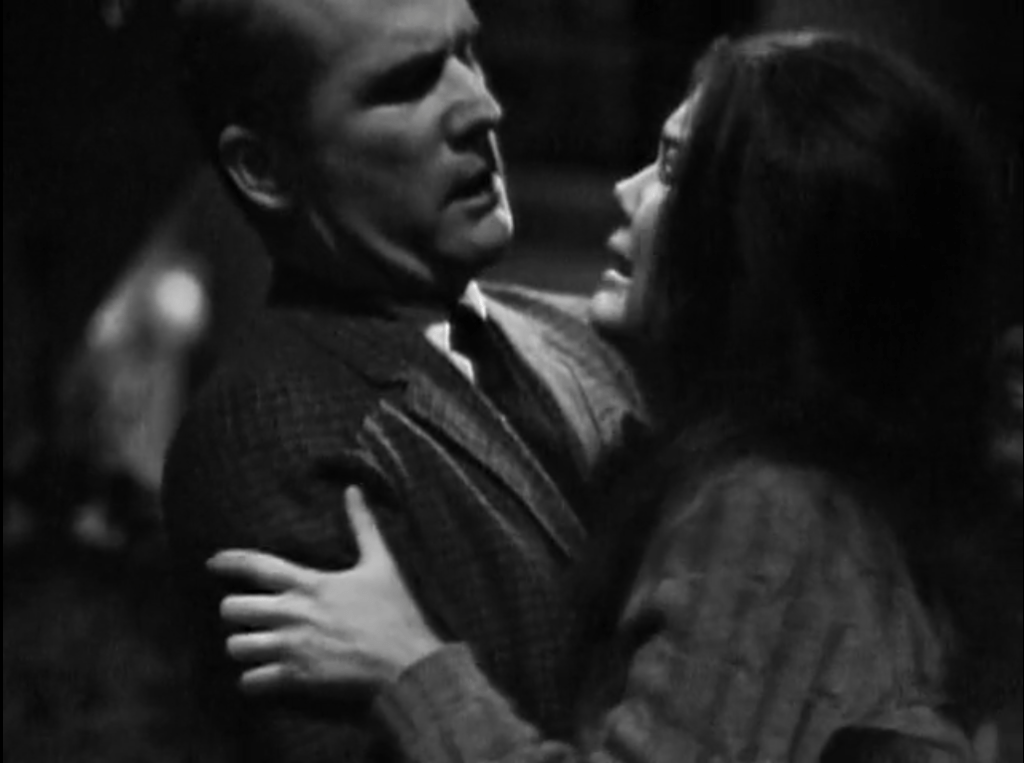
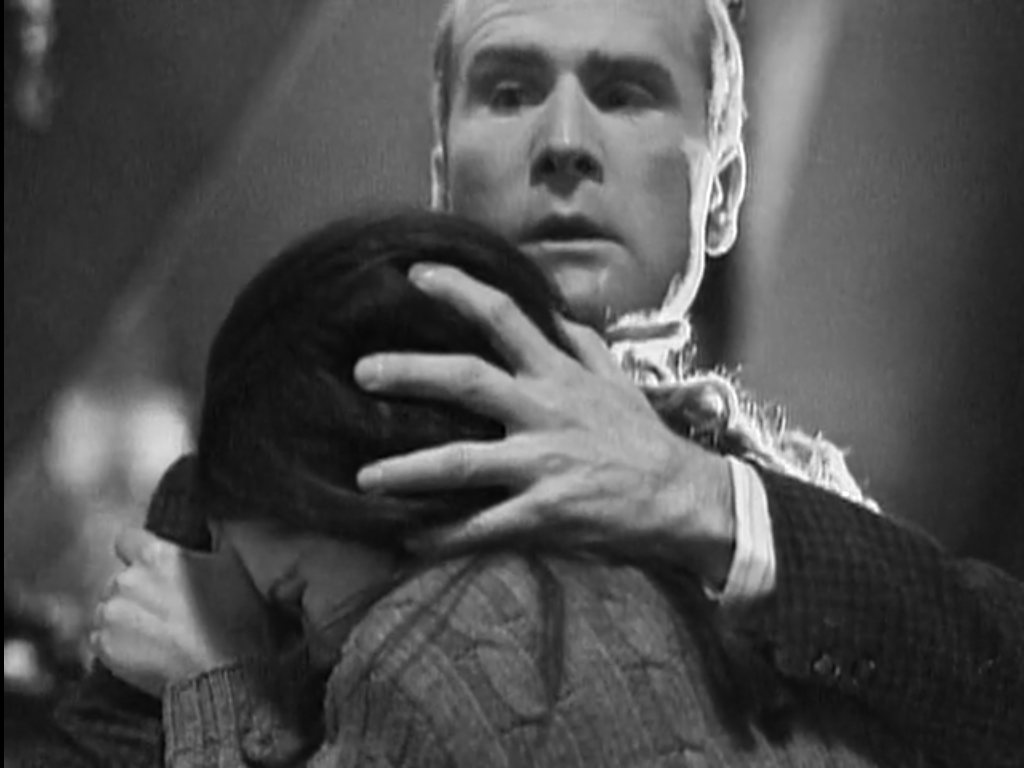
Episode 69: I believe in signs and omens

Mrs Sarah Johnson, longtime housekeeper to the late Bill Malloy, shows up in the hotel room of dashing action hero Burke Devlin. She tells Burke that she believes his enemy, high-born ne’er-do-well Roger Collins, killed Bill. Her principal evidence for this is the fact that Bill’s body washed ashore near Roger’s home on the estate of Collinwood, and “I believe in signs and omens!”

Mrs Johnson believing in signs and omens. Screenshot by Dark Shadows from the Beginning

This line is a bit of an omen itself- Clarice Blackburn will be an important part of the show, not only as Mrs Johnson, but as other characters who believe in signs and omens, and who make things happen in the name of that belief.

Meanwhile, hardworking young fisherman turned hardworking young clerk Joe Haskell is called into Roger’s office at the cannery. There, he finds flighty heiress Carolyn behind her uncle’s desk, looking seductive, or at least highly available.

Carolyn coming on to Joe. Screenshot by Dark Shadows from the Beginning

Nancy Barrett’s way of throwing herself completely into whatever her character is supposed to be doing at any given moment sometimes makes Carolyn seem even more scattered than her persona as Flighty Heiress required, but it does come in handy when the character is supposed to be sexy. That makes her stand out- even by the standards of an American television show of the 1960s, Dark Shadows is remarkably un-sultry. Sometimes it’s a marvel that they can put so many good-looking young people in close proximity to each other and still project an image of total chastity.

Joe and Carolyn kiss, and she asks him to go away with her. He tells her that he can’t just leave work in the middle of the day. She explains that she is troubled by the doings of Joe’s bête noire, Burke. This leads to a lively conversation, which in turn leads Carolyn to resume her attempts to persuade Joe to take the rest of the day off. When Joe’s boss calls for him, she offers to use her clout as the owner’s daughter to persuade him to let Joe go. He won’t let her do this. She leaves, frustrated by his refusal.

Back at the hotel, Burke and Mrs Johnson are devising a plan in which she will get a job at Collinwood and act as a secret agent for him. We get a glimpse of Burke’s persuasive abilities. When Mrs Johnson is showing reluctance to follow his plan, Burke mentions that well-meaning governess Vicki has given Roger an alibi. She immediately declares that Vicki is lying. Burke won’t agree, leading her to demand that he set aside his personal feelings and devote himself wholeheartedly to making the case against Roger. Not only does the audience see Burke showing kindly feelings towards Vicki, keeping the idea alive that they might become a couple, but we also see Mrs Johnson commit herself to going along with Burke’s plan. Whatever Burke’s actual feelings for Vicki, his emotional display at this moment is timed to lock Mrs Johnson into doing what he wants.

There is a knock on the door. It’s Carolyn. Mrs Johnson hides in Burke’s kitchen and listens as he gives Carolyn the idea of hiring her as housekeeper at Collinwood. This isn’t very hard- Burke simply mentions that Mrs Johnson needs a job, and Carolyn at once says that she will tell her mother to hire her as housekeeper at Collinwood. Even so, Burke’s skillful handling of Mrs Johnson is so fresh in our minds that we don’t need to see him actually do anything to enlist Carolyn in his scheme for this scene to reinforce his image as master manipulator.

Mrs Johnson listens in. Screenshot by Dark Shadows from the Beginning

The sight of Mrs Johnson lurking in the shadows, eavesdropping on Burke and Carolyn, further reinforces this image. A guileless woman comes into his room proclaiming her every thought at the top of her lungs, as she had done when she was introduced at the sheriff’s office in episode 67. We can hardly imagine so straightforward a personality becoming an effective undercover operative Yet within minutes of meeting Burke, he has her working as a spy.

Writer Francis Swann is credited with the script for today’s episode. He is particularly good with installments that, like this one, have only four characters. Swann’s ability to slip substantial amounts of plot exposition into natural-sounding dialogue makes a minimalist drama seem busy. In this one, it also helps us to feel that we have seen Burke perform great feats of persuasion. Burke may not have had to work very hard to plant ideas in the minds of Carolyn and Mrs Johnson, but we are aware that the scripted dialogue has planted ideas in our minds, and know that someone on the other side of the screen is good at subtle communication.

Swann and director Lela Swift also make effective use of the sets in today’s episode. This is our first look at the kitchen in Burke’s room. He’s gone in and out of there several times, most notably in episode 29 when he prepared a nonalcoholic mixed drink, the “Burke Devlin Special,” for Roger’s son, problem child David. Regular viewers might have started to wonder what it might look like, and might pay close attention when we get our first look at it. What we do see is a complex pattern of shadows that signals Mrs Johnson’s initiation into the world of film noir.

In today’s scenes with Carolyn and Joe, we spend as much time in Roger’s office as we have in any other episode. It’s the only part of the Collins’ business location we see, standing in for the whole enterprise. Played on that set, Carolyn’s flippant attitude towards Joe’s job and his mixed feelings about the demands she makes lead us to wonder if she’s going to wreck the whole business. Her persistent friendliness towards family nemesis Burke gives substance to that thought. Regular viewers will remember that Roger’s self-indulgent behavior nearly annihilated the business; seeing his favorite niece play-act as him in his office leads us to wonder if she will finish the job.

Episode 68: Only friend in the world

Well-meaning governess Vicki is determined to befriend her charge, problem child David Collins. In today’s episode, David throws a violent tantrum. Vicki looks genuinely frightened:

David throws a chair in Vicki's direction
Screen capture by Dark Shadows from the Beginning

Meanwhile, David’s father, problem adult Roger Collins, has decided to charm Vicki so as to reduce the likelihood that she will testify against him. Roger walks in on David’s tantrum. After scolding the boy and letting him go, he talks sweetly to Vicki. She tells him that she will do anything she can to understand David. He invites her to a lobster dinner. We see David, who has been eavesdropping on his hated father making friends with his hated governess, looking troubled.

David confronts his father about what he heard. Roger responds with the same charm he showed Vicki, acknowledging that he has been difficult to live with, taking the blame for all of it, and promising to be a new man in the future. He agrees with all of David’s baseless accusations against Vicki, and says that the reason he was being nice to her a few minutes before was to disarm her against David. David says that he wants to frame Vicki for some terrible misdeed that will prompt reclusive matriarch Liz to fire her; Roger replies that he doesn’t want to know what David does about that matter. He asks the boy to consider which he wants more- to be rid of him, or rid of Vicki.

These are outstanding scenes. As Vicki and David, Alexandra Moltke Isles and David Henesy both developed acting styles that built strongly on eye contact. Those styles mesh perfectly and produce an electric effect. As Roger, Louis Edmonds does everything well, but is peerless as a charming sophisticate. When Roger’s scene with Vicki begins, we don’t know that he has any especially sinister plans for her, so that scene plays as a pleasant interlude. We do know that Roger loathes David, so when we see him turning on the charm with his son, and especially when we see him agreeing with all sorts of statements from David that he knows to be false, the effect is alarming. By the time he is instructing David to keep him out of the loop when he acts against Vicki, Roger takes on a Satanic quality. His cold way of asking David his final question demonstrates that he knows David hates him and is unmoved by the fact. It’s heartbreaking to see David Henesy’s little face and imagine him as a child whose father shows that ultimate disregard for him, one of the bleakest endings of any episode in the entire series.

Episode 67: I was fresh out of arsenic

This one belongs to Maggie Evans, the nicest girl in town. We open with her doing some work in the restaurant she runs. She isn’t feeling so nice today- dashing action hero Burke Devlin has accused her father, drunken artist Sam Evans, of various crimes, including the murder of beloved local man Bill Malloy. When flighty heiress Carolyn comes into the restaurant, Maggie tells her that it might be a good idea to flavor Burke’s coffee with rat poison.

Burke does show up. When he complains about the coffee, Maggie picks up on the idea she had floated to Carolyn and apologizes for not adding arsenic.

Maggie apologizing to Burke for failing to give him arsenic
No arsenic today, sorry

Not that she’s going to let her father off without a piece of her mind. When he comes in and tells her some lies, she discards her usual adult-child-of-an-alcoholic manner of exaggerated patience and calmly asks him if he minds that she doesn’t believe him. He mumbles that there’s no reason why she should.

The sheriff comes into the restaurant to ask Maggie if she can confirm her father’s whereabouts at the time of Bill’s death. She gives him a sarcastic answer. When he asks what she is prepared to swear to on the witness stand, she makes it clear that she will swear to whatever she damn well pleases. Sam then tells the sheriff that Maggie doesn’t actually know where he was that night. At that, she declares that Sam has no idea what she does or doesn’t know. If she wants to perjure herself, it will take more than Sam and the sheriff to stop her.

In the sheriff’s office, we meet Mrs Sarah Johnson, housekeeper to the late Bill Malloy. Mrs Johnson is furious with the Collinses, the family in the big dark house on the hill who own half the town. She more or less blames them for Bill’s death. She very much blames them for his life, which he spent doing nothing but working for their interests. Mrs Johnson is even more indignant than Maggie, but the only person she interacts with is the sheriff. So we have a contrast between a character who gives us several distinct shades of outrage, one for each person she puts in their place, and another who spends her time bringing one specific shade of anger into perfect focus.

In between there’s a scene with Sam and the sheriff, and at the end one between Carolyn and Burke. These offset the studies in indignation from Maggie and Mrs Johnson, both giving the audience a bit of a breather and giving their fiery turns time to sink in.

Miscellaneous:

There’s a moment when the sheriff goes to the water cooler and finds the paper cup dispenser empty. He apologizes that he can’t offer Mrs Johnson a drink. All the websites list this as a production fault, but I’m not sure- it goes on for a while, longer than I imagine it would if he were actually drawing two drinks of water and giving her one, and the timing doesn’t seem off afterward. I don’t know if it was in the script- I suppose they might have noticed they were out of cups and improvised the scene before or during dress rehearsal. At any rate, I don’t think actor Dana Elcar was actually surprised by the absence of cups during the taping.

This episode was recorded on the Sunday before it aired. The Dark Shadows wiki quotes Kathryn Leigh Scott (Maggie) explaining that this was because one of her fellow cast members had shown up drunk on the day they were originally supposed to record it. Mitchell Ryan and David Ford both have important parts in it, and they were both alcoholics. After he stopped drinking, Ryan admitted that he showed up on the set of Dark Shadows drunk on more than one occasion. Ford never stopped drinking, and booze was apparently part of the reason he died in 1983 at the age of 57. Also, while Ryan and Ford are the two actors in this period of the show who usually have the most trouble with their lines, they are both nearly letter-perfect today, as if they had been in trouble and knew they had to be good boys or else. So it could have been either of them.

Clarice Blackburn joins the cast as Mrs Johnson today. As Mrs Johnson, Blackburn will be crucial at certain moments in the years ahead, and she will also be cast as other important characters in the later run of the show. When Mrs Johnson was cast, Blackburn was told to model her on Judith Anderson’s performance as Mrs Danvers, the frightening housekeeper in Hitchcock’s Rebecca. That instruction didn’t last very long, and when four years later they actually got round to including an homage to Rebecca, Blackburn didn’t play the Mrs Danvers part.

On his blog Dark Shadows from the Beginning, Marc Masse develops a theory that set designer Sy Tomashoff was influential in casting Dark Shadows. He focuses on a guest spot Clarice Blackburn had on an earlier series where Tomasheff did the sets, a primetime show called East Side, West Side:

The version of Mrs. Johnson we see today in episode 67 is based on an even earlier role as Gert Keller in the critically acclaimed but greatly overlooked groundbreaking series East Side, West Side, in a 1964 episode called The Givers. Perhaps the biggest surprise to those not familiar with the series would be its leading actor, featuring George C. Scott as a… social worker.

It should be noted that both of these earlier productions had Dark Shadows scenic designer Sy Tomashoff as the “art director”; in the East Side, West Side episode The Givers, the cast list even featured Bert Convy, the original early choice for casting as Barnabas Collins on Dark Shadows. Tomashoff held the same production role in For the People. Both of these series are notable for a good many cast member crossovers with Dark Shadows, often several in a single given episode; and because Sy Tomashoff worked so closely with executive producer Dan Curtis on Dark Shadows, it is likely that he played a significant part in a number of the key casting decisions in the early days of Dark Shadows.

Especially curious as noted in the introduction to today’s post is how Mrs. Johnson comes across as the grieving widow, indicating that she may have been more than just a housekeeper to Bill Malloy even if Malloy himself was never aware of this. If you see her as Gert Keller in the East Side, West Side episode, she seems to be reprising this earlier role…

An even more striking parallel between the portrayals of Gert Keller and Sarah Johnson are the similarities in character dialogue between the speech patterns and emotional tone… [I]n each instance, vocal delivery of dialogue as provided by the actress shows a similar shift between the emotional extremes of tearful despair and bitter resentment at the injustice of each character’s passing, first over Arthur Keller in East Side, West Side with an almost identical pattern and tone evident today on Dark Shadows over Bill Malloy.

In East Side, West Side, Art Keller is a business man struggling with elusive opportunities due to a past bankruptcy situation. Despite the best efforts of Neil Brock [George C. Scott] and his resources and contacts, Keller winds up ending his life soon after Brock drops by with the news that despite the availability of a possible deal for work in connection with a local congressional office, he had to intervene on Keller’s behalf because of the shady nature of the congressman’s methods of operation.

Two years later on Dark Shadows, Gert Keller is transplanted from East Side, West Side to make her debut as Bill Malloy’s bereaved housekeeper, Sarah Johnson.

It’s plausible, but not conclusive- after all, both East Side, West Side and Dark Shadows were cast with New York actors at a time when there was already more national television production, and therefore more proven acting talent, in Los Angeles. Many of the relatively well-established actors who were in New York in the 1960s were there because they were busy with specific projects and weren’t in a position to commit the time for a recurring role on a five-day-a-week TV show. So if you’re casting Dark Shadows and you’re looking for someone you can trust to give you a performance with a particular quality, of course you’re going to look at a lot of people who were on East Side, West Side, whether Sy Tomashoff recommended them or not.

Episode 66: The appearance of hospitality

Downstairs in the great house of Collinwood, high-born ne’er-do-well Roger and dashing action hero Burke have another of their quarrels. Upstairs, well-meaning governess Vicki tells reclusive matriarch Liz about her shockingly lonesome childhood. Nothing happens to advance the plot, but the actors make Francis Swann’s dialogue sparkle.

Roger and Burke’s conversation revolves around one of the two major storylines introduced in episode 1, The Revenge of Burke Devlin. Liz and Vicki’s revolves around the other, Victoria Winters’ Quest to Learn Her Origins. The investigation into the death of beloved local man Bill Malloy has suggested that one or both of these may become interesting, though by now that prospect has been reduced to rather a low order of probability.

The real themes of the conversations are the real themes of the whole series- loneliness and denial. As Vicki goes on about how solitary her childhood was at the Hammond Foundling Home, Liz’ face shows one expression of agony after another. When Liz tells Vicki that she can understand loneliness, Vicki tells her that she could leave the house if she wanted to do so. Liz replies with a note of absolute finality- “No. I couldn’t.” Vicki tries to open a new topic, mentioning Liz’ daughter Carolyn, but the barriers have gone up.

Roger insisted on talking to Burke alone. The two of them go round and round, not answering each other directly or telling each other anything new. They can’t talk productively to each other, but can’t talk to anyone else at all. The unresolved, unexplained past they share binds them together and shuts everyone else out. As he leaves, Burke declares that he will return to Collinwood- “possibly to stay.” He’d been telling Liz that he wanted to buy the house, and in previous episodes we’ve seen him scheming to drive the family to bankruptcy and collect their assets. But in this context, his line sounds less like a threat to take the house from the family than like a proposal to move in with them.

There is also a memorable production fault. A camera bounces out of control and gives the audience a view of the lights above the set:

Lights above the set

Episode 65: I think I’m having tea

Last Friday, the sheriff called the home of drunken artist Sam Evans. He warned Sam that dashing action hero Burke Devlin might be coming to his house, and urged him to call back if he did. Burke did go to Sam’s house, but Sam didn’t call the sheriff. After a brief confrontation with Burke, Sam ran away and left Burke alone with his daughter Maggie and their house-guest, well-meaning governess Vicki.

Yesterday, the sheriff called reclusive matriarch Liz at her home, the great house of Collinwood. He warned Liz that Burke might be coming to her house, and urged her to call back if he did so. Burke showed up at the house at the end of the episode.

Liz doesn’t call the sheriff either. After Burke refuses her commands to get out of her house, she decides to confuse him with a display of hospitality. It turns out to be quite an effective tactic. When Vicki walks in and asks Burke what he’s doing at Collinwood, he replies in bewilderment “I think I’m having tea.”

Burke takes the tea tray from Liz

Burke had gone to Collinwood looking for Liz’ brother, ne’er-do-well Roger. Roger is with Sam at the tavern in town. Yesterday we heard some new music at the tavern, a funky tune that sounds like it was cut from a Booker T and the MGs album. It played then as grizzled caretaker Matthew sat by himself waiting for Burke to come in so he could threaten him. It was so obviously not something Matthew would listen to that it served to emphasize his isolation. It plays again today as Roger and Sam reach the end of a strange conversation, with Roger first refusing Sam’s offer to leave town for money, then Sam refusing Roger’s offer to give him money to leave town. As Roger and Sam, Louis Edmonds and David Ford have so much fun with this exchange that it feels like an Abbott and Costello routine. The music is different enough from what we’ve heard on the show so far that it highlights Roger and Sam’s silliness.

I should also mention that in the opening voiceover, Vicki says the phrase “Dark Shadows.” This is the second time we’ve heard a character say the title of the series. The first was in episode 46, when Roger had said that a drawing by his son, problem child David, had captured “Collinwood, with all its dark shadows.”

Episode 64: Collinwood breeds murderers

Dashing action hero Burke Devlin goes to the local tavern, The Blue Whale. He sees Matthew Morgan, maniacally devoted servant of his foes, the wealthy Collins family. Matthew demands that Burke leave town. When Burke refuses, Matthew calmly informs Burke that he will kill him. Mitch Ryan plays Burke’s reaction to this announcement with a priceless look of disbelief. There’s a flicker of light in his eyes in the first second of the reaction, and he holds it long enough to be hilarious to watch:

Burke's reaction
Burke is stunned by Matthew’s casual announcement

Their conversation devolves into a bar fight. After the sheriff breaks it up, Ryan again has an opportunity for a memorable facial expression:

Burke recovering from the bar fight

Burke has been obnoxious enough, and Thayer David’s Matthew is engaging enough, that we found ourselves cheering Matthew on and laughing when Burke lost the fight.

In the sheriff’s office, both men get stern scoldings, Matthew for assaulting Burke, Burke for interfering with the police investigation of the death of beloved local man Bill Malloy. The sheriff releases both, warning Burke to stay away from the estate of Collinwood and Matthew to stay on it. Alone in the office, he calls reclusive matriarch Liz to warn her that Burke might be coming to Collinwood, and asking her to call him if he does.

Liz tells first the sheriff, then her daughter, flighty heiress Carolyn, that she doesn’t think Burke will come to the estate. The sheriff had previously assured Matthew that Burke wouldn’t go there “if he knows what’s good for him.” If soap opera characters knew what was good for them, they wouldn’t get much screen time, so of course the episode ends with Burke entering the house.

Episode 63: The world around it

Each episode of Dark Shadows begins with a voiceover. In this phase of the show, the voiceovers are all narrated by Alexandra Moltke Isles in character as Victoria Winters, well-meaning governess, and are brief passages of almost purely decorative prose, meant only to set a mood and to vanish from the audience’s memory as soon as the action starts. Art Wallace and Francis Swann, the writers credited for the first 97 episodes, were old pros who had been turning out scripts for decades, and were good at staying out of their own way. That’s why I haven’t yet said anything about any of the opening voiceovers- when Wallace or Swann set out to write something forgettable, they succeeded. By the time I started writing, I had no recollection of them whatever.

Today’s opening voiceover is unusually substantive, so much so that it threatens to leave a trace in the audience’s mind:

My name is Victoria Winters. Once again it is quiet in Collinwood. There is no sound but the ticking of the great clock in the entrance hall. And the lonely footsteps of a woman who hasn’t left its grounds in eighteen years. A woman whose life is limited to musty corridors and the endless beat of a grandfather clock. A beat that seems to ignore the vitality of the world around it.

Vicki names herself, names the estate where she lives, talks about how quiet it is, mentions the clock, tells the audience that the lady of the house is a recluse who hasn’t left home in eighteen years, complains about the air quality in the house, brings the clock up again, and assures us that interesting things are happening everywhere except here. It leaves us wondering why Vicki is so hung up on the clock, why she doesn’t run the vacuum cleaner herself, and why, if the entire world surrounding Collinwood is chock full of vitality, they don’t turn the camera in some other direction.

That’s the sort of thing we’re going to get from Wallace and Swann’s immediate successors, Ron Sproat and Malcolm Marmorstein. In writing their opening voiceovers, Sproat and Marmorstein fell between two stools. They didn’t write brief, deliberately forgettable passages as Wallace and Swann had done; nor did they integrate the opening voiceovers into the action of the show, as would happen in later years when the story is moving very fast and the episodes start with detailed recaps of events so far. Instead, Sproat and Marmorstein saw the voiceovers as vehicles for long passages of flowery, over-developed imagery. Those are certainly no more effective at setting a mood than were Wallace and Swann’s brief remarks, but they do both try the patience of the audience and linger as distractions. That’s one of the things that prejudices viewers against the character of Vicki- since so many episodes from the Sproat/ Marmorstein era start with Vicki rambling on about the weather or making vague remarks about “one small boy” or whatever, the first impression she leaves on viewers who start watching with episodes from that period is that of a prattling fool.

While Wallace and Swann are the only writers whose names have appeared in the credits thus far, it is very possible that others not credited contributed additional bits. I may be wrong, but my nose catches a whiff of Marmorstein in these six strange, distracting sentences. The description of the clock while we’re looking at it, the specified number of years since reclusive matriarch Liz has left the estate, the evocation of the “musty corridors,” the yearning glance at the eventful world outside, are all typical of Marmorstein’s attempts to turn the voiceovers into freestanding dramatic monologues, but without identifiable characters or plot development.

Today’s episode doesn’t shed much light on Vicki’s relationship to the clock or on the standards of cleanliness in the great house of Collinwood. Instead, it’s a kaleidoscope episode, in which each change of scene varies the combination of characters who interact on each set. The action plays out on two sets this time, the foyer/ drawing room representing the downstairs of the great house, and the Blue Whale tavern, representing the low and bustling life of the village. Because the sets typify the “musty corridors” inside the house and the “vitality of the world around it,” the episode is also a diptych of sorts- not Art Wallace’s usual diptych contrasting two pairs of people, but a diptych contrasting two places and the attitudes those places inspire in the people who spend time in them.

The five pieces tumbling about in today’s kaleidoscope are reclusive matriarch Liz, tightly-wound handyman Matthew, flighty heiress Carolyn, hardworking young fisherman Joe, and Maggie, the nicest girl in town. The regular bartender at the Blue Whale gets a fair bit of screen time as well. In the first 63 episodes, he’s answered to names including “Joe,” Andy,” “Mike,” and “Punchy.” Today, Joe the fisherman calls the bartender “Punchy,” a name he called him most recently in episode 56, the same episode where drunken artist Sam calls him “Mike.” Maybe we’re supposed to think that the young men know the bartender as “Punchy,” the older men as “Mike.” Eventually the show settles on the name “Bob” for him, perhaps because the performer’s name was Bob O’Connell. In one episode (#319,) Sam calls him “Ba-ba-roony,” giving rise to the idea that his name is Bob Rooney.

Liz appears only at Collinwood, of course; Joe and the bartender appear only in the bar. The others migrate back and forth between the two sets. We first see Carolyn with Joe in the bar, talking about what a flop their date has been and how pointless their whole relationship is. Maggie interrupts this thrilling conversation, looking for her father, Sam the drunken artist. After puzzling Carolyn and Joe with a number of cryptic remarks, Maggie gives up looking for her father and goes to Collinwood to look for high-born ne’er-do-well Roger. Roger isn’t home, so she winds up talking to Liz. This is the 63rd episode, and it’s the first time we’ve seen these two major characters together.

Screenshot by Dark Shadows Before I Die

We first see Matthew in Collinwood, telling Liz how much he wants to help her. He then goes to the bar, where Carolyn and Joe see him. Matthew is looking for dashing action hero Burke Devlin, whom he hates. He implies to Carolyn and Joe that Burke is to blame for the death of beloved local man Bill Malloy. Joe doesn’t like Burke any more than Matthew does. The instant he hears Matthew’s idea, he is all in on it. Carolyn resists the suggestion.

Carolyn goes home to Collinwood. Maggie has explained to Liz that Burke has been saying terrible things about her father, that she can’t find her father to ask him about Burke’s allegations, and that Roger might know something about them. Liz urges Maggie to believe in her father, and to regard Burke as a dangerous, unscrupulous man capable of many dark deeds. Hearing the last part of this, Carolyn asks her mother if she believes that Burke is capable of murder. Yes, Liz says, she does believe that he is capable of that.

Episode 62: On and on

Drunken artist Sam Evans meets with dashing action hero Burke Devlin in Burke’s hotel room. They recap the events of the previous episode. Burke accuses Sam of killing their mutual friend Bill Malloy. Sam’s anguished denials convince Burke that he is innocent.

Well-meaning governess Vicki encounters high-born ne’er-do-well Roger Collins at the mansion where they both live. They recap the events of the previous episode. Vicki is in no way impressed by Roger, responding to his charm by bluntly telling him that she knows what he is trying to get her to tell him, to his attempts at intimidation with bland indifference, to his offer of a higher-paying job at the home of friends of his in Florida with a polite refusal, and to his exclamation “Miss Winters, you’re a fool!” with a cheerful “Probably.”

It’s a pleasant 22 minutes for fans of the four actors and of their characters, even if screenwriter Art Wallace isn’t exactly tearing through story material at a breakneck pace. On his blog Dark Shadows from the Beginning, Marc Masse shows that this episode is intricately connected with #37, that there are several visual and verbal echoes that pair shots in this one to specific shots in that one, and that if we examine those pairs of shots we will gather more than a little information pertinent to the mystery of Bill Malloy’s last moments. He also acknowledges that, while these echoes are so numerous and so precise that they must be deliberate, it is unlikely that more than a tiny percentage of the original audience was aware of them:

Such minute and momentary details are fine in an episodic drama presentation of thirty minutes to an hour or in a movie that runs ninety minutes to two hours, where the mind can log these accumulating details as they are made available; but to just drop a subtle clue, like the face of the foyer clock, toward the end of a Monday episode and expect the viewer, all however many millions of them, to recall such a seemingly random instance more than three weeks later is just one of the limitations inherent in serialized drama that the producers have to work around.

Perhaps this is one reason the show has done so well in the age of streaming video and online discussion, when obsessive fans can watch and rewatch every episode, read about them all, and share their own thoughts. Tellers of mystery stories find themselves committed to slowly doling out clues throughout the whole development of the plot, including subtle clues that few people will catch the first time through. That’s built into the genre, and is hard to avoid doing even if the mystery story comes to us in a form like 1960s daytime television that simply cannot deliver that information effectively to an audience. What must have been frustrating or mystifying or outright invisible to the original audience can now be central to our enjoyment of the episodes.

Episode 61: A sandwich for a lonely man

My wife, Mrs Acilius, pointed out that my post about episode 60 was unfair. She objected to the sentence “The Friday cliffhanger is Burke asking if he may join the Evanses and Vicki for dinner.” As she explained, that moment actually is an effective cliffhanger. I hadn’t mentioned that the sheriff had called drunken artist Sam Evans to warn him that dashing action hero Burke Devlin might be coming to his house, that he urged Sam to call back if Burke did come, and that actor David Ford played Sam’s reaction to this call with a convincing display of terror.

Sam on the phone
Sam trying to conceal his fear from the women behind him and the man on the other end of the call

I also failed to mention the shot when Burke enters the room. Before Sam can get the words out to tell his daughter Maggie not to open the door, Burke has burst in. The scenes in the Evans cottage have been dimly lit, with all three figures moving before dark backgrounds. When the light colored door swings open, its relative brightness feels for a second like a flash, and when he stands in front of it Burke cuts a stark figure. We see him in contrast with Maggie, who stands against a dark background, wearing a dark top and a stunned expression:

Burke enters
Burke enters the Evans cottage

Throughout the episode, Sam had failed repeatedly to exercise any measure of control even in a social situation in his own home where the only other people are his daughter Maggie and well-meaning governess Vicki, the two kindliest characters on the show. The irruption of Burke into that setting is indeed a formidable moment for Sam.

So yes, that was a more plausible Friday cliffhanger than I allowed. Perhaps I was prejudiced against it because I remembered this episode. The purpose of a cliffhanger is to bring the audience back for the next installment. Typically, the next installment will begin by resolving the cliffhanger as quickly and unceremoniously as possible. But today, Burke’s intrusion into the Evans cottage drags on and on. In the process, it does serious harm to Burke’s character.

After rushing into the Evans cottage, Burke defies Sam and Maggie to say that he isn’t welcome. Maggie, unaware of the sheriff’s call urging Sam to let him know if Burke shows up, breaks down and says that of course Burke is welcome. Burke then tries to order Vicki and Maggie into the kitchen so that he can be alone with Sam. Neither woman is at all meek, however, and they stand up to Burke’s browbeating admirably.

Not so Sam. He takes the first opportunity to run away. We know that Sam has his guilty secrets, but he is a likable character, and it is hurts to imagine the pain that will await him the rest of his life whenever he remembers the night he left his daughter and her sweet young friend to face an angry man alone in his house. Sam doesn’t even call the sheriff. Instead, in his panic he goes to the hotel to try to retrieve a sealed envelope he had Maggie leave in the safe there. That gives us a scene with Conrad Bain as hotel manager Mr Wells. Bain is always a delight, and his little business about the envelope is certainly the most pleasant part of the episode. At the end of the episode, Sam will meet Burke at the hotel and ask to talk with him alone in his room, leaving us with the image of him trying to redeem himself in his own eyes.

Before that end comes, however, we have much, much more of Burke trying to bully the young women in the cottage. He won’t let them eat dinner. He harangues them about his manslaughter conviction. In the course of that harangue, it becomes clear that he isn’t thinking at all clearly. “I was drunk and don’t remember too much about that night, but I do remember Roger Collins taking over the wheel.” That’s just delicious- he was hopelessly drunk, blacked out in fact, but he’s pretty sure he remembers giving the keys to someone else before the fatal collision. The fact that his substitute driver was just as drunk as he was doesn’t seem to occur to him as a flaw in his “defense,” nor does the fact that this one convenient piece of information is the only thing to surface from his alcoholic stupor. That sort of thinking runs at such an oblique angle to reality that there would be nothing to say to Burke even if he were willing to listen to you. He goes on to suggest to Maggie that her father may have killed their old friend Bill Malloy, and refuses to leave the house when Maggie tells him to do so.

Burke’s abuse of Sam, Maggie, and Vicki makes it hard for us to like Burke as much as the show needs us to like him. We’re supposed to perk up when he’s on screen, not only because we don’t know what he might do next, but also because we don’t know whether we will approve of whatever surprising thing he makes happen. Even when he is trying to destroy the family to which our point of view character, Vicki, owes her loyalty, we’re supposed to want to see more of him. But when we see him treat Vicki and Maggie the way he does here, the image of him as a grinning thug sticks in the mind, and it is hard to want more of that.

All the more so, perhaps, because of his ineffectiveness as a thug. Our first concern with the show is that it should tell an interesting story, and Burke earns our attention by providing exciting story points. We can like even a very evil character who makes exciting things happen, but someone who simply shows up at your house when you’re about to eat, keeps you from your dinner, rambles on with a lot of nonsense, insults your father, and refuses to leave is just testing your patience for bad conduct.

We can compare Burke as the villain of this episode to another, more interesting villain. Throughout 1966, Mitch Ryan was not only playing Burke on Dark Shadows, but was also on Broadway in Wait Until Dark. In that play, he was one of the con men who, under the control of a mysterious figure calling himself Harry Roat, junior (and senior, but that’s another matter,) talk their way into a blind woman’s apartment and try, at first by trickery and then by threats of murder, to get her to hand over something valuable that she hadn’t realized she had in her possession. Like Maggie and Vicki, the heroine of the play stands up to Ryan’s character and the other villains. She ultimately triumphs over them. Unlike Burke, who is simply indulging on rage for its own sake and boring everyone as he does so, Roat has devised a brilliantly clever scheme to trick his victim, a scheme which fails only because she is his equal in brilliance and his superior in other ways. Wait Until Dark was a major hit in that original Broadway run, as was the movie version the next year and as many revivals of it have been in the years since. If Roat’s activities were as pointless in the play as Burke’s are in this episode, I very much doubt it would have been produced at all.

Episode 60: Double, double

Soap operas are supposed to have a weekly rhythm. Fridays bring a whirlwind of flashy, unexpected events, building up to a big cliffhanger. On Monday, the cliffhanger is resolved and the flashy, unexpected stuff is sorted out so that new viewers can find their way into the show. On Tuesdays and Wednesdays, you experiment with new storylines that may or may not go anywhere, and on Thursdays you set up for another boffo Friday.

At no point in its run did Dark Shadows adhere to this pattern. This week, for example, has had four relatively fast-paced episodes on Monday through Thursday, then slows down for a Friday episode consisting of a couple of leisurely conversations. Conversations in which the audience is presented with a lot of basic exposition, but still, a big shift down in dramatic intensity from the four days leading up to it. A bit later, after writer Art Wallace leaves the show, there will be weeks with no apparent structure at all, certainly no boffo whirlwind Fridays. After the show becomes a hit and Sam Hall takes the lead among the writing staff, every day will be a whirlwind, and every commercial break a cliffhanger.

One of today’s conversations takes place in the home Maggie Evans, the nicest girl in town, shares with her father, drunken artist Sam. The other takes place in the sheriff’s office.

Maggie has brought well-meaning governess Vicki home for dinner. They talk about Vicki’s quest to learn the secret of her origins and about the manslaughter case that sent dashing action hero Burke Devlin to prison ten years ago. Meanwhile, Burke has barged into the sheriff’s office and is demanding information about the ongoing investigation into the mysterious death of plant manager Bill Malloy. The sheriff gives Burke more answers than it would be proper for an investigator to give a member of the public in real life, but nonetheless frustrates his need to dash into heroic action. Burke leaves the sheriff’s office, and barges into the Evans cottage as dinner is served. The Friday cliffhanger is Burke asking if he may join the Evanses and Vicki for dinner.

I suppose you could call this one of Art Wallace’s diptychs. Both conversations feature insistent questioners and reluctant responders. Burke improperly demands information from the sheriff. The sheriff parries his demands, observing Burke’s reactions as he sizes him up as a suspect in the case. The sheriff remains very much in control of the situation. As in previous episodes, we see that the sheriff alone exercises power in the sheriff’s office. By contrast, Sam loses control entirely in the face of his two questioners. Again as in previous episodes, we see that Sam has no power to resolve a conflict, whether at home or anywhere else.

That’s the dramatic content of the episode. The expository content is much more involved. Vicki looks through Sam’s paintings, and finds a portrait that strongly resembles her. When Sam tells her that the painting is 25 years old and that the model was a Collinsport girl, Vicki is excited, thinking she may have found a relative. Sam tells her he doesn’t believe that’s possible. He had heard that the model, whose name was Betty Hanscombe, had died a few months after he painted her portrait, years before Vicki was born, and that she had no living relatives.

Vicki and Maggie hold the portrait of Betty Hanscombe
Screenshot by Dark Shadows Before I Die

Note that Sam had only heard that Betty died. She had left town before then, and had no close connections to anyone with whom Sam was in touch. He could easily have heard wrong. So experienced soap opera watchers will brace themselves for the possibility that Betty Hanscombe will make a surprise entrance at some point and reveal herself to be Vicki’s mother and someone else’s secret half-sister.

When Maggie and Vicki ask Sam about the manslaughter case, he becomes agitated. Trapped into telling the story, he takes a drink and looks away from the young women. He tells essentially the same story high-born ne’er-do-well Roger had told his sister, reclusive matriarch Liz, in episode 32, but with some details added.

Burke and Roger were extremely close in those days, ten years ago. For a moment, Sam seems to be having trouble finding the words to express just how close. Along with Burke’s girlfriend Laura, they went drinking one night at a bar on the road between Collinsport and Bangor. Witnesses at the bar testified that Burke was so drunk they had to carry him to his car, and that he insisted on driving. Roger and Laura were his passengers. Burke himself admitted that he blacked out and couldn’t remember the drive. At some point, the car hit and killed a man named Hansen and kept going. At the trial, Roger and Laura testified that Burke was driving when his car hit Hansen. Burke thought that he might have got out of the driver’s seat and handed the keys to Roger before the accident. Burke was convicted, and publicly swore that he would avenge himself on Roger. A week after he was sentenced, Roger and Laura were married.

So that’s the basis for “The Revenge of Burke Devlin” storyline. I’m not a criminal lawyer, but I wonder if Burke wouldn’t have been guilty of manslaughter no matter who was behind the wheel at the moment of the collision. By all accounts, Burke drove drunk, and was drunk in his car when it killed someone. If at some point he stopped driving and handed the keys to someone else whom he knew also to be drunk, that would indeed add to that person’s culpability, but I don’t see how it would clear Burke’s name. To do that, Burke would have to change the events themselves.

To make sense of the storyline, perhaps we can revisit the tale of the night of the accident. Two lovers and their friend were in a car involved in a hit and run. Afterward, one lover turned against the other, and took up with the friend. Everyone thought the lovers before that night were Burke and Laura, and that the friend was Roger. But if the men were lovers and Laura were the friend tagging along on their date, Burke’s frantic campaign to alter the past and Roger’s grim determination to hide it take on a new significance.

The cast of the show and its writing staff were largely drawn from Broadway, where in the 1950s, 60s, and 70s many playwrights had hits with dramas in which some people try to rewrite history and others try to conceal it in desperate attempts to erase unconventional sexual relationships. Indeed, when Sam stumbles in his attempt to find words to describe the bygone intimacy Roger and Burke shared, we can’t help but remember that Sam is played by David Ford, fresh off a long engagement as Big Daddy in a production of Cat on a Hot Tin Roof. It is by no means fanciful to wonder if that stumble hints at the suspicion of a relationship Tennessee Williams would have found interesting.

Miscellaneous:

At the end of his post about this episode on Dark Shadows from the Beginning, Marc Masse goes on at length about other things you might have seen on television in mid-September 1966. This is not my favorite feature of his blog, but this time it includes a couple of irresistible bits from commercials featuring Dark Shadows cast members. Here’s a still from a spot in which David Henesy sells cereal (with a side of racism, but it’s hard to imagine that was his fault):

Screenshot by Dark Shadows from the Beginning

The same post features an audio clip of Thayer David selling NyQuil. Here’s the commercial: