Episode 68: Only friend in the world

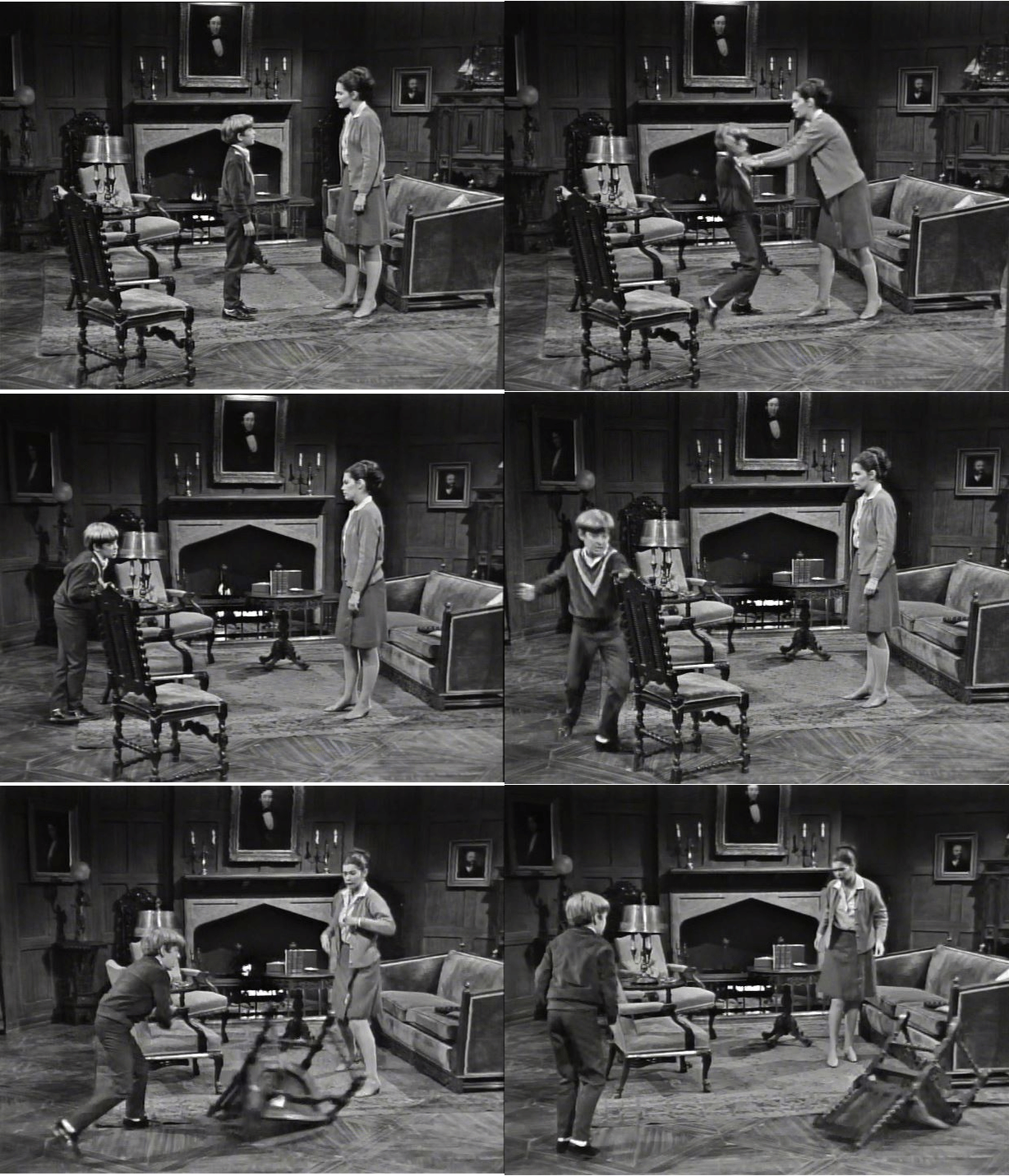
Well-meaning governess Vicki is determined to befriend her charge, problem child David Collins. In today’s episode, David throws a violent tantrum. Vicki looks genuinely frightened:

David throws a chair in Vicki's direction
Screen capture by Dark Shadows from the Beginning

Meanwhile, David’s father, problem adult Roger Collins, has decided to charm Vicki so as to reduce the likelihood that she will testify against him. Roger walks in on David’s tantrum. After scolding the boy and letting him go, he talks sweetly to Vicki. She tells him that she will do anything she can to understand David. He invites her to a lobster dinner. We see David, who has been eavesdropping on his hated father making friends with his hated governess, looking troubled.

David confronts his father about what he heard. Roger responds with the same charm he showed Vicki, acknowledging that he has been difficult to live with, taking the blame for all of it, and promising to be a new man in the future. He agrees with all of David’s baseless accusations against Vicki, and says that the reason he was being nice to her a few minutes before was to disarm her against David. David says that he wants to frame Vicki for some terrible misdeed that will prompt reclusive matriarch Liz to fire her; Roger replies that he doesn’t want to know what David does about that matter. He asks the boy to consider which he wants more- to be rid of him, or rid of Vicki.

These are outstanding scenes. As Vicki and David, Alexandra Moltke Isles and David Henesy both developed acting styles that built strongly on eye contact. Those styles mesh perfectly and produce an electric effect. As Roger, Louis Edmonds does everything well, but is peerless as a charming sophisticate. When Roger’s scene with Vicki begins, we don’t know that he has any especially sinister plans for her, so that scene plays as a pleasant interlude. We do know that Roger loathes David, so when we see him turning on the charm with his son, and especially when we see him agreeing with all sorts of statements from David that he knows to be false, the effect is alarming. By the time he is instructing David to keep him out of the loop when he acts against Vicki, Roger takes on a Satanic quality. His cold way of asking David his final question demonstrates that he knows David hates him and is unmoved by the fact. It’s heartbreaking to see David Henesy’s little face and imagine him as a child whose father shows that ultimate disregard for him, one of the bleakest endings of any episode in the entire series.

Episode 53: You can move almost anything by water

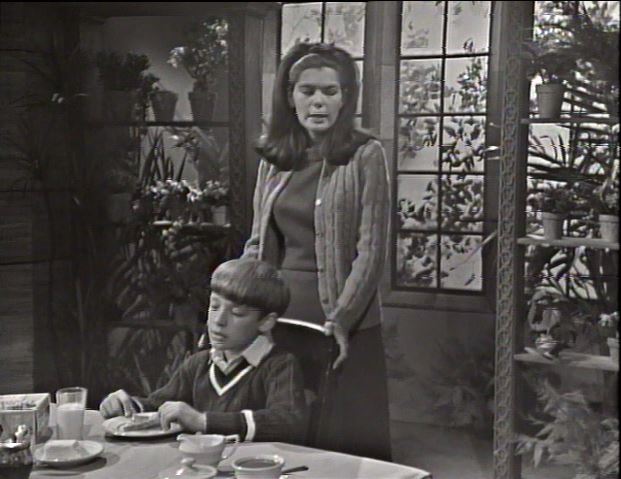
Well-meaning governess Vicki and troubled rich boy David Collins are having breakfast in the kitchen at Collinwood. David had heard Vicki and his cousin Carolyn screaming outside the night before, and saw them running back to the house. He keeps badgering Vicki for an explanation of these events, which Vicki refuses to give. In his frustration, he accuses Vicki of trying to replace his mother, and tells her that when she dies, he won’t even go to her funeral.

David and Vicki at breakfast
Screenshot by Dark Shadows from the Beginning

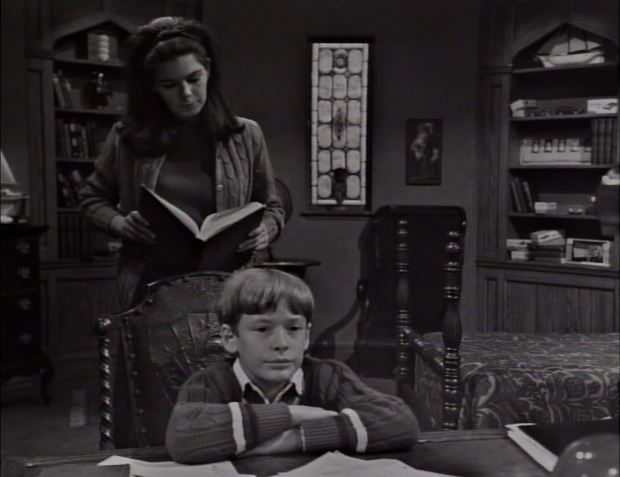
Later in the episode, after David has overheard Vicki telling hardworking young fisherman Joe that she and Carolyn thought they saw a dead man on the beach, he has another scene with Vicki, this time in his room. She’s trying to teach him about the importance of rivers in the economic development of the USA. He continues to demand information about what happened last night. He resists answering her questions about North America’s rivers, she resists answering his questions about what she saw on the beach.

David and Vicki in his room
Screenshot by Dark Shadows from the Beginning

These scenes are full of repetitious dialogue, conversational dead-ends, and descriptions of the Mississippi-Missouri river system. They could have been quite dull. Thanks to the actors, they are engrossing. As David Collins, child actor David Henesy uses an utterly flat voice and affect, to which Alexandra Moltke Isles as Vicki responds with a nuanced slow burn. When David makes common-sense observations (e.g., “Was something chasing you?… Then why were you running?”) his flatness seems to be a sign of sober intelligence. When he says terrible things (“When you’re dead, I won’t even come to your funeral,”) the same flatness is far more disquieting than a display of anger would be. As Vicki very gradually loses patience with David, her eyes never leave his face for more than a second- we can see her searching for something she can empathize with, some opening hinting at a relatable emotion, and not finding it. The two of them are irresistible together.

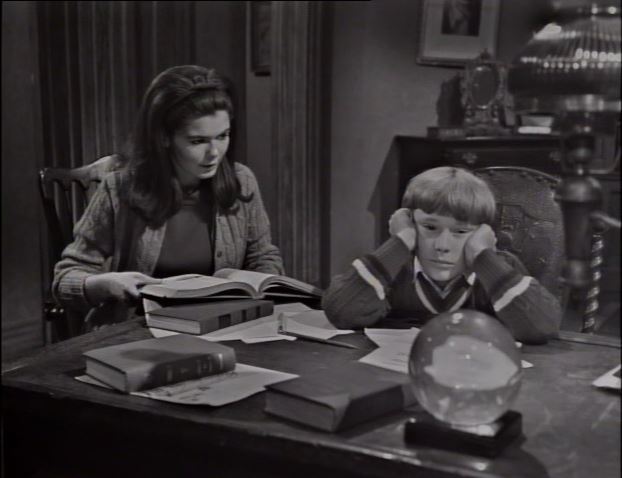
Director John Sedwick deserves a lot of credit as well. We see Vicki and David in the kitchen and in David’s room, the two most intimate spaces on the show. In each of these spaces, David is sitting still while Vicki moves about. David’s stillness allows him to keep his voice perfectly level, while Vicki’s movements give her opportunities to show signs of the emotional reaction she’s trying to keep in check as she tries to be nothing but a conscientious teacher. The camera catches David’s crystal ball to emphasize the boy’s baleful preoccupations.

Screenshot by Dark Shadows from the Beginning

Reclusive matriarch Liz meets with dour handyman Matthew in the drawing room. Liz revisits the question of the dead man on the beach. She says that she doesn’t believe Matthew has ever lied to her; he vows he never will. Liz points out that Matthew chose his words carefully last night when he came back from searching the beach, and asks if there was in fact a dead body there. He admits that there was, that it was the body of missing plant manager Bill Malloy, and that he put Malloy’s body in the water and watched as the tide carried it out to sea Horrified, Liz asks what Matthew was thinking. All he will say is that he thought it was for the best. Liz calls the police.

In his scene with Liz, Matthew mentions that before he came to Collinwood to be the handyman he worked for Liz’ father on the fishing boats. I’ve seen several websites claiming this is an inconsistency, since in episode 6 Matthew had said that he was sweeping the floors in the Collins cannery when he was called up to the big house. Those could both be true, though. He might have been a fisherman who had to leave the boats for some reason and then took the job at the cannery.

Maybe the reason was Matthew’s personality. As Liz told Vicki in episode 13, Matthew is a “strange, violent man”- it’s easy to imagine him alienating the rest of the crew of a small boat to the point where they would refuse to set out with him on board. A history like that would go a long way towards explaining Matthew’s extreme gratitude to Liz for giving him a job, especially a job where he’s alone almost all the time.

Episode 48: Tell us all where we’re going

In yesterday’s episode, Vicki the governess had come downstairs with a sketch of the great house of Collinwood that her charge David made. She showed the sketch to David’s father, Roger. Vicki tells Roger that she had taken the sketch from David’s room without David’s knowledge. Vicki spent the third week of the show trying to make it clear to David that by taking a letter from her room without her permission, he was stealing from her. Viewers who remember those episodes can’t help but wonder why Vicki is being so hypocritical.

Today, Vicki returns the drawing to David. He is surprised that she took the drawing, but pleased when she tells him how good she thinks it is. He’s starting to warm up to her, until she tells him she showed the drawing to Roger and that Roger liked it. At that reference to his hated father, David tears the drawing to pieces. David then brings up her lectures about his taking the letter and tells her she has one standard for children and another for grownups. She apologizes and agrees that she ought not to have touched the drawing. He refuses her apology and tells her he hates her. It goes on like that for a moment, until David’s aunt Liz walks in. At first Vicki tells Liz that what she’s hearing is an argument about the American Revolution, but she then says that David “had every right to be angry” because she took a drawing of his without his permission. David is involved with something else at that moment, but he does glance back at Vicki when she says “he had every right to be angry.”

Later in the series, Vicki will seem to lose quite a few IQ points. While it was foolish of her to take the drawing from David’s room without his permission and almost as foolish to tell him that Roger liked it, I don’t think this is quite a Dumb Vicki moment yet. Even the smartest adults do occasionally forget to respect children’s rights to privacy and to property, and it isn’t easy for anyone to really absorb the fact that a ten year old boy hates his father as intensely as David hates Roger. The most important thing about the scene is that Vicki admits to David that she’s wrong, apologizes to him, and tells Liz that David was in the right. The growth of a friendship between Vicki and David is going to be the most successful story-line of the first 42 weeks, and we can see the seeds of it right here.

Liz has come to David’s room to deliver a package. The package is a gift with a bow on it, brought by a messenger from the village and addressed to David. It’s a crystal ball, sent by David’s idol Burke Devlin. David loves it. Liz points out that Burke is the Collins family’s arch-nemesis, and says that it would be a good idea to send the present back. David pleads to be allowed to keep it, and she relents.

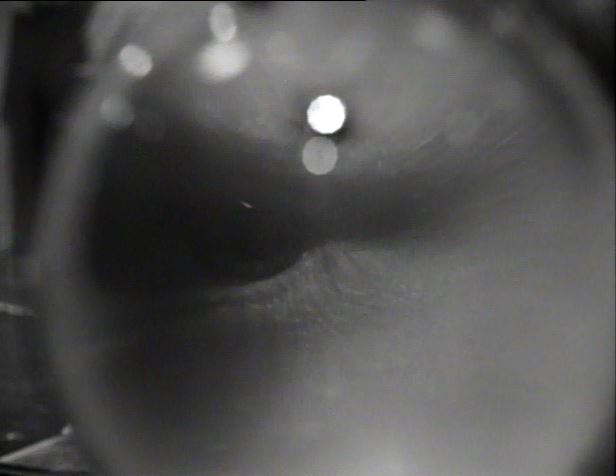
The crystal ball allows David to make all sorts of cryptic pronouncements, and gives the cameramen opportunities to take some ambitious shots. This still is featured on just about every webpage anyone has ever posted about the episode:

Screenshot from Dark Shadows from the Beginning

In a couple of years, we will see similar images, some of them giving great prominence to reflections of characters who aren’t supposed to cast reflections. For now, it is so unlike any other image in the show that I think we have to regard it as a message to the viewer. Just as David was the first character to look directly into the camera- he did it twice, in episodes 17 and 23, and no other character would do so until Sam did it day before yesterday, in #46- so he is the first one to look into a glass that will present us with a distorted image of his eye. The show seems to be laboring to get us to think about David’s viewpoint, about David as an observer.

The other plot also comes back to David as observer. Joe comes to the house and tells Liz that Bill Malloy didn’t come to work and isn’t at home. That gets everyone worried about Bill. Vicki tells Liz that Bill came to the house the night before, revealing to Liz that Roger lied to her. That gets Liz upset with Roger. David ties this together when he tells Vicki that he looked into the crystal ball and saw that Bill is dead, that his death was violent, and that Roger is responsible.

David is absent from the show for long stretches- today is the first we’ve seen him since #36. So it’s easy to regard him as a secondary character. But, we followed Vicki to Collinwood, and she came there because she had been hired to be David’s governess. The name “Collins” is something everyone on the show regards as terribly important, and David is the only candidate to carry that name into the next generation. They build a lot of story points around Burke, and at times Burke seems to be David’s fantasy come to life. David’s actions precipitated the saga of the bleeder valve, which was after all the first story-line on the show to be resolved. And David will be the fulcrum on which several story arcs will turn in the years to come. So perhaps we should see him as the central figure of the whole series.

Episode 30: What monsters we create

Thunder rumbles. The lights go out at Collinwood. Alone in the drawing room, Vicki lights a candle. The doors swing open, and a darkened figure stands in shadow. Vicki calls to the figure. It does not respond. The lights come back on. The figure has vanished. Roger happens by; he is the only other person in the house, but he is too tall to have been the figure.

This is the second occurrence in the series that is either a supernatural manifestation or an elaborate Scooby Doo-esque prank on Vicki. The first time, in episode 14, happened when David had taken the bleeder valve from the braking system on his father’s car, an event that would have dire consequences. We can assume that this second occurrence is telling us that we are about to see events that will stir up the supernatural back-world of Josette, the Widows, and heaven knows who else.

David had planted the bleeder valve in Burke’s room, trying to frame the family’s enemy for his own crime. When he spends a few minutes with Burke and takes a liking to him, he tries to retrieve the valve, not knowing that Burke has already found it and that he is carrying it in his pocket. In Burke’s car on the way to Collinwood, he pleads with Burke to go back to the hotel. He can’t give an explanation for his plea, and Burke refuses to turn back without one.

Vicki tells Roger that she had found the bleeder valve in David’s room, and Roger quickly accepts that his son had tried to murder him. When Burke brings David home, Roger takes David into the drawing room and demands he confess to his crime. Burke refuses to leave the house. Roger calls Vicki into the room; Burke insists on joining them. David calls Vicki a liar, Roger continues to browbeat him. We see a reaction shot of Burke in profile, standing in the doorway, watching the scene intently. Roger mentions the bleeder valve; Burke steps forward, and with a flourish produces the valve from his pocket. David’s face crumbles into absolute dejection.

Has Burke really betrayed David? Or is he playing some other game? We have to tune in next time to find out.

So, we begin with an indication that what follows will stir up the back-worlds, and then see an episode about the relationship between Burke and David. Roger describes Burke and David as “the two people I dislike the most.” Something Burke and David have in common, something that Roger cannot forgive, is going to bring the ghosts out of the woodwork and into the foreground.

Episode 28: Just curious

I think I said everything I wanted to say about this one in the comment I left on John and Christine Scoleri’s Dark Shadows Before I Die. So here it is:

“Idiot Plot” is a term for a story that can go on only if the characters in it are dumber than the average member of the audience. When Vicki left the valve where David could steal it in episode 26, Dark Shadows had its first Idiot Plot.

Now, just two days later, we have our second. The restaurant is open for business, and Maggie says in so many words that Roger is a frequent customer there. So he should walk right in and lay hold of David. But unaccountably, he waits for Maggie to let him in. She turns her back on David, calls Roger by name, and declares that she’s been tricking David into staying, all while David is a few feet away. Even worse, we have a number of scenes suggesting that Maggie had searched the hotel extensively for David and failed to find him, when he was simply hiding in the very telephone booth she herself had used a few minutes before.

Art Wallace is the only credited writer for the first eight weeks of the show. I’m sure he had some help, but not enough, apparently- these two episodes not only disappoint viewers who expect a well-constructed drama, but also do serious harm to the characters of Vicki and Maggie. Vicki has to be so sweet and innocent that unless she’s also as smart as she’s seemed in the first five weeks, she’ll get pretty cloying pretty fast. And Maggie, whether it’s the original wised-up dame who’s everybody’s pal but nobody’s friend or her successor, the nicest girl in town, has to produce witty dialogue and see through people’s attempts to deceive her if she’s to contribute to the story. Casting either of them as Designated Idiot is a sure way to put her on an ice floe to oblivion.

Two other things:

Interesting to see the first scene between Maggie and David. Especially so knowing that these characters will become important to each other later on, but already so as confirmation that the hostility Maggie had expressed towards the Collinses in general in Episode 1 isn’t going to define her character.

The picture of Lyndon Johnson in the sheriff’s office is apparently there to promote ABC’s coverage of the Luci Johnson’s wedding that weekend, but it’s a very odd choice of image. You’d expect the president’s photograph in a government office to show him from the chest up, showing his full face, with his eyes looking at the viewer and a calm or cheerful expression. But this picture is an extreme closeup of his face in profile, and he appears to be wincing. On a wall otherwise decorated with wanted posters, it communicates something less than unqualified admiration for President Johnson. If, as Roger implied in episode 26, the sheriff owes his office to the support of the Collins family, the picture would suggest that the Collinses were not LBJ fans.

I’ll also mention that Marc Masse’s entry for this episode on his Dark Shadows from the Beginning features one of his most outlandish accounts of a control room conversation between director Lela Swift and executive producer Dan Curtis. If you miss the sensibility of the 1970s National Lampoon, you’ll enjoy reading it.

Episode 27: In your room

Vicki tells Carolyn that David was the one who sabotaged Roger’s car, which Carolyn accepts as fact almost immediately. The story does build a foundation for Carolyn’s reaction- she repeatedly calls David a monster, and has been guilt-stricken at the thought that she let Burke into the house to commit the crime. But it is also the first example of what will become the hallmark of all of Nancy Barrett’s performances on the show. Her characters are the first to throw themselves into whatever is going on. She comes to serve as a one-woman chorus backing whoever happens to be the protagonist at the moment.

Liz still refuses to face the facts about David. When Vicki finds David’s Mechano magazine in her underwear drawer with the page about hydraulic braking systems marked, she and Carolyn see it as evidence that David had access both to the drawer and to the technical information he needed to commit the crime. Liz sees it differently, saying in a distant, ghostly voice “It was in your room, Miss Winters.”

Liz’ ghostliness is highlighted strikingly earlier in the episode. In the upstairs hallway, Carolyn is chattering away about ghosts, both the metaphorical ghosts of current problems resulting from past conflicts and the literal ghosts that, she would have you know, most definitely exist. Vicki looks at the door to the rest of the house which inexplicably opened and closed itself a few episodes back, and gasps as it opens again. This time it’s Liz coming out, having looked for David in the closed-off wing. Liz is impatient with the girls’ talk of ghosts, but her manner and appearance as she enters through that door are spectral.

The other setting in today’s diptych is a hotel room in Bangor.* Burke is meeting a private investigator there. He’s giving him a tough assignment. He wants more information about the Collinses in less time than the investigator had originally expected. He also wants the job done in absolute secrecy, and if the Collinses catch wind of the project the investigator will suffer dire consequences. The investigator is played by Barnard Hughes, a highly accomplished actor, and his skills are needed. Burke is being harsh and unreasonable, and the investigator is being deferential. Hughes is able to give his character enough texture that he seems to be keeping his dignity. Without that, Burke would have come off as a bully. The audience has to like Burke, so Hughes makes an important contribution to the show in this, his only appearance.

There’s an irony to Burke’s hard-driving intensity. He’s looking for information to hurt the Collinses, while the women at Collinwood have information far more damaging to the family than anything he’s sending his man to look for. So we’re in suspense as to what he’ll do when he catches up to them.

*In a comment on Danny Horn’s Dark Shadows Every Day, “TD” points out that the hotel room in Bangor has a television set, the first such device we see on Dark Shadows. We will not see another until 1970. That one will be in a parallel universe. We never do see a TV set in the Collinsport of the main continuity.

Evidently Mr Bronson had the hotel send a TV up to his room.

Episode 26: I want that valve!

At the end of episode 25, Vicki found the bleeder valve in David’s room, evidence that the boy tried to murder his father. In this one, she tells David she has the valve and leaves it in a drawer in her own room while she goes to tell Elizabeth about it. When Vicki and Elizabeth go to look at the valve, it is of course missing. Elizabeth chooses to believe that this means that she does not have to think any more about what Vicki has told her.

I lamented this in as comment on John and Christine Scoleri’s blog Dark Shadows Before I Die:

Watching the series first time through, it bothered me that Vicki didn’t bring the valve to the drawing room and show it to Liz. She knows David is a clever, mechanically competent little fellow, and no respecter of private property. Why on earth would she leave the valve in a dresser drawer which she knows he likes to riffle through and to which he has had considerable time to find or make a key?

That time, I could come up with an explanation. She is in shock, bewildered by the confirmation of the dark suspicions we’ve seen forming in her mind, and isn’t thinking straight.

(SPOILERS FOLLOW)

This time, though, I’m coming to the episode having seen the series through. This is the first time they resort to Idiot Plot- a story that would resolve itself immediately if the characters behaved as intelligently as would the average member of the audience. And it’s Vicki supplying the idiocy. Later on, they will rely heavily on Idiot Plot, and because she is so much the point of view character Vicki winds up as the Designated Idiot. That will ultimately destroy her character and drive her off the show. So I can’t help but feel sad now when I see this first appearance of Dumb Vicki.

The other scene is between Roger and the sheriff. In Collinwood, Elizabeth is trying to protect her image of David by forcing Vicki to pretend she hasn’t seen the valve; at the sheriff’s office, Roger is trying to impose his image on Burke by forcing the sheriff to arrest him. Vicki resists Elizabeth throughout this episode, but we are in suspense how long she will be able to hold out. The sheriff resists Roger, making a display of his blase attitude while Roger is in the room but showing great unease as soon as he leaves.

Episode 25: A neat way of managing people

The episode revolves around a letter to Victoria from the Hammond Foundling Home. The letter reports that no one connected with the Home had ever heard of the Elizabeth Collins Stoddard or any of the other Collinses before the letter came offering Vicki the job as David’s governess. This letter has set Elizabeth into a panic, since it exposes as a lie her story that Roger was friends with someone connected to the Home and that that person had recommended her. It sets David into an even more extreme panic, since he is terrified that his father will send him away to some kind of institution where children are kept and the Hammond Foundling Home is such an institution.

In her panic, Elizabeth demands that Roger sit down with Vicki and corroborate her lie. Roger is worried that Burke, who has hired private investigators to look into Vicki’s background, will discover some piece of information that will damage the family, and wants Elizabeth to confide in him. He is insistent enough about this to raise the audience’s hopes that in some future episode, we will get answers about Vicki through dialogue between the two of them. For now, she shuts him down by threatening to throw him out of the house unless he obeys her.

When Roger does talk with Vicki, she reminds him that she had asked him if she knew anything about her or about the reason she was hired when they first met. He had said no, and in every way showed bafflement about how Elizabeth heard of her. He tries to explain that away by saying that he was distracted by worry about Burke, and tries to deflect further questions by saying that his contact is a donor who wishes to remain anonymous.

Vicki is obviously unconvinced. Alexandra Moltke Isles has strabismus, and in her closeups during the scene with Roger she turns this to her advantage. Her eyes seem to be moving independently of each other, a more polite expression than eye-rolling, but just as effective at communicating disbelief. Marc Masse captured the effect quite well in this still image, on his Dark Shadows from the Beginning:

Roger’s remark to Elizabeth in this line, that she has “a neat way of managing people,” applies equally well to Vicki in her scene with him. At the end of the conversation, she knows that he was lying, and he knows that she knows. She also knows that he is under his sister’s thumb, not a threat to her position no matter how uncomfortable he may find her presence on the staff, and he knows that she knows that.

David’s panic leads him to take a less devious path than does his aunt, but ultimately an even more disastrous one. He steals the letter from Vicki. His father catches him with it and returns it to her.

Vicki herself is less concerned with the letter than with a thought we saw take shape in the back of her mind at the end of episode 23. She asks David about the magazines on auto mechanics he likes to read, about how he learns to put things together and take them apart. David responds with a denial that he sabotaged his father’s car; Vicki calmly replies that she hadn’t accused him of that.

Vicki comes into the drawing room and tells Elizabeth that David has been acting strangely ever since his father’s car went off the road, that when the sheriff came he was overwhelmed with the thought that he would be arrested, etc. Elizabeth dismisses the topic brusquely, seeing no significance in it. Vicki persists in the topic, reminding her that the sheriff said they should try to think of someone other than Burke who might want to kill Roger. Elizabeth declares “There is no one else”; at that, Roger sashays into the room and declares “Except my loving son, of course.”

Elizabeth has even less patience with this remark from Roger than with whatever it is Vicki is saying, and moves along so that Roger can tell Vicki the lie she has ordained. In the course of that conversation, she again says that they don’t actually know that Burke was the saboteur, a point that is no more meaningful to Roger than it had been to his sister.

Afterward, she goes back to her room and finds that David has stolen the letter again. She goes to his room to look for it. She doesn’t find it. Instead, she finds the bleeder valve, evidence that her suspicions are correct.

Episode 23: The dignity of my badge

Roger has finally deigned to notify the police of his suspicion that Burke Devlin tampered with his brakes in an attempt to kill him. In story time, that was twelve hours ago. In the interim, both Roger and Bill Malloy have gone to Burke’s room and told him everything they know and think they know. Roger presented Burke with Vicki and her testimony. The newspaper has run a front-page story about it.

The sheriff is peeved that Roger is bringing him into it only now. Roger explains that his goal in giving Burke all the evidence in advance of any investigation was to persuade him to leave town, but that he never had the opportunity to present that idea to Burke.

Upstairs, Vicki is trying to teach David a lesson about the history of Maine. Considering that we learned in episode 13 that Vicki has never heard of Augusta, the capital of the state, it’s difficult to be optimistic about that instruction. But every scene between David and Vicki in his room is worth watching. No matter what lines they may be required to say, David Henesy and Alexandra Moltke Isles always use body language, facial expression, tone of voice, and spatial position to convey the emotions appropriate to their characters. As episode follows episode, those emotions shift from wild hostility on David’s part and patient solicitude on Vicki’s to genuine affection and trust. It’s the one story-line that really works in the first 42 weeks of the show.

David made some incriminating remarks to Vicki and his aunt the night of his father’s wreck; they both thought he was simply expressing his guilt over his hostility to his father. In this one, he asks Vicki if she ever tried to kill anyone. She tells a story of some fist-fighting she did at the Hammond Foundling Home, and says that’s as close as she got. She looks happy telling David that story, not because it’s a happy story, but because it’s a chance to make a connection.

She isn’t happy at the end of the episode- when David grabs at the bleeder valve and the other adults ignore his action, we see it dawn on her that he is the culprit.

I had a lot to say about this episode in the comments section of John and Christine Scoleri’s Dark Shadows Before I Die. Here it is:

I don’t agree that Constable Carter seems intelligent. He greets David by asking his name. If a cop has been on the job for over ten years in Collinsport, a town under the shadow of a big house called Collinwood, home of the the Collins Cannery and the Collins Fishing Fleet, and he still doesn’t know the four members of the Collins family, he’s an idiot.

Of course, he is sensible when he’s demanding to know why Roger waited twelve hours before coming to him and expressing incredulity at Roger’s visit to Devlin. Characters in soaps and suchlike productions are always declaring they have to do their own investigations before they can go to the police, and often this is treated in the story as if it were a reasonable thing to do. But every step of the way they’ve lampshaded the preposterousness of it. Vicki kept telling him it was a bad idea before he did it, last episode Sam reacted scornfully when he told him what he repeats to the constable here, that he wanted to give Devlin a chance to leave town and never come back. And the constable shows the same scorn for the idea today.

Those scenes make Vicki, Sam, and the constable look smarter than Roger, but we’ve seen enough of Roger to know that he isn’t a fool. Something is clouding his judgment, something more complicated and slipperier than the stories that have been suggested to us so far. Roger is hiding more than one thing, and he doesn’t trust himself with his own secrets.

David looks at the camera again today, when he’s eavesdropping on the conversation with the constable. An effective tactic- we the audience know what he knows, and he seems to be pleading with us to keep quiet.

Another meaningful look at the end of the episode. When the constable, who is an idiot, says cheerfully that now we’ll know how David’s fingerprints got on the wrench, Vicki gives David a grim little glance. Just for a second- but not only is it the last moment of the episode and therefore emphatic, it is also the second time we’ve seen her give David that look. The first time was in his room, when he was betraying himself with some remarks about how terrible it would be to go to prison. We can see a terrible idea starting to form in the back of Vicki’s mind.

Episode 18: Strange sounds and lonely echoes

Only three characters in this one- Roger, Vicki, and David. In the previous episode, Roger learned that his crash was no accident, that someone tampered with his brakes. Now he wants Vicki to tell him what she can that will help him prove that Burke Devlin was the one responsible. Which is a great deal- she saw him in the garage, with a wrench, next to Roger’s car. She had gone into the garage after hearing what she thought was a car door slam. She admits that the slam could have been the hood over the engine compartment, and since the car door next to Devlin was open, this seems likely. Since the reason Roger was on the road was that Devlin had invited him to town to discuss “business,” and the two of them do not seem to have any business together at all, the case against Devlin seems quite strong.

David will place rather a substantial difficulty in the way of Roger’s hope of sending Devlin back to prison. As the audience knows, it was he, not Devlin, who removed the valve from the braking system on his father’s car. We even see him handling the valve in this episode. In episode 17, he nearly confessed to his Aunt Elizabeth, and this time he makes an incriminating statement to Vicki. Both women had assumed he was merely expressing guilt for his hostility to his father, and tried to reassure him that his feelings and thoughts didn’t mean that he was to blame for what happened on the road. David even tries to talk to his father in this one, and Roger icily dismisses him. But we’ve seen enough mystery stories, including inverted mysteries where the audience knows who done it before the detective does, to be sure that Roger will learn the truth when he least expects it.

Roger not only has reason to suspect that Burke is responsible for his crash; he also has deep, complex, ungovernable feelings where Burke is concerned. Some of those feelings have to do with the testimony he gave at the trial ten years before which sent Burke to prison. Some go back before that, and have to do with the friendship that existed between them before that trial. All of them are deeply secret.

This show was being made in 1966, when Freudianism reigned supreme in much of American intellectual life, and the most respected of respectable novels was Proust’s À la recherche du temps perdu. All of the cast and much of the production staff comes from Broadway, where at that time Tennessee Williams was the undisputed king of serious playwrights. And the part of Roger was played by Louis Edmonds, who came out of the closet as a gay man as soon as it was possible to do so, and who was never in the closet as far as his friends and colleagues were concerned. So it seems likely that the secrets Roger is so desperate to conceal include some kind of homoerotic connection with Burke. This episode lampshades some standard soap opera craziness in order to call our attention to the irrational nature of Roger’s attitude towards Burke, and I think a mid-1960s audience would be likely to suspect that a repressed sexuality is driving that irrationality.

Here’s how I put it in a comment on John and Christine Scoleri’s Dark Shadows Before I Die:

When Vicki tells Roger what she saw Devlin doing in the garage, Roger asks her to come with him to confront Devlin at the hotel. That’s a typical soap opera character idea. What isn’t so typical is Vicki’s response, that it would be better to go to the police. She sticks with that rational idea until Roger tells her of his urgent need to see Devlin’s face. That picks up on Roger’s frantic behavior in Week One and sets him up for the whole saga of Where Burke Devlin’s Pen Is, in which we see that Roger’s attitude towards Burke is rooted in some deep and complicated emotions.