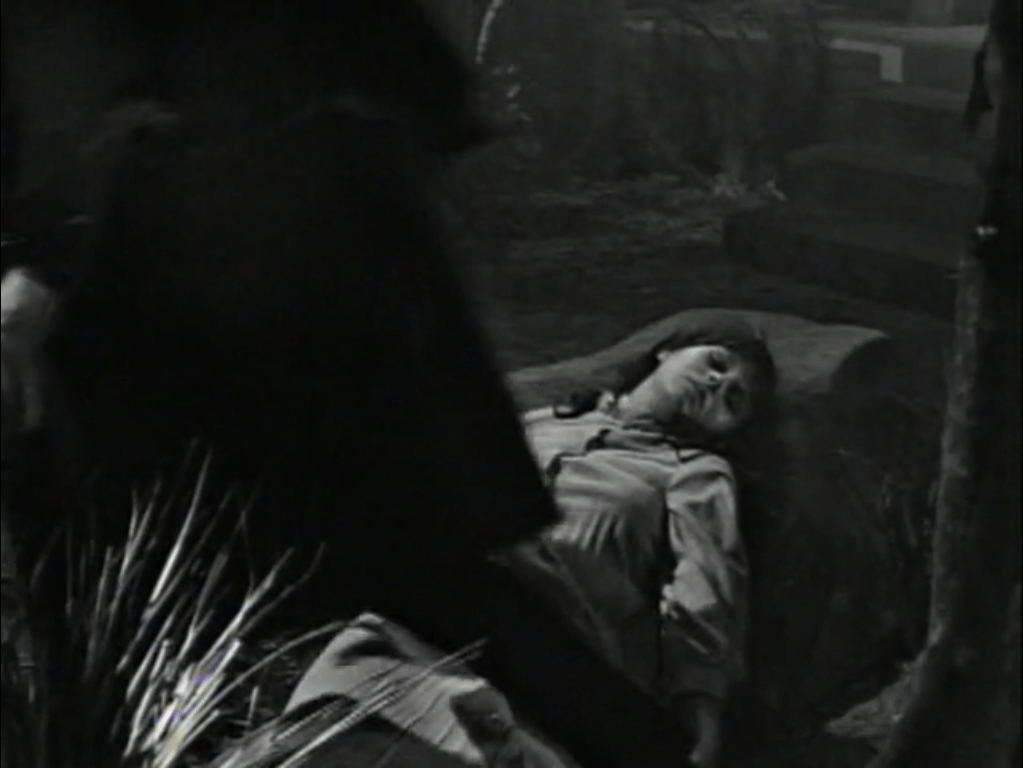
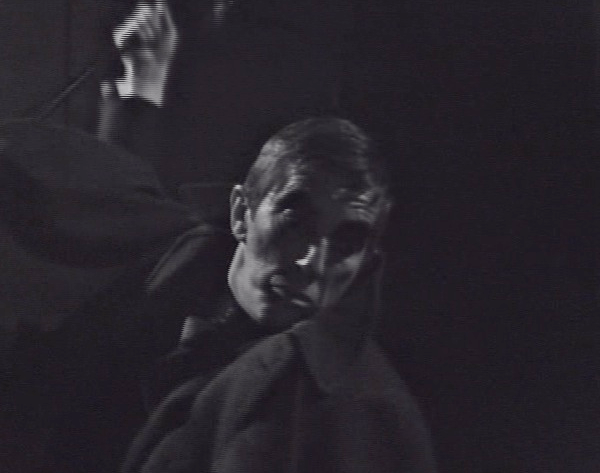
Episode 255: My fair lady

Accustomed to Her Face

Imperious eccentric Barnabas Collins wants to reinvent working girl Maggie Evans as a member of his class- genteel in manner, florid in speech, thirsty for the blood of the living. Willie Loomis does not believe Barnabas’ plan will work, but because of the nature of their relationship he of course helps him with it. Living in their house, Maggie sometimes seems to be well on her way to developing the traits Barnabas is trying to inculcate in her, but at other times protests that she will never change.

Maggie’s father Sam is a drinking man. He comes to the house today to get some cash from Barnabas. Sam doesn’t know about Barnabas’ project; his visit has nothing to do with Maggie. He is an artist, and is delivering a portrait Barnabas commissioned him to paint.

The episode ends with a musical number. Maggie is in the basement prison cell where Barnabas keeps her between elocution lessons. Through the bars of her door, she sees and hears a little girl in eighteenth century garb singing “London Bridge is Falling Down.” The girl sings an obscure variant of the song with a verse that runs “Take the key and lock her up, lock her up, lock her up. Take the key and lock her up, my fair lady.”

Falling down.
Screenshot by Dark Shadows Before I Die

Up to this point, the Barnabas story has been a mashup of Dracula with the 1932 film The Mummy. There isn’t any particular reference to vampirism today. Maggie’s neck is uncovered throughout the episode, and we don’t even see the bite marks. It’s all about The Mummy and its possible sources.

Imhotep’s attempt in The Mummy to turn Helen Grosvenor into Princess Ankh-esen-amun may have been inspired in part by George Bernard Shaw’s Pygmalion. Imhotep only has Helen in his custody for a few minutes of screen time and those minutes are so heavy with images of Egyptian antiquities, suggestions of magic, and the threat of extreme violence that they never find time for an explicit comparison.

Dark Shadows, on the other hand, keeps Maggie in Barnabas’ house for weeks and weeks, so it’s inevitable that sooner or later they would explore the connection. Thanks to Lerner and Loewe, the story of Pygmalion was very familiar to American audiences in 1967. It’s only surprising that Sam isn’t getting married in the morning, Maggie’s boyfriend Joe doesn’t tell us that he’s often walked down Barnabas’ street before, and Maggie never shouts at a race horse to move its bloomin’ arse. Considering the alarmingly awkward movements people in Collinsport make when music is playing, there was never any prospect she could have danced all night.

Just You Wait

Maggie uses the word “undead” to describe Barnabas. The first time we heard that word on Dark Shadows was in #183, when parapsychologist Dr Guthrie told blonde fire witch Laura Murdoch Collins that he believed her to be “the undead.” Though Laura’s story owed many structural elements to Bram Stoker’s Dracula, not least Guthrie’s own depiction as a Van Helsing-like figure, she was not a vampire. So “undead” is not simply a euphemism for “vampire” on this show, though it is true they will avoid saying “vampire” until Barnabas’ 41st week.

Regular viewers who find a reminder of Laura in the word “undead” will be especially interested in today’s ending. When Laura was first on the show, she was a vague presence. There were indications that she wasn’t so much a person as she was a whole collection of phenomena, some of them physical, some of them purely spectral, each of them with its own purposes. As Laura became more dynamic, those phenomena resolved themselves into the deadly fire witch and her adversary, the benevolent ghost of Josette Collins.

Like Laura, Barnabas seems to have stirred up numerous uncanny forces with his arrival. The clearest indication of this so far has been the howling of dogs when he is forming an evil plan, a howling which is not related to his physical location and which, often as not, hampers his efforts. There have also been some shenanigans with the doors in his house which don’t seem to have a natural explanation and which he wouldn’t have had a motive to arrange. The appearance of the mysterious girl* suggests that this time, the antagonist will pull a whole new cast of characters out of the supernatural back-world behind the main setting of the show.

*The girl is a lot less mysterious than she ought to be, since the closing credits identify her as “Sarah Collins.” That’s enough to tell even first-time viewers that she is a member of the ancient and esteemed Collins family that is at the center of the show. It gives more away to regular viewers. The tomb from which Barnabas emerged has marked graves for his parents, Joshua and Naomi, and his sister, Sarah, who died in childhood.

And right before Sarah appears, Barnabas was looking at Josette’s portrait. From #70 to #191, that portrait would glow when the ghost of Josette was about to do something. So if we didn’t know her name, we might think that the girl was an ally Josette had recruited, or perhaps Josette herself in a different form than the adult ghost we have seen before. That in turn would send us into the weekend speculating about the ghostly adversaries who might be lining up to oppose Barnabas. Giving the name, even to viewers who’ve forgotten about Barnabas’ sister, limits our speculations to possible one-on-one confrontations.

Episode 245: Microscopic views of hideous malignancies

Two of the best blogs about Dark Shadows share the same web address. One is Dark Shadows Every Day, a series of more than a thousand well-crafted, insightful, often hilarious essays by Danny Horn about episodes #210 through #1245 and related topics. The other is the group blog that Danny’s readers maintain in the comment threads under each of his posts. The commenters outdid themselves in their remarks on Danny’s post about this episode.

At the beginning of the episode, addled quack Dr Woodard has figured out that the two victims of vampire Barnabas Collins, sorely bedraggled blood thrall Willie Loomis and missing local girl Maggie Evans, have something in common. He hopes that if he can compare a sample of Willie’s blood with Maggie’s he will figure out what that is. Willie is terrified that this will lead to the exposure of Barnabas. Puzzlingly, Barnabas is unworried and orders Willie to cooperate. Only after Willie has given the blood and the doctor has left do we learn that Barnabas switched Willie’s sample with a normal one. “DS Willie” comments:

Barnabas is seriously messing with Willie’s mind in this one. So much of what Barnabas says has double meanings, even triple. Of course he’s playing with Woodard too, but Woodard never realizes it.

For one thing, just after Willie’s blood is taken, Barnabas makes creepy blood comments, ending with “…surrendering your utmost self” and his next line “Now, you had no choice.” I suspect this is all meant more for Willie than for the doctor. Willie had no choice but to surrender his utmost self.

Barnabas delights in repeatedly demonstrating his control over Willie, all to the doctor’s approval. When Willie flares up momentarily at Dr. Woodard’s remark about understanding being frightened, Barnabas immediately brings Willie to heel with a harsh word and harsher look.

Later Barnabas jerks Willie’s chain some more, just because he can, and to tighten his control even more. It’s classic Stockholm syndrome type stuff. The victim is abused and in absolute fear for his life, and yet any lessening of the captor’s threats or violence can be perceived as mercy, bonding the victim to his captor.

His shirt in Barnabas’ menacing grasp, Willie swears he would never, never betray Barnabas. He is only thrown to the ground instead of being choked or beaten. Barnabas proceeds to make Willie feel stupid and disloyal and dishonorable and undeserving of future protection. Add enthrallment on top of that. Oh, and the police having Willie as their top suspect, and Jason having beaten and threatened to kill Willie, even though Willie was trying to protect him.

It is actually pretty amazing that Willie has held up under the strain. He is in full-on survival mode, and yet still has the decency to try to shield Maggie and others insofar as he can, given his powerlessness.

Hey, what was up with Barnabas saying Willie’s blood is a “delicate little flower painted on glass”? He says it twice (once to Woodard and once to Willie) while looking directly at the slide. That doesn’t come across as a remark about blood in general.

“DS Willie,” on Dark Shadows Every Day, 13 October 2018 at 12:38 AM Pacific time

He adds another comment:

Oh. Barnabas was using yet another method to get Willie under his thumb: verbally emasculating him with the “delicate little flower” reference to Willie’s blood on the slide. But I think Willie was so relieved that he missed the diss.

“DS Willie,” on Dark Shadows Every Day, 26 December 2018 at 5:57 PM Pacific time

I made a contribution of my own to the thread. In response to Danny’s unfavorable comparison of Dr Woodard with Bram Stoker’s Professor Van Helsing, I commented:

Screenshot by Dark Shadows Before I Die

I don’t think Woodard is Van Helsing at all. He’s Dr John Seward, treating Lucy and Renfield and baffled by the whole thing until he calls in his brilliant old professor. The mysterious Hoffman, one of the best men in the field, that’s the expert who is going to shake things up.

Seward is young, dynamic, and ready for adventure, while Woodard is middle aged, pudgy, and ready for an afternoon tee-time at the local country club. But that change is necessary. Readers of the novel have plenty of time to think about the sort of group that might go on the expedition Van Helsing organizes, and will expect a bunch of high-spirited youths. On a soap, a character like Seward would be the heroine’s new love interest, and Dark Shadows is flailing about trying to figure out what to do with the love interests Vicki and Maggie have now. The last thing they want right now is another bold, handsome young man who is apparently under a vow of celibacy.

“Acilius,” on Dark Shadows Every Day, 19 May 2023 at 7:26 PM Pacific time

In response to Danny’s remark that Jonathan Frid’s bobbles make it hard to guess what lines the script originally gave vampire Barnabas Collins, commenter “TD” replies:

#1. “Now, in a way, isn’t that understandable?

#2. “After all, blood is the life force.

#3. “It reaches into the deepest recesses of both the heart, and the brain.

#4. “It is the familiar of our complete being.

#5. “To surrender even one drop of it is to suggest a partial surrender of one’s utmost self.”

I’m not so sure this is actual Fridspeak. Yes, it’s kind of gibberishy, but it does make grammatical sense and some sort of syntactical sense. Frid delivers it smoothly and with confidence, unlike his halting fumblings when he can’t remember his lines. When he says this, it’s in a close-up shot, and he’s looking down. My guess is that he is reading it directly from a script. Also, this is Joe Caldwell’s first script (or first credited script–he did some writing on earlier Ron Sproat scripts, if another website is accurate). Maybe this is Caldwell exhibiting the enthusiasm of a first solo outing. Dr. Woodard has a couple of hi-falutin’ and rhetorically “poetic” (and gibberishy) speeches of his own in this episode.

Also, might this episode be marked as the first one to demonstrate the “reluctant” or “sympathetic” vampire in Barnabas’s character? In this episode (in another speechy series of lines), when Dr. Woodard and Barnabas are discussing the “madman” who broke into Woodard’s office and stole the blood sample, we get this exchange:

Dr. Woodard: You know, it’s the peculiar magnificence of the human spirit that’s required to provide the potential for such corruption. [See? This is like the Barnabas “blood is the life force” speech–who talks like this???]
Barnabas: Yes, I know what you mean. Whoever he is, he must certainly be, at one and the same time, more than a man…and less than a man.
Dr. Woodard: You seem almost sorry for him.
Barnabas: Sorry? No, I’m not sorry. The truth is, I loathe him. I loathe him very, very deeply.

“TD” on Dark Shadows Every Day, 2 June 2017 at 11:06 AM Pacific time

I agree with “TD” that today’s dialogue is marred by purple passages; I would go so far as to say that none of the lines would have survived a rewrite. Not among the lines delivered by the human actors, anyway- our beagle was fascinated when the hound howled on the soundtrack.

I should mention that at least one perceptive critic of Dark Shadows disagrees with me and “TD” about the script. Patrick McCray’s Dark Shadows Daybook is in its own way the equal of the two blogs at Dark Shadows Every Day. Patrick wrote two posts about this episode. In one from 2016, he wrote that “The language is poetic and evocative. Barnabas has moments of self-loathing and ambiguity that are gorgeously, hauntingly phrased, and the same can be said for Woodard’s exploration of science and mystery.” In 2019, he went so far as to call it “the best written episode of the series.”

John and Christine Scoleri also include some interesting material in the post about this episode on their recap-heavy blog Dark Shadows Before I Die. I particularly liked the series of screenshots at the end of the post captioned with some of the purple prose from today’s dialogue.

Episode 239: The lover of her

Vampire Barnabas Collins is taking a page from the 1932 Universal Pictures film The Mummy. Boris Karloff plays Imhotep, who rises from the dead and decides that a young lady named Helen Grosvenor is actually the reincarnation of his lost love, Princess Ankh-esen-amun. He abducts Helen, tells her she is Ankh-esen-amun, and tries to kill her so that she can come back to life as that lady. Likewise, Barnabas has abducted Maggie Evans, The Nicest Girl in Town, and set about brainwashing her into thinking she is his lost love Josette. He has made it clear to the audience, if not to the other characters, that he will kill her so that she can rise as a vampiric Josette.

Today, Barnabas and Maggie are having dinner. Maggie seems to be in a daze, and only repeats what Barnabas says to her. Still, she is smiling at him and answering to the name Josette. We can’t quite tell if she is succumbing to his lunatic plan or is simply playing along with him.

Maggie’s father Sam and boyfriend Joe knock on the door. When Barnabas’ sorely-bedraggled blood-thrall Willie Loomis mentions Joe’s name, Maggie’s head jerks to the side and her eyes open. At that, we know that she was falling under Barnabas’ spell, because we can see her coming out of it.

Maggie recognizes Joe’s name

That it is Joe’s name that breaks Barnabas’ hold over Maggie echoes another of Barnabas’ sources, Bram Stoker’s Dracula. In that novel, Professor Van Helsing is delighted to hear that the vampire’s victim Lucy Westenra is receiving blood from Arthur Holmwood, because Arthur “is the lover of her!” The vampire represents, among other things, a travesty of a sexual relationship, so that real sexuality is a weapon against him.

Willie hustles Maggie upstairs to Josette’s bedroom, which Barnabas has restored complete with hairbrush, perfume, jewelry, and a portrait of the lady herself. Included among these items is a mirror, which will be of no use to Maggie once she becomes a vampire, but which, like the other things, is among the standard appointments of an ancient Egyptian lady’s tomb. Maggie can hear her father and Joe talking in the parlor below, and their voices bring her back to herself. Willie tries to keep her quiet, and does succeed in preventing her from letting Sam and Joe know that she is there, but Barnabas hears enough to know that she is trying to escape.

Sam is an artist. Before Barnabas abducted Maggie, Sam had been coming to Barnabas’ house to paint a portrait of him. He tells Barnabas that with Maggie missing, he can’t concentrate on painting. Barnabas says that of course he wouldn’t dream of asking him to work at such a time. Sam offers to take the painting home and work on it there, but Barnabas insists it stay at the house.

It has been strange that Barnabas wanted Sam to paint at his house. Barnabas only exists at night, and his house has no electricity, so conditions couldn’t be worse for painting. Moreover, he wants to get close to Maggie, and working at the Evans cottage would mean seeing her every night. Perhaps there is some magical quality that will inhere in the painting if it is done in Barnabas’ house. We’ve already seen a number of portraits act as gateways to the supernatural. The ghost of Josette has emerged from her portrait several times. And a few months ago, Josette’s ghost went to the Evans cottage and possessed Sam to literally paint a picture of what blonde fire witch Laura Murdoch Collins was up to. So Barnabas may be leery of letting the portrait out of his sight, lest Josette or some other paranormal adversary of his take control of Sam and use it to reveal his horrible secrets.

In his scenes with Maggie at the dinner table, Jonathan Frid manages to convince us that Barnabas sincerely believes that his plan will benefit her, so much so that here would be no point in trying to appeal to his conscience. It is a tribute to his success that it is startling when the episode ends with Barnabas closing in on Maggie with the intention of doing her some kind of violence. We know that he is a vampire, we know that he has attacked Maggie and other women off-screen, and we’ve seen him beat Willie savagely. But it is still chilling to see his earnest sweetness give way to violent abuse.

Episode 238: This place is becoming a prison

Well-meaning governess Vicki goes to the front door of the great house of Collinwood and brings in an afternoon paper dated 16 April 1967. There is the headline on the front page: “Pfizer Dropping Its Patent Suits on Tetracycline.” Right next to it, “Factory Labor Costs Reached Five Year High Relative to Output in October, Agency Says.” The New York papers had these stories on 24 November 1966, and ran them in the business sections. Apparently Collinsport’s afternoon paper doesn’t believe in rushing into print. There’s also some stuff there about the disappearance of Maggie Evans, The Nicest Girl in Town.

The Collinsport Star, 16 April 1967

Vicki looks directly at the paper for less than four seconds, yet when reclusive matriarch Liz asks her if the articles about Maggie provide any new information, she says no. Speed reading courses were a big fad in the 1960s, evidently Vicki must have taken one. Liz forbids Vicki or flighty heiress Carolyn to go out after dark until Maggie is found.

As soon as Liz leaves the room, Vicki suggests to Carolyn that they go for a walk to the Old House on the grounds of the estate. She wants Carolyn to see the restoration work that has been done since the courtly Barnabas Collins and his irritable servant Willie Loomis have moved in. Carolyn reluctantly agrees. We see a video insert of the women walking through the woods towards the house, with audio of their voices dubbed over it. I believe this is the first new exterior footage we have seen since #174, and the first to include actors since #130.

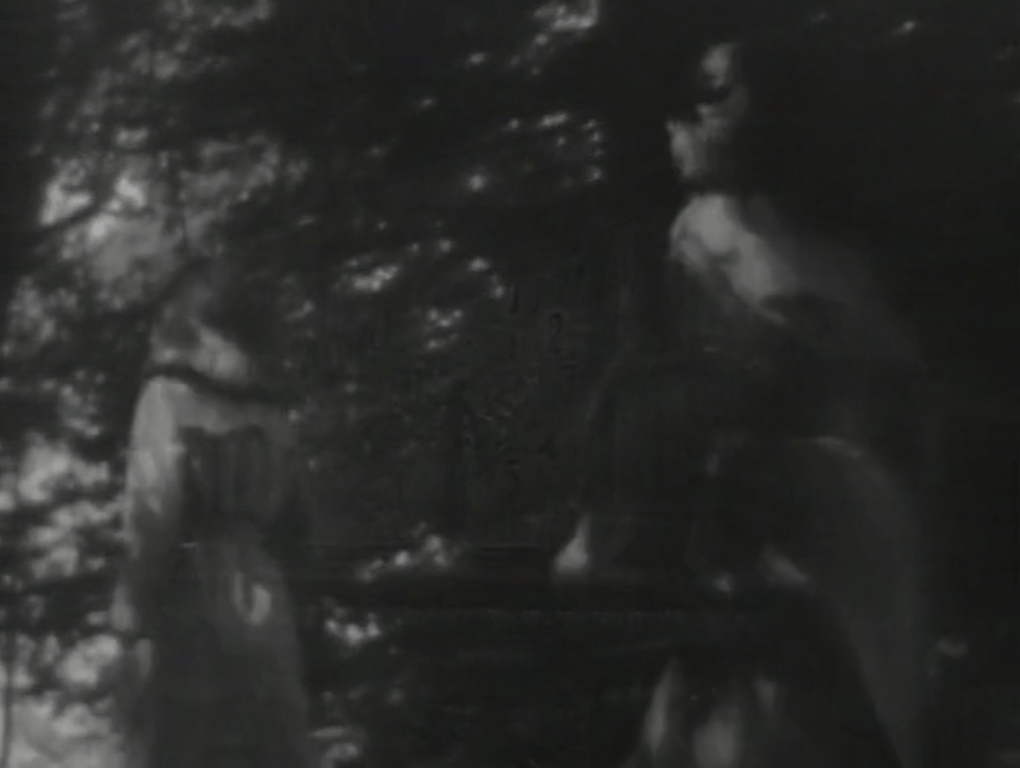
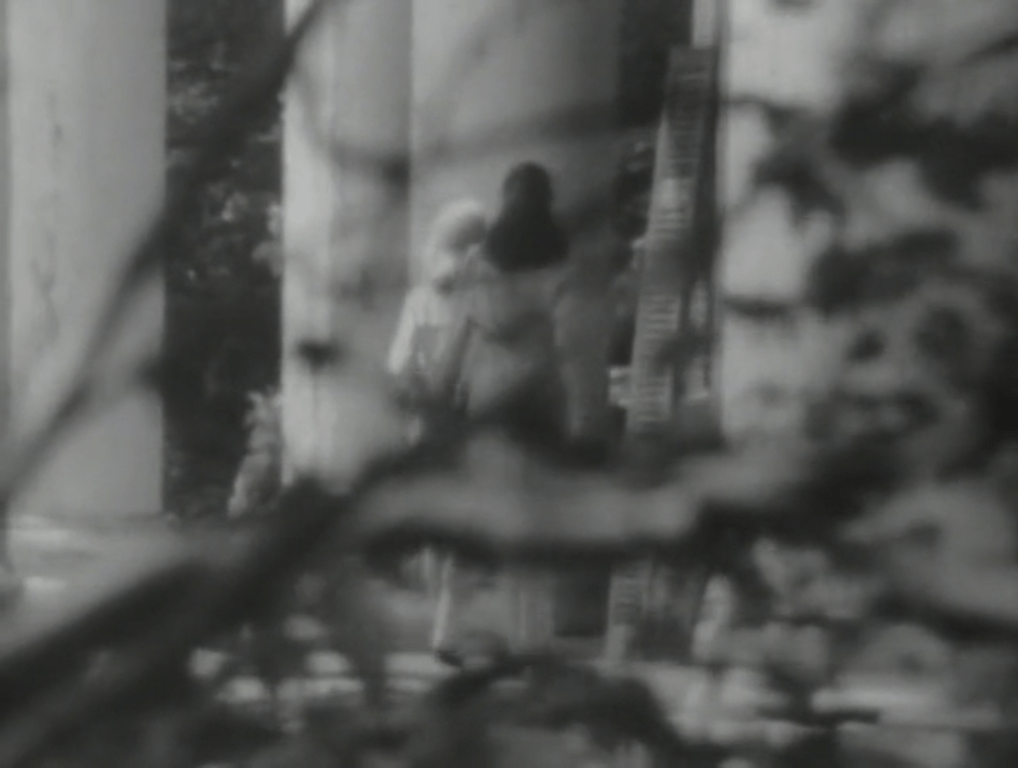
We see the women from an increasing distance, so that they appear to shrink; then through foliage, so that they appear to be in a trap; and finally from a high angle, as if they are small and weak. Since we know that Barnabas is a vampire and they are on their way to enter his lair, this is effective visual storytelling. In fact, it is the only good scene in the episode.

The beginning of the walk- Carolyn and Vicki at their largest
Approaching the house, they reach their smallest size
On the porch, behind the branches
At the bottom

Carolyn says that it is much colder around the Old House than it is at the great house, and Vicki mentions that they are closer to the ocean. This is something of a retcon. When strange and troubled boy David first took Vicki through the woods to the Old House in #70, not only was it news to her that the place existed, but the trek was a long one, suggesting it was far inland, deep into the grounds of the estate. That impression was reinforced a number of times, and Vicki’s remark is the first to contradict it. Apparently the writers are planning some story point that will require the Old House to be by the shore.

Vicki knocks on the door several times without an answer. As she and Carolyn turn to go, we see the doorknob turn and the door open. When the women see that no one is in the front part of the house, Vicki guesses that her knocking loosened the door. What we saw of the doorknob tells us that some agency opened it. It is still daylight, so Barnabas’ powers are unlikely to be at work, and it doesn’t seem that he would want people wandering into his house.

The Old House has also been the abode of the benevolent ghost of Josette Collins, and it is possible Josette might want Vicki and Carolyn to figure out what Barnabas is up to. But nothing they do today gives them a clue about him, and since it is almost nightfall it is extremely dangerous for them to be there. Josette would be unlikely to put them in that situation without good reason.

That leaves us wondering what other supernatural beings might be operating in and around the Old House. The first time Dark Shadows told a story that was modeled on Bram Stoker’s Dracula, it centered on blonde fire witch Laura Murdoch Collins. In the first weeks of that arc, it seemed that Laura was not simply a single physical body, but that she was a whole complex of material and immaterial presences, some of them working at cross-purposes to each other.

Now we are using another set of ideas from the same book. Barnabas is more dynamic than Laura was in those early days, but he too seems to have brought company with him, perhaps including companions he does not know about and whom he does not control. This is most obvious when he is planning some evil deed and the dogs start howling. Occasionally the dog-noise helps him by intimidating his victims or scaring away their would-be protectors, but more often it gets in his way by acting as a warning that trouble is brewing. If an unknown force that upsets the dogs emerged when Barnabas rose from his tomb, then perhaps still another force has appeared that is fiddling with the doors to the Old House.

Over Carolyn’s objections, Vicki insists on exploring the Old House. Carolyn protests that this is trespassing. They have been confusing about the legal status of the place. In #220, they said explicitly that Liz would continue to own it and would let Barnabas stay there. There hasn’t been any indication since that Barnabas has paid Liz anything or that she has done any paperwork. If the house belongs to Liz, Carolyn, as Liz’ daughter and heir, would be speaking figuratively when she uses the word “trespassing.” But in #223, Liz talked about the house as if it and its contents were Barnabas’ property. So who knows, maybe she signed the place over to him when the show was busy with a day of recapping.

Whether Barnabas is the proprietor of the house or a guest there, Vicki and Carolyn are certainly intruding on his privacy when they go upstairs and examine the bedrooms. Carolyn at least has the presence of mind to point this out, but Vicki just keeps repeating that Barnabas once told her she was welcome to come over any time and she interprets this to mean that she can go anywhere in the house whether he’s there or not. This is one of the most sustained, and most bizarre, of all the Dumb Vicki moments we’ve seen so far. Alexandra Moltke Isles usually tries to find something to put behind her eyes during these scenes to suggest Vicki has a thought we will find out about if we keep watching, but Vicki’s behavior today is so senseless Mrs Isles just grins and looks off into the middle distance like a crazy person. Who can blame her, really.

They find the bedroom of Josette all appointed as if Josette herself were living there, complete with jasmine-scented perfume. The door mysteriously closes, trapping them inside. Again, no one we have met, either living or ghostly, would have any motive to do this. After a moment, Willie comes to the door and demands to know why they are there. Vicki asks about the room and complains about Willie’s manners, as if she had a right to be there.

Downstairs, Vicki asks Willie to tell Barnabas how impressed she and Carolyn are with all the work that has been done. Barnabas shows up and is extremely gracious to the women. After they leave, he scolds Willie for his unfriendliness to them. Maybe he does want visitors letting themselves in and roaming freely about the house while he’s resting in his coffin and keeping a girl prisoner, who knows. That would seem foolish, but no more so than Vicki’s activities today. It was the 1960s and people’s blood had a lot of lead in it. Maybe that’s getting to Barnabas.

Vicki and Carolyn go back to the great house and tell Liz what they saw at Barnabas’. Liz is annoyed that they went to a place where they were likely to see Willie, whom she remembers from his pre-blood thrall days, when he was dangerously unstable ruffian Willie Loomis. She wonders why Barnabas has chosen to restore Josette’s room.

We return to the Old House, where the episode ends with its only scene not including Vicki. Barnabas stands before a small table in the parlor. It is set for a dinner for two. There are two plates, and two glasses. Barnabas has appeared to drink coffee at the restaurant in the Collinsport Inn, Amontillado in the study at the great house, and some kind of booze at The Blue Whale tavern. These glasses also seem to hold something other than human blood, indicating that Barnabas is not sticking strictly to the diet of his people. He tells Willie to bring their guest. Maggie enters, wearing Josette’s bridal gown and offering her hand when Barnabas addresses her as Josette.

It is by no means clear where Maggie has been up to this point. She wasn’t in Josette’s room, and doesn’t seem to be coming from the basement. The secret chamber behind the bookcase is no secret anymore, least of all from Vicki, who was held prisoner there by crazed handyman Matthew Morgan. Perhaps we are to think that her entrance, along with Barnabas’ insouciant attitude towards unexpected visitors, implies that there are spaces in the house only Barnabas can find.

Episode 234: The people who inspire the questions

We open with the sight of sorely bedraggled blood thrall Willie Loomis broken and crumpled on the floor of the Old House on the estate of Collinwood. He is under the heavy cane which vampire Barnabas Collins carries and which he uses to beat Willie. Barnabas demands Willie confess that he played a part in preventing him from taking full possession of Maggie Evans, The Nicest Girl in Town. Willie at first tries to deny his responsibility, but finally swears that he won’t disobey Barnabas again. Barnabas gives him some orders and dismisses him.

Willie under the Willie-beater. Screenshot by Dark Shadows Before I Die

At the Evans cottage, Maggie is sick in bed. When her friend, well-meaning governess Vicki, comes to sit with her, she makes Vicki promise she won’t leave her alone no matter what she says or does. She won’t even let Vicki go as far as the kitchen to fetch her a glass of milk- she doesn’t dare spend one second by herself.

Maggie’s father, artist Sam, has called Vicki because he himself has had to go to the Old House to work on the portrait he is painting of Barnabas. He is working on some problems in the background, and encourages Barnabas to take a walk. While Barnabas is away, Willie comes into the room and asks Sam where he is. Sam is concentrating hard on his work and responds to Willie’s questions with irritated grunts.

When Willie asks Sam how his daughter is doing, Sam turns to him and angrily snaps “Don’t mention her name!” He didn’t mention her name, but he was very rude to Maggie more than once in the days before he met Barnabas, when he was still dangerously unstable ruffian Willie Loomis. In #207, Willie was so crass in his behavior towards Maggie and Sam in The Blue Whale tavern that dashing action hero Burke Devlin had to beat him up and order him to leave town, the incident that prompted Willie to launch the grave-robbing expedition that released Barnabas. Sam was unhappy to see Willie again at the end of #222. By #225/226, he was willing to tell Burke that Willie had reformed, but that doesn’t mean he wants him to have anything to do with Maggie.

Of course, Maggie has already become Willie’s colleague, Barnabas’ second blood thrall. That’s the point of showing us the results of the beatings Barnabas inflicts on Willie. We’ve known Maggie for over 46 weeks and have liked her the whole time, so the idea that she is on her way to suffer that kind of abuse horrifies us. Willie’s determination to help Maggie, asking Sam about her even after the beatings, shows us how much he wants to spare Maggie the fate that has befallen him.

Back in the Evans cottage, Maggie has had another mood swing. These are familiar to readers of Bram Stoker’s Dracula, where the vampire’s victims Lucy and Mina are at one moment desperate to be rescued from him and at the next equally desperate to go to him. Maggie has been displaying these swings for several days now, and it is only because Kathryn Leigh Scott is a highly trained actress with a big bag of tricks that the scene where she demands Vicki leave is not painfully repetitious. My wife, Mrs Acilius, was particularly impressed with the way Maggie enunciates the word “leave” in her commands to Vicki.

Dogs make alarming noises near the french windows, sending Vicki into a state of panic. Maggie denies that she hears them at all. When the windows rattle and it seems that a pack of fierce dogs are about to burst in, Vicki runs to the next room to telephone Burke. When she is out, the door to Maggie’s room slams shut and Vicki finds that she is unable to open it.

Some wonder why Vicki goes to the next room to make her call when there is a telephone next to Maggie’s bed. Maggie used it to make a call in #225/226, and it was prominently featured in several shots in #231. I think it makes sense, though. Maggie is between Vicki and that telephone, and she is being extremely uncooperative. Vicki doesn’t want to take the time to fight her, she wants to call for help at once. Besides, Vicki is so terrified that we wouldn’t expect her to look around, and she has used the telephone in the other room before.

Others might wonder why she calls Burke rather than calling the police. Considering what we have seen of the Collinsport sheriff’s office, I don’t think this is a difficult decision to defend. Vicki tried to call the sheriff from the Evans cottage the other day, and no one was there to answer the phone. Nor have they managed to solve any of the crimes that have been committed on the show so far, even though the perpetrators left so much evidence lying around that Vicki herself, while going about her business, has accidentally stumbled on the solutions to one murder and two attempted murders.

The final shot of the episode, with Vicki banging on Maggie’s door and pleading with her, is not very compelling, and brings a wince to the faces of viewers who remember #84-#87, when Vicki was locked in a room in an abandoned part of the great house of Collinwood and spent several hundred hours of screen time* banging on the door and calling for help. Today’s ending isn’t exactly a Dumb Vicki moment, but it certainly isn’t an interesting moment, and we hope there aren’t any more like it.

*An approximation. It seemed like at least a thousand hours, but since the whole story played out in three and a half episodes lasting 22 minutes each I don’t suppose it could actually have been quite that long.

Episode 231: Anyone’s blood

Today is only the second time we hear a voice announce a recast over the opening title. The first time was in #35, when David Ford took over the part of drunken artist Sam Evans from wildly incompetent actor Mark Allen. This time Robert Gerringer is taking over the part of addled quack Dr Woodard from Richard Woods. Woods only played the role twice, and neither time could he find a way to distract the audience from the ignorance of medicine that the writers showed in their scripts.

Gerringer’s lines don’t make much more sense than did the ones they dumped on Woods, but he acts up a storm. Woodard is examining Sam’s daughter Maggie Evans, The Nicest Girl in Town. Unknown to Sam or Woodard, vampire Barnabas Collins has been sucking Maggie’s blood. Woodard is firm with Maggie when she resists his examination. He seems to be somewhat on edge, just enough that we wonder if there is more to it than the difficulties we can see Maggie giving him. Perhaps he is thinking something he isn’t saying. Woods never managed to make us wonder if his version of the doctor was doing that.

When Woodard and Sam leave Maggie’s room, Woodard assumes an alarmed tone. He tells Sam that Maggie is on the point of death and needs a blood transfusion at once. By showing us that Woodard was concealing the true nature of his concern when he was with Maggie, Gerringer gives substance to our hopes that the character’s nonsensical words and deeds will turn out to be a screen hiding something interesting.

Maggie’s boyfriend, hardworking young fisherman Joe, joins Sam and Woodard. Woodard asks if either Sam or Joe has blood type A. Joe does. Woodard doesn’t ask about Rh factors or Joe’s medical history or anything else, he simply marches Joe into Maggie’s room and the bodily fluids start pumping right away. Joe holds Maggie’s hand at first, but her violent protests force him to let go.

Transfusion

In Bram Stoker’s Dracula, Professor Van Helsing and Dr John Seward give blood transfusions to the vampire’s victims. That novel was written in 1897, and blood types weren’t discovered until 1900, so Van Helsing and Seward take blood indiscriminately from all the men cooperating in the effort to defeat Dracula. Van Helsing is particularly enthusiastic when he learns that Arthur Holmwood has given blood to Lucy Westenra, because Arthur “is the lover of her!” Van Helsing is Dutch, and speaks in a vaguely comical broken English. Woodard doesn’t seem particularly excited that Joe is “the lover of her,” but audiences who had read the book will recognize the allusion.

At this point in the production of Dark Shadows, the tentative plan was that Dr Woodard would become something like the expert on paranormal dangers that Dr Peter Guthrie had been during the Phoenix storyline, and that Barnabas would be destroyed in episode 275. Like Stoker’s Dracula, the Phoenix arc had featured a group of stout-hearted men and one valiant young woman coming together to do battle with an undead menace. Dr Guthrie had been their Van Helsing, an expert from out of town who leapfrogs over some weaknesses in the evidence actually available to the protagonists to get them to the same level of understanding that the audience has been given. Also like Van Helsing, Guthrie is the first to realize that the one female member of the team is the key to the success of their efforts, and so he insists on putting her in situations the other men regard as too dangerous for her. As Mina had been instrumental in the destruction of Dracula, so well-meaning governess Vicki is the person who finally thwarts the plans of the Phoenix.

If Woodard and Vicki are going to destroy Barnabas in #275, we have to wonder what story the show will have to tell in #276. The only other plotline going at the moment is the blackmail of reclusive matriarch Liz by seagoing con man Jason McGuire, and that can’t continue indefinitely. Not only will Liz run out of things for Jason to take away from her, but Dennis Patrick, the actor playing Jason, will leave the show no later than the end of June. Since the end of June is when #275 will be airing, we can hardly expect Jason to take the show over after that time.

In fact, Jason is an in-betweener brought on the show to clear away the last non-paranormal plot elements left over from the period before the show became a supernatural thriller in December 1966. By the time he leaves, both the reason for Liz’ long self-immuration in the great house of Collinwood and the identity of Vicki’s parents are supposed to be laid bare for all to see. Neither of those secrets ever generated an interesting story, but as long as they are around it is at least theoretically possible that the show will become a conventional daytime soap opera again. Without them, they are altogether committed to the spook show route. Destroy Barnabas, and you just have to come up with yet another menace from beyond the grave.

I remember Gerringer’s acting style from the first time I saw Dark Shadows. That was back in the 90s, when it was on what was then called the SciFi Channel. He so perfectly represented the doctor characters on the soaps my mother used to watch when I was a kid twenty years before that seeing him in the middle of a story about a vampire told me everything about the strangeness of a conventional daytime serial switching to a horror theme. If that guy is the one to drive the stake through Barnabas’ heart, or if he is even part of the team that finishes him off, it will be a statement that the makers of Dark Shadows have decided to stop being silly and start imitating The Guiding Light.

My wife, Mrs Acilius, was particularly frustrated with the dialogue in this episode. As Maggie, Kathryn Leigh Scott does a good job with nonverbal communication creating the image of a reluctant patient trying to get out of her skin, but her lines consist chiefly of repeating whatever is said to her. The other members of the cast are equally effective at projecting concern for a loved one whose grave illness they don’t understand and can’t help, but their lines too are so heavily loaded with repetition that we started to suspect that Malcolm Marmorstein was writing for a cast of myna birds. In particular, Woodard’s lines to Sam in the living room repeat the word “shock” so many times that they start to sound like he’s stuttering.

The original choices for the roles of Sam, Joe, Dr Woodard, and Maggie.
Photo by Bird Ecology Study Group

In his post about this episode, Danny Horn complains that there is not a single interesting still image in it. I agree with that, though I would say that the actors’ movements tell a story. Granted, it is a story that could have been told in a tiny fraction of the actual running time, but they deserve credit for holding the show together when the script gave them zero support.

Danny says that the episode would have been just as good if it were a radio show. Mrs Acilius says that it would have been “a thousand times better” than it is if it were a silent movie. Maybe they could compromise, and it could be presented with neither audio nor video, and the audience could spend the 22 minutes doing something else.

Episode 230: Some explaining to do

The Body in Question

Dark Shadows has been a supernatural thriller ever since the ghosts of Josette and the Widows scared Matthew Morgan to death in December 1966. But today’s episode is the first one that is structured like a horror movie.

Horror movies tend to focus on the visible damage done to the bodies of the female victims of the monster. The current victim is Maggie Evans, The Nicest Girl in Town, and the monster is vampire Barnabas Collins. We open with Maggie’s father, artist Sam Evans, looking helplessly around the house. Sam doesn’t know it, but Maggie was compelled to leave by the power that Barnabas has gained over her by drinking her blood.

What Sam does know is that Maggie was in extremely poor health. He cannot understand how she could have gone anywhere under her own power. We then see Maggie looking awful and wandering around the graveyard. Later, a closeup of a professional headshot of actress Kathryn Leigh Scott will dissolve into an image of Maggie among the tombstones, contrasting her usual fresh-faced beauty with her present ghastly haggardness.

Maggie’s professional headshot
The dissolve
Bride of the monster

The monster who has reduced her to this sorry state, vampire Barnabas Collins, emerges from the fog. Barnabas has been on the show for four full weeks now, but this is the first time we see his face not in the pleasant disguise of a wealthy gentleman visiting from across the sea. He is wearing a more extreme version of the makeup Maggie has on, and his fangs feature prominently. This is the introduction of the monster, a key element on any horror film, and it suggests that Barnabas is now what Maggie will become.

Barnabas inspects Maggie
Two of a kind?
Fangs on display.
Screenshot by Dark Shadows Before I Die

When Barnabas hears Maggie’s friends approaching before he can complete his evil plan, he drops her on the ground and steps over her, again treating her body as a thing.

Barnabas steps over Maggie

After she is carried home, Maggie moans about her pain but can say nothing about what has happened to her, who is responsible for it, or what she is thinking. Again, we can connect only with her physical being, not her social relations or her inner life or the events that have involved her. At the end, the handkerchief tied around her neck is removed without her permission or objection, as if she were inanimate. The camera zooms in on open wounds on her neck, isolating that area and leaving us with the image of the wounds as things available to us to examine apart from Maggie’s personality or the rest of her body.

The Source of the Evil

The episode is an adaptation of elements from Bram Stoker’s Dracula. Early in that novel, the vampire’s victim Lucy rose from her sickbed and wandered off to a graveyard. As Lucy is found by her friend Mina, so Maggie will be found by her friend, well-meaning governess Vicki. As Mina would spend the second half of the novel as the only female member of a group of stalwart and dynamic men doing battle with the evil Count, so Vicki is working with an otherwise all-male search party led by dashing action hero Burke Devlin. As Mina’s colleagues exclude her from their activities and thereby come close to total failure, so the men leave Vicki behind in the Evans cottage to wait by the phone, only to find that she is the one who will have the most to offer when she joins them in the field.

After Lucy dies and her undead form is destroyed, Mina becomes Dracula’s victim. Mina ends up as the precursor of the “Final Girl” in the mad slasher movie, playing a key part in Dracula’s final defeat, though unlike those movies Dracula ends with a successful team effort.

Since Vicki has been our point of view character from the beginning, was an effective protagonist in the “Phoenix” storyline, and is as relentlessly wholesome as the Final Girl typically is, we might expect that she will be Barnabas’ last victim. That expectation in turn suggests that Maggie, like Lucy, will die, rise as a vampire, and be destroyed by those who love her most. Maggie is one of every viewer’s favorite characters, so the prospect that she might turn into a monster and then leave the show altogether brings keen suspense.

Barnabas Beats His Willie

Vicki does have two important conversations with sorely bedraggled blood thrall Willie Loomis while she is in the Evans cottage. The first occurs when Willie comes to the door to bring a message that his master Barnabas will not be available at the usual time to sit for the portrait Maggie’s father is painting of him. Vicki tells Willie that Sam is out searching for Maggie, and Willie becomes very upset to learn that Maggie is missing.

The second conversation comes a few minutes later, when Willie, not disguising his voice in any way, telephones the Evans cottage and tells Vicki that Maggie is in the cemetery and that she is in extreme danger. Somehow Vicki doesn’t recognize his voice. I suppose there were lots of people it might have been- maybe it was Detective Mary Beth Lacey’s husband Harvey from Cagney and Lacey, or Stefan from Daughters of Darkness, or Jock Porter from Love is a Many Splendored Thing, or Geoffrey Fitton from the original Broadway cast of All in Good Time, or any of dozens of policemen and criminals who were in single episodes of cop shows in the 1970s and 1980s.

Willie’s call to Vicki made me wonder about the extent of Barnabas’ powers. When we first saw Barnabas with Willie, his power over him was so extreme that it cost Willie a great effort even to ask Barnabas an unwelcome question, and a look was enough to drive Willie to scurry off and perform the most hateful of tasks. An act of defiance like this was out of the question. Perhaps Barnabas can only keep one blood thrall under total control at a time, and by adding Maggie to his diet he has weakened his hold over Willie.

Willie intrudes on Barnabas’ encounter with Maggie in the cemetery to warn him that Maggie’s friends are on their way. Barnabas instantly suspects that Willie told them where to look for her. When Vicki’s party arrives in the cemetery, Barnabas and Willie run away and hide in the back room of the Collins family tomb where Barnabas was trapped for about 170 years until Willie accidentally released him. This is a departure from Dracula– the Count would have attacked whoever interrupted him, no matter how many of them there were, and fled only if they were armed with crucifixes or consecrated communion wafers or other objects he couldn’t tolerate. But, as my wife Mrs Acilius pointed out, Barnabas has gone a long time without using his vampire powers, so he’s probably rusty.

Barnabas and Willie listen as Burke looks around the outer room of the mausoleum. Once they are sure he is gone, Barnabas confronts Willie with his suspicions. Willie’s lies do not satisfy him, and he lifts his heavy cane and starts beating Willie with it. All we see of this beating is Jonathan Frid’s face and the cane in his hand, but those images, coupled with sound of John Karlen’s cries, imply a violence that shocks us.

In the secret room.
Screenshot by Dark Shadows Before I Die

Closing Miscellany

Burke picks Maggie up off the ground, grunting audibly as he does so. He carries her into her house, again with a lot of grunting. If I had been Kathryn Leigh Scott’s agent, the production staff would have received a very hot letter about that grunting. The good-looking young women on a soap opera aren’t supposed to weigh anything at all, certainly not enough to cause a dashing action hero to grunt like that even if he carried her all the way from the cemetery.*

In his post about this episode, Danny Horn has some lines about the ineffectiveness of the Collinsport police that I can’t resist quoting:

Sam tells the Scooby gang that he’s alerted the police — the sheriff and his deputies are out looking for Maggie. But, as everyone knows, the police department in Collinsport is 100% useless, so by now the deputies have probably arrested each other, and the sheriff’s all tangled up in a clothesline somewhere…

Vicki tries to call the sheriff, but there’s no answer; apparently every single person associated with the police department is out searching for Maggie, or falling down wells, or buying magic beans, or whatever the hell it is that Collinsport police officers do in a crisis. 

Danny Horn, “Episode 230: The Transylvania Twist,” Dark Shadows Every Day, 27 September 2013

When I first read about “the sheriff all tangled up in a clothesline somewhere” a few years ago, I laughed for about five minutes and knew I would be reading Danny’s blog to the end. I’m glad I did, it’s so much fun it inspired me to start this one.

*Mrs Acilius and I remembered a story Miss Scott tells nowadays. Early in the production of the show, Joan Bennett saw her eating a cheese Danish and said “The figure you have now can be your career for the rest of your life.” She put the cheese Danish down immediately, and hasn’t eaten another since. Our response to the story has been to eat cheese Danish on Miss Scott’s behalf at regular intervals.

Episode 219: One look at the man

This teleplay badly needed another trip through the typewriter.

In the opening scenes, seagoing con man Jason McGuire demands his friend and former henchman, the sorely bedraggled Willie Loomis, leave the estate of Collinwood and the town of Collinsport. He mentions that he saw Willie’s car the night before at the cemetery. He then orders Willie to get on a bus and leave town. Then he starts talking about Willie’s car again. Does Willie have a car or not? They’ve gone back and forth on this from one episode to another, but today they can’t keep it straight from one line of dialogue to the next.

A doctor shows up to examine Willie. He tells Jason that Willie is not sick at all. The reason he is so weak is that he has lost “an enormous amount of blood.” What does the doctor think the word “sick” means if it doesn’t apply to a person who is doing badly because of an “enormous” loss of blood?

Whatever meaning the doctor attaches to “sick” apparently also applies to “ailment.” High-born ne’er-do-well Roger Collins asks what Willie’s ailment is, and the doctor says he has no ailment. He is simply immobilized due to an enormous loss of blood.

The doctor tells first Jason, then Roger, that Willie will be fine if he gets some rest and fluids and food. The idea of a blood transfusion doesn’t cross his mind, nor do Jason or Roger bring it up. It would be one thing if the doctor, Jason, and Roger were played by the Three Stooges, but there is no sign that we are supposed to think that they are a load of idiots.

An actor who has repeatedly triumphed over bad writing reappears after an absence of sixteen weeks. This is Dana Elcar as Sheriff George Patterson. The sheriff’s activities don’t always make a great deal of sense, but Elcar’s acting choices and his zest for performance make him a pleasure to watch no matter how dire the script he has to work with.

Today, the sheriff is telling Roger that a number of cows on the farms owned by the Collins family have been destroyed. A person or persons unknown somehow sucked every drop of blood out of these cows through small punctures in their hides. Roger is deeply unsettled by this strange news, and the sheriff sympathizes with him.

Roger repeatedly asks the sheriff why he is the one telling him about the cows. He says that he would have expected the veterinarian to call him. The sheriff says that the veterinarian called his office, because he determined that the cows were killed by someone’s deliberate act. That doesn’t explain why the veterinarian, whose bill the Collinses will presumably be paying, didn’t call him. We were so glad to see these fine actors working together that the senselessness of the scene didn’t bother us while we were watching it, but as soon as it was over we were left with a feeling of confusion.

Roger and the sheriff. Screenshot by Dark Shadows Before I Die

Regular viewers do wonder what farms the sheriff and Roger are talking about. The only previous reference to the word “farm” in connection with the Collinses was in #64, when Sheriff Patterson told their servant Matthew Morgan to “work their farm for them” and stay out of trouble. Today’s conversation repeatedly refers to “farms,” plural, more than one of which are big enough to have cows. That’s an operation much too complicated for Matthew, who had many other duties, to have handled by himself. Besides, Matthew left his job in #112 and was scared to death by ghosts in #126, and hasn’t been replaced. Whatever farm Matthew was working must have been so small that the Collinses can take care of it themselves in whatever time they can spare from their main occupation, keeping secrets and being sarcastic.

Writer Ron Sproat specialized in inventorying disused storylines and getting them out of the way. Back when Matthew was on the show, the Collinses were heavily in debt and running out of money. Dashing action hero Burke Devlin spent the first 40 weeks of the show trying to avenge himself on the Collinses by driving them into bankruptcy. All of that has gone by the boards, and we aren’t hearing any more about troubles concerning the business. So it’s time for Dark Shadows to reconceive the family as financially secure, indeed as imposingly rich. Talking about their many farms and the herds of livestock on them helps Sproat open up space in his narrative warehouse, but it doesn’t offer much to interest the audience.

My wife, Mrs Acilius, thought up a little fanfic that might have introduced the same points more intriguingly. The trouble with the cows first came up in #215. Hardworking young fisherman Joe Haskell told the story of a calf belonging to his uncle that was found drained of blood. That suggested that an evil has been loosed that is spreading throughout the town and beyond. Why not stick with Joe as the point of view character in connection with the mystery of the desiccated cows? Not only would that give a badly under-utilized character something to do, but would also give us the sense that the fate of a whole community is at stake in the action.

If they needed to connect the Collinses to the cow story, they could have come up with a way to oblige them to join with Joe to figure out what’s going on. That in turn would raise the prospect of a story structured like Bram Stoker’s Dracula, in which one character after another joins the team opposing the malign Count. The formation of the group that resisted blonde fire witch Laura Murdoch Collins in the months leading up to #191 very much followed the pattern set in Stoker’s novel. Of course, the ending could be modified. The Laura story ended, not with the triumphant team-work that defeats Dracula, but with well-meaning governess Vicki cut off from her allies and left to confront Laura alone. But the team-work leading up to that point was full of interest, as characters shared information with each other, reconfigured their relationships, and found themselves doing things neither they nor we would have expected. Simply reintroducing the topic of the cows and leaving Joe and the Collinses siloed off from each other is easy for the writers, but it doesn’t take the story anywhere.