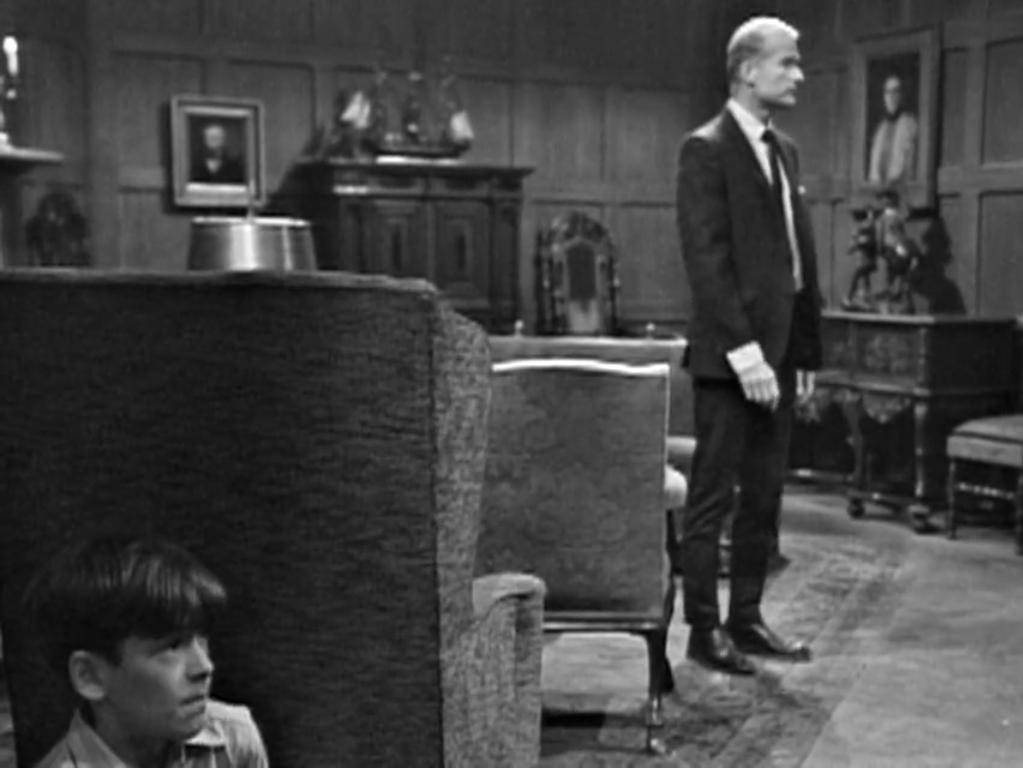
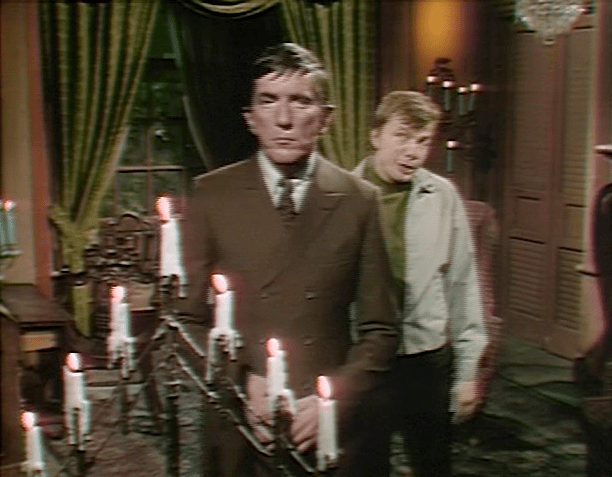
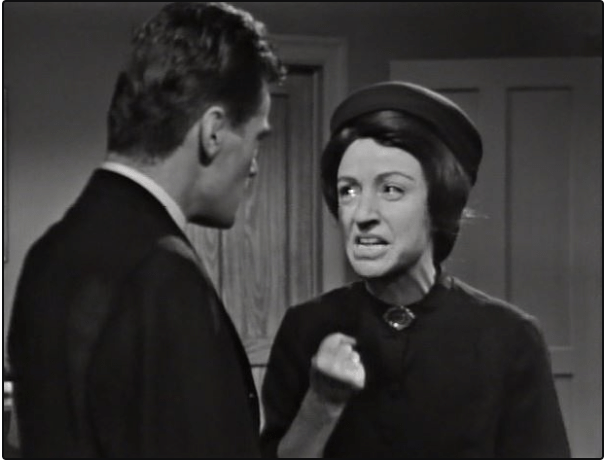
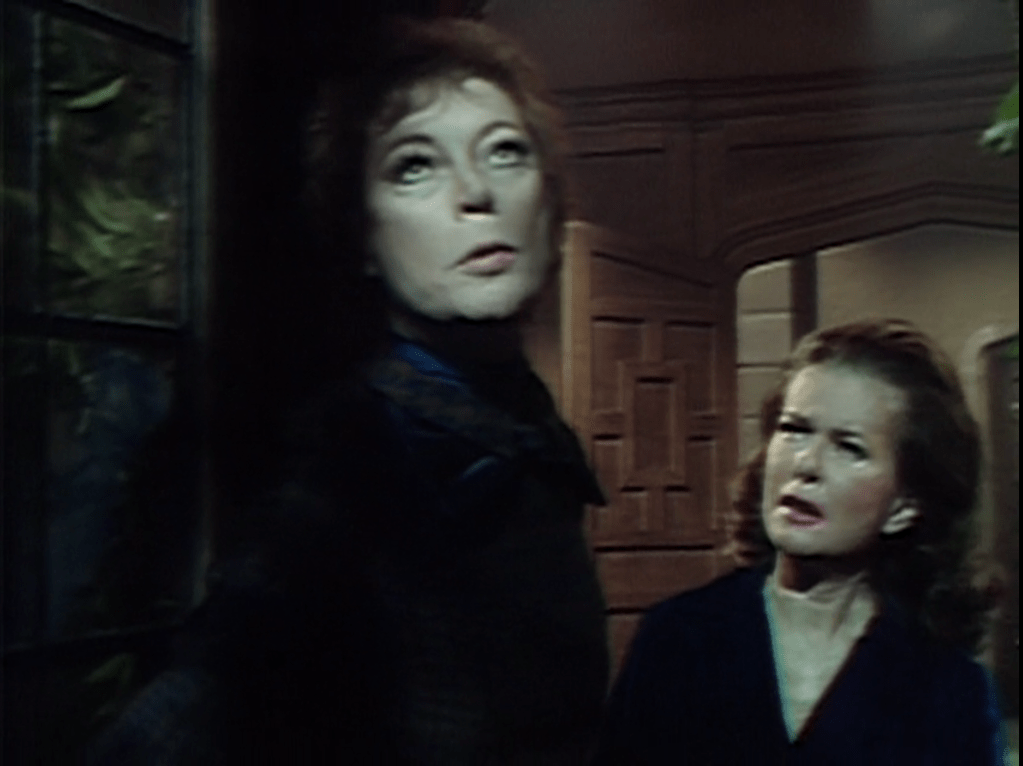
Episode 520: What is it about this family?

Permanent house-guest Julia Hoffman walks into the great house of Collinwood and greets Roger Collins with a chipper “Good morning, Rodgie!” This is the second time we have heard Roger addressed as “Rodgie.” The first time was in #103, when he called to well-meaning governess Victoria Winters with “Oh, Vicki!” and she responded with “Oh, Rodgie!” That was a disastrous blooper; at that point, Roger was the show’s chief villain and Vicki was supposed to be terrified that he was about to murder her. Roger has long since been rendered harmless, and Julia is in a breezy mood, so “Rodgie” seems appropriate.

Roger’s own mood is anything but cheerful. His wife Cassandra hasn’t been seen since last night, and there is no indication where she might be. He is convinced something must have happened to her, and he calls the police.

Julia knows that Cassandra is actually Angelique, a wicked witch who in the 1790s turned Barnabas Collins into a vampire. Now Barnabas’ vampirism has gone into remission, and Angelique/ Cassandra is determined to revive her curse on him. The other day, Julia and some other people conjured up another personage from the 1790s, the Rev’d Mr Trask, a fanatical but wildly inept witchfinder. Julia hopes that Angelique/ Cassandra’s absence means that Trask has destroyed her.

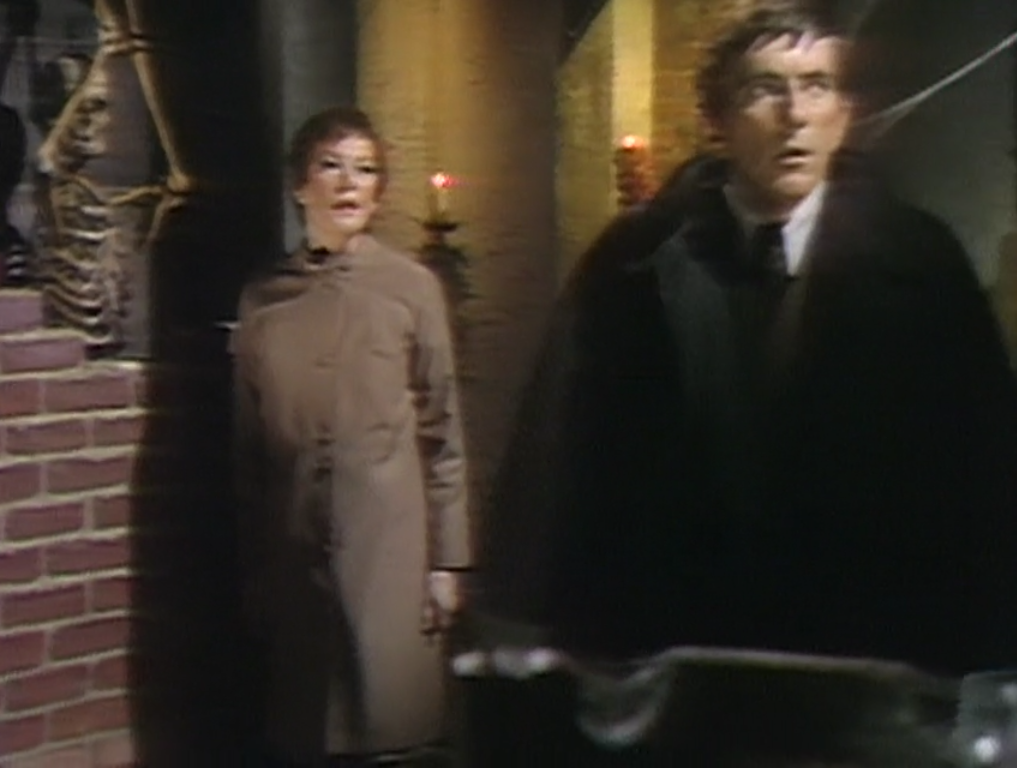
Barnabas stops by. Julia tells him of her theory. He can’t believe Angelique/ Cassandra is really gone. They go to Barnabas’ house and look in the alcove in the basement where, in 1796, Barnabas murdered Trask by hanging him from the ceiling and bricking him up. Trask’s bones had disappeared when Julia and the others brought him back to life, but are there again now. Julia takes this to mean that he is at peace, not a condition usually associated with hanging from a ceiling in a bricked-up little space, and that Angelique/ Cassandra must therefore have been defeated once and for all. At no point does it occur to them to take Trask’s bones down and give him a more respectful resting place. Apparently they consider human remains a standard part of household decor.

Trask, Julia, and Barnabas.

Back in the great house, Julia finds evidence that Angelique/ Cassandra’s powers are still at work. Matriarch Liz is still under a spell Angelique/ Cassandra cast and believes herself to be Naomi Collins, mother of Barnabas. She believes her brother Roger to be Naomi’s husband Joshua and Julia to be houseguest the Countess DuPrés. Most alarming, Liz has all the knowledge Naomi had in the hour before her suicide. She even mentions to Roger and Julia that Barnabas is “the living dead.” Roger and Liz don’t know that Barnabas was a vampire, and Julia doesn’t want them finding out.

Julia goes back to Barnabas’ house and confers with him about the situation. Barnabas says that Roger knows more about the family history than Liz does, and that if he starts hearing the actual facts there is a great danger he will figure everything out. This is a change- previously the show had always indicated that while Liz took some interest in the Collinses of years gone by, Roger took none.

We cut back to the great house and see Liz sitting at the desk in the drawing room. She is putting a note in an envelope addressed to “Joshua.” Regular viewers saw Naomi sit at this same desk and put a note in just such an envelope in #458. As Naomi did then, Liz pours a snifter of brandy, takes a container from the desk drawer, pours a powder from the container into the brandy, then drinks it. She again follows Naomi’s lead when she goes upstairs.

Barnabas and Julia enter. Julia asks exactly what Naomi did before she died. He starts telling the story, and she finds the note. Barnabas says Naomi died in the tower room; they go there, and find Liz. She talks to Barnabas as if she were Naomi and he were her accursed son. She collapses in his arms, as Naomi did in 1796.

Episode 519: Poor suffering servant of Satan!

Roger Collins is on the telephone in the foyer of the great house of Collinwood. He is assuring the caller that it will be fine if Maggie, whom returning viewers know to be The Nicest Girl in Town, comes to stay. He says that he and Cassandra will be glad to have her for as long as she wants to be with them, and that he is sure Liz will approve. First time viewers thus learn that Roger has a wife named Cassandra, and that they live as guests in a house belonging to someone called Liz. A moment later, Liz enters, and is too distracted to hear anything Roger says to her.

Roger ends the phone call, and follows Liz into the drawing room. She stares out the window and makes a gloomy remark about death. He says he understands she must be very upset about Sam Evans. Returning viewers know that Sam was Maggie’s father, and that he died in yesterday’s episode. Roger goes on about how it is natural to be grieved at the loss of a friend like Sam, but soon learns that Liz’ mood has nothing to do with Sam’s demise- it’s news to her that he is dead.

Roger’s lines will startle longtime viewers. For the first 40 weeks of the show, Roger and Sam were united by a deep and abiding mutual hatred, and since then they have had no contact at all. Roger’s words about Sam as a family friend are so far from what we have previously seen that they should be considered a retcon.

Liz and Roger spend several minutes in the drawing room. She keeps going on about the all-pervasive reality of death, and he keeps urging her to see a doctor. There isn’t much to their lines, but Joan Bennett and Louis Edmonds were such extraordinary screen performers that it’s always fun to watch them together. This scene might be a particular pleasure to longtime viewers, who have rarely seen Roger as the responsible adult in any encounter.

We dissolve to a bedroom where a young woman in a black wig is sifting through some powders, looking directly into the camera, and telling Liz that her obsession with death will become even worse than it already is and will have dire consequences. Liz will believe that she is someone else, a woman who lived and died in another century, and may die by the same poison that killed that person.

There is a knock at the door. It is Roger. The woman hides her powders and lets him in. He addresses her as Cassandra and asks why the door was locked. Thus first-time viewers learn that she is his wife, that this is their room, that she is a witch, and that Liz’ problem is the result of a spell she has cast.

Cassandra tells Roger that she locked the door because David kept pestering her about Sam’s death and she wanted a moment to herself. With that, first-time viewers find out that David is Roger’s son, that Cassandra is his stepmother, and that she expects Roger to consider locking him out of the room an appropriate response to his grief about Sam.

Roger does not so consider it, and is bewildered by what Cassandra tells him. He tells Cassandra that Liz is in a bad way, and he is worried about her. Cassandra says she did not know that Roger was so concerned about his family. Baffled by this, Roger says that of course he is concerned, Liz is his sister. This tells first time viewers both what Roger’s relationship to Liz is, and that Cassandra has so little sense of family that she cannot imagine how other people feel.

Regular viewers will learn more. In the first year of the show, Roger’s keynote was his lack of loyalty to the family. That has now been set aside once and for all, and his normal attachment to his son and his sister provide a contrast with Cassandra’s apparently sociopathic coldness. Further, we saw a great deal of Cassandra from November 1967 through March 1968, when the show was a costume drama set in the 1790s and she was called Angelique. We saw then that Angelique had no conception of family or friendship, and that her idea of love begins and ends with her control over a person.

Cassandra promises to join Roger downstairs for a game of bridge in half an hour. He leaves, and she gets back to work spellcasting. As she does so, a figure in a black cassock materializes behind her. She turns, and the figure vanishes. In a quizzical tone, she says Roger’s name, revealing that she did not see the figure or realize that it is a supernatural presence. Together with her locking the door, scrambling to hide her magical paraphernalia when Roger knocked, lying to cover what she was doing, and failing to understand what a person with a reasonable amount of human empathy would consider acceptable behavior, her puzzlement shows that whatever her powers may be, they have definite limits.

Back in the foyer, another young woman with black hair lets a man into the house. She calls him Joe, and he calls her Vicki. Joe and Vicki talk about Sam’s death and about Maggie. Joe says that he wants to marry Maggie as soon as possible and to move away. Vicki is all for their marriage, but does not want them to go. Joe talks about how close he and Sam were. Longtime viewers will remember that when Sam and Roger were enemies, Sam was the town drunk. Even then, Joe was always happy to help him in whatever way he could, and did not see his condition as any obstacle to marrying Maggie.

Liz enters and angrily addresses Joe as “Lieutenant Forbes.” Joe has never heard of Lieutenant Forbes, and cannot understand why Liz, who knows him well, would not recognize him. Vicki clearly does know who Liz is talking about, and manages to calm her down. After Liz apologizes and hastens away, Vicki answers Joe’s questions only by saying that Forbes is someone from “the past.” Since we heard Cassandra talk about Liz taking on the personality of someone who lived in “another century,” this suggests that Vicki, too, has an unnatural familiarity with that same century.

Joe wants to go upstairs to the room where Maggie is sleeping so that he will be the first person she sees when she wakes up. Vicki is about to lead him to Maggie when Cassandra insists she join her in the drawing room to talk about David. Vicki tells Joe which door to open, and complies with Cassandra’s directions. This shows that Vicki is a member of the household staff whose responsibilities have to do with David. Regular viewers know that she is his governess, and that they are very close.

Cassandra tells Vicki that David has been asking about Sam’s last words. Vicki says that he addressed them to Maggie, not to her, and implies that she did not hear them. When Cassandra continues probing, Vicki protests. She asks if Cassandra can’t see that she is upset. Considering how clueless Cassandra was about human feelings in her conversation with Roger, it is entirely possible that she cannot. Vicki tells her that Liz is deeply depressed; Cassandra feigns ignorance. Vicki says in a cold voice, “You wouldn’t know anything about that,” then leaves.

Longtime viewers know that it was Vicki who came unstuck in time in #365 and took us with her to the 1790s. During her nineteen weeks in the past, Vicki came to know not only Forbes, but Angelique. She knows perfectly well that Angelique and Cassandra are the same person, that she is a witch, and that she is a deadly menace to everyone. She likely suspects that Liz’ depression is the consequence of one of Cassandra’s spells, and the tone of her parting remark would suggest that she does. Further, those who saw the show yesterday know that Vicki is lying about Sam’s last words. They were addressed to her, and she heard them clearly. She is choosing not to repeat them to Cassandra lest Cassandra use them for her nefarious purposes.

Cassandra is alone in the drawing room for only a few seconds. She is joined there by the same figure who had appeared in her room. This time she sees him. He confronts her.

Regular viewers know that the figure is the Rev’d Mr Trask, a fanatical witchfinder who mistook Vicki for the witch in the 1790s and sent her to the gallows. He tells Cassandra that he now has the opportunity to correct that error. He shows her a cross, from which she recoils. We cut to a scene in the woods. Trask has tied Cassandra to a tree and performs an exorcism on her. This is Trask’s go-to technique; he tied Vicki to a tree in #385 and performed an exorcism on her in #386. Since Cassandra actually is in league with the devil (or as Trask would say, THE DE-VILLL!!!,) he has more success this time. Cassandra vanishes and leaves the ropes hanging on the tree.

Trask exorcises Cassandra. Screenshot by Dark Shadows Before I Die.

A first-time viewer might take this climax as an indication that Dark Shadows is a Christian show and Trask is its hero. Not only is Trask going after the right target, he is clearly making some headway. He says all the right things about casting the evil out of Cassandra and saving whatever good is left in her. His delivery of his lines is so fervent that Mrs Acilius, a vigorous Christian, cheered him on. In fact, Trask’s wild incompetence throughout the 1790s segment led to one disaster after another, and was of a piece with the show’s light regard for religion. Not until #450 did a cross provoke a reaction from a monster; that was the first suggestion the show gave that there might be anything to Christianity, and the scenes between Cassandra and Trask today are the second.

Dark Shadows borrows story points freely from all sorts of books, plays, movies, and folklore. So far, it has steered clear of Christianity as a source. For obvious reasons- most of the audience is at least nominally Christian, and Christianity is, in one way or another, a live option for the rest. So it’s a topic that can take over very quickly once it is introduced. I suppose a specifically Christian version of Dark Shadows could have worked, but I can’t imagine that the staff they had would have been particularly interested in making a show like that. So when it looks like they are going to let Trask have even a temporary win, we see the show running one of its boldest risks yet.

Episode 514: Serious talking

Hardworking young fisherman Joe Haskell is engaged to marry Maggie Evans, The Nicest Girl in Town. Early in their relationship, Maggie warned Joe that they might never be able to get married, because her father Sam was an alcoholic and would always need her to come rescue him. Joe liked Sam, drunk or sober, and was always quick to lend him a hand. He didn’t seem to understand Maggie’s worries.

Now, it’s Joe who is worried, and Maggie who doesn’t understand why. Sam’s drinking doesn’t seem to be as much of a problem as it was then. But he has been struck blind, ending his career as a painter. Joe still wants to marry Maggie, and is still glad to help Sam. But Sam has befriended a very tall, phenomenally strong man named Adam, who is wanted by the police because he abducted heiress Carolyn Collins Stoddard several days ago. Sam doesn’t consider the abduction to be a strike against Adam, whose ignorance of social customs he considers to be a disability equal to his own blindness. Joe is convinced that Adam is a violent felon and is alarmed that Sam insists on inviting him to the Evans cottage. Maggie has been out of town and doesn’t know about Adam.

Today, Joe finds a reason to be as alarmed about Maggie’s judgment of men as he is about Sam’s. Maggie was missing for some weeks in May and June of 1967, and when she was found she was so severely traumatized that she could barely talk. She spent months in a mental hospital called Windcliff after that, during which time she had regressed to childhood and developed a tendency to become wildly agitated. She seems to be her old self now, but she still has amnesia covering the whole period from her disappearance through her time at Windcliff.

Like the rest of the village of Collinsport, Joe believes that Maggie was abducted and brutalized by Willie Loomis, servant to old world gentleman Barnabas Collins, and that Willie was trying to kill Maggie when the police shot him in #322 and #323. When he survived his gunshot wounds, Willie was sent to Windcliff. In #483, Joe was appalled to find that Barnabas had arranged Willie’s release and brought him back to work for him. Joe informed Barnabas that he intended to kill Willie if he ever again saw him near Maggie.

Joe is on his way to the Evans cottage when he sees Willie heading for the front door. He confronts him and reminds him of what he told Barnabas. Willie tells him Maggie is no longer afraid of him, that they are friends now, that she visited him at Barnabas’ house earlier that evening, and that it wasn’t the first time she had gone there. Willie is going on about himself as Joe’s “competition” for Maggie’s attention when Joe hits him a couple of times and knocks him out.

Joe goes into the house and tells Maggie what happened. She admits that she did go to Barnabas’ house earlier, that she talked to Willie, and that it wasn’t the first time. Joe reacts with incredulity and says that Willie tried to kill her. Maggie insists that Willie is innocent. Joe asks why she believes that; she can’t explain. He asks why she went to Barnabas’ house. Again, she can’t explain. She says that she does not know why she went there, but that she is sure it wasn’t to see Willie. Joe is shocked that Maggie can’t explain something she did just an hour or two before. He keeps asking, but she insists that she does not know why she went to the Old House.

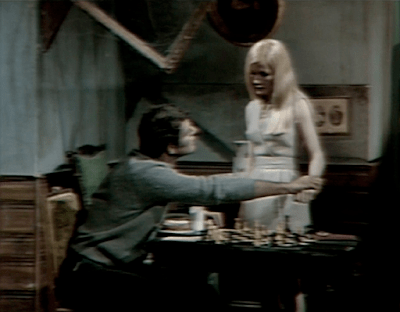
Joe becomes more and more alarmed. Maggie turns away from him, and he grabs her arm. All the fansites remark on the roughness of this move; it looks like an act of domestic violence. It certainly is not what we would expect of Nice Guy Joe, who was Carolyn’s doormat in the early months of the show and has been a Perfect Gentleman in his relationship with Maggie since then. The 1960s were a particularly bad time for intimate partner violence on screen, so it speaks relatively well of actors Joel Crothers and Kathryn Leigh Scott, and especially of director John Sedwick, that this moment passes briefly. Joe doesn’t follow it up with any further violence, and Maggie seems to forget about it instantly, as if it were an accident. In those days, it might just easily have been highlighted as a proof of Joe’s manliness.

Joe gets rough. Screenshot by Dark Shadows Before I Die.

The arm-grab is not defensible, but Joe’s intense feelings in response to Maggie’s inability to explain her behavior are. Joe and Sam visited Maggie at Windcliff in #265. She didn’t recognize them and started shrieking lyrics to “London Bridge” in what I think is the single most frightening scene in the whole of Dark Shadows. Maggie’s amnesia blotted that out, but Joe can hardly have forgotten it. He also remembers Willie as he was in his first weeks on the show, when he seemed determined to rape all the young women and beat up their boyfriends. The idea of Maggie’s mental health regressing to such a low point that she would wander off with a man like that must terrify Joe.

In his post about this episode on his Dark Shadows Every Day, Danny Horn lists eight ongoing storylines it references. They are:

#1. Sam recently went blind; that’s why Joe has to pick him up at the bar.

#2. “Cassandra” is really Angelique, who’s cast a complicated Dream Curse spell that will eventually lead to Barnabas’ death. The gift that she brought was pipe tobacco, laced with a magic powder that would make Sam have the dream.

#3. Professor Stokes is fighting Cassandra, and trying to stop the Dream Curse. He stole the pipe tobacco, because he doesn’t want Sam to have the dream.

#4. Willie has a crush on Maggie, so he stole a pair of Josette’s earrings from Barnabas, and left them in Maggie’s purse while she wasn’t looking. When she puts the earrings on, she has a flashback to the period when Barnabas held her captive, and tried to convince her that she was Josette — a period that should be blocked from her memory.

#5. Adam, the newborn Frankenstein, has befriended Sam, and is now looking for him…

[#6.] Barnabas… was chained up a couple episodes ago and trapped behind this wall. Now he’s kicking at the wall, desperate for someone to come and rescue him. 

[#7. A] man… abducted Carolyn a few weeks ago.

[#8.] Cassandra putting a curse on Liz, and making her think about death all the time. 

Danny Horn, “Episode 514: That Endless Summer,” Dark Shadows Every Day, published 2 November 2014.

Danny might have mentioned several other stories that don’t come up today, but of which regular viewers are aware and on which the ones that do come up depend. For example, Barnabas’ vampirism has gone into remission, and as a result his sometime victims were freed of the effects of his bites. It is unclear what this means for them, particularly for Willie, who often seems to have become once more the dangerously unstable ruffian whom Joe and the others knew when he first came to Collinsport. Also, a man named Peter is dating well-meaning governess Vicki, and Vicki has trouble remembering that Peter would prefer to be called Jeff. That may not be too exciting, but it’s no duller than Liz moaning endlessly about death. We could also bring up strange and troubled boy David, who has come into possession of a tape recorder with a message that has been played for the audience approximately umpteen billion gazillion times, but that no character other than Adam has heard, and if anyone else does there will be consequences. And Harry, the ex-convict son of housekeeper Mrs Johnson, is staying at Collinwood, and may someday be mentioned again. If he is, there is a danger that the audience will once more have to watch Craig Slocum try to act, truly a grim prospect.

Danny argues that the dense packing of so many storylines into the show makes watching it a stimulating cognitive exercise that “actually teaches people how to process information more efficiently.” As this blog makes obvious, I enjoy this kind of complexity very much. Not only do I keep talking about how ongoing storylines relate to each other, I reach back and find echoes of plot elements from months or years before and consider the significance of the common themes they develop; I look at the way the show borrows stories from books and plays and movies and folklore and notice how they put those source materials in dialogue with each other; and sometimes, my dissatisfaction with stories that didn’t work leads me to think up other stories that might have turned out better, adding yet another layer of narrative accretion to the already extremely intricate existing dramatic text.

I think Danny goes overboard, though, in his presentation of his case. He suggests that an increase in the number of storylines per minute of airtime is equivalent to an increase in the intellectual power of the show. But analysis and collation of plot elements is only one of many kinds of mental activities audiences engage in, and is far from the most important one. If that was all you wanted, you wouldn’t need actors. When an actor creates a character, s/he transforms the story points into the experiences of a person and the audience into witnesses of those experiences. When the drama is well executed, those experiences, even if they can be assigned to some category that is familiar to us, strike us as fresh and unique. When that happens, you don’t need a large number of interlocking storylines to generate complexity- your responses, emotionally and intellectually, will be as complex as your own background can support.

The audience’s background matters. There’s an old saying that when you engage with a literary work, it isn’t just you who read the book, but the book reads you. I often see how true this is in my job as a faculty member in ancient Greek and Latin at a state university in the interior of the USA. When I teach courses on ancient Mediterranean literature in translation, students aged 18-25 have an entirely different reaction than do the “non-traditional” students, those coming back to school after some years doing something else. Most of the students who are in the traditional college age group make interesting connections with a wide variety of topics, while others in that group get bored and can’t see a point in reading old books. But of the dozens of students I’ve taught when they were over the age of 40, every single one has found the reading to be a deeply rewarding experience. The literature that we have from the ancient world was written for adults, and the average American post-adolescent is only going to get so much out of it.

At this point in 1968, Dark Shadows is very much a show for children. The biggest and fastest-growing share of the audience is under 13 years old. So if it is going to be a smart show, it’s going to be smart in the sense that IQ tests measure, transmitting large amounts of information and giving the audience a short period of time to absorb, analyze, and recombine that information before it is followed by another close-packed message. It’s no wonder that an actor like Joel Crothers would become discontented with the show and go away complaining that the cast was being crowded out. He has ever less basis for the hope that he will be able to present the audience with a recognizable human feeling and leave them with hard thinking to do about what that feeling means.

Episode 513: The woman in the window

Wiggéd witch Angelique/ Cassandra and her reluctant cat’s paw Tony are on the terrace at the great house of Collinwood, quarreling about Tony’s failure to complete his latest mission. Angelique/ Cassandra talks about the punishments she is capable of inflicting on Tony, and decides that she will force him to fall hopelessly in love with her. This punishment will begin as soon as she has kissed him.

This is not the first time Angelique/ Cassandra has found a reason to kiss Tony. The last time she did so, in #489, her stepson David caught them, and she had to scramble to come up with a spell to wipe his memory. This time, her sister-in-law Liz catches them, and she curses Liz to become obsessed with death. As she is casting the spell, she tells Liz that the obsession will make her life less empty. It does not promise to make it more interesting for the audience to watch.

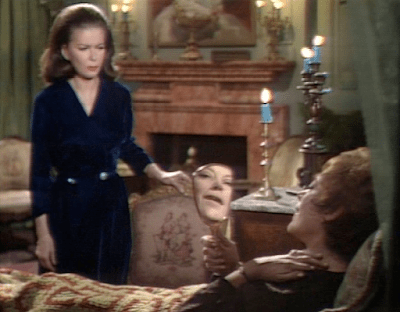
Joan Bennett as The Woman in the Window. Screenshot by Dark Shadows Before I Die.

Episode 504: A talent for making everyone feel guilty

Well-meaning governess Vicki was the main character of Dark Shadows for its first year, but has been receding further and further to the margins since. Today she returns after a 14 day absence, the first time she has been off screen so long.

Vicki is in the drawing room of the great house of Collinwood with her employer, matriarch Liz. Liz is distraught because her daughter Carolyn has been abducted by a strange man. Liz fears that Carolyn is dead or dying; Vicki urges her to set those fears aside. The police telephone; they have captured the man, but Carolyn was not with him, and he has not answered any of their questions. Liz and Vicki set out for the gaol to see him.

They are accompanied by a sheriff’s deputy. The Collinsport police are exceptionally useless, but even by their standards this deputy is a low performer. Though the man is so strong that it took twenty men to subdue him and bring him in, the deputy enjoys taunting him. He sticks his service revolver in the cell; the man is shackled to the wall, but he is so tall he sweeps his hand into contact with the gun. If the script didn’t say otherwise, he could easily take it from the deputy. Liz orders the deputy to stand back out of the man’s line of sight. Since she owns most of the town, he grudgingly obeys.

The deputy puts his weapon within Adam’s reach.

Yesterday, Liz went looking for Carolyn at the Old House on the estate, home to her distant cousin Barnabas. She found Barnabas’ servant Willie on the ground, suffering from a fresh head wound. Willie told her that the man had been by a few minutes before, and that he had been carrying the unconscious Carolyn. He also referred to the man as “Adam.” When Liz asked him why he used that name, he denied that he did and began jabbering about some bad dream that had frightened him. Today, Liz addresses the man as Adam, and he responds, proving that Willie does in fact know more about him that he will admit.

Liz and Vicki tell Adam that they will treat him as a friend if he tells them where Carolyn is. Adam knows the word “friend.” He repeats it, and adds “food!” Again he says “Friend, food!” The women do not know what he is driving at. They give up and go home.

Returning viewers know that Adam has stashed Carolyn in an abandoned structure that looks exactly like Fred and Wilma Flintstone’s house, that he calls Carolyn “Friend,” and that he had gone out to look for food for her when he was captured. He is dejected when he cannot make it clear that she is hungry.

Liz and Vicki return to Collinwood. They spend several seconds taking off their coats in unison. In the early days of the show, there were a number of scenes designed to emphasize Liz and Vicki’s resemblance and to present each as the other’s reflection in support of a storyline that led us to believe that Vicki was Liz’ unacknowledged daughter. That storyline was forgotten long ago, and it isn’t entirely clear what director Jack Sullivan is getting at here.

Back in the drawing room, Liz tells Vicki her reasons for believing that Barnabas knows a great deal about Adam. Apparently the doors separating the drawing room from the foyer amplify sound, because as the camera takes us from the drawing room to the foyer Liz and Vicki’s conversation only becomes more audible. Liz’ new sister-in-law is in the foyer. This woman calls herself Cassandra, but regular viewers know that she is in fact wicked witch Angelique. Vicki knows that perfectly well. Vicki traveled back in time in #365 and spent nineteen weeks living under the same roof as Angelique while Angelique wrought havoc on the Collins family of the 1790s and framed Vicki for her crimes. Angelique’s only disguise as Cassandra is a black wig- otherwise, she looks, sounds, and moves exactly as she had when Vicki knew her in the eighteenth century. As a result, Vicki is very much on her guard around her.

Angelique/ Cassandra enters the drawing room. Liz excuses herself, and Angelique/ Cassandra demands to know why Vicki doesn’t like her. When Vicki says that she resembles someone she didn’t get along with, Angelique/ Cassandra proclaims that she isn’t that person, bursts into tears, and runs out. Vicki stays in the drawing room, but the camera follows Angelique/ Cassandra to the staircase, where we see her smile gleefully.

Liz returns, and Vicki tells her she may have misjudged Cassandra. It doesn’t speak well of Vicki’s brainpower that a single display of crocodile tears would override the memory of their long and painful acquaintance, but since Barnabas and the others who are doing battle with Angelique/ Cassandra refuse to accept Vicki’s help, she may as well forget everything she knows. Liz tells her that she doesn’t think she misjudged Cassandra, and says she doesn’t trust her either.

Back in the gaol, the idiotic deputy goes back to Adam’s cell to taunt him some more. When Adam protests, the deputy opens the door and waves his baton at him. He places himself within easy reach of Adam, who grabs him and knocks him unconscious.

Yesterday, the high sheriff said “I’m not a stupid man.” He may not have been as stupid as is this grinning imbecile, but it is on his responsibility that he has a badge and a gun.

Another deputy enters. He sees his moronic colleague on the floor, the bars twisted in the window, and no sign of Adam.

Window.

Adam is 6’6″, so it’s difficult to see how he could fit through this opening. Perhaps he is not only tremendously strong, but is also a contortionist.

Episode 502: Some experience with the criminal mind

Yesterday, matriarch Elizabeth Collins Stoddard and her daughter Carolyn were in their drawing room quarreling about some family matters when a strange man stumbled into the house. The man was 6’6″ tall, his face was scarred, he trailed a length of chain from a shackle he wore on one ankle, and could speak only a few words. When Carolyn tuned the radio to an Easy Listening station, the man found that the listening was not at all easy for him. Saying “Not music!,” he smashed the radio. This prompted Liz to threaten him with a letter opener. Frightened, the man clutched at Carolyn. The situation escalated when Liz’ distant cousin Barnabas burst in and pointed a rifle at the man. Finally, the man ran out of the house, carrying Carolyn with him.

Today, Liz is moping in the foyer. Local man Tony Peterson, who had gone on a few dates with Carolyn some months ago, comes to the door. He and Liz discuss the situation. Liz laments the harsh tone she took with Carolyn during their argument. She tells Tony that she supposes there is a generational difference between them. He and Carolyn hide their feelings, while Liz expresses hers. This is an exceedingly strange thing for Liz to say- the whole foundation of her character is denial. In the first months of Dark Shadows, Liz was a central character, and the show was largely a study of that psychological defense mechanism and its consequences. She has moved to the margins of the action since then, but hasn’t changed her personality. Indeed, Liz’ conversation with Carolyn took a harsh turn precisely because she refused to face the unpleasant facts Carolyn was reporting to her.

Tony comforts Liz. Screenshot by Dark Shadows Before I Die.

Liz and Tony go to the Old House on the grounds of Liz’ estate, home to Barnabas. They find Barnabas’ servant Willie on the ground by the front door of that house; the door is open, and Willie is nursing a recent head wound. He confirms that the man had been there and that he was carrying Carolyn in his arms. He says that Carolyn appeared to be unconscious. Tony announces that he will go after them, and Willie tells him he will need a gun. “He’s strong, that Adam,” says Willie.

Liz demands to know why Willie called the man “Adam.” Willie denies that he did. That only irritates Liz, who insists that Willie tell her what he knows about the man. Willie repeats his denial, and says that he is worried about a nightmare. He keeps going on about this topic, to which Liz angrily responds “I don’t want to hear any more about your dream!”

Liz confronts Willie. Screenshot by Dark Shadows Before I Die.

Adam has taken Carolyn to an abandoned root cellar somewhere in the woods. This is a new set. Regular viewers, knowing what a rarity new sets are on a show with this one’s budget, will expect something important to happen there. What happens there today is that Adam and Carolyn struggle to communicate with each other. She asks him what he wants; he manages to say “Kill Barnabas!,” a goal which people who have been watching for the last several weeks will agree he has excellent reasons to pursue. He holds a burning pine cone and is surprised to find that it hurts when the fire reaches his hand; she is startled to find that he didn’t know that, and says that he is like a baby. She tries to leave the root cellar, but he won’t let her get to the door.

Liz spoke for the audience when she said she didn’t want to hear any more about Willie’s dream, but it is dramatized for us anyway. It ends with the image that frightens Willie the most, a wolf’s head. Longtime viewers can well understand why this might be a terrifying symbol to Willie. When Willie first worked for Barnabas, Barnabas habitually beat him with his heavy wooden cane topped with a metal handle in the shape of a wolf’s head. In those days, Barnabas was a vampire, and when he felt bloodlust dogs would howl. As Barnabas’ blood thrall, that sound would therefore tell Willie that either he himself would soon be drained of more blood, or that he would be forced to help Barnabas prey on someone else. So it makes sense that for Willie, terror has a canine face.

Episode 501: You’ve lied your way out of worse situations

Virtually every episode of Dark Shadows begins with one of a handful of still images of the exterior of a mansion in Newport, Rhode Island, known in those days as Seaview Terrace.* Before the series went into production, Dan Curtis took the cast up to Newport and shot some video of them on the grounds of the mansion. In 1966 and the first half of 1967, bits of that footage were occasionally inserted to give the show a more spacious and less static feeling. When they started shooting episodes in color at the end of July 1967, they could no longer use those inserts, and they had neither the time nor the budget to go back to make more.

Now, Dark Shadows uses green screen effects to create the illusion of exterior shots. Twice today, they show us actors in front of the still of Seaview Terrace that most frequently appears at the opening, with foliage hanging next to them to give an illusion of depth. The result isn’t as satisfactory as the location inserts were, but it’s nice to know the makers of the show are trying to broaden their canvas.**

Frankenstein’s monster Adam has escaped from the Old House at Collinwood and finds his way to the principal mansion on the same great estate. There, he stands outside the windows and listens to a conversation in the drawing room between matriarch Liz and her daughter Carolyn. Carolyn tells her mother that she saw Cassandra, Liz’ brother Roger’s new wife, having a romantic moment with local man Tony. Liz’ keynote has always been denial, and true to form she refuses to believe Carolyn. They go on with this until Adam stumbles through the front door and terrifies them.

Adam can only speak a few words. He smiles when he says one of his favorites, “music.” Carolyn turns on a radio we have never seen before and we hear Francois Lai’s theme to the movie “A Man and a Woman,” an instrumental hit of the 1960s which played on the jukebox at the Blue Whale tavern in #307. Adam scowls, declares it “not music,” and smashes the radio. I’ve always had a fondness for the tune, but listening to this arrangement I have to admit he has a point.

Liz reacts to Adam’s violent act by grabbing a letter opener and threatening him. Panicked, he grabs Carolyn. Two more residents of the estate burst in. They are old world gentleman Barnabas Collins, master of the Old House, and Julia Hoffman, permanent houseguest in the great house. Barnabas has a rifle and threatens to shoot Adam if he doesn’t put Carolyn down immediately. Adam flees into the woods, still carrying Carolyn.

Julia stays in the drawing room with Liz. It dawns on Liz that Barnabas must have been hunting Adam. Julia denies this, and Liz asks why Barnabas had a gun. In response, Julia talks very fast and says very little. That gives us a wonderful little scene. It’s always exciting when a brick falls out of the wall Liz built between herself and reality, and Julia is one of the most accomplished liars in drama.

Liz realizes that Barnabas and Julia know more about Adam than they are letting on. Screenshot by Dark Shadows Before I Die.

*A family named Carey bought the place in 1974, so these days it is usually referred to as the Carey mansion.

**The screenshots are from John and Christine Scoleri’s post on their blog Dark Shadows Before I Die.

Episode 473: And that’s all I want to say.

Dark Shadows‘ first supernatural menace was undead blonde witch Laura Murdoch Collins, estranged wife of sarcastic dandy Roger. Laura was on the show from December 1966 to March of 1967. During that time, Laura tried to rebuild her relationship with her son by Roger, strange and troubled boy David. David’s well-meaning governess Vicki at first encouraged her charge to go to his mother, but eventually figured out that Laura posed a deadly threat to him. Vicki formed a coalition of characters to help her fight Laura, and eventually rescued David from his mother’s clutches at the last minute.

Now, Roger has come home to the great house of Collinwood after an unexplained absence that had Vicki, his sister Liz, and his distant cousin, old world gentleman Barnabas, terribly worried. Roger happily announces that he has taken a new wife, and presents her to the family.

As it turns out, Roger has a definite type. His new bride is also an undead blonde witch, though at the moment she is wearing a black wig that doubles as a physical representation of the concept “1968.” Her name is Angelique, although she pretends it is Cassandra.

Some critics say that the film 2001: A Space Odyssey would more aptly have been titled 1968: A Bad Year for Hats. As you can see, however, headwear in general was passing through a time of trial in that period. Screenshot by Dark Shadows Before I Die.

Vicki and Barnabas recognize Angelique immediately. Vicki came unstuck in time in #365, finding herself in the year 1795, and didn’t make it back to the 1960s until #461. During her nineteen weeks in the late 1790s, Vicki got to know the people who lived at Collinwood in those days, among them Barnabas and Angelique. She saw many horrible things happen to them, and only after being blamed for those catastrophes herself would she realize that they were the consequences of spells cast by Angelique. Due to Angelique’s curse, Barnabas would be a vampire from 1796 until the week after Vicki came back to 1968. Vicki has decided to believe that Barnabas is not the same person she knew in that period, but rather that he is the descendant of that Barnabas Collins. He does not want her to know that he ever was a vampire, and she has resolved not to know that either, even though he used to bite her on the neck and suck her blood.

The battle against Laura was a fairly exciting story, at least in its latter stages. Angelique is a far more dynamic adversary than Laura, and Dark Shadows is much faster-paced and better written than it was then, so a reprise of the structure of that conflict in this new setting would likely be very exciting indeed.

To wage such a battle, Vicki and Barnabas can have no secrets from each other. Many who have been with Dark Shadows from the beginning have been hoping that its original protagonist will eventually become aware of the principal storylines, and this is one of the obvious ways to do it. Vicki can learn that Barnabas was a vampire, can find out that he was the one responsible for all the terrible crimes committed against the women and men and cows of Collinsport in 1967, and can still align herself with him, because she needs his support against Angelique, a more urgent threat. By the time they have vanquished her, not only will the idea of handing Barnabas over to the authorities have lost its salience, but Vicki will doubtless be facing another urgent threat requiring Barnabas’ assistance.

Nothing we see today suggests that such a development is on the horizon. The episode began with Vicki, Barnabas, and Liz worrying about Roger. A couple of weeks ago, Vicki brought a portrait home from an antique store and it had bizarre effects on Roger. The other day, he took the portrait and disappeared.

We can tell that today is not going to be a win for the female characters when Barnabas reacts to Liz’ expression of concern by dismissing her from his presence and she leaves, even though he is in her house. Vicki can tell Barnabas knows more about the situation than she does, and each time he condescends to mete out a little information in response to one of her questions he ends by turning his back to her and explicitly refusing to share anything more.

When Liz first leaves him alone with Vicki, Barnabas sourly remarks “I try to remember… that I must not reproach you for the reasons you’ve given not to marry me.” As Danny Horn shows in a series of screenshots in his post on Dark Shadows Every Day, their body language does not at any point support the idea that Barnabas wants to be with Vicki and she does not want to be with him. Quite the contrary; he withdraws from her, turns from her, and puts physical objects as barriers before her, while she looks at him, follows him, and leans towards him.

This has been Barnabas and Vicki’s dynamic for a long time. By #285, she went so far as to invite herself to a sleepover at his house. Barnabas was a vampire then; he entered the bedroom while she slept and bared his fangs, but couldn’t bring himself to bite her. Time and again, Vicki would all but draw a circle on her neck with the words “Mr Vampire, Bite Here!,” and Barnabas would tremblingly open his mouth, then recoil at the last moment. In #462, he finally sampled her bloodstream. By the end of #466, Barnabas’ vampirism had gone into remission, and that little storyline had evaporated. Now Vicki is vague and confused about what happened between her and Barnabas, and he is afraid he will relapse and bite her again.

Vicki is trapped between two blank walls. On one side Barnabas is excluding her from his life and therefore from active participation in the A story. On the other, she keeps having scenes with her old boyfriend from the 1790s, an unpleasant man named Peter who keeps demanding, for no apparent reason, that she call him Jeff. That habit of his was dead on arrival as a story point, and now that Angelique will be trying our patience by insisting her name is Cassandra, it will become impossibly tedious to have a second character doing the same pointless schtick. As long as she is in this position, Vicki’s prospects for contributing interesting material to Dark Shadows belong to a very low order of probability.

Episode 457: I will meet you

This is the first episode of Dark Shadows credited to a director other than Lela Swift or John Sedwick. It is also the first production of any kind directed by Dan Curtis, the series’ creator and executive producer. Curtis’ inexperience shows at several moments when the camera is in an awkward spot or the actors are unsure what to do, and in his post about the episode on Dark Shadows Every Day Danny Horn documents several of the more egregious examples with screenshots and detailed analysis. The impossible deadlines and tiny budget on which Dark Shadows was produced meant that even Swift and Sedwick, who were seasoned professionals and ambitious visual artists, sometimes had to turn in work that wasn’t much better than what first-timer Curtis manages today, and longtime viewers of the show will take even his worst stumbles in stride.

At the top of the episode, it is daytime, and much put-upon servant Ben Stokes (Thayer David) finds the lady of the house, Naomi Collins (Joan Bennett,) standing at an open coffin that holds the corpse of her son, Barnabas. Ben knows that Barnabas is a vampire who will rise at night to prey upon the living. Naomi has never heard of vampires. All she knows is that Barnabas is dead, and that his coffin has been moved from the family mausoleum to a room atop a tower in the mansion. Ben pleads with her to leave the room and to go with him back to the main part of the house.

Naomi questions Ben. Ben tells her that Barnabas has a “sleeping sickness,” and has been in a coma ever since the night he apparently died. Ben does not like to lie to Naomi, but her husband, haughty overlord Joshua, has judged that the truth would kill her, and Ben is governed by that assessment. He does tell her that the “sleeping sickness” is a symptom of a curse, that the wicked witch who placed the curse was Barnabas’ sometime wife Angelique, and that Joshua is in Boston trying to find someone who knows how to lift it.

Ben asks Naomi how she came to be in the tower room. She tells him that naval officer/ sleazy operator Nathan Forbes told her that Barnabas was being kept there, and also that Barnabas was responsible for the series of murders that had recently taken place in the town of Collinsport. At that, Ben vows to kill Nathan. To his chagrin, Naomi forbids him to do this.

Naomi forbids Ben to kill Nathan. Screenshot by Dark Shadows Before I Die.

In the part of Dark Shadows set between August and December of 1966, Bennett played reclusive matriarch Elizabeth Collins Stoddard and David played her fanatically devoted handyman Matthew Morgan. When well-meaning governess Vicki came unstuck in time and arrived in the late 1790s, she at first mistook Naomi for Liz and Ben for Matthew. This scene takes longtime viewers back to the days when Matthew was always on the lookout for someone who represented a threat to Liz’ interests and she was always sternly prohibiting him from murdering anyone for her sake.

Ben is a far saner man than Matthew ever was; the contrast between them shows the effect that growing up in Collinsport, a town suffering from the consequences of a curse that has been working its way for many generations, has had on Matthew’s personality. While Ben is a brave, kind-hearted fellow whose fierce loyalties sometimes overpower his good sense, Matthew is a paranoid ogre who kills Liz’ friend Bill Malloy and tries to kill Vicki. It isn’t just one family that will be warped by Angelique’s curse. It will breed monsters everywhere the Collinses’ influence prevails.

Naomi then turns her attention to the B-plot. Nathan has married fluttery heiress Millicent Collins, only to find that Millicent has signed her share of the Collins fortune over to her little brother Daniel. Nathan responded to that news by crafting a plot to murder Daniel. His first attempt failed when Noah Gifford, the henchman he hired to abduct Daniel and drown him, fell afoul of Vicki. Vicki found Noah strangling Daniel near the place where she was hiding, having escaped from gaol, and shot him to death. After that, Daniel and Vicki went back to the mansion and told Naomi what they knew. Naomi recognized Daniel’s description of his attacker as a man she had seen with Nathan earlier, and realizes that Nathan is trying to murder the boy. So she orders Ben to take Daniel into town to stay with the Rev’d Mr Bland, a clergyman who looks like a duck.

Naomi confronts Nathan, who keeps telling her that whatever Barnabas might look like during the day, he gets up at night and goes out to murder people. She tries to shut him up, but later she is still wondering whether she should go back to the tower room after dark to check his story out.

She sees Millicent standing in the foyer, staring at the portrait of Barnabas that hangs there. The portrait of Barnabas first appeared under the closing credits in #204, and from #205 on it figured as a means through which Barnabas could communicate with the living. Barnabas bit Millicent the other day, and she hears him summoning her.

Among the 1960s characters who receive their commands from the vampire while staring at the portrait is Liz’ daughter Carolyn, who like Millicent is played by Nancy Barrett. Millicent at times evoked an early version of Carolyn. Until the spring of 1967, Carolyn was tempestuous and irresponsible, sometimes friendly to point-of-view character Vicki, sometimes hostile to her. Millicent is as timid and overly dependent as that version of Carolyn was headstrong and self-centered. One way or another, each is a Spoiled Heiress, and evidently that’s a favorite meal of Barnabas’.

Naomi follows Millicent to the gazebo on the grounds of the estate. There, she sees Barnabas. She is stunned that the son whose corpse she was looking at just a few hours before is up and moving. He bites Millicent, and Naomi lets out a scream. Barnabas looks up, and realizes that his mother has caught him in the act.

The vampire’s bite affects each victim differently. The first victim we saw was Willie Loomis, whom Barnabas’ bite transformed from a dangerously unstable ruffian to a sorely bedraggled blood thrall. Willie was at first gravely ill, then ran to Barnabas like an addict desperate for a fix, and eventually settled into life as a sorrowful servant who could not run away from Barnabas but could resist him to the point where Barnabas occasionally found it necessary to keep him in line with beatings.

The second victim we saw was Maggie Evans, The Nicest Girl in Town. She reacted very much like the first victim in the 1790s segment, gracious lady Josette, who, like Maggie, was played by Kathryn Leigh Scott. At first, those two were alternately blissful and snappish, happy to be under Barnabas’ power and defensive with anyone who might interfere with it. But each recoiled from him by the time it became clear he planned to kill her and make her into a vampire herself. Each escaped from him to the shore below Widow’s Hill- Maggie by running through an underground tunnel that rose to the shoreline, Josette by flinging herself to her death from the top of the cliff.

Later, Barnabas bit Carolyn. She initially contemplated his most gruesome crimes with pure glee and showed great energy as his protector and enforcer. Soon her conscience reappeared, but she was still doing his dirty work faithfully when Vicki disappeared into the past.

Millicent differs from all those others in that she simply continues to go about her business in between Barnabas’ meal-times. Granted, she was already deeply disturbed by that point, so that her business was conducted mostly in show-stopping mad scenes. But it’s still odd that she can talk to Nathan as if their marriage were the main thing in her life.

When we finished watching this one, my wife, Mrs Acilius, wondered if these differences were simply the result of the victims’ personalities coming through or if the vampire can pick and choose how to apply the pressure. He wanted Willie as a slave, and the reaction he produced gave him that. He wanted to turn Maggie into a reincarnation of Josette, and wound up getting the same reaction from Maggie that he had got from Josette. He bit Carolyn in a moment of desperation, with no plan in mind, and her reaction is complicated and volatile. He bit Millicent to keep her quiet, and her reaction is remarkably inconspicuous. Maybe we’re just supposed to think that Barnabas is fabulously lucky, but there is an opening there to tell a story about how him deciding what he wants to do to a person when he sucks their blood.

Episode 420: A man’s position in society

One of the most story-productive relationships in the first 40 weeks of Dark Shadows was that between reclusive matriarch Elizabeth Collins Stoddard and her brother, high-born ne’er-do-well Roger Collins. Having squandered his entire inheritance, Roger lived as a guest in Liz’ house and drew a salary from her business. She tried to order him to rein in his bad behavior, but time and again wound up shielding him from accountability. When she does that, she reduces herself from authoritative to bossy.

In the summer of 1967, the relationship between mad scientist Julia Hoffman and vampire Barnabas Collins began to follow the same dynamic of Bossy Big Sister/ Bratty Little Brother. Appealing to her professional standing as a medical doctor doubly qualified in hematology and psychiatry and to her situational awareness as a native of the twentieth century, she makes efforts to convince him that not every problem has to be solved by murder. When he disregards her advice and kills people anyway, she covers up for him. Realizing that she is stuck with Barnabas for the rest of her life, Julia tries to drum up a romantic relationship with him, but he is not interested. Eventually, she will come to be “like a sister” to him in more senses of that phrase than she would like. In the years to come, we will even see storylines in which the two of them explicitly masquerade as siblings.

Dark Shadows took a break from its contemporary setting and began an extended stay in the late 18th century beginning in November 1967. We’ve already caught a glimpse of the Bossy Big Sister/ Bratty Little Brother dynamic in this period, when haughty overlord Joshua Collins found himself taking orders from his sister, repressed spinster Abigail. Today, we take a bit of a self-referential turn as a character decides to deliberately mimic this trope.

Caddish naval officer Nathan Forbes has talked fluttery heiress Millicent Collins into marrying him. Millicent is very rich and beautiful, Nathan is charming and handsome, and there are many reasons to think they might make a happy couple. There is one small problem. A very small problem, really; not more than five feet tall and well under 100 pounds. It is Nathan’s current wife, Suki. Suki has found out what Nathan is up to, and wants a cut of his take. To his surprise and discomfort, she shows up today at the great house of Collinwood and introduces herself to Millicent as Nathan’s sister.

The Millicent/ Nathan story has been a lot of fun so far, and Suki is just fantastic. Actress Jane Draper gives a performance as big as her body is small, and Suki instantly sees through Nathan’s every lie, which is to say his every utterance. She dominates every scene she is in.

Suki has Nathan where she wants him. Screenshot by Dark Shadows Before I Die.

Yesterday, Suki walked in on Nathan at The Eagle tavern and took charge of the place. Today, she is in command of the drawing room at Collinwood. Nathan and Millicent serve up one straight line after another, every one of which Suki answers by saying something unexpected and exciting.

Suki looks out the window and sees Barnabas looking in. She doesn’t know who he is, much less that he is a vampire, but she can recognize a miserable creep when she sees one. He throws her off her form, and we dissolve to an upstairs bedroom.

The rest of the episode is a scene where Barnabas lets himself into the bedroom occupied by his ex-fiancée, the gracious Josette. He tells Josette they can never be together again, but won’t explain why. She says she wants to be with him no matter what. He bites her. They’ve been telegraphing this scene all week. It’s a complete anticlimax, and it does nothing to make up for Barnabas interrupting our time with Suki.

For a show that plundered story ideas from virtually everywhere, Dark Shadows was remarkably wary of lifting anything from the Bible. Suki’s claim to be Nathan’s sister is something of an exception. It reminds us of Abraham, who twice in Genesis passes off his wife Sarai/ Sarah as his sister and then recommends that his son do the same with his wife Rebecca. The 1795 flashback is supposed to explain the origin of the accursed Collins family for us, to answer the question “Who are Barnabas’ kin?” as Genesis answers the question “Who are Joseph’s kin?” So Suki is in tune with the rationale of the segment when she draws on that book. While Genesis explains and justifies a patriarchal order of society, so that Sarah and Rebecca just go along with Abraham’s loony schemes, daytime serials are aimed at a mostly female audience and need self-starting female characters. So it is only to be expected that the gimmick will be at Suki’s initiative this time.