Vampire Barnabas Collins has decided that he will eventually kill his sometime accomplice turned bête-noire, mad scientist Julia Hoffman. Julia has decided that her only possible helper is the ghost of Barnabas’s ten year-old sister, Sarah.
Julia goes to Sarah’s grave in the Tomb of the Collinses and calls to her. She hears the strains of “London Bridge,” then sees Sarah. Sarah tells Julia that she will not help her, because she killed someone she liked, Dr Dave Woodard. Julia tries to put the blame for that crime on Barnabas, but Sarah declares that she helped him. We heard “London Bridge” in the background during the murder scene in #341, so we know that Sarah saw the crime and Julia will not be able to deceive her.
In this scene, Sarah says that she cannot act directly against Barnabas. This is a striking moment, because it is the first time Sarah has spoken her brother’s name out loud. Sarah’s statement explains why she watched as Barnabas and Julia killed Woodard, and also why so many of her attempts to protect her friends from him have ended up with them in worse shape than before and Barnabas insulated from all accountability.
When Julia was working with Barnabas, she too made desultory attempts to restrain his worst tendencies, while always protecting him from the consequences of his actions. The dynamic between them mirrored the Bossy Big Sister/ Bratty Little Brother pattern that matriarch Liz and her brother Roger have been modeling from the first day of the series. Seeing Julia with Barnabas’ literal sister, we see that this dynamic has defined the Collinses for centuries.
Mad scientist Julia Hoffman must hide her notebook from vampire Barnabas Collins and Barnabas’ blood thrall, his distant cousin Carolyn. The notebook documents Barnabas’ vampirism, and he does not want it to fall into the hands of the authorities. Once he gets hold of it, he plans to kill Julia.
The last time Dark Shadows devoted as much story time to attempts to hide and find an object as they have to this notebook was when high-born ne’er-do-well Roger Collins was frantically trying to hide local man Burke Devlin’s filigreed fountain pen, a story that dragged on from August to November of 1966. Few remember that storyline fondly, but at least the pen was a unique piece of evidence that might connect Roger to a homicide. The notebook is less satisfactory as a focus of attention, since there is nothing unique about it- Julia could easily have written a hundred documents detailing Barnabas’ secret and stashed them all over the world, and for all Barnabas knows she may have done. There are several strong episodes during this period, but the inadequacy of the notebook as a MacGuffin, combined with the fact that Julia could at any moment hop in her car and drive someplace where Barnabas wouldn’t be able to hurt her, prevents any momentum carrying over from day to day.
There are two important things about this installment. It is the first episode written chiefly by Sam Hall,* who will become far and away the most important member of Dark Shadows‘ writing staff. Hall would write hundreds of episodes, right up to the final one, would write the two theatrical features based on the show that were produced in the early 1970s, and would stick with producer Dan Curtis for years afterward, even contributing a script to the ill-fated 1991 primetime reboot of Dark Shadows. The husband of Grayson Hall, who played Julia, he would develop the show into something as different from its November 1967 incarnation as that version is from the show that premiered in June 1966.
On his blog Dark Shadows Every Day, Danny Horn argued that Hall’s contribution was to see Dark Shadows as, first and foremost, a “mashup” of various stories. The example he gives in his post about this episode are the scenes in the office of Tony Peterson, a local attorney whom Julia has hired to keep the notebook locked up in his safe. Tony is played by Jerry Lacy, who in the 1960s and 1970s was chiefly known for his Humphrey Bogart imitation. He would do that imitation on Broadway in 1969 in Woody Allen’s Play It Again, Sam and again in the 1972 film version of that play; here he is doing it in a 1980 commercial for the Long Beach California Press-Telegram.
In the scenes Danny focuses on, Mr Lacy imitates Bogart as Sam Spade or Philip Marlowe meeting a succession of mysterious women in his office. Grayson Hall plays Julia as a frightened and barely coherent client and Nancy Barrett plays Carolyn as the blonde you’d be a fool to trust, even if she does have a pair of gams that won’t quit. They’re all having a great time with their pastiche of The Maltese Falcon, The Big Sleep, and other staples of the Late Late Show.
I do have to demur from Danny’s claim that Hall pioneered Dark Shadows as a mashup. It was that from #1, when Jane Eyre met the Count of Monte Cristo and they both found Art Wallace trying to remake a script he’d already sold to television twice. Nor is he the first to mash up disparate genres. The story of Burke’s fountain pen led into a police procedural that merged with a ghost story; Burke’s typically soapy conflict with Roger dissolved into the story of Roger’s ex-wife, undead fire witch Laura Murdoch Collins, a story which was Dark Shadows’ first and most detailed adaptation of Dracula. The difference in Hall’s approach to mashups is that always before, one of the genres was Gothic melodrama. Today, a vampire story is meeting a film noir, and there are some elements of conventional daytime soap opera in the margins. Hall is letting go of Dan Curtis’ original idea of chasing viewers who read Gothic romances.
We get a clue as to what that might mean for the existing characters when Tony asks Julia if she is afraid of Roger Collins. Julia laughs loud and long at the idea that Roger is any kind of danger. For the first 25 weeks, Roger was indeed a deadly menace, but ever since Laura came through he has been reduced to occasional comic relief. Viewers who find a reminder of Burke’s fountain pen in the business with the notebook will see that even the villainous early Roger is a minor threat compared to the supernatural force Barnabas represents. So we are not to assume that any character or theme surviving from the show’s original conception is safe.
*The credits on screen say Gordon Russell wrote it, but evidently the paperwork from the show demonstrates that Hall did. Also, some of last week’s episodes sounded and felt as much like Hall’s work as this one does, but none of the experts tries to credit him with those, so I’ll defer to the consensus and say that while his influence may have been visible some days ago, this one marks his debut on Dark Shadows as the principal author of a teleplay.
Things have been happening fast on Dark Shadows for the last several days, and writer Ron Sproat was always aware of the need to let new viewers catch up. This is the first chance Sproat has had to write a Friday episode in some time, and since some people would watch daytime soaps only on Fridays, he goes in today for some extra heavy recapping about doings at the estate of Collinwood.
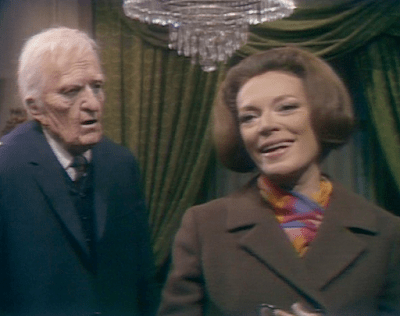
As a result, the first half of the episode is confusing to viewers who have been watching regularly. In recent days, the ghost of ten year old Sarah Collins gave a toy soldier to strange and troubled boy David to keep with him as a talisman against evil; David had a premonition that his cousin, heiress Carolyn, was in danger, and passed the toy soldier on to her; Carolyn saw Sarah, and gave the toy soldier back to David; and as we begin today, David brings the toy soldier back to Carolyn. David catches a glimpse of an extremely old man peering in through the window of the drawing room; he is gone by the time Carolyn turns to look. They talk about ghosts and visions, reenacting in one scene Carolyn’s whole progression from total rejection of David’s claims about the supernatural to total openness to them, and David’s from a desperate need to be believed to an even more desperate fear that Carolyn will be killed unless he can convince her he was lying about everything.
Carolyn tells her mother Liz that she doesn’t think David is lying, and decides to confront Liz’ aversion to the topic of ghosts and tell her that she has seen Sarah. Liz says she thinks David is mentally disturbed and must be sent away to an institution; eavesdropping, David reacts with horror. He meets Carolyn in the foyer afterward. He asks her if she thinks he is crazy. When she says she doesn’t, he says that maybe he is. He pleads with her to reject his stories as either delusions or lies.
The old man David saw looking at Carolyn is their distant cousin Barnabas, who is, unknown to them and the other residents of the great house on the estate, a vampire. Mad scientist Julia Hoffman has been trying to cure Barnabas of vampirism, but she inadvertently restarted the aging process which his condition had arrested. No longer does he look like a man in his forties- now he appears to be about ninety. He fears that if he does not start sucking people’s blood again tonight, he will soon turn into the pile of dust he would have been long ago were it not for his curse.
In Barnabas’ home at the Old House on the estate, we see him talking with Julia. His peeping at Carolyn might suggest that he has her in mind as his victim, but he does not mention her. Instead, he says he will go out into the town of Collinsport and find a stranger. Julia is disappointed that Barnabas is not planning to bite well-meaning governess Vicki, with whom she had hoped never to have another conversation. So she offers herself as a victim instead.
This offer stuns Barnabas so deeply that, for the first time, he addresses Julia by her first name. She smiles when he does this. He seems sincerely dismayed by the thought of enslaving Julia. When he tells her that if he bites her, she will have no will of her own, she smiles even more brightly. Evidently Julia believes that would be a price well worth paying if it kept Vicki from talking to her.
Julia contemplates enslavement. Screenshot by Dark Shadows Before I Die.
Barnabas declines the offer, saying that he might need to call on Julia for medical treatment at some point in the future and that as a blood thrall she wouldn’t be able to function as a doctor. Julia is hurt by Barnabas’ refusal, and asks him if the only reason he won’t enslave her is that he wants to use her professional services, and he assures her that it is.
Back in the great house, Carolyn stands in the foyer under the gaze of Barnabas’ portrait. She looks at the toy soldier and wonders about David. She decides to go to Barnabas’ house and look for evidence of the things David had claimed to see there. Oddly, she sets the toy soldier on the table and leaves without it.
Carolyn lets herself into Barnabas’ house, goes to his basement, and finds his coffin. Julia sees her there and tells her to leave immediately, “before it’s too late.” We hear Barnabas’ voice announcing “It is already too late.” Carolyn is baffled by Barnabas’ aged appearance. He moves in, bares his fangs, and bites her.
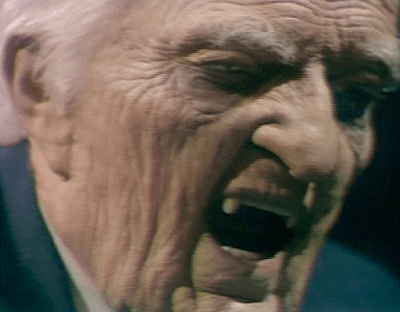
Barnabas’ old man makeup is phenomenally good, as all the Dark Shadows blogs mention. The show was very lucky to land Dick Smith, one of the pre-eminent makeup artists of all time, to do it. But I would add that Jonathan Frid’s acting takes Smith’s appliances and turns them to the best possible advantage. It is utterly absorbing to watch him as a man suddenly thrust into extreme old age, trying to figure out how to move his newly enfeebled limbs. In Frid and Smith, two artists at the top of their form collaborated to create a remarkable turn.
Mad scientist Julia Hoffman has been trying to cure Barnabas Collins of vampirism. We open today with Julia fleeing from Barnabas in terror. You’d think he’d be used to this reaction, but she’s been pretty cozy with him for a long time, so he knows she isn’t doing it for the usual reason. He demands to know why, and she tells him it’s to do with his appearance. He can’t use a mirror, so he touches his face. He realizes that, as an unforeseen side effect of Julia’s treatments, he is starting to look his age. Considering that he’s about 200 years old, the typical look would be a pile of dust, so he is quite upset about the situation.
Barnabas accuses Julia of intentionally botching the experiment because he refused to let “our relationship become all you wanted.” For the last couple of weeks, Julia has been responding to the realization that she is going to be connected to Barnabas for the rest of her life by trying to fall in love with him. He has observed this attempt, and answers it by pouring scorn on her. The other day, we saw her struggling to hold back tears at the end of an episode. She keeps her cool this time, and dismisses this particular accusation quickly.
One of the aspects of Barnabas’ sudden aging that bothers him the most is that he will have to cancel a date to watch the sun rise with well-meaning governess Vicki. Julia can hardly keep from laughing out loud when she says that “Foregoing an appointment with Vicki must be a bitter pill.” Barnabas responds “Spare me your sarcasm!” Even before she decided she would have to cultivate a romantic interest in Barnabas, Julia often showed signs of impatience when conversing with Vicki. She often rolled her eyes as soon as Vicki wasn’t looking, and sometimes plastered on a smile and spoke to her very slowly. But this is our first direct confirmation that Julia thinks Vicki is an idiot.
The Vicki/ Julia relationship is the first time on Dark Shadows that one major character is oblivious of the fact that another holds her in disdain. That adds a fresh wrinkle to their scenes together, as we wonder if Vicki will catch on to Julia’s real attitude towards her.
Barnabas orders Julia to run up to the great house of Collinwood and tell Vicki that he won’t be able to watch the sunrise with her. Julia opens the front door to comply, and sees Vicki standing there. She has overheard the last part of their conversation. Barnabas sits in a high-backed armchair with his back to her and claims that he has an illness he is afraid she will catch if she comes too close to him. He also claims that he will be leaving town on a long business trip later in the morning. When Vicki points out that these two things don’t fit together, he makes a lot of statements that don’t add up to much more than throat-clearing.
It’s also odd that Vicki, who like the other residents of the great house of Collinwood does not know that Julia is a doctor, doesn’t seem to notice that she’s wearing a lab coat, much less to wonder what she’s doing in Barnabas’ house in the pre-dawn hours. The whole scene is so ridiculous that the comedy must be intentional, on the part of the director and the actors if not of writer Ron Sproat.
After Vicki goes, Barnabas says he will have to save himself by reverting to his bloodsucking ways. Julia is shocked by the thought that the horrors will resume, and laments that she will be “partially responsible” for them.
Julia’s shock doesn’t last long. She urges Barnabas to choose Vicki as his first victim. She is absolutely gleeful about this idea.
Barnabas is miserable- he has already passed up several prime opportunities to bite Vicki, including an occasion when she invited herself over to spend the night in his house and one on the terrace of the great house when she virtually pressed her neck into his mouth. There have been times when we have expected Vicki to draw an arrow on her neck and write next to it the words “MR VAMPIRE, BITE HERE!” But Barnabas doesn’t want to let go of the fantasy that Vicki’s personality will somehow disappear and be spontaneously replaced with that of his lost love Josette. His attachment to this fantasy suggests that Barnabas is as bored with the actually existing Vicki as is Julia.
Back in the great house, Vicki tells heiress Carolyn that Barnabas was in a strange mood. Carolyn says that Vicki has become quite fond of Barnabas, and Vicki says that she is more than fond of him. She has come to rely on him. Since Vicki’s depressing fiancé, Burke, is missing and presumed dead, there is no reason why this shouldn’t mean that Vicki will fall in love with Barnabas. No reason, that is, except Barnabas’ obvious lack of interest in her.
Later, we see Carolyn and her old friend, hardworking young fisherman Joe, sitting at the Blue Whale tavern. Yesterday, Carolyn had a visit from the ghost of ten year old Sarah Collins. As a result, she believes that her young cousin, strange and troubled boy David, was probably telling the truth when he claimed to have seen various weird things.
Carolyn tries to enlist Joe in an effort to investigate David’s stories, but he won’t have it. He admits that Sarah exists. He has to- lots of people have seen her and she has made several observable things happen. Besides, Joe himself encountered the ghost of Josette in #179, so he can’t very well deny that there are such things as ghosts. But like other characters who have admitted that one or another supernatural being exists, he snaps right back to a frame of reference that doesn’t allow for the supernatural, or even for the unusual. Joe asks Carolyn if she really believes that there is “something sinister about Barnabas,” as David’s visions would imply. She admits that she doesn’t.
While Vicki sleeps, Barnabas materializes in her room. He stands there watching her, as he has done before. This time, his wizened appearance shows that it is a matter of urgency that he feed on someone. But he still can’t bring himself to bite her. Even when his existence is hanging in the balance, he just isn’t into Vicki.
After Barnabas loiters for a while trying to talk himself into doing what he so plainly has no desire to do, Carolyn comes to Vicki’s door. She apologizes for waking Vicki, and explains that she thought she heard someone in the room. Vicki isn’t upset at the interruption, but grateful for Carolyn’s concern. The two are startled when they see the silhouette of a giant bat outside Vicki’s window.
Vampire Barnabas Collins is in a chirpy mood. He and his associate, mad scientist Julia Hoffman, have just committed the premeditated murder of Julia’s medical school classmate Dave Woodard. As we saw when Barnabas made his sorely bedraggled blood thrall Willie to help him hide the corpse of seagoing con man Jason McGuire, nothing makes him happier than forcing someone to help with the killing of a former friend.
I think the actors were placed behind the laboratory apparatus intentionally, to highlight the characters’ helplessness and isolation.
Today, Julia wants to stop her attempt to cure Barnabas of vampirism, but he won’t hear of it. When she tells him she might try to kill him instead of curing him, Barnabas relishes telling her that he trusts her completely. She does knock him out of his blissful state when she suggests that if she manages to turn him into a real boy, he might have a conscience. He gives a little speech in which he says some brave things about being willing to accept the punishment fitting a man who had done the things he has done if he also gains the ability to love as a man can love. Jonathan Frid puts enough into this speech that it is possible to sympathize with Barnabas in the moment that he is delivering it.
That moment doesn’t last very long. By the end of the episode, we are back on this set, where Julia says that “someone” might love Barnabas as he is, and he takes delight in her humiliation as he makes it obvious that he knows she is referring to herself.
Some say that Barnabas’ speech about wanting to love is meant to make the character more likable, but it has the opposite effect when he so smoothly transitions back into this gleeful cruelty. The other day, Julia told Barnabas that she had wondered whether he was capable of feeling any emotions at all, but we see in this scene what we’ve seen all along, that he is nothing but emotion. Except when he is acting, trying to convince the living members of the Collins family that he is their long-lost cousin from England, his feelings are right on the surface. For a minute or two, he has some feelings about love and justice, and we see those very clearly. But that is a brief interlude in the middle of his entirely gratuitous torture of Julia. We are left in no doubt that he takes an utterly unmixed pleasure in causing her pain. We’ve already seen very cold villains on Dark Shadows and before the series ends we will see more, but by the end of this scene Barnabas claims the crown of most detestable character ever to appear on the show. It’s so hard to imagine how he could possibly sustain such a level of malignity that it’s no wonder viewers still keep tuning in to see what he will do next.
The main theme of the episode is the contrast between Barnabas’ relationship with Julia and his relationship with well-meaning governess Vicki. For the first 39 weeks of Dark Shadows, Vicki was the audience’s main point-of-view character; now Julia is the one who knows what we know, and who makes things happen when she learns new information. Seeing Barnabas first with one woman, then with the other, we see how the show has been changing since he joined the cast.
Barnabas eavesdrops on Vicki’s conversation with her depressing fiancé Burke on the terrace at the great house of Collinwood, then slides in and claims to have inadvertently overheard the last few words of their conversation. Burke gives Barnabas a dirty look, then excuses himself to do some telephoning while Vicki and Barnabas stay on the terrace and talk for a little while.
Barnabas has some vague idea of seducing Vicki, an idea he has been remarkably desultory about pursuing. In this scene, he does the only thing he has ever really got round to doing about it, which is to listen sympathetically while Vicki tells him her troubles. This time, she’s trying to convince herself that she wants what Burke wants, which is to get away from Collinwood and start a new life somewhere else. It isn’t an exciting situation, but Alexandra Moltke Isles delivers her lines with so much urgency that it holds our attention.
Vicki shares her anguish with her kindly friend Barnabas
Julia eavesdrops on this conversation. She looks miserable. Whatever she may have had in mind when she first came to Collinwood, Julia is stuck with Barnabas for the foreseeable future. Not only has Julia murdered one of her oldest friends for Barnabas’ sake, she has involved herself so deeply in so many of his activities that it is unclear how she would go back to the successful professional life she had before she met him even if he were destroyed. If he is going to spend his time hanging around other women, she faces a drab prospect.
Julia contemplates a lonely future
In the drawing room, Burke, Vicki, and Julia talk about the death of Dr Woodard. Julia can’t bear the topic, and excuses herself to go out to the terrace. There, she catches a glimpse of Woodard’s ghost. Julia screams, Burke and Vicki come, and all she can do when they ask what’s wrong is to keep jabbering that “he wasn’t there.”
There are some rough patches in the script today. For example, in the opening, Julia is touching the equipment when Barnabas exclaims “Don’t stop!” This is puzzling- she doesn’t appear to be stopping anything. And when Julia says “He wasn’t there,” Vicki has to ask “Who wasn’t there?” A person might reflexively say such a thing, and Mrs Isles’ rapid delivery of the line and simultaneous movement of the neck and the shoulders suggest such a reflex. That’s probably the best choice any actor could have made, but the line still gets a bad laugh. Barnabas and Julia’s successive eavesdropping expeditions also come off as some kind of joke, and all the scenes take too long. The whole thing could have used another trip through the typewriter. Still, writer Joe Caldwell was at his best with miniature character studies, and while he may not have had the time he needed to give this one his usual polish, the actors still have more than enough to show what they can do. It’s a fairly good outing, all things considered.
Strange and troubled boy David Collins stands outside the drawing room at the great house of Collinwood and overhears his father, Roger, talking with permanent house-guest Julia Hoffman. Roger and Julia are discussing David’s fear of his cousin, old world gentleman Barnabas Collins, and his belief that Barnabas is hiding something terrible in the basement of his home in the Old House on the estate. Roger takes it for granted that Barnabas is above reproach, and has therefore concluded that David is suffering from some sort of mental disorder. Julia encourages Roger in this conclusion, and urges him to send David away to boarding school. Roger is amenable to this idea, but tells Julia that his sister, matriarch Liz, will never allow it.
The last time David overheard his father in the drawing room saying he wanted to send him away to school, he attempted to murder him. But that was in episode #10, almost fifteen months ago. Since then, David has been through a lot, and has decided he wants to align himself with good against evil. So he doesn’t try to kill Roger this time. Instead, he steals a set of keys to Barnabas’ house that Liz keeps in her study and sets off to gather evidence with which he can prove himself right.
Returning viewers will recall that David’s friend, the ghost of ten year old Sarah, has repeatedly warned him not to go near the Old House, and especially to stay away from the basement. David remembers her words, but makes his way into Barnabas’ basement regardless. There, he sees an open coffin. While David is looking the other way, Barnabas comes up behind the lid and slams it shut. David turns, and Barnabas glares at him. Since Barnabas is a vampire who has spent quite a bit of time thinking of killing David, this would seem to leave the boy in something of a pickle.
There are three firsts in this episode, all relating to voice acting. This is the first time Alexandra Moltke Isles appears in an episode but does not read the opening voiceover. Sharon Smyth appears only through the pre-recorded voice of Sarah; her name does appear in the closing credits, the first time a performer is credited for something other than an on-camera appearance. And the closing titles end with Grayson Hall saying “Dark Shadows is a Dan Curtis Production,” the first time someone other than an ABC staff announcer* has delivered that line.
*Usually Bob Lloyd, though someone else filled in for Lloyd in #156 and #167.
Dangerously unstable ruffian Willie Loomis spent a week staring at the eighteenth century portrait of Barnabas Collins in the foyer of the great house of Collinwood back in April, then tried to rob Barnabas’ grave. That turned out to be an awkward situation when Willie found that Barnabas wasn’t entirely dead. Barnabas was a vampire who bit Willie, turned him into his sorely bedraggled blood thrall, and had lots of conversations with him. Yesterday, Willie was written out of the show.
Today we open with strange and troubled boy David Collins staring at the same portrait. As Willie was obsessed with the idea that there were jewels hidden in the Collins mausoleum in the old cemetery north of town, where in fact Barnabas’ coffin was hidden, so David is preoccupied with the idea that Barnabas has something terrible stashed in the basement of the Old House on the estate, where in fact his new coffin is hidden. As Willie sneaked off to the cemetery on his ill-starred expedition, David will sneak off to the Old House today and try to search Barnabas’ basement.
Unlike Willie, David is not driven by greed. He is afraid of Barnabas, and his friend, the ten year old ghost of Barnabas’ sister Sarah, has told him that he must not go to the Old House. But his aunt Liz and his father Roger dismiss his attempts to warn them about Barnabas, and he thinks it is his duty to provide them with evidence. So he screws up his courage and makes his way across the property.
David lets himself into the Old House by opening the parlor window. Not only have we seen David do this before, but Willie’s sometime friend, seagoing con man Jason McGuire, got into the house the same way in #274. Barnabas would kill Jason when he reached the basement in #275, so you might think he’d have put a lock on that window by now.
Jason’s fate is certainly on the minds of returning viewers when David tries to open the basement door. It comes as a relief when he finds the door locked. Barnabas’ co-conspirator, mad scientist Julia Hoffman, catches him there.
Julia demands to know what David is doing in the house, and he tries to brazen it out. He claims that he has a right to be there, since it belongs to his Aunt Liz. This is a bit of a murky point- we never see Liz transfer title to Barnabas, but she and others act as if he owns the place and its contents. Julia doesn’t clarify it when she responds that Liz gave the house to Barnabas- she doesn’t deny that it still belongs to Liz, only says that it also belongs to Barnabas.
Back in the great house, Roger is banging away at the piano. We saw Liz play the piano in #47 and #91, a reference to the conception of her character writer Art Wallace developed in his original story bible, titled Shadows on the Wall, in which she, like similar characters in a couple of TV plays he wrote in the 1950s under the title “The House,” gave piano lessons. Since then, Liz’ daughter Carolyn tried her hand at “Chopsticks” in #119 and used the piano as a prop in a teen rebel scene in #258, and Jason poked at a few keys in #198. Roger isn’t exactly Vladimir Horowitz, but he’s the first one we’ve seen who actually achieves a melody.
Liz comes in and tells Roger that David isn’t in his room. They fret over David’s attitude towards Barnabas. Julia brings David home and tells Liz and Roger where she found him. After an angry scene between father and son, David goes upstairs, and Liz scolds Roger for his inept parenting. In these as in all of Liz and Roger’s scenes together, we see a bossy big sister who tries to govern her bratty little brother, but who ultimately abets all of his worst behavior.
In the Old House, Barnabas notices that Julia is troubled. He keeps asking what’s on her mind, and she has difficulty deflecting his questions. This is odd- Julia has been established as a master of deception, and Barnabas is the most selfish creature in the universe. All she has to do is start talking about something that does not affect him directly, and he will lose interest at once. Rather than talk about her personal finances, or the job from which she is apparently on an indefinite leave of absence, or some ache or pain she might have, or how sad she is to miss her Aunt Zelda’s birthday, she brings up Willie. That does get Barnabas’ mind off her tension, but it also reminds him of David. He thinks David knows too much about him, and is thinking of murdering him. Julia assures him that the boy doesn’t know so very much, that whatever he does know he hasn’t told anyone, and that if he does say something his reputation as an overly imaginative child will lead the adults to ignore him.
From the beginning of the series, we’ve heard people say that David is “imaginative.” The audience finds an irony in this, since we have never seen David show any imagination whatsoever. All his stories of ghosts are strictly literal accounts of apparitions he has seen. We’ve seen some drawings he has done and heard quotes from some essays he has written. Some of these are technically accomplished for a person his age, but they are just as literal as his ghost stories. And when he tells lies to cover his various misdeeds, he tells simple little tales that fall apart at once.
In #327, well-meaning governess Vicki became the first character to dissent from the “David is a highly imaginative child” orthodoxy. Liz and local man Burke Devlin were dismissing David’s laboriously accurate account of his latest encounter with Sarah as a sign of his “imagination,” and Vicki interrupted with “I don’t think it has anything to do with his imagination.” Now, Barnabas goes a step further. After pronouncing the word “imaginative” in a truly marvelous way that makes it sound like something I’ve never heard before, he tells Julia that she has given him an idea. Frightened, she asks what he means. All he will say is “You’ll see.”
Roger goes to David’s room and has a friendly talk with his son. Throughout the conversation and afterward, David is thinking intensely, trying hard to figure out what his next step should be.
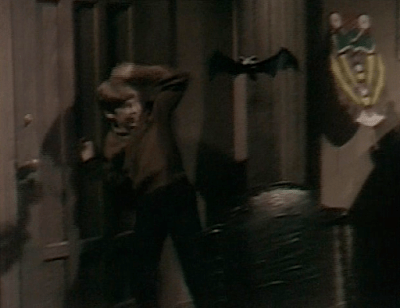
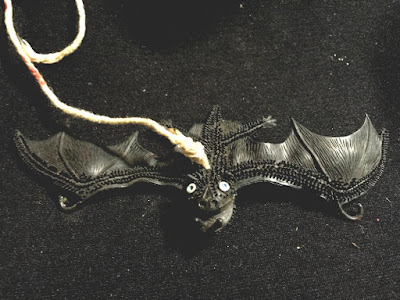
Once he is alone in the room, the window blows open and a bat enters. More precisely, a bat-shaped marionette is brought in on clearly visible strings by a pole that casts a shadow we can see the entire time, but no one who has been watching the show up to this point will doubt for a second that David’s fear, as depicted by David Henesy, is fully justified. David tries to flee from the bat, but he cannot open the door to escape from his room. His back against the door, David slides onto the floor and screams as the bat comes near him.
When Barnabas is about to attack someone, dogs start howling. Sometimes this works to his advantage, but it so often puts his intended victims on their guard that it doesn’t really seem to be something he is doing on purpose. So this bat represents something new. Perhaps Barnabas is using magic to control a bat- if so, it marks the first time we have seen Barnabas use magic to project influence over something other than a human mind. Or perhaps he himself has assumed the form of a bat. If so, that is the first indication we’ve had that he has shape shifting powers. In either case, Barnabas’ powers have just gone up a level.
Closing Miscellany
The bat was created by famed puppeteer Bil Baird. Most famous today for the puppets he created for “The Lonely Goatherd” sequence in The Sound of Music, Baird was a frequent guest on television programs like The Ed Sullivan Show, and Jim Henson cited Baird’s own TV series, the short lived Life with Snarky Parker, as a major influence on the Muppets. In December 1966, Baird opened a marionette theater in New York City, at 59 Barrow Street in Greenwich Village; it operated until 1978, and many leading puppeteers, including dozens who would go on to work with Henson, were members of its company in those years.
This is the last episode to end with ABC staff announcer Bob Lloyd saying “Dark Shadows is a Dan Curtis production.” We do hear the announcement again in February of 1969, but that won’t be because Lloyd has returned- they used an old recording for the music under the closing credits that day, and they picked one with him on it.
Fans of Dark Shadows will often talk about “the early episodes” which ended with Lloyd making that announcement. So I suppose #330 is the last of “the early episodes.”
Danny Horn’s post about this one on Dark Shadows Every Dayincludes a morphology of episode endings. He divides them into five categories, Haiku,* Restatement of Threat, ** New Information,*** Crisis Point,**** and Spectacle.***** It’s an intriguing scheme, and he makes a good case for it.
*Danny explains that “Haiku” “aren’t necessarily recognizable as endings in the traditional sense, because nothing is resolved and no progress is made. It’s just a little moment when a character pauses, and possibly has a feeling about something… In some extreme cases, the audience may not realize that the episode is over until halfway through The Dating Game.”
**Restatement of Threat, at this period of Dark Shadows, usually means Barnabas looking at us through his window and saying that someone or other “must die!” Which of course means that you can safely sell a million dollar life insurance policy to that character.
***”A New Information ending provides an actual plot point, which either advances the story another step, or tells us something that we didn’t know.”
****”The Crisis Point cliffhanger is the big game-changer, and for best effect, it should come at the end of a sequence that’s been building up for a while. This is a big turn in the story, and it should feel satisfying and thrilling… The defining feature of a Crisis Point ending is that the resolution marks a change in the status quo, ending one chapter and setting up the next.”
***** “Obviously, plot advancement is always welcome, but every once in a while the show needs to set its sights a little higher. These are the moments when the show goes above and beyond, in order to surprise and dazzle you… The point of a Spectacle is: You can’t take your eyes off the screen. Housewives in the audience have put down the iron, and switched off the vacuum. Teenagers have stopped swatting at their siblings… A Crisis Point cliffhanger will bring you back for the next episode, because you want to see what happens next. But a Spectacle cliffhanger is bigger than that — you’ll be coming back for the next episode, but it’s because you can’t believe what you’re seeing, and maybe tomorrow they’ll do it again.”
The Collinsport police have solved the case of the abduction of Maggie Evans, The Nicest Girl in Town. The investigation has been stalled for months, because Maggie is suffering from amnesia covering the entire period of her captivity. So the authorities spread a rumor that Maggie’s memory was returning, camped out on her lawn, shot the first guy who strayed onto the property, and declared him to be the culprit.
Though this method would appear to be impeccably scientific, strange and troubled boy David Collins is unconvinced. The wounded man is the luckless Willie Loomis, servant of David’s cousin, old world gentleman Barnabas Collins. David is sure that Willie wouldn’t hurt anyone, and has developed an intense aversion to Barnabas.
David’s aunt, matriarch Elizabeth Collins Stoddard, is discussing this situation with his well-meaning governess Vicki. Liz mentions that Willie originally came to the estate of Collinwood as a friend of seagoing con man Jason McGuire. She says that she is prepared to believe any bad thing about any friend of Jason’s.
This is the third day in a row we have heard Jason’s name mentioned. That marks quite a departure from recent months of the show. In #275, Barnabas killed Jason, and in #276 he forced Willie to help him bury the body. He was forgotten, apparently forever, shortly thereafter.
It is not clear at all where the show is heading. A few weeks ago, David learned that the secret chamber where Jason is buried exists, that Barnabas and Willie know about it, and that there is something hidden in it that makes Willie uncomfortable. Barnabas knows that David has been in the chamber, and is thinking of killing him. So perhaps the next storyline will involve Barnabas trying to do away with David lest Jason’s death be discovered.
Bolstering that expectation is the fact that Willie has survived the shooting. When he was first shot, day before yesterday, the police said he had five bullets in his back and that only a miracle could keep him alive. Yesterday, we heard that he was in a coma and that the preliminary medical report on his case gave him virtually no chance of living. Today, his doctor, addled quack Dave Woodard, tells his medical colleague Julia Hoffman that the odds are a hundred to one against Willie seeing another day. Experienced soap opera viewers will know that when a man has been declared dead so many times, he will be with the series for years to come. Willie does feel bad about what happened to Jason, so if David manages to lead the authorities to the secret chamber, that might bring matters to a head.
The scene between Woodard and Julia marks an interesting first. Julia is, among other things, a psychiatrist, and Maggie was her patient for a time. Woodard believes that she is at Collinwood in order to find out who abducted Maggie. He is surprised she plans to stay on now that Willie has been named. She claims that she is trying to keep her cover story intact, that she is an historian studying the old families of New England. This doesn’t make much sense to him, but he doesn’t expect it to- he thinks he knows her real motive. He thinks she is in love with Barnabas. Julia smiles, and doesn’t deny it.
Returning viewers know that Julia’s actual motives are infinitely less wholesome. She is a mad scientist, and Barnabas is a vampire. She is conducting an experimental treatment which, if successful, will relieve him of that condition. For the sake of that experiment, she has become Barnabas’ accomplice. She induced Maggie’s amnesia, she has lied to everyone she has met, including the sheriff, and she is happy that Willie is likely to die and take the blame for Barnabas’ crimes. Woodard’s idea that she is in love with Barnabas delights her because it helps conceal her true role. It also starts us wondering if it is the beginning of a story in which the two of them avoid awkward questions by pretending to be a couple, then perhaps really do fall in love.
When Dark Shadows began, one of the most important relationships was that between matriarch Elizabeth Collins Stoddard and her brother, high-born ne’er-do-well Roger Collins. Liz and Roger each had a terrible secret to hide. In the work of hiding, they embodied opposite extremes. Liz was motivated to conceal her secret by a fear that she would damage the reputation of the Collins family and the fortunes of its members. Her morbidly intense concern for the family’s position both made her a prisoner in her home and gave her a certain air of nobility. Roger’s motives for hiding his secret were wholly selfish, and he was a symbol of lack of family feeling. So much so that he squandered his entire inheritance, jumped at a chance to sell the ancestral seat to his sworn enemy, and openly hated his own son.
Since Roger was living in Liz’ house as her guest and working in her business as an employee, it fell to her to rein in her impossibly irresponsible younger brother. But the very quality that led her to try to exercise authority over him undercut her efforts to do so. Liz’ devotion to the Collins family compelled her to try to keep Roger on the strait and narrow path, but that same devotion prevented her from taking any action against him so harsh that it might actually deter him from misconduct. Further, her own secret compromised her moral authority and kept her from engaging with anyone outside the family. So she wound up less as a commanding matriarch than as a bossy big sister.
Liz and Roger both let go of their secrets, Roger in #201, Liz in #270. Roger is still far from heroic, but he no longer gives Liz the nightmares he once did. Liz is still mindful of the family’s good name, but there is nothing keeping her from following through on whatever orders she might give. So Liz and Roger’s Bossy Big Sister/ Bratty Little Brother dynamic is no longer a productive story element.
Now, the show is reintroducing the same dynamic with another pair of characters. Mad scientist Julia Hoffman is conducting an experiment which she hopes will turn vampire Barnabas Collins into a real boy. When Barnabas threatens to murder her, she becomes impatient and tells him to stop being ridiculous. When he threatens to murder other people, she threatens to discontinue the experiment unless he starts behaving. He usually responds to Julia’s orders by pouting, sulking, and giving in to her.
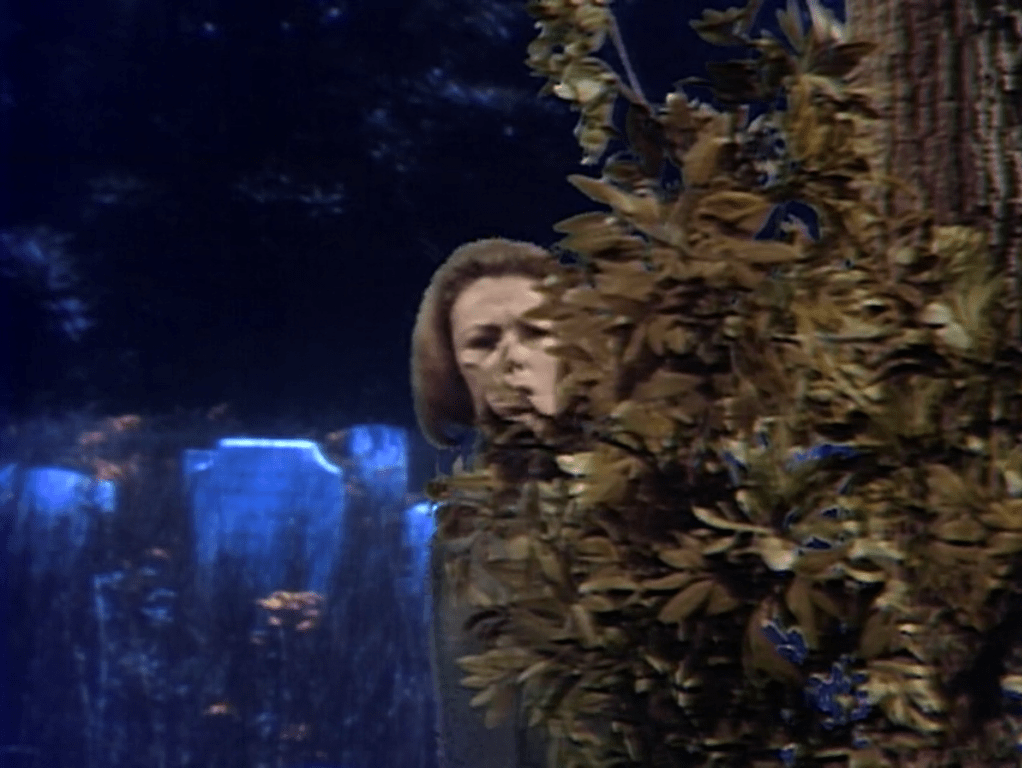
In the opening scene, Julia was in Barnabas’ house. He told her that he was likely to kill Roger’s ten year old son David because he thinks David might know that he is a vampire. Julia demanded that he leave David alone, prompting him to walk out of his own house. She then followed him to the old cemetery north of town, where Barnabas heard her footsteps in the distance and she hid behind a tree.
This woman holds a medical doctorate and is qualified in two unrelated specialties.
Barnabas enters the Tomb of the Collinses. Julia confronts him there, insisting he tell her what secret about the place he is keeping from her. He demands that she leave and threatens to kill her if she does not. He tells her that he ought to stash her corpse nearby, “along with”- then interrupts himself. Regular viewers know that Barnabas killed seagoing con man Jason McGuire in #275 and buried him in the secret chamber inside the tomb in #276. Jason has barely been mentioned since, not once in any scene featuring Julia. When she asks Barnabas what he is talking about, he says “Never mind.”
Julia presses Barnabas with “You’ve shared all your other secrets with me. You have no choice but to share this one with me too.” The logic of this statement eludes me, but all Barnabas can do when Julia has made it is to walk backward away from her, staggering into a corner and pouting at her.
Barnabas, stunned by the force of Julia’s reasoning.
Meanwhile, Sam and Dave are walking through the cemetery.
No, not that Sam and Dave. Local artist Sam Evans and addled quack Dr Dave Woodard have noticed that a series of odd occurrences have taken place in the vicinity of the tomb lately and have come to the cemetery to investigate. They run into the old caretaker, who delays them with his usual warnings about the unquiet spirits of the dead.
Alas, the final appearance of Daniel F. Keyes as the Caretaker.
Back in the tomb, Barnabas is telling Julia everything she wants to know. He lets her into the secret chamber and explains that he was imprisoned there in a coffin for many years, freed only when the luckless Willie Loomis accidentally released him to prey upon the living. Julia listens, showing pity as Barnabas recounts his woes.
Barnabas finds David’s pocket knife, proving that the boy was in the chamber and convincing Barnabas that he must kill him. He takes the knife close to Julia in a gesture that might be threatening, were its blade intact. The broken blade negates the threat and emphasizes Barnabas’ powerlessness before Julia. Since 1967 was the heyday of Freudianism in the USA, it is likely that many in the original audience would have seen it not only as a useless tool, but also as a phallic symbol. As such, not only its brokenness, but also the fact that it was made to be carried by a little boy, would make the point that Barnabas brings no sexual potency to his relationship with Julia. Her own behavior towards him may be childlike, but in her eyes he is a smaller child than she is.
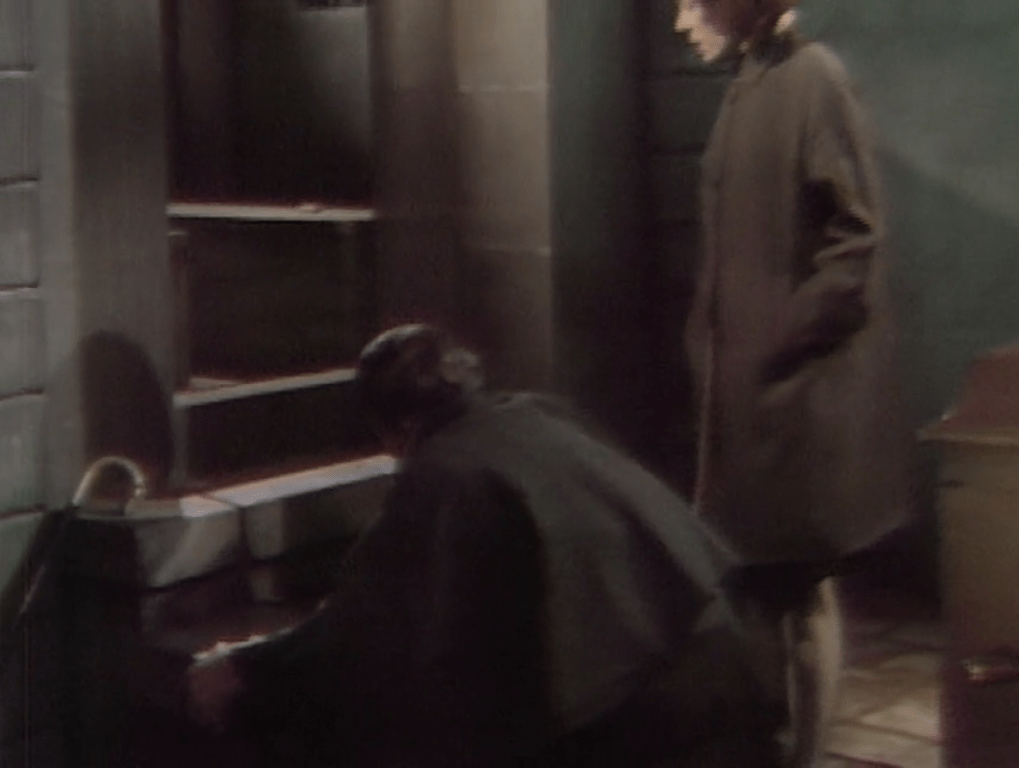
Julia protests, claiming that someone else might have left the knife there. Barnabas dismisses her assertions, but does not regain control of the situation. As they prepare to leave the chamber, he kneels and she stands over him, watching him open the panel.
On his knees before her.
They hear Sam and Dave approach. (Still not the cool ones.) They scurry back into the secret chamber, as David had done when he heard Barnabas and Willie approaching the tomb in #310. They listen to the men discuss the facts that have brought them to the tomb, and grow steadily more alarmed as they realize how close they are to discovering Barnabas’ terrible secret.
This is the first episode not to include any actors who were signed to the show at the time production began. The character of Sam Evans was at that time played by a loud man called Mark Allen; Allen’s last episode was #22, taped on 12 July 1966, and David Ford’s first was #35, taped on 29 July. The Caretaker was introduced in #154, Barnabas in #210,* Dave Woodard in #219,** and Julia in #265.
*As the hand of stand-in Alfred Dillay- Jonathan Frid wouldn’t appear until #211. Though the portrait he sat for was on screen in #204, and was identified as that of Barnabas Collins in #205.
**Played by Richard Woods. Robert Gerringer took over the part in #231.
Both Danny Horn and Patrick McCray wrote fine blog posts about this episode. I have a few things to add to what they’ve said.
When vampire Barnabas Collins and his sorely bedraggled blood thrall Willie approach the Tomb of the Collinses, strange and troubled boy David hears them talking about mysterious little girl Sarah. Since Sarah had made him promise to keep her connection to the place secret, he opens the panel to the concealed chamber she had shown him and hides there. To his horror, he hears Barnabas order Willie to open the panel. Still trying to keep Sarah’s secret, he hides in the coffin in the center of the chamber while Willie and Barnabas walk around it. He hears them talk about Barnabas’ relationship with Sarah and Willie’s discomfort with the chamber.
They don’t mention that Barnabas is a vampire, or that he was the one who imprisoned Maggie Evans, The Nicest Girl In Town. But they say enough that David should be able to figure out all of Barnabas’ secrets. Once he has heard Barnabas say that he was left to comfort Sarah after their dog was put down, it isn’t much of a leap to conclude that Sarah is his little sister. And once he’s heard Barnabas ask Willie if he is frightened by the “contents” of the chamber, he should know that there is something in there more than can be seen at a first glance.
In episodes #301 and #306, we were reminded of Jason McGuire, whom Barnabas killed and forced Willie to bury in the floor of this chamber. We also saw the chamber itself in #306, so that regular viewers would be sure to think of Jason’s grave. If David should repeat Barnabas’ comment about the chamber’s “contents” at the right time, Jason might yet be exhumed. So Barnabas has created an extreme danger to himself with his big mouth. Since it does not seem that Dark Shadows could continue if either Barnabas or David were to destroy the other, we are in suspense as to how they will get out of this situation.
After Barnabas and Willie leave, David gets out of the coffin and finds he cannot open the panel from the inside. Willie had used a gadget hidden in the stairs to open it, the first time we have seen this device. As David starts to panic, he hears the strains of Sarah’s signature tune, “London Bridge.” He turns away from the panel, looks at the blank walls of the chamber, and starts calling on Sarah.
In his post, Danny Horn asks “Has David just figured out that Sarah’s a ghost?” I think it’s more complicated than that. In #288, David happily considered the possibility that Sarah might be a ghost, and throughout the series he has been on easy terms with several ghosts. So I think he has assumed she was a ghost all along, and was just too tactful to bring it up when he was talking with her.
Back in the great house of Collinwood, well-meaning governess Vicki is on the terrace, worried about David’s disappearance. Barnabas peeks at her through the gate, as he would do if he were not allowed to look at her. Then he just walks up and starts a conversation with her, leaving us to wonder what the whole peeping-Tom act was about.
Vicki is so concerned for David that she starts crying. Barnabas tells her to put her head on his shoulder, which she does. He seems to be trying to restrain himself, but she has such a long, pretty neck, and it’s right there, and he’s so very thirsty…
As Barnabas lunges in to bite her, my concern and sympathy is challenged as I ponder her almost athletic lack of awareness. Of course, I’ll inevitably side with the person getting her throat ripped out… but it won’t stop me from wondering why she’s practically painting a landing strip on her neck. Vicki? You have a generation of young people idolizing you.
Today, the discussion isn’t even a metaphor. No, she’s not asking for it. No one is. So, what is the message that we’re supposed to take away from a dangerous conversation like this? For a person constantly asking questions about everything — and never understanding what she hears — Vicki is the picture of unawareness. Evil is evil. An attack is an attack. And awareness is power. Ironic that her would-be attacker, Barnabas, is frequently even more unaware than is she. However, if anyone on a soap paid attention at all, the stories would last ten minutes. But that’s the point. The more the characters lack focus, the more we learn its value. David is the most aware character on the show, and in this episode, he learns the most he ever will in one night. Pity it’s from inside a coffin.
That part of the discussion is too much metaphor to ignore.
Patrick McCray, “The Dark Shadows Daybook: August 22,” The Collinsport Historical Society, 22 August 2018.
Again, I think it’s a more complicated. I think we have to analyze Vicki’s behavior at three levels of intentionality. First, there’s the in-universe level, the sort of analysis of her motives another character in the same story might give if they had the same information we do. If that character saw Vicki’s depressing fiancé Burke angrily telling her she was crazy for saying that she had seen and heard things that we have also seen and heard, refusing to give her even the most basic information about himself and airily dismissing her questions as a morbid preoccupation with “the past,” and telling other people that her imagination will “run wild” unless he monitors and controls her, they might very well think that Vicki is tired of Burke’s abusive ways. To that character, there would be nothing “athletic” about Vicki’s failure to suspect Barnabas- it is perfectly natural for her to want to think the best of a man who has always been pleasant and respectful to her, unlike the blatant villain she is supposed to marry.
The second level of intentionality is of Vicki’s usual function in the narrative. Up to this point, every storyline has come to its climax when Vicki found out what was going on. She is still the audience’s main point of view character, and as such she naturally tends towards the center of the action. All of the action lately has been in the vampire story, so we expect her to involve herself deeply in it. In the first weeks, when it was possible that Barnabas, as the second in a parade of supernatural nemeses, would be destroyed and make way for a third as undead fire witch Laura Murdoch Collins had made way for him, we expected Vicki to be the one who drive the stake into his heart. Now that it is clear he is on the show for the long haul, we are expecting Vicki to become his victim, and presumably to become a vampire herself. As the protagonist, she is actively working to get more deeply involved with Barnabas. She hasn’t yet resorted to “painting a landing strip on her neck,” but she did invite herself to spend the night at Barnabas’ house in #285 and #286, and it wasn’t her fault she left in the morning still having all her blood.
Vicki the unappreciated fiancée wants only a friend who will respect her; Vicki the protagonist wants to be part of the main story. The tension between the incompatible goals of these two aspects of Vicki is expressed in the third level of intentionality, which Alexandra Moltke Isles expresses in the choices that make up her performance. Mrs Isles takes every opportunity to show that Vicki is more strongly drawn to Barnabas than to anyone else, most definitely including Burke. That attraction brings the character back to life. After a few days when she was trying to submit to Burke’s abuse and ignore “the past,” Barnabas asks her to intercede with Burke on his behalf and she comes roaring back, an assertive character who will not give an inch even when Burke makes some good points.
It is the sight of this strong Vicki that introduces a conflict into the audience’s feelings. On the one hand, we don’t want to lose her, and if she does not become a vampire, it’s hard to see a future for her on the show. On the other, it would be a terrible betrayal for Barnabas to repay her trust in him by doing such a thing to her. All the more so because we’ve spent so much time seeing Vicki become close to David, and if she follows the pattern set in Bram Stoker’s Dracula, vampire Vicki will be a threat to all children.
Our sadness at that betrayal would be a deep emotion of exactly the kind soap operas are supposed to create. That so shocking a crime would lead to a more meaningful and more suspenseful story and a richer part for our favorite character would guarantee that we would surprise ourselves by forgiving Barnabas for it and cheering when he and Vicki become a couple. So, I think a savvy audience watching Dark Shadows up to this point would have to expect to see just that story play out.











 Dark Shadows Commentary