The first 19 weeks of Dark Shadows were credited to writers Art Wallace and Francis Swann. Wallace and Swann both specialized in finely etched character studies. So the plot doesn’t move very quickly in those opening months, but the actors do get an opportunity to show their stuff.
Every member of yesterday’s all-female cast, Alexandra Moltke Isles, Nancy Barrett, Joan Bennett, Kathryn Leigh Scott, and Clarice Blackburn, had at least one emotionally charged scene that gave her a star turn. Each made the most of it. Today’s episode is quieter. Most of it consists of people waiting for the coroner to rule whether the death of beloved local man Bill Malloy was an accident or homicide.
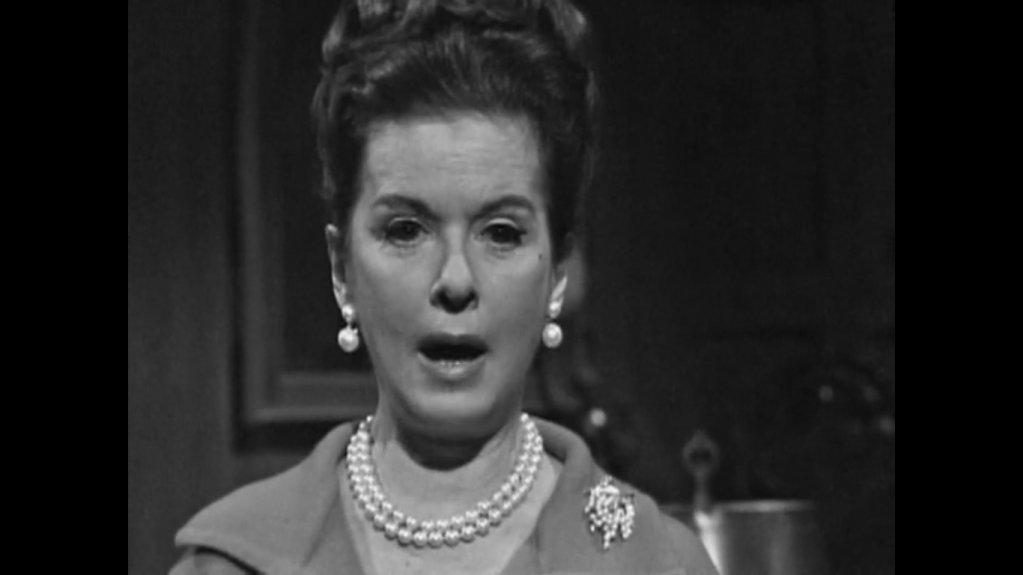
Joan Bennett and Kathryn Leigh Scott are back as reclusive matriarch Liz and restaurant operator Maggie. They are joined by David Henesy as problem child David Collins, David Ford as drunken artist Sam, and Dana Elcar as the sheriff.
Sam goes into the sheriff’s office to ask about the coroner’s report, and quickly realizes that no matter what he does or says, he keeps making himself look like a suspect in Bill’s death. Sam’s anxiety plays effectively against the sheriff’s serenity.
At the great house of Collinwood, David thinks he has a card to play against well-meaning governess Vicki. He tells Liz that Vicki never showed up to give him his lessons for the day. To his disappointment, Liz tells David that she knows all about that, that Vicki isn’t in trouble, and that she will be his governess for years to come. The two of them have a very nice scene in which David tries to convince his aunt that he will never like Vicki and Liz isn’t having it.
The sheriff comes to Collinwood to tell Liz that the coroner ruled Bill’s death an accident. As he is approaching, David runs out the front door. There’s a bit of unintentional humor there- Liz is calling David to come back to the house when we hear a car. It sounds as if the nine-year old David is driving away.
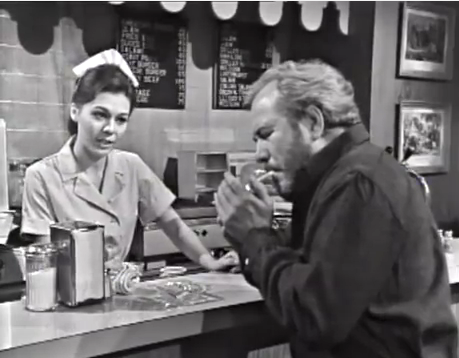
David goes to the restaurant, where Maggie and her father Sam are having one of their depressing conversations about the consequences of his alcoholism. Maggie introduces David to Sam. David smiles when Sam addresses him as “Mr Collins,” and is excited to learn that Sam is a professional artist. A happy moment is budding until Sam asks David how his father is doing. David hates his father. If he knew that Sam also hates him, they would no doubt become fast friends. But he seems to think Sam and his father are friends, and so he rushes off. It’s a poignant bit.
Reclusive matriarch Liz calls well-meaning governess Vicki into the drawing room in the great house at Collinwood. She asks Vicki where her charge, problem child David, is. When she tells her David is upstairs in his room, she asks Vicki to close the drawing room doors, explaining that she does not want their conversation overheard.
Of course David comes downstairs and puts his ear to the doors as soon as they are closed. Liz starts talking with her about some recent plot developments, and we hear a commotion outside the doors. Tightly-wound caretaker Matthew has caught David eavesdropping. Liz sends Vicki and David away, and talks to Matthew about events we saw several days ago.
David starts telling Vicki about the ghosts who haunt Collinwood, and shows her a drawing he made of one of them. Vicki is impressed with the drawing, and shows it to Matthew. Matthew accuses David of going to the Old House and copying the portrait hanging there. Vicki has never heard of the Old House- nor has the audience, it’s the first reference to it. David denies Matthew’s accusation, and says that it is a drawing of a ghost he has seen.
Vicki takes the drawing to Liz, who immediately recognizes it as Josette Collins. She opens the family history to the page featuring a portrait of Josette, and asks David if he copied that portrait. Again David insists it is a drawing of an actual ghost he has seen. The day before yesterday, in episode 68, we saw David studying that page, so it is quite plausible that he did copy it. Still, regular viewers will remember that in episode 52 the book opened itself to that same page when no one but the audience could see, so we might also wonder if David is telling the truth.
Flighty heiress Carolyn tries to talk her mother into hiring a housekeeper. When she mentions that one thing a housekeeper might relieve Liz of is her loneliness, she answers wryly, “You forget, dear, I have all of David’s ghosts.” In this reply, we return to the ambiguity of the first weeks of the show, when, in conversations with Vicki, one character after another would use the word “ghost” in a metaphorical sense, to refer to present difficulties resulting from unresolved conflicts in the past. Vicki would invariably respond with some line like “Surely you don’t believe in ghosts!,” as if they were talking about literal ghosts. And each time, the response would be that they did indeed believe in literal ghosts, and that if she stayed in the old dark house on the hill for any length of time she would believe in them too. Aside from the book opening itself in #52, the ghostly manifestations we have seen so far have been equivocal, possibly hoaxes, possibly tricks of the light. Even the incident of the book was small and symbolic. The ghosts could still dissolve into the atmosphere and into mere metaphor.
Determined to befriend David, Vicki agrees to go to the Old House with him to look for ghosts. We are treated to 90 seconds of location footage of Vicki and David walking through the woods to the Old House. This is by far the longest exterior sequence in the entire series, and it is done with extraordinary ambition. Most of Dark Shadows’ exterior shots are not only extremely brief, but are accompanied only by music. In this one, the actors’ voices are dubbed throughout, and multiple sound effects are added.
Vicki and David enter the Old House. As they do so, David shines his flashlight directly into the camera and creates a halo effect. This would not seem desirable, but it will be done dozens of times in episodes to come. It’s probably a mistake here- maybe a mistake most of the time- but they do it so often, there must have been some kind of intentionality behind it.
The first flashlight halo
Vicki and David examine the portrait of Josette hanging above the mantle. Vicki is impressed with its likeness to David’s drawing. David tells her that he has been through every part of the Old House, but denies that the portrait was his model. He tells Vicki of the legend that Josette’s ghost is trapped at Collinwood until another girl falls to her death from Widow’s Hill, and goes on and on about his hope that Vicki will be that girl.
This charming conversation is interrupted when the door suddenly opens. Frightened, David breaks off in the middle of telling Vicki that he wants her to die and clutches at her for safety.
I want you to die! Please save me!
In a moment like this, we can understand why Vicki keeps believing she can reach David. She knows that he is deeply disturbed, and that his violence may well turn against her. But she can also see inside him an awareness that he needs a friend. She has decided to risk his worst in hopes that his sense of that need will eventually break through his rage.
It is Matthew at the door. He scolds Vicki and David for visiting the Old House after he had told them how dangerous it is. The three of them talk a bit about the legends, then Matthew insists on leaving. Vicki turns to David, apparently willing to stay there with him. David looks bitterly at Matthew, and says that there is no point in staying. Josette won’t appear when Matthew is around, because she doesn’t like him. When Matthew says the place should be torn down, David becomes upset and says that he will tell Josette to kill him if he tries it.
The three of them do leave. Then something happens…
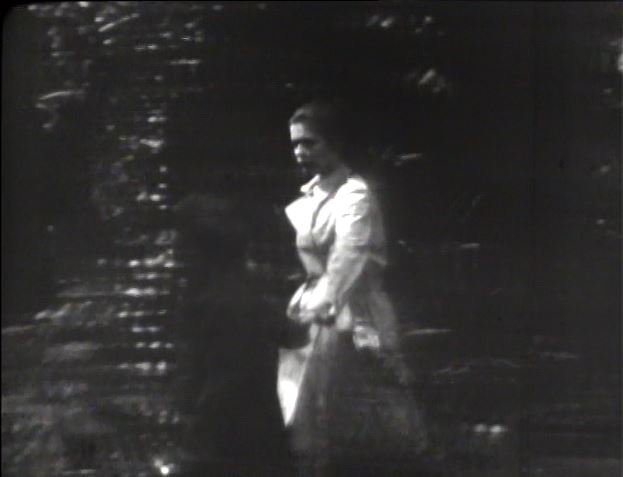
We see the vacant parlor of the Old House. The portrait of Josette begins to glow. A figure takes shape, and walks down from the portrait to the floor. It vanishes from the parlor, and reappears outside. It dances among the columns surrounding the house, glowing an unearthly white. Josette has come all the way out of the back-world into the foreground. We can expect her to stick around. Perhaps others will follow where she has led.
Evidently, Johnson and Crock had access to much of the original paperwork generated by the makers of the show. Today’s closing credits are truncated by a technical fault. The only writing credit shown is Art Wallace’s story creator tag. Fandom has jumped to the conclusion that Art Wallace wrote the episode, but the documents show that Francis Swann did. That makes sense- the two of them have been swapping weeks, with Wallace writing five episodes, then Swann writing five. Swann wrote the other four episodes this week, and Wallace wrote next week’s five, so it would be a deviation from the pattern if Wallace wrote this one as well. Since the episode is such a watershed in the development of the show it is tempting to attribute it to the original writer. But clearly, it is Swann who gave us our first looks at the Old House and at Josette.
Mrs Sarah Johnson, longtime housekeeper to the late Bill Malloy, shows up in the hotel room of dashing action hero Burke Devlin. She tells Burke that she believes his enemy, high-born ne’er-do-well Roger Collins, killed Bill. Her principal evidence for this is the fact that Bill’s body washed ashore near Roger’s home on the estate of Collinwood, and “I believe in signs and omens!”
This line is a bit of an omen itself- Clarice Blackburn will be an important part of the show, not only as Mrs Johnson, but as other characters who believe in signs and omens, and who make things happen in the name of that belief.
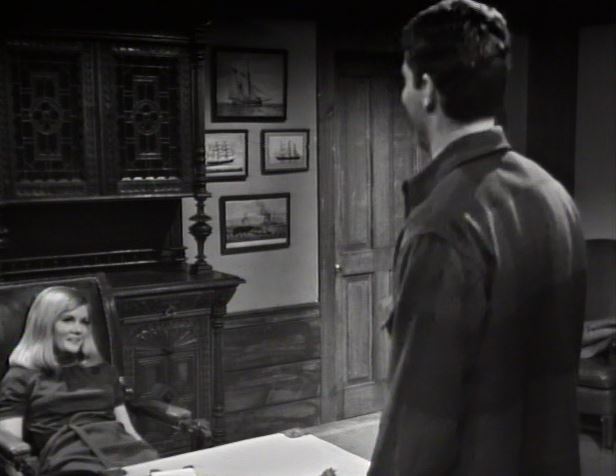
Meanwhile, hardworking young fisherman turned hardworking young clerk Joe Haskell is called into Roger’s office at the cannery. There, he finds flighty heiress Carolyn behind her uncle’s desk, looking seductive, or at least highly available.
Nancy Barrett’s way of throwing herself completely into whatever her character is supposed to be doing at any given moment sometimes makes Carolyn seem even more scattered than her persona as Flighty Heiress required, but it does come in handy when the character is supposed to be sexy. That makes her stand out- even by the standards of an American television show of the 1960s, Dark Shadows is remarkably un-sultry. Sometimes it’s a marvel that they can put so many good-looking young people in close proximity to each other and still project an image of total chastity.
Joe and Carolyn kiss, and she asks him to go away with her. He tells her that he can’t just leave work in the middle of the day. She explains that she is troubled by the doings of Joe’s bête noire, Burke. This leads to a lively conversation, which in turn leads Carolyn to resume her attempts to persuade Joe to take the rest of the day off. When Joe’s boss calls for him, she offers to use her clout as the owner’s daughter to persuade him to let Joe go. He won’t let her do this. She leaves, frustrated by his refusal.
Back at the hotel, Burke and Mrs Johnson are devising a plan in which she will get a job at Collinwood and act as a secret agent for him. We get a glimpse of Burke’s persuasive abilities. When Mrs Johnson is showing reluctance to follow his plan, Burke mentions that well-meaning governess Vicki has given Roger an alibi. She immediately declares that Vicki is lying. Burke won’t agree, leading her to demand that he set aside his personal feelings and devote himself wholeheartedly to making the case against Roger. Not only does the audience see Burke showing kindly feelings towards Vicki, keeping the idea alive that they might become a couple, but we also see Mrs Johnson commit herself to going along with Burke’s plan. Whatever Burke’s actual feelings for Vicki, his emotional display at this moment is timed to lock Mrs Johnson into doing what he wants.
There is a knock on the door. It’s Carolyn. Mrs Johnson hides in Burke’s kitchen and listens as he gives Carolyn the idea of hiring her as housekeeper at Collinwood. This isn’t very hard- Burke simply mentions that Mrs Johnson needs a job, and Carolyn at once says that she will tell her mother to hire her as housekeeper at Collinwood. Even so, Burke’s skillful handling of Mrs Johnson is so fresh in our minds that we don’t need to see him actually do anything to enlist Carolyn in his scheme for this scene to reinforce his image as master manipulator.
The sight of Mrs Johnson lurking in the shadows, eavesdropping on Burke and Carolyn, further reinforces this image. A guileless woman comes into his room proclaiming her every thought at the top of her lungs, as she had done when she was introduced at the sheriff’s office in episode 67. We can hardly imagine so straightforward a personality becoming an effective undercover operative Yet within minutes of meeting Burke, he has her working as a spy.
Writer Francis Swann is credited with the script for today’s episode. He is particularly good with installments that, like this one, have only four characters. Swann’s ability to slip substantial amounts of plot exposition into natural-sounding dialogue makes a minimalist drama seem busy. In this one, it also helps us to feel that we have seen Burke perform great feats of persuasion. Burke may not have had to work very hard to plant ideas in the minds of Carolyn and Mrs Johnson, but we are aware that the scripted dialogue has planted ideas in our minds, and know that someone on the other side of the screen is good at subtle communication.
Swann and director Lela Swift also make effective use of the sets in today’s episode. This is our first look at the kitchen in Burke’s room. He’s gone in and out of there several times, most notably in episode 29 when he prepared a nonalcoholic mixed drink, the “Burke Devlin Special,” for Roger’s son, problem child David. Regular viewers might have started to wonder what it might look like, and might pay close attention when we get our first look at it. What we do see is a complex pattern of shadows that signals Mrs Johnson’s initiation into the world of film noir.
In today’s scenes with Carolyn and Joe, we spend as much time in Roger’s office as we have in any other episode. It’s the only part of the Collins’ business location we see, standing in for the whole enterprise. Played on that set, Carolyn’s flippant attitude towards Joe’s job and his mixed feelings about the demands she makes lead us to wonder if she’s going to wreck the whole business. Her persistent friendliness towards family nemesis Burke gives substance to that thought. Regular viewers will remember that Roger’s self-indulgent behavior nearly annihilated the business; seeing his favorite niece play-act as him in his office leads us to wonder if she will finish the job.
Downstairs in the great house of Collinwood, high-born ne’er-do-well Roger and dashing action hero Burke have another of their quarrels. Upstairs, well-meaning governess Vicki tells reclusive matriarch Liz about her shockingly lonesome childhood. Nothing happens to advance the plot, but the actors make Francis Swann’s dialogue sparkle.
Roger and Burke’s conversation revolves around one of the two major storylines introduced in episode 1, The Revenge of Burke Devlin. Liz and Vicki’s revolves around the other, Victoria Winters’ Quest to Learn Her Origins. The investigation into the death of beloved local man Bill Malloy has suggested that one or both of these may become interesting, though by now that prospect has been reduced to rather a low order of probability.
The real themes of the conversations are the real themes of the whole series- loneliness and denial. As Vicki goes on about how solitary her childhood was at the Hammond Foundling Home, Liz’ face shows one expression of agony after another. When Liz tells Vicki that she can understand loneliness, Vicki tells her that she could leave the house if she wanted to do so. Liz replies with a note of absolute finality- “No. I couldn’t.” Vicki tries to open a new topic, mentioning Liz’ daughter Carolyn, but the barriers have gone up.
Roger insisted on talking to Burke alone. The two of them go round and round, not answering each other directly or telling each other anything new. They can’t talk productively to each other, but can’t talk to anyone else at all. The unresolved, unexplained past they share binds them together and shuts everyone else out. As he leaves, Burke declares that he will return to Collinwood- “possibly to stay.” He’d been telling Liz that he wanted to buy the house, and in previous episodes we’ve seen him scheming to drive the family to bankruptcy and collect their assets. But in this context, his line sounds less like a threat to take the house from the family than like a proposal to move in with them.
There is also a memorable production fault. A camera bounces out of control and gives the audience a view of the lights above the set:
Each episode of Dark Shadows begins with a voiceover. In this phase of the show, the voiceovers are all narrated by Alexandra Moltke Isles in character as Victoria Winters, well-meaning governess, and are brief passages of almost purely decorative prose, meant only to set a mood and to vanish from the audience’s memory as soon as the action starts. Art Wallace and Francis Swann, the writers credited for the first 97 episodes, were old pros who had been turning out scripts for decades, and were good at staying out of their own way. That’s why I haven’t yet said anything about any of the opening voiceovers- when Wallace or Swann set out to write something forgettable, they succeeded. By the time I started writing, I had no recollection of them whatever.
Today’s opening voiceover is unusually substantive, so much so that it threatens to leave a trace in the audience’s mind:
My name is Victoria Winters. Once again it is quiet in Collinwood. There is no sound but the ticking of the great clock in the entrance hall. And the lonely footsteps of a woman who hasn’t left its grounds in eighteen years. A woman whose life is limited to musty corridors and the endless beat of a grandfather clock. A beat that seems to ignore the vitality of the world around it.
Vicki names herself, names the estate where she lives, talks about how quiet it is, mentions the clock, tells the audience that the lady of the house is a recluse who hasn’t left home in eighteen years, complains about the air quality in the house, brings the clock up again, and assures us that interesting things are happening everywhere except here. It leaves us wondering why Vicki is so hung up on the clock, why she doesn’t run the vacuum cleaner herself, and why, if the entire world surrounding Collinwood is chock full of vitality, they don’t turn the camera in some other direction.
That’s the sort of thing we’re going to get from Wallace and Swann’s immediate successors, Ron Sproat and Malcolm Marmorstein. In writing their opening voiceovers, Sproat and Marmorstein fell between two stools. They didn’t write brief, deliberately forgettable passages as Wallace and Swann had done; nor did they integrate the opening voiceovers into the action of the show, as would happen in later years when the story is moving very fast and the episodes start with detailed recaps of events so far. Instead, Sproat and Marmorstein saw the voiceovers as vehicles for long passages of flowery, over-developed imagery. Those are certainly no more effective at setting a mood than were Wallace and Swann’s brief remarks, but they do both try the patience of the audience and linger as distractions. That’s one of the things that prejudices viewers against the character of Vicki- since so many episodes from the Sproat/ Marmorstein era start with Vicki rambling on about the weather or making vague remarks about “one small boy” or whatever, the first impression she leaves on viewers who start watching with episodes from that period is that of a prattling fool.
While Wallace and Swann are the only writers whose names have appeared in the credits thus far, it is very possible that others not credited contributed additional bits. I may be wrong, but my nose catches a whiff of Marmorstein in these six strange, distracting sentences. The description of the clock while we’re looking at it, the specified number of years since reclusive matriarch Liz has left the estate, the evocation of the “musty corridors,” the yearning glance at the eventful world outside, are all typical of Marmorstein’s attempts to turn the voiceovers into freestanding dramatic monologues, but without identifiable characters or plot development.
Today’s episode doesn’t shed much light on Vicki’s relationship to the clock or on the standards of cleanliness in the great house of Collinwood. Instead, it’s a kaleidoscope episode, in which each change of scene varies the combination of characters who interact on each set. The action plays out on two sets this time, the foyer/ drawing room representing the downstairs of the great house, and the Blue Whale tavern, representing the low and bustling life of the village. Because the sets typify the “musty corridors” inside the house and the “vitality of the world around it,” the episode is also a diptych of sorts- not Art Wallace’s usual diptych contrasting two pairs of people, but a diptych contrasting two places and the attitudes those places inspire in the people who spend time in them.
The five pieces tumbling about in today’s kaleidoscope are reclusive matriarch Liz, tightly-wound handyman Matthew, flighty heiress Carolyn, hardworking young fisherman Joe, and Maggie, the nicest girl in town. The regular bartender at the Blue Whale gets a fair bit of screen time as well. In the first 63 episodes, he’s answered to names including “Joe,” Andy,” “Mike,” and “Punchy.” Today, Joe the fisherman calls the bartender “Punchy,” a name he called him most recently in episode 56, the same episode where drunken artist Sam calls him “Mike.” Maybe we’re supposed to think that the young men know the bartender as “Punchy,” the older men as “Mike.” Eventually the show settles on the name “Bob” for him, perhaps because the performer’s name was Bob O’Connell. In one episode (#319,) Sam calls him “Ba-ba-roony,” giving rise to the idea that his name is Bob Rooney.
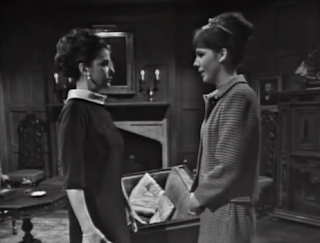
Liz appears only at Collinwood, of course; Joe and the bartender appear only in the bar. The others migrate back and forth between the two sets. We first see Carolyn with Joe in the bar, talking about what a flop their date has been and how pointless their whole relationship is. Maggie interrupts this thrilling conversation, looking for her father, Sam the drunken artist. After puzzling Carolyn and Joe with a number of cryptic remarks, Maggie gives up looking for her father and goes to Collinwood to look for high-born ne’er-do-well Roger. Roger isn’t home, so she winds up talking to Liz. This is the 63rd episode, and it’s the first time we’ve seen these two major characters together.
We first see Matthew in Collinwood, telling Liz how much he wants to help her. He then goes to the bar, where Carolyn and Joe see him. Matthew is looking for dashing action hero Burke Devlin, whom he hates. He implies to Carolyn and Joe that Burke is to blame for the death of beloved local man Bill Malloy. Joe doesn’t like Burke any more than Matthew does. The instant he hears Matthew’s idea, he is all in on it. Carolyn resists the suggestion.
Carolyn goes home to Collinwood. Maggie has explained to Liz that Burke has been saying terrible things about her father, that she can’t find her father to ask him about Burke’s allegations, and that Roger might know something about them. Liz urges Maggie to believe in her father, and to regard Burke as a dangerous, unscrupulous man capable of many dark deeds. Hearing the last part of this, Carolyn asks her mother if she believes that Burke is capable of murder. Yes, Liz says, she does believe that he is capable of that.
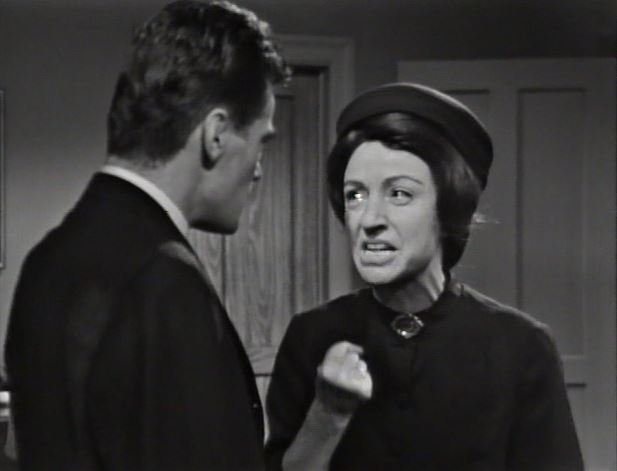
Sheriff Patterson is at the mansion on the estate of Collinwood, talking with reclusive matriarch Liz and Liz’ ne’er-do-well brother Roger about the mysterious death of plant manager Bill Malloy. Liz listens as Roger answers the sheriff’s questions, seeming every bit the trusting sister. The minute the sheriff leaves, she turns to Roger and asks in an icy voice “How much of what you told him was the truth?” She confronts Roger with the differences between what he told the sheriff and what he’d told her. Roger is upset, and finally tells Liz she has to trust him. Liz looks sadly off into the distance and says that yes, she does have to do that.
“Yes, I do have to do that.”
I’m always interested to watch actors play characters who are themselves acting. When she’s concealing her doubts about Roger from the sheriff, Joan Bennett has her first chance to show us what sort of actress she thinks Liz would be. She’s a skillful one- she does have some subtle reactions to Roger’s evolving story when the sheriff isn’t looking at her, but her abrupt, contemptuous turn to Roger is the removal of a convincing enough mask that it shocks the audience. And her statement that she does have to believe Roger, coming after she has made it clear that she knows he has been lying to her and is likely to go on lying, is a performer’s resolution to go on playing a part, however unpromising that part may be.
Intercut with the scenes at Collinwood are scenes in the restaurant at the Collinsport Inn. Waitress Maggie Evans is serving one customer, her father Sam Evans. Sam wants Maggie to return a sealed envelope he gave her some time ago. He won’t tell her what’s in the envelope, why he wants it back, or why he gave it to her in the first place. She won’t give it back to him without answers to at least some of those questions.
Francis Swann is the writer credited with today’s script, but the contrast between the scenes at Collinwood and those in the restaurant form a diptych of the sort Art Wallace specialized in. Sister Liz demands information which brother Roger won’t give; Roger is a fountain of lies and evasions, and finally tells Liz that her idea of family loyalty requires her to behave as if he were telling her the truth. Daughter Maggie demands information which father Sam won’t give; Sam mutters little lies, stonewalls, and begs her to forget about the whole thing.
The two family pairs are both unhappy, but in different ways. The Evanses aren’t having any fun, but you can imagine them reopening communication and re-establishing trust, if only Sam can get off the hook in this crisis. Liz and Roger don’t seem ever to have trusted each other, but they are so much fun to watch that you can see how they might choose to go on fighting these battles indefinitely.
No one has told Maggie or Sam or anyone else that Bill Malloy is dead. When Maggie wonders if Bill might be able to help Sam with whatever troubles he’s refusing to tell her about, Sam replies that yes, Bill might be the only one who can help him. Dashing action hero Burke Devlin telephones the restaurant to order delivery of a meal; he asks if Maggie has seen Bill. Maggie tells Sam that everyone has been asking about Bill.
The sheriff comes in to the restaurant. Roger had told him that he was with Sam and Burke the night Bill disappeared, and the sheriff mentioned then that he’d be talking to both of them. The sheriff reacts strongly when he sees Sam, and tries to strike up a friendly conversation with him. Before the sheriff can elicit much of a response, he gets a telephone call. He rushes out of the restaurant as soon as he’s hung up. On his way out, he casually mentions to the Evanses that it was the Coast Guard calling to say they’d found Bill Malloy’s corpse. They are shocked at the news.
The sheriff doesn’t seem to be watching Sam’s reaction to the news about Bill’s death. That’s odd- while viewers know that Roger is the show’s principal villain at this point, Sam seems to be an equally likely suspect in the case of Bill Malloy. Casually mentioning such a terrible piece of news would seem to be a tactic that a policeman might use to gauge a suspect’s emotional state. Unless it is a tactic of some kind, it would be a spectacularly unprofessional way of announcing to the people of a small town that a highly respected local man was dead. Up to that point the sheriff hadn’t been presented as a blundering fool, so I wonder what they were saying by having him do that.
Miscellaneous:
Marc Masse’s blog posts about the first 54 episodes of Dark Shadows include promotions for Kathryn Leigh Scott’s novel Dark Passages. His post for episode 55 is the first that doesn’t include one of those, and is also the first in which he refers to Miss Scott as “the actress who plays Maggie Evans.” As in “scenes like this emphasize the great and natural chemistry for the father-daughter relationship being portrayed as embodied by David Ford and the actress who plays Maggie Evans.” I wonder if Miss Scott was alienated by “The Dan and Lela Show,” the dialogues between executive producer Dan Curtis and director Lela Swift that he claims to have heard in the background of the episodes. Many Dark Shadows fans were indignant about these, and I’m sure they let Miss Scott know about their objections. Perhaps she pulled her ads from Masse’s blog, and he couldn’t bring himself to mention her name afterward.
Sam Evans is starting to regret writing his Get Into Jail Card that confesses his role in Devlin’s railroading. He tries to get Maggie to return it to him, but she’s not stupid. Maggie is probably a better avatar for the show’s audience than Victoria, and if there’s anything we like more than a mystery, it’s learning the solution to said mystery. While there’s genuine concern for her father’s latest alcohol, caffeine and tobacco binge, she suspects she’s in possession of the final few pages in the mystery novel the whole town is talking about. And she’s running out of reasons not to take a peek and see how things end.
Sam is doing his usual “I’m not looking suspicious by trying not to look suspicious, am I?” thing at the restaurant when Patterson arrives. There’s something of a performer in Sam, who brings his sketchiest A-game when he sees the sheriff, and gets twitchier than Peter Lorre with a pocket full of letters of transit. Luckily for him, the sheriff has other things on his mind. The Coast Guard has found Bill Malloy. Dead.
I’m beginning to lose track of how often we’ve been given the news that Malloy is dead.
Three people expressed surprise in episode 40 that Roger Collins wasn’t at his office. He still isn’t there today, and three more people are surprised. He finally decides to go in when Liz presents him with the alternative of looking for Carolyn.
Bill Malloy isn’t at work either, hasn’t been all day. He and Roger have been taking turns inviting themselves into Sam Evans’ house. Sam is also not working, and in fact takes time out of his busy schedule of downing one glass of whiskey after another to destroy the only thing we’ve seen him make as part of a paying job, a sketch of Burke. Maggie pieces the sketch back together- she’s also at home when she’s supposed to be working.
Telephones are unusually dynamic in this episode. Typically we see only one end of a phone call on Dark Shadows. This time, we cut back and forth between both ends of three telephone conversations this time. In the teaser Roger is browbeating Sam; Sam sets the phone down and walks off. While he gets another drink, the receiver is in the foreground and we hear Roger’s voice at the same volume as we did when Sam was listening. Sam comes back, returns the receiver to its cradle, and goes to sit down while it rings.
The bit when we see the phone and hear Roger’s voice, though Sam isn’t looking at the phone and can’t hear it, establishes the telephone as a character with its own relationship to the audience, independent of anyone who may or may not be paying attention to it. It’s a neat moment:
Liz calls the office and talks to Joe. Joe tells her Bill hasn’t been in all day. The stress in his voice, the papers piled on his desk, and the tight grip he has on the telephone receiver all make it credible that he’s the only person in town who showed up for work today:
Liz mainly wants to talk to Joe about Carolyn. Joe tells her he hasn’t talked to Carolyn in some time, and that he has no idea what if anything she is thinking about their relationship. While he breaks this news to Liz, we see him continue working, then cut back to the look of distress on Liz’ face.
Maggie calls Collinwood. Vicki answers and is excited to talk to Maggie. I guess the show is telling us they’re friends now. Maggie asks to talk to Roger. Vicki says Roger is probably in the office at this time of day, Maggie somehow knows he isn’t, Vicki remarks that he isn’t in the habit of confiding in her. Roger overhears this and asks “Is there any reason why I should confide in you?” When Vicki holds the receiver out to him and says Maggie Evans is on the line, he takes it and hangs up without so much as putting the receiver to his ear. Vicki and Roger then have one of their little quarrels.
That’s the only thing Vicki does in the episode. Her character is heading into a danger zone. Through the first eight weeks, she was on all the time. She was our representative, the outsider who knew nothing about the other characters or the town they live in, and to whom everything had to be explained. Now she knows as much about the rest of the characters as they know about each other, and we know as much as we want to learn by hearing explanations.
The major characters all have their secrets, but the only two who know each other’s secret are Roger and Sam. Vicki isn’t any likelier than anyone else to uncover that one. She has no secrets of her own, and her original story-line- her quest to discover her origins- is dead in the water. What’s more, Vicki is no good at lying. Soap operas are mostly conversation, and the big events on them are lies and the exposure of lies. The only time Vicki has tried to lie to anyone- in episode 13, when she told Matthew that Liz knew she was in his cottage- she was immediately found out, with disastrous consequences. If she’s going to stay relevant to the show, something is going to have to change, and fast. It’s fun to watch Alexandra Moltke Isles bicker with Louis Edmonds, but the characters they play need something meatier to bicker about.
This is the first episode credited to writer Francis Swann, indeed the first episode credited to anyone other than Art Wallace. Swann’s teleplay finds humor in the idea that so many people have taken the day off. Each time another character remarks on a case of absenteeism it gets that much closer to raising a chuckle. And Roger’s line that looking for Carolyn would require him to “neglect my vital tasks at the office… Dear me, no” is genuinely funny, especially as Louis Edmonds delivers it. The telephone scenes are also an innovation, and promise a new source of visual activity. Those favorable omens are offset by Vicki’s scene and its suggestion that her character is about to be allowed to wither on the vine.
A couple of the blogs I read when I prepare my comments made remarks about this episode with which I disagree. John Scoleri of Dark Shadows Before I Die says this of the quarrel between Sam and Maggie:
I know Sam gets frustrated with Maggie, but I’m beginning to wonder about their relationship. If he’s that close to hitting Maggie when he gets drunk, there’s no way I’m believing he hasn’t done that before.
It doesn’t look to me like Sam has hit Maggie. She’s inches from his face when he is at his angriest, yet she doesn’t flinch, doesn’t slump down, doesn’t show any sign of withdrawal or fear or anger or panic or sullenness or bewilderment or any other possible response to physical abuse.
There hasn’t been much happening on DARK SHADOWS in the last few weeks, but that doesn’t mean the show hasn’t been moving forward. There’s been a growing sense of doom throughout the show, and it’s obvious that someone is going to die. In this episode Sam rips up his portrait sketch of Burke Devlin, he and Roger lob threats at each other, Liz begins to draw Joe’s attention to his girlfriend’s romantic intentions on the family rival, and Victoria has been pushed around by just about everyone in the cast. In theory, any one of them is eligible for a ride in the bone wagon, but the show has been implying that Devlin is headed for a fall. It’s interesting that the show decides to go in another direction: I don’t know when Bill Malloy checks in at Eagle Hill Cemetery, but it’s probably sooner rather than later.
While it is true that “in theory, any one of them is eligible for a ride in the bone wagon,” I do think there’s a clear front-runner to be the first Dark Shadows character to be killed. It’s Sam who is obsessed with the fear of death, Sam whom Roger has threatened, Sam who left a mysterious sealed envelope to be opened in the event “something happens.” And, from an out-of-universe perspective, it’s Sam who has a daughter played by an appealing actress who needs a story-line. Maggie seeking revenge for the killing of her father would be just the plot to elevate Kathryn Leigh Scott from the bottom of the second string to the starting lineup where she so obviously belongs.
No other character has anyone so well-positioned to play avenger if they’re killed. The only keen attachment Bill Malloy has shown is his devotion to Liz, and in her scene with Matthew in episode 38 Liz demonstrated that she sees devotion from people outside the family as a tool to use when time comes to protect the good name of those inside it. So if she suspects Roger killed Bill, she won’t become Bill’s avenger- if she could order Matthew to throw away his own good name to cover up the truth about David, we can hardly expect her to expose Roger to redress Bill’s grievance against him. Indeed, when Bill is murdered, they will introduce an entirely new character to seek revenge for him.
Vicki is an orphan, who tells us in today’s opening narration that before she arrived at Collinwood she had never known a home. No one is likely to avenge her, and besides, she still does the opening narration for every episode- she’s supposed to be important, even if the writers can’t quite figure out what to do with her. Burke is supposed to be rich and powerful. Presumably he has friends, but we haven’t seen any of them. Joe is Mr Nice Guy and he’s mentioned a friend or two, but again, we haven’t seen them. The series story bible calls for Roger to die when Burke finally gets his revenge, but every time Louis Edmonds’ performance is the most interesting thing in an episode it becomes so much the less likely that they will ever get around to playing that scene. So the smart money, at this point, would be on Sam to be the victim in the first Dark Shadows murder. So much so, indeed, that it might not be surprising enough if it does happen- they may think they have to kill someone else to keep the audience engaged.






 Dark Shadows Commentary