Art Wallace, credited as the author of this episode’s script, specialized in finely-etched character studies. Often as not, he favored a diptych structure, in which the episode intercuts between two groups of characters. In the contrast between their relationships, we learn more about them in a shorter time than we could if one group was on screen the whole time.
He doesn’t use that structure today. It’s more of a kaleidoscope, in which the characters tumble about, moving from set to set, recombining in different groups. The five reflecting surfaces in this particular kaleidoscope are drunken artist Sam; hardworking young fisherman Joe; the sheriff; flighty heiress Carolyn; and problem child David. Their reactions to the mysterious death of plant manager Bill Malloy have set them spinning.
Carolyn, Sam, and the sheriff play it very hot. Bill was like a father to Carolyn. She wants to keen over him, and is raging with frustration that she can’t find anyone to wail with. Bill was trying to prove that Sam had committed a crime. He can barely restrain himself from panicking in his fear that he will be accused of killing Bill. The sheriff is investigating the case. He wants answers from Sam, and comes down on him very hard when he doesn’t get them.
Joe is more subdued. He is clearly saddened by the death of a man he worked for and admired, but is quiet and attentive to others. When Sam insistently tries to get him to figure out what the police will be able to reconstruct from the place where Bill’s body washed up on shore, Joe very patiently explains about tide tables and the like. When the sheriff comes upon Sam and Joe and suggests Joe go away, he complies in good humor.
David is absolutely cool. He is trying to figure out where Bill’s body first went into the water in hopes that he will be able to prove that his father, whom he hates, murdered Bill. When Carolyn demands that he adopt an attitude consistent with hers, he flatly refuses. She persists, he delivers one incisive comeback after another.
Carolyn bemoans their fate, living in the walls of the mansion at Collinwood. David says he likes it, that it’s fun to live in a house with real ghosts. “Sure, it’s scary sometimes,” he allows, but the ghosts are his friends. Maybe Mr Malloy will be one of them. Carolyn is exasperated by this reply, but can’t bring herself to deny that the house is haunted.
Joe shows up at the big dark house on the hill to see Carolyn. David picks up where Sam left off, and questions Joe about how to read a tide table. Unlike Sam, David has a set of tide tables with him, and the two of them sit down and start doing calculations. Carolyn reacts to this with abhorrence. Joe leaves with Carolyn, but not before encouraging David to stick with his calculations. He tells the boy to ask his father for help, a suggestion to which David reacts sharply.
After Joe and Carolyn have left the house, a knock comes at the door. David exclaims joyously, “Joe, I knew you’d come back!” When he opens the door, though, it isn’t Joe- it’s the sheriff. David resumes his perfect serenity and asks, “Have you come to see my father?” When he says yes, David goes to fetch him, a blissful smile on his face.
We’ve been watching each episode of Dark Shadows on the 56th anniversary of its original broadcast. Today was the 56th anniversary of the broadcast of episode 56, so a milestone of sorts.
Word is making its way around the town of Collinsport that the Coast Guard has found the body of Bill Malloy, manager of the fishing fleet and cannery that between them employ most of the men in town and sustain the Collins family in their big dark house on the hill. In the opening, reclusive matriarch Liz is stumbling over her words trying to break the news of Bill’s death to her daughter Carolyn. The phone rings. Carolyn answers it, and gets the Coast Guard’s report. Liz is shattered.
Carolyn tells well-meaning governess Vicki that Bill’s body has been found. In episode 52, Carolyn had told Vicki that Bill was like a father to her. Carolyn, as played by Nancy Barrett, does indeed seem as upset in this scene as would someone who had just heard that her father’s body had washed up on shore. Vicki, as played by Alexandra Moltke Isles, is very calm and deliberate as she listens to Carolyn, letting her say what she has to say and emote as she needs to emote. It’s quite a well-turned bit of drama.
In the Blue Whale, Collinsport’s tavern, Liz’ ne’er-d-well brother Roger finds drunken artist Sam Evans, his co-conspirator in a long-ago crime. Sam tells Roger that the Coast Guard has found Bill’s body. Roger first takes a very lofty tone and announces that he will do whatever he must to ensure that Bill’s killer is brought to justice. After Sam asks him what he means by this, Roger coaches him on the lies the two of them should tell to ensure that neither of them is convicted of killing Bill.
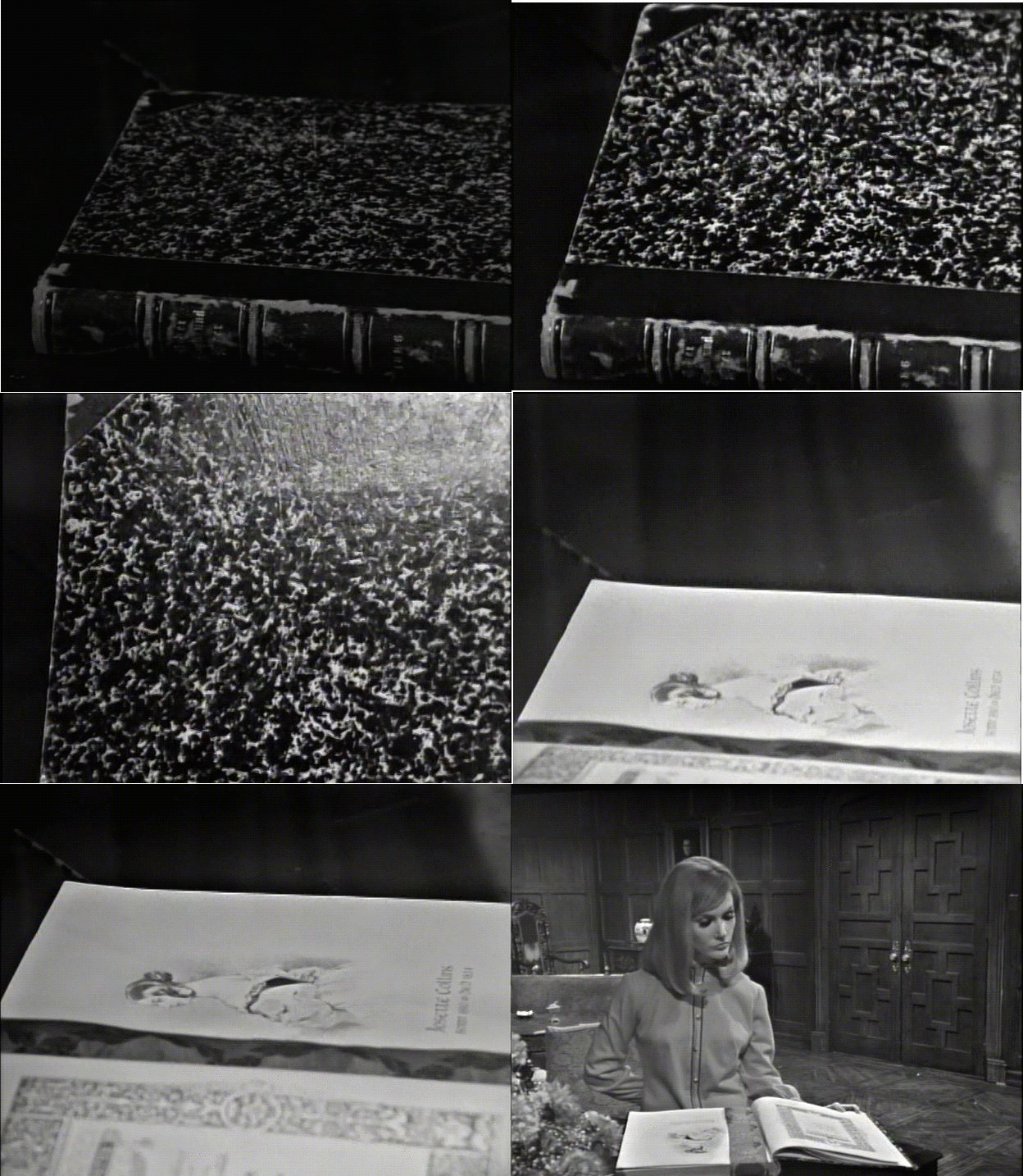
Back at the great house on the estate of Collinwood, we see the Collins family album open to the page with the picture and name of Josette Collins. The last time we saw this was in episode 52, when the book opened to that page without the aid of any visible hands. Now we see that Carolyn is opening the book. That is followed immediately by the drawing room doors opening. That too has been the prelude to a ghostly apparition, but this time turns out to be Vicki’s doing.
The first few weeks, several characters used the word “ghosts” in metaphorical senses when talking with Vicki. Each time, she behaved as if they were talking about literal ghosts and said something like “Surely you don’t believe in ghosts!” To which they said that they damn well did believe in them, and that if she goes on living in the house at Collinwood for any length of time she will, too. Reminding us of ghostly manifestations and then showing mortal agency behind them harks back to this kind of open question. Art Wallace, who was the only writer credited on the first 40 episodes, is the writer today as well. Evidently he wants to remind us of the supernatural themes and to keep us guessing where they will take us.
We intercut between two contrasting scenes: in the mansion at Collinwood, Vicki the governess and Carolyn the heiress pour their hearts out to each other, while in the Evans cottage drunken artist Sam refuses to answer any of the questions his adult daughter Maggie puts to him.
The disappearance of doughty plant manager Bill Malloy looms over both conversations. Vicki and Carolyn can’t avoid the conclusion that the body they saw face-down on the beach at the end of Friday’s episode was Malloy’s. Sam tells Maggie that the reason he can’t sleep is that he’s worried about Malloy.
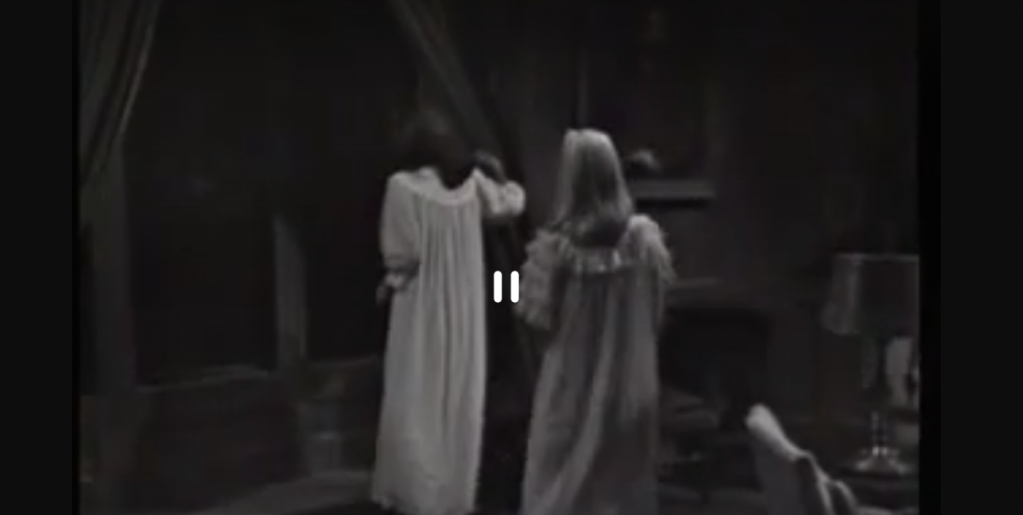
The two settings connect when Sam telephones Collinwood in hopes the dastardly Roger will answer. The call prompts Vicki and Carolyn to break up their slumber party in Vicki’s room and come to the telephone outside the drawing room.
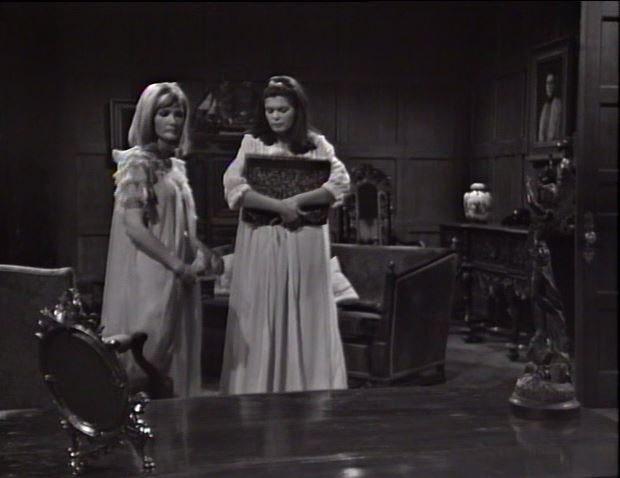
Vicki answers the telephone. Sam says “Collins,” Vicki asks to whom she is speaking, he hangs up. They then hear a noise from inside the drawing room. They go in and search to see if anyone is hiding there. Vicki goes directly to the window and pays special attention to the area behind the curtain on her right, a spot that will become a frequent hiding place much later in the series. I suppose it makes sense that people would eventually start hiding there- the camera has a great angle on it. Smart of Vicki to know that’s the first place to look.
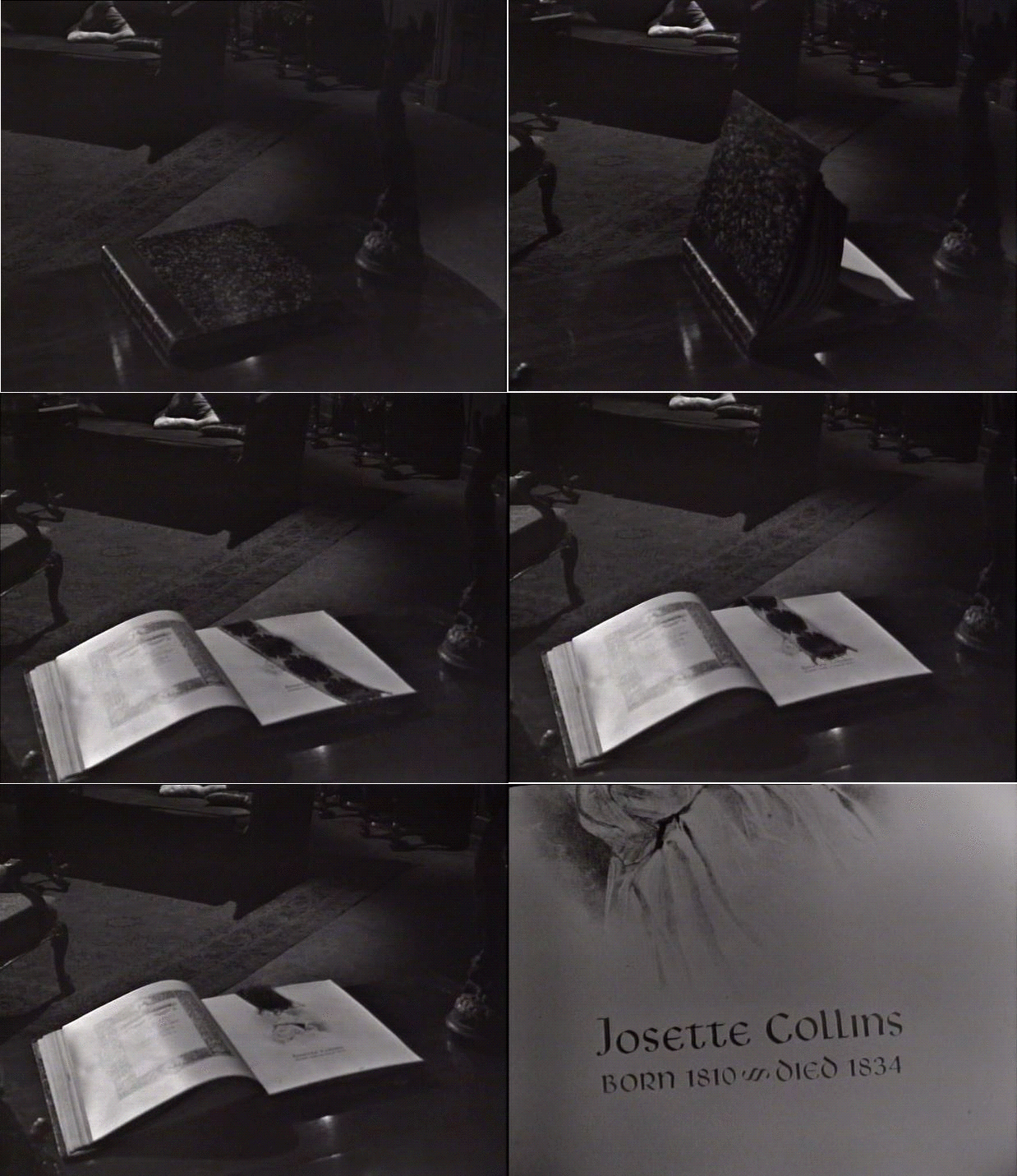
The girls find a book open on the floor. Vicki demonstrates that the noise they heard was the sound of the book falling, but she cannot explain how it moved several feet from the table where it was kept to the spot where she and Carolyn found it. Carolyn insists that they consider the possibility that a ghost put it there. Since they had heard the same sound at least once while they were still in Vicki’s room, it would make sense to consider that someone or something must have been involved in picking it up and dropping it again.
Vicki and Carolyn leave the drawing room, and we see the book reopen itself to the same page. The camera zooms in, and we see that the page bears the name and likeness of Josette Collins. This is the first supernatural manifestation that the audience sees when no character is looking. We’ve been hearing about the ghost of Josette Collins from week one; we have to assume that she is leaving us her carte de visite.
Each of the previous supernatural manifestations had marked a moment when off-screen events were stirring up the spirits that inhabit the back-world behind the universe the characters inhabit. When troubled rich boy David had tampered with the brakes on his father Roger’s car in an attempt at patricide, reclusive matriarch Liz was asleep and ghosts were trying to reach her in her dreams. That same night, Vicki saw a door open and close itself inexplicably, and saw a shrouded figure on the threshold of the drawing room. At the beginning of this episode, Carolyn admitted to Vicki that while Collinwood has always been a strange place, it was only when she and Burke came to town that the really weird stuff started happening. So we have to take it that Vicki’s presence in the house is itself a matter of concern to Josette and the other ghosts, and that what is happening off-screen in connection with the body on the beach and the secrets Sam refuses to share with Maggie are going to bring the phantoms out of the back-world into the foreground.
It’s also interesting that the first character we see after the ghost of Josette announces herself is Maggie. At this point and for some months to come, the show will be developing a connection between Vicki and the ghost of Josette. But later on, both Maggie the character and Kathryn Leigh Scott the actress will be very much involved with Josette. The series involved very little advance planning, nothing at all like daytime serials of the present day that have their stories sketched out in detail months in advance, so that is probably just something you’d expect to happen when you only have four actors in the studio. Still it’s an eldritch moment for repeat viewers.
Within the context of the show as it actually was at this period, I think there is a point to the juxtaposition of the ghost of Josette with the scene between Maggie and Sam in the Evans cottage. Vicki and Carolyn are girls at a slumber party scaring each other with ghost stories. Even when the slumber party takes place in a mansion on a great estate belonging to the family that gave the town its name, that’s a silly situation. When the ghost stories turn out to be true, though, you’re suddenly vaulted into an elevated realm of fantasy. Turn to a small house where the adult child of an alcoholic is wearing her late mother’s night-gown and trying fruitlessly to prise some useful information out of her drunken parent, and you land back in the real world with a thud. Nothing here seems to be either silly or fantastic. Sam’s association with Roger’s secret, and therefore with the unknown events that are roiling the supernatural world, suggests that the mundane struggles of the Evanses and the fantastic doings at Collinwood will sooner or later collapse into each other.
I should mention Marc Masse’s post about this episode on his always intriguing, usually inaccessible blog Dark Shadows from the Beginning. Masse meticulously demonstrates the influence of the 1944 film The Uninvited on the show in general and this episode in particular with close analysis and multiple screenshots, and then does the same thing with an episode of Alfred Hitchcock Presents called “The Gentleman from America.” It’s a very impressive and thoroughly convincing work of scholarship.
Masse’s blog is infamous among many Dark Shadows fans because of what he presents as transcripts of conversations between director Lela Swift, executive producer Dan Curtis, and others that he claims were picked up by the control room microphone and that he has recovered by some more or less magical technique unknown to other audio technicians. In this one he includes such a “transcript,” in which Swift (who didn’t direct this episode, but is supposed to be in the control room anyway) tells Curtis that she thinks it’s a terrible idea to do a ghost story or a Hitchcock story on daytime TV.
That installment of “The Dan and Lela Show” is pretty tedious to read, but in a way it’s a relief. In previous posts Masse has presented Swift as maniacally driven by lust for the female cast members, a presentation that her husband and their children might have found surprising. His post for episode 48 brings that presentation to a sort of crescendo. Since this one includes two shots of Vicki and Carolyn in bed together, I braced myself for Masse to outdo himself in that line, but there isn’t a bit of it there.
Roger’s mounting anxiety about what Burke may learn from Sam leads him to alternate in each scene between yelling and begging. Depicting this, Louis Edmonds’ chews the scenery so hard that he momentarily loses track of Roger’s mid-Atlantic accent and slips into his native Louisiana drawl, yelling at Vicki “Jes supposin’ you a-tell me how long you wah standin’ in that doah-way?” Perhaps this is Marc Masse’s “David Ford Effect”– Ford came to the show from a long engagement as Big Daddy in Cat on a Hot Tin Roof, maybe they’ve decided to transport Collinsport from Maine to the Mississippi Delta.
At the Evans cottage, Sam gives Maggie a sealed envelope to be opened in event of his death. Maggie is bewildered and upset. Surmising that her father’s trouble is to do with Collinwood, she wishes that the mansion would burn to the ground. Sam waxes philosophical, opining that “Ghosts of the past don’t live inside a home. They live inside each man. They fight for his soul.. twist it into something unrecognizable.”
Moments later we find out that Sam is wrong, ghosts totally live inside a home. In the middle of the night, Vicki is awakened by the same strange sobbing she had heard in episode 4. She follows it to the basement. Last time she was in the basement, in episode 6, Matthew found her there and spoke sharply to her. Now Roger finds her there and yells at her. As she had stood up to Roger in the drawing room earlier, so she stands up to him now. After their showdown, he even admits that he has heard the sobbing woman many times, and says that she may be “one of our ghosts.”
I divide the series into several periods, the first of which I call “Meet Vicki.” The major story-lines of the Meet Vicki period are all in a down-cycle during this episode. Roger’s panic and Sam’s melancholy are part of the Revenge of Burke Devlin story, but Roger’s activities today do nothing to advance that story, and Sam’s letter will become one of the most tedious MacGuffins in a series that is notorious for forcing the audience to sit through overlong contemplation of its MacGuffins. Roger’s angry reaction to finding Vicki in the basement touches on the Mystery of the Locked Room, which is connected with the question of why Liz became a recluse. Those stories haven’t advanced for weeks. The sobbing woman revives the question of whether the house is haunted. While Roger’s admission that he has heard the sobbing marks the first time one character knows what another is talking about concerning the ghostly happenings, it does not prompt any further action. The question of Vicki’s origins is at a stalemate, the romance between Carolyn and Joe is dead in the water, and David is so alienated right now that they can’t do much with Vicki’s attempts to befriend him.
So the Meet Vicki period has reached a dead end. Tomorrow we’re going to meet someone else, and a new period is going to begin.
Thunder rumbles. The lights go out at Collinwood. Alone in the drawing room, Vicki lights a candle. The doors swing open, and a darkened figure stands in shadow. Vicki calls to the figure. It does not respond. The lights come back on. The figure has vanished. Roger happens by; he is the only other person in the house, but he is too tall to have been the figure.
This is the second occurrence in the series that is either a supernatural manifestation or an elaborate Scooby Doo-esque prank on Vicki. The first time, in episode 14, happened when David had taken the bleeder valve from the braking system on his father’s car, an event that would have dire consequences. We can assume that this second occurrence is telling us that we are about to see events that will stir up the supernatural back-world of Josette, the Widows, and heaven knows who else.
David had planted the bleeder valve in Burke’s room, trying to frame the family’s enemy for his own crime. When he spends a few minutes with Burke and takes a liking to him, he tries to retrieve the valve, not knowing that Burke has already found it and that he is carrying it in his pocket. In Burke’s car on the way to Collinwood, he pleads with Burke to go back to the hotel. He can’t give an explanation for his plea, and Burke refuses to turn back without one.
Vicki tells Roger that she had found the bleeder valve in David’s room, and Roger quickly accepts that his son had tried to murder him. When Burke brings David home, Roger takes David into the drawing room and demands he confess to his crime. Burke refuses to leave the house. Roger calls Vicki into the room; Burke insists on joining them. David calls Vicki a liar, Roger continues to browbeat him. We see a reaction shot of Burke in profile, standing in the doorway, watching the scene intently. Roger mentions the bleeder valve; Burke steps forward, and with a flourish produces the valve from his pocket. David’s face crumbles into absolute dejection.
Has Burke really betrayed David? Or is he playing some other game? We have to tune in next time to find out.
So, we begin with an indication that what follows will stir up the back-worlds, and then see an episode about the relationship between Burke and David. Roger describes Burke and David as “the two people I dislike the most.” Something Burke and David have in common, something that Roger cannot forgive, is going to bring the ghosts out of the woodwork and into the foreground.
Vicki tells Carolyn that David was the one who sabotaged Roger’s car, which Carolyn accepts as fact almost immediately. The story does build a foundation for Carolyn’s reaction- she repeatedly calls David a monster, and has been guilt-stricken at the thought that she let Burke into the house to commit the crime. But it is also the first example of what will become the hallmark of all of Nancy Barrett’s performances on the show. Her characters are the first to throw themselves into whatever is going on. She comes to serve as a one-woman chorus backing whoever happens to be the protagonist at the moment.
Liz still refuses to face the facts about David. When Vicki finds David’s Mechano magazine in her underwear drawer with the page about hydraulic braking systems marked, she and Carolyn see it as evidence that David had access both to the drawer and to the technical information he needed to commit the crime. Liz sees it differently, saying in a distant, ghostly voice “It was in your room, Miss Winters.”
Liz’ ghostliness is highlighted strikingly earlier in the episode. In the upstairs hallway, Carolyn is chattering away about ghosts, both the metaphorical ghosts of current problems resulting from past conflicts and the literal ghosts that, she would have you know, most definitely exist. Vicki looks at the door to the rest of the house which inexplicably opened and closed itself a few episodes back, and gasps as it opens again. This time it’s Liz coming out, having looked for David in the closed-off wing. Liz is impatient with the girls’ talk of ghosts, but her manner and appearance as she enters through that door are spectral.
The other setting in today’s diptych is a hotel room in Bangor.* Burke is meeting a private investigator there. He’s giving him a tough assignment. He wants more information about the Collinses in less time than the investigator had originally expected. He also wants the job done in absolute secrecy, and if the Collinses catch wind of the project the investigator will suffer dire consequences. The investigator is played by Barnard Hughes, a highly accomplished actor, and his skills are needed. Burke is being harsh and unreasonable, and the investigator is being deferential. Hughes is able to give his character enough texture that he seems to be keeping his dignity. Without that, Burke would have come off as a bully. The audience has to like Burke, so Hughes makes an important contribution to the show in this, his only appearance.
There’s an irony to Burke’s hard-driving intensity. He’s looking for information to hurt the Collinses, while the women at Collinwood have information far more damaging to the family than anything he’s sending his man to look for. So we’re in suspense as to what he’ll do when he catches up to them.
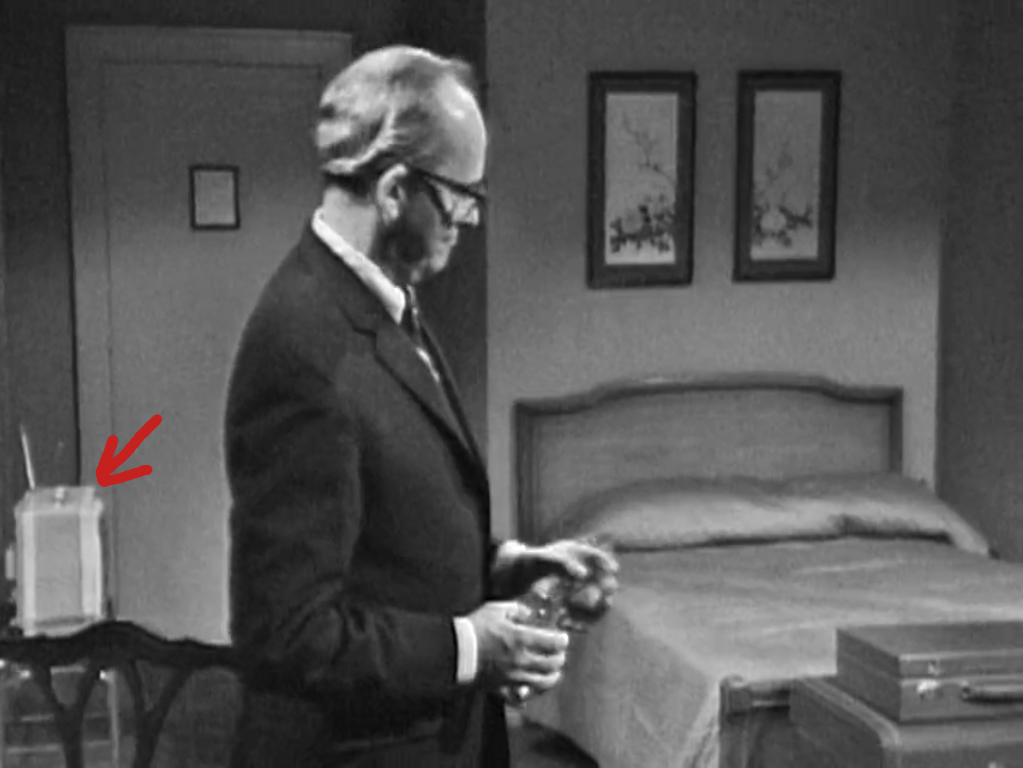
*In a comment on Danny Horn’s Dark Shadows Every Day, “TD” points out that the hotel room in Bangor has a television set, the first such device we see on Dark Shadows. We will not see another until 1970. That one will be in a parallel universe. We never do see a TV set in the Collinsport of the main continuity.
Evidently Mr Bronson had the hotel send a TV up to his room.
We see David looking for a place to hide a small metal valve. He settles on Vicki’s underwear drawer. She catches him going through it; he runs off, and she finds nothing missing. She would apparently rather not think about what he was doing in that particular drawer. Later, he will claim that he was trying to slip a present into the drawer- a seashell, at first; then, a magazine.
Alone in the upstairs hallway, Vicki sees the locked door to the closed-off part of the house open and close, apparently by itself. At first, she thinks it’s David playing a prank on her, but he comes out of his room so soon after that there doesn’t seem to be any way he could have done it. The show has been using the idea of ghosts in episode after episode to suggest that something big is about to happen; now, for the first time, we see an event that is either a supernatural manifestation or an elaborate, Scooby Doo-esque hoax perpetrated by some unknown person for some unknown reason. So what she’s doing now- looking for David, trying to figure out what he’s been up to- is directly connected to something that is disturbing the supernatural back-world of Collinwood. It may be a while before the back-world erupts into the foreground, and even longer before it crowds out everything else and becomes the whole show. But that little valve represents the first irretrievable step on the path that will lead to what Dark Shadows became.
This is also the first episode in which Vicki gets to make someone laugh. Carolyn says that she and Joe will probably go to a movie, because “What else is there to do in this town?” To which Vicki replies “You could get into a fight in a bar.” It’s also the last episode in which Vicki is allowed to make a joke. Humorlessness one of the things that will eventually squeeze the life out of the character. Alexandra Moltke Isles delivers her one good joke well enough that it clearly could have been otherwise. Those of us who wish Vicki had stayed at the center of the show all the way through can’t help but feel sad that it wasn’t to be.
Roger and Vicki encounter each other on the peak of Widow’s Hill. Roger remarks it is the highest point in the area. At the end of their conversation, Vicki will call to Carolyn, inviting her to join them “down here.” This may seem to be a blooper, but since we hear “down” used to mean “up” in a later episode, I speculate that it’s a peculiarity of Collinsport English.
Little happens to advance the plot in this episode, but between Roger’s announcement that he and Vicki are standing on the highest point in the area and Vicki’s invitation to come “down here,” we hear a lot about the ghostly legends of the place. After the scene in episode 11 where the ghosts are troubling Elizabeth while David is doing something mysterious involving motor grease and little pieces of metal, it seems that the show is using the ghosts as a sign that something big is happening. Certainly the “Widow’s Wail” is a striking sound effect, and Louis Edmonds does a good job of selling the idea that Roger really does believe in all the legends about the house that his social position might require him and Elizabeth to ridicule publicly.
It’s a bit jarring that Carolyn drifts into the scene asking what Vicki and Roger are doing- “planning a suicide pact?” She had just told Vicki about the legend that a third governess would die by jumping off the cliff, and the series story bible still calls for Roger to throw himself to his death from it. So you might think it would be in questionable taste to bring that particular topic up just now.
There’s also a scene in the Evans cottage where Maggie (Kathryn Leigh Scott) tries to get Sam (Mark Allen) to tell her what’s been bothering him. In episode 11, Conrad Bain had triumphed over a weak script and Mark Allen’s relentless whine to turn what might have been a lot of tedious recapping into a compulsively watchable scene. At the beginning of this scene, Kathryn Leigh Scott is mustering such powerful emotions that it looks like she might be about to accomplish the same feat, but Allen has switched from whining all his lines to bellowing them. So the scene is a dead loss.
Carolyn is in Burke’s hotel room, where he charms her and tricks her into believing that he’s planning to leave town soon. I suppose the definition of “dashing” would be a charming fellow who makes things happen, things you wouldn’t have predicted and of which you aren’t sure you can approve. Burke is at his most dashing in scenes where he’s trying to enlist the women and children of Collinwood to his side. With Carolyn here, with Vicki back in episode 7, most of all with David in episode 30, we wonder what exactly he’s trying to do. He’s not so good with the men- when he tries to recruit Joe Haskell to his intelligence-gathering operation in episode 3, he ends up baldly offering him a bribe.
Liz and Roger are in the drawing room, where she demands he be less openly hostile to his son David. Unknown to them, David and his toy robot (a Horikawa “Attacking Martian,” which sold for $4.22 in 1966, not including two D batteries) are hiding behind a chair listening to Roger’s brutal denunciations of the boy. Unknown, that is, until Roger goes to the brandy bottle for his second drink, when the Attacking Martian starts attacking Roger.
Roger all but assaults David in response. David flees his father’s rage. He runs out of the house, telling Roger he hopes Burke Devlin gets even with him. Roger is as bleak and maladroit in these interactions as Burke is glittering and skillful in his handling of Carolyn. Again we see Art Wallace’s use of intercut scenes to bring out a comparison between characters.
After the second part of the scene in Burke’s room, David slips back into the house to find his Aunt Elizabeth asleep in a chair, muttering about ghosts. After all the talk about ghosts in the first two weeks, Elizabeth’s muttering about them seems significant- perhaps we are to think that her dream is a message from the ghosts who linger about the house, a sign that something is happening that will stir them up. Elizabeth awakes, and sees that David is in front of her, smeared with grease and holding a small object. He won’t answer any questions or let her see what he has in his hand. Before she can pursue the matter, Carolyn appears in the foyer, bringing an unexpected guest- Burke Devlin. Confronted with this shocking sight, she forgets all about David.
The episode begins with Bill Malloy at the front desk of the Collinsport Inn, using the telephone to call Burke Devlin’s room. Burke hangs up on him. It ends with Carolyn Stoddard standing on the same spot, making the same call. Burke invites her up. Marc Masse has a nice discussion on his blog of what this pair of scenes means within the formal structure of the show at this point.
Carolyn tells Vicki about Josette and the two governesses who fell to their deaths from Widow’s Hill, and about the legend that a third governess will follow. Liz declares “There are no ghosts here,” but uses the word “Poltergeist” in a little speech about ghosts, a sufficiently sophisticated term in 1966 to suggest that someone using it has done serious reading about the supernatural. Coupling these lines with Burke’s statement in episode 7 that there are literal ghosts at Collinwood and other remarks that Roger and Carolyn have made in other episodes, the show is going out of way to keep the possibility open that there will be literal ghost stories.


 Dark Shadows Commentary