Episode 862: Reexamine your loyalties

Know Yourself

In yesterday’s episode, Kitty Soames, the dowager countess of Hampshire, found a note on the dresser in the room where she has been staying in the great house of Collinwood. It read “Know yourself, be who you must be.” The dramatic date is 1897, 1504 years after the Delphic oracle went out of business, so it is unlikely that its management sent the message as a translation of and commentary on their motto γνῶθι σεαυτόν.* It was also 83 years before the US Army adopted the slogan “Be all you can be,” so we can rule out the idea that a recruiting sergeant was trying to get Kitty to enlist. The US Army didn’t even accept countesses in those days, not even if, like Kitty, they originally came from Pennsylvania and are now in Maine.

Ever since she arrived at Collinwood in #844, the ghost of the gracious Josette has been taking possession of Kitty from time to time. The note prompts another spell of Josettification. Kitty puts on Josette’s wedding dress and wraps a red cloak around it. She mutters that “He is waiting for me,” not specifying who “he” is. She goes to the top of Widows’ Hill, the precipice from which Josette flung herself to her death a century before.

Josette was married to Jeremiah Collins. Jeremiah’s ghost appears to Kitty/ Josette. He urges her to leave Collinwood at once, lest “he” kill her. By this time the possession has worn off, and Kitty has no more idea who Jeremiah means by “he” than anyone overhearing her earlier would have known who Kitty/ Josette meant when she said that “he” was waiting for her.

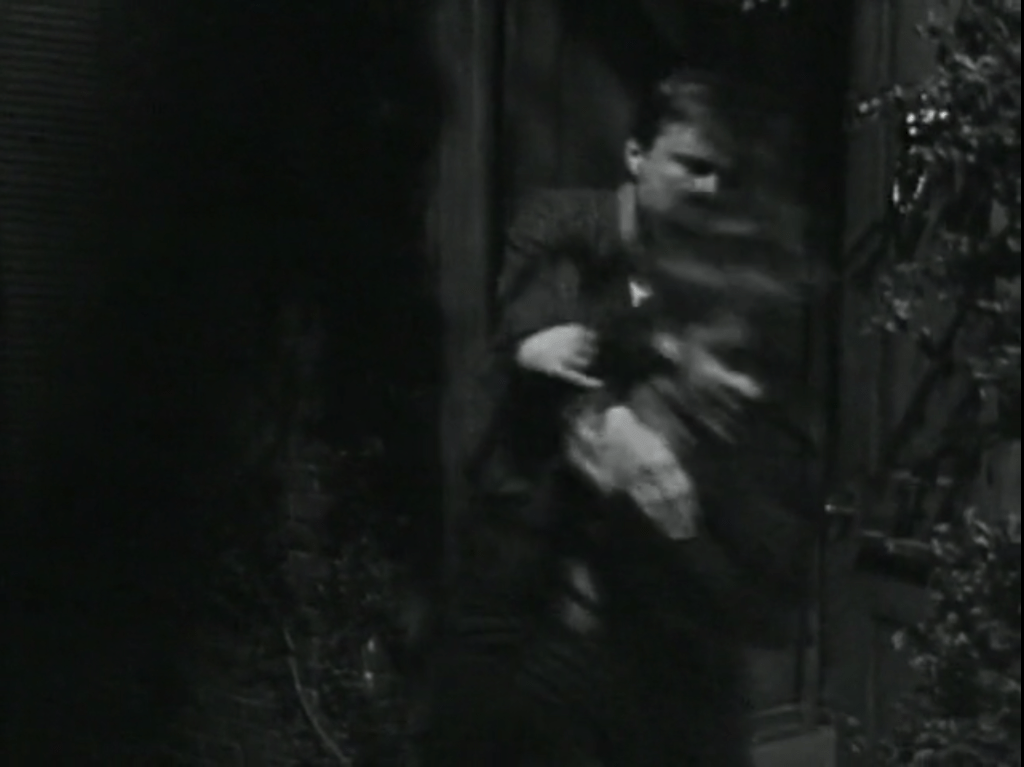
Jeremiah’s ghost reaches out to Kitty.

Be on Guard Against Your Enemies**

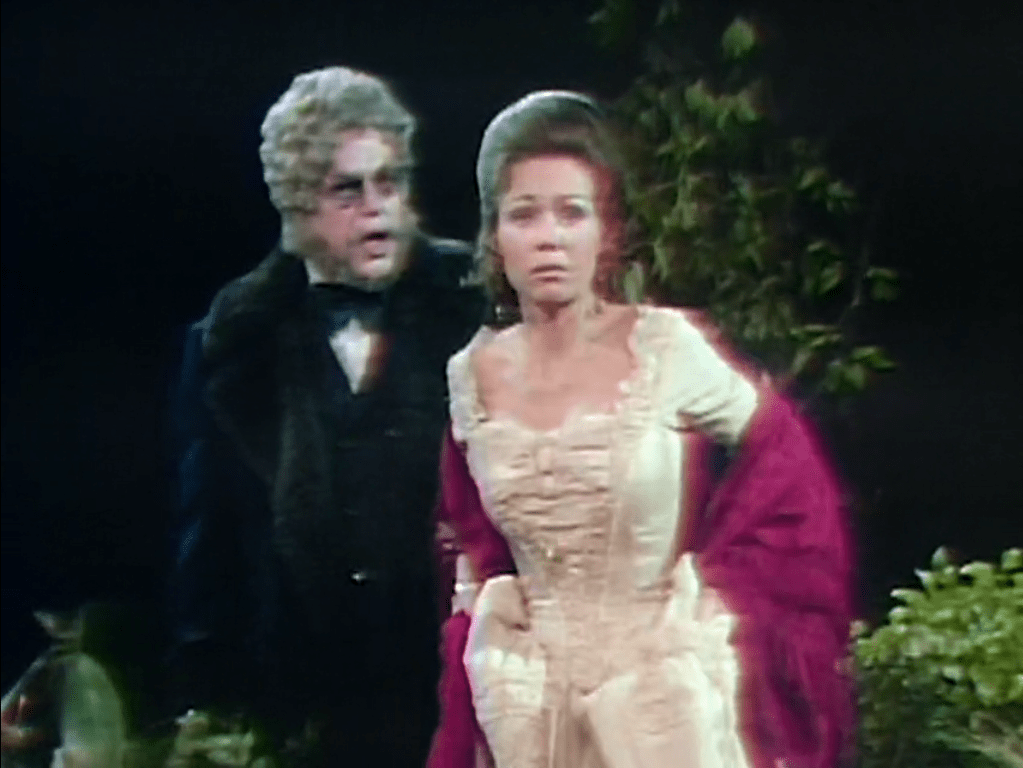
Jeremiah vanishes, and Kitty is joined by a man she believes to be Count Petofi, the sorcerer who drove her husband to suicide. She fears Petofi and hates him, and is unhappy to find herself standing next to him at the top of a cliff, especially when she is in a confused frame of mind.

In fact, the man is not Petofi. Two weeks ago, Petofi used magic to force the devastatingly handsome Quentin Collins to change bodies with him. Now Petofi occupies Quentin’s strong young form, while Quentin is trapped in Petofi’s aging and feeble one. While this predicament lasts, I refer to Quentin as played by Thayer David as P-Quentin, and Petofi as played by David Selby as Q-Petofi.

P-Quentin meets Kitty.

P-Quentin tells Kitty that he saw Jeremiah’s ghost and assures her he did not cause it to appear. He tells her he is going to Collinwood, and firmly recommends she accompany him. She waits a moment, but seeing no alternative, she goes his way.

Do Not Fight an Absent Foe***

When P-Quentin first found himself estranged from his own body and encased in Petofi’s, he was too stunned to show much tactical sense. He went around blurting out what had happened, earning nothing but a reputation as a lunatic. Now he has learned to let people believe he is Petofi and to conduct himself as befits that role. So yesterday, he found that his sister, Judith Collins Trask, had returned to the house after a long absence. She had not met Petofi, so he introduced himself to her by that name and used his memories of their childhood to befriend her.

Back at Collinwood, P-Quentin enters the drawing room and tells Judith that Kitty is resting comfortably upstairs. Judith is impressed with his thoughtfulness, and leaves him alone in the drawing room while she goes to Kitty’s room. He sees that she is preparing a note for her attorney, Evan Hanley. It occurs to him that Evan can be of use to him, and he sets out for his house.

Give the Advice the Time Calls For ****

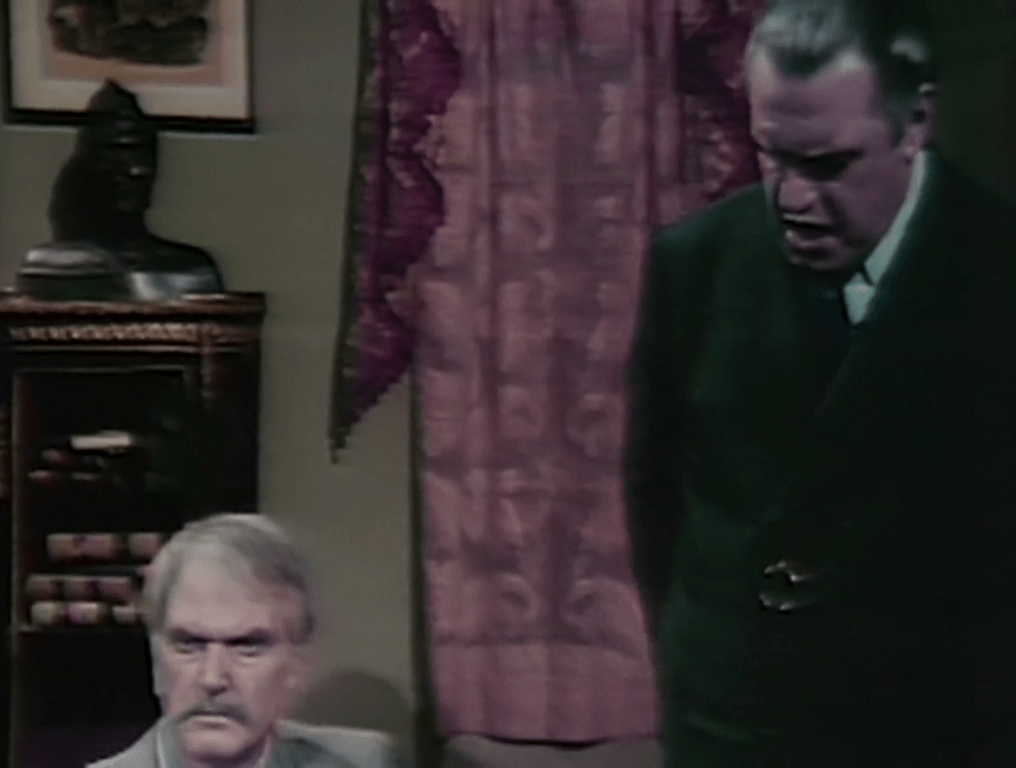
P-Quentin knocks on Evan’s door. Evan never met Petofi, and does not recognize him. He and Quentin were for a long time close friends and fellow Satanists, and when he identifies himself as Quentin he does not gain credence. He pushes his way in, and eventually persuades Evan to take him seriously. Evan agrees to go to Collinwood and see if the man who appears to be Quentin knows him, and, if he does not do so, to trick him into participating in a ceremony to reverse the body-swap.

Judith comes. While P-Quentin hides on the terrace, she tells Evan that she wants to revoke the power of attorney she granted to her husband, the odious Gregory Trask, while she was away. Evan makes excuses, but she insists, and he agrees to follow her directions. She exits.

P-Quentin returns, and tells him that if he has involved himself with Trask’s evil schemes, it is time for him to disentangle himself from them.

Act Like a Stranger, If You Are One*****

Back at Collinwood, Q-Petofi opens the drawing room door and sees Judith. Petofi never met Judith, and Quentin has not seen her since she left more than thirteen weeks ago. Not knowing who she is, Q-Petofi simply apologizes, says he didn’t know anyone was in there, and leaves. Thinking he is her brother, Judith is of course indignant.

Q-Petofi walks in on Judith.

Judith goes to the foyer and says she expected a warmer greeting. Not having the faintest idea who she is, the best Q-Petofi can manage is “Welcome to Collinwood.” When she protests that even their rather distant brother-sister relationship entitles her to expect better than that, the light comes to him and he calls her by name. This does not appease her.

There is a knock at the front door. Judith is enraged to see Q-Petofi standing still, and orders him to answer it. He does, and lets Evan in. When he does not speak to his old friend, Judith demands to know if he doesn’t recognize Evan either. Q-Petofi pretends to know him, and is powerless to do anything but agree when Evan asks him if he remembers the meeting at his house tonight.

Q-Petofi had been cruising along unchallenged so far. How could he not, when the secret he is concealing is so bizarre? But his interaction with Judith, though it has not exposed his identity, has antagonized someone whose support would be useful to him, and now Evan knows that P-Quentin was telling him the truth.

Know Your Chance ******

Q-Petofi shows up at Evan’s. After some verbal jousting, Evan tells Q-Petofi to take a seat with his back to the room. He says that he has been chosen to preside over the festivities. P-Quentin sneaks up and chloroforms him. Evan says that he doesn’t know how long the chloroform will last, so they must proceed with the ceremony at once.

Honor Good Men *******

When Jeremiah’s ghost fades away, we see Timothy Gordon for the last time. Gordon was a frequent stand-in and background player starting in July 1966. His right hand, which he extends to Kitty in the screenshot above, was the hand that shot out of the coffin Willie Loomis was trying to plunder in #210. In mischievous moments, I think that makes him “Barnabas Collins #1,” in imdb terms. Then again, Jonathan Frid had posed for the face of the portrait of Barnabas some weeks before, and producer Robert Costello modeled for the portrait’s body before that. Many of his fellow extras went on to big careers, but Gordon’s turn as Jeremiah’s ghost made him the only performer to graduate from background player to credited member of the main cast of Dark Shadows. So I think of him as their representative.

*Greek for “Know yourself,” one of 150 maxims inscribed in the walls at the oracle. Γνῶθι σεαυτόν (gnōthi seauton) was one of two inscribed at the entrance, the other being Μηδεν ἄγαν (mēden agan,) “nothing in excess.” The maxims are preserved in a book by a fifth century CE author named Stobaeus; many of them appear on stones that archaeologists have found at Delphi. There’s a handy list of them on Wikipedia, pairing the Greek with some more or less OK translations. The eighth maxim on Stobaeus’ list is Σαυτον ἴσθι (sauton isthi,) “Be who you are,” which sounds a bit like the second half of the note on Kitty’s dresser.

**Stobaeus’ twenty-ninth maxim is Ἐχθρους ἀμύνου (ekhthrous amynou,) “Be on guard against your enemies.”

***Stobaeus’ 125th maxim is Ἀπόντι μὴ μάχου (aponti mē makhou,) “Do not wage a battle against one who is absent.”

****Stobaeus’ 103rd maxim is Βουλεύου χρόνῳ (bouleuou kronoi,) “Give the advice right for the time.”

*****Stobaeus’ twelfth maxim is Ξένος ὢν ἴσθι (xenos ōn isthi,) which we would translate word for word as “Stranger being, be.” The idiom plays on two senses of the verb εἰμί- the participle ὢν means “If you in fact are,” while the imperative ἴσθι is “assume the character of.” It is the same kind of play on words that you see in the word “like” in the English sentence “Time flies like an arrow, but fruit flies like a banana.”

******Stobaeus’ tenth maxim is Καιρον γνῶθι (kairon gnōthi,) “Know the proper time.”

*******Stobaeus’ sixty fifth maxim is Ἀγαθους τίμα (agathous tima,) “Give honors to the good.”

Episode 253: Ring cycle

Vampire Barnabas Collins is keeping Maggie Evans, The Nicest Girl in Town, in a prison cell in his basement. He won’t let her out until she discards her personality and adopts that of his long-lost love Josette. That would seem to rule Maggie out as a source of plot development for quite some time.

Writer Joe Caldwell knew that he was not the first dramatist to have to tell a story in which one of the main female characters is cooped up. In ancient Athens, women of citizen rank were supposed to be immured in the house, hidden away from all men outside their immediate families. While the reality was a great deal more complicated, audiences at the city’s dramatic festivals liked to see plays set in a world that approximated that ideal. So tragedians like Euripides, and after him the Greek and Roman playwrights of the New Comedy, devised a whole repertoire of ways that ladies could send messages to their boyfriends without leaving home.

One of the most prominent of these methods was the dispatch of an identifiable token by a household servant. Since many people, both men and women, wore rings with unique decorations, rings were very often used for this purpose. In plays where the heroine has been captured by pirates and is being held prisoner by someone to whom the pirates made a gift of her, as in Plautus’ Miles Gloriosus (sometimes translated into English as The Swaggering Soldier,) the heroine and her accomplices will use the villain’s greed or that of his servant to trick them into taking a valuable ring and showing it to someone who will be able to help her. Plautus would have been relatively familiar to audiences in 1967, and very much front-of-mind for the Broadway-oriented people involved in making Dark Shadows, because of the success of the 1962 show A Funny Thing Happened on the Way to the Forum and its 1966 film version, both of which end with a recognition prompted by the sight of an unusual ring.

Maggie doesn’t seem to be up on her New Comedy. In the first part of the episode, she asks Barnabas to take her ring to her father to let him know she is still alive. Barnabas is insulted that she would think he was dumb enough to do that.

There is some good dialogue in this scene, and Kathryn Leigh Scott and Jonathan Frid are always fun to watch together, but we have to share Barnabas’ reaction. Until today, Maggie had been one of the few characters on the show who had never done or said anything inexplicably stupid, and asking Barnabas to give her father the ring breaks that streak. Barnabas’ complaint lampshades the problem, which does help a bit- it gives us time to think that maybe Maggie is trying to distract Barnabas from another plan she is cooking up, or maybe the script is telling us that she is so desperate she doesn’t know what she’s doing.

Later, Barnabas’ sorely-bedraggled blood thrall Willie Loomis comes to check in on Maggie. Willie is so obsessed with jewels that when Maggie offered him a diamond necklace on Friday, he turned his back on Barnabas’ coffin while she stood there preparing to stab him through the heart. Maggie persuades Willie to take her ring as a token of her gratitude for keeping Barnabas from killing her on Monday. That marks a good recovery from the earlier dumbness, and gets us off to a fresh start.

Strange and troubled boy David Collins sneaks into Barnabas’ house through an unlocked window. He often visited the house in the months before Barnabas was introduced to Dark Shadows, when the ghost of Josette was the principal supernatural presence on the show and the house was her stronghold. David can’t feel her presence there now, and calls for her forlornly as he wanders through the front parlor.

Willie catches David and demands to know why he is in the house. David tries to defend his indefensible behavior, and when that fails he goes on the attack. He says that he knows what Barnabas and Willie are doing. Willie tenses and asks what it is they are doing. David says they are hurting Josette. Willie listens until he is sure that David is talking only about the ghost, not about Maggie. Then he picks David up and throws him out the front door. There is so much hilarious stuff in this part that not even the bit in the middle when Willie briefly thinks he may have to murder David dampens the mood.

Willie picks David up…
…and throws him down.

In the course of bodily ejecting David from the house, Willie drops the ring. David finds it on the ground while he is getting back onto his feet. He calls to Willie and tries to return the ring, but Willie has already locked the door and will give no response but shouts of “Go away!” David takes a good long look at the ring and goes home to the great house of Collinwood.

Well-meaning governess Vicki greets him there, scolding him for having gone so far from the house. She notices the ring in his hand. This moment comes straight out of ancient comedy- David’s clothes have pockets, after all, but this scene is written for an actor wearing a pallium and a terracotta mask. David won’t tell Vicki where he found the ring, and she examines it. She has seen that there is an inscription in it and is just about able to read it when a knock comes at the door.

It is Barnabas. He tells David that he wants to apologize for Willie’s forcible ejection of him from his house. Vicki turns to David and asks if that’s where he was. The boy has little choice but to admit it, and suggests that the ghost of Josette invited him. Vicki asks if he found the ring at Barnabas’ house. Barnabas, startled by the mention of a ring, asks to see it. He claims that it is a family heirloom which he gave Willie to sell. He takes it, and in a genial voice suggests David steer clear of Willie.

Back home, Barnabas returns to Maggie’s cell. She pretends to be coming around to believing that she is Josette. Barnabas shows her the ring and shatters her hopes. He leaves. Rather than end the episode with a shot of her staring helpless through the barred door, we follow Maggie into the cell and see her slam shut the lid of Josette’s music box. We see her thwarted, but no less able to take action than she was when we began.

Caldwell deserves credit for a fine script, aside from the awkwardness in Maggie’s early scene with Barnabas. Director John Sedwick keeps it looking clean and crisp, and the final shot of Maggie in her cell is a triumph of timing. Best of all, the actors all liked each other and were having fun working together today, and that gives an irresistible energy to the finished product. The result is the fourteenth episode, and the first since #182 early in March, that I would label “Genuinely Good.”

Episode 171: Making a suggestion

Yesterday, we saw the first séance on Dark Shadows. Today, the characters who participated in that séance try to make up their minds about what it meant.

At opposite poles stand flighty heiress Carolyn and her uncle, high-born ne’er-do-well Roger. Roger declares that he has made up his mind to forget all about the séance, and demands that its organizer, visiting parapsychologist Dr Guthrie, be expelled from the great estate of Collinwood. Carolyn regards the séance as a success, and tells Roger that Guthrie will be continuing his work. They quarrel about this difference. There are weighty threats veiled in the dialogue. Their voices are sometimes quite sharp, but their facial expressions and body language are anything but. Watch the scene without sound, and Carolyn looks like she is pleading with Roger, while he just looks sad. They are losing something that neither of them wants to let go.

Something is ending

In the first weeks of the series, Carolyn spoke rather alarmingly of her crush on her uncle. Her flirtation with Roger’s enemy, dashing action hero Burke Devlin, somewhat reduced the intensity of that crush, dialing it down from frankly incestuous to merely disquieting. After the Carolyn/ Burke flirtation ended, we had some scenes where we were reminded of Roger and Carolyn’s odd intimacy. This scene marks the end of all that. Roger might still address Carolyn as “kitten” from time to time, but the red flags are furled for good and all. Dark Shadows won’t be developing any kind of storyline about unsavory goings-on between Carolyn and Roger, or using hints of such to emphasize any point they might want to make about the weirdness of the Collins family.

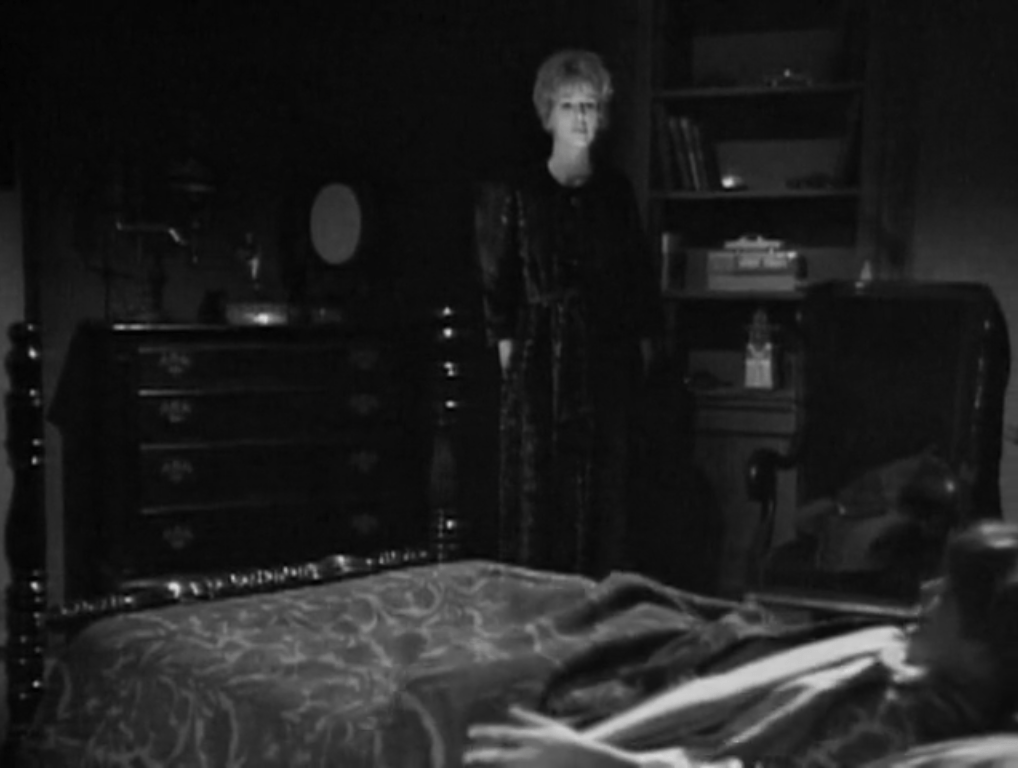
Well-meaning governess Vicki had a rough time at the séance. The ghost of Josette Collins used her as a mouthpiece, and blonde fire witch Laura used her powers to keep herself from being named as the source of the recent troubles and as a danger to her son, strange and troubled boy David. Caught in the crossfire between these supernatural beings, Vicki was exhausted and disoriented. At 2:15 AM, Laura materializes in Vicki’s bedroom, waking her. Vicki is bewildered by Laura’s presence. Like a dream in ancient Greek literature, Laura stands at the foot of Vicki’s bed and makes a speech. Unlike those Greek dreamers, Vicki talks back, engaging Laura in conversation. Laura’s point is that Vicki ought to quit the service of the Collinses and leave Collinwood immediately. She tells Vicki that she will be taking David away soon in any case, removing the need for a governess. Vicki looks away from Laura for a moment while gathering her thoughts. When she looks back, Laura has vanished.

Laura has appeared and disappeared in this manner before. This time, it would seem that she is trying to raise a question about Vicki’s sanity. Vicki might think she was dreaming, or might wonder if she is suffering some kind of hallucination. She might also tell others in the house all about the incident, leading them to wonder the same things about her. If Laura can undercut Vicki’s confidence in herself, she might reduce her overall effectiveness as an adversary. If others start to wonder whether Vicki might be given to psychotic breaks, the events of the séance might seem less significant.

Episode 150: Time isn’t easy to give

Yesterday, several characters saw clear evidence that supernatural forces are intervening to warn that the mysterious and long-absent Laura poses a grave danger to her son, strange and troubled boy David Collins.

High-born ne’er-do-well Roger Collins was one of those characters. In keeping with his family’s traditions, Roger habitually responds to signs of the supernatural by going into denial. He has an especially strong motive for denying that there is anything alarming about the relationship between David and Laura. David is his son, Laura is his wife, and he wants to be rid of them both. Laura wants to divorce him and leave with David, a prospect he finds most attractive.

At the insistence of well-meaning governess Vicki, Roger tells reclusive matriarch Liz some of the signs that uncanny beings are at work. In response, Liz decides to go to Laura and tell her that she may no longer see her son.

The confrontation between Laura and Liz takes place in the cottage where Laura is staying now that she has returned from her long absence. Laura points out that it is absurd for a child’s paternal aunt to forbid his mother from seeing him. The only case Liz could make in answer to this objection would rest on yesterday’s supernatural manifestations, but even if she had seen those events first-hand that isn’t something you can really bring up while conducting an argument in the modern world. So the two women just make assertions about their respective strength of personality.

Upstairs at Collinwood, David was crying before Vicki managed to calm him by telling him his mother’s favorite story, the legend of the Phoenix. In his sleep, he is crying again. Laura appears as a glowing figure in the corner of the room. She awakens him and stands at the foot of his bed.

Laura appears
Laura speaks

The oldest surviving version of the legend of the Phoenix appears in the Histories of Herodotus. Many passages in Herodotus describe dreams, and they all represent the dream as a figure standing at the foot of the dreamer’s bed, making a speech to him. That’s the usual form dreams take in ancient Greek literature generally, in fact, and that Greek image of the dream has had its influence in later writing. So I suppose it could be that Laura’s visit to David is a nod to the sources of the Phoenix legend, and it certainly could be meant to suggest a familiar way dreams are depicted in literature.

Diana Millay usually plays Laura as a dreamlike figure, rather vague in manner and stilted in speech, and this scene is no exception. David Henesy plays David Collins here in the wide-awake style of an uncomfortable character in a comedy of manners. Laura makes cryptic promises of being forever united to David, to which he gives polite but nervous responses such as “That’s nice!” and “I’m sure we will!” David doesn’t seem to be asleep, suggesting that Laura’s otherworldly manner signifies nothing so familiar as a dream.

Laura notices David’s tears. She gives him a handkerchief to dry them. At the end of their conversation, she vanishes into thin air and David falls asleep. The handkerchief is still there, however, proving it was no ordinary dream.

At this stage of her existence, Laura seems to be divided into at least three entities. There is the woman who lives in the cottage, visits the great house, and talks to the other characters. There is a ghostly image David has seen flickering on the lawn. And there is a charred corpse in the morgue in Phoenix, Arizona. There is no assurance that these are the only three components of Laura, and no explanation of how they relate to each other. Does the speaking character know about the ghost? Does one control the other? If they operate independently, do they have the same goals? If they have different goals, might they come into conflict with each other? A scene like this one raises all of those questions, because we don’t know which Laura we’re dealing with.

It is also possible that she isn’t Laura at all. A couple of weeks ago, we thought it was Laura who compelled drunken artist Sam Evans to paint pictures of her naked and in flames. Yesterday, we learned that the spirit possessing Sam was actually the ghost of Josette Collins, and that she was doing it to oppose Laura’s plans. So maybe Josette has disguised herself as Laura in order to unsettle David and keep him from following his mother to his doom.

There is an unusual blooper just short of the 3 minute mark. From 2:51 to 2:57, Alexandra Moltke Isles has a fit of the giggles. This starts when Joan Bennett enters and flares up again as she walks past Mrs Isles. It’s true that Miss Bennett’s dress betrayed a good deal more of the outlines of the garments underneath it than one would expect. That may have had something to do with the laughing attack, but Mrs Isles was usually so professional that it is difficult to believe she wouldn’t have gotten that under control after dress rehearsal. Some of the actresses have talked about how Louis Edmonds would make remarks to them before shots that made it extremely difficult for them not to laugh on camera during serious scenes, perhaps he was the culprit here.

The giggle begins
The giggle resumes
The giggle concealed