Maggie Evans is working the counter in the restaurant at the Collinsport Inn. We open with her on the telephone, explaining to her father Sam that she hasn’t seen Bill Malloy. Dashing action hero Burke Devlin comes in, orders breakfast, and asks Maggie if she’s seen Bill Malloy. Hardworking young fisherman Joe Haskell comes in, scowls at his bête noire Devlin, and asks Maggie if she’s seen Bill Malloy. Flighty heiress Carolyn Stoddard comes in. Carolyn already knows that Maggie hasn’t seen Bill Malloy, so she talks about her car.
Maggie and Carolyn are both cheerful when the episode opens, and by the end the men have dragged them down into gloom. Joe is in a sour mood, not only because shares the universal worry about where Bill Malloy is, but also because of the steadily mounting evidence that Carolyn doesn’t have any intention of getting married. Burke is in a towering rage because of his suspicion that either the dastardly Roger Collins or the drunken Sam Evans did away with Bill Malloy to prevent Bill from clearing Burke of the manslaughter charge that long ago sent Burke to prison. Sam is wallowing in despair, as per usual.
Maggie goes home to the Evans cottage to find that Burke is there, confronting Sam. The two men have been yelling at each other about not knowing where Bill Malloy is. After Burke leaves, Maggie tries to get Sam to tell her what’s going on. He refuses to do so. Downcast, she turns to go back to work. Before she leaves she asks her father “Where are we all heading?” After she’s gone, Sam looks at the closed door and says “Towards death, Maggie darling. We’re all heading towards death.”
Carolyn goes home to the mansion at Collinwood with Joe. They start to hug and kiss when there’s a knock at the door. Carolyn answers. It’s Burke, demanding to speak to Roger. He wants some answers, mainly about where Bill Malloy is. Joe and Burke wait in the foyer while Carolyn searches the house for Roger.
Burke gives an angry and not very coherent speech denouncing the Collinses. Some commentators think the evident difficulty Mitch Ryan has with this speech is a sign that he was drunk during taping. Ryan did have a drinking problem, and admitted that in the 1960s he sometimes showed up to work drunk. But the speech itself is so awkward and weird that I suspect there is another culprit aside from alcohol- uncredited additional dialogue by Malcolm Marmorstein. Be that as it may, the speech rubs Joe the wrong way, and by the time Carolyn comes back and tells Burke that Roger isn’t home, Joe is in a worse mood than ever.
Three people expressed surprise in episode 40 that Roger Collins wasn’t at his office. He still isn’t there today, and three more people are surprised. He finally decides to go in when Liz presents him with the alternative of looking for Carolyn.
Bill Malloy isn’t at work either, hasn’t been all day. He and Roger have been taking turns inviting themselves into Sam Evans’ house. Sam is also not working, and in fact takes time out of his busy schedule of downing one glass of whiskey after another to destroy the only thing we’ve seen him make as part of a paying job, a sketch of Burke. Maggie pieces the sketch back together- she’s also at home when she’s supposed to be working.
Telephones are unusually dynamic in this episode. Typically we see only one end of a phone call on Dark Shadows. This time, we cut back and forth between both ends of three telephone conversations this time. In the teaser Roger is browbeating Sam; Sam sets the phone down and walks off. While he gets another drink, the receiver is in the foreground and we hear Roger’s voice at the same volume as we did when Sam was listening. Sam comes back, returns the receiver to its cradle, and goes to sit down while it rings.
The bit when we see the phone and hear Roger’s voice, though Sam isn’t looking at the phone and can’t hear it, establishes the telephone as a character with its own relationship to the audience, independent of anyone who may or may not be paying attention to it. It’s a neat moment:
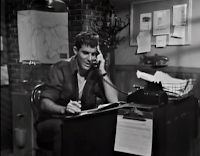
Liz calls the office and talks to Joe. Joe tells her Bill hasn’t been in all day. The stress in his voice, the papers piled on his desk, and the tight grip he has on the telephone receiver all make it credible that he’s the only person in town who showed up for work today:
Liz mainly wants to talk to Joe about Carolyn. Joe tells her he hasn’t talked to Carolyn in some time, and that he has no idea what if anything she is thinking about their relationship. While he breaks this news to Liz, we see him continue working, then cut back to the look of distress on Liz’ face.
Maggie calls Collinwood. Vicki answers and is excited to talk to Maggie. I guess the show is telling us they’re friends now. Maggie asks to talk to Roger. Vicki says Roger is probably in the office at this time of day, Maggie somehow knows he isn’t, Vicki remarks that he isn’t in the habit of confiding in her. Roger overhears this and asks “Is there any reason why I should confide in you?” When Vicki holds the receiver out to him and says Maggie Evans is on the line, he takes it and hangs up without so much as putting the receiver to his ear. Vicki and Roger then have one of their little quarrels.
That’s the only thing Vicki does in the episode. Her character is heading into a danger zone. Through the first eight weeks, she was on all the time. She was our representative, the outsider who knew nothing about the other characters or the town they live in, and to whom everything had to be explained. Now she knows as much about the rest of the characters as they know about each other, and we know as much as we want to learn by hearing explanations.
The major characters all have their secrets, but the only two who know each other’s secret are Roger and Sam. Vicki isn’t any likelier than anyone else to uncover that one. She has no secrets of her own, and her original story-line- her quest to discover her origins- is dead in the water. What’s more, Vicki is no good at lying. Soap operas are mostly conversation, and the big events on them are lies and the exposure of lies. The only time Vicki has tried to lie to anyone- in episode 13, when she told Matthew that Liz knew she was in his cottage- she was immediately found out, with disastrous consequences. If she’s going to stay relevant to the show, something is going to have to change, and fast. It’s fun to watch Alexandra Moltke Isles bicker with Louis Edmonds, but the characters they play need something meatier to bicker about.
This is the first episode credited to writer Francis Swann, indeed the first episode credited to anyone other than Art Wallace. Swann’s teleplay finds humor in the idea that so many people have taken the day off. Each time another character remarks on a case of absenteeism it gets that much closer to raising a chuckle. And Roger’s line that looking for Carolyn would require him to “neglect my vital tasks at the office… Dear me, no” is genuinely funny, especially as Louis Edmonds delivers it. The telephone scenes are also an innovation, and promise a new source of visual activity. Those favorable omens are offset by Vicki’s scene and its suggestion that her character is about to be allowed to wither on the vine.
A couple of the blogs I read when I prepare my comments made remarks about this episode with which I disagree. John Scoleri of Dark Shadows Before I Die says this of the quarrel between Sam and Maggie:
I know Sam gets frustrated with Maggie, but I’m beginning to wonder about their relationship. If he’s that close to hitting Maggie when he gets drunk, there’s no way I’m believing he hasn’t done that before.
It doesn’t look to me like Sam has hit Maggie. She’s inches from his face when he is at his angriest, yet she doesn’t flinch, doesn’t slump down, doesn’t show any sign of withdrawal or fear or anger or panic or sullenness or bewilderment or any other possible response to physical abuse.
There hasn’t been much happening on DARK SHADOWS in the last few weeks, but that doesn’t mean the show hasn’t been moving forward. There’s been a growing sense of doom throughout the show, and it’s obvious that someone is going to die. In this episode Sam rips up his portrait sketch of Burke Devlin, he and Roger lob threats at each other, Liz begins to draw Joe’s attention to his girlfriend’s romantic intentions on the family rival, and Victoria has been pushed around by just about everyone in the cast. In theory, any one of them is eligible for a ride in the bone wagon, but the show has been implying that Devlin is headed for a fall. It’s interesting that the show decides to go in another direction: I don’t know when Bill Malloy checks in at Eagle Hill Cemetery, but it’s probably sooner rather than later.
While it is true that “in theory, any one of them is eligible for a ride in the bone wagon,” I do think there’s a clear front-runner to be the first Dark Shadows character to be killed. It’s Sam who is obsessed with the fear of death, Sam whom Roger has threatened, Sam who left a mysterious sealed envelope to be opened in the event “something happens.” And, from an out-of-universe perspective, it’s Sam who has a daughter played by an appealing actress who needs a story-line. Maggie seeking revenge for the killing of her father would be just the plot to elevate Kathryn Leigh Scott from the bottom of the second string to the starting lineup where she so obviously belongs.
No other character has anyone so well-positioned to play avenger if they’re killed. The only keen attachment Bill Malloy has shown is his devotion to Liz, and in her scene with Matthew in episode 38 Liz demonstrated that she sees devotion from people outside the family as a tool to use when time comes to protect the good name of those inside it. So if she suspects Roger killed Bill, she won’t become Bill’s avenger- if she could order Matthew to throw away his own good name to cover up the truth about David, we can hardly expect her to expose Roger to redress Bill’s grievance against him. Indeed, when Bill is murdered, they will introduce an entirely new character to seek revenge for him.
Vicki is an orphan, who tells us in today’s opening narration that before she arrived at Collinwood she had never known a home. No one is likely to avenge her, and besides, she still does the opening narration for every episode- she’s supposed to be important, even if the writers can’t quite figure out what to do with her. Burke is supposed to be rich and powerful. Presumably he has friends, but we haven’t seen any of them. Joe is Mr Nice Guy and he’s mentioned a friend or two, but again, we haven’t seen them. The series story bible calls for Roger to die when Burke finally gets his revenge, but every time Louis Edmonds’ performance is the most interesting thing in an episode it becomes so much the less likely that they will ever get around to playing that scene. So the smart money, at this point, would be on Sam to be the victim in the first Dark Shadows murder. So much so, indeed, that it might not be surprising enough if it does happen- they may think they have to kill someone else to keep the audience engaged.
I think I said everything I wanted to say about this one in the comment I left on John and Christine Scoleri’s Dark Shadows Before I Die. So here it is:
“Idiot Plot” is a term for a story that can go on only if the characters in it are dumber than the average member of the audience. When Vicki left the valve where David could steal it in episode 26, Dark Shadows had its first Idiot Plot.
Now, just two days later, we have our second. The restaurant is open for business, and Maggie says in so many words that Roger is a frequent customer there. So he should walk right in and lay hold of David. But unaccountably, he waits for Maggie to let him in. She turns her back on David, calls Roger by name, and declares that she’s been tricking David into staying, all while David is a few feet away. Even worse, we have a number of scenes suggesting that Maggie had searched the hotel extensively for David and failed to find him, when he was simply hiding in the very telephone booth she herself had used a few minutes before.
Art Wallace is the only credited writer for the first eight weeks of the show. I’m sure he had some help, but not enough, apparently- these two episodes not only disappoint viewers who expect a well-constructed drama, but also do serious harm to the characters of Vicki and Maggie. Vicki has to be so sweet and innocent that unless she’s also as smart as she’s seemed in the first five weeks, she’ll get pretty cloying pretty fast. And Maggie, whether it’s the original wised-up dame who’s everybody’s pal but nobody’s friend or her successor, the nicest girl in town, has to produce witty dialogue and see through people’s attempts to deceive her if she’s to contribute to the story. Casting either of them as Designated Idiot is a sure way to put her on an ice floe to oblivion.
Two other things:
Interesting to see the first scene between Maggie and David. Especially so knowing that these characters will become important to each other later on, but already so as confirmation that the hostility Maggie had expressed towards the Collinses in general in Episode 1 isn’t going to define her character.
The picture of Lyndon Johnson in the sheriff’s office is apparently there to promote ABC’s coverage of the Luci Johnson’s wedding that weekend, but it’s a very odd choice of image. You’d expect the president’s photograph in a government office to show him from the chest up, showing his full face, with his eyes looking at the viewer and a calm or cheerful expression. But this picture is an extreme closeup of his face in profile, and he appears to be wincing. On a wall otherwise decorated with wanted posters, it communicates something less than unqualified admiration for President Johnson. If, as Roger implied in episode 26, the sheriff owes his office to the support of the Collins family, the picture would suggest that the Collinses were not LBJ fans.
I’ll also mention that Marc Masse’s entry for this episode on his Dark Shadows from the Beginning features one of his most outlandish accounts of a control room conversation between director Lela Swift and executive producer Dan Curtis. If you miss the sensibility of the 1970s National Lampoon, you’ll enjoy reading it.
In episode 18, Roger (Louis Edmonds) had demanded Vicki (Alexandra Moltke Isles) come with him to Burke’s hotel room, where they will tell Burke (Mitch Ryan) about all the evidence they have connecting him to Roger’s car wreck. Vicki repeatedly protests in that episode that it would be better to take this information to the police. In this one, they arrive at the hotel, and again Vicki objects that they really should be going to the police. Roger, however, is a man obsessed. He asks Vicki to wait in the restaurant while he goes to Burke’s room, telling her that it may not be necessary for her to join him.
Sam (Mark Allen) comes to the restaurant looking for his daughter Maggie. Finding that Maggie isn’t at work, he invites himself to Vicki’s table. Their previous encounter had been a strange and frightening one on the top of Widow’s Hill; Vicki is no more comfortable with Sam now than she had been then. He bellows at her, she reacts with quietly frosty disdain. These attitudes may have less to do with the script or the direction than with Mark Allen’s limitations as an actor; he bellows all of his lines in this episode, and quiet frostiness is as effective a technique as any other for holding onto the audience while sharing a scene with an incompetent loudmouth.
There’s no incompetence in the scenes in Burke’s room. Louis Edmonds and Mitch Ryan were first-rate stage actors, and their confrontation is a terrific fireworks display. When Roger brings Vicki up to tell Burke what she saw him do in the garage, she again plays the scene quietly, an effective counterpoint to the artillery blasts the men have been letting loose.
In the Evans cottage, Sam finds that Maggie (Kathryn Leigh Scott) has been home all this time. When Allen bellows at her, Scott bellows back at him, a far less effective tactic than the quiet intensity Mrs Isles had used earlier. The scene has some potential- the situation is that an alcoholic finds that his adult daughter has been checking up on him, he resents it, and they have a fight about all of the ways in which she has been forced to take on the parental role in their relationship. But as a shouting match, it might as well be about anything, or about nothing.
Returning home after their confrontation with Devlin, Roger and Vicki say goodnight in the foyer. Time and again in these early episodes, people have urged Vicki to leave Collinsport while she still can. Even in this episode, Burke had told her that. But as they part ways for the night, Vicki to her bedroom and Roger to the brandy bottle, Roger tells her that as a witness, “you can’t leave now.”
That line is effective enough, but if the scene between Sam and Maggie had worked it would have been very powerful. The Evanses, father and daughter, are a case of two people who are trapped, trapped in Collinsport, trapped with each other, trapped with his alcoholism and her sense of obligation to keep him alive. As written, the scene could have brought all that out, and induced a claustrophobic sense in the audience that would have made Roger’s line feel like a death sentence. As ruined by Mark Allen, it just leaves us with the sense that we’re watching a show that needs some recasting.
Roger and Vicki encounter each other on the peak of Widow’s Hill. Roger remarks it is the highest point in the area. At the end of their conversation, Vicki will call to Carolyn, inviting her to join them “down here.” This may seem to be a blooper, but since we hear “down” used to mean “up” in a later episode, I speculate that it’s a peculiarity of Collinsport English.
Little happens to advance the plot in this episode, but between Roger’s announcement that he and Vicki are standing on the highest point in the area and Vicki’s invitation to come “down here,” we hear a lot about the ghostly legends of the place. After the scene in episode 11 where the ghosts are troubling Elizabeth while David is doing something mysterious involving motor grease and little pieces of metal, it seems that the show is using the ghosts as a sign that something big is happening. Certainly the “Widow’s Wail” is a striking sound effect, and Louis Edmonds does a good job of selling the idea that Roger really does believe in all the legends about the house that his social position might require him and Elizabeth to ridicule publicly.
It’s a bit jarring that Carolyn drifts into the scene asking what Vicki and Roger are doing- “planning a suicide pact?” She had just told Vicki about the legend that a third governess would die by jumping off the cliff, and the series story bible still calls for Roger to throw himself to his death from it. So you might think it would be in questionable taste to bring that particular topic up just now.
There’s also a scene in the Evans cottage where Maggie (Kathryn Leigh Scott) tries to get Sam (Mark Allen) to tell her what’s been bothering him. In episode 11, Conrad Bain had triumphed over a weak script and Mark Allen’s relentless whine to turn what might have been a lot of tedious recapping into a compulsively watchable scene. At the beginning of this scene, Kathryn Leigh Scott is mustering such powerful emotions that it looks like she might be about to accomplish the same feat, but Allen has switched from whining all his lines to bellowing them. So the scene is a dead loss.


 Dark Shadows Commentary