We open in the drawing room of the great house on the estate of Collinwood. Well-meaning governess Vicki is taking a page from her adversary, blonde fire witch Laura, and staring into the flames of the hearth. She delivers a speech to visiting parapsychologist Dr Guthrie. Even though today’s script is credited to Ron Sproat, the speech is full of the kind of elevated language and overwrought imagery fans of Dark Shadows usually associate with writer Malcolm Marmorstein. I suspect Marmorstein actually wrote this speech. Marmorstein’s flowery gibberish will defeat actor after actor until a Canadian character man with a Shakespearean background joins the cast and gets it all to himself. From him, it will sound gorgeous.
As Vicki, Alexandra Moltke Isles delivers the speech with her back slightly arched, her shoulders still, her face rigid, and her voice raised to an almost operatic level. It’s as big a performance as we have seen her give, and it very nearly sells the purple prose she has to utter. She’s describing a dream that her charge, strange and troubled boy David, told her that he had while he was staying with his mother Laura. There’s fire, and it’s very dark, and David and Laura are alone in infinite space, and a whole lot of other hugger-mugger.
In several of Vicki’s scenes with her boyfriend, instantly forgettable young lawyer Frank, Mrs Isles has had to project this combination of a personality forceful enough to lead a battle against supernatural evil with a mind struggling to find its way through a situation with no conventional points of reference. In those previous scenes, that combination was a feature of Vicki and Frank’s relationship. Playing the same combination in a scene without Frank, it becomes a feature of Vicki’s characterization. She pulls it off as well as anyone could, considering the lines she has to say.
Guthrie’s speeches are just as badly overwritten. John Lasell takes a different approach to them. He hunches his shoulders forward, speaks in a quieter and slightly higher-pitched voice than usual, and looks at his feet a lot. He is giving his scene partner as much room as possible for her larger than life turn by making himself very small. It’s a challenge to remember anything that is said in this scene, but the image the two actors create lingers. We see Vicki as the leader ready to drive the action on behalf of the forces of daylight and Guthrie as the sage seared by his contact with the powers of the dark.
In the cottage on the grounds of the same estate, Laura is talking with her estranged husband, high-born ne’er-do-well Roger. She says over and over that she hasn’t much time- she must take their son David immediately. Roger asks why she is so hurried all of a sudden. She tries to evade the question, stirring his suspicions.
Roger tells Laura that he can’t oblige her in any case. He must stay on the good side of his sister, reclusive matriarch Liz. Liz is dead set against Laura taking David. Laura cast a spell on Liz a couple of weeks ago, and now she is in a hospital, catatonic. Roger lives as a guest in Liz’ house and receives a paycheck from her business. If she returns and finds that he has sent David away with Laura, she might put him in a position where he has no alternative but to work for a living. Laura should know her husband well enough to know he would go to any lengths to avoid that horrifying prospect.
Back in the great house, Guthrie talks with Vicki and flighty heiress Carolyn about his idea of holding a séance. Carolyn talks through her feelings about it, and decides that her initial reluctance is a matter of fear. Roger comes in, and they tell him about the idea. Louis Edmonds has a lot of fun with Roger’s lines denouncing Guthrie’s “quackery.” Roger ultimately agrees to participate if it will get rid of Guthrie. When he learns that Guthrie wants Laura to take part as well, he reacts incredulously.
Roger facing the “quack”
When Guthrie first came on the show, it was indicated that he would be staying in the house. But at the end of this scene, Vicki shows him out. Evidently he has taken rooms somewhere else. It’s confusing.
Carolyn is sure Laura can’t be talked into attending their séance. Nor does she see any other reason to keep her around. Over Vicki’s objections, she declares that she will confront Laura with evidence that she has been lying about what she did the night Liz was taken ill, and that once she has done this she will order her to leave the estate.
Carolyn does go to Laura’s cottage. She leads Laura to repeat the lies she told. When she springs the evidence on her, Laura tells more lies. Carolyn refuses to accept them, and Laura makes a menacing reply. Carolyn holds her ground, but does not order Laura to leave.
The episode originally aired on Valentine’s Day in 1967 (as they would say on the show, exactly 56 years ago!!!!) Mrs Isles was in the spirit of the holiday, as witness her blowing a kiss to the camera while holding the slate.
The announcements over the closing credits are delivered by someone other than ABC staff announcer Bob Lloyd. It sounds like the same voice we heard giving the announcements at the end of #156. I miss Bob!
Every episode of Dark Shadows begins with a voiceover narration. This is how today’s goes:
My name is Victoria Winters. The brightness of the morning cannot mask the fact that the night has been marked by a restless, fitful sleep, especially for one young woman who has been disturbed by strange premonitions and events that she does not fully understand.
We then see the drawing room of the great house at Collinwood, where two young women are both showing signs of disturbance. There’s no way of telling which one the narration is referring to. Flighty heiress Carolyn is pacing and talking, while well-meaning governess Vicki is clenched tight playing solitaire. This sloppy mismatch is the first sign that we’re dealing with a script by Malcolm Marmorstein, the worst writer on Dark Shadows.
Disturbed by strange premonitions and events
Vicki and Carolyn are worried about strange and troubled boy David. David has spent the night with his mother, blonde fire witch Laura, and is not back yet. They are convinced that Laura is dangerous, but cannot be sure how or to whom. Marmorstein’s awkward dialogue stumbles up to a climax in which Vicki tells Carolyn that visiting parapsychologist Dr Peter Guthrie had said he was inclined to organize a séance. Considering that he first discussed that idea in a conversation with the two of them yesterday, Vicki’s announcement of this as news and Carolyn’s incredulous reaction will leave returning viewers mystified.
David comes home. He’s fine. He tells Vicki that he sensed the presence of the ghost of Josette Collins watching over him in his mother’s cottage, and that he knows he is safe wherever Josette is. What the audience knows, but neither Vicki nor David does, is that Laura and Josette had a confrontation while he was sleeping, and that Josette retreated. Josette is not strong enough to defeat Laura by herself. When David goes to sit by the fire and stare at it in a trance-like state, as his mother habitually does, we wonder how Vicki and the others will put together a strong enough force to help Josette save David. That’s a suspenseful sequence, effectively realized.
Hardworking young fisherman Joe comes to the house on a business matter. He and Carolyn have a conversation about their defunct romance. Carolyn says that she has matured since those days, and that she is free to give it another try. Joe says he is not free. For a show with so many ghosts and ghoulies, it’s surprising that Dark Shadows inspires the greatest fear in its fans when they threaten to bore us yet again with a tedious dead-end storyline like the Carolyn/ Joe relationship. It’s certainly a relief when Joe is so firm as to leave no doubt that we’re finally done with that.
Joe has transferred his affections to Maggie Evans, The Nicest Girl in Town. We dissolve to an extreme closeup of the laughing mouth of Maggie’s father, drunken artist Sam Evans. Sam is in the local tavern, The Blue Whale, with a drink in his hand, a crony on either side of him, and some music we haven’t heard before on the jukebox.
Glad Sam
Maggie and Joe are at a table, where he is trying to make her jealous by telling her of Carolyn’s interest in him, and she can’t stop watching her father and fretting about his drinking. The two of them talk a bit about how Sam’s drinking has reversed the roles of parent and child. That’s the big theme of Maggie in the first 42 weeks of the show, that she is an Adult Child of an Alcoholic. It’s because she’s had to cope with Sam’s addiction that Maggie is so nice to everyone, and also because of it that she has a habit of starting her lines with a little laugh that doesn’t always make sense in context. As the show goes on, Sam drinks a lot less and Maggie gets involved in a wider variety of stories, but that weird little laugh, the union card of many an ACoA, stays with the character to the end of her time on the the series.
Maggie leaves Joe alone at the table while she confronts Sam. She doesn’t stop him drinking, but she does manage to wreck the good mood he and his buddies had going. In the course of their talk, they recap the conversation Sam had with Dr Guthrie Thursday.
Dashing action hero Burke Devlin comes in and sits down with Joe while Maggie is scolding Sam. The two of them have been at odds over Carolyn, and now discover that neither of them is interested in her any longer. Joe seems irritated that his list of reasons to dislike Burke has grown shorter.
When Maggie returns to the table, Burke exchanges a few friendly words with her. He then goes to the bar to buy Sam a drink. Maggie voices her dismay at this plan, and even Bob the bartender gives a dark look at the idea of serving Sam yet more booze. But Burke ignores them both.
Burke wants to know about the conversation Sam had with Dr Guthrie. They recap the conversation Sam had with Maggie a few minutes before. Burke is in love with Laura, and may be under her influence. This conversation raises the prospect that Burke will be an ally of Laura’s against Vicki and her team. Its similarity to the conversation Maggie and Sam had so shortly before suggests that the Evanses may also make themselves more useful to Laura than to the good guys. The repetition grates hard enough on the audience that it is an inefficient way of making that point, but the point itself does add to the suspense.
Most episodes of Dark Shadows have only five credited actors and no extras. This one has seven credited actors and a bunch of extras, including featured background player Bob O’Connell as the bartender. There have been several episodes the last couple of weeks with only four actors; apparently they’ve been saving up to splurge on this one. It is by no means the dullest installment of this period of the show, but neither are there any of the thrills or major story developments you would expect from a high-budget episode. Frankly, it’s rather worrying that this is what they lay out the big bucks for now. Is this as exciting as the show is going to get?
At the end of last week, reclusive matriarch Liz left the estate of Collinwood for an extended stay in a hospital. It would seem that she took all of Dark Shadows‘ plot points with her. This is the third episode in a row in which we see nothing but characters reprising conversations that didn’t advance the story the first time we heard them. Writers Ron Sproat and Malcolm Marmorstein have been in charge of the scripting for twelve weeks, and they are clearly in big trouble.
This one has a bizarrely dumb opening. Yesterday, strange and troubled boy David took Dr Peter Guthrie, visiting parapsychologist, to the long-abandoned Old House on the grounds of the great estate of Collinwood. Dr Guthrie told David that he would leave him alone in the parlor for a few minutes to try to summon the ghost of Josette Collins. David stared at the portrait of Josette over the mantelpiece until it transformed. It became a painting of David and his mother, blonde fire witch Laura Murdoch Collins, in flames.
Today’s episode picks up at that point. Dr Guthrie finds David standing on what returning viewers will recognize as the exact spot where he had left him two or three minutes before. Even someone who had never seen Dark Shadows before will look at the set and see that David occupies what must be the most conspicuous location in the entire house, between the foot of the staircase, the fireplace, and the front door. Inexplicably, Guthrie comes downstairs calling “David! Da-a-a-vid!” and announces “I was looking for you!” In a later scene, David will tell Laura that Dr Guthrie is nice but not very smart. After this senseless exchange, that line draws a laugh from the audience.
A conversation between Laura and her estranged husband, high-born ne’er-do-well Roger Collins includes a couple of interesting remarks. Roger wonders whether Laura will succeed in what they both want and persuade their son to leave with her after their divorce becomes final. Laura’s assurance that she can win David over after a single night alone with him (“That’s all I need, Roger–one night…one night alone with him and you’ll never be troubled by him again…because he’ll belong to me…completely”) is delivered in the same jarringly sensual tone she had used talking to David in #159. Considering that David has already tried to kill his father, the suggestion that the danger Laura presents to David is something to do with Freud’s theory of the Oedipus complex is not far to find.
Roger says that when they lived together, Laura’s receptiveness to other men’s attention made him jealous. She contradicts him, saying that the only reason he ever wanted her was that his nemesis, dashing action hero Burke, wanted her. We’ve seen time and again that neither Roger nor Burke is ever as excited about anyone else as they are about each other, and we’ve been invited to wonder what exactly went on between them before they became enemies.
When David comes to Laura’s cottage, the two of them talk about the idea that he might leave Collinwood and live with her. He brings up a point he hasn’t in their previous discussions of this matter, saying that well-meaning governess Vicki will lose her job if he does that. When Laura says that Vicki can get another job, and will probably get married and have children of her own soon, David insists that Vicki loves him more than she does anyone else. This is a touching moment for regular viewers, who saw David move from hatred of Vicki to friendship for her in the one narrative arc of the first several months of Dark Shadows that worked every time we saw it. The Laura story, whatever else it may be, is the grand finale of that theme, and therefore the logical conclusion of the show as we have known it so far.
Mrs Acilius and I agree that the best part of the episode comes in the four seconds after Laura hears someone knocking on her door. As we’ve seen several times, she is sitting motionless, staring into the fire, and only after the second knock does she stir. This time Diana Millay does a particularly good job of looking robotic while Laura tears herself away from the flames.
It registers on Laura that someone is knocking on the door
The best thing about the last two weeks has been the addition to the cast of John Lasell as Dr Guthrie. As of this writing,* it would appear that Mr Lasell is still alive; I’ve found addresses for John Whitin Lasell, Jr, aged 95 years, in both Los Angeles and Orange, New Jersey. Oddly enough, there’s also a Post Office Box in his name in Franklin, Maine. Franklin is about 40 miles from Bangor, down towards the coast where Collinsport would have been.
IMDb says that Mr Lasell was born 6 November 1928 in Worcester, Massachusetts. Wikipedia agrees about the date, but says that he was born in Williamstown, Vermont. The 1940 US Census records the 11 year old John W. Lasell, Jr, as a resident of Northbridge, Massachusetts and gives his birthplace as Massachusetts. There is a memorial to John W. Lasell, Sr, in Northbridge, commemorating his heroic death in the Second World War. So I think we can be confident that John Junior was a Bay Stater by birth. I’m inclined to think Wikipedia’s claim that he was born in Vermont is the result of confusion with dairy farmer John Elliot Lasell. John E. Lasell actually did live in Williamstown, Vermont, and does not appear to have been any relation to the actor. Also, Mrs. John W. Lasell, Sr, the former Frances Sumner, lived into her 97th year, so it shouldn’t be too much of a surprise that her son is still around in his mid-90s.
There isn’t really any structure to this episode, certainly no suspense. It’s a collection of scenes in various moods, each exploring some familiar themes, all taking place in the great house of Collinwood.
Reclusive matriarch Liz wakes her nephew, strange and troubled boy David. She is glad to find that David is cheerful, but disturbed to hear that his mother, the mysterious and long-absent Laura, visited him in his room last night. Liz says that Laura couldn’t have been in the house last night. David proves that she was there by showing Liz the handkerchief she gave him.
Liz is puzzled how Laura got in and out of the house without being seen. Friday, she learned that there had been strong evidence of supernatural activity in the house yesterday. As she questions David about the details of Laura’s visit, it looks like she might be trying to rule out a supernatural explanation of Laura’s visit. That’s a bit of a dead end- Liz is committed to covering up anything that will make the family look weird, so if she is thinking along those lines she certainly won’t be talking about it with anyone. But she had a confrontation yesterday with Laura, in the course of which each implied that she had sufficient willpower to defeat the other. So Liz’ unsettled reaction might explain why Laura left the handkerchief. She wants Liz to know that she is not dealing with any ordinary antagonist.
We then see Liz and her brother, high-born ne’er-do-well Roger Collins, having breakfast in the kitchen. Roger is delighted by the prospect that his wife Laura will divorce him and go away with their son David. He promises Liz he will think fondly of David when David is a distant memory. Liz is exasperated with Roger’s narcissism. She reminds him that he lives as a guest in her house, and that it was for David’s sake she took him in. He studiously ignores the implication that if David goes away, he will have to find a place to live and pay his own bills.
Liz’ daughter, flighty heiress Carolyn, comes into the kitchen as Roger is leaving. She informs Liz that Laura has been seeing the family’s arch-nemesis, dashing action hero Burke Devlin. Before Laura came back, Burke had been leading Carolyn on, and she has been bitterly disappointed that no romance will be blossoming between them. She leads Liz to the idea that after Roger and Laura are divorced, Laura will deliver David to Burke. “The last of the Collins! The only hope our name will continue!” exclaims Liz. Fearing Burke’s intentions, she vows to keep Laura away from David.
While she may not have forgotten what she heard Friday about the indications of supernatural doings, Liz has not grasped the message the ghosts are trying to send. While Burke may want David to forget Roger, think of him as his father, and change his name from Collins to Devlin, the ghosts have been telling anyone they can reach that he won’t get the chance. If David goes to Laura, she will change far more about him than his last name. Perhaps she will kill him, perhaps she will turn him into some kind of otherworldly creature, but whatever her plans are, Burke should be the least of Liz’ worries.
Roger was among those who saw and heard the signs of the ghosts on Thursday. On Friday, he flatly declared to well-meaning governess Vicki that he refused to think about them any more. While Carolyn is in the kitchen giving Liz the news about Burke and Laura, Roger goes to David’s room to try to talk him into spending more time with his mother.
When he hears Roger at the door, David is sitting on his bed, playing with toy soldiers on a chessboard. He hastily shoves the soldiers and the edge of the board under his pillow and picks up a textbook.
Everything Roger says seems to bewilder David. When Roger tells David that he has done something to please him, David replies “I have?” David continues to answer all of Roger’s statements in that wise until Roger protests that David is using “two-word questions” only to annoy him. He talks about how important it is for a boy to spend time with his mother, that he ought to ask Liz if he can go on a long trip with his mother, etc. At the end of their talk, Roger tells David “You can be a very intelligent little fella when you want to be.” David continues to give him a mystified look.
Since David has already had several scenes where he angrily told Roger that he knew Roger was trying to send him away with his mother because he wants to get rid of him, regular viewers are likely to take this scene as an indication that David is changing his approach to Roger. He’s tried confronting his father with the ugly truth, screaming at him, and threatening him. Last summer, when Laura was still an unseen, half-remembered figure David would call to while standing at the window, he tried murdering him. None of those tactics got him anywhere, so now he is just deflecting him with a show of incomprehension.
There is another possible explanation for David’s change. The most shocking of David’s recent behavior came when the ghost of Josette Collins was making her most intense efforts to get through to him about the danger his mother represented. That process manifested itself in nightmares and a frightening painting that threw David’s mind into an uproar. Now, Laura has appeared to him in the night, blocking the nightmares, and Roger has burned the painting. Josette is temporarily silenced. David is not afraid of his mother, and may not be enraged with his father.
Those who have been watching closely all along will find another interesting note in Roger’s attempt to manipulate David. In #68, Roger had been eager to get rid of well-meaning governess Vicki. In those days, David saw Vicki as an enemy. Roger sits with David in the drawing room and talks very calmly about the fact that David hates him. He asks if he doesn’t hate Vicki even more. David doesn’t deny it, and expresses extreme hostility. This was only a few weeks after Roger found out that David had tried to kill him, so it is rather chilling when he tells David that he will leave it entirely up to him to solve the problem of Vicki.
In that scene of horrifying child abuse, David was helpless as his father deliberately set about warping his mind so that he would attempt a murder. By contrast, this scene is a comedy in which David Henesy and Louis Edmonds get real laughs, and David Collins is certainly no worse off at the end than he was a the beginning.
David is playing with his toy soldiers again when he hears someone else at the door. Again, he stuffs the soldiers under his pillow. It is his cousin Carolyn. He tells her that with so many visitors to his room, he is having trouble studying. Carolyn takes the soldiers from under the pillow and says she can see how hard he’s been studying. He asks “Secret?” She replies “Secret!”
As far as I can recall, this is the first time we’ve seen Carolyn in David’s room. The “Secret?” “Secret!” exchange is certainly the first time we’ve seen them so friendly. It’s a relief- Carolyn’s over-the-top denunciations of David as a “little monster” were getting monotonous, and each of these characters needs more people to talk to.
After she and David have talked about Laura for a while, Carolyn goes back downstairs to talk to her Uncle Roger. Roger is lounging on the couch doing the crossword puzzle. He is quite annoyed that Carolyn is interrupting him in this most important task of his day. This is a bit of mirroring- as David is more concerned with his toy soldiers than with his studies, so Roger is more concerned with his puzzle than with any of the responsibilities you might suppose would attach themselves to a grown man who is nominally employed as an executive at his sister’s business.
Carolyn brings up Burke and Laura. Roger says that she needn’t worry about that- until their divorce is final, Laura won’t dare do anything to alienate the Collinses. Carolyn asks what will happen after the divorce, when David is living with Laura and Laura is available to Burke. It seems to dawn on Roger that it might be bad for the Collinses if the family’s only male heir is the stepson of their deadliest enemy, and so he says he’ll do something about it. Carolyn so adores her uncle and so resents Laura and Burke’s relationship that not even his crossword puzzle can keep her from blinding herself to his complete ineffectiveness. She is gleeful at the thought that Burke and Laura will now get their comeuppance at his hands.
Like Roger, Carolyn was among those who saw and heard the signs of Josette’s presence Thursday. She knows all about David’s nightmare and about the painting in which she warned that Laura would set fire to herself and David. Yet she has inherited the family’s tradition of denial. She will not see what is in front of her, and cannot shift her focus from her thwarted desire for Burke to the grave danger impending over David.
At the end of yesterday’s episode, Maggie Evans, The Nicest Girl in Town, and her boyfriend, hardworking young fisherman Joe Haskell, had gone out to look for Maggie’s father, drunken artist Sam Evans. Maggie and Joe wound up carrying Sam home from the tavern.
Joe left the Evans cottage, Maggie went to the kitchen to brew up some coffee, and Sam lit a cigarette and passed out. The cigarette fell on some newspapers and started a fire.
While the fire began, the face of blonde fire witch Laura Collins was superimposed on the image of Sam. Some mysterious force has compelled Sam to paint pictures of Laura naked and in flames. Laura objects to these portraits. She came to the Evans cottage the afternoon before the fire and told Sam she would find a way to stop him painting any more of them. Her face appearing over the fire, along with spooky music and everything else the show has told us about Laura, demonstrates that she is casting a spell on Sam with the intention of making good her threat.
Today, Sam regains consciousness and sees the fire. He tries to put it out with his hands, burning them badly. Maggie comes running and beats the flames out with a rug.
The current storyline hinges on the idea that Laura’s supernatural powers make her a deadly threat to her son, strange and troubled boy David Collins, and perhaps to others as well. The outcome of this spell creates suspense as the audience wonders if Laura is mighty enough to keep the narrative arc going. After all, causing Sam to pass out and mess himself does not take much. There’s no suggestion that any magical abilities reside in Bob the bartender, yet he manages to do that just about every night, and he collects a paycheck for it to boot. For all we know, Laura’s spell might have been a total failure- it might be a sheer coincidence that she was trying to make him pass out and drop a lit cigarette when that’s what he was going to do anyway.
Maggie scolds Sam for his drinking. To Maggie’s exasperation, he raves that Laura started the fire. As he goes on and on about an unnamed power that has been controlling his behavior, Maggie responds “I think they call it alcohol.” Yesterday, Maggie was talking to Joe about laying aside her role enabling her father’s alcoholism and leaving the town of Collinsport altogether. Regular viewers will remember that conversation today, when she tells Sam that she is approaching the limit of what she will take from him. Sam loves Maggie more than anything, and he desperately tries to convince her that he is telling the truth. She sees his desperation, and we see her struggle to make herself say that nothing can convince her of a story like the one he is telling her.
As the voice of correction, Maggie is perfectly reasonable, perfectly justified, and perfectly mistaken. Sam is indeed the plaything of uncanny powers. A couple of weeks ago, they gave us scene after scene full of sound and fury, repeating the point that some spiritual force was making Sam paint Laura’s picture. We see today how little of that was necessary- Laura’s likeness and the theremin music are plenty to show us that the fire is in line with a spell she is casting. But Maggie, while she has often said that she wants to avoid the estate of Collinwood because she believes the stories that ghosts and ghouls haunt it, refuses to entertain the idea that there is anything unearthly at the root of Sam’s troubles. She says that she has to have evidence she can look at out in the open, and that she isn’t going to listen to Sam’s talk about unseen and unknowable powers. Although we know that Sam is right and Maggie is wrong about the particulars of this incident, to the extent that Maggie is speaking to her father as an adult child of an alcoholic she is the voice of the audience.
Meanwhile, Laura is sitting by the hearth in the drawing room at the great house of Collinwood. She is casting her spell on Sam. Reclusive matriarch Liz enters and tries to get Laura’s attention. When Laura finally looks up, her face is contorted in an unattractive expression. Liz remarks on it, and Laura asks if she looked ugly. Liz says yes, then for a fraction of a second looks embarrassed when she realizes that she told another woman that she was ugly. She quickly makes some meaningless remarks in a courteous voice. It is a small moment, but Joan Bennett extracts the jewel of comedy from it quite deftly.
Laura has come to Collinwood to re-establish a relationship with David. After years away, she wants to take David and leave. David’s father, high-born ne’er-do-well Roger, is all for this plan, but Liz is determined to thwart it. As the only male of his generation in the family, David represents the sole hope that the name of Collins will continue. As the custodian of the family’s past and future, Liz wants to be the chief maternal presence in David’s life. Besides, she never leaves the estate, so she needs all the company she can get.
Liz tells Laura that, while she had agreed that Laura could take David if their relationship were to make the right sort of progress, she is not at all satisfied that such is happening. Her objections don’t make much sense, and if the audience hadn’t been informed that Laura is an uncanny being whose plans will likely lead to David’s death we would probably be appalled at how unfair she is.
Roger shows up and takes Laura’s side. While the two of them stand firm against Liz’ wispy arguments, a knock comes at the front door. It is Maggie. Laura is shocked to see her- apparently she had expected her spell to do enough damage to the Evans cottage that Maggie would be unable to go visiting tonight. Laura’s reaction is dramatic enough, and the music behind it is overstated enough, that we may think Laura expected to kill Maggie. Again, the indications of Laura’s failure lead us to wonder if she is enough of a witch to deliver the supernatural thriller we have been led to expect.
Maggie wants to tell Laura about Sam’s accident, and to lament that Sam’s obsession with Laura has led him to the idea that she somehow caused it. Roger is indignant that Sam would say such things about his estranged wife, and storms off to the Evans cottage to give Sam a piece of his mind. Liz, on the other hand, is intrigued by Sam’s ideas and wants Maggie to give as many details as possible about Laura’s visit to the cottage earlier that day.
When we were watching the episode, Mrs Acilius wondered if Liz’ interest in Maggie’s story was a sign that she had noticed something eerie about Laura during their previous acquaintance. My interpretation was that Liz is so desperate to find information she can use to present Laura as an unfit mother that she is ready to listen when the town drunk claims she cast a spell on him. As reasonable, justified, and wrong as Maggie was in her scolding of Sam, so unreasonable, unjustified, and right is Liz in her conversation with Laura.
When Maggie says that Laura had threatened to stop Sam painting pictures of her naked and in flames, Liz asks what threat she made. Laura answers that all she said was that she would find a way to stop him. With a look of suspicion on her face, Liz asks what she was planning to do when she said that. “Just what I did do,” Laura answers. After a pause, she specifies, “Turn the matter over to Roger.”
In the Evans cottage, Roger reads the Riot Act to Sam. Louis Edmonds was a master of sarcastic dialogue, and Roger’s lines in this scene give him many chances to shine. Indeed, he and David Ford have a blast playing Roger and Sam’s mutual hatred. When Roger ridicules his claim to be subject to mystic powers, Sam replies in a taunting voice that Roger is in as much trouble as he is. The two men jeer contemptuously at each other, and it is a wonder to behold.
Mrs Acilius was particularly impressed by the contrast between the opening scene with Maggie scolding Sam and the closing scene with Roger railing at him. Sam’s two interlocutors make the same basic point, but the differences between them as individuals and between their respective relationships to Sam tell us entirely different things. Sam hates Roger almost as much as he loves Maggie, and their hostility is as explosive as Sam’s scene with Maggie is poignant. Maggie’s lovable, down-to-earth persona makes her the polar opposite of Roger with his haughty manner, sharp tongue, and utterly debased moral stature. In her scene, Maggie was to an extent the voice of the audience; insofar as Roger is continuing the lesson Maggie began teaching Sam, he is taking over in that capacity. It is quite a different thing for us to relate to The Nicest Girl in Town as our voice than it is for us to see a virtueless snob like Roger in that capacity, and so Roger’s first moments berating Sam in the Evans cottage whip us around fast.
Sam confirms that he has been driven to paint another picture of Laura, and Roger announces that he will destroy it. Sam doesn’t object. When Roger goes over to the painting, he sees that most of it has already been burned away. Sam is shocked to see this- the fire was on the other side of the room, and nothing in the several feet between a burned spot on the carpet and the painting has been touched by the flames. With this, the suspense is resolved- we know that Laura’s fire magic did achieve a result that Sam’s drinking could not. So the show will have a story to tell after all.
The script is credited to Malcolm Marmorstein, who was by far the worst writer on Dark Shadows. It is difficult for me to believe that someone who delivered so many low points wrote a script this good all by himself. Joe Caldwell was making uncredited contributions to the writing by this time, and he was so much better than Marmorstein that I am inclined to suspect that he wrote this one.
I suppose Marmorstein might just have been having a good day. There don’t seem to be any surviving documents identifying those contributors to the writing whose names didn’t appear in the on-screen credits for any given episode, so we can only guess which ones Caldwell worked on in his first several months on the show. But the structure, dialogue, and pacing of this one feel a lot more like the ones with his name on them than they do like the general run of Marmorstein’s work.
A few times in the early months of Dark Shadows, writers Art Wallace and Francis Swann found themselves in a corner. The story could move forward only if a character took a particular action, but they couldn’t come up with a reason to explain why any character would take that action. So they had the character do whatever it was simply because it was in the script, and hoped the actors or director or somebody would come up with sleight of hand to conceal their desperation.
Since well-meaning governess Vicki was on screen more than anyone else, she was the one most often required to behave without motivation. Sometimes, Alexandra Moltke Isles finds a way to make Vicki’s behavior intelligible in spite of the writers. The scenes in which Vicki tries to befriend her charge, strange and troubled boy David Collins, are Dark Shadows‘ premier example of good acting trumping bad writing, and there are smaller examples as well. But there are three times in the Wallace/ Swann era- in episodes 26, 38, and 83– when Vicki simply looks like an idiot. This “Dumb Vicki” will appear more and more often as the series goes on, and will eventually ruin the character and do grave damage to the show.
Some weeks ago, Wallace and Swann were succeeded as the principal writers of the show by Ron Sproat and Malcolm Marmorstein. Sproat was a cut below Wallace and Swann, and Marmorstein was far less talented even than Sproat. Today, we get a succession of Dumb Vicki moments resulting from basic incompetence on Marmorstein’s part.
Vicki is visiting her friend Maggie Evans, The Nicest Girl in Town. Maggie has shown her a canvas that her father, drunken artist Sam, was possessed by an unexplained force to paint. Sam hates the painting and is surprised as he watches it take shape under his brush, but is powerless to stop working on it. It depicts Laura Collins, mother of David. Laura is shown as a winged figure, nude and engulfed in flames.
Sam has had several scenes in which he was shown in closeup delivering speeches about his hatred for the painting and going through convulsions while spooky music plays on the soundtrack. He has also had scenes with Maggie and with Laura’s husband, high-born ne’er-do-well Roger Collins, in which he tries to explain what is going on with him and the painting. Yesterday, Maggie recapped much of this to Vicki, sharing the suspicion that Laura is somehow responsible for Sam’s compulsion to paint the picture. Since the show has also given us loads of hints that Laura is connected to the supernatural, this all adds up to a very heavy-handed way of telling the audience that Sam is possessed.
Once you can say that your characters are possessed by unseen spirits, you get a lot of extra latitude as to what constitutes motivation. Once they have shown us that he is possessed, all we need to know about Sam for his actions to make sense is that he has some kind of connection to Laura and that Laura has some connection to the supernatural. The results of the possession hold our interest as we compare them with other events in the story and look for a pattern we can fit them into.
As far as the supernatural beings responsible for the possession go, we don’t need much information at all about their motivation. Far less than for human characters. Most audiences have more or less definite ideas as to what human beings are and what makes them do the things they do. We’re more flexible as to what supernatural beings are, and are willing to spend a long time searching for coherence hidden in story elements that don’t seem to have a logical connection once we have seen that there are uncanny forces in operation.
To get the benefit of that audience participation, a writer does have to show that supernatural forces are at work. Today, Vicki seems to be possessed, but there is no scene showing us that this has happened. Vicki looks at the painting and says she wants it. Asked why, she says she doesn’t know. Nothing she says makes much sense, or much impression.
Three seconds of Vicki staring at the painting while we hear a theremin cue on the soundtrack would have sufficed to tell us that she was falling under a spell. Not only don’t we get that, Mrs Isles never gets a chance to show us what is happening to Vicki. When Vicki first looked at the painting, she was partially obscured, standing behind Maggie; examining it later, she has her back to the camera. During her dialogue with the loudly agitated Sam, only a few brief shots focus on her. Sam gives Vicki the painting. When Maggie says she wonders how Laura will react when Vicki brings the painting into the house, Vicki mumbles that she doesn’t know.
Had we seen Vicki falling under the spell, the result could have been a powerful moment. As a supernatural storyline goes on, the mysterious forces behind it spread their influence from one character to another. The first moment in this one when we could see that sort of contagion at work is when the powers that have been controlling Sam take hold of Vicki. To hide that moment from us is to hide the whole development of the narrative arc.
Moreover, that this particular development takes place on this set among these characters is quite significant. When Vicki and Maggie first met, Maggie told her that she was a jerk for taking a job at the great house of Collinwood. She told Vicki that Collinwood was a source of trouble for the town of Collinsport. As the weeks went on, Maggie and other Collinsport natives made it clear that a big part of that trouble comes from the ghosts and ghoulies that are housed in Collinwood and that threaten to break out and take over the town. This will indeed become the major theme of the show in the years ahead.
Now Vicki has lived in Collinwood for over six months, and the only ghosts she has seen are the friendly, protective spirits of Josette Collins and beloved local man Bill Malloy. The first time a supernatural being does something frightening to Vicki is in the town of Collinsport, in Maggie’s own house.
Indeed, the Phoenix storyline is the only one in the whole series to invert the usual pattern of Collinwood as hell-mouth and Collinsport as a beleaguered outpost of normality. There are other storylines where evil powers came from far away, from across the sea or from another dimension, and settled in Collinwood before spreading out to threaten Collinsport, but in this story the source of the disturbance is Laura. While she may tell David in episode 140 that she comes from one of the realms described in the legends of the Holy Grail, that origin applies only to her uncanny side. When Laura first came to town, she had told Maggie that she was originally from Collinsport, and in episode 130, Laura’s estranged husband Roger, and Roger’s sister, reclusive matriarch Liz, had mentioned that Laura’s family had moved away from town.
The episode also leaves us on our own trying to figure out what Vicki is thinking. Regular viewers might take some time during the commercial break to puzzle it out, put it in the context of what we’ve seen previously, and wonder if Vicki is in a stupor because she too is possessed. That might help us to get through the rest of the episode, but if we are to feel a live connection to the character we have to understand what she is feeling while we are watching her. A theory we come up with after the fact is no substitute for empathy we experience during the scene. And of course people tuning in to Dark Shadows for the first time will simply think that Vicki is some kind of idiot.
Many fans of Dark Shadows, especially those who haven’t seen the first 42 weeks of the show or who didn’t see them until later episodes had given them fixed impressions, blame Alexandra Moltke Isles’ acting for Dumb Vicki. But today’s scene in the Evans cottage shows how deeply unfair that is. If an actor doesn’t have lines to deliver, she can’t use her voice to create a character. If the camera isn’t pointed at her, her body language is no use. And if the director is telling her to play the scene quietly while the others are going over the top, she’s likely to fade into the background. Without even a musical sting on the soundtrack to support her, there is nothing Mrs Isles could have done to communicate to the audience what Vicki is going through in this scene.
It is easy for me to denounce Malcolm Marmorstein, since his scripts are so often so bad. I am reluctant to place a share of the blame on director John Sedwick, since I am always impressed with Sedwick’s visual style and usually with his deployment of actors. But I can’t believe anyone would have stopped him pointing a camera at Mrs Isles at the appropriate moment, giving her a chance to play her part.
Back at the great house of Collinwood, David and Laura are sitting by the fire. David asks his mother about her old boyfriends. He wants to know if she ever dated dashing action hero Burke Devlin. She admits that she did. When David lets on that he wishes Burke, rather than Roger, were his father, Laura squirms. We’ve had a number of indications that Burke might in fact be David’s biological father, and Laura is alarmed that David is raising the topic.
The front door opens, and David and Laura are glad to see their friend Vicki. They are intrigued by the package Vicki is carrying. David begs to see what’s inside. Laura, in a light and cheerful voice, tells him that if Vicki wanted him to see it, she would have shown it to them. He continues to beg. Vicki says “All right!,” and unveils it. When we were watching the episode, Mrs Acilius exclaimed “All right!?,” appalled at Vicki’s nonsensical decision to yield to David’s pleas despite the cover Laura was giving her. Again, the idea that Vicki’s weird decisions and vague, distracted manner might be symptoms of possession was somewhere in our minds, but since nothing had been shown to give direct support to that idea our emotional reaction suited a Dumb Vicki moment.
As Maggie had suggested she might be, Laura is horrified to see herself depicted in this fiery image. David is thrilled- he had been plagued by a recurring nightmare, one he had described in detail to the deeply concerned Vicki, in which his mother stood in a sea of flames and beckoned him to join her. He asks how Sam knew about his dream- did he have the same dream? Vicki mumbles that he didn’t, that he didn’t know anything about the dream or even why he was painting the picture. The audience may have wondered why Vicki didn’t remember the dream until now- the explanation that fits best with the story is that she has been possessed by the same spirit that possessed Sam, but with so little attention given to Vicki as she was reacting to the painting some very insightful critics have taken it as another Dumb Vicki moment.
David points to a white space in the painting, one the shape of his own head, and asks what goes there. Vicki mumbles that she doesn’t know, and that Sam himself didn’t know. David is delighted with the painting and wants to hang it in his room. He asks Vicki to give it to him. Vicki tells him that his mother will have to rule on that question. Laura hates the painting and tries to talk David out of hanging it, but he is nothing deterred. She finally caves in.
While David goes upstairs with the painting, Laura asks Vicki what she was thinking bringing such a terrible thing into the house. Vicki says she doesn’t know- something just came over her. That goes to show that the writer wanted us to think that Vicki was possessed, which in turn makes it all the more exasperating that he didn’t let us in on it at the appropriate time. The fact that we know the writer wants us to have a reaction doesn’t mean that we actually have it. Confusion pushes people away from a story, and merely intellectual explanations offered after the fact don’t draw us back in.
Vicki, seeming to regain some of her brainpower, goes to David’s room and tries to talk him out of keeping the painting. He dismisses her concerns immediately, without even changing his delighted manner, and hangs it on his wall. Looking at it, Vicki admits that it looks like it belongs there.
Laura enters, and tells David she has changed her mind. She thinks it would be bad for him to have such an image on display, and asks him to get rid of the painting. David responds by threatening never to speak to her again. Laura has just been reunited with David after years of separation, and his initial reaction to her return was confused and traumatic. So it is understandable that she capitulates to this extortion.
It is more surprising that Vicki responds by turning away and wringing her hands after Laura leaves. Usually Vicki scolds David after he is nasty to people, and she has been on a particular mission to break down the barriers between him and his mother. If it were clear that Vicki was under the influence of a spirit and was not herself, this uncharacteristically diffident response might have carried a dramatic punch, at least for regular viewers. As it is, it slides past as yet another Dumb Vicki moment.
Back in the Evans cottage, Sam comes back from his usual night of drinking at the local tavern. Maggie is infinitely weary of her father’s alcoholism, but does smile to hear him reciting poetry and talking about a seascape he is planning to paint. At least he’s happy. Sam goes to his easel to start that seascape, only to recoil as he realizes that he is in fact painting another version of the picture of Laura in flames.
David is asleep in his room. The painting starts to glow. Then Laura’s painted likeness is replaced with a video insert of her face. The insert grows and grows, and David screams for it to stay away.
Maggie’s suspicion that Laura is behind the portrait fits with the many signs the show has given us of Laura’s uncanny nature. Laura’s reaction when Vicki brings the painting home, though, shows us that what has been happening to Sam does not serve Laura’s interests, any more than David’s nightmare did.
I think there are three possible explanations for the origin of the compulsion Sam had to paint the picture, the compulsion Vicki had to claim it, and David’s nocturnal disturbances. It could be that by exposing David time and again to the image of him following her into flames, Laura is gradually wearing down David’s resistance to a horrible idea that will lead to his destruction. In support of this interpretation, we remember the first night Laura was at Collinwood. She was calling David’s name in a quiet voice at the window of her cottage, far from the great house. Yet the sound of her voice penetrated David’s mind as he slept. He writhed on his bed, and went into the nightmare. Laura’s objection to the painting militates against this explanation.
When we were watching the episode, Mrs Acilius suggested a second reading. There might be a lot to Laura. Maybe in addition to the physical presence in the house that wants David to come away with her, there is also a ghostly presence that wants to warn him and everyone else of the danger that implies. That interpretation would fit with David’s sighting, the night Laura first came to the house, of a flickering image on the lawn that looked like Laura. David longed for that Laura to come to him, but reacted with terror when he saw the fleshly Laura in the drawing room. Perhaps there are two of her, and one is trying to protect David from the other. It is also possible that the two Lauras are not aware of each other, or even fully aware of themselves. So this interpretation is easier to reconcile with apparently contradictory evidence.
Vicki’s involvement suggests a third possibility. The ghost of Josette Collins appeared to her and comforted her in episode 126, and an eerie glow had emanated from the portrait of Josette when David left Laura alone in the Old House yesterday. Laura was alarmed to hear that David was interested in the ghosts of Collinwood, had not wanted to go to the Old House, and lies to David when he asks if he saw any sign of Josette’s presence. Perhaps Josette is intervening to thwart Laura’s plans, and it is her power that is benumbing Vicki today. Josette’s previous interventions have been intermittent and subtle, suggesting that it is difficult for her to reach the world of the living. So if she is preparing for a showdown with Laura, we might it expect it to take her some time to recruit her strength.
Again, this is the kind of search for patterns that an audience will gladly go into once you’ve let them know that there are supernatural forces at work in your story. Since Josette has been in the background of the show from week one, has appeared repeatedly, has a set devoted to her in the Old House, and has established connections with both Vicki and David, we might expect her to be the first of the uncanny presences we think of when we enter a supernatural storyline. That she is a tutelary spirit presiding over Collinwood brings it into sharp focus that the estate is under assault from a supernatural force emanating from the town of Collinsport. Today’s failure with Vicki kicks Josette’s ghost out of the spotlight, and that is one of the major faults with the episode.
The restaurant at the Collinsport Inn appeared in the very first episode of Dark Shadows. Well-meaning governess Vicki arrives in town, and stops there on her way to her new home in the great house on the estate of Collinwood. Counter-woman Maggie Evans, The Nicest Girl in Town, gave Vicki a bit of a hard time at first, but quickly emerged as the person likeliest to be her friend. And indeed, Vicki and Maggie have visited each other, had heart-to-heart talks, etc.
We’ve seen the restaurant many times since. As part of the inn, it has always figured as territory associated with dashing action hero Burke Devlin, arch-nemesis of Vicki’s employers, the ancient and esteemed Collins family. It was Burke who brought Vicki to the inn and therefore sent her Maggie’s way, and the major scenes in the restaurant since have revolved around Burke and his doings. By making the whole complex of the inn an extension of Burke’s personality, it established him as a force equal to the Collinses with their mansion and its precincts.*
Today marks a shift in the use of the set from a symbol of Burke’s power to a neutral space where new characters are introduced without giving away their relationships to the ongoing storylines. While Burke figures in the conversation, he doesn’t appear in the episode, and the action does not depend on what he has done.
Maggie presides over the place. Her interactions with newcomers begin from the fact that she works there. The only other public spaces we’ve seen are the Blue Whale tavern, where the bartender does not speak and any conversations start as part of whatever story the speakers are involved in, and the sheriff’s office, which is nobody’s idea of a casual hangout. So Maggie is elected Welcoming Committee.
A blonde woman in a stylish hat takes a seat at a table while Maggie is at the counter bantering with her boyfriend-in-waiting, hardworking young fisherman Joe. Joe tells Maggie that the woman looks familiar, but that he can’t quite place her. After Joe leaves, Maggie gives the woman a menu, pours her a cup of coffee, and talks with her.
The woman asks about Grace, whom Maggie replaced at the restaurant five years ago. She confirms that she lived in Collinsport when Grace ran the restaurant. Since she is from Collinsport, Maggie is surprised that she came to town on the bus and is staying at the inn. The woman asks about the Collinses. Maggie says that high-born ne’er-do-well Roger Collins is the same as ever, only more so. When the woman asks what that means, Maggie explains that he is the person in town likeliest to play the role of Ebenezer Scrooge.** The woman asks about Roger’s son, strange and troubled boy David Collins. She is happy when Maggie says that David is a cute, clever boy, and startled when she says that “a nice dungeon would help” him to be easier to live with.
The woman is never named, but returning viewers will have a very short list of people she might be. The ongoing storylines are:
Vicki’s quest to learn the identity of her birth parents. The woman doesn’t look anything like Vicki, and the one potential lead Vicki has discovered in her time in Collinsport is a portrait of a woman who looks exactly like her. If the woman is connected with that storyline, therefore, it would likely be in some roundabout way- we wouldn’t expect them to cast a blonde actress as a close relative of the brunette Vicki after the big deal they made of that portrait.
The mistress of Collinwood, reclusive matriarch Liz, hasn’t left home in eighteen years and no one knows why. Liz is the first person the woman asks about, so it could be that she has come to shed some light on this puzzle. The only women who lived in the house eighteen years before who have gone away since were the servants, so it could be that this woman is a former Collins family servant who has come into money.
Homicidal fugitive Matthew’s abduction of Vicki. Matthew has always been friendless, and his only relative is an elderly brother. He has always lived in poverty, and did not know the servants who were connected with the house before Liz became a recluse. So it is difficult to see what connection he could have to this woman. On the other hand, the ghosts with whom the show has been teasing us since the first week have been making their presence very strongly felt as that story reaches its climax. The woman may have some connection with the supernatural back-world of the series, and that may somehow link her to Matthew or Vicki.
Vicki’s love-life. Vicki and Burke had been spending a lot of time together, but she has told him that because he is the enemy of her employers they can never see each other again. Burke doesn’t seem to be ready to accept this. Since she has been missing, Burke has taken an aggressive part in searching for her. Vicki has been seeing instantly forgettable young lawyer Frank, but we haven’t seen him since she’s been abducted (that I recall; the guy is very forgettable.) The woman seems to be a bit too sophisticated for Frank, but she may be a rival for Burke’s affections.
Joe’s breakup with flighty heiress Carolyn and his budding romance with Maggie. Maggie doesn’t recognize the woman at all, Joe can’t identify her, and their working-class backgrounds make her almost as unlikely a connection for them as she is for Matthew. Still, if she is a former servant at Collinwood, she might have some connection with one or the other of their families.
Burke’s quest to avenge himself on the Collinses in general and Roger in particular. There is a woman involved in Burke’s grudge against Roger- Roger and a woman named Laura were in Burke’s car when it killed a pedestrian. They both testified that Burke was driving, saw him sentenced to prison for manslaughter, then married each other. Burke swears that Roger was driving, and Laura was apparently Burke’s girlfriend, certainly not Roger’s, before the night of the fatal collision. Laura is still married to Roger, though they have lived apart for some time, and she is David’s mother. The mystery woman’s reactions to Maggie’s descriptions of Roger and David would make sense if she were Laura, as would her evident affluence and her separation from friends or relatives.
Vicki’s effort to befriend David. If the woman is David’s mother, she could complicate this, the quietest but most consistently successful of all the show’s storylines.
Maggie’s reference to “a nice dungeon” is ironic. There are dungeons about, both literal and figurative. Matthew is keeping Vicki bound and gagged in one inside the long-abandoned Old House on the grounds of Collinwood, where his helper David visits him today. David doesn’t know that Matthew is holding Vicki until the end of the episode, when he stumbles upon her. As David Collins, David Henesy gives a splendid reaction to this shocking sight:
Before the mystery woman enters, Maggie herself seems to be in a kind of dungeon. Her dungeon is built not of stone walls or iron bars, but of careless writing. Joe is filthy and exhausted after many long hours searching for Vicki, who is missing and may be in the clutches of a murderer. Even though she is Vicki’s close friend and The Nicest Girl in Town, Maggie doesn’t show a moment of concern for her. She giggles, jokes, and smiles all the way through her conversation with Joe. Not only is her dialogue out of character, it is composed entirely of cliches that remind you forcibly that you’re watching a 56 year old soap opera. For example, when Joe mentions that he crossed paths with Carolyn in Burke’s hotel room, she exclaims, “That is a convention!” The dread Malcolm Marmorstein strikes again…
*My wife, Mrs Acilius, developed this point in our discussion of the episode.
**Louis Edmonds would indeed have made a marvelous Scrooge. It’s too bad the cast of Dark Shadows didn’t get round to performing A Christmas Carol until 2021, two full decades after his death. It was a great performance, highly recommended, and is followed by a Q & A every fan of the series will find fascinating.
Each of the 1225 episodes of Dark Shadows features one name under the credit “Written by.”* A total of nine names rotate in that spot. While we know that some episodes included writing from uncredited contributors, the only such contributors we can identify come from among that tiny group of eight men and one woman. For example, Malcolm Marmorstein, credited with today’s script, wasn’t officially named among the writers until #115, but he may well have written additional dialogue as far back as #46. Joe Caldwell’s name doesn’t appear on-screen until #245, but he will actually be writing some of the scripts attributed to Ron Sproat starting this month, maybe this week.
Opinions will of course vary as to which of the nine identifiable writers was better and which was worse. Few, however, will find a place for Marmorstein on a list of Dark Shadows’ eight best writers. Although he had extensive experience in the theater, Marmorstein had none of the sense of what actors can do that Art Wallace and Francis Swann brought to the first nineteen weeks of the show. Nor did he know how to structure a drama, write crisp dialogue, or invent fresh story points. Directors Lela Swift and John Sedwick collaborate with a uniformly strong cast to put Marmorstein’s scripts on such a strong footing that at moments they seem like they are about to be good. Those brief flashes of hope are invariably, cruelly, disappointed.
There are indeed some bright spots in today’s episode. Reclusive matriarch Liz is in the drawing room of the great house of Collinwood. Well-meaning governess Vicki and homicidal fugitive Matthew are both missing, and Liz is worried that Vicki may have fallen into Matthew’s hands. Wildly indiscreet housekeeper Mrs Johnson shares her conviction that Matthew has killed Vicki, and won’t stop talking about this belief even after Liz expressly orders her to do so. Clarice Blackburn plays Mrs Johnson as a woman with no self-awareness whatsoever, and no screen actor has ever had a more effective way of showing horror at displays of social maladroitness than did Joan Bennett. In their hands, this scene is laugh-out-loud funny.
A knock at the door rescues Liz from Mrs Johnson’s untrammeled morbidness. The sheriff has come to report to Liz on the state of the searches for Vicki and Matthew. Mrs Johnson answers the door and won’t let the sheriff see Liz until she’s given him a piece of her mind about the incompetence of his department. There aren’t any memorable lines in this exchange, but the contrast between Blackburn’s highly animated movements and Dana Elcar’s cheerful placidity is so obviously suitable for comedy that it feels funny.
Back in the drawing room, the episode starts to fall apart. Liz and the sheriff talk about the searches for Vicki and Matthew. The dialogue is full of repetition and wasted words. Liz asks if the sheriff has an idea where Matthew might be, to which he replies, “He could be anywhere, and everywhere.” Might he hurt Vicki? “He might, but on the other hand he might not.” After all, “he’s very unpredictable.” Then, “you know how unpredictable he is.” Yep, unpredictable, let’s repeat that word five or six more times, that’ll keep us busy until the commercial break.
They could have cut some of that smoke-blowing and replaced it with lines about what the sheriff has done. My wife, Mrs Acilius, wishes the sheriff had mentioned telephoning Vicki’s former residence, the Hammond Foundling Home, and asking people there about where Vicki might have gone and whom she might have tried to contact. That might not have led to any action, but at least it would invite us to imagine that something might be going on somewhere.
The scene between Liz and the sheriff does have an effective ending. She asks him if he holds out much hope for Vicki. He replies, “Frankly, no.” She turns to leave the room. We break for commercial on that downbeat, which lets the bleakness of the situation sink in.
Strange and troubled boy David Collins comes home. David is the one person who knows that Matthew is hiding in the long-abandoned Old House on the grounds of the estate. He has been delivering supplies to him. Even David does not know that Matthew is holding Vicki prisoner in a hidden chamber. David sees that the sheriff is in the house, and asks Mrs Johnson if the sheriff has any news about Vicki or Matthew. Mrs Johnson seizes this opportunity to resume denouncing the sheriff’s incompetence, saying that the only clue he can recognize one that tells him it is time to eat and make himself even fatter than he already is.
David is about to move on when Mrs Johnson questions him about the pack of cigarettes he stole from her earlier. She sets some punchlines up for David in this exchange. She mentions that she lit a cigarette while serving David his breakfast, to which David replies by asking if she is supposed to smoke while working. She says she knows that she set her pack of cigarettes on the table when she and David were alone in the kitchen, and that she hasn’t seen it since. He suggests it walked away by itself. She tells him he’s the only one who could have taken them; he says that if he wanted cigarettes, he wouldn’t steal them, he’d buy them. None of these lines is much on the page, but as delivered by Blackburn and David Henesy, they are genuinely funny.
David goes into the drawing room and talks with the sheriff. Picking up on Mrs Johnson’s remark about the sheriff’s vigilant observation of meal-times, David asks him what it means when the whistle blows at the cannery. “Lunch,” says the sheriff. Again, not a world-class piece of comic material, but Henesy and Elcar make it land.
David then asks the sheriff for the details of his search for Matthew. The sheriff happily answers all of David’s questions in detail, as if he were giving a briefing to the state police. He tells David that anyone who might be hiding Matthew will go to jail.
This scene shows the limits of what a good actor can do with bad material. David is going to return to the Old House at the end of the episode. He will be prompted to go back there because he has learned information from the sheriff that Matthew will want to know. While there, he will set up suspense by revealing to Matthew that the sheriff has triggered his intense phobia of jail. That locks the sheriff into playing his scene with David as a babbling oaf.
In Elcar’s first episodes as the sheriff, he had made indiscreet remarks to David, but as we saw him observing the reactions those remarks elicited from David and others he seemed to be using them as ploys to advance his investigations. For example, in #59, he had given David some information that excites him and unnerves his father, high-born ne’er-do-well Roger Collins.
We can see how he might use similar tactics in this situation. After all, Vicki is David’s governess, and David has spent more time with her than has anyone else. Matthew had been the caretaker in the house where David lives, and David knows him quite well also. In this conversation, when the sheriff refers to Matthew as unlikable, David becomes very excited and exclaims “I like him! Er, I did like him, I mean.” If the sheriff knows his business he might well pay very close attention to everything David says, and keep encouraging David to say more. He will certainly notice David’s terrified reaction to the idea that someone helping Matthew will go to jail, and test his reaction to further comments on related themes. But if he takes any note at all of David’s attitude, the current storyline will end within minutes. So in this scene, Marmorstein leaves Elcar no way to play the sheriff as an intelligent character.
After the sheriff leaves, David and Liz have a scene in the drawing room that builds up to a tremendously frustrating moment. David keeps asking his aunt one question after another about Matthew and Vicki, Vicki and Matthew, does Matthew have Vicki, is Vicki in danger from Matthew, then without taking a breath “Do you know any secrets about the Old House?” Liz responds “I wish that someday you’d ask an important question.”
Granted, we know that Matthew is holding Vicki prisoner in the Old House and Liz does not, but it is hard to imagine anyone failing to see the connection between these two thoughts. Joan Bennett and David Henesy had a fine rapport that made the scenes between Liz and David Collins a delight, and you can see them trying to save this exchange. David is in a panic at the beginning of the scene and gets steadily more worked up as it goes along. We see Liz observing his agitated emotional state, paying such close attention to his facial expressions, tone of voice, and frantic bodily movements that she misses key elements of his words. It’s a valiant attempt on their part to make the scene work.
David wants to go to the Old House to see Matthew. In the foyer, Mrs Johnson again confronts him about the cigarettes. He yells at her to “Get off my back!” and runs out. This might have been an attempt to show that David feels his world closing in on him, but it doesn’t succeed. We’ve already seen those two characters say everything they had to say about that topic on that set. Repeating it just feels like filler.
*There are reference works that draw on the original paperwork produced by the makers of the show; even these list one writer per episode. That’s how the Dark Shadows wiki manages to list a writer for every episode, including those that don’t show writing credits on-screen.
The actors do what they can to hold it together, and there are a couple of memorable lines. Reclusive matriarch Liz calls her daughter, flighty heiress Carolyn, a “young girl” during yet another conversation pleading with her to stop dating the family’s arch-nemesis, dashing action hero Burke Devlin. Carolyn asks when her mother will admit that she is a woman. “When it is a fact,” Liz replies. Carolyn declares that “It won’t be a woman who bestows that title on me, but a man- Burke Devlin!” Everyone in Collinsport seems to be living according to a rule of chastity, so Carolyn’s open declaration that she plans to have sex with Burke is rather startling.
Liz’ brother, high-born ne’er-do-well Roger, comes home. Liz tells Roger that well-meaning governess Vicki is missing and may be in danger. Roger refuses to take an interest in the matter. When Liz is shocked by his indifference, he says that she sometimes expects too much of him. Considering that Burke and hardworking young fisherman Joe are searching the grounds of the estate for Vicki, and that the sheriff’s department has been involved in the search as well, Roger’s disregard for Vicki is not merely cavalier, but childish in the extreme.
When Roger finds out that Carolyn had been on a date with Burke, he tries to take the authoritative tone that her mother had taken with her earlier. Neither Carolyn nor Liz is impressed with the attempt this boy-man is making to impersonate a paterfamilias. Liz and Roger are the prototype for Dark Shadows‘ most characteristic relationship, that between a bossy big sister and her bratty little brother. She tries to correct his behavior, and when he disappoints her she shields him from accountability. In this scene, she sees yet again how useless he really is.
Burke and Joe come to the house to report that their search for well-meaning governess Vicki has been fruitless. Roger makes one sarcastic remark after another to Burke. Louis Edmonds is so skilled at delivering acerbic dialogue that these lines are fun to listen to, even though they don’t advance the plot or add to our understanding of the characters in any way.
It’s a shame the scene isn’t better written. During the nineteen weeks when Art Wallace and Francis Swann were in charge of writing the show, they hinted that there may have been some kind of sexual relationship between Burke and Roger. This time, Burke has borrowed Roger’s shotgun, and Roger very conspicuously handles the gun after Burke returns it to him. He unloads it, and for no reason that we can see reloads it. As directed by Lela Swift, the actors are uncomfortably close to each other, and can’t keep themselves from getting closer as they exchange their wildly bitter remarks. In the hands of Wallace or Swann, or for that matter of almost any moderately competent writer, that scene would have made sense as a Freudian interlude. But today belongs to Malcolm Marmorstein, and the evidence of repressed sexuality doesn’t add up to much.
Carolyn tries to break the tension in the drawing room by playing “Chopsticks” on the piano. All she gets for her trouble is an irritated look from her mother.
Joe and Carolyn were dating when the series started. All we saw of their relationship was one breakup scene after another. They have a nice loud one today. If there had ever been anything between them, it would be a dramatic moment.
Earlier in the episode, Burke had told Joe he didn’t think he would ever really put his attachment to Carolyn behind him. We’ve seen Joe have a couple of happy dates with Maggie Evans, The Nicest Girl in Town, and are hoping the two of them will have a storyline together. The prospect that Burke may be right and we may be sentenced to sit through yet more bickering between Joe and Carolyn is too dreary for words.
In episode 98, strange and troubled boy David Collins appeared to be a true sociopath, never losing his cool while he manipulated the adults around him according to his sinister plans. It was easy to see how a character like that could drive the story for a long time.
Traces of this conception resonated in David Henesy’s portrayal of David Collins as recently as this week. In #113, David Collins found homicidal fugitive Matthew hiding in the Old House on the estate of Collinwood. Matthew shows David the same fury he had earlier shown both well-meaning governess Vicki and reclusive matriarch Liz. Those grown women needed impressive amounts of courage to keep their composure while dealing with Matthew in that state, but nine-year-old David is as relaxed and chipper as a kitten. He simply disregards Matthew’s obviously menacing affect, and cheerfully enlists him in his scheme to send his father to prison. We can see a detached, calculating mind undisturbed by mere human feelings.
Today seems to put an end to the idea of Sociopath David. David brings Matthew a meal at the Old House. Matthew startles David, then spends a moment making vaguely creepy remarks about having frightened people in the past. These remarks suffice to petrify David. It takes Matthew two and a half scenes of happy talk to calm David’s fears. Once David has warmed up, he starts boasting about how well he knows the Old House. Matthew claims to know a secret about the place that David does not know. This upsets David. He pleads with Matthew to fill him in, and won’t let it go until they hear Vicki nearby calling for him.
Matthew hides while David and Vicki stand in the entryway talking. David’s defensive mood carries over to that conversation. He insists that ghosts really do haunt the Old House, something Vicki hasn’t denied. He tries to frighten her by talking about the multitude of rats that infest the house. Longtime resident that she was of the Hammond Foundling Home, an institution that sounds like a cross between the bleakest creations of Charles Dickens and H. P. Lovecraft, Vicki doesn’t bat an eye at the notion that she is surrounded by countless rats. Still, she does have a bus to catch, so she hustles David back to the great house on the estate.
There, David has an earnest conversation with his aunt Liz about loyalty and unfortunate people who need help. David feels unloved and expresses a longing for a friendship with someone he can trust absolutely. The unemotional iceman of #98 is nowhere in sight.
The best storyline they’ve had so far has been the budding friendship between David and Vicki. I suppose turning David into a master manipulator with no conscience and no capacity for empathy would bring that storyline to an abrupt conclusion, but the move they make here folds him into it completely. His relationships with the other characters have so far been defined for us by what Vicki learned about events that took place before she arrived at the beginning of the series. The only person David knew before Vicki came and towards whom he has changed his attitude since is Matthew, and there is a very short list of possible surprises that David and Matthew can generate together.
That raises the question of how David will meet any new characters who might come on the show. He’s nine, so presumably he will need to be introduced. He hates his father, high-born ne’er-do-well Roger, and his cousin Carolyn has no patience for him. Liz loves him very much, but she hasn’t left home in 18 years. He often sneaks off and visits his father’s sworn enemy, dashing action hero Burke Devlin, but Burke keeps these meetings secret. So if David does interact with any new characters, those interactions are likely to be presented in the context of his friendship with Vicki. Since Vicki has more possibilities than David does to move the plot, that means that they will be presented primarily in terms of their effects on Vicki. The needy, untrusting David of this episode might get himself into trouble from which Vicki will have to rescue him, and he might get Vicki into trouble from which others will have to rescue her. But unless he gets a more dynamic character motivation matrix, it’s hard to see how he will ever contribute anything to the narrative beyond support for Vicki.
Vicki is the main character of the first 39 weeks of Dark Shadows, and this week is particularly Vicki-heavy. The week began with Liz preventing Matthew from breaking Vicki’s neck, and ends today with Matthew capturing Vicki when she comes back to the Old House to get something she had dropped there. The next couple of weeks will focus on her imprisonment. So if you’re going to be relegated to supporting one character, I suppose Vicki is the one you would choose. But still, it’s a shame. Not only is David Collins too promising a character, and David Henesy too talented an actor, to be reduced to sidekick status, but the notion of a show that’s on five days a week having one main character is just nuts. You need multiple sources of plot development and thematic coherence. David would be a terrific one.

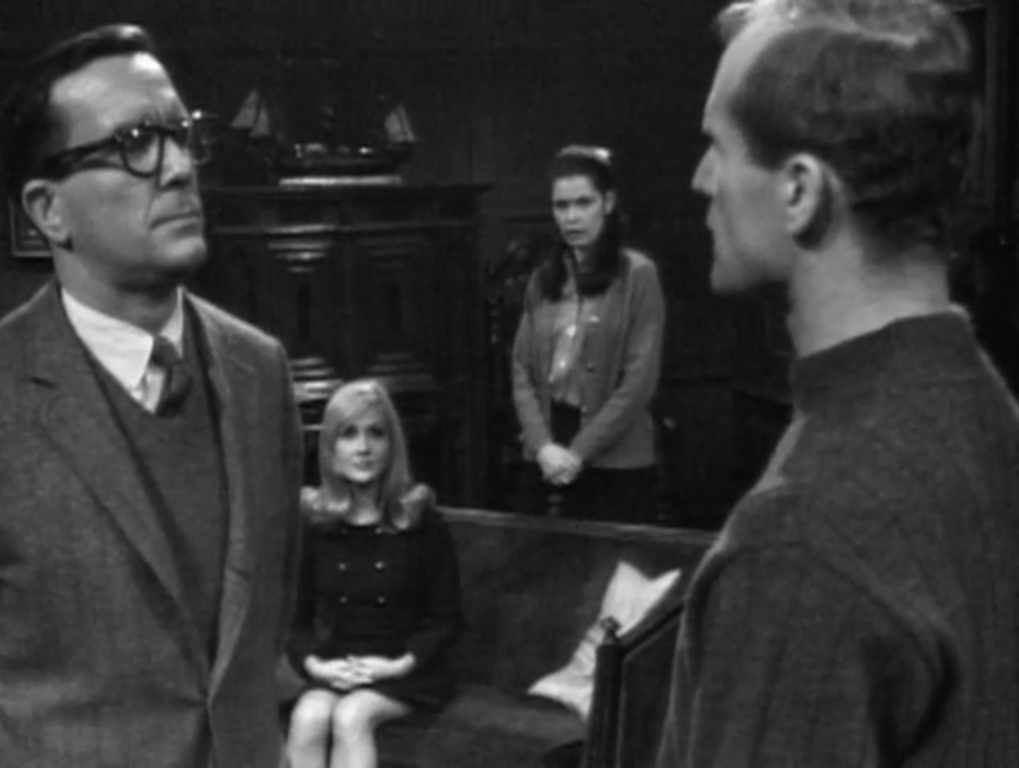
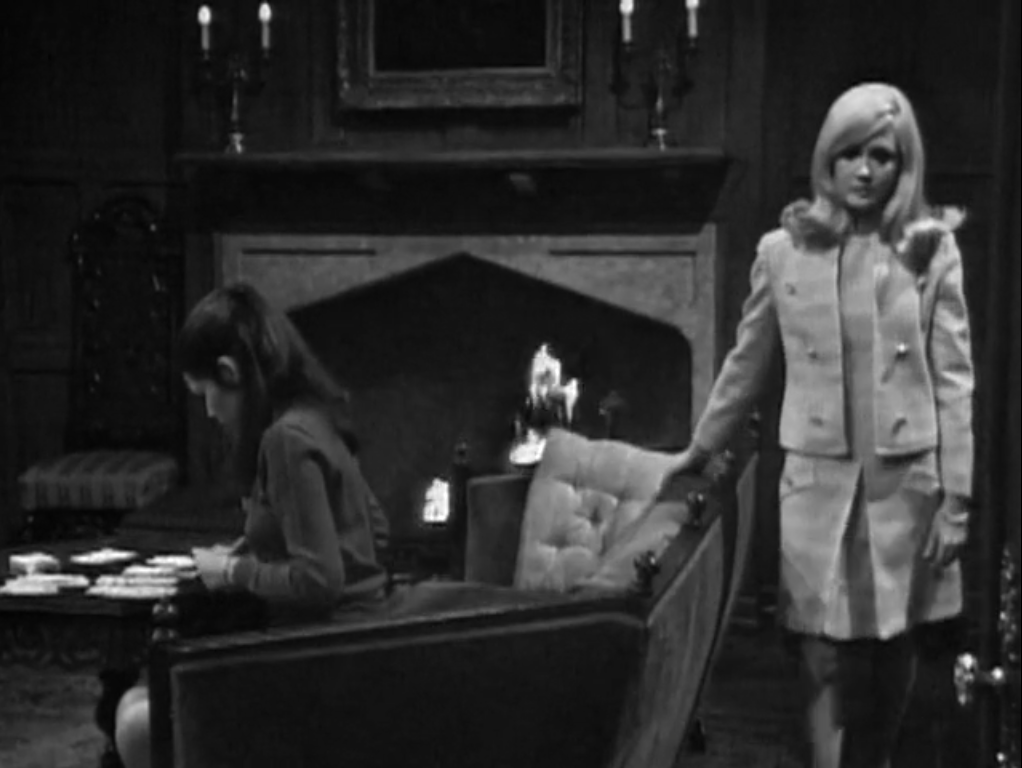




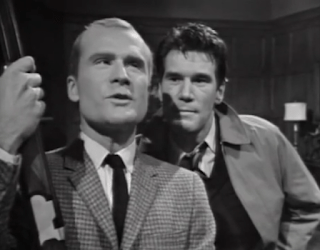

 Dark Shadows Commentary