Diana Millay’s Laura Murdoch Collins was instrumental in two of the most important turns in the development of Dark Shadows. When she was on the show from December 1966 to March 1967, she was its first supernatural menace, marking its transition from the Gothic melodrama of its first months to the monster-driven thriller it became. And in her current tour of duty, in April and May of 1969, it is while doing battle against Laura that Barnabas and Quentin Collins become friends, a friendship that will be central to the show from now on.
Today is Laura’s final appearance. Her sendoff is startling. After she bursts into flames, we cut directly to the closing credits, already in progress with Jonathan Frid’s credit for the part of Barnabas scrolling over an image of the outside of the great house typically shown during the opening voiceover. The bottom of the image is atypically cut off, creating a letterbox effect. None of this is in itself spectacular, but each part of it is a deviation from the usual format. Taken together, it leaves us with the feeling that Laura must have exited by way of the control room.
In the opening reprise, Laura thinks she is waking her son Jamison. She pulls the covers back from Jamison’s bed, and finds that she has been talking to a pile of pillows. In the corner of the room, Laura’s fellow undead blonde fire witch Angelique bursts out laughing.
Well might Angelique laugh. Not only is it ridiculous to see an ancient and terrible creature like Laura fall for so childishly simple a trick, but heaping up pillows under covers to make it look like someone is in bed is a favorite practice of Angelique’s. In #402, Barnabas went to Angelique’s bedroom intending to stab her, only to find her in the corner laughing at him after he had chopped up some pillows under her blanket.
It is fitting that Angelique is the one who destroys Laura. Matthew Hall, son of Sam and Grayson Hall, writes in the essay he contributed to The Dark Shadows Companion that when he and his father were among the writers developing the reboot of Dark Shadows that aired briefly on NBC early in 1991, the idea of including a version of Laura was rejected because “the Phoenix was virtually a test run of all the ideas that would subsequently reach fruition in the character of Angelique. Thus: Laura’s ability to cast spells that set fire to distant things is but one if Angelique’s large arsenal of tricks. Of course, on the original show, advantage was taken of how evenly matched these two characters were: they fought viciously during one episode.” There are some odd things in this assessment, but it is certainly that a character like Laura, who was frightening precisely because she herself was unknowable and her presence implied a world that humans could never hope to understand, had no place on a show where the supernatural is represented by figures like Angelique and Barnabas, whose feelings and intentions are overwhelmingly obvious and all too relatable.
Laura’s children are hidden from her in a room in the east wing of Collinwood. It is in this room, in front of them, that she burns up. The east wing has been mentioned only a few times, mostly by actors who were supposed to say “west wing.” This is the first episode with a scene set in the east wing.
Sarah Collins has taken her friend and distant cousin, strange and troubled boy David Collins, home with her. Since Sarah is a ghost, her home is in a mausoleum. She has decided to show David one of the most interesting features of the place.
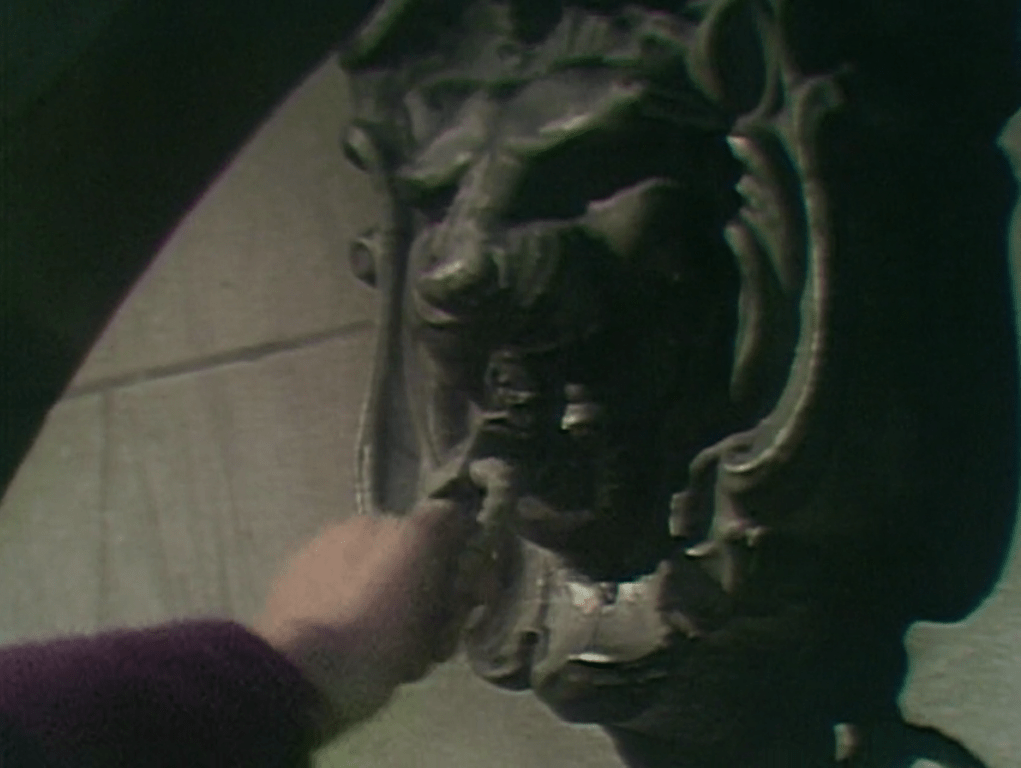
As we open, David is following Sarah’s instructions. He is standing on the sarcophagus of her mother and pulling a metal ring in the mouth of a stone lion’s head. The ring comes forward and a panel opens, revealing a room that was hidden for more than a century and a half.
The lion’s head.Pulling the ringThe panel opens
The first time we saw the panel open was in #210, when dangerously unstable ruffian Willie Loomis happened upon the ring and ended up releasing vampire Barnabas Collins from his coffin in the hidden room. Now that we see this gimmick again and see it in color, it’s starting to seem odd that all you have to do to open the panel is pull the ring. The ring stands out as the only piece of metal in the tomb. Anyone entering the space would be tempted to tug on it, if only to polish it. If you’re wanting to make sure your vampire doesn’t get loose, I’d think you’d install a more secure system. Maybe you could add two or three additional decorative doodads to the wall, one of which you turn, say, three quarters of the way to the left, the other of which you turn some other way, and between them they release the ring.
Be that as it may, Barnabas’ old coffin is still in the hidden room. Sarah announces they will be opening it, and David resists the idea. He debates with Sarah for a while before curiosity gets the better of him.
Sarah the psychopomp. David wants to let the dead rest.David’s resistance crumbles.
He is shocked to see that it is empty. David asks Sarah why an empty coffin would be put in such a place, and she happily tells him that it wasn’t always empty. There was someone in it once, but he got up and left. David protests that the dead don’t walk away, to which Sarah replies that “Sometimes they do.”
David is shocked.Nobody’s home.
When David first met Sarah in #256, she was outside Barnabas’ house, puzzled that she couldn’t find her parents or anyone else she knew. Now it is starting to seem that she knows that she is a ghost haunting a time long after her own, but Sarah’s lines here are the first clear indication that she knows what is going on with her brother Barnabas.
David’s bafflement that the coffin is empty echoes #273. In that episode, matriarch Liz was shocked to find that the chest seagoing con man Jason McGuire buried in her basement did not contain the murdered remains of her husband. Liz kept asking “Why is there nothing there?” David seems almost as appalled as his aunt had been at the sight of some clean fabric unadorned with a rotting corpse. A few days after Liz found out Jason hadn’t really buried her husband in her basement, Barnabas killed Jason. Regular viewers will already have this story in mind, because in #276 Barnabas and his sorely bedraggled blood thrall Willie buried Jason in the floor of the very room David and Sarah are visiting at this moment. Clearly Barnabas would not be happy were he to find out that David knows about the room.
That wasn’t the first vacant grave in Dark Shadows. From #126 to #191, the show was mainly about David’s mother, undead fire witch Laura Murdoch Collins. As the Laura arc progressed, graves of various women named Laura Murdoch were revealed to be empty. Now Laura’s son is coming face to face with an unoccupied coffin, suggesting to loyal fans that he may yet learn something about his own origins.
To Sarah’s consternation, David says he has to go home. He tells her that if he does not, his governess, the well-meaning Vicki, will be upset with him. He simply refers to Vicki by name, as if Sarah already knows who she is. Regular viewers have reason to believe she does know who Vicki is, but it is not clear why David assumes that he can just say “Vicki” without explaining to Sarah who he means. Sarah swears David to secrecy about the existence of the room.
By the time David gets back to the great house of Collinwood, it is 9:30 PM and Vicki is indeed worried about him. Apparently no one else is at home; certainly, no one else has missed David. Vicki sits David down on a seat that’s been in the foyer from the beginning of the series, but which has only been used once or twice before. They have an earnest little talk that recalls the scenes they shared in the first 39 weeks of Dark Shadows, when their complicated relationship was the one storyline that consistently worked.
Rarely used seat.
David describes Sarah to Vicki. It finally dawns on her that Sarah is the little girl she saw on top of the stairs at Barnabas’ house in #280. When the light flashed in Vicki’s eyes, my wife, Mrs Acilius, shouted at the screen “Tell him!” Vicki and David again look like the fast friends they had become by #140, so we would indeed expect her to tell David that she thinks she has seen Sarah, and to tell him where and when she saw him. If she and David join their lines of inquiry and work together to find out about Sarah, the plot will move more quickly and on a much bigger scale than it can so long as everyone pursues their own questions in isolation.
Vicki catches on.
But, Vicki is also very fond of Barnabas, and reluctant to believe anything bad about him. Sarah has been seen in several places connected to the abduction of Maggie Evans, The Nicest Girl in Town. Vicki doesn’t want anyone to add Barnabas’ house to that list, so perhaps it is not a “Dumb Vicki” moment when she decides to keep the information to herself.
Meanwhile, Barnabas is at home. He is irritated with mad scientist Julia Hoffman. Julia is attempting to cure Barnabas of vampirism, and he is dissatisfied with the progress of the treatment. He is also irked that Sarah broke Maggie out of the mental hospital where Julia was keeping her locked up, and blames Julia for failing to ghost-proof the place. He declares that Julia is “a meddlesome and domineering woman,” and that he, as a native of a different century, has no intention of tolerating such a person.
Barnabas and Julia discuss Vicki’s depressing boyfriend Burke. Burke has been investigating Barnabas, and his operatives have come upon some information that would raise questions Barnabas would have a hard time answering. Julia agrees that Burke must be stopped, and urges Barnabas to let her handle the matter. He says that he will take care of it, and that he will do so with “finesse” of a sort unfamiliar to the loutish inhabitants of the twentieth century.
Barnabas’ masterful finesse consists of telling Vicki what Burke is doing and asking her to make him stop. Those eighteenth century guys must have been amazing, to come up with something so complex and subtle in just a couple of days.
Julia comes into the great house as Barnabas is leaving. She asks Vicki if David is back yet. Vicki tells her that he had been out playing with Sarah in some location he refuses to disclose. Barnabas tries to conceal his alarm with a laughing remark about leaving Vicki and Julia to investigate the mystery of David’s playmate.
David comes out of his room to ask for food. While Vicki goes to fetch the housekeeper for him, Julia meets him at the top of the stairs and they talk about Sarah. David points out that she is repeating questions she has asked in previous episodes. He tells her that he doesn’t mind questions and neither does Sarah, but cautions her that the answers Sarah gives don’t make much sense.
The stained glass windows at the top of the stairs look great in color, and it is a relief when David shares the audience’s awareness that we’ve heard Julia’s lines before. Even so, the scene is a disappointment. David and Julia were fun to watch in their previous scenes because they were so relaxed together. Perhaps that was because David Henesy and Grayson Hall understood each other right away. Not only did they have similar ways of working as actors, but her son Matthew is about his age, so she might already have been familiar with a lot of things in his life that the other adults on set wouldn’t have known about.
Today, though, they are both having trouble with their lines. That keeps them from making enough eye contact with each other to sell the scene. David Henesy keeps looking at the teleprompter, which he could evidently read from the top of the stairs with only a little squint; Grayson Hall couldn’t read from that distance, but she does tilt her head back and look up when she’s searching her memory for her next line. Since the characters aren’t looking at each other, we don’t feel an emotional connection between them.
Hall has to thread a particularly small needle in this scene. Julia is trying to make her interest in Sarah seem casual in the same way Barnabas affected a lack of interest in her, by delivering lines about her with a jokey inflection. We know that she is urgently concerned with finding Sarah, and her efforts have to leave David unsure whether she really is the easygoing adult he has so far taken her to be or whether she is trying to pull a fast one.
In the course of a friendly chat between two people who obviously like each other, onetime Academy Award nominee and frequent Broadway luminary Hall could certainly have accomplished all of this. But in the course of this awkward encounter, it all falls flat. Especially so with Julia’s last line to David. After he has told her how difficult it is to get a straight answer from Sarah, she puts on a goofy voice and says that she’ll keep that in mind if she ever meets her. Since she isn’t looking at him when says this, it comes off not as an affectionate gesture acknowledging that they’ve run out of things to say, but as a high-handed dismissal. Even though she pats him on the shoulder and he smiles after that line, it still doesn’t seem that David would come away from the interaction with as complex an emotional response as he is supposed to have. Most likely he would just be irritated with Julia, as indeed the audience is likely to be.
“I’lll kee-e-ep that in mind.” Departure.
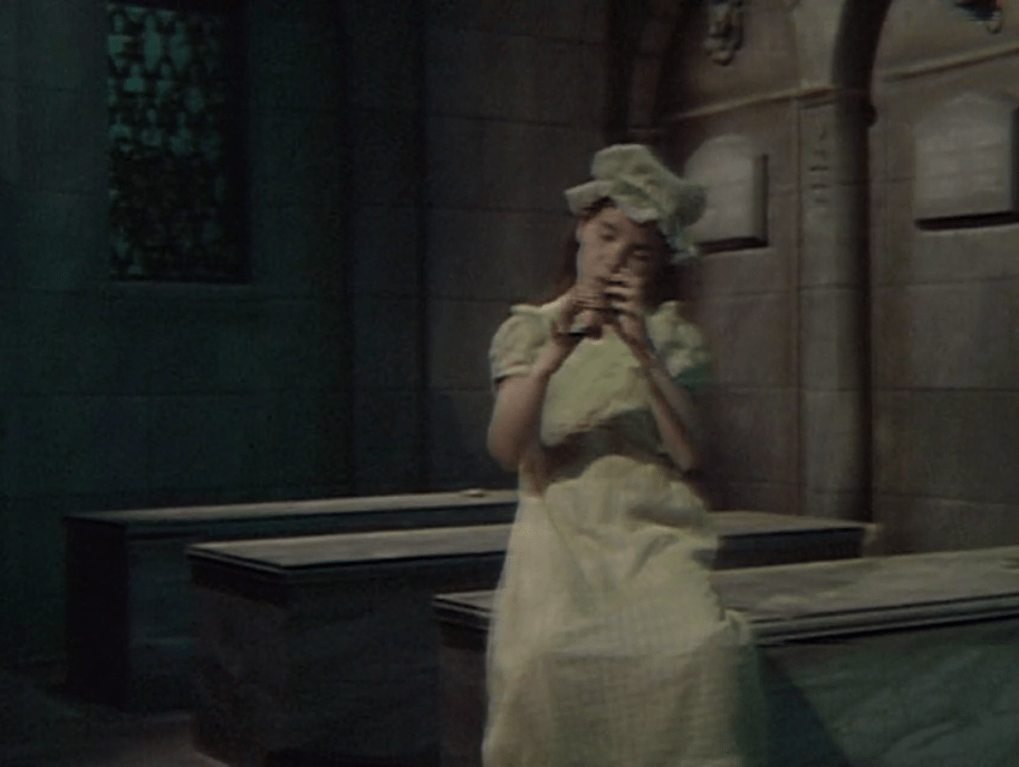
We end back at Sarah’s place. Barnabas is in the cemetery looking pathetic. He hears the strains of “London Bridge” coming from the mausoleum. We see Sarah sitting on her mother’s sarcophagus moving her fingers on her recorder far more rapidly than the music we hear would call for. She looks more like she’s playing a rock ‘n’ roll number.
Jammin’ with the Junior Funky Phantom of 1967.
Barnabas calls out to Sarah. He identifies himself as her brother and says that he has come to take her home. He goes into the mausoleum only to find that she has vanished. Wracked with sorrow, he pleads with her to come back, saying that he loves her and needs her. He touches the plate marking her grave. This underscores the futility of his desire to take her home. Leading him here, it is she who has brought him to what is in fact her home, and what ought also to be his.
Sad Barney.The impassable barrier.
This shows us a Barnabas we can sympathize with, but it also sets him on a collision course with David. Barnabas has been so harmless lately that we might wonder if his part is going to be recast with a purple felt puppet counting “Vun peanut butter saand-veech!” If he sets out to kill a child, he’ll be back on track as a horrifying menace.
Besides, David is not just any child- as the last bearer of the Collins name, David’s survival has a great symbolic importance to the show. He was central to everything that happened on Dark Shadows in its first 39 weeks. So if Barnabas becomes a threat to David, it will be a case of conflict between the current main character and the previous main character. Since Vicki originally represented the audience’s point of view and is still a major character, the divided loyalties between Barnabas and David that we first see influencing her behavior today could create a high level of dramatic tension. Especially so if Barnabas turns her into a vampire, and she winds up like Lucy in Dracula, the “Bloofer Lady” who herself preys on children.






 Dark Shadows Commentary