
The entire episode is set in the Collinsport Inn- the lobby, the restaurant, and Burke’s room.
In episode 21, Vicki took Liz in hand as if she were Plato’s Socrates and Liz were some pompous Athenian aristocrat, leading her through a series of simple, seemingly innocent questions to a most uncomfortable conclusion. That took place in the drawing room at Collinwood, while Carolyn watched. In episode 24, Carolyn joins Burke and the sheriff in Burke’s room. It’s Burke’s turn to play Socrates, Carolyn’s to answer the questions, and the sheriff’s to be an audience. Burke’s questioning is not only effective at raising doubts in the sheriff’s mind, but also prompts regular viewers to bracket Vicki and Burke together and see them as a likely, indeed inevitable, romantic pair.
The scenes in Burke’s room also highlight Roger’s bizarre folly in telling Burke his evidence against him before going to the police. We saw Vicki try to talk Roger out of this in two episodes, and the sheriff commented on it later. Watching the well-prepared Burke cross-examine Carolyn as effectively as any defense attorney, it is all the clearer that Roger’s behavior was driven not by any rational calculation, but by some wild impulse he cannot entirely control.
The scenes in the lobby and the restaurant show us a quiet rewriting of some characterizations laid out in episode 1. In that episode, Burke stood in the lobby and refused to admit that he so much as knew the name of Mr Wells, the hotel clerk, simply because Wells was from the town from which he was sent to prison ten years before. Now he stands on the same set, warmly greets one of the policemen who made the case against him, and repeatedly tries to persuade him to join him for lunch. Also in episode 1, Maggie stood behind the counter of the restaurant and told Vicki that she considers her, as a member of the staff of Collinwood, to be a “jerk” practically as bad as the family that owns the house. In this one, Carolyn herself comes into the restaurant and she and Maggie have a warm, cozy chat, like old friends.
I suppose it was inevitable that they would retcon Burke into a hail-fellow-well-met and Maggie into a friend of at least some of the Collinses. After all, soap operas consist mostly of conversation, so characters who aren’t on speaking terms with each other are dead weight. Placing these scenes on the same sets used in episode 1 is an emphatic way to make it clear to viewers who remember that episode that the change is intentional and permanent.
The videography is also as ambitious as we ever see it in this show. The camera tracks fluidly through the lobby, showing us more of that set than we see in any other episode, ending in a low angle shot of the sheriff that makes him look ominous. Some of those tracking shots are too much for Michael Currie, the actor playing the sheriff- during his scene alone with Burke, he bumps into one camera, stumbles into a piece of furniture, and then the other camera hits him in the back of the head. After that, he stands with his back to Burke and his elbows bent in front of him, looking for all the world like he is urinating on the floor:
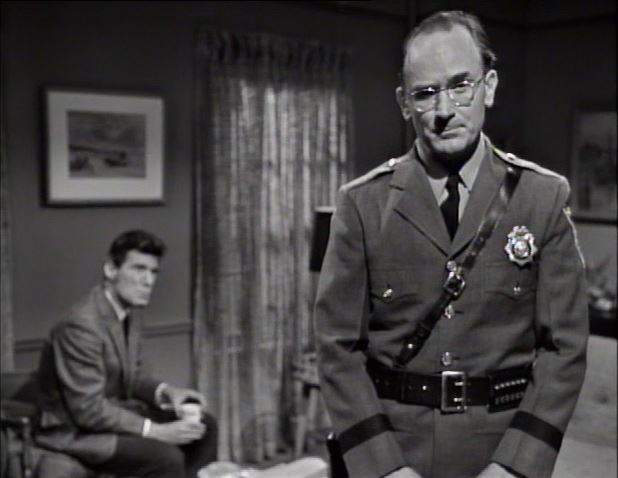
Currie is so physically awkward that when Burke asks the sheriff the rhetorical question “Have you ever sat on a wrench?,” it seems to be a pretty near certainty that the answer is yes.
Currie has a rough time in this episode with his lines as well as with his movement. Perhaps the single funniest blooper comes when he declares that a good memory “is what I’m paid for,” then forgets his next line. It’s also interesting when he calls Burke “Burt.” Bloopers are after all one of the things Dark Shadows is known for, so we can’t be too annoyed with him for those. Worse is what happens when he does remember his lines. He intones them all as if he were leading the Pledge of Allegiance.
In the months after Mark Allen left the show, the standard of acting on it was remarkably high. Every actor other than Currie consistently turns in performances so strong that watching an episode feels like a fine evening at the theater. And bad as he is, even Currie doesn’t keep his scene partners from delivering good performances. He just wasn’t ready for professional acting. So I don’t have the same need to complain about him as about Allen, but he does deliver the series’ first laugh-out-loud moments of incompetence, and it is a relief when he is replaced.
 Dark Shadows Commentary