Episode 913/914: An abominable boy

Episodes 1 through 274 of Dark Shadows opened with voiceovers by Alexandra Moltke Isles, usually in character as well-meaning governess Victoria Winters. What followed was therefore in some sense a story told by Vicki, implying that she would eventually learn everything that happened in it. Indeed, this was the case for the first 39 weeks of the show. Vicki represented our point of view, and nothing remained secret from her for long.

That changed after vampire Barnabas Collins joined the cast in #211. Originally it seemed that Barnabas would be merely the second in a series of supernatural Big Bads, and that like his predecessor, undead blonde fire witch Laura Murdoch Collins, he would meet with defeat after Vicki caught on to his true nature and rallied the other characters against him. But Barnabas drew a whole new audience to the show. After a few weeks, he had raised Dark Shadows from its place at the bottom of the daytime ratings; by the summer, the show was a sort of hit. It was out of the question to destroy him. They had to find a way to keep him on the show indefinitely. Since the core of Vicki’s character was her trustworthiness, she could not possibly know about a vampire and fail to destroy him. So she ceased doing the narrations, ceased functioning as the audience’s representative, and after a while ceased to have any reason to be on the show at all. Vicki was written out late in 1968, and is now almost entirely forgotten.

Mrs Isles’ final episode as Vicki was #627. In our last glimpse of her, she was talking with Julia Hoffman, a permanent houseguest in the mansion of Collinwood. That shot represented the hand-off from one audience point of view character to another.

Julia first joined the show in the summer of 1967 as a psychiatrist treating one of Barnabas’ victims, then came to Collinwood to join forces with Barnabas as she left psychiatry to pursue her true calling as a mad scientist. Julia soon knew everything about the horrors Barnabas and the other monsters who joined the cast perpetrated. As deceptive as Vicki was truthful, as incriminated as she was pure, Julia was perfectly at home in the all-villain cast that is the hallmark of the show’s strongest periods.

Julia was absent from the show for most of 1969, when Dark Shadows was a costume drama set in 1897. She traveled back in time to that year and took part in the action for much of September, but for the other seven months we were in suspense as to when she would find out what had happened and what she would do with the news. When her friend Barnabas returned to 1969 from his long stay in 1897, she expected him to bring her up to date. We knew that he had come under the influence of a mysterious group and was likely to be distant towards her, but were still shocked when he refused to tell her anything at all.

Today, Julia’s function as the character who knows what the audience knows is dramatized when matriarch Elzabeth Collins Stoddard and her brother Roger are in the drawing room at Collinwood having a conversation about Roger’s son David. Julia is on the stairs in the foyer, heading to her room, when she sneaks back down and places her ear to the door. In no way does this conversation concern Julia; she eavesdrops only to reassure us that she will know what is happening.

Julia’s friendship with Barnabas has been her starting point in most of the stories so far. She is so well established on the show that she doesn’t really need him, but she does need someone to talk to about her investigations and discoveries. A flunky who will follow her orders will suffice to serve that purpose for now, and so she has taken troubled drifter Chris Jennings on in that capacity.

When Vicki was leading the fight against Laura, she needed a flunky. So they gave her a boyfriend named Frank Garner. Every character has to have some connection to the ancient and esteemed Collins family; Frank and his father were the lawyers representing the family in its business dealings. Long before they were introduced, the show had moved on from the business stories of its first months. By that time, all we hear about the Collinses’ money is that they have an inexhaustible supply of it, and it occasionally attracts unwelcome attention. Conard Fowkes was a capable actor and did what he could with the part, but there was so little to it that he wound up doing a very convincing imitation of a person you might meet in a law office in Bangor, Maine in 1966, with no more entertainment value than you might expect such a person to offer.

Chris gives the writers far more to work with than Frank ever did. He is related to the Collinses through his great-grandfather Quentin Collins, and like Quentin is a werewolf. Chris and heiress Carolyn Collins Stoddard dated before his lycanthropy took hold, and they still have not resolved their feelings for each other. His little sister Amy lives at Collinwood, and is often involved in the stories. He hopes that Julia will be able to cure him of his curse.

Julia’s plan for accomplishing this goal centers on a man named Charles Delaware Tate. When Julia was in 1897, she befriended Quentin and learned that Tate had painted a portrait of him. On nights of the full moon the portrait becomes that of a wolf while Quentin remains human. In fact, Quentin himself came back to Collinsport a few days ago, still alive and to all appearances 28 years old. He has amnesia and refuses to believe any of the preposterous facts Julia tells him about himself, but is quite obviously Quentin. Julia has found two almost identical paintings done in recent years, one signed “C. D. Tate” and the other “Harrison Monroe.” Julia has tracked Monroe down in the hope that he really is Tate and that he will be able to paint a portrait that will do for Chris what was done for Quentin.

Yesterday, Julia had told Chris she wanted to go to Monroe’s place to see if he was Tate. Later, we simply cut to her in front of the door. She rang the doorbell, and a voice from a loudspeaker mounted above the door-frame told her to go away. She said she had a message from “Delaware Tate,” and the door drifted open. She entered the door as the episode ended.

Today’s opening reprise recreates the scene at the door, with a different voice coming through the loudspeaker and Grayson Hall remembering to put the “Charles” in front of “Delaware Tate.” When we come back from the main title sequence, she is wandering around inside a darkened house while a voice from another loudspeaker gives her directions.

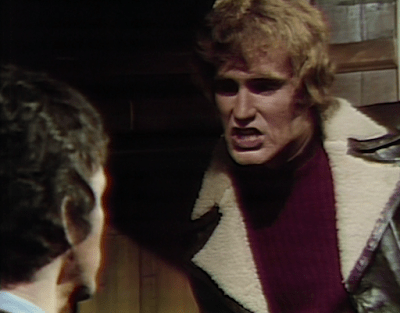
Julia makes her way into a room where a young man sits at a desk. The room is as dark as the rest of the house, but she can see him clearly. She recognizes him as Tate, his appearance unchanged from what we saw in 1897. It is not entirely clear how she knows who he is- she and Tate did not meet during her sojourn in the past- but viewers who are faithful enough to know this also know that she represents our point of view. Since we saw far more of this unappealing character than we wanted, we are untroubled that Julia knows him.

The mysterious group that has coopted Barnabas is generating a story based on H. P. Lovecraft’s novella The Dunwich Horror. Fans of Lovecraft who are happy about this will recognize the shadowy figure in a corner of a room who speaks through an electronic amplifier as an homage to his The Whisperer in Darkness, throughout which the protagonist consults with a man who meets that description. Julia and we get a much closer look at Tate today than Professor Albert Wilmarth gets of Henry Wentworth Akeley until the conclusion of the story, at which point Akeley’s true appearance represents a twist ending.

Tate looks down throughout their conversation and keeps shouting at Julia that she should go away. His mouth moves in time with the words booming from the loudspeaker. He responds to everything she says with an announcement that it is of no interest to him. When she mentions that she has “transcended time” and compares that feat with Tate’s apparent success at finding “a way to suspend time,” he is as gruffly indifferent as if she had said she had washed her car and he has changed the oil in his. She tells him what he did for Quentin; he shouts that the story is “only a legend.” Finally, Tate looks up, he laughs, the lights flicker, a noise sounds, and he looks back down. Julia takes this as her cue to leave.

Accompanied as it is by the sound and lighting effects that precipitate Julia’s exit, I take it that the laugh is supposed to be maniacal or unearthly or something. Roger Davis had extensive training as an actor and has had a huge career on screen, so one supposes he could deliver such an effect had he chosen to do so. Instead, what he actually does is stick out his upper lip and emit a throaty guffaw, sounding very much like the Disney character Goofy.

“Hyuck-hyuck!”

I was left wondering why Julia left this meeting while still holding the strongest card in her hand. Quentin is not the only person who has come to town recently whom Tate knew in 1897. A woman calling herself Olivia Corey is actually Amanda Harris, who popped into existence one day in 1895 when Tate was painting a portrait of his ideal woman. Like Quentin, Amanda appears to be the same age she was when she was in Collinsport in 1897. Tate was obsessed with her then, but she and Quentin fell in love with each other. She still loves Quentin, and has now met him and set about trying to restore his memory. Julia knows all about Amanda, and has even come into possession of one of the portraits Tate painted of her. Had she said that she knew where he could find Amanda Harris, Julia could have expected a strong reaction from Tate. I suppose we can expect to see Julia team up with Amanda and then pay another visit to Tate.

The Whisperer in Darkness is not the only work of fiction Julia’s meeting with Tate recalls. It will also remind longtime viewers of #153 and #154, when Vicki and Frank went to a building in the old cemetery north of town and met the cemetery’s caretaker. Much of #153 was taken up with what writers call “shoe leather,” material showing how characters get from one scene to another. There was a whole act about Vicki and Frank setting out on a date for dinner in a restaurant, riding in his car, and her developing a vague sense they should go somewhere else instead. They quarrel about her vague sense, then he capitulates and takes a series of turns she dictates. It gradually dawns on her that the ghost of Josette Collins is feeding the directions into her mind. They find themselves in the cemetery, and Vicki relays further directions from Josette until they find themselves at the door. They knock, wait around, and are about to leave. Then, the door drifts open. They stand there staring inside. That’s the end of the episode.

Vicki and Frank were still at the front door in the reprise that opened #154. They were met there by the caretaker of the cemetery, who asked them if they were ghosts. The conversation got weirder from there, but he did let them into the building. Frank faded into the background during that scene, but his unfailingly rational, serviceably masculine presence did rule out any possibility that Vicki would be in any serious danger during the scene. Had Vicki been alone with the caretaker, there would have been some suspense as to what would happen between them. The setting is eerie enough that he might turn out to be a ghost himself, or some other kind of being who will be a threat to her. As it is, he is labeled a harmless old crank from the first moment we see him.

Yesterday’s episode dispensed with all of #153’s shoe leather. We’ve heard Julia wants to visit Monroe, we cut to her pressing a doorbell, and we assume that she drove to Monroe’s house. The door drifted open at the end of yesterday’s episode just as it did at the end of that one, but Julia actually went inside. She goes alone, so that she will not have anyone to help her fight any enemy she may find there or to corroborate her version of whatever events she may witness.

In those ways, these two episodes are an improvement over what we saw in #153 and #154. There is another way, however, in which they are a deep step down. The doddering old caretaker, played by Daniel F. Keyes, was hilarious, a refugee from EC Comics who got laughs every minute he was on screen. Tate, like other Roger Davis characters, elicits impatience at best and revulsion all too often. Julia, and we, deserve better than to have to see him again.

Episode 638: Red Riding Hood

Maggie Evans, The Nicest Girl in Town, is visiting the great house of Collinwood to sit with her sick friend Vicki. There, she meets mysterious drifter Chris Jennings. Maggie is furious with Chris, because he refuses to stay in Collinsport and take his little sister Amy in. Ever since their brother Tom died, Amy has been living at Windcliff, a mental hospital 100 miles north of town. Chris won’t explain to Maggie or anyone else why he keeps moving.

Julia Hoffman, MD, is the director of Windcliff, and she has been a permanent houseguest at Collinwood since last summer. Julia comes downstairs, and finds Maggie still reading the Riot Act to Chris. When she tells Maggie that Vicki is ready to see her, Maggie looks contemptuously at Chris, exclaims “Good!,” and stalks out.

Julia picks up where Maggie left off. Chris tells her he came to Collinwood to give her some money to pass on to Amy; Julia gives the money back to him, and says “She doesn’t need money, she needs you!” Chris won’t tell Julia where he is going or why. She asks if he will at least stop at the hospital on his way out; he says he will not.

In #632, we saw Chris visit Amy at Windcliff. Also in that episode, it became very clear that Chris is a werewolf. Returning viewers who remember that about him also know that Julia is an expert in vampires and Frankensteins with secondary interests in ghosts and witches, so if Chris came clean with her she might well have a prescription for him. But wherever Chris has been wandering, it isn’t a market where the ABC affiliate runs Dark Shadows, so he misses his opportunity to seek specialist medical attention.

Vicki has some symptoms that require Julia’s attention. On her way upstairs, she asks Chris not to leave before she comes back, since she has some more scolding to do. When Julia does come back down, she gets a telephone call from Windcliff. Amy has run away. She asks where Chris is, only to find that he did not comply with her request.

Matriarch Liz decides to go to the Old House on the estate, home of her distant cousin Barnabas. She explains that Barnabas and Vicki have always been close, so that she thinks he might be able to help calm her. Julia apologizes that she can’t accompany Liz on the walk through the woods, explaining that she has to wait by the telephone in case Windcliff calls again.

Liz is wearing a bright red dress we haven’t seen before, and as she leaves the house she puts on a bright red coat that is also new. This striking ensemble makes her look very much like Red Riding Hood. We see Chris skulking in the woods as Liz is walking nearby; he isn’t wearing character makeup, but is bending down and panting, suggesting The Big Bad Wolf. Liz hears him and calls out, asking who is there. She is looking into the camera, a look of alarm growing on her face, while we zoom in on her. Growling, snarling noises play on the soundtrack, suggesting that our point of view is that of the attacking werewolf. Liz has been a major character since episode #1; also introduced in #1 was the keeper of the Collinsport Inn, Mr Wells, whom we saw the werewolf brutally kill in #632. The show has been dropping major characters from the story and important actors from the cast recently, so it is not in fact impossible that this might really be the death of Liz.

Red Riding Hood from the Big Bad Wolf’s point of view. Screenshot by Dark Shadows Before I Die.

When I was a teenager and first started reading long books, page 638 was always a milestone for me. When I’d read page 638, I was always sure I would make it to the end, no matter how many pages were left. Ever since, 638 has been my lucky number. I can’t claim to be certain I will carry this blog all the way to #1245-WordPress has been getting steadily buggier lately, blogging itself is an increasingly old-fashioned pastime, and who knows what might happen to me between now and April of 2027- but it does give me a boost to have reached this point.