
Many fantastic tales dwell on a sense that dreams have a great power in the world, and so their characters are often afraid of falling asleep. Dark Shadows has several times referenced Edgar Allan Poe, who explored that fear in stories like “The Premature Burial,” “The Tell-Tale Heart,” and “The Man of the Crowd.” The show brought up another writer of fantastic tales preoccupied with the fear of sleep in #808. Aristide, henchman of sorcerer Count Petofi, threatened an enemy of Petofi’s with “the mysterious shadow he can cast, the shadow that isn’t your own that follows you.” That was a reference to George MacDonald’s 1858 novel Phantastes, in which a man named Anodos is plagued by a shadow that moves about on its own, following him and blighting his existence. Not only does Anodos fear sleep from time to time in Phantastes, but the main theme of MacDonald’s other very popular novel, 1895’s Lilith, is Mr Vane’s long refusal to sleep and the great battle he must wage in the dream-world when he finally does allow himself to nod off.
Aristide’s threat suggested that the show was about to give us a story based on Anodos and the autonomous shadow. Aristide is dead now, and Petofi is running out of story, so that isn’t going to happen, at least not in the segment of Dark Shadows set in the year 1897. But today we do get a little bit of George MacDonald in the form of a battle against sleep. Petofi is casting a spell over himself and handsome young rake Quentin Collins. If Quentin loses conscious control of his mind for even a moment, he and Petofi will evacuate their respective bodies and be re-embodied as each other. Petofi will then transport himself, in Quentin’s body, to the year 1969. Quentin will be left behind in 1897, occupying Petofi’s aging form and waiting helplessly for Petofi’s mortal enemies to come and kill him, thinking they are taking their long-delayed revenge.
By the time Quentin finds out what’s going on, it is the wee hours of the morning, after he hasn’t slept for a couple of nights. His friends, Cockney showgirl/ mentalist Pansy Faye and time-traveler/ recovering vampire Barnabas Collins, keep marching him around the drawing room of the great house of Collinwood in an effort to keep him awake. They don’t brew up any coffee, strangely enough. But Barnabas does call on wicked witch Angelique and appeals to her to use her powers to put some kind of barrier between Quentin and Petofi.
Angelique tells Barnabas that she is reluctant to help Quentin because she is upset that he wants to go to New York and look for a woman named Amanda Harris. She had wanted Quentin to fall in love with her, and is jealous that he chose Amanda instead. Barnabas points out that if she doesn’t help Quentin, he won’t exist in the form that either she or Amanda knew. Angelique explains that she has a reason for her attitude:
Before I came here this time, I was in the everlasting pits of Hell, where other creatures of my kind live. Only, my stay here on Earth made me dissatisfied with my life there. I longed to come back here… To Earth, to become a human being. I begged my master for the chance.
Finally, he gave it to me on one condition and one condition only… That I make one man fall in love with me, without any use of supernatural spells or powers. One man, one chance. That’s what I was granted.
Since Quentin is the one man who represented Angelique’s one chance, letting him go to Amanda might mean that Angelique has to go back down. My favorite part of her speech is “Only, my stay here on Earth made me dissatisfied with my life there.” Sure, she could have been happy in the everlasting pits of Hell, as one is, but how ya gonna keep ’em down on the farm after they’ve seen Pa-ree. Or, since Angelique’s sojourns in the upper world have all brought her to Collinsport, after they’ve had the lobster roll at the Blue Whale.
While Barnabas is talking with Angelique, Pansy is on Quentin duty. She decides to keep him awake by compelling him to join in a performance of her song. A record of this song, performed by Nancy Barrett and David Selby, hit the stores the very day this episode was first broadcast, so this is product placement. But Pansy is doing exactly what she would do in this situation, Quentin is reacting just as he would react, and it is a charming moment.
The musical number is preceded by Pansy making what literary critics call a programmatic statement. “Feel like it or not, you gotta do it, the show must go on. That’s the one and only rule there is, love. So let’s have a bright chorus from that new team, Pansy Faye and Quentin Collins.” Pansy is not only a good pal and a gifted psychic, she is an accomplished scientist. She has indeed stated the complete physics, metaphysics, and every other operating principle of the universe of Dark Shadows when she says that “The show must go on.”
Angelique and Barnabas enter. Angelique insists on some time alone with Quentin. He says that once he gets to New York he most definitely will be looking for Amanda and that he has no interest in a relationship with Angelique. She looks away from him and talks herself into believing it will be OK if he falls in love with her after Amanda “has ceased to exist.” Longtime viewers can be fairly sure this means that Angelique is planning to murder Amanda, but at the moment the important thing is to get Angelique involved in helping Quentin against Petofi.
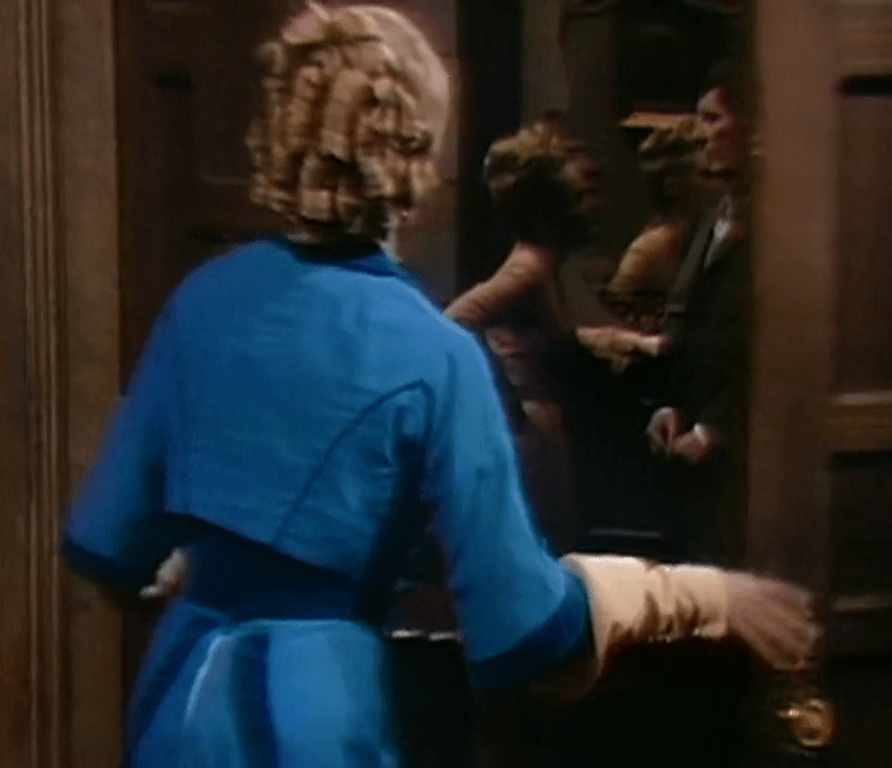
Angelique opens the door to the foyer, where we catch a glimpse of Nancy Barrett and Jonathan Frid doing a really marvelous mime depicting “intense conversation.” It’s one of those deliberately stagey bits of business that these twentieth century New York actors do so well.
Angelique stares into the fire and tries to project psychic power Petofi-ward. We get a process shot simultaneously depicting Angelique in the drawing room and Petofi in his lair. The shot is not very successful, and Angelique explains that her efforts aren’t working either. She says that Petofi is in so deep a trance that she cannot reach him as she has done before.


Pansy, eavesdropping from the foyer, hears Angelique say that she will need to have something Petofi is wearing right now, something still warm from contact with him, in order to reach him with her powers. Pansy resolves to provide this, and she sneaks out. She makes her way to his lair, and is about to undo Petofi’s necktie when he comes out of his trance and tells Pansy she has interfered with his plans once too often. We have flashed to the motionless Petofi several times today, leading us to think that Thayer David was going to collect his fee without having to deliver a line. So it is quite effective when he springs into action.
 Dark Shadows Commentary