
Suave warlock Nicholas has expressly forbidden his subordinate, the wicked witch known variously as Angelique and Cassandra, from killing Frankenstein’s monster Adam. But now he has twice caught her trying to do just that. He punishes her by stripping her of her powers. He tells her that she is now a human being, and that she will die soon.

Angelique/ Cassandra’s husband, sarcastic dandy Roger, comes downstairs and confronts her about her indifference to him. She responds that there never was anything between them and never will be, and rushes out of the house. My wife, Mrs Acilius, is a soap opera fan from way back, and she says that as far as she is concerned this archetypal soap moment makes for a “Genuinely Good Episode.”
Angelique/ Cassandra goes to see recovering vampire Barnabas. He opens the door and asks what she wants. She says that she was once the mistress of the house and that as such she has a right to enter.
Ever since she showed up in the year 1968, Angelique/ Cassandra has been trying Barnabas’ patience and the audience’s by pretending that she was not the witch he married in the 1790s. He asks her why she has dropped that pretense now, and she says that she, like he, has become human. She also says that she will die at dawn. It is unclear why she thinks this- all Nicholas told her was that her life expectancy was to be measured in “minutes.” She declares her intention to kill Barnabas, and is pointing a gun at him when the episode ends.
If it does not lead to her immediate demise, depriving Angelique/ Cassandra of her powers would be an intriguing way of making her a more flexible character. In the costume drama segment set in the late eighteenth century, she was so powerful that she painted herself into a corner, facing no real opposition. The only suspense she could generate came when she was indecisive or distracted and got in her own way. In 1968, her subordination to Nicholas has pushed her to the opposite extreme. She has been very busy, but hasn’t done much. If she survives without her powers, it might be interesting to see her learn how to live as a human after all this time.
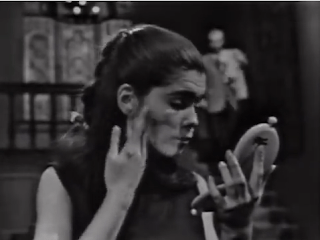
Angelique/ Cassandra’s appearance reflects the end of her dual identity perhaps more clearly than was intended. When she answered to the name Angelique in the 1790s, she had blonde hair; when she turned up in 1968 calling herself Cassandra, she wore a black wig. Throughout this episode, the wig keeps sliding around on her head.
This episode includes another of the innumerable replays of an audiotape message about Barnabas and Adam. The other day, it seemed that Nicholas and Cassandra had taped over the message, as undead fire witch Laura Murdoch Collins taped over a recording she didn’t want parapsychologist Peter Guthrie to hear in #172. But Friday they played it for us yet again. When Nicholas threatens Angelique/ Cassandra with death if she keeps disobeying him, Mrs Acilius said to the screen “I’ll kill you myself if you play that tape again!” I am glad to report that this is the last time we will hear the thing.
Danny Horn’s Dark Shadows Every Day post about this episode juxtaposes screenshots and dialogue from the scene in which Nicholas strips Angelique/ Cassandra of her powers with screenshots and dialogue from a contemporary episode of General Hospital. The contrast is hilarious. It also shows why even the conventionally soapy scenes with Roger and Barnabas stand out from the other daytime dramas of the period. Director Lela Swift’s use of the camera was incomparably more dynamic and ambitious than anything General Hospital was doing, Robert Cobert’s original orchestral score is comprehensible to a modern audience in a way that an organ playing in the background would never be, and the action is paced so that it takes less time for Angelique/ Cassandra to lose her supernatural powers, end her marriage to Roger, and pull a gun on Barnabas than it took Lucille to explain to Audrey that she had an idea about how she could learn to play bridge.




 Dark Shadows Commentary