In episodes #853-#856, Sorcerer Count Petofi (Thayer David) used his powers to force the devastatingly handsome Quentin Collins (David Selby) to trade bodies with him. Ever since, Quentin (Thayer David) has been trying to persuade someone to believe his story about Petofi (David Selby.) For the duration of the switch, I shall refer to Thayer David’s version of Quentin as P-Quentin, and David Selby’s version of Petofi as Q-Petofi.
P-QuentinQ-Petofi
Yesterday, P-Quentin persuaded his old friend and fellow Satanist, Evan Hanley, of what had happened. Evan agreed to conduct a ceremony to call upon their dark lord and ask for the transfer to be broken. They trick Q-Petofi into coming to Evan’s house and knock him out with chloroform. Then Evan begins an odd incantation:
Oh, Lucifer…
Great God of man and beast, look upon us with favor. Help us correct this evil which has been done in defiance of you.
Renew our bondage as your servants. Grant us the power we need this night, and we will be yours for eternity.
For Baal, who guides your mind.
For Beelzebub, who rules your spirit.
The robber of a soul must not be spared. The robbed must be avenged.
I exorcise thee.
Oh, impure spirit, who is the mind of the enemy, by the holy rite of Hecate, I conjure thee that thou do immediately hear and obey my command. Leave this man’s body, that he may return… Oh, yes, spirits of invisibility, I conjure and constrain thee herewith to consecrate this ceremony. So that surely and without trickery, thou may return each, to the body of [its] origin.
So be it.
Oh, Lucifer, so be it.
So be it…
I charge thee. I conjure thee. I command thee. Answer my demand.
Depart from these alien bodies and return to those from whence you came.
Depart.
So be it.
So be it.
So be it.
Oh, Lucifer, we give thee thanks.
Evan and P-Quentin seem to have the wrong guy. Whatever Satan’s powers may be, undoing evil, restoring property to its rightful owners, and enforcing justice are not exactly among the old fellow’s core competencies. Of course the ceremony fails. Q-Petofi wakes up from the chloroform, tells Evan he has made the greatest and last mistake of his life, and puts the zap on his brain. The next we see him, Evan is digging a grave, refusing P-Quentin’s offer to help him, and listening to Q-Petofi announce that he is about to be buried alive.
Q-Petofi’s announcement is the closing cliffhanger, suggesting that Evan has a somewhat longer life expectancy than we might have imagined when the ceremony fell apart. But once in a while cliffhangers really are resolved with the death of the character who is in peril, and that would seem to be a possibility in this case. Yesterday was Evan’s first appearance after an absence of more than eleven weeks, and he is not associated with any major loose ends in the plot. His alliance with the odious Gregory Trask, husband of Judith Collins Trask, may have given him a foothold now that Judith is back from her own long absence and is looking on Trask with suspicion, but yesterday he seemed to back off from siding with Trask in whatever fight might be coming up. So if the makers of the show are thinking it’s time for Q-Petofi to confirm his credentials as a major villain by killing a familiar character, Evan would be the obvious choice.
Judith confronts Trask today. He lies to her to cover up his misdeeds during the more than thirteen weeks she was confined to a mental hospital. She does not contradict all of his lies, and invites him to embrace her. He seems to think he has regained his control over her, but she tells him two things that make him uncomfortable. First, she says that she has persuaded his daughter to leave her apartment in the village and move back into the great house of Collinwood. When he protests that “She is not my daughter!,” Judith calmly replies that she is, closing the subject and leaving him looking like a petulant child. She also says that she hopes he has not bought or sold any stocks in her name lately, since she has revoked his power of attorney over her holdings. Again, he can say nothing in response.
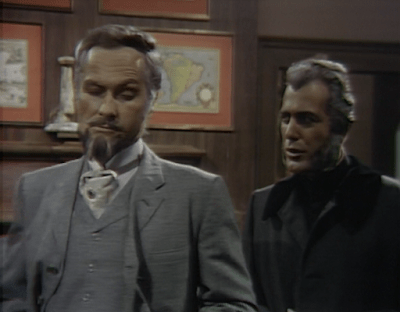
Judith’s brother, the stuffy but lovable Edward, does not hear the details of this conversation. After Judith leaves the drawing room, Edward enters and tells Trask that he has won again. Trask perks up at this, and becomes his usual overbearing self. But he is just as quickly deflated when Edward tells him that he is looking into what he has been doing for the last thirteen weeks, and that when he finds out he will make a full report to Judith.
When Dark Shadows first became a costume drama set in 1897, Edward assumed he was to inherit the estate of Collinwood and all the family’s businesses. He was haughty and commanding, and Judith was a fragile spinster. But then their grandmother died, and the will left everything to Judith. She fell victim to Trask’s machinations and married him; he gaslighted her into the madhouse. Now that she has come home, Judith has found a new strength, sufficient to hold her own in the household if not to uphold justice and right on the scale which her position in the community would seem to demand. Edward’s dependent financial position, coupled with the many supernatural horrors he has witnessed, have gradually reduced him to a childlike state. In their scenes today, we see that the two of them have come to embody that signature dynamic of Dark Shadows, the relationship between Bossy Big Sister and Bratty Little Brother.
The dramatic date is 28 August 1897. On 23 July, in #803, sorcerer Count Petofi cast a spell on stuffy Edward Collins. Ever since, Edward has believed he was a valet recently separated from the service of the Earl of Hampshire. This led Edward’s brother, the rakish Quentin, to follow the Collinses’ long-established procedure for responding to mental illness and lock him up in the room on top of the tower in the great house of Collinwood.
In #816, broadcast on 11 August 1969 and therefore set on 11 August 1897, Petofi brought something even stranger on Edward’s twelve year old son Jamison. He called the spirit of Jamison’s grandson David to project itself from 1969 and to take possession of Jamison. In 1969, David is deathly ill because Quentin’s ghost had besieged him and everyone else at Collinwood. Now, Jamison too is dying, and in the moments he has been able to speak he has let the living Quentin in on the fact that he will eventually become a family-annihilating ghost.
Wicked witch Angelique has made a bargain with Quentin. She will try to restore Jamison and Edward to their usual selves, and if she succeeds Quentin will marry her. We see her beside Jamison, talking earnestly with him, praying loudly to “the Master of Darkness” to cure him and Edward so that she and Quentin can devote themselves to the service of that supernatural personage. In 1968, when the show was in contemporary dress, Angelique and others used a lot of euphemisms like “Master of Darkness,” but lately the ratings are high enough that the ABC network’s office of Standards and Practices has been letting them say the name “Satan.” I suppose Angelique’s persistence in the former phrasing shows that she’s still devoted to the old time religion.
Satan comes through, and Jamison and Edward are freed. This leads to a bit of awkwardness in each case. Quentin and Edward’s step-niece Charity Trask has lost her personality as the result of another of Petofi’s spells, and is now hosting that of the late Pansy Faye, Cockney showgirl and onetime fiancée of Quentin and Edward’s late brother Carl. Charity/ Pansy is exploring the great house when she comes to the locked door of the tower room. She hears Edward inside calling for help. He is still in his valet persona, and he is delighted with her when she promises to get a key and let him out. Edward returns to himself, with no memory of anything that has happened since 23 July, while Charity/ Pansy is away. When she comes back up and opens the door, she finds that he is in a foul mood and that he disapproves of her intensely. She is understandably miffed at his apparent fickleness and ingratitude.
For his part, Jamison’s quite different experience has left him with some memories. He tells Angelique of images that are floating around in his mind. She recognizes them as things associated with Petofi, and is distressed. She tells him he is better off not knowing what they are. Quentin is more distressed when Jamison looks at him and asks why he is trying to kill David Collins. Jamison can’t explain who David Collins is or how he learned that Quentin was trying to kill him, but this does confirm everything Quentin has gathered about his post-mortem destiny.
While Edward comforts Jamison in the study, Quentin and Angelique meet in the drawing room. She asks if he will honor his end of their deal; he says that he will, though he makes abundant protests about his reluctance to do so. Charity/ Pansy eavesdrops at the door. She has decided that she will marry Quentin, and is horrified to hear this conversation.
Edward enters and asks Angelique to excuse him and his brother. She exits, and Edward declares that the first order of business must be to hunt and destroy vampire Barnabas Collins. Quentin is appalled at this. He tries to tell Edward that Petofi is their most immediate threat; after he explains who Petofi is, Edward agrees that they will get around to fighting him at the appropriate time, but he insists that Barnabas is their main concern.
Edward exits, and Charity/ Pansy enters. She tells Quentin that she overheard his conversation with Angelique. She says that he will not marry Angelique. Quentin bitterly responds that he will, and that there is nothing she can do to stop it. At this, Charity/ Pansy picks up a knife and tries to stab Quentin. Quentin holds her at bay, and Edward enters in time to see what is happening and to get Charity/ Pansy off of Quentin. Quentin says that Charity/ Pansy’s condition is further evidence of the need to focus on fighting Petofi, but Edward will not swerve from his determination to concentrate on Barnabas. Moreover, he decides that he will now quiet Charity/ Pansy himself. He sends Quentin out of the room and prepares to give Charity/ Pansy a stern talking-to.
Charity/ Pansy’s attempt to prevent Quentin’s marriage to Angelique by stabbing him is of a piece with her attempt to break up Quentin’s relationship with maidservant Beth in #823/824 by poisoning Beth’s brandy. The original Pansy, whom we saw as a live person in #771, was not exactly nice. She was cold, hard, and cynical, trying to exploit the childlike Carl. But she didn’t seem to be bent towards physical violence. That appears to be Charity’s contribution to the composite being that the two of them now make up.
Before Edward can deliver whatever lecture he had planned to give Charity/ Pansy, she goes into a trance. The live Pansy had done a stage act as a “mentalist” and fortune teller, and was astonished in #771 when she tried to do her act at Collinwood and found herself actually channeling spirits from the great beyond. Now Charity/ Pansy routinely acts as a medium.
Charity/ Pansy announces that something terrible will happen on 10 September. Countdowns don’t usually work as a source of suspense on soaps. They might be all right in a play or a feature film, where we know that there will be a final curtain or a last frame after which the imaginary universe will cease to exist, but so long as the series is scheduled to come on every weekday at 4 PM, we know that there is always going to be room to move any deadline a little further out. Besides, since Dark Shadows was done virtually live to tape, they could rarely predict with any accuracy just how many ticks of the clock it would take to get all the movements made and dialogue spoken before the crisis is supposed to be reached. But “10 September” is in a slightly different category. Quentin explicitly says on screen that today is 28 August, which was indeed the original broadcast date in 1969. And when Edward says that his last memories are of 23 July, he is indeed referencing the original broadcast date of #803. So when Charity/ Pansy says “10 September,” she is committing the show to something in the real world. We may well sit up and take notice.
Charity/ Pansy has a vision of what will happen on that date. She sees Angelique looking at a portrait of Quentin in the drawing room. Red paint is dripping from the figure’s chest into a pool on the floor. That pool is next to a trail of other drops of red. In her mind’s eye, Charity/ Pansy follows the drops into the foyer, up the stairs, and into the tower. There, she sees Angelique opening the door to the tower room and finding Quentin sprawled, a sheet of red plastic, or perhaps construction paper, on his chest. Charity/ Pansy screams and runs out. From the dramatic music and Charity/ Pansy’s agitated reaction, I take it the object lying on Quentin’s chest is meant to suggest blood.
The acting is all very strong today. I was fascinated with Nancy Barrett’s use of her face to highlight Charity/ Pansy’s makeup. She relaxes her jaw muscles slightly more than usual, causing the dark treatment around her eyes to stand out. That in turn creates a visual metaphor labeling Charity/ Pansy a “painted lady.”
My wife, Mrs Acilius, was particularly impressed with Louis Edmonds’ realization of Edward. When the spell breaks and he becomes himself again, Edward is alone in an empty room. He has no dialogue, no props, and no scene partner to work with. Yet he instantly conveys what has happened. Even first time viewers will understand that the obliging servant has now become a stuffy authority figure.
Edward’s towering indignation when Quentin first tells him he was the one who locked him in the tower room gives way instantly when Quentin explains that he was under a delusion at the time. Edmonds executes that transition so smoothly that first time viewers will not notice the oddness of it, but longtime fans who remember the many previous occasions when the Collinses locked each other there as a response to mental illness will chuckle.
One of the prominent features of Edward’s personality is his warm relationship with his children. This sets him apart from the first two characters Louis Edmonds played on the show, high-born ne’er-do-well Roger Collins and haughty overlord Joshua Collins. Edward’s dialogue in his scene alone with Jamison involves several discrete points of information, and it would have been understandable if the affection he displays for Jamison while he getting all of those words across had been either perfunctory or mawkish. But he and David Henesy get the emotions exactly right while also delivering the lines very clearly.
Edward’s preoccupation with Barnabas is a delicious little bit of commentary on the show itself. Dark Shadows‘ ratings, chronically low during its first 42 weeks on the air, perked up when it added Barnabas to the cast in April 1967. That summer, schoolkids curious to see a vampire on daytime TV made it into a hit, and not long after Barnabas became one of the pop culture sensations of the 1960s, instantly recognizable to many millions of people who never watched the show. To this day, people who have heard of Dark Shadows are likely to refer to it as “the vampire soap opera from the 60s.” It was Barnabas who took us with him to 1897, when he traveled back in time in the course of his attempt to rescue David from Quentin’s ghost, and for the first months of the 1897 storyline he was the only character who knew what was at stake for the 1969 version of the Collinses in the events going on around him.
But now Barnabas is on the fringes of the story, and Quentin, Angelique, and Petofi all know about 1969. Edward’s idea that the action has to focus on Barnabas is evidence that he hasn’t been watching the show. Petofi is the principal antagonist now, Quentin the chief protagonist, and Barnabas can be absent for weeks at a time while they and others find all sorts of things to do. This represents, not Barnabas’ failure, but his ultimate success. Before he was introduced, every story revolved around well-meaning governess Vicki, the main character. A soap opera can’t really have a main character. It needs to keep multiple storylines running at once, occasionally intersecting with each other, often running for long periods with little or no interaction. When one person had to be at the center of every development, the result was slow and claustrophobic.
Barnabas blew that confining structure open, because as a vampire his function in the story was not to solve problems, but to create problems for other people to solve. So no matter how much time they spent focusing on him, he always directed our attention towards everyone else. We wondered who would catch on to his secret, who would fall victim to his malign intentions, who would find a way to fight him, etc. When a mad scientist managed to free Barnabas of the effects of the vampire curse, he retained his function as a problem-maker, even when he set out to be a problem solver. Every time he announced that he had a plan, we looked forward to seeing how the rest of the cast would react to that plan’s rapid and catastrophic collapse.
Barnabas is as hapless in 1897 as he has been in every other time period, as witness the fact that he has been exposed as a vampire and driven into hiding. But he isn’t even the show’s Screw-Up-in-Chief now. That title belongs to broad ethnic stereotype Magda Rákóczi. In #807, Petofi compelled Magda to review the preceding 22 weeks of the show and admit that she had precipitated every plotline. The first of those was the release of Barnabas into the world of 1897, so that his crimes and misadventures are just a subcategory of hers. Since Magda is played by Grayson Hall, who in her original role of Julia Hoffman is waiting for us in 1969, we can be confident she won’t be coming back to contemporary dress with us, but for the moment she has relegated Barnabas to the status of a secondary character.
In December 1967, Dark Shadows was a costume drama set in the 1790s. In that month it introduced the Rev’d Mr Trask, a witch-hunter from Salem, Massachusetts, came to central Maine* to drive witchcraft out of the village of Collinsport and off the estate of Collinwood. Trask was bad at this job; wicked witch Angelique easily deceived him into blaming well-meaning governess Victoria Winters for her own crimes, leading to Vicki’s hanging and exacerbating the consequences of Angelique’s evil spells.
Now the show has relocated to the year 1897, and a descendant of Trask is among the villains. He is the Rev’d Mr Gregory Trask, and he runs a boarding school along lines dictated by his own sadistic delight in punishing innocent children.
Fans often say that while the original Trask** was a sincere believer who did harm because of his fanaticism, Gregory is a hypocrite who uses a pretense of religion to enable his perversions and his greed. I think the truth is more complicated, and more interesting, than this. In #441, the original Trask found the strangled body of a professionally agreeable lady named Maude Browning in his bed; it had been placed there to frame him for Maude’s murder. Trask’s principles, were he to follow them, would seem to imply that he should go directly to the authorities. If the worst happened and they hanged him, to the extent that he was targeted because of his Christian witness his death would win for him an everlasting crown of martyrdom. But fear got the better of Trask. He enlisted a man named Nathan Forbes to help him hide Maude’s remains, and went on from there to expand his conspiracy to suborn Nathan’s perjured testimony against Vicki. Considering the emphasis the Reformed movement put on the Ten Commandments, Trask could not have been unaware of the sinfulness of bearing false witness against a neighbor.
I think Trask’s fanaticism led him to overestimate the importance of the success of his mission in this world. It is not enough that he will be vindicated in the courts of God; God must be vindicated through Trask’s success in the courts of Massachusetts. Thus it is his very sincerity that turns Trask into a hypocrite. Eric Hoffer’s book The True Believer was one of the most influential publications of the 1960s; Trask, the fanatic-turned-hypocrite, could easily have found a home in its pages.
Gregory Trask is certainly a hypocrite. Today we hear Gregory’s wife Minerva talk about women he has dallied with over the years. Gregory comes upon Satanists Quentin Collins and Evan Hanley in the act of summoning the Devil; Gregory’s response is to blackmail Evan into using his command of the black arts to cast a spell to brainwash hapless schoolteacher Tim Shaw into murdering Minerva. We have seen in previous episodes that Gregory has plans for spinster Judith Collins and her enormous fortune; Minerva’s death, if it can be arranged just so, will leave him well-positioned to marry Judith and become the Master of Collinwood.
As his ancestor’s very sincerity turned him into a hypocrite, so Gregory’s hypocrisy occasionally turns him into a sincere believer in his own powers, if not exactly in God. We saw in #735 that Gregory does not take the same pleasure in reading the Bible that he does in leafing through his “Punishment Book,” a ledger which evidently details his abuse of the children attending his school. But he does read it and quote it, and when in #726 he encountered a case of possession, he immediately and with untroubled self-assurance set to work performing an exorcism. The possession was real, and so far as Gregory could tell his exorcism was successful. He reacted to that apparent success with a serenity that betrayed no suggestion that he had ever doubted that he was the right person to cast out the spiritual forces of darkness.
As the original Trask was a stranger to the routine play-acting that makes ordinary social life bearable and therefore gave himself permission to become a party to the most horrendous deceptions, so Gregory wears his mask so tightly that his face grows to fit it. Dark Shadows was often very self-conscious about showing characters who were acting; its greatest success, vampire Barnabas Collins, won over the audience when they saw him trying desperately hard to play the role of a living man native to the twentieth century. In the Trasks, we see men who do not know that they are acting and therefore cannot manage the effect that the parts they play in everyday life have on their personalities.
Gregory does have a tight mental focus on his projects. When he goes to Evan with his blackmail demands, Evan has learned of his eye for the ladies, and is hoping to use that information to lower his price. So his opening gambit is to describe himself as a man who drifts from one idea to another as other men drift from one woman to another. Three times he says the word “woman,” in each case as the last word of a sentence, in each case about twice as loudly as the words before it. Gregory is unimpressed, and Evan realizes he doesn’t have anything definite to use against Gregory. He crumbles and agrees to Gregory’s extreme demand.
Gregory’s academic standards seem considerably less exacting than are his expectations of his co-conspirators. He mentions to Tim today that when he was a young teacher, the first class he ever taught was in elementary Latin. He challenges Tim to translate the words amo, amas, amat; Tim wearily replies “I love, you love, he loves.” “Very good!” exclaims Gregory. Traditionally the first words students learned on the first day of Latin class were amo, amas, amat, amamus, amatis, amant– I love, you love, s/he loves, we love, you (plural) love, they love. “Very good!” would seem to be an outrageously inflated appraisal to apply to someone who has merely recognized the first three of those six words.
Gregory sends Tim to Evan’s house to read a Latin document that has some bearing on a legal matter that has come up in Evan’s work as an attorney. As it happens, I went to graduate school in ancient Greek and Latin at the University of Texas at Austin, and local attorneys would sometimes call our department asking for someone to help them translate Latin they had found in old Spanish legal documents. They would usually refer those calls to the ablest Latinists among us, since the legal Latin used in the Spanish Empire in the days it ruled Texas was rather a specialized form of the language. Tim can virtually speed-read Evan’s document, suggesting that “amo, amas, amat” was not a particularly stringent test of his abilities.
*Maine was part of Massachusetts until 1821.
**Who is never given a first name. One of the Big Finish audio dramas refers to him as “Vilorus Trask” and actor Jerry Lacy once said he thought his name should have been “Orville.” Neither of those sounds like a very plausible name for a junior-grade Puritan divine of the late eighteenth century. So we are left calling him “the original Trask.” My wife, Mrs Acilius, points out that this seems to suggest that Gregory should be “the extra-crispy Trask.” Maybe he will die by fire, as others have done.
In November 1968, the production staff of Dark Shadows was planning to introduce the Devil as a character. But a lot of fundamentalist Protestants and traditionalist Roman Catholics were making noise just then about the ungodly nature of network TV programming in general and of Dark Shadows in particular, so they decided to scale him back a little. In the scripts for #628 and #629, he was called “Balberith,” and in the credits he was listed as “Diabolos.” In The Dark Shadows Companion, writer Sam Hall is quoted as saying “We demoted him from the Devil to a devil, just one of Hell’s Associate Vice Presidents in Charge of Witchcraft.”
By the spring of 1969, the show had been a hit for quite a while, and the ratings were still climbing. So they could get away with things that had been off limits before. When vampire Barnabas Collins joined the cast in April 1967, ABC’s office of Standards and Practices decreed that he would have to bite his blood thrall, the luckless Willie Loomis, on the wrist rather than the neck, hoping that would keep the viewers from seeing anything homoerotic in their relationship. But when Barnabas traveled back in time to 1897 in #701, he immediately bit a man named Sandor Rákóczi on the neck, and yesterday we saw that he had bitten dimwitted servant Dirk Wilkins, again on the neck.
In this episode, a knock comes at the door while lawyer/ warlock Evan Hanley is asleep. Evan finds his friend and fellow Satanist Quentin Collins, profoundly drunk and asking for help. Quentin has been turned into a werewolf, and tomorrow night there will be another full moon. He pleads with Evan to help release him from the curse.
Evan says that he has no powers. In the course of his conversation with Quentin, it comes up that Evan is adept in black magic, and that the two of them have together managed to raise demonic spirits. So Evan suggests Quentin come back the next day for a ceremony in which they will summon “The supreme power of the underworld.” Quentin asks if Evan is referring to the Devil, and Evan affirms that he is. In the subsequent rite, Evan uses not only the word “Devil,” but says and repeats the name “Satan… Satan!”
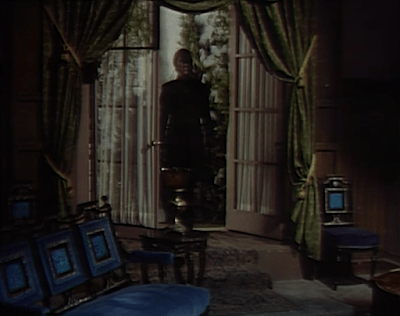
Even Diabolos, whom I think of less as an Associate Vice President of Hell than as an assistant regional manager for upper New England in the black magic division of some company to which the Devil has outsourced some of his less urgent terrestrial operations, was irked when witches expected him to come to them. Their summoning ceremonies ended with them finding themselves in his office, which appeared to be located in space he had rented in a corner of Barnabas’ basement. So regular viewers will be skeptical of the closing cliffhanger, when a shadowed figure appears in the window at the climax of the ceremony meant to summon Old Scratch himself.
My wife, Mrs Acilius, gives another reason to doubt that the figure really will turn out to be Satan. The most potent villains on Dark Shadows have all been female. The first supernatural menace was undead blonde fire witch Laura Murdoch Collins, who joined the show in December 1966 and transformed it from a more or less conventional soap into a thriller about the spiritual forces of darkness.
Barnabas came in Laura’s wake and brought a new audience, but the show was as slow-paced in his first months as it had been before Laura came. It was only when Barnabas teamed up with mad scientist Julia Hoffman in #291 that the plot started to move at a speed that could hold the attention of the preteen viewers Barnabas attracted.
From November 1967 to March 1968, the show was a costume drama set in the 1790s. We saw then that Barnabas became a vampire because of a curse placed on him by wicked witch Angelique. Angelique’s manic behavior kept the 1790s segment moving at breakneck speed, and the show never really slowed down again thereafter.
Late in 1968, we met the all-destroying ghost of Quentin Collins and the terrible werewolf Chris Jennings. Barnabas came to 1897 as a result of his efforts to find out what was behind these two menaces. What we have found is that they are both the products of a curse placed by another female character, Sandor’s wife, the charmingly amoral Magda.
Angelique herself has come to 1897 to plague Barnabas. Laura was present at the great estate of Collinwood in that year as well. Last week was devoted to a battle between Angelique and Laura, representing a contest between two versions of Dark Shadows. It was a foregone conclusion that Angelique would win that battle- no one believes we are going back to the sedate, atmospheric, tantalizingly spooky show that ran early in 1967. But the two women were far more compelling adversaries than were any two men who have squared off against each other on the show. If you put Satan on stage, you can’t very well top him with a bigger Big Bad, so once we see that the figure in the French windows is male, we can’t really believe that Evan and Quentin’s visitor is the one they have invited.



 Dark Shadows Commentary