Episode 232: One quick day

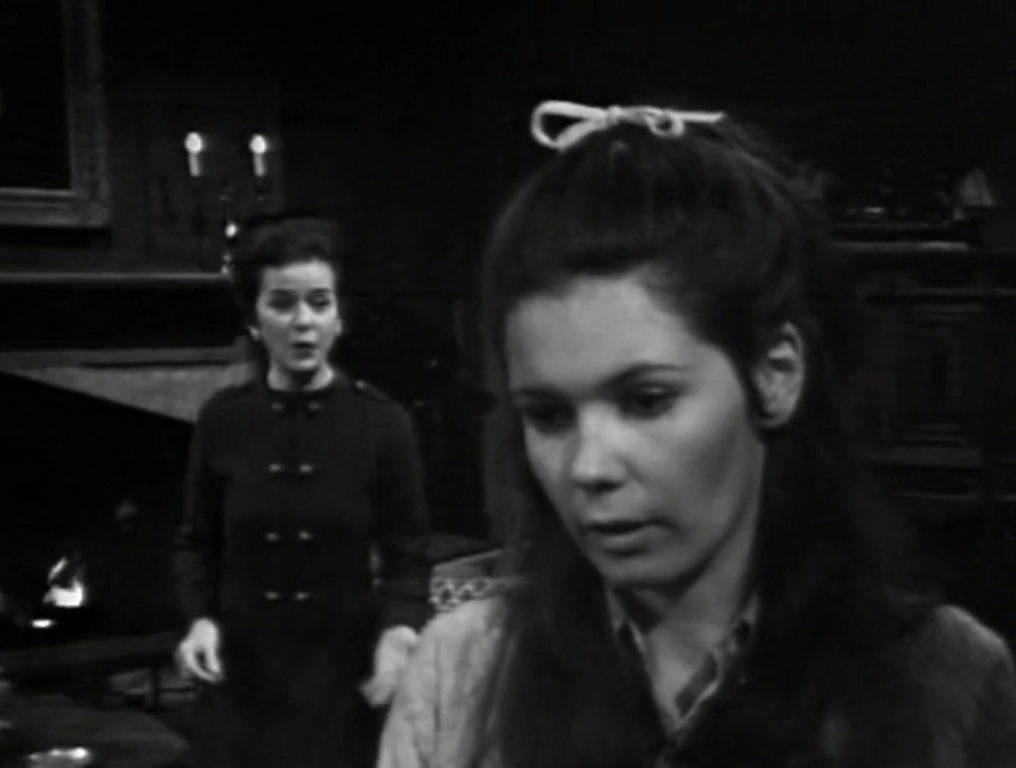
Maggie Evans, The Nicest Girl in Town, has been sick in bed. As long as the sun is up, she is very weak, has no memory of what’s been going on, and can sleep. When darkness comes on, she has wild mood swings and has to be physically restrained from running out into the night.

Moreover, the people who have spent the most time trying to help Maggie have no idea what is wrong with her and don’t seem to be making any progress towards finding out. Her doctor is as ignorant of medicine as are the writers, which is to say completely. The parts assigned to her father Sam and her boyfriend Joe consist of variations on the theme of helplessness.

As this episode begins, Maggie is still in bed, Joe is still sitting with her, and they are still at a loss to understand the situation or develop any plans. After yesterday’s episode, in which the actors labored mightily to inject three minutes of nonverbal storytelling into the half hour window Dark Shadows filled, things are looking pretty grim for the audience.

But then we get a sign of hope. Joe calls well-meaning governess Vicki and asks her to sit with Maggie. At the end of #229, Vicki realized that Maggie’s condition is the same as that which befell the luckless Willie Loomis a few weeks back. Moreover, Vicki is our point-of-view character, and she has consistently been the first to catch on to information after it has been shown to the audience. In the storyline centering on blonde fire witch Laura Murdoch Collins, Vicki led the team that opposed Laura’s attempt to burn her son David to death, and ultimately rescued David as Laura vanished in the flames. So if a battle is going to be waged for Maggie’s sake, we expect Vicki to be a central figure in it.

When Vicki takes Joe’s call, she is in the foyer of the great house of Collinwood. Seagoing con man Jason McGuire is in the same space, and asks her about Maggie. Vicki hates Jason, who is flagrantly blackmailing reclusive matriarch Liz. Vicki keeps trying to excuse herself without answering his questions, and won’t make eye contact with him. But Jason insists, and she tells him enough that he, too, recognizes that Maggie is suffering from the same thing that happened to Willie.

If we remember the ending of #229, this is a poignant moment. If Vicki and Jason could work together, they could solve the puzzle and discover that the mysterious Barnabas Collins is in fact a vampire who has enslaved Willie and is preying on Maggie. But Vicki’s eminently justified loathing of Jason, combined with Jason’s own shortcomings, makes this impossible. As a result, Barnabas is free to go on wreaking havoc.

While Vicki makes her way to Maggie’s house,* Jason goes to the Old House on the grounds of Collinwood to call on Willie. He finds that his onetime henchman’s face is badly bruised and scraped. Regular viewers know that Barnabas used his heavy cane to give Willie a beating the other day, and these disfigurements confirm that Barnabas is quite uninhibited in his use of violence.
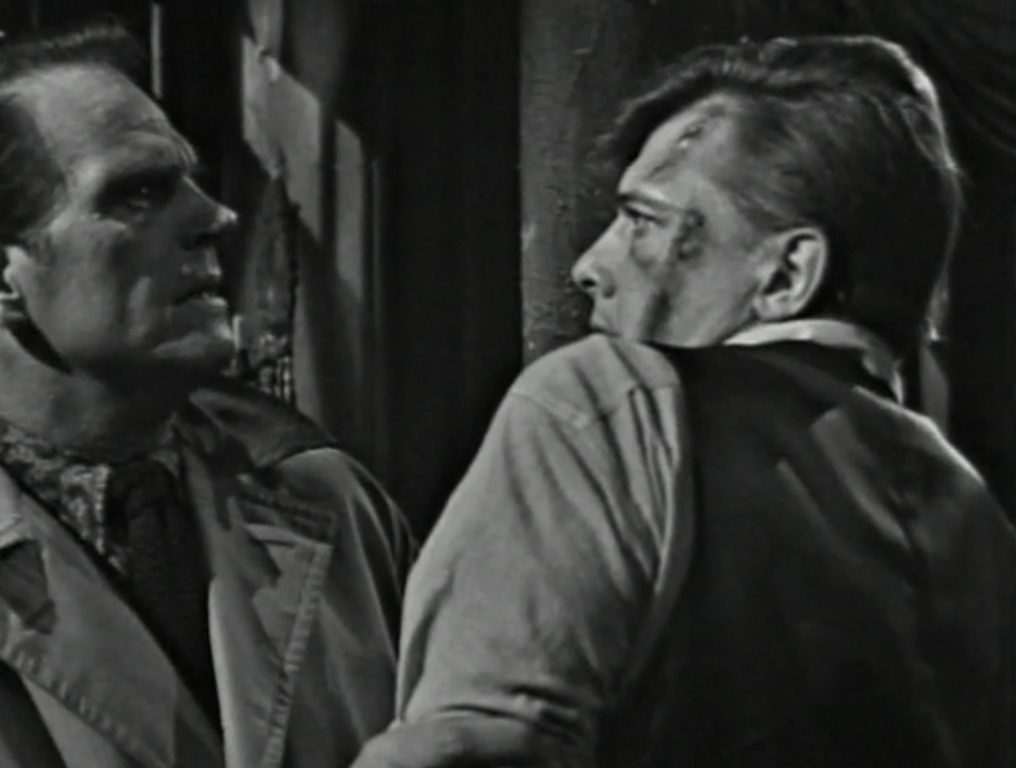
Jason discovers Willie’s wounds

Jason reminds Willie that he has found him a couple of times in Eagle Hill cemetery.** After one of those visits, Willie turned up very sick, with two little punctures in his skin and a great loss of blood. Though he was desperately weak during the day, at night he gained strength and ran out. Now, Maggie Evans has been found wandering in the same cemetery, and she exhibits the same symptoms.

Jason tells Willie that he won’t tolerate anything that might bring the police to Collinwood, and demands to know what is behind the troubles he and Maggie have had. Willie tells him it isn’t wise to probe into that matter. When Jason says that sounds like a threat, Willie replies that it is simply a warning. “Threat or warning, I don’t need either from you!” Willie has a strange faraway look as he replies “OK… but, at the moment, it’s all I have to give.” Willie then says “You’ll have to excuse me, but Mr Collins doesn’t like my entertaining guests.”

The reluctant host

The dialogue between Jason and Willie in this scene is spare and elegant, without a wasted word. The actors match it, giving delicate performances of a sort the scripts rarely support.*** As Willie, John Karlen begins it trying to conceal his wounds from Jason and scampering about the set looking for a place to hide. As Jason, Dennis Patrick begins in a stern but solicitous manner. When Jason cannot get Willie to tell him how his face was hurt, Jason finally declares “I’m not going to concern myself with what happened to you.” He then becomes more directly menacing, but with a faint undercurrent of panic as his fear that whatever is happening with Willie will upset his own plans grows. He loses his advantage, and Willie stops trying to hide. By the time the scene ends, Willie is in control. Jason promises to find out what Willie is up to, and Willie replies “Fortunately, you’re not a man who keeps his promises. Fortunately for you, that is.”

The scene is not only an improvement over the repetitious jabbering we heard in the episode Malcolm Marmorstein wrote yesterday, but such a departure from the usual standards of the show in this period that it’s hard to believe it was actually written by Ron Sproat, as the credits say it was. Joe Caldwell has been making uncredited contributions to the scripts for months now, and I believe this scene must have been one of his.

Vicki doesn’t know about Willie’s connection to Eagle Hill. She also doesn’t know that it was Willie who called to tell her where to find Maggie, something Jason figures out in his scene with Willie. Again, if it were possible for Vicki and Jason to pool their knowledge, things would start moving very quickly.

Back in the Evans cottage, Joe tells Vicki that Maggie is not herself. “I was in that room with her most of the day. I never missed her so much in my life.” I think that line was also one of Caldwell’s. Sproat was capable of writing the occasional lapidary epigram, as indeed was Marmorstein, but neither of them had much feeling for what the actors could do. So few people could deliver that line in as natural a tone as Joel Crothers achieves that it must have come from a writer who had Crothers’ voice in his head.

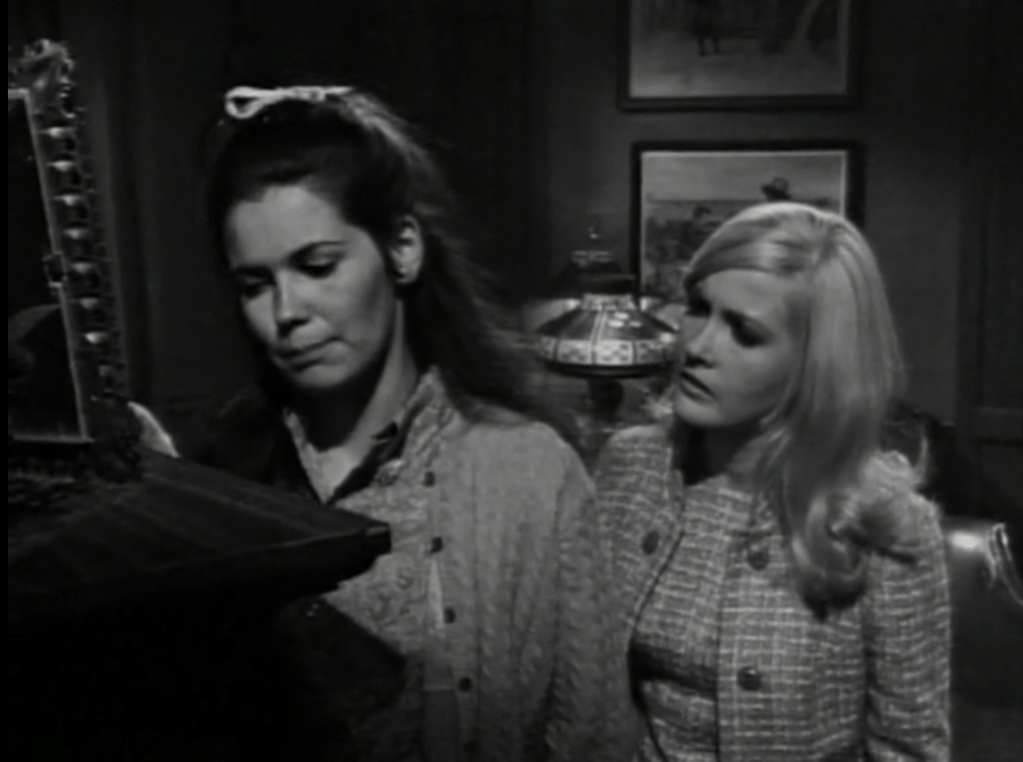
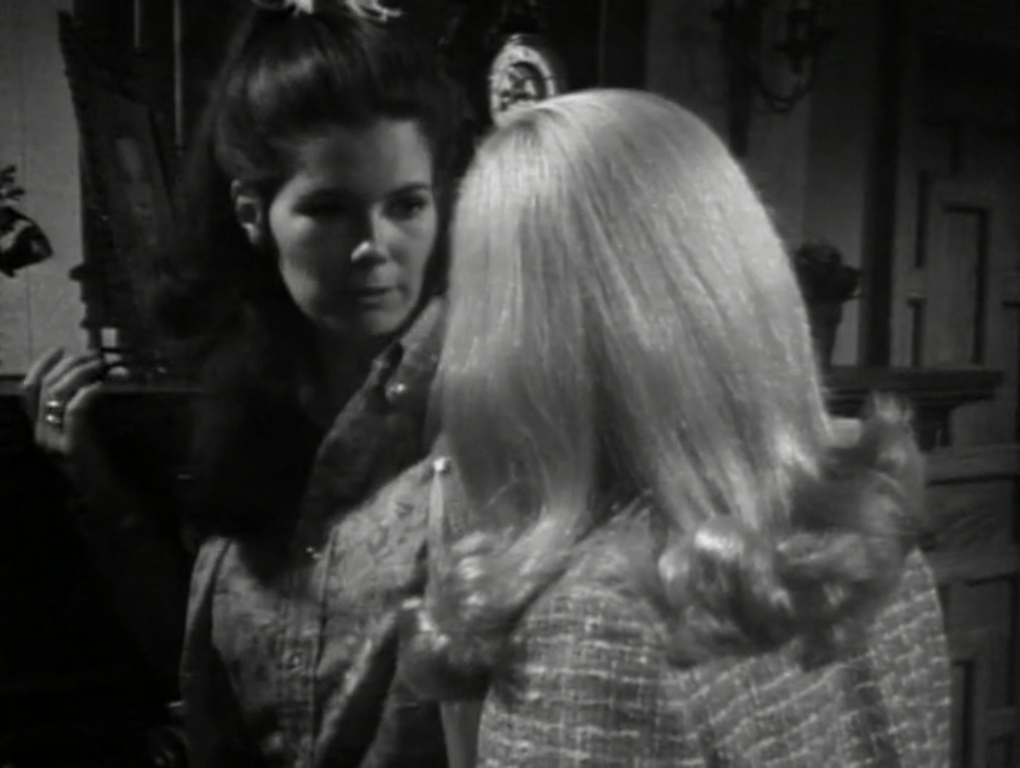
When Maggie was alone with Joe, she yelled at him to go away and never come back. Then, she sounded like a sick person who didn’t know what she was saying. With Vicki, she says very calmly that she and Joe must never see each other again as long as she lives. It leaves no doubt that she is protecting him, wanting him to stay away from her as she is absorbed into Barnabas’ world of the undead. That was clear enough to the audience yesterday, when she found herself receiving a transfusion of Joe’s blood and screamed that she didn’t want anyone’s blood, especially not his. If Vicki were able to add Jason’s information about Willie to what she already knows, she might begin to suspect something like it.

The thunder roars, the french windows swing open, and an ominous silhouette appears in the lightning. It is the figure of a man in a cape, holding a cane in his left hand.**** Vicki stifles a scream. The lightning illuminates the night again, and the figure is gone. Vicki rushes to close the windows, ignoring Maggie’s plea to leave them open.

Now you see him
Now you don’t

After closing the windows, Vicki turns to Maggie, bends over, and creaks out in a frightened voice “Ma-a-aggie!” Maggie responds “It’s all right… it’s all right now… it’s all right.” We cut to the closing credits, wondering just how wrong Maggie’s version of “all right” has become.

*How, I’d like to know? It’s unlikely she walked- Collinwood is miles from town, it’s a dark and stormy night, and several local women have been attacked by an assailant who is still unidentified and at large. But she doesn’t ask anyone to lend her a car, as she always has when she has wanted to go anywhere in previous episodes. Joe doesn’t say anything about coming to get her. And there hasn’t been any indication that she herself has acquired a car, or a bicycle, or a pogo stick.

**The show is still equivocating on the name of the cemetery. When it was first mentioned in #209, it was called “Eagle’s Hill.” Vicki and Sam still call it that, but the other characters who have mentioned it call it “Eagle Hill.” Eventually that latter form will become usual.

***John Karlen uses a vaguely Southern accent at some moments today. The first Willie Loomis, James Hall, is from Mississippi, and Karlen sometimes tries to make his version of the character sound like he also came from that part of the world. Eventually he will give up on that, and Willie, like Karlen, will be a native of Brooklyn.

****As a private joke,amusing only to me, I think of this as “Barnabas Collins #4.” Before the part was cast, producer Robert Costello was the model in the first stages of the painting of the portrait of Barnabas. Then stand-in Timothy Gordon played the hand that darts out of Barnabas’ coffin and grabs Willie’s throat in #210. Jonathan Frid first appeared in #211, making him Barnabas Collins #3. Today, stand-in Alfred Dillay becomes Barnabas Collins #4.

Episode 229: A very sick girl

The opening voiceover tells us that “Evil reaches deeply into man’s soul, turning his heart to stone, transforming him into a vile monstrosity, and it is horrible to observe this process in an innocent and not be able to recognize it or prevent it.” Without that introduction, first-time viewers would have no reason to assume that Maggie Evans, The Nicest Girl in Town, is going through anything other than an ordinary sickness that has her looking bad and snapping at people.

Kathryn Leigh Scott does play Maggie’s moodiness very well. She does an especially admirable job in the scene where she yells at her boyfriend, hardworking young fisherman Joe, and orders him out of the house. After Joe goes, Maggie looks directly into the camera, and returning viewers will recognize that she is well on her her way to becoming the undead.

Bloofer lady

Meanwhile, well-meaning governess Vicki and dashing action hero Burke are dressed up and having dinner in Collinsport’s only night spot, The Blue Whale. Most of the time, The Blue Whale is a waterfront dive with frequent bar fights. But when Burke and Vicki dine there in their good clothes, the place transforms into a respectable restaurant, as it did in #189.

Burke and Vicki recap some plot points surrounding the great estate of Collinwood. Later, Maggie’s father Sam comes in and tells them of her condition. Vicki replies to Sam’s description with “Now let me see if I understand this. You said that yesterday she was sick and she collapsed, and last night she was up and around, and this morning she was sick again?”

In his post about this episode on his great blog Dark Shadows Every Day, Danny Horn’s response to this line is “IT IS NOT OKAY TO SUMMARIZE A RECAP THAT HE JUST SAID ONE SENTENCE AGO.” It’s true that the episode is heavy on recapping. A defter writer than Malcolm Marmorstein probably would have started the scene with Vicki putting this question to Sam, leaving out the recap that it re-recaps. But Vicki’s question itself is a good moment. As she delivers it, Alexandra Moltke Isles uses her face to show Vicki coming to a realization that has so far eluded everyone else.

The moment of recognition

Vicki recognizes that Maggie’s symptoms are identical to those which sorely bedraggled blood-thrall Willie Loomis displayed a couple of weeks ago. As she explains this, we see Burke gradually catch on and Sam absorb the information. Up to this point, everyone has been remarkably obtuse in failing to make this connection- the same doctor who examined Willie examined Maggie today, and doesn’t give any sign of recognizing it, or for that matter of understanding anything else relating to medicine.

As Vicki was the only character yesterday who escaped the long-running Idiot Plot that goes on because everyone fails to notice the abundant evidence that reclusive matriarch Liz killed her husband and buried him in the basement, so she is the only character today who spots the obvious similarity between the cases of the two victims of the vampire. The show is still sputtering along, but in a Smart Vicki turn like this we can find a glimmer of hope that it will start moving soon.

Episode 228: An unending succession of demands

We start with the twelfth iteration of a ritual that has been numbing our minds since March. Seagoing con man Jason McGuire makes a demand of reclusive matriarch Liz, in this case a position as Director of Public Relations for the Collins family business. Liz resists. Jason threatens to expose her terrible secret. Liz capitulates.

Liz’ daughter, flighty heiress Carolyn, is fed up with Jason’s endless impositions on her mother and everyone else in and around the great house of Collinwood. She knows that Jason was a friend of her long-absent father, Paul Stoddard. When her uncle, high-born ne’er-do-well Roger Collins, tells her that some belongings of Stoddard’s are kept in the mysterious locked room of the basement of Collinwood, Carolyn decides she wants to go into the room and examine them.

Liz has the only key to the room, and hasn’t let anyone in it in the 18 or 19 years since Stoddard disappeared. She is shocked when Carolyn asks for the key. She tells her that they have nothing of Stoddard’s and that the room is empty. Roger and well-meaning governess Vicki are there when Carolyn presses Liz on the subject and Liz becomes agitated.

Later, Liz talks to Vicki privately and apologizes for her tone in that conversation. Vicki can’t believe that the locked room is empty. Vicki turns away from Liz, looks down, and says she can understand that it would be painful for her if Carolyn went through Stoddard’s belongings. We’ve seen Vicki try to lie on several occasions. She has always been unsuccessful at it, in part because she has mannerisms like these that give her away.

Vicki lying to Liz

Liz is so desperate to recruit an ally that she ignores Vicki’s tells, and immediately confirms that she is keeping things of Stoddard’s in the room. She must not realize that Vicki is an inept liar, because she asks her to back up her own lie and to persuade Carolyn that the room is empty.

Liz choosing to believe Vicki

In the study, Vicki finds Carolyn searching for the key to the locked room. The two women argue a bit about whether Carolyn ought to let herself into the room. Vicki turns away from Carolyn, looks down, and asks her to consider that her father’s things might not be in the room at all. Since these are the same mannerisms that told us she was lying to Liz, at first we think she is getting ready to repeat Liz’ lie to Carolyn.

Vicki looking like she’s about to lie to Carolyn

Carolyn asks Vicki what she is talking about. She turns to Carolyn and says that she wonders if there is something hidden in the room that would be far worse to uncover than a few random possessions of Paul Stoddard’s could be. With that, we cut to the closing credits.

Vicki not lying to Carolyn

The whole story of the locked room is a case of what Roger Ebert famously called “Idiot Plot,” a story that would end immediately if any of the characters were as smart as the typical member of the audience. No one has seen or heard from Stoddard since he disappeared. Liz hasn’t left the house since that night. She fired all the household staff, replacing them with a single extremely unsociable man, and discouraged strangers from entering the house. She is terrified of anyone entering a room in the basement that she locked shortly after Stoddard left, and is now flagrantly being blackmailed by a man who was around at that time.

It’s refreshing that Vicki is the one who seems to be figuring out that Stoddard’s corpse might be buried in the locked room. Again and again, the writers have painted themselves into a corner and found themselves able to get from one story point to the next only by having a character disregard all available facts and logic and do something inexplicably foolish. Since Vicki gets more screen time than anyone else, it has usually fallen to her to be Designated Dum-Dum. Indeed, the writers will eventually rely on Dumb Vicki so often that the character becomes unusable. But today, we get a look at Smart Vicki, and that version of her is terrific.

Episode 25: A neat way of managing people

The episode revolves around a letter to Victoria from the Hammond Foundling Home. The letter reports that no one connected with the Home had ever heard of the Elizabeth Collins Stoddard or any of the other Collinses before the letter came offering Vicki the job as David’s governess. This letter has set Elizabeth into a panic, since it exposes as a lie her story that Roger was friends with someone connected to the Home and that that person had recommended her. It sets David into an even more extreme panic, since he is terrified that his father will send him away to some kind of institution where children are kept and the Hammond Foundling Home is such an institution.

In her panic, Elizabeth demands that Roger sit down with Vicki and corroborate her lie. Roger is worried that Burke, who has hired private investigators to look into Vicki’s background, will discover some piece of information that will damage the family, and wants Elizabeth to confide in him. He is insistent enough about this to raise the audience’s hopes that in some future episode, we will get answers about Vicki through dialogue between the two of them. For now, she shuts him down by threatening to throw him out of the house unless he obeys her.

When Roger does talk with Vicki, she reminds him that she had asked him if she knew anything about her or about the reason she was hired when they first met. He had said no, and in every way showed bafflement about how Elizabeth heard of her. He tries to explain that away by saying that he was distracted by worry about Burke, and tries to deflect further questions by saying that his contact is a donor who wishes to remain anonymous.

Vicki is obviously unconvinced. Alexandra Moltke Isles has strabismus, and in her closeups during the scene with Roger she turns this to her advantage. Her eyes seem to be moving independently of each other, a more polite expression than eye-rolling, but just as effective at communicating disbelief. Marc Masse captured the effect quite well in this still image, on his Dark Shadows from the Beginning:

Roger’s remark to Elizabeth in this line, that she has “a neat way of managing people,” applies equally well to Vicki in her scene with him. At the end of the conversation, she knows that he was lying, and he knows that she knows. She also knows that he is under his sister’s thumb, not a threat to her position no matter how uncomfortable he may find her presence on the staff, and he knows that she knows that.

David’s panic leads him to take a less devious path than does his aunt, but ultimately an even more disastrous one. He steals the letter from Vicki. His father catches him with it and returns it to her.

Vicki herself is less concerned with the letter than with a thought we saw take shape in the back of her mind at the end of episode 23. She asks David about the magazines on auto mechanics he likes to read, about how he learns to put things together and take them apart. David responds with a denial that he sabotaged his father’s car; Vicki calmly replies that she hadn’t accused him of that.

Vicki comes into the drawing room and tells Elizabeth that David has been acting strangely ever since his father’s car went off the road, that when the sheriff came he was overwhelmed with the thought that he would be arrested, etc. Elizabeth dismisses the topic brusquely, seeing no significance in it. Vicki persists in the topic, reminding her that the sheriff said they should try to think of someone other than Burke who might want to kill Roger. Elizabeth declares “There is no one else”; at that, Roger sashays into the room and declares “Except my loving son, of course.”

Elizabeth has even less patience with this remark from Roger than with whatever it is Vicki is saying, and moves along so that Roger can tell Vicki the lie she has ordained. In the course of that conversation, she again says that they don’t actually know that Burke was the saboteur, a point that is no more meaningful to Roger than it had been to his sister.

Afterward, she goes back to her room and finds that David has stolen the letter again. She goes to his room to look for it. She doesn’t find it. Instead, she finds the bleeder valve, evidence that her suspicions are correct.

Episode 23: The dignity of my badge

Roger has finally deigned to notify the police of his suspicion that Burke Devlin tampered with his brakes in an attempt to kill him. In story time, that was twelve hours ago. In the interim, both Roger and Bill Malloy have gone to Burke’s room and told him everything they know and think they know. Roger presented Burke with Vicki and her testimony. The newspaper has run a front-page story about it.

The sheriff is peeved that Roger is bringing him into it only now. Roger explains that his goal in giving Burke all the evidence in advance of any investigation was to persuade him to leave town, but that he never had the opportunity to present that idea to Burke.

Upstairs, Vicki is trying to teach David a lesson about the history of Maine. Considering that we learned in episode 13 that Vicki has never heard of Augusta, the capital of the state, it’s difficult to be optimistic about that instruction. But every scene between David and Vicki in his room is worth watching. No matter what lines they may be required to say, David Henesy and Alexandra Moltke Isles always use body language, facial expression, tone of voice, and spatial position to convey the emotions appropriate to their characters. As episode follows episode, those emotions shift from wild hostility on David’s part and patient solicitude on Vicki’s to genuine affection and trust. It’s the one story-line that really works in the first 42 weeks of the show.

David made some incriminating remarks to Vicki and his aunt the night of his father’s wreck; they both thought he was simply expressing his guilt over his hostility to his father. In this one, he asks Vicki if she ever tried to kill anyone. She tells a story of some fist-fighting she did at the Hammond Foundling Home, and says that’s as close as she got. She looks happy telling David that story, not because it’s a happy story, but because it’s a chance to make a connection.

She isn’t happy at the end of the episode- when David grabs at the bleeder valve and the other adults ignore his action, we see it dawn on her that he is the culprit.

I had a lot to say about this episode in the comments section of John and Christine Scoleri’s Dark Shadows Before I Die. Here it is:

I don’t agree that Constable Carter seems intelligent. He greets David by asking his name. If a cop has been on the job for over ten years in Collinsport, a town under the shadow of a big house called Collinwood, home of the the Collins Cannery and the Collins Fishing Fleet, and he still doesn’t know the four members of the Collins family, he’s an idiot.

Of course, he is sensible when he’s demanding to know why Roger waited twelve hours before coming to him and expressing incredulity at Roger’s visit to Devlin. Characters in soaps and suchlike productions are always declaring they have to do their own investigations before they can go to the police, and often this is treated in the story as if it were a reasonable thing to do. But every step of the way they’ve lampshaded the preposterousness of it. Vicki kept telling him it was a bad idea before he did it, last episode Sam reacted scornfully when he told him what he repeats to the constable here, that he wanted to give Devlin a chance to leave town and never come back. And the constable shows the same scorn for the idea today.

Those scenes make Vicki, Sam, and the constable look smarter than Roger, but we’ve seen enough of Roger to know that he isn’t a fool. Something is clouding his judgment, something more complicated and slipperier than the stories that have been suggested to us so far. Roger is hiding more than one thing, and he doesn’t trust himself with his own secrets.

David looks at the camera again today, when he’s eavesdropping on the conversation with the constable. An effective tactic- we the audience know what he knows, and he seems to be pleading with us to keep quiet.

Another meaningful look at the end of the episode. When the constable, who is an idiot, says cheerfully that now we’ll know how David’s fingerprints got on the wrench, Vicki gives David a grim little glance. Just for a second- but not only is it the last moment of the episode and therefore emphatic, it is also the second time we’ve seen her give David that look. The first time was in his room, when he was betraying himself with some remarks about how terrible it would be to go to prison. We can see a terrible idea starting to form in the back of Vicki’s mind.

Episode 21: “Carolyn’s mother is a witch.”

In the teaser, Carolyn asks Vicki what’s on her mind. “The meaning of life?” “No, just the opposite- death.” Exchanges like that go a long way towards explaining the appeal the show has to depressives. Casting makes a difference, too- actresses Nancy Barrett and Alexandra Moltke Isles seem to be far from death-obsessed, so they can deliver the most preposterously gloomy lines without boring the audience.

After the first break, Vicki and Carolyn are having breakfast in the kitchen. As it always does, that set creates an intimate atmosphere which makes it seem natural that the characters should share confidences. Carolyn confesses her feelings of guilt at having brought Burke to the house; Vicki confesses that she doesn’t believe Burke tampered with Roger’s brakes. For some reason, Vicki tells Carolyn that when she was six years old, an attendant at the foundling home played a prank and told her that her birth parents would be coming for her. All of Vicki’s stories about her childhood are like that, it’s no wonder she feels at home in Collinwood.

There’s a scene between Bill Malloy and Burke in Burke’s room. It’s always interesting to see actors as talented as Mitch Ryan and Frank Schofield playing off each other. It is puzzling that a Collins family retainer as loyal and intelligent as Bill would go to Burke before the police have a chance to question him or search his room and tell him everything he knows and suspects about the crime. But Roger has already tipped his hand to Burke, so another indiscretion isn’t going to damage the prospects of the prosecution by much. This scene, in which Burke is eating breakfast while Bill is confronting him with his suspicions, is intercut with the scene in which Vicki and Carolyn are eating breakfast and consoling each other. So, opposite extremes- former friends in a hostile setting, new friends in a nurturing setting.

Carolyn tells Liz that Vicki doesn’t think Burke is guilty. Liz responds that she doesn’t “care what Miss Winters thinks.” Liz then collapses into pity for Carolyn and guilt about herself as a mother. She remembers that when Carolyn was a child, she would come home from school crying because the other children taunted her, saying that “Carolyn’s mother is a witch.”

That’s an interesting story, because it implies that Carolyn went to the school in town. How did she get there? It’s much too far to walk. Did a school bus come up the hill to Collinwood to pick her up and drop her off? That’s a bit hard to imagine. Liz doesn’t want anyone around the place. Sooner or later, some adventurous child would slip off the bus with Carolyn and go exploring the grounds, no doubt finding a way into the house itself. Roger didn’t live there until recently, and Liz has never set foot outside the grounds since Carolyn’s birth. The only servant on the estate is Matthew, and he and Carolyn are not at all close, not as they would be if he’d taken her to and from school every day in her childhood.

That leaves Bill Malloy. He comes to the house more or less daily to go over business with Liz- perhaps he used to combine those visits with picking Carolyn up for school and dropping her off afterward. He is very close to her, calling her “Princess.” He’d have to pick her up very early in the morning, since his responsibilities involve supervision of the fishing boats. She might still have been in her pajamas. She’d have needed to get dressed and have breakfast at Bill’s house. We learn later that he has a housekeeper who has been with him many years; much, much later, that housekeeper will reminisce with Carolyn about brushing her hair for her when she was a little girl. So maybe that was it…

Vicki talks with Liz and Carolyn about the private investigator Burke has hired to look into her background. Liz doesn’t want to talk about anything that touches on how she heard about Vicki and what she knows about her, but by a skillful line of Socratic questioning, Vicki leads Liz to the conclusion that something about her origins might be embarrassing to someone associated with Collinwood. Liz walks out of the room, as Euthyphro walks out when Plato’s Socrates springs a similar trap for him, and we can see how smart and determined Vicki is.

Scenes that focus on the question of Vicki’s origins tend not to get much attention from fandom, perhaps because the whole story-line ultimately fizzled out with no resolution. But watching it forward, not thinking about what comes later, we can see some strong scenes devoted to it.

Episode 4: Frightening a new friend

Here’s the comment I left on the Scoleris’ Dark Shadows Before I Die blog entry about this episode:

Interesting how the early episodes tiptoe towards the supernatural. Burke, Roger, and Carolyn all use the word “ghost” metaphorically, to refer to unresolved conflicts from the past that are still causing problems in the present. Liz and Vicki, each in her turn, responds by saying there are no such things as literal ghosts, only to hear the first person assert that there absolutely are. Giving this same little conversation to both Liz and Vicki is one of the ways the show tries to establish Liz and Vicki as mirrors of each other, of presenting Liz’s current life as a possible future for Vicki and of Vicki as a revenant of Liz’s past.

The sobbing sounds Vicki hears in this one are the first occurrences that would have to be explained as the act either of a ghost or of someone trying to make Vicki believe there are ghosts. The next such moment will come in episode 14, and there will be several more in the weeks and months ahead. This tiptoeing is what the Dark Shadows wiki on fandom tracks as “Ghostwatch.”

In view of the near-sexlessness of the later years of the show, it’s striking how frank this one is. Roger’s aggressiveness towards Victoria is plainly sexual. Liz catches him trying to sneak into Victoria’s bedroom, he derides her attempt to regulate his “morals.” He offers Victoria a drink, they talk about pleasure and pain in words that so clearly about sex that they barely qualify as sens double. Indeed, that is the only moment in the whole series when Victoria seems like what she’s supposed to be, a street kid from NYC. And the flirtation between Uncle Roger and his niece Carolyn is so blatant that it’s a wonder how Louis Edmonds and Nancy Barrett keep the scene from making the audience either laugh or feel ill.