Episode 842: Some kind of an unnatural creature

Mad scientist Julia Hoffman has traveled back in time to the year 1897 to help her friend, vampire Barnabas Collins. Julia has fallen into the clutches of sorcerer Count Petofi and is bound and gagged in Petofi’s lair. A loaded revolver is tied to the doorknob, rigged to fire a round through her heart when the door opens.

Barnabas has learned where Julia is, but not about the death-trap in which she is ensconced. He storms into the building, turns the doorknob, and thereby discharges the gun. He sees Julia slumped over in her chair, and shouts at Petofi’s henchman that he will kill him. He then goes to Julia and finds that she is alive. There is a bullet-hole through the back of her chair, but she herself is unharmed.

Julia declares that there is only one explanation for this phenomenon that makes sense. Considering the kinds of stories that play out on Dark Shadows, we would think that an explanation that makes sense would be the one we could discard immediately, but Julia plows ahead. When she traveled back in time, only her “astral body” made the trip. Her physical body is still in 1969. For his part, Barnabas had a body in 1897, trapped in a sealed coffin. That body is hosting his personality, which is why he is subject to physical injury. But Julia is in no danger. When she later says that she can disregard Petofi’s threats, Barnabas says that if he finds out the truth, Petofi will just find another way to immobilize her, so she has to lie low.

Petofi is so powerful that Barnabas does not believe that he and Julia can fight him by themselves. So he tells Julia to summon wicked witch Angelique. Barnabas and Angelique have been enemies for centuries, but he thinks they have a common cause now. Angelique is determined to marry his cousin Quentin, whom he has befriended and Petofi has enslaved. So Barnabas expects she will agree to help fight Petofi.

Angelique does come in response to Julia’s message. She remembers Julia from time she herself spent in the 1960s, and is shocked to find her in 1897. Julia refuses to explain how she made her way back in time. She says that if Angelique can come to 1897 from 1968, she oughtn’t to be surprised she has come there from 1969. Angelique responds that Julia is not like herself and Barnabas. “I’m human,” says Julia. Since she is separated from her proper body, she isn’t fully human, not at the moment, but she still takes evident satisfaction in applying the label to herself. This marks a contrast with Angelique, who was offended earlier in the episode when Petofi laughed and taunted her for being “so human.” Julia and Angelique then snipe at each other about their respective relationships to Barnabas.

Julia says that it is essential Barnabas should “complete his mission” and solve the problems they were facing in 1969. Angelique responds that he will never be able to do that, because he has changed history too much in the time he has spent in 1897. This remark is intriguing for regular viewers. Barnabas’ six months of bungling around, picking fights, and committing murders must have had major consequences for what came after. That gives the show two ways forward. When Barnabas and Julia go back to a contemporary setting, they might meet an entirely different cast of characters and have to find a place for themselves in an alternate universe. Or they might do what they did when the show’s first time-travel story ended in March 1968, and dramatize the force of the Collins family’s propensity for denial. The head of the family in the 1790s decided to compel everyone in and around the village of Collinsport to pretend that none of the events we had seen had ever taken place, and when the costume drama segment ended we found that he had made that pretense stick ever since.

After Julia points out that it is to her advantage to emancipate Quentin from his bondage to Petofi, Angelique agrees to help. She still will not answer Julia’s questions. After she leaves the room, Julia looks in the mirror, sees an image of Angelique, and says that now she understands what she is going to do and believes it will work. That puts her one up on the audience.
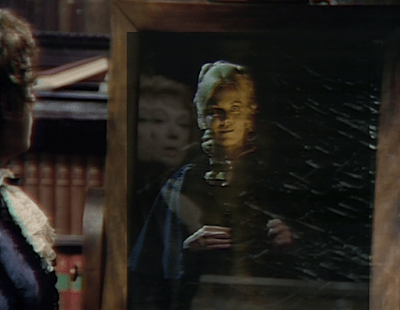
Julia looks for an image of herself, and finds Angelique. Screenshot by Dark Shadows Before I Die.

The scene pairs Julia and Angelique as two women whose lives have been shaped by their pursuit of Barnabas. Their bickering makes this similarity explicit. When Julia looks in the mirror and sees Angelique, they put very heavy emphasis on the similarity. In a brilliant, but now inaccessible, post on the great Collinsport Historical Society,* Wallace McBride wrote that “On Dark Shadows, your reflection always tells the truth.” He demonstrated that on the show, reflections are very strongly coded as true, so much so that they must be making a serious statement when they give us an image like this one. They are committing to the idea that Julia is, in some important way, the same as Angelique.

There are also a couple of scenes featuring the repulsive Roger Davis as artist Charles Delaware Tate. Mr Davis is especially hard to take in a scene with Donna McKechnie as the mysterious Amanda Harris. Miss McKechnie had already done outstanding work on Broadway as a singer and dancer by this time, but she felt herself to be a beginner as an actress, and she could not conceal her discomfort when Mr Davis shouted his lines. The 4:3 aspect ratio of old-time American television meant that the performers spent much of their time only a few inches from each other, and when Mr Davis yells in Miss McKechnie’s ear, she winces. He clutches at her arm, and she recoils; before she can relax from that invasion of her space, he slams down on a table, making a loud noise and causing her to jump.

Mr Davis’ incessant shouting will bring back memories for viewers who have been with the show from the beginning. The scene takes place on a set which is known in the parts of Dark Shadows set in the 1960s as the Evans Cottage. The Evans Cottage was home to drunken sad-sack Sam Evans and his daughter Maggie, The Nicest Girl in Town. Sam, like Tate, was an artist, and the artworks scattered around the set in the 1897 segment remind us of the cottage’s iconography.

The first seven times we saw Sam, between #5 and #22, he was played by an actor called Mark Allen. Like Mr Davis, Allen had considerable training as an actor and a long resume of stage and screen appearances. Also like him, he is just terrible. Mr Davis did have extensive skills and could on occasion give nuanced performances, though he rarely chose to do so. He much preferred spending his time roughing up the women and children in the cast.

But Allen never once did a good job of acting. In each of his episodes, he either shouted every line with the same ear-splitting bellow, or whined every line in the same putrid snivel. Allen didn’t assault his scene partners on camera, as Mr Davis routinely did, though Kathryn Leigh Scott, who played Maggie, has made it clear that she did not feel safe in scenes where they embraced. Moreover, in some corners of fandom there are persistent rumors about abusive behavior off-camera that led to Allen’s dismissal. People claim to have heard remarks cast members and others associated with the show let drop at Dark Shadows conventions over the years, and from those remarks they come to some alarming conclusions about what Allen did behind the scenes. Who knows if those conclusions are correct, or if the people who report the remarks even heard them clearly, but Allen was so unpleasant as a screen presence that it is tempting to believe the worst about him.

The point of Tate’s scene with Amanda is that she does not want to believe that she is an artificial being who came to life when he painted a portrait that looked like her. Tate’s success as an artist is the result of magic powers Petofi gave him; he just recently learned that he can make things pop into existence by drawing or painting them. To convince Amanda that he has this power, Tate sketches an imaginary man. She screams, and we see her looking at the man who has come into being.

This seems like a bad choice on Tate’s part. Why not draw an inanimate object instead? If he’d drawn a hat or a gold bar or a gemstone, he could just have given it to Amanda with his compliments. But now he has a 25 year old man whom he is obligated to help make his way in the world. If an inanimate object wasn’t a striking enough image to send the episode out with a dash of spectacle, then Tate could have created a farm animal, such as a donkey or a goat. If Amanda didn’t want such an animal, Tate could just shoo it outside and be confident someone would claim it- Collinsport is supposed to be a tiny town in the middle of a rural area, after all. But for all the irresponsible behavior we’ve come to accept from characters on Dark Shadows, we are not going to be able simply to forget about this human being. They are going to have to do something to account for him.

*A site which has now been taken over by a “crypto-based casino” outfit! You’d be safer at Collinwood.
Episode 330: bat by Bil Baird

Dangerously unstable ruffian Willie Loomis spent a week staring at the eighteenth century portrait of Barnabas Collins in the foyer of the great house of Collinwood back in April, then tried to rob Barnabas’ grave. That turned out to be an awkward situation when Willie found that Barnabas wasn’t entirely dead. Barnabas was a vampire who bit Willie, turned him into his sorely bedraggled blood thrall, and had lots of conversations with him. Yesterday, Willie was written out of the show.

Today we open with strange and troubled boy David Collins staring at the same portrait. As Willie was obsessed with the idea that there were jewels hidden in the Collins mausoleum in the old cemetery north of town, where in fact Barnabas’ coffin was hidden, so David is preoccupied with the idea that Barnabas has something terrible stashed in the basement of the Old House on the estate, where in fact his new coffin is hidden. As Willie sneaked off to the cemetery on his ill-starred expedition, David will sneak off to the Old House today and try to search Barnabas’ basement.

Unlike Willie, David is not driven by greed. He is afraid of Barnabas, and his friend, the ten year old ghost of Barnabas’ sister Sarah, has told him that he must not go to the Old House. But his aunt Liz and his father Roger dismiss his attempts to warn them about Barnabas, and he thinks it is his duty to provide them with evidence. So he screws up his courage and makes his way across the property.

David lets himself into the Old House by opening the parlor window. Not only have we seen David do this before, but Willie’s sometime friend, seagoing con man Jason McGuire, got into the house the same way in #274. Barnabas would kill Jason when he reached the basement in #275, so you might think he’d have put a lock on that window by now.

Jason’s fate is certainly on the minds of returning viewers when David tries to open the basement door. It comes as a relief when he finds the door locked. Barnabas’ co-conspirator, mad scientist Julia Hoffman, catches him there.

Julia demands to know what David is doing in the house, and he tries to brazen it out. He claims that he has a right to be there, since it belongs to his Aunt Liz. This is a bit of a murky point- we never see Liz transfer title to Barnabas, but she and others act as if he owns the place and its contents. Julia doesn’t clarify it when she responds that Liz gave the house to Barnabas- she doesn’t deny that it still belongs to Liz, only says that it also belongs to Barnabas.

Back in the great house, Roger is banging away at the piano. We saw Liz play the piano in #47 and #91, a reference to the conception of her character writer Art Wallace developed in his original story bible, titled Shadows on the Wall, in which she, like similar characters in a couple of TV plays he wrote in the 1950s under the title “The House,” gave piano lessons. Since then, Liz’ daughter Carolyn tried her hand at “Chopsticks” in #119 and used the piano as a prop in a teen rebel scene in #258, and Jason poked at a few keys in #198. Roger isn’t exactly Vladimir Horowitz, but he’s the first one we’ve seen who actually achieves a melody.

Liz comes in and tells Roger that David isn’t in his room. They fret over David’s attitude towards Barnabas. Julia brings David home and tells Liz and Roger where she found him. After an angry scene between father and son, David goes upstairs, and Liz scolds Roger for his inept parenting. In these as in all of Liz and Roger’s scenes together, we see a bossy big sister who tries to govern her bratty little brother, but who ultimately abets all of his worst behavior.

In the Old House, Barnabas notices that Julia is troubled. He keeps asking what’s on her mind, and she has difficulty deflecting his questions. This is odd- Julia has been established as a master of deception, and Barnabas is the most selfish creature in the universe. All she has to do is start talking about something that does not affect him directly, and he will lose interest at once. Rather than talk about her personal finances, or the job from which she is apparently on an indefinite leave of absence, or some ache or pain she might have, or how sad she is to miss her Aunt Zelda’s birthday, she brings up Willie. That does get Barnabas’ mind off her tension, but it also reminds him of David. He thinks David knows too much about him, and is thinking of murdering him. Julia assures him that the boy doesn’t know so very much, that whatever he does know he hasn’t told anyone, and that if he does say something his reputation as an overly imaginative child will lead the adults to ignore him.

From the beginning of the series, we’ve heard people say that David is “imaginative.” The audience finds an irony in this, since we have never seen David show any imagination whatsoever. All his stories of ghosts are strictly literal accounts of apparitions he has seen. We’ve seen some drawings he has done and heard quotes from some essays he has written. Some of these are technically accomplished for a person his age, but they are just as literal as his ghost stories. And when he tells lies to cover his various misdeeds, he tells simple little tales that fall apart at once.

In #327, well-meaning governess Vicki became the first character to dissent from the “David is a highly imaginative child” orthodoxy. Liz and local man Burke Devlin were dismissing David’s laboriously accurate account of his latest encounter with Sarah as a sign of his “imagination,” and Vicki interrupted with “I don’t think it has anything to do with his imagination.” Now, Barnabas goes a step further. After pronouncing the word “imaginative” in a truly marvelous way that makes it sound like something I’ve never heard before, he tells Julia that she has given him an idea. Frightened, she asks what he means. All he will say is “You’ll see.”

Roger goes to David’s room and has a friendly talk with his son. Throughout the conversation and afterward, David is thinking intensely, trying hard to figure out what his next step should be.

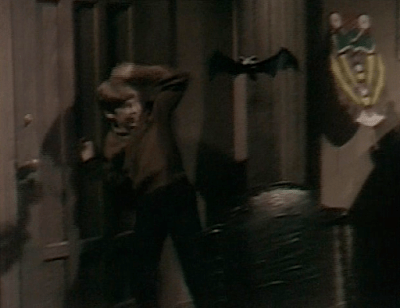
Once he is alone in the room, the window blows open and a bat enters. More precisely, a bat-shaped marionette is brought in on clearly visible strings by a pole that casts a shadow we can see the entire time, but no one who has been watching the show up to this point will doubt for a second that David’s fear, as depicted by David Henesy, is fully justified. David tries to flee from the bat, but he cannot open the door to escape from his room. His back against the door, David slides onto the floor and screams as the bat comes near him.

David finds that he cannot escape. Screenshot by Dark Shadows Before I Die.
David helpless before the bat. Screenshot by Dark Shadows Before I Die.

When Barnabas is about to attack someone, dogs start howling. Sometimes this works to his advantage, but it so often puts his intended victims on their guard that it doesn’t really seem to be something he is doing on purpose. So this bat represents something new. Perhaps Barnabas is using magic to control a bat- if so, it marks the first time we have seen Barnabas use magic to project influence over something other than a human mind. Or perhaps he himself has assumed the form of a bat. If so, that is the first indication we’ve had that he has shape shifting powers. In either case, Barnabas’ powers have just gone up a level.

Closing Miscellany

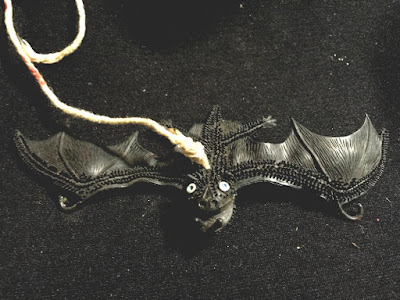
The bat was created by famed puppeteer Bil Baird. Most famous today for the puppets he created for “The Lonely Goatherd” sequence in The Sound of Music, Baird was a frequent guest on television programs like The Ed Sullivan Show, and Jim Henson cited Baird’s own TV series, the short lived Life with Snarky Parker, as a major influence on the Muppets. In December 1966, Baird opened a marionette theater in New York City, at 59 Barrow Street in Greenwich Village; it operated until 1978, and many leading puppeteers, including dozens who would go on to work with Henson, were members of its company in those years.

Bil Baird’s bat-credit. Screenshot by Dark Shadows Before I Die.
The original string wasn’t quite so conspicuous. Screenshot by Dark Shadows Before I Die.

This is the last episode to end with ABC staff announcer Bob Lloyd saying “Dark Shadows is a Dan Curtis production.” We do hear the announcement again in February of 1969, but that won’t be because Lloyd has returned- they used an old recording for the music under the closing credits that day, and they picked one with him on it.

Fans of Dark Shadows will often talk about “the early episodes” which ended with Lloyd making that announcement. So I suppose #330 is the last of “the early episodes.”

Danny Horn’s post about this one on Dark Shadows Every Day includes a morphology of episode endings. He divides them into five categories, Haiku,* Restatement of Threat, ** New Information,*** Crisis Point,**** and Spectacle.***** It’s an intriguing scheme, and he makes a good case for it.

*Danny explains that “Haiku” “aren’t necessarily recognizable as endings in the traditional sense, because nothing is resolved and no progress is made. It’s just a little moment when a character pauses, and possibly has a feeling about something… In some extreme cases, the audience may not realize that the episode is over until halfway through The Dating Game.”

**Restatement of Threat, at this period of Dark Shadows, usually means Barnabas looking at us through his window and saying that someone or other “must die!” Which of course means that you can safely sell a million dollar life insurance policy to that character.

***”A New Information ending provides an actual plot point, which either advances the story another step, or tells us something that we didn’t know.”

****”The Crisis Point cliffhanger is the big game-changer, and for best effect, it should come at the end of a sequence that’s been building up for a while. This is a big turn in the story, and it should feel satisfying and thrilling… The defining feature of a Crisis Point ending is that the resolution marks a change in the status quo, ending one chapter and setting up the next.”

***** “Obviously, plot advancement is always welcome, but every once in a while the show needs to set its sights a little higher. These are the moments when the show goes above and beyond, in order to surprise and dazzle you… The point of a Spectacle is: You can’t take your eyes off the screen. Housewives in the audience have put down the iron, and switched off the vacuum. Teenagers have stopped swatting at their siblings… A Crisis Point cliffhanger will bring you back for the next episode, because you want to see what happens next. But a Spectacle cliffhanger is bigger than that — you’ll be coming back for the next episode, but it’s because you can’t believe what you’re seeing, and maybe tomorrow they’ll do it again.”