Episode 187: Exactly one hundred years (reprise)

Yesterday’s episode ended with a séance in the long-abandoned Old House on the estate of Collinwood.  Strange and troubled boy David Collins was possessed by the spirit of David Radcliffe, a boy who died in 1867. David Radcliffe and his mother, Laura Murdoch Radcliffe, stood in flames, refusing to be rescued, and burned happily to death. Through David Collins, David Radcliffe told well-meaning governess Vicki and drunken artist Sam that he wanted to be with his mother forever, but that he was separated from her when they died. He also tells them there will be another deadly fire very soon, in a small house by the sea.

Vicki, Sam, and others suspect that David Collins’ mother, Laura Murdoch Collins, is a reincarnation of Laura Murdoch Radcliffe. A humanoid Phoenix, she will burn herself and somehow rise from the ashes. The voice of David Radcliffe, someone of whom David has never heard, confirms their fear that Laura will take David with her into the flames of her latest pyre, and that he will burn to death there.

During the séance, dashing action hero Burke Devlin and hardworking young fisherman Joe Haskell had waited outside the Old House. When today’s episode opens, Joe has apparently taken Sam home. Burke carries David into the great house on the estate, with Vicki walking beside them. David is awake and keeps protesting that he can walk, but Burke insists on carrying him to his room. Burke has never seen David’s room before, and David enjoys telling him how to get there.
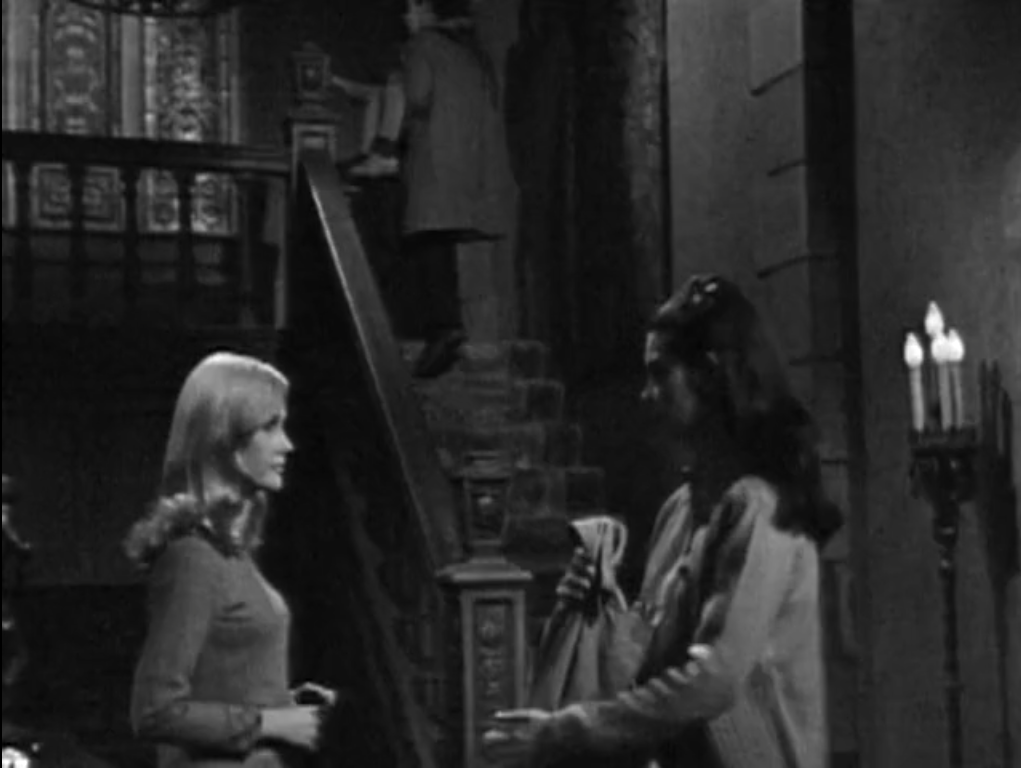
David points the way to his room

Vicki is very serious. She tells Carolyn that their friend, parapsychologist Dr Guthrie, was killed in a car crash on his way to the séance. They both believe that Laura somehow caused this crash, and lament their apparent helplessness before her. Vicki also recaps the events of the séance, leaving Carolyn terrified that Laura will take David soon.

Burke comes down and says that David wants Vicki. Vicki goes up to David’s room with some extra blankets; he is already in bed. He asks her what happened to him at the séance. Vicki lies to him, claiming that he just fell asleep and started dreaming. We know that Vicki is a deeply honest person, largely because she is such an inept liar. When she is about to say something that is not true, she looks down, stiffens, and starts talking fast. Most of the time, Vicki’s attempts to lie precipitate an immediate disaster, and this is no exception. David blows up at her and declares that he is going to go to his mother in the morning and tell her he wants to live with her from now on. It would be hard enough for Vicki to respond to this under any circumstances, but having just told David an obvious lie she can barely find words suitable for mumbling.

Downstairs, David’s father, high-born ne’er-do-well Roger, comes home looking miserable. Carolyn tells her Uncle Roger that she has bad news for him. She means Guthrie’s death, which Roger says everyone in town already knows about. He expresses regret that he behaved so churlishly to Guthrie when Guthrie was only trying to help.

Roger proceeds into the drawing room and sees Burke. Roger and Burke are bitter enemies, and when Carolyn said that she had bad news she may well have been thinking of the fact that Burke was in the house. But Roger knows about that, too. He crossed paths with Joe, who brought him up to date. Roger and Burke agree to set their differences aside for the duration of the crisis.

Vicki comes down and tells Burke, Roger, and Carolyn about David’s decision. The four of them collaborate on a plan to keep David away from Laura. Burke will take David on a fishing trip in the morning. Once they are well away, Roger will go to the cottage on the estate where Laura is staying and throw her out.

Roger and Burke go together to David’s room and tell him that Burke wants to take him fishing. David says that he has to see his mother in the morning. Burke keeps pushing the idea, describing a fishing lodge at a lake in northern Maine that can be reached only by seaplane, where he might catch a record-setting muskie. David can’t resist that. Roger says he will tell Laura about David’s decision while he and Burke go away.

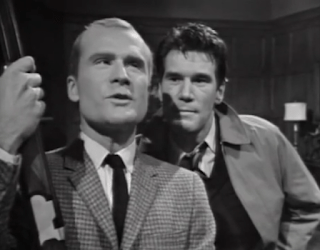
Fathers and son

Roger and Burke do a good job of co-parenting David. There was some talk early in the Phoenix storyline about which of the two of them was David’s biological father; this scene shows that that was always the wrong question. If they were truer to themselves, Roger and Burke would forget their differences permanently, set up housekeeping together, and David would have two dads. Burke and the Collinses are rich enough and powerful enough to ignore convention, and people in town gossip about them constantly anyway, so why not.

Back in the drawing room, Roger and Burke are confident they have matters under control. Vicki isn’t listening to them. She looks at a contemporary newspaper clipping about the deaths of David and Laura Murdoch Radcliffe and notices something she had overlooked before. The fire took place “Exactly one hundred years ago!” The others dismiss this as a coincidence, but Vicki declares that the fire in which Laura will lure David to his death will happen within 24 hours.

Once you start telling stories about the supernatural, you cut yourself off from the usual laws that we see operating in our daily lives. You need some other system of cause and effect to maintain suspense. Dark Shadows settles on anniversaries as forces that can make things happen. Vicki had noticed hundred year intervals between the fiery deaths of women named Laura Murdoch, but this is the first time an anniversary is explicitly presented as the cause of an event.

Episode 163: Poor relation

At the end of last week, reclusive matriarch Liz left the estate of Collinwood for an extended stay in a hospital. It would seem that she took all of Dark Shadows‘ plot points with her. This is the third episode in a row in which we see nothing but characters reprising conversations that didn’t advance the story the first time we heard them. Writers Ron Sproat and Malcolm Marmorstein have been in charge of the scripting for twelve weeks, and they are clearly in big trouble.

This one has a bizarrely dumb opening. Yesterday, strange and troubled boy David took Dr Peter Guthrie, visiting parapsychologist, to the long-abandoned Old House on the grounds of the great estate of Collinwood. Dr Guthrie told David that he would leave him alone in the parlor for a few minutes to try to summon the ghost of Josette Collins. David stared at the portrait of Josette over the mantelpiece until it transformed. It became a painting of David and his mother, blonde fire witch Laura Murdoch Collins, in flames.

Today’s episode picks up at that point. Dr Guthrie finds David standing on what returning viewers will recognize as the exact spot where he had left him two or three minutes before. Even someone who had never seen Dark Shadows before will look at the set and see that David occupies what must be the most conspicuous location in the entire house, between the foot of the staircase, the fireplace, and the front door. Inexplicably, Guthrie comes downstairs calling “David! Da-a-a-vid!” and announces “I was looking for you!” In a later scene, David will tell Laura that Dr Guthrie is nice but not very smart. After this senseless exchange, that line draws a laugh from the audience.

A conversation between Laura and her estranged husband, high-born ne’er-do-well Roger Collins includes a couple of interesting remarks. Roger wonders whether Laura will succeed in what they both want and persuade their son to leave with her after their divorce becomes final. Laura’s assurance that she can win David over after a single night alone with him (“That’s all I need, Roger–one night…one night alone with him and you’ll never be troubled by him again…because he’ll belong to me…completely”) is delivered in the same jarringly sensual tone she had used talking to David in #159. Considering that David has already tried to kill his father, the suggestion that the danger Laura presents to David is something to do with Freud’s theory of the Oedipus complex is not far to find.

Roger says that when they lived together, Laura’s receptiveness to other men’s attention made him jealous. She contradicts him, saying that the only reason he ever wanted her was that his nemesis, dashing action hero Burke, wanted her. We’ve seen time and again that neither Roger nor Burke is ever as excited about anyone else as they are about each other, and we’ve been invited to wonder what exactly went on between them before they became enemies.

When David comes to Laura’s cottage, the two of them talk about the idea that he might leave Collinwood and live with her. He brings up a point he hasn’t in their previous discussions of this matter, saying that well-meaning governess Vicki will lose her job if he does that. When Laura says that Vicki can get another job, and will probably get married and have children of her own soon, David insists that Vicki loves him more than she does anyone else. This is a touching moment for regular viewers, who saw David move from hatred of Vicki to friendship for her in the one narrative arc of the first several months of Dark Shadows that worked every time we saw it. The Laura story, whatever else it may be, is the grand finale of that theme, and therefore the logical conclusion of the show as we have known it so far.

Mrs Acilius and I agree that the best part of the episode comes in the four seconds after Laura hears someone knocking on her door. As we’ve seen several times, she is sitting motionless, staring into the fire, and only after the second knock does she stir. This time Diana Millay does a particularly good job of looking robotic while Laura tears herself away from the flames.

It registers on Laura that someone is knocking on the door

The best thing about the last two weeks has been the addition to the cast of John Lasell as Dr Guthrie. As of this writing,* it would appear that Mr Lasell is still alive; I’ve found addresses for John Whitin Lasell, Jr, aged 95 years, in both Los Angeles and Orange, New Jersey. Oddly enough, there’s also a Post Office Box in his name in Franklin, Maine. Franklin is about 40 miles from Bangor, down towards the coast where Collinsport would have been.

IMDb says that Mr Lasell was born 6 November 1928 in Worcester, Massachusetts. Wikipedia agrees about the date, but says that he was born in Williamstown, Vermont. The 1940 US Census records the 11 year old John W. Lasell, Jr, as a resident of Northbridge, Massachusetts and gives his birthplace as Massachusetts. There is a memorial to John W. Lasell, Sr, in Northbridge, commemorating his heroic death in the Second World War. So I think we can be confident that John Junior was a Bay Stater by birth. I’m inclined to think Wikipedia’s claim that he was born in Vermont is the result of confusion with dairy farmer John Elliot Lasell. John E. Lasell actually did live in Williamstown, Vermont, and does not appear to have been any relation to the actor. Also, Mrs. John W. Lasell, Sr, the former Frances Sumner, lived into her 97th year, so it shouldn’t be too much of a surprise that her son is still around in his mid-90s.

*3 February 2023

Episode 149: The scent of jasmine

Yesterday’s episode gave writer Ron Sproat six major points to communicate to the audience:

  1. None of the characters yet believed that the relationship between mysterious and long-absent Laura Collins and her son, strange and troubled boy David, involved physical danger or crime, much less a threat from the supernatural realm.
  2. An police investigation taking place off-screen and centered in Phoenix, Arizona will advance the plot.
  3. Well-meaning governess Vicki is a credible protagonist in the storyline about Laura.
  4. Dashing action hero Burke Devlin is too smitten with Laura to be of much help to Vicki in her efforts to protect David from Laura.
  5. The budding romance between Burke and flighty heiress Carolyn is at an end.
  6. Vicki has decided the time has come to start fighting Laura.

With more help from the actors than he really deserved, Sproat managed to get all six of these points across. Today, Malcolm Marmorstein has only two themes to deal with. First, he shows us Carolyn processing her feelings about Burke. Then, he shows us the characters discovering that they are living in a ghost story.

Carolyn comes home to the great house of Collinwood in a grim mood. Vicki asks Carolyn who has upset her. She says that Burke has put an end to their budding romance. She asks Vicki to guess who has caught Burke’s eye now, and Vicki names Laura.

Later, Carolyn puts the same question to Laura’s estranged husband, her uncle, high-born ne’er-do-well Roger Collins. Roger also names Laura, also without batting an eye. When Carolyn is surprised at his calm reaction, he assures her he has no interest in anything Burke and Laura might get up to.

In her anguish, Carolyn tells Roger that he would take an entirely different attitude if he could see Burke from a woman’s point of view. As Roger, Louis Edmonds replies to this remark by raising an eyebrow ever so slightly.

Not-so-straight faces

The episodes Art Wallace and Francis Swann wrote in the first twenty weeks of Dark Shadows gave more than a few hints that Burke and Roger’s enmity has its roots in a past homoerotic relationship. In the months since Sproat and Marmorstein took over the writing duties, that idea has only cropped up a couple of times in Sproat’s scripts, and not at all in Marmorstein’s.

Edmonds’ raised eyebrow here will bring a chuckle to regular viewers who have caught on to the theme. As the look passes from his face, Carolyn turns to look at her uncle. When Nancy Barrett saw Louis Edmonds, she must have been glad the scene was ending, as she didn’t have to worry about keeping herself from laughing out loud.

In the village of Collinsport, drunken artist Sam Evans and his daughter Maggie, The Nicest Girl in Town, are at home. Maggie is trying to cheer her father up after a recent mishap with fire injured his hands, leaving him temporarily unable to hold either a paint brush or a whiskey glass. Losing his ability to paint is not as upsetting to Sam as it might be at another time. Lately, an occult power has compelled him to paint nothing but pictures of Laura, naked and in flames, a subject which he and everyone else, especially the lady herself, finds horrifying.

Maggie tries to talk sense to Sam. Screenshot by Dark Shadows Before I Die

What is weighing most heavily on Sam at the moment is a mystical feeling that something is happening to the first of these paintings. It now hangs at Collinwood in the bedroom of Laura and Roger’s son, strange and troubled boy David. An occult power, presumably the same one that took possession of Sam, made Vicki take it back to Collinwood and show it to David. David took the painting because it depicted the scene of a recurring nightmare that had afflicted him and that Sam had no way of knowing about. In the nightmare, Laura had beckoned David to join her in the flames. Again, the nightmare seems to be a communication from an occult power, and there is no reason why it could not be the same one that possessed Sam and Vicki.

The painting has a blank spot the size and shape of David. Sam’s mystical feeling suggests to him that the painting is being completed. He goes to Collinwood to investigate.

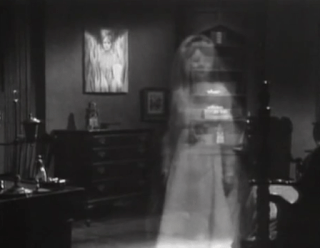
While Sam is on his way, we see David’s room. The painting glows, as both it and the portrait of Josette Collins hanging in the long-abandoned Old House have done when supernatural beings were about. Josette herself manifests. She looks around. She turns to the painting and touches the blank spot.

Josette’s ghost is played here by stand-in Rosemary McNamara. We get a fair glimpse of her face. Her hair and makeup looks very much like those we just saw Kathryn Leigh Scott wearing as Maggie. Miss Scott has played the ghost of Josette several times already and will be closely associated with Josette later in the series. If resemblance is intentional, as it would seem it must be,* why not simply have Miss Scott play Josette today?

The ghost of Josette in David’s room. Screenshot by Dark Shadows Before I Die

Roger, Carolyn, and Vicki are gathered in the drawing room, talking about the painting. Carolyn reminds Roger that David is out of the house, and suggests that he take the painting now and destroy it. Vicki objects that David would take that as a grave betrayal.

A knock comes at the door. Vicki answers it and greets Sam. She shows concern for his injured hands, and very gently takes his coat. She tells him that she is as mystified by her own actions in taking the painting and giving it to David as Sam is mystified by his compulsion to paint it in the first place. Sam asks to speak with Roger. Vicki ushers him into the drawing room, where he meets Roger and Carolyn.

Roger and Sam hate each other, but in front of the young ladies they behave almost correctly. Certainly their hostility doesn’t slow down the exchange of story-productive information. Sam asks to see the painting. Roger and Carolyn send Vicki up to David’s room to fetch it.

That’s an interesting moment. When Sam knocked, Vicki had gone to answer the door at once, and had presented him to Roger and Carolyn very much in the person of a household servant. When Roger and Carolyn send her for the painting, she is all smiles, happy to be on the job. Yet when she and Carolyn were in the drawing room earlier discussing Burke, Vicki was functioning entirely as Carolyn’s equal. The two of them sound like old friends, or like the sisters the show has been hinting they might be. Vicki can move with remarkable facility between the roles of servant and family member. That extraordinary flexibility is one of the qualities that we can imagine will come in handy as she confronts the spiritual forces of darkness gathering in the background.

When Vicki enters David’s room, spooky music starts to play. Vicki walks in slowly, looking from side to side. She senses an eerie presence. She looks at the painting, and sees that where it once was blank it now sports an image of David. She screams.

Roger, Carolyn, and Sam are momentarily stunned by Vicki’s scream. By the time they leave the drawing room, Vicki is already on the stairs holding the painting. Seeing David’s face depicted there, Roger exclaims that he saw the painting earlier that day, and that the spot was still blank then. Sam touches it, and says that is impossible- it is oil paint, and would take days to dry. Roger says that the painting now shows the whole scene of David’s nightmare.

As the four of them try to figure out what could have happened, Vicki says that when she entered the room she felt a weird presence. She says there was a specific perception accompanying this vague feeling- she could smell jasmine perfume. None of the ladies in the house wear that scent. Vicki says that she smelled it once before- in #126, when she saw the ghost of Josette Collins. The association of Josette with the scent of jasmine will continue throughout the series.

Vicki and Carolyn wonder how David will react to his own likeness in the painting, and Roger replies that he never will see it. He throws it in the fireplace. As it burns, the sound of a woman’s scream rings through the room.

Screen capture by the Dark Shadows wiki

This episode is a turning point. Hints of supernatural activity have been cropping up in the show from week one, the audience has been seeing evidence of it for months, and both Vicki and David have seen and talked with ghosts. But the completed painting and the scream that emerges from the fireplace are the first unambiguous tokens of the occult that have been presented to a group like these four.

The only other time more than one person had seen anything like it came in #88, when Roger and his sister, reclusive matriarch Liz, found seaweed on the spot where Vicki reported that the ghost of beloved local man Bill Malloy had dropped it. But Roger and Liz both want to keep the stories of Collinwood’s haunting to a minimum, and they threw the seaweed into the fire without telling Vicki or anyone else that they had found it. Denial, the psychological defense mechanism, is the ruling passion of their lives, and when the two of them found the evidence it was a foregone conclusion that it would be destroyed.

There is no such unity among Sam, Vicki, Carolyn, and Roger. Now that the only way any of them can deny that supernatural powers are operating in connection with Laura and David is to lie, we see that the four of them are strikingly ill-appointed to be the members of a plot to keep a secret. Sam is an outsider and no friend of the Collinses. Vicki is too conscientious to be part of a coverup. Carolyn is a loose cannon, and might tell anyone anything. Roger is unburdened by a conscience and is quite happy to tell lies, but he is also so cowardly and irresolute that he might be the weak link in any conspiracy he might join. So, not only do these characters now know that spirits are at work in connection with Laura’s relationship with David, but everyone else is likely to find out as well.

*Rosemary McNamara’s face is of the same general type as Kathryn Leigh Scott’s, but I think the hair and makeup above emphasize the similarity. Here’s the picture from her imdb profile:

Rosemary McNamara, from imdb

Episode 139: Are you going to Madagascar?

High-born ne’er do-well Roger Collins walks in on his estranged wife, the mysterious and long-absent Laura, fending off an attempt by his arch-nemesis, dashing action hero Burke Devlin, to plant a kiss on her. Roger is equipped with a bolt action rifle.

Great emphasis is placed on the rifle. The most prominent set in all of Dark Shadows is the drawing room in the great house of Collinwood, and it was altered yesterday to put a gun rack on its wall. This will startle regular viewers who remember that in episode #118 reclusive matriarch Liz had to go to the back part of the house to dig up Roger’s almost-forgotten guns. Now, those guns are on display in the family’s main dwelling place and holiest shrine.

It is 1967 and everyone associated with the creative side of the show is connected with the NYC theater world, so there is approximately a 100% chance that we are intended to read these scenes in Freudian terms. The gun is a phallic symbol, but a corrupted, sickened one- it promises, not pleasure and the creation of new life, but pain and killing. In the context of Roger and Laura’s dead marriage, it demonstrates that Roger’s sexual frustration has warped him and led him to violence.

Roger declares that Burke is trespassing on his property and bothering his wife, and declares that no court in the world would convict him of anything were he to shoot Burke to death. He also says that killing Burke would give him great pleasure. Burke asks him why he doesn’t do it, and Laura wearily complains that she had enough of these sort of encounters between them ten years ago.

Laura’s remark comes as a jolt. Ten years ago, Roger and Laura were not a long-separated couple in the process of divorcing- they were not yet a couple at all. As far as the world was concerned, she and Burke were involved with each other, and Roger was a friend who sometimes tagged along on their dates. That was the situation until a fatal hit-and-run accident involving Burke’s car. This is the first time the three of them have been alone together since that night. After the accident, Laura and Roger testified against Burke. He went to prison and they married each other. When Laura says that the way Roger and Burke are carrying on now is the way they interacted ten years ago, she is saying that even when she was ostensibly Burke’s girlfriend the two men were more excited about each other than either was about her. Perhaps Laura was the one who tagged along on Roger and Burke’s dates.

Burke grabs the gun. He and Roger struggle for it. It fires into the ceiling, and Burke tears it from Roger’s hands, flinging it to the floor. Burke picks it up. Roger rants and raves, vowing to kill Burke. Yet he does not make any protest when Burke walks off with the rifle, even though the rifle is a valuable piece of property and a central feature of Collinwood’s decor. Roger can attempt to express his masculinity only in conjunction with Burke. When Burke removes the phallic symbol and silently leaves, Roger is struck mute.

After Burke leaves, Roger and Laura continue to develop the themes of powerlessness and sterility. Having none of the influence over her an ongoing sexual relationship might give him, he complains of her disloyalty to him and of his humiliation in the eyes of those who might see her socializing with Burke. He tries to assert power over her with threats of legal consequences if she goes along with Burke’s plan to reopen the hit-and-run case. Laura agrees that she cannot help Burke without losing the one thing she wants to gain, custody of their son, strange and troubled boy David. Roger completes the image of his own emasculation with a parting remark that he will be happy to see Laura leave with their son “if David is my son.”

There is something of a fault with the production. Neither Laura nor Roger is in a position to bring new life into the world, and we are in doubt as to whether Laura is, strictly speaking, alive at all. Yet as Laura, Diana Millay is quite visibly pregnant, and she will only get “pregnanter and pregnanter” as the story goes on. Her style of acting, her personality, and her looks are so perfect for the part that it is impossible to imagine anyone else playing it, but it was very confusing to present her as an avatar of death and the unreal past when she is such a strong visual symbol of life and the growing future.

After Roger flounces out of Laura’s cottage, she goes to the window and calls to David. We see David asleep in his room in the great house. He is writhing on his bed, hearing his mother’s voice and having a nightmare. Well-meaning governess Vicki wakes David, telling him that it is 10:30 AM.* David tells her that he had the same nightmare he did the night before, in which his mother beckoned him into a firestorm. Vicki tries to assuage his fears, purring lovingly at him, but he is still deeply disturbed.

Screenshot by Dark Shadows Before I Die

Roger enters and tells David to come along and see his mother. David flies into a tantrum, insisting that he will not see her and that no one can make him. When Roger threatens to beat him, David clings to Vicki and pleads with her to stop his father from hitting him. Vicki calmly states that “No one is going to hit you,” underlining Roger’s lack of authority in his relationships with both David and the hired help. David runs off.

Vicki sits on David’s bed and tells Roger that she has a theory about David’s behavior. She believes that he really wants to see his mother and that her love is tremendously important to him, but that he has worked himself into his current state because he is afraid she will reject him. This theory has a very substantial basis in fact. When Laura first came to the house in #134, David was extremely eager to meet her, until he suddenly asked Vicki “What if I do or say something to make her hate me?” From that moment on, he has become more and more reluctant to see Laura. Vicki tells Roger that she will work to arrange a meeting between mother and son in a situation where he will not feel pressured to perform in any particular way.

Vicki shows up at the cottage carrying a tray of tea things. Laura is impressed with the breakfast. Vicki shares her idea of arranging an apparently chance meeting during the walk she and David take around the grounds every afternoon beginning at 4:30.** Laura does not eat or drink anything during her breakfast with Vicki, but she does ask a series of questions about David. Vicki enthusiastically tells her every nice thing about him she can think of, leaving out such awkward incidents as his attempts to murder Roger and Vicki herself.

Laura chooses the top of Widow’s Hill for their “chance” meeting. This is rather an odd place considering that it is likely to be getting dark by 4:30 PM in early January in central Maine, and Widow’s Hill is a place from which people famously fall to their deaths. But, Laura is the boy’s mother. Besides, the other option was the greenhouse, and they don’t have a set for a greenhouse, so Vicki goes along with it.***

At the top of the hill, David asks Vicki why she wanted to go there, and starts talking about how dangerous it is. He noodles around at the edge of the cliff, alarming her, but he says he knows the ground so well it isn’t dangerous for him. After a minute, David says it’s boring there and he wants to leave. Vicki scrambles for a reason to stay, and finds a ship on the horizon. That catches David’s attention. He watches it, wanders ever closer to the precipice, and talks about sailing around the world.

That’s when Laura shows up. In episode 2, Roger introduced himself to Vicki by startling her while she stood on the edge of the cliff, nearly prompting her to fall to her death. In #75, Vicki returned the compliment. Now, Laura simply starts talking while David is on the precipice. Shocked to hear her voice, he jumps back.

Laura goes on about how David was always interested in exotic places when he was a little boy. He looks petrified, but does agree that he remembers those conversations. She reaches out and calls him to come to her. He recoils, slips, and ends up clutching the side of the precipice. That’s what’s known as a “cliffhanger ending.”

Screenshot by Dark Shadows Before I Die.

*In many markets, ABC affiliates ignored the network’s recommendation that Dark Shadows be broadcast at 4:00 PM and showed it at 10:30 AM. Hearing Vicki mention this hour makes me wonder if we are supposed to think of the action of a soap opera taking place, not only on the date of the original broadcast, but at the time.

**4:30 was the time when Dark Shadows ended in markets where the ABC affiliate went along with the network’s recommended schedule. Mustn’t have people outdoors between 4 and 4:30!

***Mrs Acilius pointed out this consideration when we were watching the episode.

Episode 138: You should know about the Grim Reaper

The authorities in Phoenix, Arizona have asked the sheriff in Collinsport, Maine to inform high-born ne’er-do-well Roger Collins that they have identified the charred body of a woman as that of Roger’s wife, mysterious and long-absent Laura. The body was found in what was left of Laura’s apartment in Phoenix after a fire destroyed the building, and the woman was Laura’s age, height, and build. Since Laura was the only person associated with the building whose whereabouts were unknown, the identification of the remains as hers seemed secure to the Arizona authorities.

It seems less so in Collinsport, as Laura is no longer absent. She’s been back in town for days. She has been staying at the Collinsport Inn, where she met several old acquaintances. They recognized each other and engaged in conversation. She has come to the great house of Collinwood, where she talked with Roger and other members of the family, and will be staying in the caretaker’s cottage on the grounds of the estate. Only her son, strange and troubled boy David, has expressed any doubt as to her identity, and no one takes that doubt literally.

If the sheriff knew that he was living in a soap opera, he might suspect that the woman who has come to town is a previously unknown evil twin posing as Laura. If he knew that his particular soap is loaded with supernatural storylines, he might try to figure out what sort of uncanny being she could be. But he seems to be under the impression that he lives in the world. When at one point Roger tells him to “Stop being melodramatic,” it doesn’t occur to him that he has no choice but to be melodramatic. So, all he can do is ask Laura if she knows who the dead woman might have been. When tells him she doesn’t, he leaves.

Roger is eager to divorce Laura and send her away with their son, David. After the sheriff goes, Roger expresses his consternation at the news of the fire. Laura has nowhere to take David. When she tells him that she never planned to take David to that apartment, but that she had “made a commitment to another place,” he is instantly relieved. He does not ask where that other place is. His interest in where Laura or David will be or what they will be doing is exhausted the moment he learns they will be far away from him.

Someone else is visiting Collinwood tonight who wants more from Laura than Roger does. That is Roger’s nemesis and Laura’s ex-boyfriend, dashing action hero Burke Devlin. Flighty heiress Carolyn has gone to get Laura’s bag from the Collinsport Inn and bring it to her aunt. While in town, she met Burke. When she told him of her errand, Burke volunteered to help her carry the bag. Now she and Burke are in the drawing room at Collinwood. They kiss, and he persuades her to let him carry the bag to the cottage. When Carolyn says that she is jealous of his interest in her aunt, he assures her it’s “all business.” She tells him he can’t fool her, to which he replies “Yes I can.”

Burke kisses Carolyn. Screenshot by Dark Shadows Before I Die.

As Carolyn, Nancy Barrett plays, first, excitement as Burke moves in to kiss her; then, a mixture of frustration and confusion, as she begins to suspect that he is only using her to get to Laura. Regular viewers have seen Burke several times after a flirtatious scene with Carolyn, and each time he has switched immediately into hard-driving businessman mode the moment she wasn’t looking. With her performance in this scene, we start to wonder if she is about to catch on that he doesn’t have any feelings for her.

Roger finds Burke and Carolyn in the drawing room. He is furious with Burke for coming to the house, and with Carolyn for inviting him in. He and Burke rage at each other. As Roger, Louis Edmonds does a superb job of simultaneously conveying white-hot rage at Burke and a much colder anger towards his niece. Up to now, Carolyn has responded to her uncle’s prohibitions against seeing Burke flippantly, but this time she seems to accept that she has gone too far. After Burke leaves, she kisses Roger on the cheek and whispers “Goodnight, uncle,” sounding genuinely chastened. Roger is usually a difficult man to take seriously, but Edmonds’ tremendous performance in this scene leaves her with no choice but to give a hushed reaction.

Placing this scene after Roger’s blasé reaction to his wife and Burke’s cynical toying with Carolyn makes the point that Roger and Burke are more excited about each other than either ever is about anyone else. The show embeds their emotions in the “Revenge of Burke Devlin” storyline. Burke is trying to send Roger to prison, and is scheming to enlist Laura in his efforts. Ten years ago, Burke was imprisoned because Roger and Laura testified that he was driving his car, with them as passengers, when he ran down a pedestrian and left him to die. Before the accident, Burke and Laura had been a couple; the day Burke was sentenced, Laura and Roger were married. Now Burke hopes Laura will say that she perjured herself, and that Roger was driving.

Burke’s plans never quite make logical sense. Were Laura to confess to perjury, she would be in as much legal trouble as Roger. Even if she struck a bargain to keep herself out of prison, she would certainly not advance her goal of taking David by alienating Roger and branding herself a criminal. It is difficult to see what incentive Burke imagines that she has to join him.

At the cottage, Laura is sitting by the fire, staring off into space. When Burke knocks on her door, she continues staring. In Laura’s scenes by fireplaces, the spooky music, the slowly panning camera, and Diana Millay’s rigid posture all combine to create the impression that what we see when we look at Laura is only a fragment of a human being.

Laura stares off into space. Screenshot by Dark Shadows Before I Die.

Once Laura lets Burke in, he talks her into closing the door, pushes himself close to her, and insists on telling her about the demands he will be making on her. He wants her to testify against Roger, to restore the years he spent behind bars, and to love him. When she tells him that the things he wants are not in her power to give, he refuses to take no for an answer. Over her objections, he takes her in his arms and forces a kiss on her. As Burke kisses Laura, the door opens and Roger appears with a gun.

Burke kisses Laura. Screenshot by Dark Shadows Before I Die.

Burke’s demand that the past be undone and his attempt to force Laura to feel love for him show the unreality of his ambitions. He claims to represent “Honesty and the Truth,” but everything he clamors for is an empty fantasy. So much so that we wonder if what he really wants might be something quite different from what he keeps saying he wants.

Episode 119: We criss-crossed paths a dozen times

Nothing today but recapping.

The actors do what they can to hold it together, and there are a couple of memorable lines. Reclusive matriarch Liz calls her daughter, flighty heiress Carolyn, a “young girl” during yet another conversation pleading with her to stop dating the family’s arch-nemesis, dashing action hero Burke Devlin. Carolyn asks when her mother will admit that she is a woman. “When it is a fact,” Liz replies. Carolyn declares that “It won’t be a woman who bestows that title on me, but a man- Burke Devlin!” Everyone in Collinsport seems to be living according to a rule of chastity, so Carolyn’s open declaration that she plans to have sex with Burke is rather startling.

Liz’ brother, high-born ne’er-do-well Roger, comes home. Liz tells Roger that well-meaning governess Vicki is missing and may be in danger. Roger refuses to take an interest in the matter. When Liz is shocked by his indifference, he says that she sometimes expects too much of him. Considering that Burke and hardworking young fisherman Joe are searching the grounds of the estate for Vicki, and that the sheriff’s department has been involved in the search as well, Roger’s disregard for Vicki is not merely cavalier, but childish in the extreme.

When Roger finds out that Carolyn had been on a date with Burke, he tries to take the authoritative tone that her mother had taken with her earlier. Neither Carolyn nor Liz is impressed with the attempt this boy-man is making to impersonate a paterfamilias. Liz and Roger are the prototype for Dark Shadows‘ most characteristic relationship, that between a bossy big sister and her bratty little brother. She tries to correct his behavior, and when he disappoints her she shields him from accountability. In this scene, she sees yet again how useless he really is.

Burke and Joe come to the house to report that their search for well-meaning governess Vicki has been fruitless. Roger makes one sarcastic remark after another to Burke. Louis Edmonds is so skilled at delivering acerbic dialogue that these lines are fun to listen to, even though they don’t advance the plot or add to our understanding of the characters in any way.

Burke and Roger having words. Screenshot by Dark Shadows Before I Die

It’s a shame the scene isn’t better written. During the nineteen weeks when Art Wallace and Francis Swann were in charge of writing the show, they hinted that there may have been some kind of sexual relationship between Burke and Roger. This time, Burke has borrowed Roger’s shotgun, and Roger very conspicuously handles the gun after Burke returns it to him. He unloads it, and for no reason that we can see reloads it. As directed by Lela Swift, the actors are uncomfortably close to each other, and can’t keep themselves from getting closer as they exchange their wildly bitter remarks. In the hands of Wallace or Swann, or for that matter of almost any moderately competent writer, that scene would have made sense as a Freudian interlude. But today belongs to Malcolm Marmorstein, and the evidence of repressed sexuality doesn’t add up to much.

Carolyn tries to break the tension in the drawing room by playing “Chopsticks” on the piano. All she gets for her trouble is an irritated look from her mother.

Joe and Carolyn were dating when the series started. All we saw of their relationship was one breakup scene after another. They have a nice loud one today. If there had ever been anything between them, it would be a dramatic moment.

Earlier in the episode, Burke had told Joe he didn’t think he would ever really put his attachment to Carolyn behind him. We’ve seen Joe have a couple of happy dates with Maggie Evans, The Nicest Girl in Town, and are hoping the two of them will have a storyline together. The prospect that Burke may be right and we may be sentenced to sit through yet more bickering between Joe and Carolyn is too dreary for words.

Episode 86: No way to go but down

Strange and troubled boy David Collins has managed to lock his well-meaning governess, Vicki, in a room in the long-abandoned west wing of the great house of Collinwood. David’s father, high-born ne’er-do-well Roger and his aunt, reclusive matriarch Liz, have noticed that Vicki is missing and are beginning to make inquiries.

It is inexplicable that Vicki fell into David’s trap, and her efforts to escape are embarrassingly inept. Today, Liz also behaves inexplicably. In David’s room, she finds the key to the closed part of the house where David is keeping Vicki, and she confronts David with it. When he denies that he locked Vicki up, she says she believes him and drops the subject. I’m afraid this has to be classified as an instance of what Roger Ebert called “idiot plot,” a story that goes on only because the characters are dumber than the audience. It’s especially frustrating to see characters like Liz and Vicki, who up to now have used their intelligence to make plot points happen, suddenly do things that can be explained only by saying that the script told them to do it.

Roger doesn’t appear to be fooled, but neither is he in any hurry to rescue Vicki. He sees her as a threat to his evil plans, and wants her out of the way. We see him alone in the drawing room, smiling broadly and drinking a toast to “Miss Victoria Winters… wherever you are.” He’s so deliriously happy with Vicki’s absence that he’s standing around not wearing any pants.*

Southern exposure

Meanwhile, Liz’ daughter, flighty heiress Carolyn, is sharing a cozy moment with the family’s arch-nemesis, dashing action hero Burke Devlin. In Friday’s episode, the two of them crossed paths at the tavern, and today they are sitting cozily on the couch in Burke’s hotel room. Burke gives Carolyn alcoholic drinks she isn’t of legal age to have, charms her with stories of his time in Brazil, and kisses her goodbye. He seems to be drunk, but as soon as she leaves the room he looks into the camera and in a sober voice vows that his vengeance will destroy her along with the rest of the Collins family.

There is one moment when Carolyn is still in the room when Burke slips out of his drunk act and forgets his charm. Carolyn asks if he’s ever been in love. He springs up from the couch, his face contorted with rage, looks away from her, and spits out the word “Once!” Startled, Carolyn asks if it’s always so painful. Then he remembers himself and resumes the role of the marginally amorous drunk.

Dark Shadows is very literal in its cutting in these early months. They often use scene connectors in the dialogue, moments when the last word of a scene they cut away from is one of the first words of the scene they cut to. And a question at the end of a scene will often be answered by the visual to which the scene jumps- so if someone asks “Who tampered with the brakes on Roger’s car?,” we will cut to a shot of David. At the end of this little exchange about the single, painful, time Burke fell in love, we cut to… Roger.** It’s 1966, and it’s American television, so it is unlikely that the show will actually tell us that Burke and Roger were lovers. On the other hand, it’s 1966, and the actors, writers, and directors are from the New York theater, so it is all but certain that they wanted some segment of the audience to wonder about that.

There’s also a bit of trivia. The drawing room scene among David, Liz, and Roger marks the first time David refers to Vicki as “Vicki.” Up to now he has always called her “Miss Winters.”

*In fact, this is the scene that actor Louis Edmonds famously played without the lower part of his costume.

**In his pantsless scene, no less.

Episode 66: The appearance of hospitality

Downstairs in the great house of Collinwood, high-born ne’er-do-well Roger and dashing action hero Burke have another of their quarrels. Upstairs, well-meaning governess Vicki tells reclusive matriarch Liz about her shockingly lonesome childhood. Nothing happens to advance the plot, but the actors make Francis Swann’s dialogue sparkle.

Roger and Burke’s conversation revolves around one of the two major storylines introduced in episode 1, The Revenge of Burke Devlin. Liz and Vicki’s revolves around the other, Victoria Winters’ Quest to Learn Her Origins. The investigation into the death of beloved local man Bill Malloy has suggested that one or both of these may become interesting, though by now that prospect has been reduced to rather a low order of probability.

The real themes of the conversations are the real themes of the whole series- loneliness and denial. As Vicki goes on about how solitary her childhood was at the Hammond Foundling Home, Liz’ face shows one expression of agony after another. When Liz tells Vicki that she can understand loneliness, Vicki tells her that she could leave the house if she wanted to do so. Liz replies with a note of absolute finality- “No. I couldn’t.” Vicki tries to open a new topic, mentioning Liz’ daughter Carolyn, but the barriers have gone up.

Roger insisted on talking to Burke alone. The two of them go round and round, not answering each other directly or telling each other anything new. They can’t talk productively to each other, but can’t talk to anyone else at all. The unresolved, unexplained past they share binds them together and shuts everyone else out. As he leaves, Burke declares that he will return to Collinwood- “possibly to stay.” He’d been telling Liz that he wanted to buy the house, and in previous episodes we’ve seen him scheming to drive the family to bankruptcy and collect their assets. But in this context, his line sounds less like a threat to take the house from the family than like a proposal to move in with them.

There is also a memorable production fault. A camera bounces out of control and gives the audience a view of the lights above the set:

Lights above the set

Episode 60: Double, double

Soap operas are supposed to have a weekly rhythm. Fridays bring a whirlwind of flashy, unexpected events, building up to a big cliffhanger. On Monday, the cliffhanger is resolved and the flashy, unexpected stuff is sorted out so that new viewers can find their way into the show. On Tuesdays and Wednesdays, you experiment with new storylines that may or may not go anywhere, and on Thursdays you set up for another boffo Friday.

At no point in its run did Dark Shadows adhere to this pattern. This week, for example, has had four relatively fast-paced episodes on Monday through Thursday, then slows down for a Friday episode consisting of a couple of leisurely conversations. Conversations in which the audience is presented with a lot of basic exposition, but still, a big shift down in dramatic intensity from the four days leading up to it. A bit later, after writer Art Wallace leaves the show, there will be weeks with no apparent structure at all, certainly no boffo whirlwind Fridays. After the show becomes a hit and Sam Hall takes the lead among the writing staff, every day will be a whirlwind, and every commercial break a cliffhanger.

One of today’s conversations takes place in the home Maggie Evans, the nicest girl in town, shares with her father, drunken artist Sam. The other takes place in the sheriff’s office.

Maggie has brought well-meaning governess Vicki home for dinner. They talk about Vicki’s quest to learn the secret of her origins and about the manslaughter case that sent dashing action hero Burke Devlin to prison ten years ago. Meanwhile, Burke has barged into the sheriff’s office and is demanding information about the ongoing investigation into the mysterious death of plant manager Bill Malloy. The sheriff gives Burke more answers than it would be proper for an investigator to give a member of the public in real life, but nonetheless frustrates his need to dash into heroic action. Burke leaves the sheriff’s office, and barges into the Evans cottage as dinner is served. The Friday cliffhanger is Burke asking if he may join the Evanses and Vicki for dinner.

I suppose you could call this one of Art Wallace’s diptychs. Both conversations feature insistent questioners and reluctant responders. Burke improperly demands information from the sheriff. The sheriff parries his demands, observing Burke’s reactions as he sizes him up as a suspect in the case. The sheriff remains very much in control of the situation. As in previous episodes, we see that the sheriff alone exercises power in the sheriff’s office. By contrast, Sam loses control entirely in the face of his two questioners. Again as in previous episodes, we see that Sam has no power to resolve a conflict, whether at home or anywhere else.

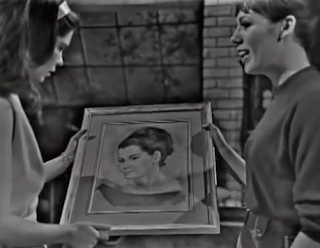
That’s the dramatic content of the episode. The expository content is much more involved. Vicki looks through Sam’s paintings, and finds a portrait that strongly resembles her. When Sam tells her that the painting is 25 years old and that the model was a Collinsport girl, Vicki is excited, thinking she may have found a relative. Sam tells her he doesn’t believe that’s possible. He had heard that the model, whose name was Betty Hanscombe, had died a few months after he painted her portrait, years before Vicki was born, and that she had no living relatives.

Vicki and Maggie hold the portrait of Betty Hanscombe
Screenshot by Dark Shadows Before I Die

Note that Sam had only heard that Betty died. She had left town before then, and had no close connections to anyone with whom Sam was in touch. He could easily have heard wrong. So experienced soap opera watchers will brace themselves for the possibility that Betty Hanscombe will make a surprise entrance at some point and reveal herself to be Vicki’s mother and someone else’s secret half-sister.

When Maggie and Vicki ask Sam about the manslaughter case, he becomes agitated. Trapped into telling the story, he takes a drink and looks away from the young women. He tells essentially the same story high-born ne’er-do-well Roger had told his sister, reclusive matriarch Liz, in episode 32, but with some details added.

Burke and Roger were extremely close in those days, ten years ago. For a moment, Sam seems to be having trouble finding the words to express just how close. Along with Burke’s girlfriend Laura, they went drinking one night at a bar on the road between Collinsport and Bangor. Witnesses at the bar testified that Burke was so drunk they had to carry him to his car, and that he insisted on driving. Roger and Laura were his passengers. Burke himself admitted that he blacked out and couldn’t remember the drive. At some point, the car hit and killed a man named Hansen and kept going. At the trial, Roger and Laura testified that Burke was driving when his car hit Hansen. Burke thought that he might have got out of the driver’s seat and handed the keys to Roger before the accident. Burke was convicted, and publicly swore that he would avenge himself on Roger. A week after he was sentenced, Roger and Laura were married.

So that’s the basis for “The Revenge of Burke Devlin” storyline. I’m not a criminal lawyer, but I wonder if Burke wouldn’t have been guilty of manslaughter no matter who was behind the wheel at the moment of the collision. By all accounts, Burke drove drunk, and was drunk in his car when it killed someone. If at some point he stopped driving and handed the keys to someone else whom he knew also to be drunk, that would indeed add to that person’s culpability, but I don’t see how it would clear Burke’s name. To do that, Burke would have to change the events themselves.

To make sense of the storyline, perhaps we can revisit the tale of the night of the accident. Two lovers and their friend were in a car involved in a hit and run. Afterward, one lover turned against the other, and took up with the friend. Everyone thought the lovers before that night were Burke and Laura, and that the friend was Roger. But if the men were lovers and Laura were the friend tagging along on their date, Burke’s frantic campaign to alter the past and Roger’s grim determination to hide it take on a new significance.

The cast of the show and its writing staff were largely drawn from Broadway, where in the 1950s, 60s, and 70s many playwrights had hits with dramas in which some people try to rewrite history and others try to conceal it in desperate attempts to erase unconventional sexual relationships. Indeed, when Sam stumbles in his attempt to find words to describe the bygone intimacy Roger and Burke shared, we can’t help but remember that Sam is played by David Ford, fresh off a long engagement as Big Daddy in a production of Cat on a Hot Tin Roof. It is by no means fanciful to wonder if that stumble hints at the suspicion of a relationship Tennessee Williams would have found interesting.

Miscellaneous:

At the end of his post about this episode on Dark Shadows from the Beginning, Marc Masse goes on at length about other things you might have seen on television in mid-September 1966. This is not my favorite feature of his blog, but this time it includes a couple of irresistible bits from commercials featuring Dark Shadows cast members. Here’s a still from a spot in which David Henesy sells cereal (with a side of racism, but it’s hard to imagine that was his fault):

Screenshot by Dark Shadows from the Beginning

The same post features an audio clip of Thayer David selling NyQuil. Here’s the commercial:

Episode 45: Where Burke Devlin’s pen is

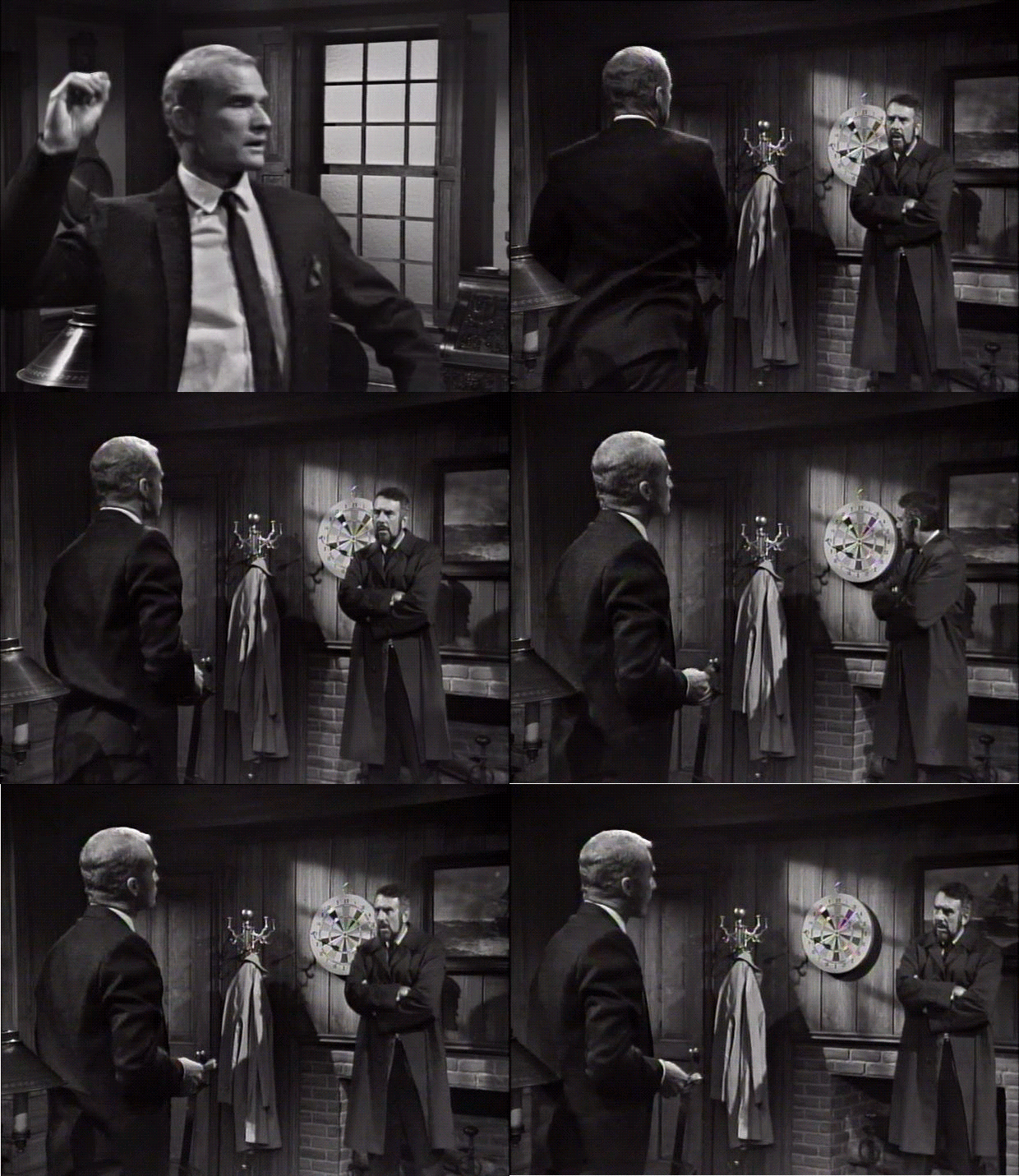
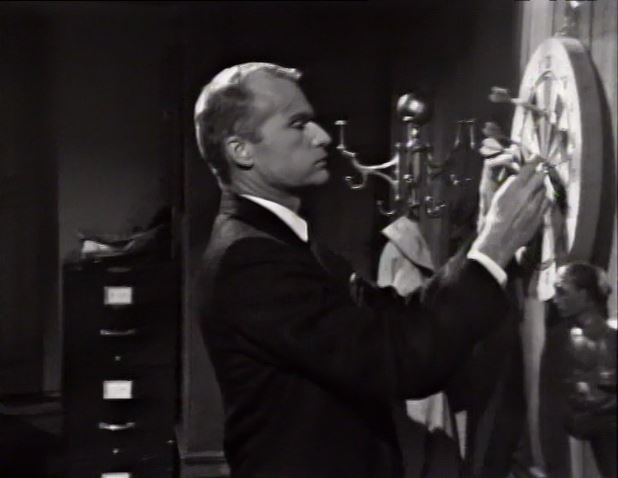
Roger is trying to keep his hands busy today. Our first look at his office focuses on his dart board, and he spends a great deal of time handling the darts.

Roger pulling the darts out of the dartboard on the wall in his office
Screenshot by Dark Shadows from the Beginning

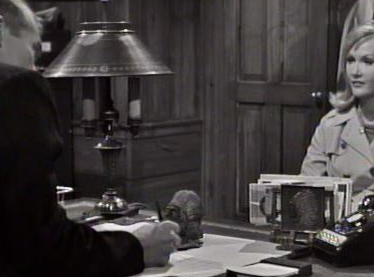
Carolyn stops in the office. Roger hugs her, calls her “Kitten,” and doodles with his pen while he and his niece flirt pretty daringly.

Roger and Carolyn flirting with each other while Roger plays with his pen
Screenshot by Dark Shadows from the Beginning

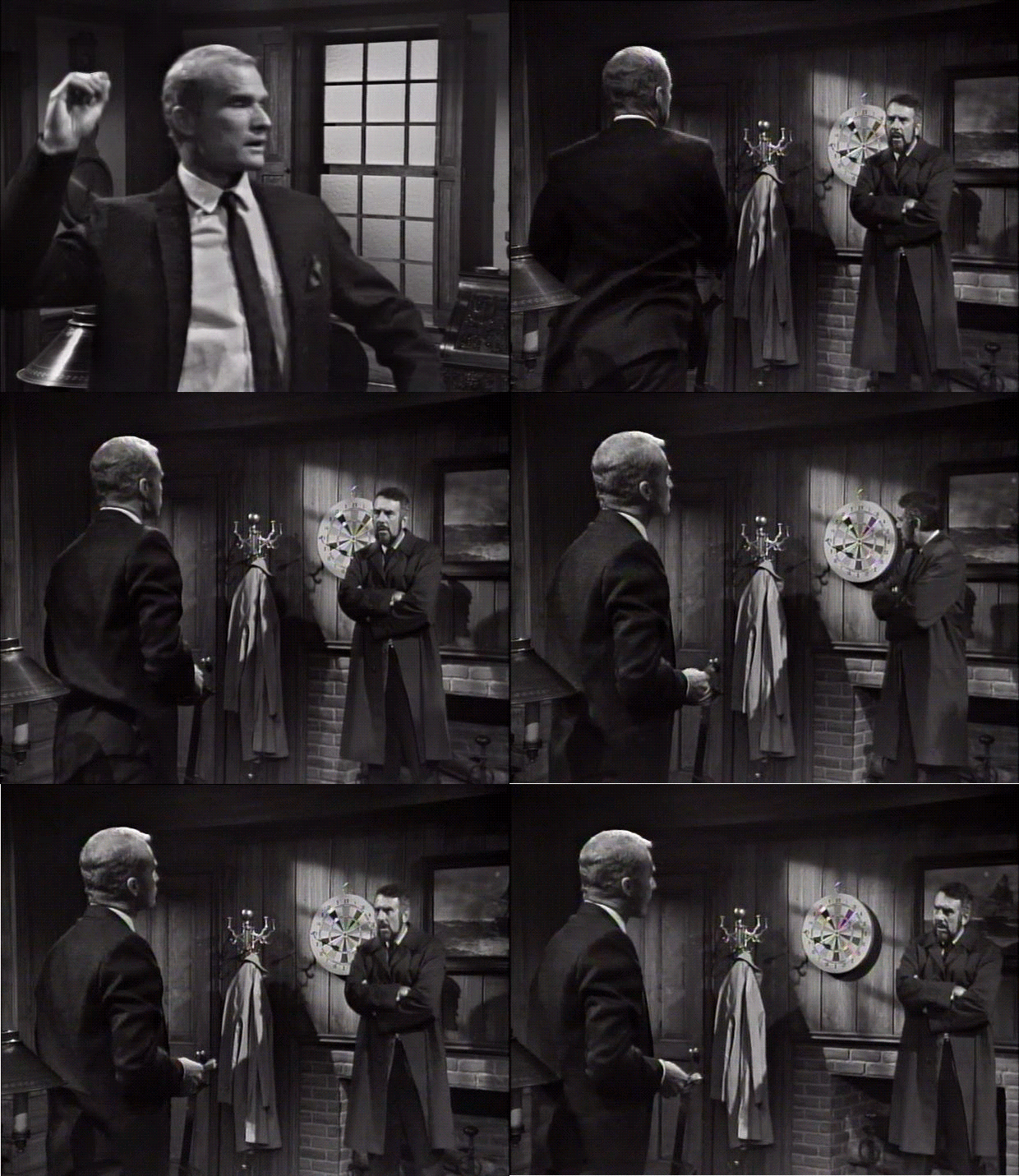
Bill, whom we just saw in the Blue Whale giving Burke a stern talking-to, comes to Roger’s office to continue his stern talking-to concert tour. He drives Carolyn away. Roger stops handling the pen playfully and handles the darts menacingly.

Roger throws a dart in Bill's direction
Screen capture by Dark Shadows from the Beginning

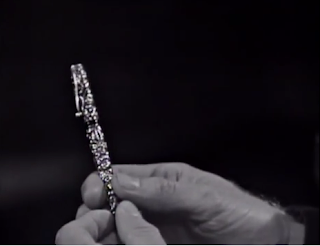
Later, Roger sees Carolyn at home. He finds out she had lunch with Burke and that Burke gave her his pen. He explodes at this and demands that she give up the pen. After a phone call from Bill (stern talking-to #3) and a commercial break, Roger simmers down. He apologizes and calls Carolyn “Kitten” again. She admits that she’s probably just hanging around Burke out of curiosity. She also tells Roger about the evidence that Burke is trying to put the family out of business. Roger takes this news calmly- after all, the Collinses’ cannery, fishing fleet, and other financial interests can hardly compare to the significance of who gets to touch Burke’s pen.

Roger's hands fondling Burke's pen
Screenshot by Dark Shadows Before I Die

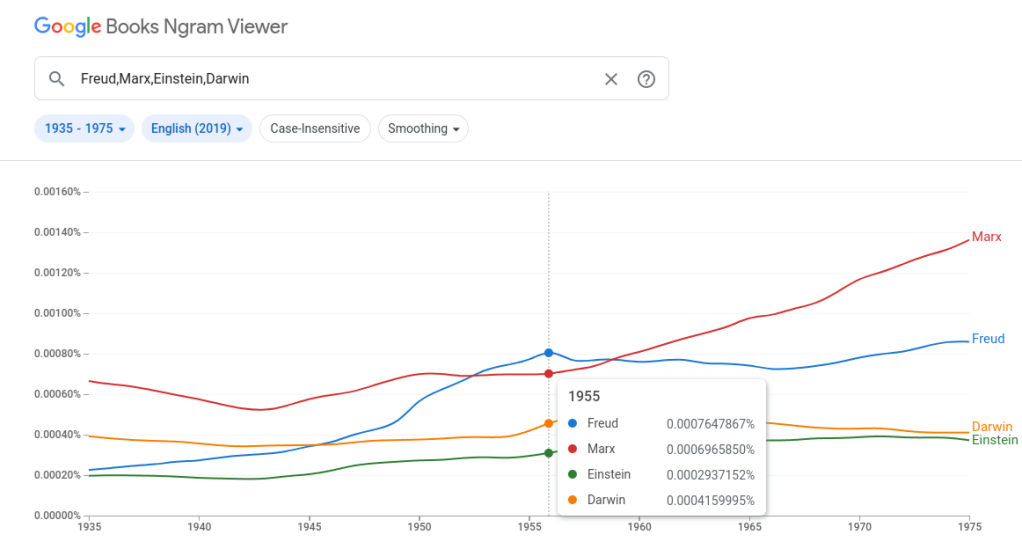
Roger’s obsession with where Burke Devlin’s pen is will become the show’s obsession for a couple of months. Anyone unsure whether there is some symbolic significance to this might have a look at the books, plays, and movies the makers of Dark Shadows and other intellectually ambitious New Yorkers were likely to be paying attention to in the summer of 1966. Maybe we can learn something about the ideas that were in the air if we look up the some famous thinkers on Google NGrams:

Google Ngram tracing the relative prominence of the names Marx, Freud, Darwin, and Einstein in English language books from 1935 to 1975

Looks like Marx was a biggie in those days- maybe Roger’s obsession with where Burke’s pen is illustrates the Marxist concept of commodity fetishism. That might also explain Roger’s relative disregard for the family’s capital holdings- he’s so caught up in the fantasy of value as something inherent in a physical object that he has lost sight of the actual source of his wealth.

Darwin was on people’s minds as well. Perhaps Roger’s fixation on Burke’s pen is the result of his genealogy- maybe the Collinses have been bred to their little niche for so many generations that they have emerged as a new species, one which does not have the same survival strategies as other humans and so does not share values and concepts which we would understand.

And there’s Einstein, also a popular preoccupation among people who aspired to advanced learning back then. One of Einstein’s most famous ideas was that time passes at different rates for different observers depending on how fast those observers are moving through space. There will be twenty or more episodes of Dark Shadows that focus largely or entirely on the question of where Burke’s pen is, and as we move through that narrative space there will be many occasions when it seems that time itself is about to grind to a halt. Could be that, I guess!

That leaves Freud. Hmm, looks like Dark Shadows was written and acted chiefly by people from Broadway, and that Freudianism was a major inspiration on Broadway in the 1950s, 60s, and 70s. I suppose we’ll have to figure out what Freud would have made of a fascination with where Burke’s pen is. Then maybe we’ll have some idea what’s really going on with Roger.