
Episode 42: The anticipation of doing it

In these early months of the show, the Collinses are in danger of running out of money and losing their position. In yesterday’s episode, we learned that Roger blew his half of the inheritance and Liz drew heavily on hers to keep the business in the family; in this one, we learn that the house is a moldering ruin and the rest of the family’s assets are leveraged to the hilt. Burke plans to take his revenge in part by buying up their debts and making himself their master, which it appears he is in a position to do.

Burke and his investigator are at a table in a restaurant in Bangor when they discuss these matters. Carolyn has followed Burke to the restaurant. Burke spots her, invites her to his table, and sends the investigator away. Burke flirts with Carolyn as he makes sure she didn’t overhear any important information. He makes a show of his elaborately filigreed pen. When she admires it, he makes a gift of it to her.

The last time Carolyn made her way to Burke’s luncheon table, she played with her ring, called his attention to it, and left it behind as a deliberate stratagem to prompt him to call her. She seemed altogether unconcerned with the fact that the ring was a gift from Burke’s sworn enemy, her Uncle Roger, even after Burke indicated that he found it significant; and went ahead to keep an appointment to get the ring back from Burke even after Burke had given it to Roger and Roger had returned it to her. This strange obliviousness in all things having to do with Roger recalls the equally strange blitheness with which Carolyn told Vicki about her crush on her Uncle Roger when they first met “he sends me, he really does!”)

This time the object that passes from one to the other is another distinctive bit of metal associated with some important relationships. Burke tells Carolyn how few pens there are like it in the world, that he had them made to distinguish their bearers as key people in his life. When he makes the pen a gift to Carolyn, he implies that what he is giving her is not just a thing, but a new connection between them.

I made some remarks about these scenes in a comment on John and Christine Scoleri’s Dark Shadows Before I Die:

Carolyn comes to Burke’s table at one restaurant and leaves a special ring with him; she comes to his table at another restaurant and he gives a special pen to her. Even if the mid-60s weren’t the Age of Freud among intellectually ambitious people in the USA, the flirty tone of the two encounters would make it difficult not to see these tokens as body part symbols.

…As for the pen, it is going to become a more and more unmistakable phallic symbol over the next several weeks, leading us to wonder what the show is trying to tell us about the relationship between Burke and Roger and what was really going on between them before that accident ten years ago.

There’s also a scene between Sam and Liz. Yesterday’s episode ended with a big cliffhanger when Liz opened the doors and saw Sam waiting outside, suggesting that he is going to unburden himself of the secret he and Roger share. In true soap opera fashion, once the cliffhanger has brought the audience back to watch the next episode it has served its purpose. It is then to be got out of the way as quickly and anticlimactically as possible.

Today’s anticlimax sheds an unexpected light on Sam’s position. Sam’s extreme reluctance to tell his secret grew out of his assumption that whenever and wherever he started talking, he would find a hyper-attentive audience who would listen to his his every word and lose no time putting them into far-reaching and disastrous action. What he actually meets in Liz is personal dislike for him and impatience with anything he might want to say. Once Sam starts to talk about Roger, she assumes he has come to blackmail her with some sordid information about her no-good brother, and she makes it clear she will not be having it. Joe comes to the house, Liz mentions Bill, and Sam crumbles, his secret untold and unwanted. If the audience is expecting Sam to murdered, this result will add an extra touch of bathos to his plight- a man carrying a secret that spells his doom, but that does not attract the attention of a suitable listener.

Ray Stewart, later to gain a place in history as part of the gay couple on Barney Miller, appears in this episode as a featured extra. He’s the head-waiter in the restaurant in Bangor. Both the Dark Shadows wiki and his imdb page list his role as “Customer,” but here you see him telling the server which table to go to first:

Screenshot by Dark Shadows from the Beginning

And here you see him greeting Carolyn when she arrives at the restaurant:

Screenshot by Dark Shadows from the Beginning

Ray Stewart is still alive, maybe he should complain about his role being mislabeled. In all seriousness, I’d like to see him and other onetime background players on one of those panel discussions they used to have at Dark Shadows cons and now have on Zoom. I’d like to know what it was like being an extra on the show. And of course some of them went on to become big names.
Episode 24: Have you ever sat on a wrench?

The entire episode is set in the Collinsport Inn- the lobby, the restaurant, and Burke’s room.

In episode 21, Vicki took Liz in hand as if she were Plato’s Socrates and Liz were some pompous Athenian aristocrat, leading her through a series of simple, seemingly innocent questions to a most uncomfortable conclusion. That took place in the drawing room at Collinwood, while Carolyn watched. In episode 24, Carolyn joins Burke and the sheriff in Burke’s room. It’s Burke’s turn to play Socrates, Carolyn’s to answer the questions, and the sheriff’s to be an audience. Burke’s questioning is not only effective at raising doubts in the sheriff’s mind, but also prompts regular viewers to bracket Vicki and Burke together and see them as a likely, indeed inevitable, romantic pair.

The scenes in Burke’s room also highlight Roger’s bizarre folly in telling Burke his evidence against him before going to the police. We saw Vicki try to talk Roger out of this in two episodes, and the sheriff commented on it later. Watching the well-prepared Burke cross-examine Carolyn as effectively as any defense attorney, it is all the clearer that Roger’s behavior was driven not by any rational calculation, but by some wild impulse he cannot entirely control.

The scenes in the lobby and the restaurant show us a quiet rewriting of some characterizations laid out in episode 1. In that episode, Burke stood in the lobby and refused to admit that he so much as knew the name of Mr Wells, the hotel clerk, simply because Wells was from the town from which he was sent to prison ten years before. Now he stands on the same set, warmly greets one of the policemen who made the case against him, and repeatedly tries to persuade him to join him for lunch. Also in episode 1, Maggie stood behind the counter of the restaurant and told Vicki that she considers her, as a member of the staff of Collinwood, to be a “jerk” practically as bad as the family that owns the house. In this one, Carolyn herself comes into the restaurant and she and Maggie have a warm, cozy chat, like old friends.

I suppose it was inevitable that they would retcon Burke into a hail-fellow-well-met and Maggie into a friend of at least some of the Collinses. After all, soap operas consist mostly of conversation, so characters who aren’t on speaking terms with each other are dead weight. Placing these scenes on the same sets used in episode 1 is an emphatic way to make it clear to viewers who remember that episode that the change is intentional and permanent.

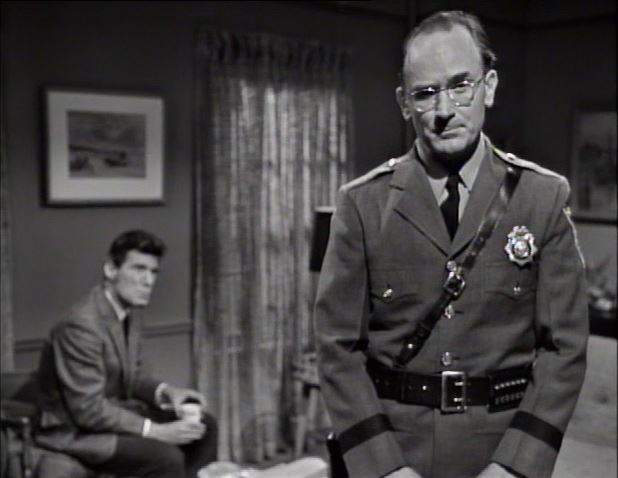
The videography is also as ambitious as we ever see it in this show. The camera tracks fluidly through the lobby, showing us more of that set than we see in any other episode, ending in a low angle shot of the sheriff that makes him look ominous. Some of those tracking shots are too much for Michael Currie, the actor playing the sheriff- during his scene alone with Burke, he bumps into one camera, stumbles into a piece of furniture, and then the other camera hits him in the back of the head. After that, he stands with his back to Burke and his elbows bent in front of him, looking for all the world like he is urinating on the floor:

Currie is so physically awkward that when Burke asks the sheriff the rhetorical question “Have you ever sat on a wrench?,” it seems to be a pretty near certainty that the answer is yes.

Currie has a rough time in this episode with his lines as well as with his movement. Perhaps the single funniest blooper comes when he declares that a good memory “is what I’m paid for,” then forgets his next line. It’s also interesting when he calls Burke “Burt.” Bloopers are after all one of the things Dark Shadows is known for, so we can’t be too annoyed with him for those. Worse is what happens when he does remember his lines. He intones them all as if he were leading the Pledge of Allegiance.

In the months after Mark Allen left the show, the standard of acting on it was remarkably high. Every actor other than Currie consistently turns in performances so strong that watching an episode feels like a fine evening at the theater. And bad as he is, even Currie doesn’t keep his scene partners from delivering good performances. He just wasn’t ready for professional acting. So I don’t have the same need to complain about him as about Allen, but he does deliver the series’ first laugh-out-loud moments of incompetence, and it is a relief when he is replaced.

Episode 18: Strange sounds and lonely echoes

Only three characters in this one- Roger, Vicki, and David. In the previous episode, Roger learned that his crash was no accident, that someone tampered with his brakes. Now he wants Vicki to tell him what she can that will help him prove that Burke Devlin was the one responsible. Which is a great deal- she saw him in the garage, with a wrench, next to Roger’s car. She had gone into the garage after hearing what she thought was a car door slam. She admits that the slam could have been the hood over the engine compartment, and since the car door next to Devlin was open, this seems likely. Since the reason Roger was on the road was that Devlin had invited him to town to discuss “business,” and the two of them do not seem to have any business together at all, the case against Devlin seems quite strong.

David will place rather a substantial difficulty in the way of Roger’s hope of sending Devlin back to prison. As the audience knows, it was he, not Devlin, who removed the valve from the braking system on his father’s car. We even see him handling the valve in this episode. In episode 17, he nearly confessed to his Aunt Elizabeth, and this time he makes an incriminating statement to Vicki. Both women had assumed he was merely expressing guilt for his hostility to his father, and tried to reassure him that his feelings and thoughts didn’t mean that he was to blame for what happened on the road. David even tries to talk to his father in this one, and Roger icily dismisses him. But we’ve seen enough mystery stories, including inverted mysteries where the audience knows who done it before the detective does, to be sure that Roger will learn the truth when he least expects it.

Roger not only has reason to suspect that Burke is responsible for his crash; he also has deep, complex, ungovernable feelings where Burke is concerned. Some of those feelings have to do with the testimony he gave at the trial ten years before which sent Burke to prison. Some go back before that, and have to do with the friendship that existed between them before that trial. All of them are deeply secret.

This show was being made in 1966, when Freudianism reigned supreme in much of American intellectual life, and the most respected of respectable novels was Proust’s À la recherche du temps perdu. All of the cast and much of the production staff comes from Broadway, where at that time Tennessee Williams was the undisputed king of serious playwrights. And the part of Roger was played by Louis Edmonds, who came out of the closet as a gay man as soon as it was possible to do so, and who was never in the closet as far as his friends and colleagues were concerned. So it seems likely that the secrets Roger is so desperate to conceal include some kind of homoerotic connection with Burke. This episode lampshades some standard soap opera craziness in order to call our attention to the irrational nature of Roger’s attitude towards Burke, and I think a mid-1960s audience would be likely to suspect that a repressed sexuality is driving that irrationality.

Here’s how I put it in a comment on John and Christine Scoleri’s Dark Shadows Before I Die:

When Vicki tells Roger what she saw Devlin doing in the garage, Roger asks her to come with him to confront Devlin at the hotel. That’s a typical soap opera character idea. What isn’t so typical is Vicki’s response, that it would be better to go to the police. She sticks with that rational idea until Roger tells her of his urgent need to see Devlin’s face. That picks up on Roger’s frantic behavior in Week One and sets him up for the whole saga of Where Burke Devlin’s Pen Is, in which we see that Roger’s attitude towards Burke is rooted in some deep and complicated emotions.