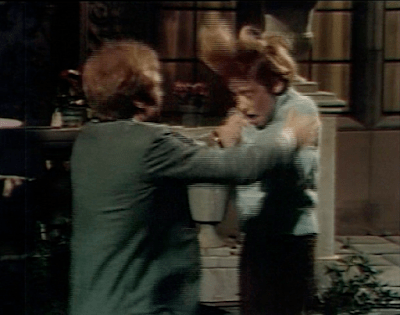
Episode 785: Time is my hobby

Early in 1969, the great estate of Collinwood became uninhabitable. The ghost of Quentin Collins took possession of the place and was about to kill strange and troubled boy David Collins. Quentin and David’s distant cousin Barnabas Collins traveled back in time to the year 1897, when Quentin was a living being, and hoped to somehow prevent Quentin from becoming an evil spirit.

So far, Barnabas has managed to make everything much, much worse. As soon as he arrived in 1897, he found that he had become a vampire. So far, he has been responsible for at least six homicides that did not take place the first time through this period of history. He has also enslaved three people by biting them. He has not prevented a curse that has made Quentin a werewolf, which is evidently the origin of the disaster at Collinwood in 1969.

Moreover, Barnabas’ blunderings have caused Judith Collins, who owns Collinwood and the Collins family businesses, to become close to the hypocritical Rev’d Gregory Trask. Trask has responded to Judith’s interest in him by enlisting lawyer/ Satanist Evan Hanley to carry out a particularly cruel plan to murder Trask’s wife Minerva. Now Trask and Judith are married. Today she tells her brothers, Quentin and the stuffy Edward, that she is changing her will. Edward’s twelve year old son Jamison will still be her heir, but Gregory will administer the estate if Judith dies before Jamison is 21. Regular viewers know, not only that Gregory killed Minerva on the off-chance that he would thereby get a shot at taking Judith’s money, but that he is a sadist who takes special pleasure in making Jamison miserable. So this provision is a death sentence for Jamison. Since the residents of the great house at Collinwood in the 1960s are Jamison’s daughter Liz, son Roger, and grandchildren Carolyn and David, Trask will negate Dark Shadows‘ contemporary timeline if he murders Jamison.

It is not impossible that this might happen. The show is now chiefly about time travel, and the 1960s are not an indispensable destination. Barnabas did leave a few interesting characters behind when he traveled to the nineteenth century- sooner or later he is going to have to be reunited with mad scientist Julia Hoffman, MD, and occult expert Professor Timothy Eliot Stokes also has a lot to offer. But if Barnabas could find a way to come unstuck in time, Julia and Stokes can too. Wicked witch Angelique has already made her way to 1897. And anyone else we might miss can be replaced by the same actor playing a similar part. It does seem unlikely Collinwood will become Traskwood. But in April 1967 it seemed even less likely that the ABC network would devote thirty minutes of airtime five days a week to showing a vampire feeling sorry for himself, yet here we are.

Quentin is amused by Judith’s marriage to Trask, Edward appalled. Edward tells Judith that their grandmother’s will specified that he and Quentin would have the right to stay in the house as long as they wished, a point Judith concedes. This is a retcon. When the will was read in #714, it was made very clear that only Quentin was given a place in the house. Jamison was named as contingent heir. Edward was not mentioned at all. Neither was Carl Collins, another brother of Judith’s, whom Barnabas murdered a couple of days ago and who has already been forgotten.

Judith runs Edward and Quentin out of the drawing room. When she comes back in, she finds that the new will has been torn to shreds, a dagger has been stuck into a Bible under a verse lamenting the sufferings of the righteous, and there is a childish drawing tacked to the wall labeled “Mrs Trask.” Although “Mrs Trask” is now her own name, a fact which she proudly declared to Edward a few minutes before, she immediately assumes the drawing depicts Minerva.

Not the usual sort of portrait one finds on the walls of the great house. Screenshot by Dark Shadows Before I Die.

This resonates with two stories that longtime viewers will remember. From November 1967 to March 1968, Dark Shadows was set in the 1790s. The ancestor of the future Collinses in that period was Daniel Collins, who like Jamison and David is played by David Henesy. Daniel’s big sister Millicent married roguish naval officer Nathan Forbes, who set about trying to murder Daniel in order to get all of Millicent’s wealth for himself.

Yesterday Judith saw Minerva’s ghost in the same part of the drawing room where these odd occurrences have taken place, and the Biblical verse is very much the sort of thing Minerva would have been likely to quote. So we are to assume that she is indulging in a little poltergeist activity. But the “Mrs Trask” drawing is so unlike anything the somber Minerva would have made herself that we can only assume she took it from some other spirit out in the unseen realm. Since “Mrs Trask” is Judith’s name now, the question of who that spirit might be brings up a second old story.

From March to July 1967, Liz was being blackmailed by seagoing con man Jason McGuire. Jason’s ultimate demand was that Liz should marry him, giving him control of the Collins family fortune. Liz’ daughter Carolyn was outraged when it looked like she was going to marry Jason, and in #252 she taunted her mother by shouting the name “Mrs McGuire!” over and again. Perhaps Minerva’s dead spirit has crossed paths with Carolyn’s unborn one, and Carolyn has drawn the picture as a way of rehearsing for that scene. Though Carolyn is an adult, Jamison had a dream in #767 in which he caught a glimpse of the Collinwood of 1969 and saw that Carolyn has a fondness for childish imagery.

There is also some business in this episode about broad ethnic stereotype Magda Rákóczi’s effort to lift the werewolf curse she placed on Quentin. Magda has stolen a severed hand that has magic powers and plans to put it on Quentin’s heart when he begins transforming tonight. Yesterday, Evan forced Magda to let him see the hand; when he looked at it, the hand grabbed him. It left him unconscious and severely disfigured. Now Magda is keeping Evan in her home, the Old House at Collinwood, and treating him with surprising tenderness. Quentin sees Evan there. He does not recognize him, even though he and Evan were close friends, Evan is wearing the same gray suit he always wore, and his very distinctive hair and beard are unchanged. Eventually Evan regains the ability to say his name, and Quentin freaks out. He does not want to go through with Magda’s plan, but when the transformation begins he drops his opposition.
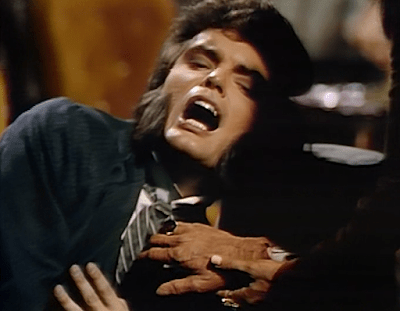
Magda placed the hand on Quentin. Screenshot by Dark Shadows Before I Die.

The hand looks very much like a Halloween decoration, so much so that I wonder if Dan Curtis hoped to make some money by getting copies of it into department stores by October 1969. It’s pretty disgusting to look at, but that’s the point.

One of the problems Dark Shadows had throughout its run was that it tended to veer between appealing exclusively to adults and exclusively to children. In the early months, its glacial pace, heavy atmosphere, psychological depth, and reliance on the star power of Joan Bennett drew a rather mature audience. As the supernatural and fantastic themes came to predominate, the average age of the viewers dropped towards the single digits. By the end of the big Monster Mash that ran through 1968, the show’s strongest demographic was probably elementary school pupils. Dividing an episode between the relatively adult melodrama of Edward’s reaction to the Judith/ Trask marriage and the undisguised kids’ stuff of The Hand of Count Petofi would seem to be a way of offering something to both the oldest and youngest viewers.

This episode originally aired on 27 June 1969. That was the third anniversary of the show’s premiere. That first installment, like 332 of those that followed it, revolved around the character of well-meaning governess Victoria Winters, played by Alexandra Moltke Isles. Mrs Isles left the show in November 1968; her son Adam Isles, who would in the 2000s become a top official of the USA’s Department of Homeland Security, was born this day. Mrs Isles has said in interviews that while she was recovering from the birth she tuned in to Dark Shadows, but that the show had changed so much in her time away from it that she couldn’t figure out what was going on.

I imagine Mrs Isles had changed a great deal as well. Like so many members of the cast and production staff, she was a fashionable, sophisticated New York society figure. While she was working on the show, she was immersed in its imaginary world, but after several months away she would have refocused her attention on the sorts of things she was raised to care about when she was growing up as the daughter of Countess Mab Moltke. One doubts that magical severed hands, werewolves, devil worshipers, and actors in brownface makeup would have ranked especially high on that list.

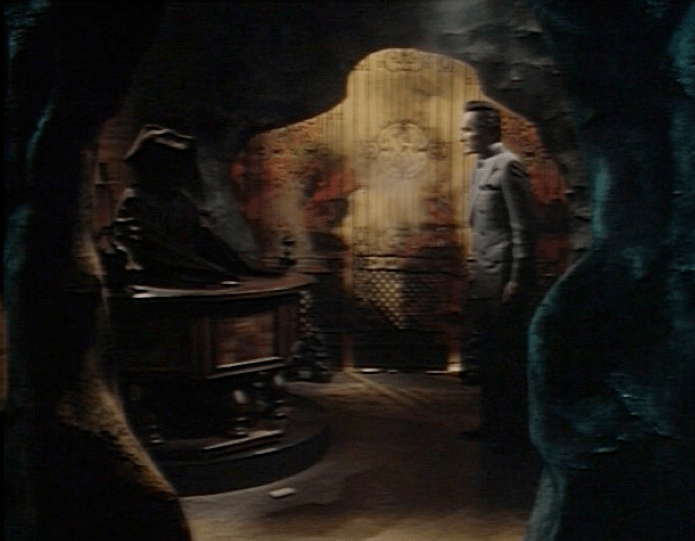
Episode 744: Sometimes he makes himself invisible

The House by the Sea

In September and October 1967, well-meaning governess Vicki and her depressing boyfriend Burke wanted to buy a long-disused property that everyone referred to as “The House by the Sea.” Collinsport is a coastal village, so many of its houses would lie by the sea, but at that point only that one was so designated on Dark Shadows. It was important that The House by the Sea lay on the other side of Collinsport from the great estate of Collinwood. When it was first introduced, matriarch Liz was eager to go there, signaling that the show was done with an old and unproductive theme presenting Liz as a recluse. And Burke was willing to live there with Vicki, whom he is determined to get away from Collinwood and the Collins family.

The house belonged to the Collinses, and the show suggested that it might be haunted in such a way that if Burke and Vicki lived there they would become possessed by the unquiet spirits of its former occupants, Caleb Collins and his wife, whom we know only by the initials “F. McA. C.” When Liz found in #335 that for legal reasons she would not be able to sell Vicki and Burke the house for a few years, the whole story vanished without a trace. We did not hear the phrase “The House by the Sea” again until #679, in January 1969.

At that point, the show was in fact running a story about ghosts taking possession of the living, a coincidence that leads me to wonder if the writers were making an inside joke about a story that was in the flimsies early in 1967, that was reflected in the talk about “The House by the Sea” that autumn, and that went nowhere. At the beginning of January 1969, strange and troubled boy David Collins was intermittently possessed by the ghost of his Aunt Liz’ great-uncle Quentin, and when Liz questioned him about some of his odd doings he made up a story about The House by the Sea to persuade her that he was just being silly.

In between those two stories, we did hear a great deal about another place called “A House by the Sea.” From #549 in August 1968 until #633/634 in November, this house was rented by suave warlock Nicholas Blair. At first it was said to be located at some distance from Collinwood, and it seemed that it might be the house Burke and Vicki had been interested in. But as we saw it, we could see that it was in quite a different architectural style. And as time went on, the house moved closer and closer to Collinwood. After a while, the opening narrations referred to it as “Another house on the same great estate.” That did not stop Big Finish Productions from conflating Vicki and Burke’s “The House by the Sea” with Nicholas’ “A House by the Sea” in their 2012 drama The House by the Sea, but the houses remained distinguishable on the show as of early 1969.

Now, Dark Shadows has become a costume drama set in the year 1897. Well-meaning time-traveler/ bloodsucking fiend Barnabas Collins has gone to that year, when Quentin was a living being, in hopes of preventing the events that made him into the all-destroying evil spirit of 1969. Barnabas does not have the slightest idea what those events were, and in the absence of that information he has decided that the best course of action is to antagonize as many people as possible.

Among the enemies Barnabas has made is the evil Rev’d Gregory Trask, head of a boarding school/ abusive cult called Worthington Hall. Another of Barnabas’ new enemies has, for reasons of her own, burned Worthington Hall to the ground. Trask has captivated the current mistress of Collinwood, spinster Judith Collins, and in #739 Judith offered Trask the use of a “small house on the estate” as a temporary base for the school until she can finance the restoration of the previous site. Today, Judith instructs a servant to take steps to prepare “the house by the sea” for this purpose.

Perhaps this means that Trask’s cruelty center will occupy the house Burke and Vicki wanted to buy. That Judith said it was “on the estate” would suggest that it is the one where Nicholas lived, and they have decided that so few people remember the dead-end storyline of autumn 1967 that they no longer need to keep the two houses distinct by calling only one of them “The House by the Sea.”

No More Knife

While Quentin was haunting Collinwood in late 1968 and early 1969, he showed himself to be a peculiarly corporeal sort of ghost. In addition to the usual ghostly business of materializing and dematerializing inside closed rooms, possessing children, and making noises resound from everywhere and nowhere all at once, he also poisoned one person, choked another, and came and went through a secret passage. Occasionally this served to show that Quentin’s power started small and grew steadily until he was irresistible, but it also left the impression that Quentin simply enjoyed feeling like he had a body. Now that we see Quentin as a living being, the impression that he revels in the flesh is frequently confirmed.

Quentin’s estranged wife Jenny has gone mad and is being kept prisoner in the great house by Quentin’s sister Judith and brother Edward, with the assistance of a couple of the servants. Quentin learned of Jenny’s continued presence at Collinwood only when she escaped and stabbed him a few weeks ago, and he still can’t figure out where in the house she is locked up. He has vowed to kill her once he does find her.

Jenny is on the loose again today. Judith has a close call in the drawing room. She finds Jenny there. Jenny menaces Judith with a knife; just as she gets Judith into a helpless position and it looks like she is about to stab her to death, Jenny picks up a candlestick and knocks Judith unconscious. Shortly after, Quentin comes in and finds Judith recovering from the blow. Judith tells him what happened. He gets a gun and goes out to hunt Jenny down.

Jenny makes her way to the Old House on the estate. She knocks on the door, and Barnabas answers. They introduce themselves to each other. His name means nothing to her; he arrived only nine weeks ago, long after she lost her marbles and was consigned to a hidden cell. No one has told her that Judith invited a distant cousin from England to stay in the Old House. But Barnabas knows exactly who Jenny is, and he listens to her every word and watches her every move with vivid interest.

Jenny announces that she has come to find Quentin. Barnabas says that Quentin is not there, and invites Jenny to search the house. As she walks through the front parlor, Jenny announces that “Sometimes he makes himself invisible.” That line will strike a chord with regular viewers who remember the ghostly Quentin of the 1960s, though Jenny is apparently thinking of a psychotic break she had earlier in the episode when she hallucinated his voice coming from various pieces of furniture in the drawing room. Nonetheless, Jenny is confident that she will know if Quentin is nearby.

Jenny talks about her “children”; Barnabas visited one of her former cells, and saw that there were dolls there. He asks twice if the children she is talking about are dolls, and each time she angrily insists that she has real live children and that they are in her room at Collinwood. She sings a lullaby in a minor key; she forgets the lyrics halfway through, and asks Barnabas if he knows them. She has a lovely voice, and he seems to be sincere when he says he is sorry that he cannot help her finish the song.

As Jenny talks about her children, it dawns on Barnabas that she may in fact have had children who were taken from her. His reaction to this is an important moment. In 1969, Barnabas learned that in 1897 a baby died and was buried in an unmarked grave on the grounds of Collinwood with an amulet meant to ward off werewolves. So far in his trip back to that year, he has found no babies and there is no werewolf. His response to Jenny’s talk of her children looks like a man making a wild surmise. If the baby in the unmarked grave was one of Jenny’s children, the werewolf must be coming very soon.

Barnabas makes the connection.

Jenny is sitting on the staircase for part of this conversation with Barnabas. Ever since Barnabas first met David in #212, he has had his most human moments while standing on the floor and talking to people on that staircase, and his talk with Jenny is an outstanding example. He talks to her very gently. Perhaps he has the presence of mind to try to befriend someone who might be useful to him, but whatever he is thinking he shows a real warmth.

Jenny tries to stab Barnabas; he takes the knife from her. She cowers in a heap on the floor, wailing that now he will kill her. He throws the knife in the fire and tells her she has nothing to fear. Of course, a metal blade could not harm a vampire, so it was easy enough for Barnabas to remain unruffled during the attack.

Barnabas vetoes Jenny’s demand to search the basement, where his coffin is, and takes her upstairs to a bedroom once occupied by his lost love Josette. In 1967, he restored that bedroom to the condition it was in when Josette lived there, and for some reason he has done the same this time. By the time they get to Josette’s room, Jenny thinks that she and Quentin are on their honeymoon and that Barnabas is a bellhop. She apologizes that she has no money to give him as a tip.

Jenny looks into the mirror and is revolted by the terrible person she sees there. Barnabas points to an assortment of lady’s toiletries and assures her that the terrible person will go away if she uses them. He locks her in the room and calls for his servant Magda.

Jenny is so crazy we can never be sure what she will make of any set of facts she encounters, and Barnabas is, for once, keeping his thoughts to himself throughout his scene with her. But however much ambiguity may be built into Barnabas and Jenny’s interactions with each other, there is no question what Marie Wallace and Jonathan Frid are doing. She is supposed to play Jenny without restraint, and she makes the most of that opportunity to be larger-than-life. He also seizes his chance to show what he can do when he has time to really learn his part. He is not only letter-perfect with his lines, but also subtle and precise in his characterization of Barnabas’ reactions and intentions. It is a fascinating performance.

Jenny hears Barnabas calling Magda’s name. She not only repeats it, but also says the name of Magda’s husband Sandor. Magda and Sandor have been in the Old House for quite some time, well before Barnabas showed up and forced them into his service, so it is no surprise that Jenny remembers them. It is interesting that she seems to have strong feelings about them, though. Before she left the great house, Jenny was talking to herself, saying that her father was “a king in India.” Sandor and Magda are Romani, and the Romani people originated in India. Their ethnicity may be what brought that part of the world to Jenny’s mind.

Magda and Sandor are out. The sun is rising. Barnabas leaves a note for Magda, and goes to his coffin for the day. Quentin enters, brandishing his pistol. He finds the note and a key, and goes upstairs. We close with him standing outside Josette’s room. He and Jenny talk to each other through the locked door. He tells her that he is coming to her and that they will never be separated again.

In a comment about Danny Horn’s post about this episode on Dark Shadows Every Day, David Pierce makes an interesting observation:

My favorite line was from Quentin to Judith when he wants to know how Jenny escaped: “What, did she leave by fasting and prayer?” He was misquoting Jesus from the New Testament, Matthew Chapter 17, verse 21 “Howbeit this kind goeth not out but by prayer and fasting.”

David Pierce, comment left at 12:01 PM Pacific time 13 January 2021 on Danny Horn, “Episode 744: Crazy Little Thing,” Dark Shadows Every Day, 9 October 2015

Quentin does paraphrase the Bible quite often, a habit which, combined with his penchant for Satanist ceremonial practice and his gleeful libertinism, suggests that he won’t pass up any potential source of delights.

Episode 629: I know him by another name

Suave warlock Nicholas has botched his main project, and is in big trouble with his supervisor. He is called into the corner office, which apparently represents Hell, and talks the boss into giving him another chance.

Nicholas gets an unsatisfactory performance review. Screenshot by Dark Shadows Before I Die.

Regular viewers will immediately recognize Hell as a redress of the basement of the Old House on the great estate of Collinwood, home to old world gentleman Barnabas. Strangely enough, this is not the first time it has seemed that Hell is in a corner of Barnabas’ basement. In #325, strange and troubled boy David had a dream in which the ghost of Barnabas’ sister Sarah brought him to the basement. The set was decorated much as we see it today. David met a faceless figure and saw Barnabas, who was at that time a vampire, rise from his coffin. In #512, the ghost of the Rev’d Mr Trask, a witchfinder whom Barnabas murdered in the late eighteenth century, conjured up the spirits of many of Barnabas’ victims, and put him on trial in the basement. Again, we see that it is the abode of the unhappy dead.

Nicholas has to admit to his boss that he has fallen in love with Maggie, The Nicest Girl in Town. Contemptuous of warm human feelings, the boss tells Nicholas that he and Maggie can indeed be together for all time, but only “here”- confirming that the set does represent Hell. Nicholas is horrified, but the boss yields nothing. He will have to sacrifice Maggie in a Black Mass so that she can be damned along with him. He must also get his original project back on track, breeding a race of Frankenstein’s monsters who will be loyal to the spiritual forces of darkness.

Returned to the world of the living, Nicholas goes to the great house of Collinwood, where he tries to persuade mad scientist Julia to help him with the Frankenbabies plan. She can see that he is desperate, and is therefore unimpressed with him. She presses him for more information, and he tells her to read the Book of Genesis. His boss figures in it, as the one who tempted Adam and Eve. Julia gasps at the idea that Nicholas is one of Satan’s direct reports. Nicholas explains what he wants her to do. Julia calls the idea “monstrous,” a description which Nicholas considers apt. She refuses to have any part in such an enterprise, but she capitulates when he threatens her dear friend Barnabas.

Danny Horn’s post about this episode on his great Dark Shadows Every Day is devoted to the packet of View-Master reels featuring images related to episodes made around this time. I’ve always enjoyed View-Master; I think it’s a shame it was slotted as something for young children only. I find it refreshing to spend three or four minutes peering into its little worlds. I left this comment:

Some years ago I bought a bunch of ViewMaster reels. I’d liked them when I was a kid, and I was curious about the non-cartoon ones, the reels depicting landscapes and such. I found that it was a meditative exercise looking into the viewer and teasing out all the 3-D effects.

Anyway, I still have those reels, including the Dark Shadows set. Inspired by this post, I looked at them this morning. There are a bunch of very good shots with high contrast between actors and background. Bud Astredo was particularly good at striking poses that would make him stand out. Grayson Hall is just as good, it’s a shame she’s only in the one picture.

(20 October 2020, 11:12 am Pacific time)

Danny’s post also links to this wonderful piece about the packet on a blog called View-Master 3D.

Episode 609: For want of a fig leaf

Adam and Eve are discussing the Fall, comparing their incomplete memories of what came before it. This is not a flashback. The Adam and Eve we see today are Frankenstein’s monsters, and they do not live in exile from Eden when the world was young, but in the town of Collinsport, Maine in 1968. The Fall they have in mind is the one that is also known as Autumn. Adam is ashamed, not because he is naked, but because Eve accuses him of preferring life in captivity. He is not naked at all, even though Eve walks in on him and sees his Harry Johnson. Harry Johnson is the man to whom Adam has entrusted a letter, but since Adam’s favorite pastime is studying the works of Sigmund Freud, and since by 1968 “johnson” had been a familiar English slang word for “penis” for over a century, he would likely have been the first to make the connection to the predicament of their Biblical namesakes.

Adam takes Eve to his old home, a dusty room in the long-deserted west wing of the great house of Collinwood. Heiress Carolyn hid him there for a period that seemed so long the audience might feel that the original Adam and Eve were probably still around when it started. Carolyn greets them there. She is happy to see Adam again and eager to befriend Eve. Adam wants that too, but Eve isn’t having it. She quarrels with Adam and storms out, leaving Carolyn in an awkward position.

On the terrace outside the great house, an unpleasant man named Peter who prefers to be called Jeff is waiting for his date, well-meaning governess Vicki. Vicki has kept him waiting for an hour. Vicki’s charge, young David, happens by. Peter/ Jeff immediately makes it clear why Vicki is in no hurry to see him. He greets David with an accusation that he was hiding from him. When David denies this, Peter/ Jeff demands that he tell him who he was hiding from. Peter/ Jeff may have forgotten who is a guest in whose house, but David hasn’t, and he turns to go. Peter/ Jeff stops him, asking “We’re friends, aren’t we?” David doesn’t explicitly agree that they are, but he stays.

Peter/ Jeff starts to talk about his plans to marry Vicki. David calls him “Peter,” and since the closest thing he has to a personality is his insistence on being called “Jeff” he grabs David and shakes him violently. Watching this scene today, my wife, Mrs Acilius, said one word- “Psycho.” She wasn’t talking about Peter/ Jeff, but about actor Roger Davis. When one character shakes another, it is usually the actor playing the shakee who makes all the movements, while the shaker just mimes the action without actually touching them. Not so Mr Davis- he really did rattle David Henesy around hard enough that it’s pure luck he didn’t give him a concussion. That’s typical of the approach Mr Davis took to his performances on Dark Shadows, in the course of which he assaulted several women on camera. Mr Henesy is uncharacteristically tense throughout this scene, does not sustain eye contact with Mr Davis, and when the scene ends he rushes off stage.

Roger Davis has his fun. Screenshot by Dark Shadows Before I Die.

In his dialogue, Peter/ Jeff makes some pretty bizarre remarks:

You know, David, pretty soon, you’re gonna find out that love isn’t something you can remember. Sixteen years old… You know when you’re sixteen, you can really love somebody. And then you come back ten years later and you wouldn’t even notice her.

At this, David gives Peter/ Jeff a look that accords with Mrs Acilius’ one word assessment of Roger Davis. “Love isn’t something you can remember”? Which item on the sociopathy screening test is that? And what does “Sixteen years old” have to do with anything? David is twelve, Peter/ Jeff and Vicki are in their twenties, no one mentioned the number sixteen. And David would be doing Vicki a solid if he told her that her fiancé won’t remember her in ten years.

David Collins wonders what the #%*^ is wrong with Peter/ Jeff, while David Henesy recovers from Roger Davis’ assault on him. Screenshot by Dark Shadows Before I Die.

David leaves, and Eve shows up. She recognizes Peter/ Jeff and addresses him as “Peter Bradford!” The closing credits start rolling before Peter/ Jeff can shake her violently while whining that he wants to be called “Jeff Clark.” Eve is the reincarnation of an eighteenth century homicidal maniac; she hasn’t killed anyone since she was brought to life the other day, and Peter/ Jeff would be an excellent choice for her first victim. If she does kill him, I would be “Team Eve” all the way.

Episode 420: A man’s position in society

One of the most story-productive relationships in the first 40 weeks of Dark Shadows was that between reclusive matriarch Elizabeth Collins Stoddard and her brother, high-born ne’er-do-well Roger Collins. Having squandered his entire inheritance, Roger lived as a guest in Liz’ house and drew a salary from her business. She tried to order him to rein in his bad behavior, but time and again wound up shielding him from accountability. When she does that, she reduces herself from authoritative to bossy.

In the summer of 1967, the relationship between mad scientist Julia Hoffman and vampire Barnabas Collins began to follow the same dynamic of Bossy Big Sister/ Bratty Little Brother. Appealing to her professional standing as a medical doctor doubly qualified in hematology and psychiatry and to her situational awareness as a native of the twentieth century, she makes efforts to convince him that not every problem has to be solved by murder. When he disregards her advice and kills people anyway, she covers up for him. Realizing that she is stuck with Barnabas for the rest of her life, Julia tries to drum up a romantic relationship with him, but he is not interested. Eventually, she will come to be “like a sister” to him in more senses of that phrase than she would like. In the years to come, we will even see storylines in which the two of them explicitly masquerade as siblings.

Dark Shadows took a break from its contemporary setting and began an extended stay in the late 18th century beginning in November 1967. We’ve already caught a glimpse of the Bossy Big Sister/ Bratty Little Brother dynamic in this period, when haughty overlord Joshua Collins found himself taking orders from his sister, repressed spinster Abigail. Today, we take a bit of a self-referential turn as a character decides to deliberately mimic this trope.

Caddish naval officer Nathan Forbes has talked fluttery heiress Millicent Collins into marrying him. Millicent is very rich and beautiful, Nathan is charming and handsome, and there are many reasons to think they might make a happy couple. There is one small problem. A very small problem, really; not more than five feet tall and well under 100 pounds. It is Nathan’s current wife, Suki. Suki has found out what Nathan is up to, and wants a cut of his take. To his surprise and discomfort, she shows up today at the great house of Collinwood and introduces herself to Millicent as Nathan’s sister.

The Millicent/ Nathan story has been a lot of fun so far, and Suki is just fantastic. Actress Jane Draper gives a performance as big as her body is small, and Suki instantly sees through Nathan’s every lie, which is to say his every utterance. She dominates every scene she is in.

Suki has Nathan where she wants him. Screenshot by Dark Shadows Before I Die.

Yesterday, Suki walked in on Nathan at The Eagle tavern and took charge of the place. Today, she is in command of the drawing room at Collinwood. Nathan and Millicent serve up one straight line after another, every one of which Suki answers by saying something unexpected and exciting.

Suki looks out the window and sees Barnabas looking in. She doesn’t know who he is, much less that he is a vampire, but she can recognize a miserable creep when she sees one. He throws her off her form, and we dissolve to an upstairs bedroom.

The rest of the episode is a scene where Barnabas lets himself into the bedroom occupied by his ex-fiancée, the gracious Josette. He tells Josette they can never be together again, but won’t explain why. She says she wants to be with him no matter what. He bites her. They’ve been telegraphing this scene all week. It’s a complete anticlimax, and it does nothing to make up for Barnabas interrupting our time with Suki.

For a show that plundered story ideas from virtually everywhere, Dark Shadows was remarkably wary of lifting anything from the Bible. Suki’s claim to be Nathan’s sister is something of an exception. It reminds us of Abraham, who twice in Genesis passes off his wife Sarai/ Sarah as his sister and then recommends that his son do the same with his wife Rebecca. The 1795 flashback is supposed to explain the origin of the accursed Collins family for us, to answer the question “Who are Barnabas’ kin?” as Genesis answers the question “Who are Joseph’s kin?” So Suki is in tune with the rationale of the segment when she draws on that book. While Genesis explains and justifies a patriarchal order of society, so that Sarah and Rebecca just go along with Abraham’s loony schemes, daytime serials are aimed at a mostly female audience and need self-starting female characters. So it is only to be expected that the gimmick will be at Suki’s initiative this time.