Episode 281: All the unhappiness of all my ancestors

Vampire Barnabas Collins is giving a costume party in his home at the Old House on the great estate of Collinwood. His distant relatives, the living members of the Collins family, are dressed as their ancestors from Barnabas’ own time as a living being. The whole thing was impossibly dull until the mischievous and witty Roger Collins suggested they have a séance. Now well-meaning governess Vicki is in a trance, channeling the spirit of Josette Collins.

The last time Josette took possession of Vicki at a séance was in #170 and #171. At that time, Josette delivered her message in French. Since Vicki could not speak French (but Alexandra Moltke speaks it fluently,) that was evidence enough to convince even the most skeptical that something was going on. Today Josette speaks English. The characters are all sure that she is the one speaking, but it doesn’t have the same effect on the audience as did that earlier irruption of a language we had not expected to hear.

I do wonder if the decision not to use French came at the last moment. Even though Vicki/ Josette’s voice is loud and clear, the others make a show of struggling to understand what she is saying and seize on a word here and there (“Something about ‘run!'”,) as people do when they are listening to someone speak a language they don’t quite understand. Perhaps writer Joe Caldwell wasn’t quite up to writing in French, and the Writer’s Guild wouldn’t let Alexandra Moltke Isles or any other Francophones on set make a translation. Or maybe they thought that the switch to French wouldn’t be as effective the second time as it was the first.

Josette is telling the story of her death. A man was chasing her, and fleeing him she threw herself off the peak of Widow’s Hill to the rocks below. Barnabas interrupts and breaks Vicki’s trance.

When the others scold him for stopping Josette before she could reveal the name of the man who ran her off the cliff, Barnabas says that the name could not have been of any importance, since whoever it was who drove Josette to kill herself must have been dead for “almost 200 years.” The others do not suspect that he was that man. They do not know that he is a reanimated corpse; they think he’s just English.

When Dark Shadows started, the stories of the tragic death of Josette and of the building of the great house of Collinwood were set in the 1830s. In the weeks before Barnabas’ introduction in April of 1967, they implied that Josette’s dates were much earlier, sometime in the 18th century. Last week, they plumped for the 1830s again. But Barnabas’ line about “almost 200 years ago” puts us back to the 1700s.

After the séance ends, we have evidence that this bit of background continuity might start to matter. Vicki looks at the landing on top of the staircase and sees the ghost of Barnabas’ 9 year old sister Sarah watching the party.

Sarah watches the party. Screenshot by Dark Shadows Before I Die

It seems that when Barnabas was freed to prey upon the living, he unknowingly brought Sarah with him. Sarah has been popping in and out quite a bit the last few weeks, and she has already made some important plot points happen. We’re starting to wonder just how many more beings will emerge from the supernatural back-world into the main action of the show. The opening voiceover today tells us that “the mists that have protected the present from the past are lifting,” so perhaps they will have to nail these dates down sooner rather than later.

The whole party had accepted instantly that Vicki was channeling the spirit of Josette and none of them ever comes to doubt it. But when she says that she saw a little girl at the head of the stairs, they get all incredulous. By the end of the episode, Vicki will have encountered so much disbelief on this point that she herself will decide that she must have been hallucinating.

Back in the great house, Roger is still overjoyed that the séance turned out to be so exciting. His sister Liz and Liz’ daughter Carolyn consider this to be in terrible taste. But Roger won’t give an inch. He has some great lines, exiting with “I think that all of the unhappiness of all of my ancestors is my rightful heritage, and you shouldn’t try to keep it from me. Good night, ladies.” Both Patrick McCray, in his Dark Shadows Daybook post about this episode, and Danny Horn, in his Dark Shadows Every Day post, make insightful remarks as they analyze the fun Louis Edmonds has playing Roger.

Carolyn approaches Vicki to speak privately. She tells her that she isn’t bothered that fake Shemp Burke Devlin is dating Vicki. Vicki’s response to this is “What?” Carolyn reminds Vicki that she used to be interested in Burke and was initially jealous of Burke’s interest in her. But she assures her she doesn’t feel that way any longer. Vicki smiles, nods, and looks away. Carolyn then says “He’s really very nice!” Vicki answers “Who?” “Burke!” says Carolyn. Again, Vicki smiles, nods, and looks away.

This is probably supposed to tell us that Vicki is coming under some kind of spell associated with Barnabas, but in fact it is likely to suggest something quite different to the audience. Burke was originally a dashing action hero played by Mitch Ryan. Dark Shadows never really came up with very much for a dashing action hero to do, but Ryan’s skills as an actor and his charismatic personality always made it seem that he was about to do something interesting. Several weeks ago, Ryan was fired off the show after he came to the set too drunk to work.

Since then, the part of Burke has been played by Anthony George. George was a well-trained actor with an impressive resume, and by all accounts was a nice guy. But he cannot dig anything interesting out of the character of Burke as he stands at this point in the series. The only scene in which George has shown any energy so far was in #267, when Burke had lost a dime in a pay phone. The rest of the time, he has blended so completely into the scenery that it is no wonder Vicki can’t remember him from one line to the next.

Back in the Old House, Barnabas talks to Josette’s portrait. In the months from #70 to #192, it was established that Josette can hear you if you do this. Several times she manifested herself either as a light glowing from the surface of the portrait or as a figure emerging from it. In #102, we saw strange and troubled boy David Collins having a conversation with the portrait- we could hear only his side of it, but it was clear that Josette was answering him.

The first time we saw Barnabas in the Old House, in #212, he spoke to the portrait. At that point, Josette was not yet his lost love. It seemed that she was his grandmother, and that she had sided against him in some terrible fight with his father Joshua. He ordered Josette and Joshua to leave the house to him. The next time David tried to talk to the portrait, in #240, it seemed that they had complied- David could no longer sense Josette’s presence in it.

Barnabas had spoken briefly to the portrait the other day, but today he makes his first substantial address to it since banishing Josette and Joshua in #212. Again he entreats her to go, but for a very different reason. Now he says that she is lost to him forever, and must allow him to live in the present. Since he has been scheming to capture a woman, erase her personality, replace it with Josette’s, and then kill her so that she will rise from the grave as a vampiric Josette, this sounds like he has decided to make a big change in his relations to the other characters.

It turns out that he hasn’t, but the writers have decided to change their relationship to their source material. Barnabas’ original plan was identical to that which Imhotep, the title character in the 1932 film The Mummy, had pursued in his attempt to replicate his relationship with his long-dead love Princess Ankh-esen-amun. Imhotep met Helen Grosvenor, whom he regarded as the reincarnation of Ankh-esen-amun because they were both played by Zita Johanns, and subjected her to the same treatment Barnabas first inflicted on Maggie Evans, The Nicest Girl in Town, and now plans to try on Vicki.

Maggie is played by Kathryn Leigh Scott. The audience in 1967 would not have known that Miss Scott also played the ghost of Josette in some of her most important appearances. However, they would have noticed when David saw Maggie dressed as Josette in #240 he assumed it was the ghost, because her face was “exactly the same” as it had been when she manifested herself to him previously. So we have the same reason to believe that Maggie is the reincarnation of Josette that Imhotep had to believe that Helen was the reincarnation of the princess, and we therefore assume that Barnabas, like Imhotep, was trying to take possession of both the ghost and the living woman.

But after Barnabas tells Josette to go away, he declares that if he is to have her, she must be someone from the present. This sequence of words is nonsensical in itself, but harks back to a theory he had laid out to his sorely bedraggled blood thrall Willie in #274: “Take the right individual, place her under the proper conditions and circumstances, apply the required pressure, and a new personality is created.” Jonathan Frid would always sound and move like Boris Karloff, but now his project of Josettery is inspired less by Imhotep than by the various “mad doctors” Karloff played in the 1940s. Of course, in the 1960s real-life mad scientists such as Stanley Milgram and John Money were performing experiments on human subjects for which Barnabas’ statement might have served as a motto. So Barnabas is coming to be less a merger of Dracula and Imhotep than of Dracula and Dr Frankenstein.

One of the devices by which Barnabas tries to place women “under the proper conditions and circumstances” for Josettification is a music box which he bought for the original Josette and may or may not have given her.* He gives this to Vicki. To his satisfaction, she is reduced to a complete stupor when she hears it play. She is in that state when the episode ends.

* In #236, he says he never had the chance to give it to her. In subsequent episodes, he implies the opposite.

Episode 277: Redesigned to live without it

Part One. The Unlamented Man

Vampire Barnabas Collins and his sorely bedraggled blood thrall Willie Loomis talk about the man Barnabas killed the other day, seagoing con man Jason McGuire. Willie has been in town, and assures Barnabas that no one misses Jason. They say a few words about Barnabas’ plan to take control of well-meaning governess Vicki, erase her personality, and replace it with that of his long-lost love Josette. Barnabas then decides to invite the residents of the great house of Collinwood to a costume party.

In the drawing room of the great house, matriarch Liz and her brother Roger talk about the family business. Liz hasn’t willingly left home for 18 years, for reasons that were never very interesting and that the show has now promised to stop bothering us with. So Roger urges her to stop working from home and start coming to the office. She reflexively says that she can’t, but then agrees that she will. It’s an interesting moment of psychological realism- even if Liz’ original motive for cooping herself up had nothing to do with agoraphobia, such a long immurement would breed tenacious habits.

Liz and Roger wonder about Jason. He had been living at Collinwood while blackmailing Liz, and now has disappeared. They are glad to see the last of him, but are puzzled that he didn’t take any of his belongings. Even his razor is still in his room.

That will also strike regular viewers as odd. Willie had been staying at Collinwood when Barnabas claimed him, and they were able to get Willie’s things out of the house without anyone noticing them come or go. You’d think they’d have done the same with Jason’s things, just to prevent any suspicion forming.

Part Two. Gone the Sun

Barnabas comes by the great house. Vicki greets him at the door. He invites her to come outside and look at the scenery. He chats about the loveliness of the sea and the Moon, then starts hating on the Sun. “I find the daylight harsh and cruel, whereas the night is kind and soft… When one considers that the Moon takes on its beauty by reflecting the rays of the Sun, it seems inconceivable that the sun could be so ugly… One cannot even look upon it without being blinded; it burns the skin, it scorches the Earth.” The episode was taped in New York City on 5 July 1967, a fairly hot day, so the part about how the Sun “scorches the Earth” was at least topical.

In reply to this, Vicki says of the Sun that “our whole universe revolves around it. We can’t exist without it… man was designed to live with it.” Vicki may overstate the scientific case with her reference to “the whole universe,” but she is putting the matter into a powerful mythological context. In trying to alienate Vicki from the Sun, Barnabas is trying to lure her into his private world away from the common light in which communities of people live. His world is cut off from the cycle of growth, fertility, aging, and death which the Sun traditionally represents.

Further, the Sun is in many cultures a symbol of the masculine, and its relationship to the Earth represents the union of male and female. Barnabas’ plans for Vicki will short-circuit her sex life and replace it with something that is essentially solitary. Perhaps this aspect of the vampire myth explains why so many pubescent girls in the late 1960s embraced Barnabas. Though within his narrative universe he is a blood-sucking creature of Hell, in terms of the situation such girls are actually uneasy about he is a Non-Threatening Boy who will not push her into something she isn’t ready for.

That may also be part of the reason why LGBTQIAAPP+ people have had such a complicated reaction to the image of the vampire over the years. On the one hand, the vampire promises an escape from compulsory heterosexuality. On the other, that escape leaves in place a whole cosmic order centered on opposite sex relationships. It leads to an absolute dead end of isolation, sterility, and parasitism. A figure like Barnabas shows that a real liberation for sexual minority groups can come only in the course of revolutionary change on the grandest scale, not as a result of individual adventures.

Part Three. A Family Party

Barnabas invites Liz, Roger, and Vicki to his party. Liz initially declines. While Barnabas and Vicki wait in the study, presumably going into greater depth about how ugly the Sun is, Roger exhorts her to give up her reclusive ways. She agrees.

Barnabas explains that he has clothing that belonged to their ancestors in the late eighteenth century, and that he will make it available to his guests. He will dress as his “ancestor” (actually himself,) Barnabas Collins. Roger and Liz will dress as Barnabas’ parents, Joshua and Naomi Collins. He turns to Vicki and says “You will be Josette Collins.” The credits roll.

Vicki reacts to Barnabas’ casting her as Josette

Vicki was excited when Barnabas first invited her to the party, but looks pensive when Barnabas tells her that she will be Josette. My wife, Mrs Acilius, pointed out that for Vicki, Josette is still an active presence. Josette’s ghost appeared and spoke to her in #126, and interacted with her and her friends many times during the arc centering on Roger’s ex-wife, undead fire witch Laura Murdoch Collins. Further, Barnabas’ house had been Josette’s stronghold in the months between her first appearance in #70 and Barnabas’ arrival there in #212. As far as Vicki is concerned, Barnabas is asking her to dress in the clothing of the mistress of the house and to impersonate her while she watches. That would make anyone feel silly.

Episode 271: A secret you had no right to keep

A wedding is being held in the drawing room of the great house at Collinwood. Matriarch Liz is marrying seagoing con man Jason. Carolyn, Liz’s daughter by her first husband, Paul Stoddard, has a pistol in her purse, which she is planning to use to shoot Jason before the ceremony can be completed. Well-meaning governess Vicki is distressed, because Liz confided in her in #259 that she is marrying Jason only because he is blackmailing her. Liz killed Stoddard long ago and Jason buried the body in the basement, facts he will reveal if she does not comply with his demands. The other guests hate Jason, but they share neither Vicki’s understanding of the situation nor Carolyn’s sense of initiative, so they just stand around and scowl.

When the judge asks Liz if she takes Jason to be her lawful wedded husband, she exclaims that she cannot. She points to him and declares “I killed Paul Stoddard and that man was my accomplice.” Carolyn drops the gun, Vicki flashes a defiant look at Jason, and everyone else is stunned.

Vicki triumphant

The judge excuses himself. He claims that he might be required to act as a judicial officer in a case that could arise from what Liz is about to say. That may not make sense in terms of the laws or canons of judicial conduct actually in effect in the State of Maine in 1967, where what he has already heard would be far too much to avoid being called as a witness. But it fits nicely with the logic of Soap Opera Law, in which neither the police nor the courts may be notified of any criminal matter until the prime suspect has completed his or her own investigation.

Carolyn says “You killed my father.” Before Liz can say much in response, Carolyn announces that she was about to kill Jason. Vicki’s boyfriend, Fake Shemp Burke Devlin, finds Carolyn’s gun. For some reason, Burke holds the gun up. He points it at whomever he is facing. When Jason announces he will be leaving the room, Burke is pointing the gun at him and forbids him to go. Again, giving orders to a person on whom you have a deadly weapon trained may be a felony in our world, but it is all well and good under Soap Opera Law.

Liz mentions that Vicki already knows that she killed Stoddard and that Jason has been blackmailing her. This prompts Liz’ brother Roger to tell Vicki “That was a secret you had no right to keep.” Liz responds that, had Vicki told anyone, she would have denied it and sent her away. Liz then describes the events of the night eighteen years before when she and Stoddard had their final showdown. We see them in flashback, on this same set.

Stoddard told Liz he was leaving her, never to return. She replied that she did not object to his going, but that the suitcase full of bonds, jewels, and other valuable assets he was planning to take was Carolyn’s property and would have to stay.

When the show started, just over a year ago, Stoddard’s disappearance had been 18 years in the past. So it still is, moving its date from 1948 to 1949. At that time, Stoddard was last seen six months before Carolyn was born. Later, they would say she was a newborn when her father vanished. In the flashback today, he answers Liz’ assertion of Carolyn’s right to the contents of the suitcase by saying that he has been putting up with the child for two years. We saw her birth-date as 1946 the other day, so apparently they are planning to stick with the idea that she was a toddler when Stoddard was last seen.

Stoddard and Liz quarrel over the suitcase. He confirms that he and his friend Jason have a plan to convert its contents into a big bundle of cash. He is walking away from her when she takes a poker from the fireplace and hits him on the back of the head. This may be another deed entirely unjustifiable by real-world law, but under Soap Opera Law any act committed against a man who openly despises his two-year old daughter and tries to steal from her is outside the jurisdiction of the courts.

Stoddard fell to the floor, bled, and remained very still after Liz hit him. Shocked by what she had done, she reeled out of the drawing room and closed the doors behind her. As she stood in the foyer wishing she were dead, Jason entered the house. Liz sent him into the drawing room to look at Stoddard. He came out, told her Stoddard was dead, and offered to bury him for her. After all, everyone in town knew he was leaving- there need be no scandal to cloud Carolyn’s future.

Liz asks why Jason wants to help her- he was Stoddard’s friend, planning to help Stoddard steal from her. Jason explains that Stoddard is beyond help now. Liz goes along with his plan.

In this flashback, Jason’s Irish accent is convincingly realistic. It sounds like he’s from Antrim, or someplace else in Norn Iron. That’s a contrast with what we’ve heard so far, when he’s been more than a little reminiscent of this guy:

Hearts, moons, clo-o-overs

My in-universe, fanfic theory is that Jason hadn’t been home or spent much time with other Irishmen in the years between 1949 and 1967, and so his accent drifted into a music hall Oyrish. My out-of-universe theory is that Dennis Patrick spent some time with a dialect coach after joining the show, but by the time he had learned to sound plausible Jason’s silly accent was already such an established part of the character that he couldn’t change it.

When Jason was done with his work downstairs, he showed Liz the storage room where he buried Stoddard in the floor. We got a long, long look at that floor in #249, when it was clean and tidy and there were many boxes and crates on it. When Jason left it to Liz “18 years ago,” there was dirt piled up all over the floor, a shovel in the corner, and few boxes or crates. Evidently Liz cleaned it up herself and organized its contents at some point. That doesn’t fit with the idea she had before #249, that a person entering the room would immediately discover her secret. Since Liz had often gone into the room in the early months of the show, it never had made sense she would believe such a thing, but it is annoying to be reminded of it.

In voiceover, Liz tells us that when Jason left her with the key to the room she knew she would be a prisoner of the house forever. The episode then ends, after less than 18 minutes of scripted content. That’s the shortest installment so far. The closing credits roll slowly, so slowly that they run out of music. The names scroll by in silence for 25 seconds before ABC staff announcer Bob Lloyd says “Dark Shadows is a Dan Curtis production.”

That cannot have been Plan A. This episode has eight speaking parts, two segments of events set in different decades, voiceover narration, a costume change, etc. So there was plenty of stuff that might have proven impossible in dress rehearsal, requiring a quick rewrite that might have left them running a little short. But they’ve been ambitious before, and have never ended up like this. So I suspect that the late script change that got them into trouble was more complicated than that.

Art Wallace’s original story bible for Dark Shadows, titled Shadows on the Wall, called for the mystery of Vicki’s parentage to be resolved at the same time as the blackmail plot. Wallace’s first idea was that Vicki would be shown to be the illegitimate daughter of Paul Stoddard, and that Liz’ interest in her well-being began with guilt after she responded to the news of Vicki’s existence by attacking Stoddard. Wallace also said that if it were more story-productive, they could say that Vicki was Liz’ illegitimate daughter.

Casting Alexandra Moltke Isles as Vicki committed them to that second course of action. Famously, when Joan Bennett first saw Mrs Isles on set she mistook her for her daughter, and the show has often capitalized on their resemblance to present Vicki as a reflection of Liz. For example, notice how the two women stand in this shot from today’s episode:

Pay particular attention to their legs- it’s the same posture

Moreover, the ghost of Josette Collins took a lively interest in Vicki in the first 39 weeks of the show, and Josette is specifically a protector of members of the Collins family. If Vicki is Paul’s illegitimate daughter, she is not a Collins and not linked to Josette.

The only advantage we’ve ever seen of establishing Vicki as a non-Collins would be the possibility of a romance between her and Roger. Since Vicki the foundling-turned-governess is Jane Eyre and Roger the father of her charge is Mr Rochester, this is an obvious direction to go. The show took a few feints towards such a relationship in the early days, but those clearly led nowhere. Vicki came to town in #1 on the same train as Burke, so they are fated to get together. Roger and Burke openly hate each other and often seem to secretly love each other, making for a potentially explosive love triangle if Vicki comes between them, but neither Roger and Burke’s much-advertised enmity nor their barely concealed homoerotic connection ever developed into a very interesting story. The whole thing fizzled out completely months ago. So there doesn’t seem to be a point in resolving the question of Vicki’s parentage any other way than with Liz admitting maternity.

So the first question is, when did they decide that this episode would not include that admission? The short running time would seem to suggest that it was only a few days before taping.

The second question is, why did they make that decision? Liz’ line today that she would fire Vicki if she had betrayed her secret, coupled with all the remarks she has been making to Vicki in the last few weeks about how Carolyn is the one and only person she really cares about, would suggest that the producers and writers are thinking of moving away from the idea of Vicki as Liz’ natural daughter. But the directors are still committed to it, as are the actresses.

We begin to suspect that the producers and writers are hoping that the viewers who have joined the show since the vampire came on in April won’t care about Vicki’s origin, so that they can just drop the whole thing. Since the only storylines they have going are the blackmail arc, which Liz is bringing to its end with her confession today, and the vampire arc, in which nothing at all is happening at the moment, you might think they would be glad to fill some screen time with Vicki and the rest of them reorienting themselves around a newly revealed family relationship. But, maybe not!

Episode 256: Always choose the worst things to want

A mysterious little girl in eighteenth century garb shows up outside the dungeon cell where vampire Barnabas Collins is keeping his victim, Maggie Evans. The girl stands with her back to Maggie’s cell and sings a couple of verses of “London Bridge” over and over while tossing a ball. Maggie pleads with her to stop singing, to get away before Barnabas and his sorely bedraggled blood thrall Willie Loomis catch her, and to tell someone that she has seen her. The girl does not acknowledge Maggie in any way.

Seconds after the girl has strolled slowly away, Willie comes by the same path she had taken. Maggie is bewildered that Willie didn’t see her. She urges Willie to escape from Barnabas. Willie gives a big speech about how he thinks about escaping all the time, and that when he is in his car he has sometimes tried to keep driving. But Barnabas’ power keeps pulling him back. Regular viewers will be interested in this confirmation that Willie has a car.*

Willie’s big speech.
Screenshot by Dark Shadows Before I Die

At the great house of Collinwood, strange and troubled boy David Collins is impatient with the geography lesson his governess Vicki is trying to give him. In the first 39 weeks of the show, the only set which consistently saw interesting scenes was David’s room, where he and Vicki became friends during his lessons. They don’t have the studio space to build that set today, so this lesson is conducted in the drawing room. When flighty heiress Carolyn comes into the room, Vicki sends David to play outside. Since the interrupted lesson was about Australia, he hops away kangaroo-style.

Vicki and Carolyn talk about Carolyn’s boyfriend, motorcycle enthusiast Buzz. Buzz is a refugee from Beach Blanket Bingo, so broadly comic a figure that he might have been too silly even for the biker gang in that movie and its sequels. Unfortunately, Buzz doesn’t show up today, and Vicki and Carolyn’s conversation is a pure specimen of old-time soap opera earnestness. There is an odd moment when Vicki asks Carolyn “How far do you intend to go with Buzz?” and Carolyn answers “All the way!” At the end of the scene, Carolyn uses the phrase “all the way” again. She’s talking about her plan to marry Buzz, but “all the way” was such a familiar euphemism for sexual intercourse in the 1960s that it is hard to imagine it wasn’t intentional on some level. When Carolyn tells Vicki that she and Buzz will go “all the way” while Vicki watches, we wonder what weddings are like in Collinsport.**

David has gone to the yard around Barnabas’ house. We see a location insert of him on the swing set there. This footage is reused from #130, when we discovered that he was being watched by his mother, blonde fire witch Laura Murdoch Collins. Laura had died sometime previously, but it didn’t take.

Now, he is being watched again. The mysterious little girl from the dungeon has made her way up to the porch and calls to him as “Boy!” When he tells her his name is David, she says “I know.” She gives her name as Sarah, and asks him to play with her. They toss her ball back and forth, and he finds fault with her fondness for “London Bridge.” She says she used to go to school, a long time ago. She lives around there, but everyone she lives with went away and left her all alone. She excuses herself to go look for them. Willie then comes out of the house. David tells him about Sarah, and Willie shoos him away.

Playing catch as best you can when you’re on a tiny set, photographed in 4X3.
Screenshot by Dark Shadows Before I Die

That Sarah can come and go from the dungeon without being seen shows that she is one of the ghosts who haunt the house. David has seen several of these, but does not recognize her. Her behavior in the opening scenes leaves us wondering if she is aware of Maggie’s presence; if not, she may simply be an apparition, unable to interact with the living characters.

When Sarah meets David, not only is she able to converse with him, but her ability to play catch with him using the ball she brought with her shows that she has a physical body and that she can manipulate material objects. That makes it all the more puzzling that she did not answer Maggie. Was she ignoring her, or was she somehow less capable in the dungeon than she is on the porch?

When Sarah uses the words “a long time ago,” we suspect that she knows she is a ghost and she has been displaced to a future century. But then she becomes confused as to where her people are, and is filled with a terrible urgency to go look for them. Again it is ambiguous just what sort of being Sarah is and what she can do.

There is always a vagueness about the supernatural- if you could explain a phenomenon fully in words and measurements, it wouldn’t be in that category at all. The key to holding an audience’s attention with a story about ghosts and such is to intrigue them with questions that seem like they might have answers and to use them to lead to another, equally imponderable set of questions before the first set gets old. So it is a promising sign that Sarah is introduced while we are still asking what Barnabas can do, what he wants to accomplish, what he needs for survival, and how he got to be the way he is.

That we see David in a lesson with Vicki and then hear him talking with Sarah about how neither of them goes to school anymore is also interesting to regular viewers. Dark Shadows is just about a year old. It started with Vicki’s arrival at Collinwood, where reclusive matriarch Liz had summoned her to teach David. David and his father, Liz’ impecunious brother Roger Collins, had been living at Collinwood for about a month. Before then, they had lived in Augusta, Maine, where David went to school.

When Vicki showed up, Roger objected that he knew nothing about her, and Liz refused to tell him or Vicki how she knew that she existed or why she chose her to be David’s governess. The show has been hinting very heavily that Vicki is Liz’ biological daughter and that Liz is desperate to keep that relationship secret. It is also clear that Liz wants above all for David to grow into her idea of a male Collins, an idea to which her bratty little brother Roger does not in any way conform.

Barnabas’ plan for Maggie is a ghoulish parody of Liz’ for David. He wants to erase her personality and replace it with that of his long-lost love, Josette Collins. Over the generations since her death, Josette has become the patroness of the Collins family and the emblem of its perfect female member. And of course Barnabas is as anxious to hide the secrets in his basement as Liz is to hide those in hers. That Sarah appears to both Maggie and David emphasizes that Barnabas is a funhouse mirror reflection of Liz.

Back in the great house, David hears Buzz’ motorcycle and tells Carolyn that he is there for her. She can’t quite bring herself to tell David that she and Buzz are planning to get married, but does encourage his interest in going for a bike ride with Buzz. As she leaves, he brilliantly mimes motorcycle riding.

David gives Vicki a detailed account of his encounter with Sarah. She is disappointed he didn’t bring her home. Though it is her job to be David’s only friend, Vicki is no more enthusiastic about his isolation from playmates his own age than Willie is about Barnabas’ treatment of Maggie.

Back in the dungeon, Willie finds that Maggie has not eaten. They share a sad moment. He leaves, and Sarah reappears. Maggie talks to her. At first, she doesn’t respond. But then she turns to her and says “If you see my big brother, don’t tell him you saw me. He doesn’t like anybody to come down here.” Then she leaves, a spring in her step.

The last time a ghost spoke to an imprisoned woman was in the same house, in #126. That time, Vicki was bound and gagged and hidden in a secret room on the main floor by crazed handyman Matthew Morgan. When Matthew had gone to get an ax with which to decapitate Vicki, the ghost of Josette had appeared to her and said, in a perfectly cheerful voice,*** “Do not be afraid.” Josette didn’t untie Vicki or anything, she just told her that and vanished. Later in the episode, she and some other ghosts scare Matthew to death before he can kill Vicki. When Sarah goes away from the stunned Maggie and skips along the floor, regular viewers might remember that event and see a promise that Sarah has something up her sleeve.

Closing Miscellany

Sarah is identified in the closing credits as “Sarah Collins,” the name given in #211 for Barnabas’ sister who died in childhood. That rather blunts the surprise of her closing reference to her “big brother.”

Sarah’s identity raises a couple of other questions. Barnabas’ house was the original Collins family home, and he and Sarah would have lived there. The cell in which he keeps Maggie is covered with cobwebs, evidently a feature of the house from its beginning. When she tells Maggie that her big brother “doesn’t like anybody to come down here,” she is speaking from experience- the adults don’t like it when you go near the jail cell in the basement.

Slavery was a legal institution in Massachusetts**** until 1783, and indentured servitude under conditions not so far removed from those to which slaves were subject continued long after. The Old House has been described as a “huge mansion,” so presumably its owners would have held people under at least one of these statuses. As a Collins of the eighteenth century, Sarah’s blithe attitude towards someone held in the cell would seem to be chillingly appropriate.

Sarah’s address to David as “Boy!” when she knows his name is also interesting coming from her. To be sure, if she had called him by name before they met, he would have known right away that there was something very strange about her. Since he has seen many ghosts and knows that ghosts congregate in and around the Old House, he may have identified her as one right away.

On the other hand, during the “Revenge of Burke Devlin” storyline that ran from #1-#201, there was considerable doubt as to whether David was Roger’s natural son or Burke’s. That doubt came to a head when Laura was on the show. Laura only left 13 weeks ago, and Burke is still hanging around. As far as we know, the question may come back up, and David Collins may turn out to be David Devlin. In that case, Sarah may have chosen to call him “boy” because she is a Collins and therefore better than everyone who is not.

I posted a couple of long comments about this episode on Danny Horn’s Dark Shadows Every Day. I won’t copy them here, because they contain spoilers for people who haven’t seen the whole series. But I’ll link to them- under the post about this episode, I argued that Sarah’s introduction was the most important plot development in the entire series; and under a post about a much later episode, I wish one of the words in her closing line had been different.

*Regular viewers are interested in some weird stuff, what can I say.

**My wife, Mrs Acilius, is very much taken with the actresses’ recollections of how Louis Edmonds, who played Roger, would make them laugh so hard during rehearsals that it was sometimes difficult for them to stay in character during filming. She says it is just as well that Roger wasn’t in this episode, because there is no way they could have got through this scene if he had been.

***Provided by Kathryn Leigh Scott, who also plays Maggie.

****Maine was part of Massachusetts until 1821.

Episode 255: My fair lady

Accustomed to Her Face

Imperious eccentric Barnabas Collins wants to reinvent working girl Maggie Evans as a member of his class- genteel in manner, florid in speech, thirsty for the blood of the living. Willie Loomis does not believe Barnabas’ plan will work, but because of the nature of their relationship he of course helps him with it. Living in their house, Maggie sometimes seems to be well on her way to developing the traits Barnabas is trying to inculcate in her, but at other times protests that she will never change.

Maggie’s father Sam is a drinking man. He comes to the house today to get some cash from Barnabas. Sam doesn’t know about Barnabas’ project; his visit has nothing to do with Maggie. He is an artist, and is delivering a portrait Barnabas commissioned him to paint.

The episode ends with a musical number. Maggie is in the basement prison cell where Barnabas keeps her between elocution lessons. Through the bars of her door, she sees and hears a little girl in eighteenth century garb singing “London Bridge is Falling Down.” The girl sings an obscure variant of the song with a verse that runs “Take the key and lock her up, lock her up, lock her up. Take the key and lock her up, my fair lady.”

Falling down.
Screenshot by Dark Shadows Before I Die

Up to this point, the Barnabas story has been a mashup of Dracula with the 1932 film The Mummy. There isn’t any particular reference to vampirism today. Maggie’s neck is uncovered throughout the episode, and we don’t even see the bite marks. It’s all about The Mummy and its possible sources.

Imhotep’s attempt in The Mummy to turn Helen Grosvenor into Princess Ankh-esen-amun may have been inspired in part by George Bernard Shaw’s Pygmalion. Imhotep only has Helen in his custody for a few minutes of screen time and those minutes are so heavy with images of Egyptian antiquities, suggestions of magic, and the threat of extreme violence that they never find time for an explicit comparison.

Dark Shadows, on the other hand, keeps Maggie in Barnabas’ house for weeks and weeks, so it’s inevitable that sooner or later they would explore the connection. Thanks to Lerner and Loewe, the story of Pygmalion was very familiar to American audiences in 1967. It’s only surprising that Sam isn’t getting married in the morning, Maggie’s boyfriend Joe doesn’t tell us that he’s often walked down Barnabas’ street before, and Maggie never shouts at a race horse to move its bloomin’ arse. Considering the alarmingly awkward movements people in Collinsport make when music is playing, there was never any prospect she could have danced all night.

Just You Wait

Maggie uses the word “undead” to describe Barnabas. The first time we heard that word on Dark Shadows was in #183, when parapsychologist Dr Guthrie told blonde fire witch Laura Murdoch Collins that he believed her to be “the undead.” Though Laura’s story owed many structural elements to Bram Stoker’s Dracula, not least Guthrie’s own depiction as a Van Helsing-like figure, she was not a vampire. So “undead” is not simply a euphemism for “vampire” on this show, though it is true they will avoid saying “vampire” until Barnabas’ 41st week.

Regular viewers who find a reminder of Laura in the word “undead” will be especially interested in today’s ending. When Laura was first on the show, she was a vague presence. There were indications that she wasn’t so much a person as she was a whole collection of phenomena, some of them physical, some of them purely spectral, each of them with its own purposes. As Laura became more dynamic, those phenomena resolved themselves into the deadly fire witch and her adversary, the benevolent ghost of Josette Collins.

Like Laura, Barnabas seems to have stirred up numerous uncanny forces with his arrival. The clearest indication of this so far has been the howling of dogs when he is forming an evil plan, a howling which is not related to his physical location and which, often as not, hampers his efforts. There have also been some shenanigans with the doors in his house which don’t seem to have a natural explanation and which he wouldn’t have had a motive to arrange. The appearance of the mysterious girl* suggests that this time, the antagonist will pull a whole new cast of characters out of the supernatural back-world behind the main setting of the show.

*The girl is a lot less mysterious than she ought to be, since the closing credits identify her as “Sarah Collins.” That’s enough to tell even first-time viewers that she is a member of the ancient and esteemed Collins family that is at the center of the show. It gives more away to regular viewers. The tomb from which Barnabas emerged has marked graves for his parents, Joshua and Naomi, and his sister, Sarah, who died in childhood.

And right before Sarah appears, Barnabas was looking at Josette’s portrait. From #70 to #191, that portrait would glow when the ghost of Josette was about to do something. So if we didn’t know her name, we might think that the girl was an ally Josette had recruited, or perhaps Josette herself in a different form than the adult ghost we have seen before. That in turn would send us into the weekend speculating about the ghostly adversaries who might be lining up to oppose Barnabas. Giving the name, even to viewers who’ve forgotten about Barnabas’ sister, limits our speculations to possible one-on-one confrontations.

Episode 253: Ring cycle

Vampire Barnabas Collins is keeping Maggie Evans, The Nicest Girl in Town, in a prison cell in his basement. He won’t let her out until she discards her personality and adopts that of his long-lost love Josette. That would seem to rule Maggie out as a source of plot development for quite some time.

Writer Joe Caldwell knew that he was not the first dramatist to have to tell a story in which one of the main female characters is cooped up. In ancient Athens, women of citizen rank were supposed to be immured in the house, hidden away from all men outside their immediate families. While the reality was a great deal more complicated, audiences at the city’s dramatic festivals liked to see plays set in a world that approximated that ideal. So tragedians like Euripides, and after him the Greek and Roman playwrights of the New Comedy, devised a whole repertoire of ways that ladies could send messages to their boyfriends without leaving home.

One of the most prominent of these methods was the dispatch of an identifiable token by a household servant. Since many people, both men and women, wore rings with unique decorations, rings were very often used for this purpose. In plays where the heroine has been captured by pirates and is being held prisoner by someone to whom the pirates made a gift of her, as in Plautus’ Miles Gloriosus (sometimes translated into English as The Swaggering Soldier,) the heroine and her accomplices will use the villain’s greed or that of his servant to trick them into taking a valuable ring and showing it to someone who will be able to help her. Plautus would have been relatively familiar to audiences in 1967, and very much front-of-mind for the Broadway-oriented people involved in making Dark Shadows, because of the success of the 1962 show A Funny Thing Happened on the Way to the Forum and its 1966 film version, both of which end with a recognition prompted by the sight of an unusual ring.

Maggie doesn’t seem to be up on her New Comedy. In the first part of the episode, she asks Barnabas to take her ring to her father to let him know she is still alive. Barnabas is insulted that she would think he was dumb enough to do that.

There is some good dialogue in this scene, and Kathryn Leigh Scott and Jonathan Frid are always fun to watch together, but we have to share Barnabas’ reaction. Until today, Maggie had been one of the few characters on the show who had never done or said anything inexplicably stupid, and asking Barnabas to give her father the ring breaks that streak. Barnabas’ complaint lampshades the problem, which does help a bit- it gives us time to think that maybe Maggie is trying to distract Barnabas from another plan she is cooking up, or maybe the script is telling us that she is so desperate she doesn’t know what she’s doing.

Later, Barnabas’ sorely-bedraggled blood thrall Willie Loomis comes to check in on Maggie. Willie is so obsessed with jewels that when Maggie offered him a diamond necklace on Friday, he turned his back on Barnabas’ coffin while she stood there preparing to stab him through the heart. Maggie persuades Willie to take her ring as a token of her gratitude for keeping Barnabas from killing her on Monday. That marks a good recovery from the earlier dumbness, and gets us off to a fresh start.

Strange and troubled boy David Collins sneaks into Barnabas’ house through an unlocked window. He often visited the house in the months before Barnabas was introduced to Dark Shadows, when the ghost of Josette was the principal supernatural presence on the show and the house was her stronghold. David can’t feel her presence there now, and calls for her forlornly as he wanders through the front parlor.

Willie catches David and demands to know why he is in the house. David tries to defend his indefensible behavior, and when that fails he goes on the attack. He says that he knows what Barnabas and Willie are doing. Willie tenses and asks what it is they are doing. David says they are hurting Josette. Willie listens until he is sure that David is talking only about the ghost, not about Maggie. Then he picks David up and throws him out the front door. There is so much hilarious stuff in this part that not even the bit in the middle when Willie briefly thinks he may have to murder David dampens the mood.

Willie picks David up…
…and throws him down.

In the course of bodily ejecting David from the house, Willie drops the ring. David finds it on the ground while he is getting back onto his feet. He calls to Willie and tries to return the ring, but Willie has already locked the door and will give no response but shouts of “Go away!” David takes a good long look at the ring and goes home to the great house of Collinwood.

Well-meaning governess Vicki greets him there, scolding him for having gone so far from the house. She notices the ring in his hand. This moment comes straight out of ancient comedy- David’s clothes have pockets, after all, but this scene is written for an actor wearing a pallium and a terracotta mask. David won’t tell Vicki where he found the ring, and she examines it. She has seen that there is an inscription in it and is just about able to read it when a knock comes at the door.

It is Barnabas. He tells David that he wants to apologize for Willie’s forcible ejection of him from his house. Vicki turns to David and asks if that’s where he was. The boy has little choice but to admit it, and suggests that the ghost of Josette invited him. Vicki asks if he found the ring at Barnabas’ house. Barnabas, startled by the mention of a ring, asks to see it. He claims that it is a family heirloom which he gave Willie to sell. He takes it, and in a genial voice suggests David steer clear of Willie.

Back home, Barnabas returns to Maggie’s cell. She pretends to be coming around to believing that she is Josette. Barnabas shows her the ring and shatters her hopes. He leaves. Rather than end the episode with a shot of her staring helpless through the barred door, we follow Maggie into the cell and see her slam shut the lid of Josette’s music box. We see her thwarted, but no less able to take action than she was when we began.

Caldwell deserves credit for a fine script, aside from the awkwardness in Maggie’s early scene with Barnabas. Director John Sedwick keeps it looking clean and crisp, and the final shot of Maggie in her cell is a triumph of timing. Best of all, the actors all liked each other and were having fun working together today, and that gives an irresistible energy to the finished product. The result is the fourteenth episode, and the first since #182 early in March, that I would label “Genuinely Good.”

Episode 241: What other name?

Much of the first 39 weeks of Dark Shadows consisted of characters telling each other that strange and troubled boy David Collins was a “very imaginative child.” In fact, David showed remarkably little imagination. He simply gave accurate reports concerning ghosts and other topics the adults around him didn’t want to think about.

Today, David Collins sneaks into the Old House on the grounds of the estate of Collinwood. For a long time, the Old House was the stronghold of his friend, the ghost of Josette Collins, and he often went there to visit her. Now, his distant cousin Barnabas is residing there. Unknown to David and the rest of the family, Barnabas is a vampire. Barnabas has somehow stripped Josette of much of her power, and he is holding Maggie Evans, The Nicest Girl in Town, and trying to brainwash her into thinking she is Josette.

David thinks he sees Josette’s ghost in the front parlor, but it is actually Maggie, wearing Josette’s dress and dazedly answering to her name. David hasn’t seen Maggie as often as he has seen Josette, but he’s met her several times and she’s been in the news since she disappeared from the hospital a number of days ago. Granted, he expects to see Josette, and Maggie is using a different voice than she used when she was slinging hash at the restaurant in the Collinsport Inn. But it is a bit odd that he doesn’t at least notice that Josette and Maggie look a lot alike. Perhaps he is finally showing the vivid imagination we heard about for so long, and is so carried away by the atmosphere that he overlooks the obvious.

David studies Maggie’s face

David is delighted by the encounter, since he hasn’t sensed Josette’s presence since Barnabas moved in. After a few minutes, he remarks that it is the longest conversation they’ve ever had. He sees the portrait of Barnabas that Maggie’s father, artist Sam Evans, had been painting, and mentions Sam’s name. That triggers something in Maggie’s memory, and Barnabas’ name triggers something else.

Maggie’s reaction to the name “Evans” does not suggest anything to David

A knock comes at the door. David’s father, high-born ne’er-do-well Roger Collins, and his governess, the well-meaning Vicki, call his name. Maggie slips away. Roger and Vicki scold David for intruding in Barnabas’ house. Roger asks David if he went there looking for Josette. David denies it, and also denies that he did see her. Vicki knows Josette well, a fact which she apparently forgot for the duration of Friday’s episode, but her memory is restored today. She detects the scent of Josette’s perfume, and knows that David is lying.

The three of them are still there when Barnabas comes in. He is irked, and Roger is terribly embarrassed. They scurry back to the great house, where Roger tells Vicki to have David copy the word “honesty” and its definition fifty times in tomorrow’s lesson.

Before David goes to his room, Vicki asks him to tell her the truth about Josette. She listens carefully. He mentions that Josette had a music box, to which Vicki reacts visibly. She has seen the music box and the perfume jar in Josette’s restored bedroom upstairs at the Old House, and looks like she is trying to find the connection. She promises to keep the story between them. This glimpse of Smart Vicki, after Friday’s excruciating Dumb Vicki, revives our hope that someday, something will happen on the show.

Back in the Old House, Barnabas is sitting with Maggie and giving her instructions. She only repeats his words in a quizzical inflection, often just the last word he speaks. She hadn’t known who she was when she was talking to David, but she participated in the conversation so much more actively than this that we might wonder if she is putting on an act to keep distance between herself and Barnabas. At the end of the episode, she wanders back downstairs and calls “Little boy! I need you!”

Episode 240: Don’t look for her there

Vampire Barnabas Collins has taken up residence in the long-abandoned Old House on the grounds of the great estate of Collinwood and restored two rooms, leaving the rest of the mansion a shambling ruin. That image captures the current state of Dark Shadows. This episode, like many others we’ve seen recently, contains some scenes that are all right by themselves, but that do not contribute to any structure. The result is continual frustration and disappointment.

From its introduction in #70 until Barnabas claimed it in #212, the Old House was the stronghold of the ghost of Josette Collins and the playground of Josette’s darling, strange and troubled boy David Collins. We’ve seen Josette appear several times, and characters including David, well-meaning governess Vicki, and artist Sam Evans have interacted with her. Now, Barnabas not only seems to have silenced Josette’s ghost, but is holding Sam’s daughter Maggie and trying to turn her into a resurrected Josette by following the procedures Boris Karloff’s character Imhotep demonstrated in the 1932 film The Mummy. Regular viewers are growing impatient to see Josette emerge from her portrait and lead the battle against Barnabas, as she led the successful battles against crazed handyman Matthew Morgan in #122-#126 and against blonde fire witch Laura Murdoch Collins in #126-#191.

Today, David reflects our impatience. We see him at the Old House, knocking on the door, then peeping through the window. He sees a veiled figure in Josette’s white dress walking down the stairs. He returns to the door, which opens for him. No one is in sight.

We have assumed that the woman in white was Maggie wearing the dress Barnabas gave her, but the fact that she was out of sight by the time the door opened suggests that it might have been Josette’s ghost after all. David calls to Josette. When she does not answer, he goes upstairs to look for her.

David finds Josette’s restored bedroom, where her portrait now hangs. He talks to the portrait, not in the easy conversational tone he had used with it in #102, but in awkward shouts. He pleads and protests that he can’t sense her presence. When he came to the house in #223 and saw that the portrait was not in its old place above the mantle in the front parlor, he had wandered around whining that the portrait is lost and Josette is lost with it. Now that he has found the portrait, his perplexity deepens- she is still nowhere near.

Barnabas enters, and demands to know what David is doing deep in his house. After a moment, he sits and talks with the boy. He tries to present the idea of ghosts as absurd on its face, but David has seen too much to find that convincing. When Barnabas tells him that the door probably opened because of the warping of the wood, we know that it must have been the work of a paranormal being- a villain cannot say something so plausible unless it is false. Even if the figure David saw was Maggie, there is definitely some spectral presence in the house that Barnabas does not know about and cannot control.

Barnabas and David have a man-to-man talk, or should I say ghoul-to-boy.

Barnabas finally tells David to take a long, deep look at the portrait, and asks him if he still feels that Josette is there. David says that he does not have that feeling. Barnabas triumphantly declares that Josette is really gone.

Now, at last, we expect everything will start to come together. David will talk to Vicki, they will compare notes about their encounters with Josette, and will try to figure out how and why she has changed. There will be images building on the ambiguity about who David really saw through the window and who really opened the door for him. David’s father, high-born ne’er-do-well Roger, will try to revert to his usual denials that anything peculiar is going on, but will grudgingly admit that the events of the last several months have proven that Josette’s ghost is real, and will not be able to resist wondering what is going on with it now. That in turn will lead to a new understanding between Roger and Vicki, allowing Roger’s relationships with both her and David to become more dynamic. Barnabas will realize that, even if he can keep Josette from manifesting herself again, she has already revealed enough to the characters about the supernatural back-world behind the settings in which they operate that she has created a dangerous situation for him, and he will have to scramble to keep them from discovering that he is a vampire.

The script brings us right up to the brink of every one of those events, only to whisk us away and instead show us something dull and pointless. David does tell Vicki that he saw Josette’s ghost, that Josette is in some way he cannot explain different than she was when he saw her before, and that he could not feel Josette’s presence in her portrait. But Vicki does not draw on her many experiences with Josette and join David in trying to unriddle these mysteries. Instead, she behaves as she did in the first twelve weeks of the show, and treats David as if he is having a neurotic episode.

David tells Vicki that Josette’s face, as he saw it through Barnabas’ window, was “exactly the same” as it was when he saw her ghost before. We don’t see the face at all today, and when we’ve seen Josette before, the only look we had at her face were brief glimpses in #149, #165, and #184. In each of those episodes, she was played by stand-in Rosemary McNamara. Today, the performer wearing the dress is Dorrie Kavanaugh. Casting Miss McNamara and letting a bit of her face peep out for a fraction of a second would seem to be way of building on the ambiguity, especially since she resembles Kathryn Leigh Scott strongly enough that she could easily be taken for Maggie.

Though Miss Scott played Josette’s ghost in #70 and #126, this is the first we’ve heard that Maggie resembles Josette. Perhaps Barnabas chose Maggie, not only because she is an attractive young woman who works late and often has to walk home alone after dark, but because she really does look like Josette. If so, the parallel with The Mummy is stronger- Helen Grosvenor looked just like the Princess Ankh-esen-amun, and the movie hints that Imhotep may have been right to believe that she was her reincarnation.

Vicki doesn’t react at all to David’s observation. She simply grows more exasperated with him for his persistence in believing in ghosts and intruding on Barnabas’ privacy, and warns him that “your father and I” will have to become stricter with him if his behavior does not improve.

Meanwhile, Barnabas and Roger are talking in the drawing room. Roger speculates that David has gone back to his preoccupation with ghosts because everyone is so worried about the missing Maggie, then remarks that it is strange that the boy’s behavior should have created a connection between Maggie and the portrait of Josette. This line doesn’t make any sense in the script as written, but if we could believe that Roger remembers what he recently knew to be true about Josette’s ghost, its powers, and its connection to Maggie’s father, it would be a sign that he is on his way to making a crucial discovery. In that situation, Barnabas’ mounting dread as he listens to Roger would carry considerable dramatic force, as opposed to the meaningless throwaway it in fact is.

Barnabas absorbing what Roger has said

Vicki’s amnesia is especially depressing, because the only story that consistently worked in the first 39 weeks of the show was the relationship between Vicki and David. At first David hated Vicki and wanted to kill her. After he found out she’d seen a ghost, David proclaimed his love for Vicki, but that was a love that might quickly transform itself into a violent hostility. Gradually, a true friendship grew between them. The Laura arc was the climax of that story, ending with David turning away from the biological mother who wanted to kill him and embracing Vicki as a more acceptable mother figure.

Once David had adopted Vicki as his new mother, their story was complete. Alexandra Moltke Isles and David Henesy made so much of Vicki and David’s scenes together, often in spite of very bad writing, that we are eager to see a sequel to that story that will give us more victories over the stuff that dribbled out of the typewriters of Ron Sproat and Malcolm Marmorstein. One possible sequel would have been an arc in which Vicki and David have to work together to defeat the vampire. If Vicki has forgotten everything that’s happened on the show since October of 1966, when she saw the ghost of Bill Malloy in #85, she won’t be able to do that, or much of anything else for that matter. The show has been primarily a supernatural thriller for months now, and if Vicki is excluded from the supernatural stories her future on it is very limited indeed.

A possible non-supernatural storyline might have been a romance between Vicki and Roger. After all, if Vicki is acting as David’s mother and she lives in the same house as his father, it only makes sense that the two of them should become a couple. And indeed, there are moments today when that seems to have happened. She hesitates for a fraction of a second while delivering the line about “your father and I,” which does sound so much like something an impatient mother would say. She then goes on to have a quarrel with Roger about how to discipline David and what emotions it is proper to display in front of him, sounding like they’ve been married for years. After a lot of raised voices, they apologize to each other and leave together.

We’ve seen Vicki and Roger in date-like situations a few times, for example in #78 and #96, and each time it has immediately become clear that the two of them are wrong for each other. Besides, Roger has been turning into the actor who plays him, the obviously gay Louis Edmonds. So a relationship between Vicki and Roger would be doomed from the start.

Still, it would reactivate some dead storylines. The series started with Vicki on a quest to learn who her parents were, a theme that went nowhere. They’ve been hinting very heavily that Roger’s sister, reclusive matriarch Liz, is Vicki’s mother, so that an engagement between Vicki and Roger would put Liz in a position where she could hardly keep that secret any longer. Moreover, Vicki has gone on some dates with dashing action hero Burke Devlin, who is not directly connected to any ongoing storylines. Burke hates Roger and is attracted to Vicki, so a love triangle involving the three of them might bring him back into the show. But that fizzles out just as the other potentially interesting situations do, leaving us without much to look forward to.

Episode 238: This place is becoming a prison

Well-meaning governess Vicki goes to the front door of the great house of Collinwood and brings in an afternoon paper dated 16 April 1967. There is the headline on the front page: “Pfizer Dropping Its Patent Suits on Tetracycline.” Right next to it, “Factory Labor Costs Reached Five Year High Relative to Output in October, Agency Says.” The New York papers had these stories on 24 November 1966, and ran them in the business sections. Apparently Collinsport’s afternoon paper doesn’t believe in rushing into print. There’s also some stuff there about the disappearance of Maggie Evans, The Nicest Girl in Town.

The Collinsport Star, 16 April 1967

Vicki looks directly at the paper for less than four seconds, yet when reclusive matriarch Liz asks her if the articles about Maggie provide any new information, she says no. Speed reading courses were a big fad in the 1960s, evidently Vicki must have taken one. Liz forbids Vicki or flighty heiress Carolyn to go out after dark until Maggie is found.

As soon as Liz leaves the room, Vicki suggests to Carolyn that they go for a walk to the Old House on the grounds of the estate. She wants Carolyn to see the restoration work that has been done since the courtly Barnabas Collins and his irritable servant Willie Loomis have moved in. Carolyn reluctantly agrees. We see a video insert of the women walking through the woods towards the house, with audio of their voices dubbed over it. I believe this is the first new exterior footage we have seen since #174, and the first to include actors since #130.

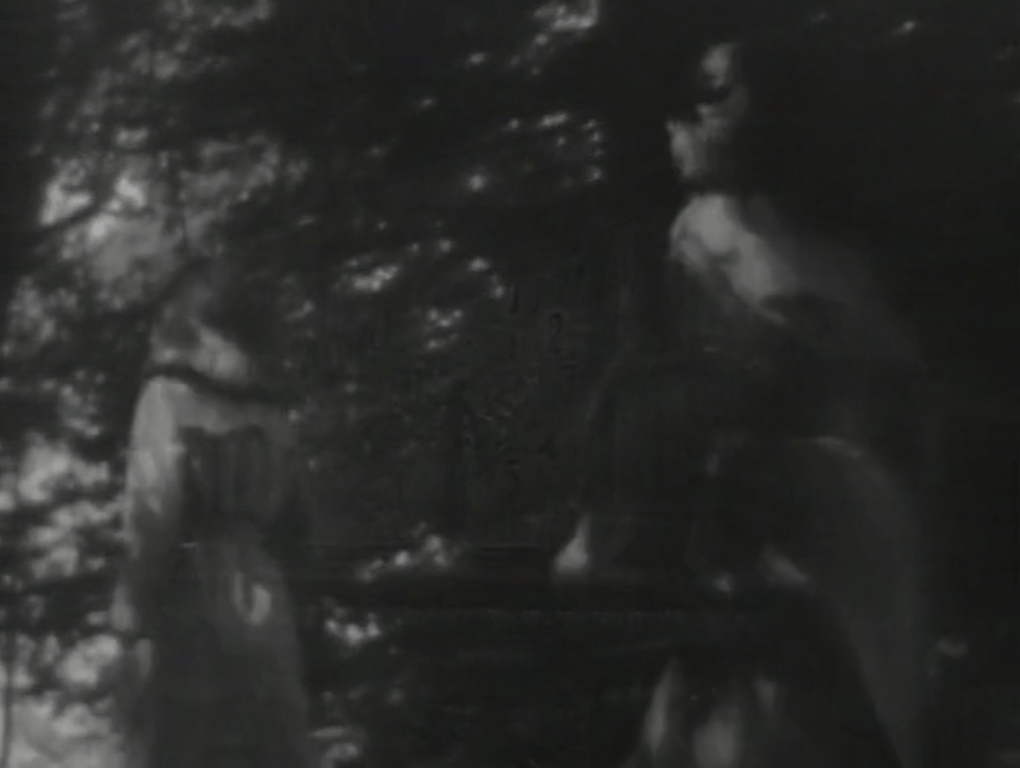
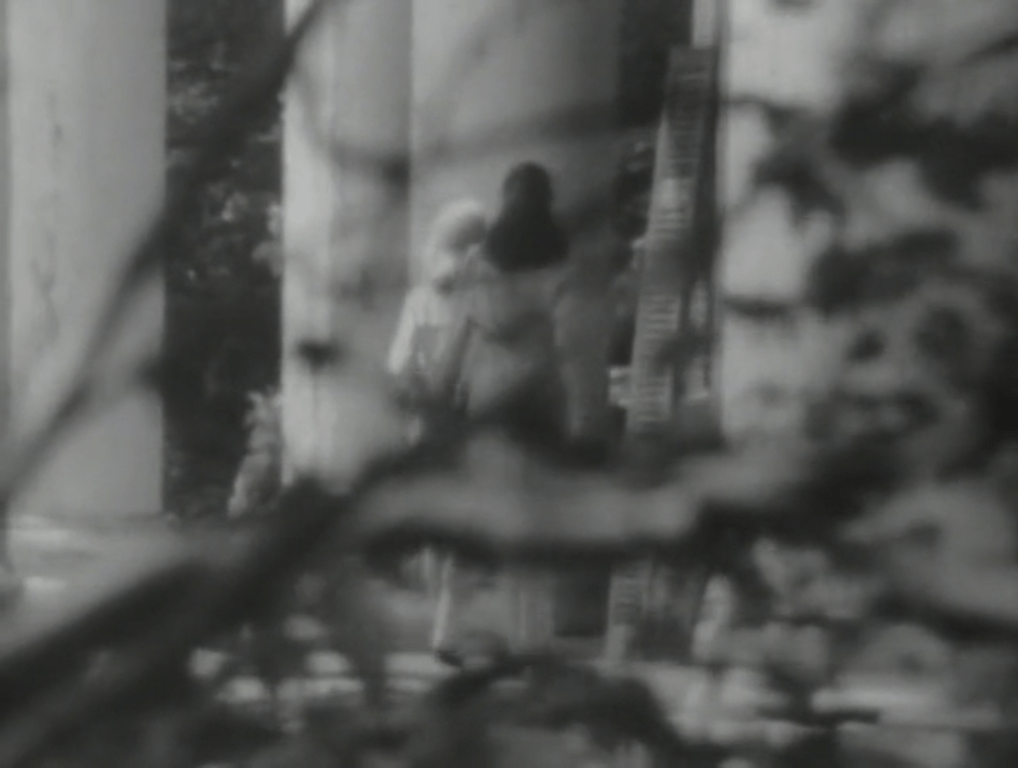
We see the women from an increasing distance, so that they appear to shrink; then through foliage, so that they appear to be in a trap; and finally from a high angle, as if they are small and weak. Since we know that Barnabas is a vampire and they are on their way to enter his lair, this is effective visual storytelling. In fact, it is the only good scene in the episode.

The beginning of the walk- Carolyn and Vicki at their largest
Approaching the house, they reach their smallest size
On the porch, behind the branches
At the bottom

Carolyn says that it is much colder around the Old House than it is at the great house, and Vicki mentions that they are closer to the ocean. This is something of a retcon. When strange and troubled boy David first took Vicki through the woods to the Old House in #70, not only was it news to her that the place existed, but the trek was a long one, suggesting it was far inland, deep into the grounds of the estate. That impression was reinforced a number of times, and Vicki’s remark is the first to contradict it. Apparently the writers are planning some story point that will require the Old House to be by the shore.

Vicki knocks on the door several times without an answer. As she and Carolyn turn to go, we see the doorknob turn and the door open. When the women see that no one is in the front part of the house, Vicki guesses that her knocking loosened the door. What we saw of the doorknob tells us that some agency opened it. It is still daylight, so Barnabas’ powers are unlikely to be at work, and it doesn’t seem that he would want people wandering into his house.

The Old House has also been the abode of the benevolent ghost of Josette Collins, and it is possible Josette might want Vicki and Carolyn to figure out what Barnabas is up to. But nothing they do today gives them a clue about him, and since it is almost nightfall it is extremely dangerous for them to be there. Josette would be unlikely to put them in that situation without good reason.

That leaves us wondering what other supernatural beings might be operating in and around the Old House. The first time Dark Shadows told a story that was modeled on Bram Stoker’s Dracula, it centered on blonde fire witch Laura Murdoch Collins. In the first weeks of that arc, it seemed that Laura was not simply a single physical body, but that she was a whole complex of material and immaterial presences, some of them working at cross-purposes to each other.

Now we are using another set of ideas from the same book. Barnabas is more dynamic than Laura was in those early days, but he too seems to have brought company with him, perhaps including companions he does not know about and whom he does not control. This is most obvious when he is planning some evil deed and the dogs start howling. Occasionally the dog-noise helps him by intimidating his victims or scaring away their would-be protectors, but more often it gets in his way by acting as a warning that trouble is brewing. If an unknown force that upsets the dogs emerged when Barnabas rose from his tomb, then perhaps still another force has appeared that is fiddling with the doors to the Old House.

Over Carolyn’s objections, Vicki insists on exploring the Old House. Carolyn protests that this is trespassing. They have been confusing about the legal status of the place. In #220, they said explicitly that Liz would continue to own it and would let Barnabas stay there. There hasn’t been any indication since that Barnabas has paid Liz anything or that she has done any paperwork. If the house belongs to Liz, Carolyn, as Liz’ daughter and heir, would be speaking figuratively when she uses the word “trespassing.” But in #223, Liz talked about the house as if it and its contents were Barnabas’ property. So who knows, maybe she signed the place over to him when the show was busy with a day of recapping.

Whether Barnabas is the proprietor of the house or a guest there, Vicki and Carolyn are certainly intruding on his privacy when they go upstairs and examine the bedrooms. Carolyn at least has the presence of mind to point this out, but Vicki just keeps repeating that Barnabas once told her she was welcome to come over any time and she interprets this to mean that she can go anywhere in the house whether he’s there or not. This is one of the most sustained, and most bizarre, of all the Dumb Vicki moments we’ve seen so far. Alexandra Moltke Isles usually tries to find something to put behind her eyes during these scenes to suggest Vicki has a thought we will find out about if we keep watching, but Vicki’s behavior today is so senseless Mrs Isles just grins and looks off into the middle distance like a crazy person. Who can blame her, really.

They find the bedroom of Josette all appointed as if Josette herself were living there, complete with jasmine-scented perfume. The door mysteriously closes, trapping them inside. Again, no one we have met, either living or ghostly, would have any motive to do this. After a moment, Willie comes to the door and demands to know why they are there. Vicki asks about the room and complains about Willie’s manners, as if she had a right to be there.

Downstairs, Vicki asks Willie to tell Barnabas how impressed she and Carolyn are with all the work that has been done. Barnabas shows up and is extremely gracious to the women. After they leave, he scolds Willie for his unfriendliness to them. Maybe he does want visitors letting themselves in and roaming freely about the house while he’s resting in his coffin and keeping a girl prisoner, who knows. That would seem foolish, but no more so than Vicki’s activities today. It was the 1960s and people’s blood had a lot of lead in it. Maybe that’s getting to Barnabas.

Vicki and Carolyn go back to the great house and tell Liz what they saw at Barnabas’. Liz is annoyed that they went to a place where they were likely to see Willie, whom she remembers from his pre-blood thrall days, when he was dangerously unstable ruffian Willie Loomis. She wonders why Barnabas has chosen to restore Josette’s room.

We return to the Old House, where the episode ends with its only scene not including Vicki. Barnabas stands before a small table in the parlor. It is set for a dinner for two. There are two plates, and two glasses. Barnabas has appeared to drink coffee at the restaurant in the Collinsport Inn, Amontillado in the study at the great house, and some kind of booze at The Blue Whale tavern. These glasses also seem to hold something other than human blood, indicating that Barnabas is not sticking strictly to the diet of his people. He tells Willie to bring their guest. Maggie enters, wearing Josette’s bridal gown and offering her hand when Barnabas addresses her as Josette.

It is by no means clear where Maggie has been up to this point. She wasn’t in Josette’s room, and doesn’t seem to be coming from the basement. The secret chamber behind the bookcase is no secret anymore, least of all from Vicki, who was held prisoner there by crazed handyman Matthew Morgan. Perhaps we are to think that her entrance, along with Barnabas’ insouciant attitude towards unexpected visitors, implies that there are spaces in the house only Barnabas can find.

Episode 236: The future, for the first time

Maggie Evans, The Nicest Girl in Town, has vanished from her hospital bed. We start with a long succession of characters talking about this fact with Maggie’s father Sam. Had David Ford played Sam as effectively as he did in his first weeks on the show, one such exchange might have made for a good scene. But Ford is overacting today, and the first part of the episode drags on and on.

We cut to the Old House on the great estate of Collinwood, where Maggie’s boyfriend Joe and dashing action hero Burke Devlin have gone. Vampire Barnabas Collins resides in the Old House along with his sorely bedraggled blood thrall, Willie Loomis. Joe and Burke have no clue there is anything odd about Barnabas, but they don’t like Willie and suspect he may know what happened to Maggie.

Barnabas lets Joe and Burke in the house and explains that he sent Willie to run some errands for him out of town. When they tell him about the evidence that has led them to think Willie might be connected with Maggie’s disappearance, he persuades them that there is nothing to their suspicions. Once they are gone, he calls out “It’s all right, they’ve gone. You’re safe here- safe here with me.” Maggie walks into the room.

Barnabas talking to Burke

This scene is very good. Barnabas is made up to look much more like The Vampire than he has been in previous encounters with characters he was trying to fool into thinking he was a harmless eccentric recently arrived from overseas. He is polite enough to Joe and Burke that they can chalk his appearance up to the lateness of the hour, but as the audience watches him extract information from them point by point, until he knows exactly what they do and don’t know, we can see him calculating when and how he will have to kill them. It is as good a scene as Jonathan Frid has had since he debuted as Barnabas.

Frid’s performance in this scene benefits from his flawless line delivery. Not so, unfortunately, the scene that follows. His bobbles are not especially bad by Dark Shadows standards, but his task is far more fragile than any he has taken on before. We’ve seen him pretending to be the Collins family’s mild-mannered cousin from England; in those moments, Barnabas himself is taking on a challenging acting job, and Frid’s difficulties sometimes dovetail with troubles we might expect Barnabas to have in his performance. We’ve seen him abusing Willie; in those moments, we might expect him to sputter a bit, and Frid can hide some of his memory lapses in that mannerism. But now, he is telling Maggie what his plans are for her. As he does so, we realize he is a crazy man spilling out his deepest and sickest obsession. That context leaves nowhere to conceal even the slightest flub. As a sign of triumphant psychosis, the lines have to flow without interruption. Every time Frid stumbles for a fraction of a second, he breaks character.

Nor can Kathryn Leigh Scott bail him out. As Maggie, her part is to wander around in a stupor and occasionally repeat the last word or two of whatever is said to her. She makes that a lot more interesting to watch than you might expect, but there’s only so far it can take you.

Barnabas’ plan takes us outside the themes we are familiar with from vampire fiction. He wants to brainwash Maggie into thinking that she is Josette Collins, who has now been retconned into the woman Barnabas loved in his human days. His goal is that Maggie Evans will cease to exist, and that in her body Josette will live again.

Dracula never wanted to do anything like that, though after Dark Shadows has a hit with this storyline it will become part of vampire lore. Prince Mamuwalde, the menace in the 1972 film Blacula, kidnapped the heroine and tried to turn her into his long-dead love. Another undead fictional man from Africa had tried the same thing in 1932, when Imhotep, played by Boris Karloff, had spent the bulk of The Mummy trying to turn the heroine into a revived form of his adored Princess Ankh-esen-amun. Frid’s face and coloring were somewhat similar to those of Bela Lugosi, a fact often remarked in connection with his casting as a vampire. But his voice and movements are strongly reminiscent of Boris Karloff, and as a mashup of Dracula and Imhotep he is a synthesis of these two actors.

Barnabas gives Maggie a music box that he had intended to give Josette. He says that he bought it for Josette in his travels in “the Orient,” intending to give it to her “on a very special day,” and “this is that day.” This leaves us wondering why the day never came when he could give it to Josette. Did he become a vampire before he returned from his travels? Did he come back from his travels to find that she was no longer available to him? Or was it supposed to be a present at their wedding, a wedding that never occurred?

Barnabas also produces Josette’s wedding dress and tells Maggie that she, as the new Josette, will wear it. When Imhotep produces Ankh-esen-amun’s clothing and jewelry, we remember that royal personages in ancient Egypt were buried with their possessions and assume that he has retrieved them from her tomb. The show did lead us to wonder if the Collinses once had a similar practice. Willie released Barnabas because he had heard a story that some of the Collinses were buried with expensive jewelry and so was trying to rob a grave. The story of the buried jewels was framed as an echo of the Gothic romances that inspired the first weeks of Dark Shadows, but has now become an anticipation of the show’s journey into Universal Pictures’ back catalogue of horror movies.

If Barnabas does manage to somehow erase Maggie and bring Josette back to life in her body, it won’t be the first time Miss Scott has played Josette. In #70, Miss Scott was the ghost who emerged from Josette’s portrait and danced outside the Old House. Miss Scott put Josette’s veil on again in #126 when she led the ghosts who scared maniacal handyman Matthew Morgan to death before he could murder well-meaning governess Vicki. In that one, she delivered a few lines as Josette. Miss Scott’s name did not appear in the credits as Josette in either of those episodes, and the only time we caught a glimpse of Josette’s face was in #149, when she was played by stand-in Rosemary McNamara. But if by any odd chance a viewer does know that Miss Scott has played Josette before, the final dissolve from a closeup of Miss Scott to one of Josette’s portrait suggests a definite possibility that Barnabas’ plan, nonsensical though it seems, will somehow succeed.

Danny Horn’s post about this episode on his Dark Shadows Every Day is particularly good. He compares its visual strategy to that of the one surviving contemporary segment of General Hospital, and praises the ambitious approach director Lela Swift took to composing images. I should also mention Patrick McCray’s Dark Shadows Daybook post, in which he analyzes the way the story alienates us from our rooting interest in Maggie’s safety by promising a more exciting story if Barnabas has his way with her for an extended period.