Blonde fire witch Laura Murdoch Collins opens the front door of the great house of Collinwood. Housekeeper Mrs Johnson intercepts her. Laura wants to see her son, strange and troubled boy David Collins. Mrs Johnson tells her that David has gone to town with well-meaning governess Vicki to buy shoes. Laura objects that she was supposed to take David to get new shoes, and is quite upset that Vicki has taken this from her. She is even more upset when Mrs Johnson says she is under orders to keep David in the house unless he is with Vicki or flighty heiress Carolyn. Laura asked who gave those orders, and is shocked to hear that it was her estranged husband, high-born ne’er-do-well Roger.
Laura shouts for Roger, who comes downstairs to see her. In the drawing room, she demands to know why he is keeping David from her. At first he repeats Vicki’s old line that David is falling behind in his studies, but when Laura dismisses this he tells her that he is suspicious of her because of all the strange goings-on that started when she came back to town. They quarrel about this for some time, and Roger holds his ground.
Laura goes to the Collinsport Inn, where her ex-boyfriend, dashing action hero Burke Devlin, is in residence. Burke also refuses to help her. He tells her that she is not at all the same person he was in love with ten years before. She protests that everyone gets older, and he says it isn’t that. She has somehow become a stranger to him.
Yesterday, visiting parapsychologist Dr Guthrie had laid out the case against Laura to Roger, while Vicki presented the same facts to Burke. Roger resisted until the ghost of Josette Collins intervened to present him with some particularly hair-raising information. Today, we see that Josette and Guthrie have combined to carry their point, and have enlisted Roger in the fight against Laura.
After Vicki had told Burke why she regards Laura as a threat to David, Burke had said that he thought he ought to go along with her request that he stop urging David to leave with his mother. But he admitted that Laura has such a strong emotional effect on him that he couldn’t promise that he would be able to follow that resolution. In the scene between Burke and Laura, Burke alternately gives Laura hard stares and avoids eye contact altogether, turning his back on her and edging away whenever possible. Returning viewers will appreciate the effort he is making to keep his feelings from overwhelming him. By the time the scene ends, the two most important men in David’s life are both on the team opposing Laura.
Laura loses her last ally, Burke breaks his own heart
Back at Collinwood, Guthrie talks briefly with Roger. For the first time, Roger speaks respectfully to Guthrie, whom he has always before disdained as a quack. Roger leaves, and Guthrie has a few words with Mrs Johnson. Mrs Johnson mentions that when she was cleaning the cottage where Laura is staying, she made a move to extinguish the fire in the hearth. Laura responded with terror, frantically demanding that she leave the fire alone. At this news, Guthrie decides to pay a call on Laura.
In the cottage, Guthrie says that it is very warm and makes a move to put the fire out. He observes Laura’s panicked reaction. He asks her why fire is important to her; she says she merely dislikes cold rooms. He asks if she derives a power from fire; she says she doesn’t know what he’s talking about.
Laura asks Guthrie if he is the one who talked Roger into keeping her from seeing David. Guthrie says yes. She asks why, and he tells her he thinks she is a danger to her son. She asks what danger she could be to David, and he asks her who she really is. When he says that she is not the woman Roger married, she ridicules the idea that an impostor could fool all the people who have identified her as Laura. He says that he doesn’t mean that she is an impostor. When she asks what he does mean, he asks if she really wants him to say the words. She says yes. He tells her “You, Laura Murdoch Collins, are the undead.”*
*If I recall correctly, that marks the first time the phrase “the undead” is spoken on Dark Shadows.
Like many children of divorce, strange and troubled boy David Collins finds himself having to decide which parent he will live with. He and his father, high-born ne’er-do-well Roger, have been living in the great house of Collinwood as guests of Roger’s sister, reclusive matriarch Liz, ever since Roger ran out of money some months ago. Now David’s mother, blonde fire witch Laura Murdoch Collins, has reappeared after an absence of many years, and she wants to take David. This idea delighted Roger from the first, but David had initially reacted to Laura with fear. He still has mixed feelings about her.
Today, well-meaning governess Vicki is trying to get David to focus on his studies. He tells her that he is thinking about his living situation. He likes Collinwood, especially since Vicki came. But he has just about decided to go away with his mother.
Vicki asks why David wants to do this. He reminds her of a vision he had yesterday that terrified him. He saw himself in the fireplace, immersed in flames and showing no sign of wanting to escape them. He interprets this as a warning from the supernatural realm that he is in great danger, and that the danger is to be found at Collinwood. He believes he will find safety if he goes far from the estate with his mother.
Vicki knows that David is partly correct. She has considerable evidence that the ghost of Josette Collins has been trying to warn David and her and several other people that David is in danger of being burned alive. She is also sure that the source of this danger is at Collinwood- it is Laura herself. She is an inhuman creature who will burn David alive. Vicki can’t tell David about this, but she does remind him of some of Josette’s previous warnings. David realizes that his mother featured prominently in those warnings, but does not see that she is the one Josette is warning him about. To Vicki’s dismay, David concludes that Laura is also in danger, and that it is urgent that the two of them go off together at once.
When her warnings to David backfire, Josette is running true to form. The first time she tried to rescue someone from imminent peril was in episode 122, when crazed handyman Matthew Morgan had kidnapped Vicki. Matthew’s response upon hearing a ghostly voice was to put a knife to Vicki’s throat. Eventually Josette enlisted some of her buddies from that land of ghosts which forms the back-world behind what we see, and together they would stop Matthew and save Vicki. Here again, Josette needs help getting her point across.
Of all the characters, David is the one who has had the easiest rapport with Josette. In #102, we saw him standing in front of her portrait in the long-abandoned Old House on the grounds of Collinwood, chattering happily away to her. We couldn’t hear her, but he could. She had no need to manifest herself visibly or do anything else spectacular; she and David could just talk to each other.
Now, Laura is blocking Josette’s attempts to communicate. In #165, Josette manifested in a room with Laura and David; Laura ordered her to go away, and she did. In #170, Josette began speaking through Vicki at a séance; Laura silenced her, and in later episodes visiting parapsychologist Dr Guthrie said that Josette was battling against some power at least equal to her own. Strong as Josette’s connection to David has been, she cannot break through his mother’s interference.
Vicki confers with Guthrie. They decide to present their case to Roger, who alone has the legal right to oppose Laura’s wish to take David, and to dashing action hero Burke Devlin, who has a great influence over the boy. Guthrie meets with Roger in the drawing room, and Vicki goes to Burke’s suite at the Collinsport Inn.
Roger despised Guthrie as a quack starting almost as soon as he met him, but in his most recent appearance, in #178, he started to suspect that there might be something to Guthrie’s ideas. He is quite rude to Guthrie throughout their conversation today, but does hear him out.
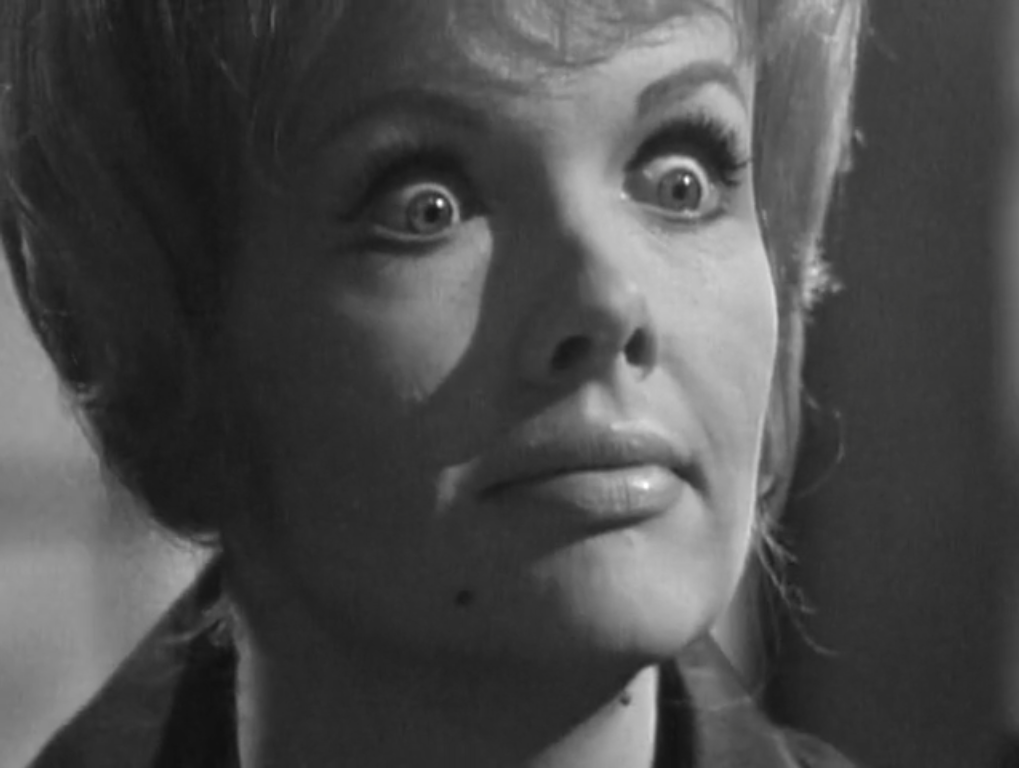
Burke respects Vicki, but finds it impossible to sit still when she starts talking about Josette. So she sticks to the demonstrable facts. The camera sticks to Alexandra Moltke Isles’ eyes, on which the light plays arrestingly.
Vicki looks at Burke
At length, Burke admits that something strange might be going on. Vicki asks Burke if he will stop encouraging David to go away with his mother. He says he believes that he ought to stop doing that, but that he doesn’t know what he will actually do after he next sees Laura. Vicki says she knows how he feels about Laura. Burke tells her that he himself doesn’t know how he feels about Laura, or about anyone else.
Mitch Ryan projects Burke’s bewilderment about his own behavior when he is with Laura. We haven’t seen any sign that Laura has cast a spell on Burke. So far, it is entirely possible that Burke is just smitten with Laura. She was the ex-girlfriend who left him for Roger and is now suggesting she wants to get back together with him. As such, she is the symbol of both his lost youth and his upcoming triumph over his bitter enemy. Also, she is beautiful, and can be hilariously funny. That combination would be enough to cloud anyone’s mind. But when Burke is telling Vicki how confused he is about his emotions, we wonder if there might be some witchcraft involved as well.
Back at Collinwood, Roger and David are in the drawing room. David tells Roger that he wants to go away with Laura, and when Roger asks why he has made that decision David tells him what he saw in the fire. David asks him if he still wants him to go away. In previous episodes, David had asked Roger about his hostility towards him. Sometimes Roger parried these questions with witty remarks, other times he simply dismissed David and walked away. Now Roger just chokes up. “We’ll see,” he keeps saying. “We’ll see.” What we the audience see in Louis Edmonds’ performance is a man who is starting to realize what he has thrown away by refusing to love his son. It makes a powerful moment.
Roger tries to connect with David
After David leaves him alone in the drawing room, Roger assumes his usual position in front of the brandy bottle and pours himself a glass. He lifts it to his lips, then looks around, as if he detects an unusual scent in the air. He sets the drink down. He turns, and sees an old book open itself.
Roger sees the book open itself
A book first did this in the drawing room in #52. That time the Collins family history opened to a picture of Josette. More recently, Josette’s signature jasmine perfume was in the air in the crypt at the old cemetery when a book opened itself there in #157. Regular viewers will therefore assume that when a book opens without visible aid of a cast member, it is Josette, the spectral research librarian, leading the characters to the information they need.
Roger hasn’t seen these previous occurrences, and he has chosen to disregard the evidence he has seen for the existence of supernatural influences around him. So the sight of the book opening itself comes as a great shock to him. When he looks at the page to which it has opened, he finds out something about the death of a woman named Laura Murdoch Radcliffe, whom Guthrie and Vicki believe to be an earlier incarnation of his wife. That Laura had died by fire in 1867, along with her young son David. Guthrie had told Roger that. A fact he had not mentioned, and which strikes Roger with particular terror, is that David Radcliffe had not wanted to be rescued from the fire. He had wanted to burn.
The idea of Laura the Phoenix is an interesting one, and the storyline gives Josette and the other vague, indefinable spirits of the supernatural back-world Dark Shadows has been hinting at since it began a suitable adversary to bring them into the action of the main continuity. But most of the individual episodes are so slow, so heavy with recapping, and so confused in their development that few of them can be recommended on their own merits. Indeed, this is only the second episode from the Laura arc, after #146, to which I apply the “Genuinely Good Episode” tag.
After we watched the episode, my wife, Mrs Acilius, shared her theory that the show is getting better because they’ve learned that it will be renewed for another 13 weeks. That makes sense- if it was going to be canceled after #195, the writers might not want to come up with any fresh stories and the producers certainly wouldn’t want to pay to build any new sets or hire actors to play new characters. Better just to run out the clock so that the Laura arc ends in #195 and everyone else lives spookily ever after. But if they know they can keep going until #260, they will have time to work out new ideas.
Yesterday, we saw four men visiting a crypt. They are parapsychologist Dr Guthrie, hardworking young fisherman Joe, instantly forgettable young lawyer Frank, and the unnamed Caretaker of the old cemetery. They witnessed an uncanny event when the ghost of Josette Collins opened the coffin of Laura Murdoch Stockbridge, who died (by fire!) in 1767.
The ghostly intervention was disturbing enough in itself, but when the four men saw that the coffin was absolutely empty they had to change their ideas. Before Josette took action, the Caretaker had vowed that he would die rather than let a grave be disturbed. After they have seen the empty interior of the coffin, Guthrie asks him about another grave he wants to dig up and the Caretaker gives him directions. Frank had shouted at Joe and Guthrie that they would go to jail if they didn’t immediately stop disturbing the crypt, but now he agrees to go to the other grave and help dig. Joe had joined Guthrie only with utmost reluctance and had wanted to stop when the Caretaker first showed up, but now he is the one who points out a toolshed from which he volunteers to grab some shovels.
The second grave is that of Laura Murdoch Radcliffe. In 1867, just one hundred years after the fire that killed Laura Murdoch Stockbridge, Laura Murdoch Radcliffe died the same way. What’s more, a woman initially identified as Laura Murdoch Collins died (by fire!) in Phoenix, Arizona earlier in 1967 and her body inexplicably disappeared from the morgue some weeks after her death. Evidently Guthrie’s hypothesis is that graves will both be empty, because the body of each Laura Murdoch disappeared after death. He also surmises an otherworldly connection between these three dead and vanished Laura Murdochs and the apparently alive Laura Murdoch Collins who has been hanging around the great estate of Collinwood for a couple of months.
Back in the crypt, the Caretaker is delivering a soliloquy. He thinks Guthrie, Joe, and Frank are wasting their time trying to learn secrets from the dead. He has information he could share if they would stay and listen to him. He remembers that there was something strange about the death of Laura Murdoch Radcliffe, and that a book about the Radcliffes is on the shelves in the crypt. He looks through the book and finds the information. “The child!” he exclaims.
Laura Murdoch Collins materializes in a dark corner and strikes up a conversation with the Caretaker. As her talk grows more and more mystifying, the Caretaker looks confused, as if he has never before been the least weird person in any room.
Laura’s appearance gave us (Mrs Acilius and I) two grounds for fear. Our first fear was that Laura might kill the Caretaker. We could easily imagine Guthrie, Joe, and Frank coming back to the crypt to find it in flames, the records kept there in ashes, and the Caretaker dead (by fire!) We like the Caretaker, and want to see him in future episodes.
Our second fear was that Laura would go to the grave of Laura Murdoch Radcliffe and interrupt the exhumation. What we dreaded about that prospect was that it would slow the story down. Yesterday’s show moved at a nice clip, and while today does not match it, at least some things are happening to advance the plot. In the last several weeks, the pace has alternated between glacial and dead stop. So the idea of yet another delay is well worth a shudder.
Laura Murdoch Collins examines the coffin of Laura Murdoch Stockbridge
There is a moment when it seems that Laura will go to stop the men. The Caretaker tells her that they have gone to the grave of Laura Murdoch Radcliffe, and starts to give her directions. She tells him not to bother explaining where it is. Laura doesn’t speak the line “I’ve been there before,” but Diana Millay’s eyes communicate the thought to the audience. Having already seen her inspecting the inside of Laura Murdoch Stockbridge’s empty coffin, we know that she is on a tour of her old neighborhood.
Laura Murdoch Collins doesn’t need directions to the grave of Laura Murdoch Radcliffe
For whatever reason, Laura does not interfere with Guthrie, Joe, and Frank. They dig up the coffin of Laura Murdoch Radcliffe. They open it and look inside. Guthrie asks “What do you see?” Frank replies “What you thought we’d see.” There it is, a bullfrog in a top hat singing “Hello, My Baby.” Oh no wait, I changed the channel there for a second. On Dark Shadows, the answer is “Nothing. Absolutely nothing. An empty box. It’s almost like it’s always been empty.” No wonder we’re still watching the show after all these years, where else can you find thrills like that.
Hello, my ragtime gal
The Caretaker is talking to Laura and looks down for a second. When he looks up, he is baffled. We cut back to the spot where she had been standing, and it is vacant.
Guthrie, Joe, and Frank return to the crypt. They apologize for having been away for so long. The Caretaker tells them they have only been gone for a minute or two. They are puzzled. They find the book about the Radcliffes, and discover that a portion of a newspaper clipping containing an account of Laura Murdoch Radcliffe’s death has been erased, as by an intense light generated by a fire. This leaves us wondering why Laura erased only that section of the clipping, calling attention to it, when she could just as easily have set fire to the book and destroyed the whole thing.
It’s a relief that the Caretaker survives to dodder another day, and a relief that Guthrie, Joe, and Frank complete their business in the cemetery and free us to move on to the next story point. As Guthrie, John Lasell was visibly bored yesterday; today his part is smaller, but he is back on his game, and the others are good too.
Daniel F. Keyes has some particularly good moments as the Caretaker. Yesterday he struck the heroic note when he told Guthrie and Joe that they would have to kill him before they could open the graves, and he made that a powerful moment. Today, he shows us both how lonely the Caretaker is, and why he cannot escape that loneliness. The feeling is painfully raw in his soliloquy about the information he could give if only the others would listen, and his exaggeratedly careful movements and other mimicries of a fragile old age give that rendition of helpless, desperate loneliness an extra punch. His interaction with Laura is even more interesting- while he lives too much in the world of ghosts and taboos to be at home with the living, he is too much a part of the this-world institution of the cemetery and of its rational, bureaucratic routines to know what to do when he encounters an otherworldly being face to face. He is entirely alone, caught in the interstices between the natural and the supernatural, unable to communicate with the denizens of either realm.
Today is the last time we will see actor Conard Fowkes and his character, Frank. I call him “instantly forgettable young lawyer Frank” because, while Fowkes consistently does an excellent job of embodying whatever Frank supposed to be at any given moment, he never gives the feeling that there is anything else under the surface. I keep wishing Frederic Forrest, who danced at the Blue Whale in #137, had been cast as Frank. Forrest could have created a convincing character while also giving a sense of a goofy, engaging personality inside whatever Frank is in any given scene, so that you not only appreciate each turn but also wonder what is coming next. Each time you see Fowkes, you can recognize that he presented exactly what he was supposed to present, but he never drops a hint that anything different might be coming. Still less does he leave you wanting more.
Today, Frank is supposed to be chastened by the sight of what Josette did and willing to join Guthrie and Joe in their exhumation. He is the very image of “Chastened.” Yesterday, he was indignant about Guthrie and Joe’s lawless behavior. A still of him from that episode would have been a fine illustration for a dictionary definition of “Indignant.” In #169, he was haggard and concerned about the mysterious illness gripping reclusive matriarch Liz. Again, he was a faultless model for “Haggard and Concerned.” When we first saw him in the offices of his firm in #92, he was so much the fellow you would expect to meet in a law office in Bangor, Maine in 1966 that you felt like you were reading a writ of replevin.
In a way, Fowkes was an excellent actor. Unfortunately, it wasn’t the way in which a regular member of the cast of a scripted television series ought to excel. The proper medium for him would be something more static, such as filmstrips or View Master reels, in which we could stop and look at him as he demonstrated various moods and personality types. I suppose he might also have been an outstanding mime. Fowkes was always pleasant, and in her scenes with him Alexandra Moltke Isles has a chance to show aspects of the personality of well-meaning governess Vicki that we never see in any other setting. So I’ll miss him, but I’d have missed Forrest a whole lot more.
John Lasell is a tremendous actor, and was electrifying when he first appeared on Dark Shadows as parapsychologist Peter Guthrie in episode 160. But four weeks of endless recapping has taken its toll on him. In today’s pre-credits sequence, recreating yesterday’s final scene, we see what it looks like when John Lasell is bored.
Dr Guthrie and hardworking young fisherman Joe have arrived at the door to a mausoleum which houses a grave they plan to break into. Finding that he cannot turn the knob to the building’s front door, Guthrie says “It’s locked.” More precisely, he whines “It’s laaaakt.” The character has several sides, but this is the first time we’ve seen him as a cranky five-year old. As the two of them fumble about, Guthrie at one point lifts Joe’s tool box, gestures towards the inside of it, and says “Try this.” Try what, all of his tools simultaneously? When the door mysteriously opens, Guthrie takes a beat before he turns to look at it, and he never does get around to looking surprised.
They enter the crypt. Guthrie shines a flashlight directly into the camera. Characters on Dark Shadows do this so often that it must be intentional, at least to the extent that the directors resigned themselves to letting actors get away with it, but it always looks like a mistake. It’s especially jarring here, when John Lasell is himself looking into the camera when he shines the light in our eyes.
Hey Guthrie, are you a doctor of optometry?
Once Guthrie and Joe have found the vault housing the coffin of Laura Murdoch Stockbridge, they quarrel about whether to go through with their plan. They go through the same arguments they used in their scene in the drawing room of the great house of Collinwood yesterday. As yesterday, Joel Crothers manages to put enough verve into Joe’s mixed emotions that he is interesting to watch, but Lasell simply cannot bring himself to commit to another tired rehash. The only thought his performance in this scene brings to mind is puzzlement as to what happened to Guthrie’s glasses.
Back at Collinwood, instantly forgettable young lawyer Frank charges into the drawing room and demands that flighty heiress Carolyn tell him where Guthrie is. She replies that Guthrie swore her to secrecy. Frank says that Guthrie had called him shortly before to ask about a plan that might get him sent to jail. Frank asks Carolyn if Guthrie has gone to the crypt at the old cemetery. Faced with the prospect that Guthrie and Joe might land in jail, Carolyn admits that they are both there.
Guthrie and Joe try to pry Laura Murdoch Stockbridge’s nameplate off the wall of the crypt. They keep talking about how the whole thing might as well be a single block of stone. The actual wall keeps springing back in a way that only cheap grades of plywood do, undercutting this dialogue and requiring the actors to put more and more effort into keeping it from falling down. By the end of the sequence, both of Joel Crothers’ arms and one of John Lasell’s are holding the wall up, so that Dr Guthrie has to remove the supposedly massive nameplate with one hand. Even the blocking isn’t up to director Lela Swift’s usual standards- most of what we see in this sequence is the back of John Lasell’s coat. Considering what’s going on with the set, that may not be such a bad thing.
After Joe and Guthrie get the nameplate off the wall, Crothers flashes a look at Lasell that shows he is struggling to keep a straight face. Lasell’s boredom saves the take- if he had been intellectually available enough to notice Crothers’ twitching lips, he would have burst out laughing:
Straight face
The coffin is quite large and apparently very heavy. Guthrie and Joe put all their strength into carrying it a few feet. They then place it on a miniature tea stand.
Sure, that’ll hold, why not.
Guthrie fits a wedge under the lid and holds it while Joe swings a hammer. The elderly Caretaker enters and orders them to stop. If only for the sake of the tea stand, this command comes as a great relief.
The Caretaker tells Guthrie and Joe that they won’t open the coffin unless they kill him first. That doesn’t stop Guthrie’s efforts to win him over, but it is enough for Joe. Frank shows up. He apologizes to the Caretaker and yells at Guthrie.
Guthrie tries to explain himself to Frank. When Frank tells him that a court would likely respond to his hypotheses by committing him to a psych ward, Guthrie responds “Well, doesn’t that prove my point halfway?” When Frank asks how, Guthrie says “Wouldn’t a court… um… would a court be more sympathetic… uh… before the point? My reasons? Than after?” I’m sure that was not how it was phrased in the script, but I can’t imagine that whatever was written there made any more sense. Guthrie’s behavior is so preposterous today that it is understandable John Lasell didn’t bother to put in much of a performance. Still terribly disappointing, and quite unusual to see him as the weakest member of the cast. The rest of them all do very well in this well-paced, if not particularly well-mounted, episode.
The three men are about to leave the crypt when Joe says he detects a flowery scent. Guthrie asks if it is the scent of jasmine- the sign that the ghost of Josette Collins is near. Joe doesn’t know what jasmine smells like. The Caretaker can just about make out the scent of jasmine, far away, as if it were wafting in from the sea. In a reprise of a moment from #154, when the Caretaker told Vicki the same thing, Joe protests that the scent is not far away at all. It is flooding the room, is overpowering, is coming from behind an obstacle in the crypt.
The coffin opens itself, evidently the result of Josette’s action. The men gather round and look inside. It is empty- no bones, no dust, no sign that there ever was a body inside. Guthrie’s hypothesis, that the body of Laura Murdoch Stockbridge vanished after burial, is confirmed.
Friday, Dark Shadows showed us its first séance. Yesterday, the people who attended that séance tried to figure out what it meant. Today, word of the séance starts to get out to people who weren’t there.
These three episodes also involve wrapping up a lot of loose ends that only people who watched the show from the beginning will remember. Friday’s episode harked back to the ghostly image we saw in #30. Yesterday’s episode drew a line under the alarmingly inappropriate crush flighty heiress Carolyn had on her Uncle Roger in the first few weeks of the show. Today, dashing action hero Burke Devlin shows that he is still laboring under a misunderstanding that led him to a dead end in #89 and #99.
In those episodes, Burke was trying to take his revenge on the ancient and esteemed Collins family by hiring the most valued employees away from their cannery. He was confident he would succeed in this plan because he had more money than the Collinses. In #89, he explained that confidence to his lawyer with a bunch of cliches rich guys use when they are villains in old movies: “Money talks. Money buys loyalty. Everyone has their price. Name it and you can buy them. Some just come a little higher than others, that’s all, but everyone is for sale.”
Those men all rebuffed Burke’s offer, as hardworking young fisherman Joe had refused Burke’s attempt to buy his loyalty in #3. Burke believes that the Collinses’ power comes from their money. His failures suggest that it is more nearly the other way around. The Collinses dominate the town of Collinsport because the population is so much in the habit of deferring to them that they can’t really imagine any other way of life. Simply by living in town, they have been indoctrinated into an ideology that puts the Collinses at the center of everything. Though from the perspective of the outside world Burke may have come back to town as a representative of high finance and large-scale capitalism, in the eyes of the locals he might as well be trying to start a communist revolution.
The one Collinsport resident who has agreed to take Burke’s money as payment for working against the Collinses is Mrs Johnson. For many years, Mrs Johnson had been the faithful housekeeper to cannery manager Bill Malloy. In her first appearances, Mrs Johnson talked of her unrequited love for Bill and her conviction that the Collinses were responsible for his death. Wanting revenge on them, she agreed to Burke’s plan to take a job as housekeeper at Collinwood and to give him whatever information she could gather. He has been paying her ever since.
Today, Mrs Johnson comes to Burke’s room and announces she has some information she would give him even if he weren’t paying her. This remark will strike regular viewers as absurd. Those who remember Mrs Johnson’s early appearances know that her motivation for joining with Burke was not his money, but her drive for vengeance. Those who have seen her since, including earlier in this episode, know that she always tells everyone she meets everything she knows. Her usual conversational gambit is to declare “I mind my own business, and expect others to do the same!” and then divulge the entire contents of her awareness, including everything she learned by her incessant eavesdropping on everyone in the house.
In Mrs Johnson’s case, Burke is overlooking not only the power of ideology, but also the persistence of personal habits. Mrs Johnson not only does not need to be paid to give information; no amount of money could keep her from giving information. She can’t be incentivized out of telling too much, because she doesn’t know that she is doing it. She is perfectly sincere when she says “I mind my business!” or “I’m not a gossip!” or makes any of her other usual protestations.
One thing Burke and Mrs Johnson have in common is a tender regard for well-meaning governess Vicki. The séance was very hard on Vicki, because her body was the scene of a battle between the ghost of Josette Collins and blonde fire witch Laura. Josette had possessed Vicki in order to warn the company about Laura, but Laura used her own powers to drive Josette from Vicki before she could say her name. Now Vicki is spending the day sick in bed. After talking with Burke, Mrs Johnson goes back to Collinwood and takes it upon herself to keep anyone from bothering Vicki.
The first person to try to see Vicki is visiting parapsychologist Dr Guthrie. Mrs Johnson stands on the stairs and forbids him to go up. He tries to persuade her that, as a doctor, he might be able to help. She responds that the only way he will get to Vicki’s room is by knocking her down and walking over her. At that, he gives up and goes to the drawing room.
Keeping Guthrie at bay
Laura then comes to the house and tries to see Vicki. Mrs Johnson takes exactly the same line with her. Laura is more aggressive than Guthrie had been, and tries to walk past Mrs Johnson. Mrs Johnson puts her arm in the way to physically block her. Laura too gives up and goes to the drawing room.
Keeping Laura at bay
There, she finds Dr Guthrie listening to the audiotape he made of the séance and taking notes. We hear Vicki’s voice desperately muttering about “le tombeau vide” before he sees Laura and shuts the player off. He explains that he does not want anyone who was at the séance to hear the recording, as he does not want it to color their recollections.
Laura and Guthrie talk about the tape recorder and about his use of electronic devices in his work as a scientist. Not even actors as capable as Diana Millay and John Lasell can make this dialogue seem to have much point. But a few weeks ago, friend of the blog Courtley Manor called my attention to a 1957 novel for children, David and the Phoenix, by Edward Ormondroyd. I think there is a reference to that book in this scene.
Ormondroyd’s David is a preteen boy who climbs a mountain and finds himself in a magical realm where he comes face to face with the Phoenix. The Phoenix is initially guarded with David, but relaxes when David says that he doesn’t know any scientists. Evidently the Phoenix’ great goal is to be left alone, and scientists were to learn that there really was such a bird as the Phoenix that goal would forever pass out of reach.
Some of the similarities between Dark Shadows’ “Phoenix” storyline and David and the Phoenix may be the result of common source material. In #140, Laura tells David that her real home is a magical world that sounds quite a bit like the place Ormondroyd’s David stumbles upon. But from the 1930s through the 1960s, the legends of the Holy Grail were a staple of university English departments in the USA, and many of those associate the Phoenix with just such places. So it could be that both Edward Ormondroyd and Malcolm Marmorstein had read Wolfram of Eschenbach or someone like him. And “David” was an extremely common name for boys born in the USA in the 1940s and 1950s, so that could be a coincidence.
But when The Scientist appears in Ormondroyd’s book and emerges as the great enemy of the Phoenix, Ormondroyd presents The Scientist in terms of his equipment. He must wait for his equipment to arrive before he can act against the Phoenix, he puts a great deal of effort into transporting his equipment and setting it up, and he suffers his climactic defeat when the Phoenix sabotages his equipment. So readers of Ormondroyd’s book would have to see a nod to it in this conversation between Guthrie the Scientist and Laura the Phoenix.
After Laura has left, Guthrie calls urgently to Mrs Johnson. He asks her if she touched the tape recorder. She tells him she wouldn’t touch the machine with a ten-foot pole. He plays the tape back, and shows that the sounds of the séance have been replaced with the sounds of a crackling fire. Ormondroyd’s readers will remember that The Scientist did not give up after the Phoenix destroyed his equipment, and will expect Guthrie to try to find new ways to fight Laura.
When we heard the crackling on the tape, Mrs Acilius jokingly asked me when the show was made. “This was before Watergate, right?” Yes, indeed; Dark Shadows was not making a reference to the 18 1/2 minute gap in the Nixon tapes. While the consensus among scholars today is that that gap was caused accidentally, it is amusing to imagine that someone in the White House in those days was a Dark Shadows fan and took a page from Laura’s book. I guess the president’s daughter Tricia was into the show for a while, but even if the erasure were deliberate she wouldn’t have been a very likely suspect.
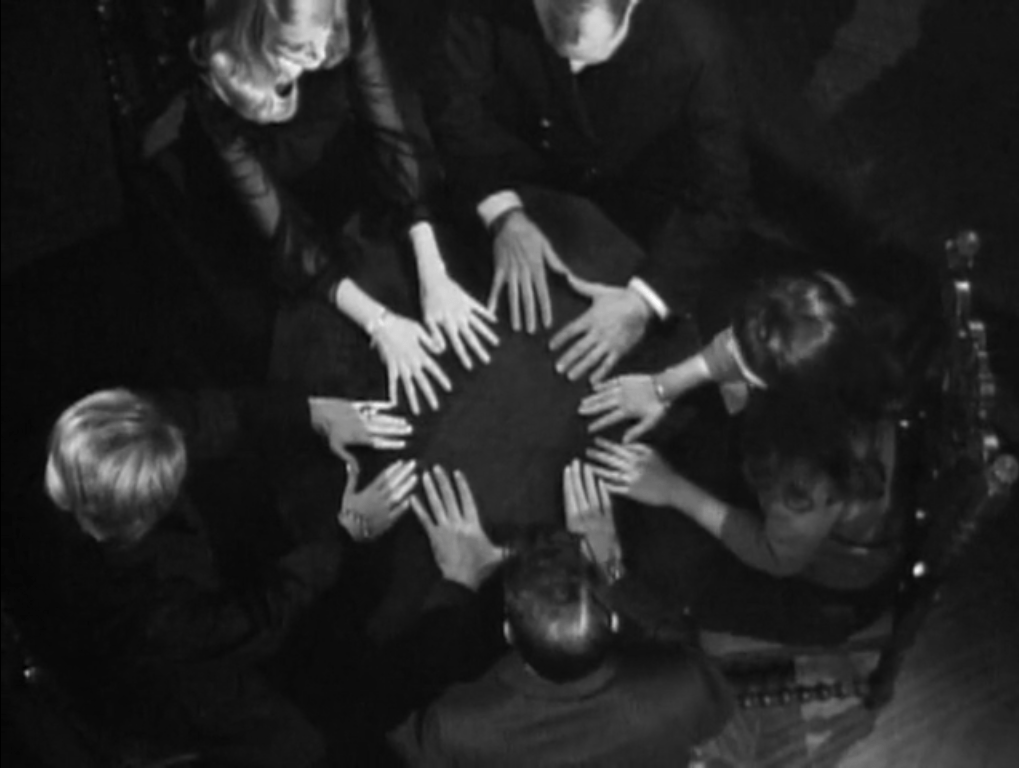
Visiting parapsychologist Dr Guthrie and well-meaning governess Vicki have persuaded flighty heiress Carolyn and high-born ne’er-do-well Roger to join them in the drawing room of the great house on the estate of Collinwood for a séance. Their goal is to contact the ghost of Josette Collins. The table is photographed by a camera pointing straight down, a first for Dark Shadows.
Gathering for the first attempt at a séance
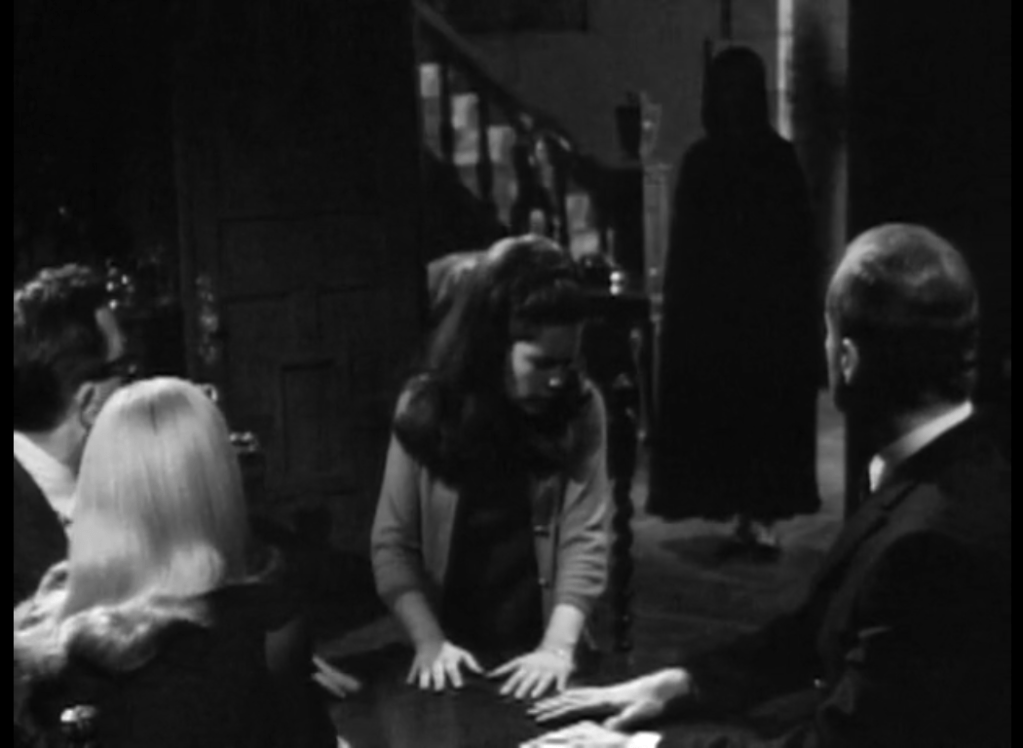
As Vicki starts moaning, the doors to the room fly open and a shrouded figure appears. After a commercial break, the figure is revealed to be Roger’s estranged wife, blonde fire witch Laura. Laura says that she has changed her mind, and decided to accept Guthrie’s earlier invitation to join the séance.
Séance, take two
The five gather, and after a moment Vicki resumes moaning. She utters a series of words in French, most of them disconnected. Laura glares at Vicki, and it seems to be a great struggle for Vicki.
Laura glaresVicki struggles
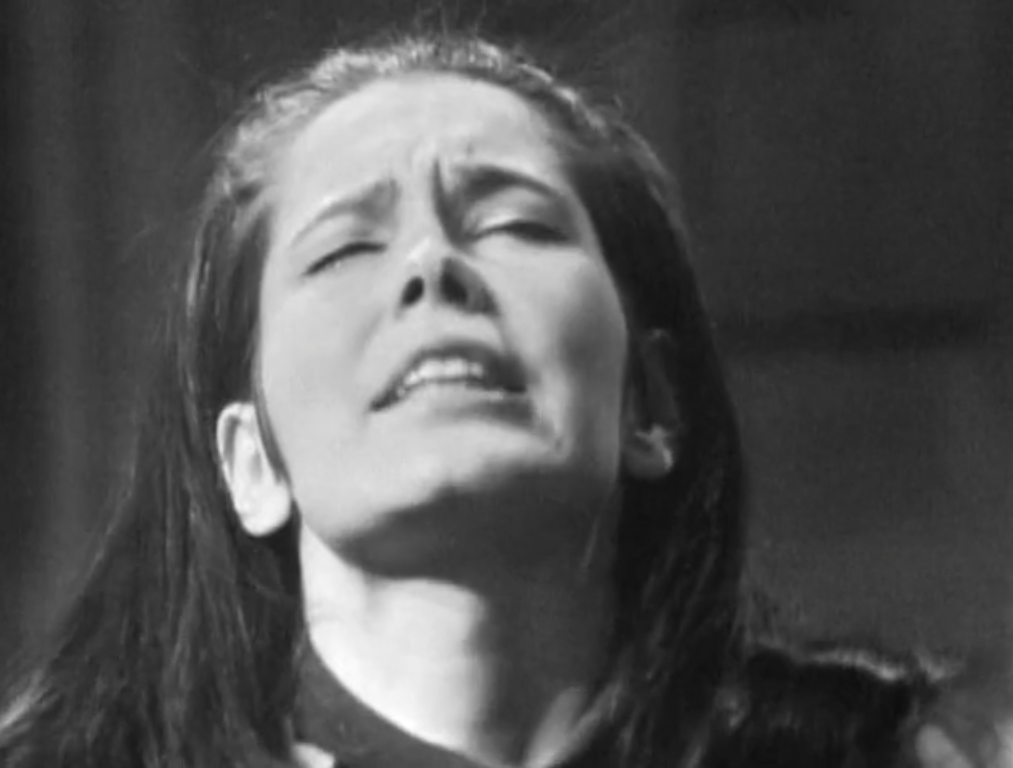
Carolyn says that Vicki doesn’t speak French. Since Josette was originally French, they conclude she is the one speaking to them. Regular viewers know that Laura and Josette are enemies, and that Laura forced Josette to retreat the other day. So when we see Laura making this odd face at Vicki, we know that Laura is using black magic to frustrate Josette’s attempt to speak through Vicki. Through Vicki, Josette manages to force out the French for the words reclusive matriarch Liz repeated after she fell ill a few weeks ago- bird, fire, stone. She says that a stranger is present, that a small boy is in extreme danger, that the stranger is both dead and not dead, mentions an empty tomb, and describes flames rising to the sky. She twice struggles to say “The name of this person is” before Vicki screams and collapses face first onto the table.
Alexandra Moltke Isles strains every muscle to depict the intensity of Josette’s battle with Laura. She is convincing enough that her final scream and collapse don’t seem at all exaggerated. Unlike Vicki, Mrs Isles is a fluent French speaker, and her superb accent enables her to craft a distinct character for Josette in these few gasping words.
Laura’s arrival will raise a question for those who have been keeping track of the show from its beginning. The first time we saw the drawing room doors fly open was in #30. That was also the first time we saw the room lit by candlelight during a thunderstorm, as we again see it today. On that occasion, Vicki saw a silhouetted figure there.
Episode 30
It is never made clear who this figure is. The only living person in the house with Vicki is Roger, and unless he was wearing a wig it can’t have been him.
Compare that silhouette with what we see when the doors fly open this time:
Laura stops by
Are those of us who have been watching from the beginning supposed to make the connection and wonder if the figure Vicki saw in #30 was Laura? That was an episode at the climax of the story that began when Laura and Roger’s son, strange and troubled boy David, tried to murder his father. When he made that attempt in #15, we saw David saying “He’s going to die, mother, he’s going to die!” There was a suggestion then that David was in psychic contact with his mother, and since then we have learned that Laura is able to materialize across distances. Perhaps she already had this ability last summer.
Vicki saw the ghost of Josette in #126. At that time, the ghost spoke to her in English, in a clear, calm voice, and used complete sentences. They’ve spent a lot of time in recent weeks explaining that it is difficult for Josette to appear to more than one living person at a time, but I think we are to assume that her struggles communicating today are less a consequence of that limitation than they are the result of Laura’s interference.
Two actresses share the part of Josette in this episode. Mrs Isles is her voice at the séance. We also cut away from the séance to the long-abandoned Old House on the grounds of the estate. There, we see footage that originally appeared in #70, where Josette (played by Kathryn Leigh Scott) takes shape in front of her portrait above the mantelpiece and walks down to the floor. This effect introduces a more intense phase in the séance. One of the major themes of supernaturalism is that there is a geography of mysterious connections among particular places, and seeing an instantaneous reaction in the drawing room of the great house to an apparition in the parlor of the Old House directs our attention to arcane geography.
One of the moments that does not work so well comes in between the two attempts at séance. Before the first, Roger had been harshly skeptical, deriding Guthrie as a quack and taking every opportunity to show his exasperation with Vicki and Carolyn for playing along with him. When Guthrie invites Laura to join their second attempt, Roger says, with evident sincerity, that he is no longer skeptical. What has changed his mind?
During the first attempt, even before Vicki started to make sounds, Carolyn and Guthrie said that they felt a ghostly presence approaching. When the doors fly open and a figure is seen in silhouette, they react as if that figure might be a ghost. When they see that it is Laura, the audience suspects they may have been right, but they behave as if she were a living human being. Roger certainly does not regard Laura as anything other than the wife whom he is so eagerly trying to divorce. If Roger did feel an eerie presence, as Carolyn and Guthrie did, it must have been a remarkably strong feeling for his skepticism not to return when he sees that the figure was Laura.
This leaves Roger looking like a cardboard character with no real motivation of his own. That could easily have been avoided. The séance doesn’t begin until the episode is half over. Everything up to then is a total waste. Add a few moments to the séance, and you’d have plenty of time to show that Roger is experiencing something he won’t be able to shake. As it stands, we can assume that something of that sort happened, but we shouldn’t have to make that assumption. Something should have been shown to us that would explain the point and advance Roger’s characterization.
Considering that the only sign of the séance’s success we saw before Roger’s change of mind were the first few seconds of Vicki’s channeling Josette, we might imagine Laura going into disdainful ex-wife mode and making a salty wisecrack. Something to the effect that all a woman has to do is moan a couple of times and Roger thinks he’s done something great. It’s just as well she doesn’t say this, but it is too bad the episode sets itself up to be deflated so readily.
We see more of the exterior of the cottage on the grounds of the estate of Collinwood than we have before when dashing action hero Burke Devlin bangs on the door and demands that its current resident, blonde fire witch Laura Murdoch Collins, let him in. Laura eventually gives in. Then, they sit around recapping previous episodes for about ten minutes.
Through the window, we see Laura by the fireThe ivy-covered wall Laura in the glass door
Not only is Laura reluctant to open the door to Burke, she also takes every opportunity to urge him to cool his enthusiasm for her. Most notably, when he tells her that he doesn’t like the way visiting psychologist Dr Guthrie is asking questions about her, Laura gives a plausible explanation for Guthrie’s behavior. Guthrie is trying to figure out why reclusive matriarch Liz fell into a catatonic state. He knows that the new thing in Liz’ life at the time of her attack was a conflict with Laura. Since Liz can’t talk, Laura says it’s reasonable that he’s asking other people about that conflict.
We saw Laura cast a spell that caused Liz’ condition, and we’ve seen her use her magical powers to influence others. But we’ve never seen her do any such thing concerning Burke. For all we know, his devotion to her might be entirely native to his psychology. Even if she is exercising control over him, that may be perfectly natural. Burke has strong feelings for Laura and she knows him well, so she may be able to manipulate him without resort to sorcery. So it is by no means clear what Laura wants Burke to do about Guthrie. Maybe she is tricking Burke into confronting Guthrie, or maybe she sincerely wants him to leave Guthrie alone.
As the next scene opens, Guthrie arrives at the local tavern, The Blue Whale. Guthrie sees drunken artist Sam Evans at the bar. He tells Sam that Burke called him and asked to meet him there. Burke isn’t there yet, but we hear the jukebox play a few measures of Les and Larry Elgart’s recording of “Brasil.” In #3, Burke sat in the tavern and told hardworking young fisherman Joe that he got rich because of something that happened in South America, and we heard several more references to Burke’s connections to that continent in the first couple of months of the show. So that bit of music might suggest to regular viewers that The Blue Whale is Burke’s territory, at least as far as Dr Guthrie is concerned.
Sam tells Guthrie the story of the fire in which he injured his hands. That’s odd- less than a week ago, in #164, Sam unburdened himself of all sorts of things in a conversation that began when Guthrie noticed evidence of that fire. It’s hard to believe he wouldn’t have told him what he tells him today, that he thinks Laura somehow started the fire and made him stick his hands in the flames even though she was far away.
Burke shows up and Guthrie follows him to a table. Burke puts on a menacing demeanor. Guthrie quickly turns the conversation into a therapy session, and Burke falls into the role of hostile patient. Guthrie does leave the tavern when Burke dismisses him, so it remains Burke’s territory, but Burke looks like a fool. He looks even sillier when he goes to Sam and starts giving orders, none of which Sam shows the slightest inclination to follow. If Laura did want Burke to stay off the front lines of her conflict with Guthrie and the rest, perhaps it is because she knew that his efforts would end up like this.
Guthrie goes to Laura’s cottage and invites her to participate in a séance he is organizing. She declines. He tells her he wants to contact the ghost of Josette Collins. We know that Laura and Josette are adversaries, so her reaction to this is interesting to watch. It is possible that Guthrie tells her about it because he wants to test her reaction. She is startled, becomes nervous, and turns away from him, while he watches her intently.
Laura absorbing the news that Guthrie is trying to contact Josette
Every episode of Dark Shadows begins with a voiceover narration. This is how today’s goes:
My name is Victoria Winters. The brightness of the morning cannot mask the fact that the night has been marked by a restless, fitful sleep, especially for one young woman who has been disturbed by strange premonitions and events that she does not fully understand.
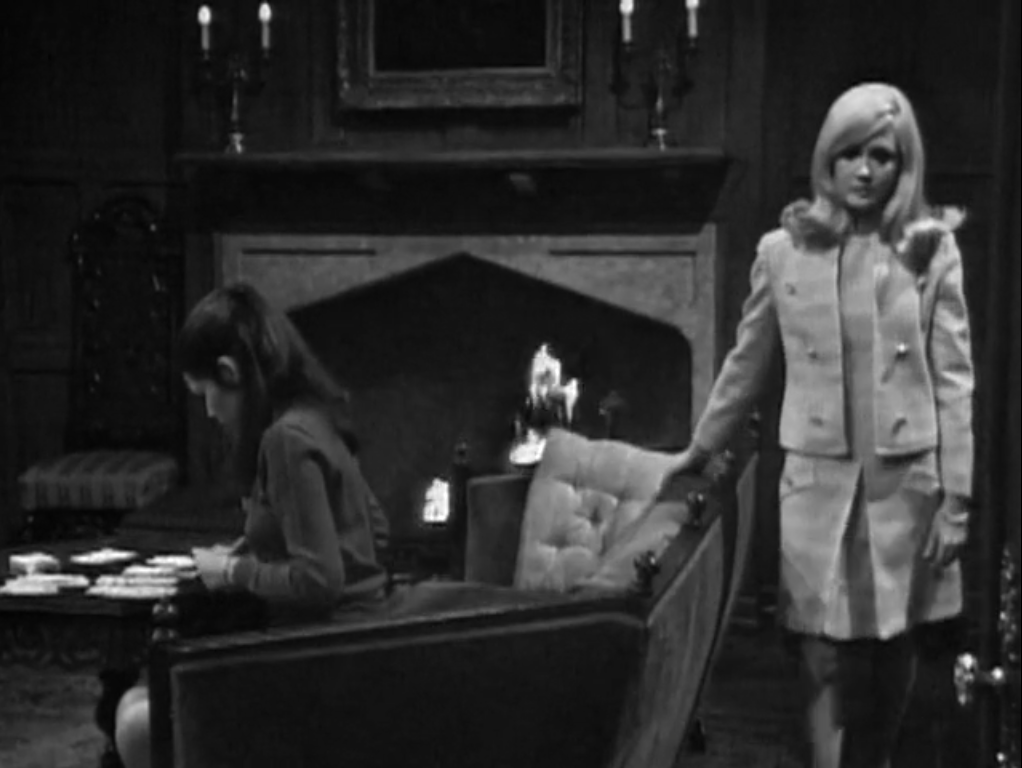
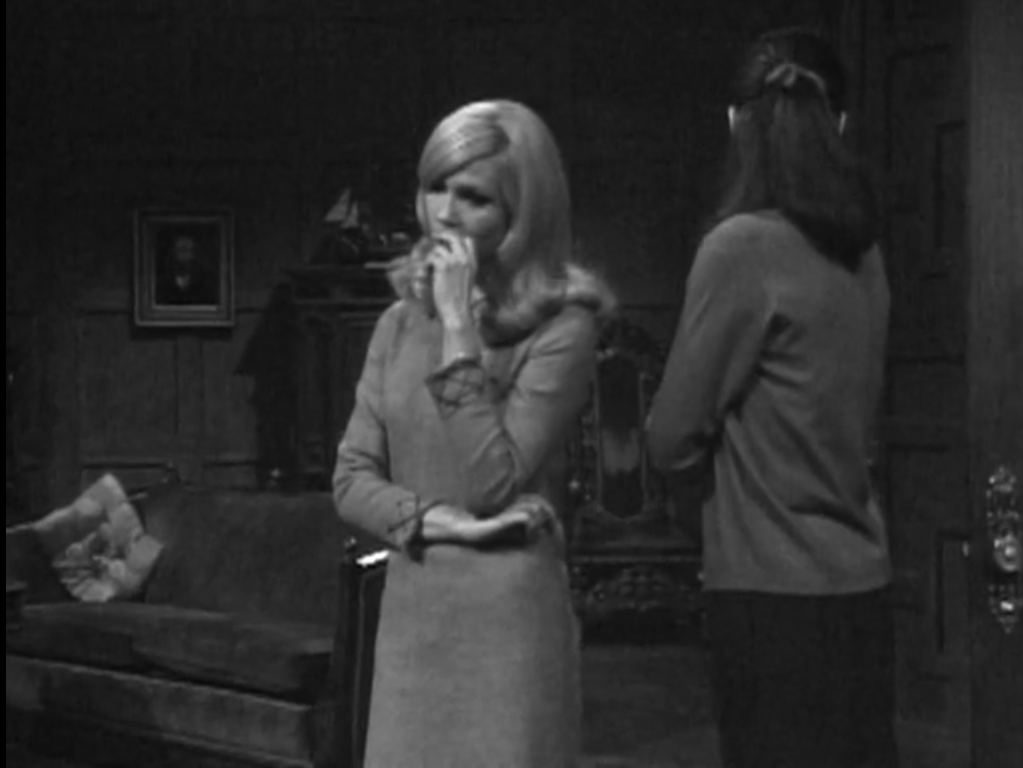
We then see the drawing room of the great house at Collinwood, where two young women are both showing signs of disturbance. There’s no way of telling which one the narration is referring to. Flighty heiress Carolyn is pacing and talking, while well-meaning governess Vicki is clenched tight playing solitaire. This sloppy mismatch is the first sign that we’re dealing with a script by Malcolm Marmorstein, the worst writer on Dark Shadows.
Disturbed by strange premonitions and events
Vicki and Carolyn are worried about strange and troubled boy David. David has spent the night with his mother, blonde fire witch Laura, and is not back yet. They are convinced that Laura is dangerous, but cannot be sure how or to whom. Marmorstein’s awkward dialogue stumbles up to a climax in which Vicki tells Carolyn that visiting parapsychologist Dr Peter Guthrie had said he was inclined to organize a séance. Considering that he first discussed that idea in a conversation with the two of them yesterday, Vicki’s announcement of this as news and Carolyn’s incredulous reaction will leave returning viewers mystified.
David comes home. He’s fine. He tells Vicki that he sensed the presence of the ghost of Josette Collins watching over him in his mother’s cottage, and that he knows he is safe wherever Josette is. What the audience knows, but neither Vicki nor David does, is that Laura and Josette had a confrontation while he was sleeping, and that Josette retreated. Josette is not strong enough to defeat Laura by herself. When David goes to sit by the fire and stare at it in a trance-like state, as his mother habitually does, we wonder how Vicki and the others will put together a strong enough force to help Josette save David. That’s a suspenseful sequence, effectively realized.
Hardworking young fisherman Joe comes to the house on a business matter. He and Carolyn have a conversation about their defunct romance. Carolyn says that she has matured since those days, and that she is free to give it another try. Joe says he is not free. For a show with so many ghosts and ghoulies, it’s surprising that Dark Shadows inspires the greatest fear in its fans when they threaten to bore us yet again with a tedious dead-end storyline like the Carolyn/ Joe relationship. It’s certainly a relief when Joe is so firm as to leave no doubt that we’re finally done with that.
Joe has transferred his affections to Maggie Evans, The Nicest Girl in Town. We dissolve to an extreme closeup of the laughing mouth of Maggie’s father, drunken artist Sam Evans. Sam is in the local tavern, The Blue Whale, with a drink in his hand, a crony on either side of him, and some music we haven’t heard before on the jukebox.
Glad Sam
Maggie and Joe are at a table, where he is trying to make her jealous by telling her of Carolyn’s interest in him, and she can’t stop watching her father and fretting about his drinking. The two of them talk a bit about how Sam’s drinking has reversed the roles of parent and child. That’s the big theme of Maggie in the first 42 weeks of the show, that she is an Adult Child of an Alcoholic. It’s because she’s had to cope with Sam’s addiction that Maggie is so nice to everyone, and also because of it that she has a habit of starting her lines with a little laugh that doesn’t always make sense in context. As the show goes on, Sam drinks a lot less and Maggie gets involved in a wider variety of stories, but that weird little laugh, the union card of many an ACoA, stays with the character to the end of her time on the the series.
Maggie leaves Joe alone at the table while she confronts Sam. She doesn’t stop him drinking, but she does manage to wreck the good mood he and his buddies had going. In the course of their talk, they recap the conversation Sam had with Dr Guthrie Thursday.
Dashing action hero Burke Devlin comes in and sits down with Joe while Maggie is scolding Sam. The two of them have been at odds over Carolyn, and now discover that neither of them is interested in her any longer. Joe seems irritated that his list of reasons to dislike Burke has grown shorter.
When Maggie returns to the table, Burke exchanges a few friendly words with her. He then goes to the bar to buy Sam a drink. Maggie voices her dismay at this plan, and even Bob the bartender gives a dark look at the idea of serving Sam yet more booze. But Burke ignores them both.
Burke wants to know about the conversation Sam had with Dr Guthrie. They recap the conversation Sam had with Maggie a few minutes before. Burke is in love with Laura, and may be under her influence. This conversation raises the prospect that Burke will be an ally of Laura’s against Vicki and her team. Its similarity to the conversation Maggie and Sam had so shortly before suggests that the Evanses may also make themselves more useful to Laura than to the good guys. The repetition grates hard enough on the audience that it is an inefficient way of making that point, but the point itself does add to the suspense.
Most episodes of Dark Shadows have only five credited actors and no extras. This one has seven credited actors and a bunch of extras, including featured background player Bob O’Connell as the bartender. There have been several episodes the last couple of weeks with only four actors; apparently they’ve been saving up to splurge on this one. It is by no means the dullest installment of this period of the show, but neither are there any of the thrills or major story developments you would expect from a high-budget episode. Frankly, it’s rather worrying that this is what they lay out the big bucks for now. Is this as exciting as the show is going to get?
Our point of view character is well-meaning governess Vicki. Vicki believes that her charge, strange and troubled boy David, is in danger from his mother, blonde fire witch Laura. Today we see several weaknesses in Vicki’s position against Laura.
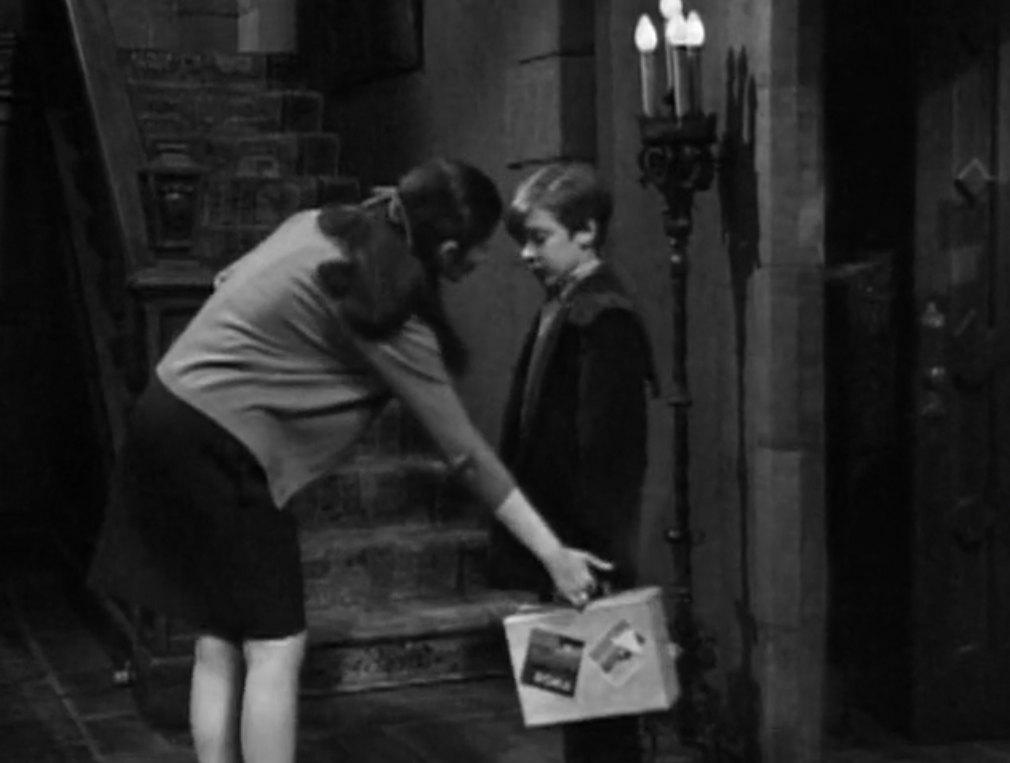
The opening sequence shows that physical force is useless to Vicki. David comes down the stairs in the great house on the estate of Collinwood carrying a small cardboard suitcase. Vicki sees him and asks where he is going. He tells her he is going to the cottage on the estate to spend the night with his mother. Vicki tells him he is not. She grabs at his suitcase.
Vicki grabs for the suitcase
Vicki is not given to clutching at David or his possessions. The last time they had a physical confrontation comparable to this was in #68. In that one, David was throwing a tantrum, and Vicki’s attempt to restrain him only led him to escalate his violent behavior:
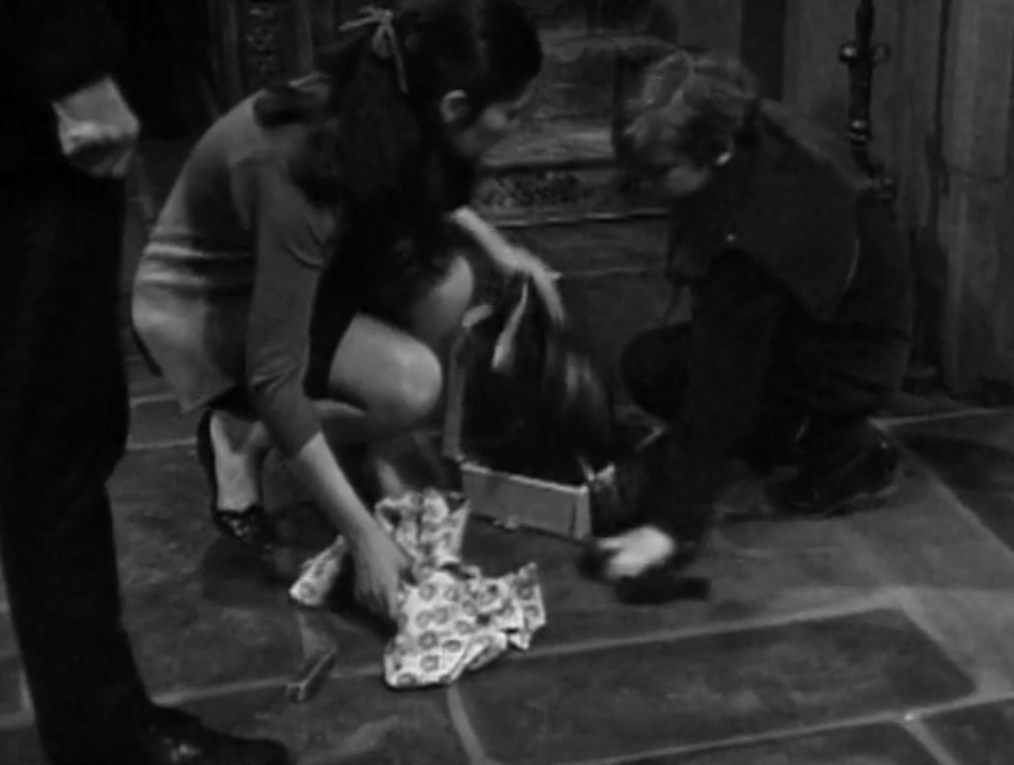
Today, Vicki’s intrusion into David’s personal space backfires just as badly. She inadvertently knocks the suitcase open, dumping his pajamas on the floor. She is shocked to see what she has done:
Vicki sees what she has done
She tries to undo the damage by picking up the contents of the suitcase. That requires her to crouch down before David, destroying whatever authority she may have had over him at the beginning of the encounter:
Kneel before D’vod!
Making matters even worse, David’s father, high-born ne’er-do-well Roger, shows up and stands over Vicki while she and David are on the floor. Roger wants David to go away, and since Laura wants to take him he is working with her. As David’s governess, Vicki has no legal right to oppose the wishes of his parents, and in a conversation that begins with her in this position it is going to be psychologically difficult for her even to voice her objections:
Roger stands over Vicki and David
Vicki does insist Roger meet with her alone in the drawing room while David waits upstairs, and she makes her case valiantly. But that conversation only shows that Roger is as useless to Vicki as is brawn. He ignores every consideration that does not advance his own interest, and his interest now is getting rid of David.
Flighty heiress Carolyn comes into the room and supports Vicki. Roger won’t budge. He gives a long speech about his position as David’s father, a speech which actor Louis Edmonds takes straight off the teleprompter. He delivers it with as much conviction and brio as if he had actually learned it. At the end of his dramatic reading, Nancy Barrett and Alexandra Moltke Isles bite their fingers and Mrs Isles finally turns her back to the camera, so we don’t see either of them laughing.
The finger-bitersMrs Isles gives up and laughs silently
In Laura’s cottage, David complains to his parents about Vicki’s attempts to keep him from his mother and mentions that his father stood up for him. Roger, rather surprisingly, rises to Vicki’s defense, denying that there was any need for standing up to anyone- he claims that Vicki simply did not realize that he had given David permission to spend the night with Laura, and that they had talked about improving communication to avoid similar confusions in the future. Laura isn’t fooled by Roger’s covering up his conflict with Vicki- she clearly knows that Vicki is her adversary. Nor is the audience encouraged to believe that Roger will support Vicki when it counts. He simply thinks that he has her under control.
When Roger leaves David and Laura alone in the cottage, he says good night. He turns and walks out the door as they watch him. Neither of them says anything. This is the sort of thing that often happens in plays, less often on screen, and almost never in real life. I suppose it’s hard to make the sorts of fumbling exchanges people actually have in those moments fit into a drama, but still, it would have avoided a distracting moment to have Laura and David say good night in reply.
Back in the great house, Vicki talks with Carolyn and visiting parapsychologist Dr Guthrie. They tell Carolyn that Laura was lying when she denied having seen Carolyn’s mother, reclusive matriarch Liz, on the day when Liz was stricken with the mysterious ailment that has sent her to the hospital. Dashing action hero Burke Devlin has told Vicki that Liz came upon him and Laura in Laura’s cottage shortly before Liz’ first attack, and that Liz and Laura were still together when Burke left them.
Carolyn has been madly in love with Burke, unable to think about anything else when she is reminded of him. She does initially react to his name with “You talked to Burke?” in the same dreamy tone of voice she has used hithertofore, but quickly resumes her focus on the business at hand. Her feelings for him have not vanished, but she has matured sufficiently that she can set them aside while she deals with a crisis.
That is not to say that Carolyn is entirely grown-up in her behavior. When she learns that Laura has lied about Liz, Carolyn wants to march down to the cottage at once and confront her with “absolute proof that she is responsible for my mother’s illness.” Vicki points out that Laura’s lie is by no means proof of any such thing, and Guthrie says that he doesn’t want Laura to know how much the three of them know.
Having learned that Vicki and her allies have nothing to hope from either physical force or from Roger, we then discover that they can’t count on the writers either. Carolyn asks why Guthrie wants to hide their knowledge from Laura. The audience knows that they are in conflict with Laura and will have to be careful with any information that might enable them to catch her off-guard at a strategic moment. That Carolyn does not know this makes her sound like an idiot.
Guthrie’s response makes this bad situation worse. He makes the nonsensical claim that they should try to keep Laura from realizing that they are suspicious of her. Carolyn is openly hostile to Laura, Vicki has had to tell Laura repeatedly that she is trying to keep her son from her, and Laura treated Guthrie frankly as an enemy when they met yesterday. Considering that the only thing that has happened so far this week is that Dr Guthrie has been brought up to date with the story, seeing him presented to us as someone unable to hold onto information or process it gives the audience the feeling that we’ve just wasted a whole lot of time.
In the course of this miserable conversation, Guthrie does disclose a fateful plan. He says that he is considering organizing a séance. That marks the first utterance of what will, in the years to come, become perhaps the single most important word in all of Dark Shadows. In this instance, it is obscured by Guthrie’s inexplicable idea that Laura might agree to join them as a participant in their séance.
In the cottage, Laura’s behavior towards David is quite peculiar and seems to unsettle him. He was sitting next to her on the couch she has made up for a bed when she suggested he go get a book and read to her. When he found the book and sat down where it had been, she at once pleaded with him to come back and sit by her again. After expressing his puzzlement, David humors her. She squeezes him while he holds a smile. In an extended closeup, that smile shows several emotions- pleasure and self-satisfaction are in there, but so are confusion, discomfort, and loneliness.
Mixed feelingsMixed feelingsMixed feelings
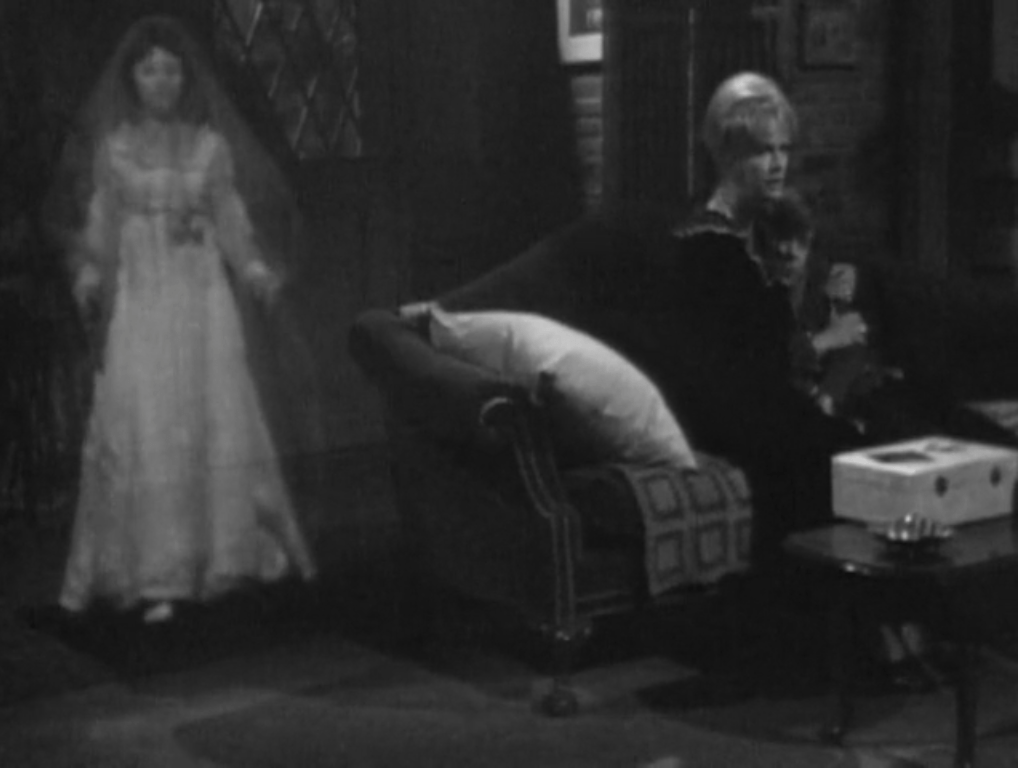
David drifts off, and a visitor comes to the cottage. Laura calls to her before we can see her. “Josette! I know you’re here!” David has a friendly relationship with the ghost of his ancestor, Josette Collins. Apparently Laura is also on a first name basis with Josette. For some time now, the show has emphasized that Josette never appears to more than one person at a time. Though Laura and David are both in the room, Josette manifests:
Manifestation
Laura orders Josette to go away, and she does. After she has gone, David wakes up. He says that “It feels like someone was here.”Laura tells him no one was, and he goes back to sleep.
Laura has her back to Josette, and David is unconscious. So perhaps that’s why she is able to break her usual rule and appear when more than one person is in the room.
Or perhaps there isn’t more than one person in the room. We know that Laura is not quite human, and not exactly alive. In her previous star turn, when she rescued Vicki from the crazed Matthew Morgan in #126, Josette was accompanied by the ghosts of beloved local man Bill Malloy and the Widows of Collinsport. Perhaps we are to conclude that Laura, like them, has erupted into the narrative from the supernatural back-world.
As we opened with a demonstration of the protagonists’ weaknesses, so Josette’s retreat exposes a further weakness. Josette has been established as the mighty supernatural protectress of David, Vicki, and the rest of the household. Yet Josette cannot overpower Laura. If there is to be a happy ending for David, Vicki will have to marshal her forces with care.
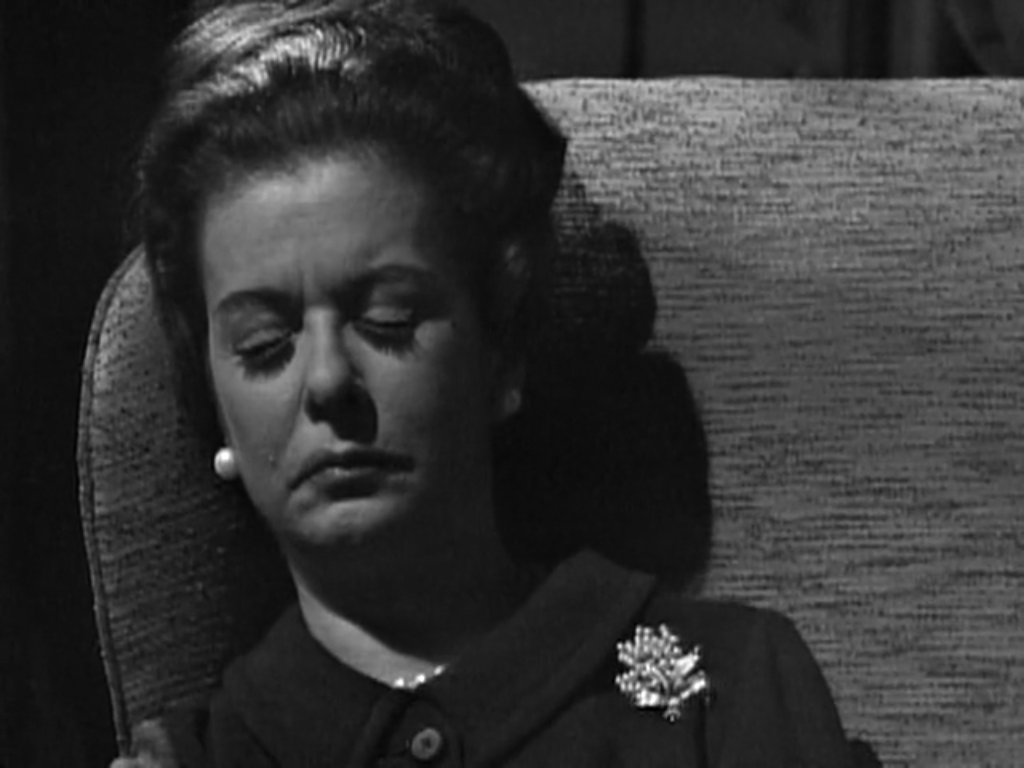
In episode 10, reclusive matriarch Liz had napped in a chair in the drawing room of the great house of Collinwood. Her sleep was troubled by unpleasant dreams; we saw her shifting in the chair and heard her muttering about ghosts. Strange and troubled boy David awakened her when he came in, having just sabotaged his father’s car in an attempt to murder him.
Liz’ troubled sleep in episode 10
Today, we open with well-meaning governess Vicki sleeping in the same chair, showing the same signs of discomfort, and muttering in her sleep words she had heard Liz say in a mad scene at the end of yesterday’s episode: “fire… stone… bird…”
Vicki’s troubled sleep in episode 157
Vicki awakens, not to find David returning from a homicidal errand, but to be overwhelmed by the presence of the ghost of Josette Collins. She smells Josette’s jasmine perfume, and the picture is out of focus. She walks around the room talking to Josette, whom we can neither see nor hear. She agrees to some instruction from Josette only she can hear.
Vicki’s boyfriend, instantly forgettable young lawyer Frank, shows up. He is complaining that Vicki called him at 5 AM, asked him to come over at once, and still won’t explain why.
Liz’ brother, high-born ne’er-do-well Roger Collins, appears at the top of the stairs and demands to know what Frank is doing in the house. Vicki claims that she wants Frank to take her for a drive in the country to help her clear her head. This makes sense to Roger. Liz is in a very bad way, for no reason the doctors can determine, and it has been a rough night in the house. Roger tells Vicki that he thinks it would be a good idea if she and Frank did take a drive. He is going to need a lot of help today, and the more relaxed Vicki is, the better able she will be to provide it.
The audience knows what Vicki has come to suspect, that Roger’s estranged wife Laura is a blonde fire witch who is responsible for Liz’ condition. Laura is staying in the cottage on the estate and she and Roger have begun the process of divorce. Laura and Liz clashed about guardianship of David, and Laura responded by casting a spell on Liz. With something like this in mind, Vicki wants Frank to take her back to a cemetery where they found some clues about Laura last week.
It is interesting to see Vicki with Frank in this episode. She is usually very demure, rarely looking anyone directly in the eye and consistently using a soft, delicate voice. She is that way today when Roger is around. But she looks straight at Frank and tells him in a crisp, candid tone just what they are going to do and why they are going to do it. That’s one of the reasons I keep wishing someone other than Conard Fowkes had played Frank. Fowkes is so dull that he simply could not survive on a show like Dark Shadows, but Frank is a character who gives us a chance to see a seldom-glimpsed side of Vicki.
Frank and Vicki visit the Caretaker of the cemetery outside town. In the archives of his building, Vicki smells jasmine and feels Josette’s presence. The Caretaker catches a distant whiff of jasmine too, but only Vicki’s nose can lead her to where Josette wants her to go. Josette pushes a book off a shelf and opens it to a page about a Laura Murdoch Radcliffe, who died by fire in Collinsport in 1867. Since they already know of another Laura Murdoch who died by fire there in 1767 and of someone who is medically indistinguishable from Laura Murdoch Collins who died by fire in Arizona earlier this year (1967,) Vicki finds great significance in the interval of 100 years. She tells Frank that the Laura Murdochs who died in Collinsport in 1767 and 1867 and the woman who died in Arizona this year are parts of the same corporate entity that is represented by the woman staying in the cottage.
Patrick McCray and Wallace McBride of “The Collinsport Historical Society” gave up writing daily episode commentaries around the time Ron Sproat joined the writing staff of Dark Shadows, but McCray does have a post about this episode. As usual, his remarks are thought-provoking:
We are about fifty episodes away from the introduction of Barnabas Collins, and you can feel the show straining with the need for it. We are at least watching a supernatural show, now. Going back to something less exotic will take the charm of a Dennis Patrick to pull off. He and Laura have something new that they are bringing/will bring to the show. One of the problems with the first six months of the show is how sad it is. The villains are wracked with guilt, somewhat grating in their personalities, and driven by necessity. Laura changes that. Her contribution to the show is less supernatural than philosophical. She likes who she is. She likes what she’s doing. She is demented enough to see that burning David alive is just dandy. Contrast this with Roger. He just wanted to be left alone, like a quietly queeny, ineffectual Hulk.
I’m not at all sure Laura “likes what she’s doing.” Most of the time, what she’s doing is sitting motionless by the fire. She is stirred from that position only when someone calls for her, and then only with difficulty.
The only times happiness registers on Diana Millay’s face are when Laura is talking to David and telling him about the blissful life that awaits in the fantastic realm she comes from, not about the path she must take to approach that realm. At other times, her dominant mood is weariness and her manner is so distant as to be inscrutable. With characters other than David, she is energetic and immediate only when she flies into a rage.
We don’t even know how many of her there are. Vicki tells Frank at the end of today’s episode that Laura seems to be made up of four components, but the audience also knows of ghostly apparitions that seem to travel with those corporeal Lauras and to be at least partly independent of them. Maybe somewhere in that complex there is a spirit that delights in the idea of taking David into a pyre, but we don’t see that delight.
McCray goes on:
Burke? He just wanted to even the odds. I get that. But his victory would mean shutting down Collinwood, and that gives any viewer mixed feelings. As much as I like Burke, his storyline misfired because you’re left with nobody to root for. If Burke wins, the show has to end, and that’s not going to happen. For Burke to lose, justice must elude him once more, and a character we like goes away. I suppose that the show originally was so Vicki-centric that we weren’t supposed to care for either Team Burke or Team Collins compared with Team Winters. With the arrival of Laura, all of this changes. (I say this because Matthew was a loon and couldn’t take pride in his wrongdoing.) Like Burke and Roger or not, everyone is pitted against/used by the first in a series of Gloucesters employed by the series to delight viewers.
Ibid
McCray is exactly right that Burke’s original storyline could never be resolved. The character had an even bigger problem that prevented the writers from coming up with a new storyline for him. That problem is his type. As a dashing action hero, sooner or later he’s going to have to rescue someone. Yet he never gets to save anyone from anything.
The first three rescues on the show are all rescues of Vicki. David locks her up and leaves her to die in the abandoned part of the great house of Collinwood. Burke doesn’t have access to that part of the house, so she ends up being rescued by Roger, of all people. That adds some complexity to Vicki’s attitude to Roger, keeps her from catching on to some plot points she isn’t supposed to understand yet, and most importantly enlarges the obstacles keeping her from befriending David, thereby enriching the one narrative arc that works every time we see it.
Next, gruff groundskeeper Matthew tries to break Vicki’s neck in the cottage. Liz saves her that time. It would have to be her, since she is the only person Matthew listens to. That’s the in-universe reason. Also, Joan Bennett is the biggest star on the show, the origin of the relationship between Liz and Vicki is supposed to be the biggest secret in the show, and the mostly-female audience of a daytime soap might be interested in a scene where a female character saves the day. So it is more satisfying all around to have Liz rescue Vicki from Matthew than it would have been to have Burke barge in.
When Matthew is holding Vicki prisoner in the Old House on the estate and is about to swing an ax at her head, Burke is in the area looking for her. But it is the ghosts of Josette and the Widows, accompanied by the ghost of beloved local man Bill Malloy, who rescue Vicki then. Burke and Roger show up after the fact and walk her home. The show has spent so much time building up the ghosts and the supernatural back-world behind the continuity in which the characters operate that it would be a cheat if they did not come forward at this point and bring a story to its climax. Again, Burke is left on the outside looking in.
Now David needs rescuing, but since the show’s most reliably interesting storyline has been the budding friendship between David and Vicki, she is the only one who can be his rescuer. Burke is got out of the way by having Laura entrance him with the memory of their old love. Since the threat to David is supernatural, this is also an opportunity to bring the ghosts back into play.
When the vampire story begins, Burke will become entirely superfluous. A dashing action hero can’t allow a bloodsucking fiend to run amok. But stop the vampire, and you stop the first ratings generator the show has ever had. So that will finish Burke once and for all.
Further:
I may be so-so on the Phoenix as a big bad on the show, partly because she was such an out-there villain, grounded in an unclear mythology. Nonetheless, she ushered in a sentient, supernatural threat and a new school of evil that finally gave viewers a moral compass to lead them through Collinsport.
Ibid.
It may be pedantic to point this out, but it is the nature of supernatural mythologies to be unclear. Once you pass the point where the laws of nature that we can examine out in the open apply, it’s up to the audience to guess at what the alternative structure of cause and effect might be. The storytellers can guide our guesses. Vicki’s discovery that the three Laura Murdochs died by fire in 1767, 1867, and 1967 leads her to tell us that the hundredth anniversary of the previous fire has the power to cause the next one. The power of anniversaries will indeed become a major part of Dark Shadows’ cosmology, coming up in several future storylines, and is the inspiration for my posting these blog entries at 4:00 pm Eastern time on the 56th anniversary of each episode’s original broadcast.
When you get to vampires and witches and Frankensteins and werewolves and other relatively familiar monsters, you can draw on horror movies produced by Universal Studios in the 1930s and endlessly shown on television since the 1950s, and beyond those on the plays, novels, and folklore from which those movies derived some of their imagery. That reduces the amount of explaining the protagonist has to do. We all know what blood and bats and wooden stakes and crosses and mirrors and daylight signify in connection with vampires, for example. That creates an impression that there are clear and logical rules, but when you hang out with the vampire for a thousand episodes you start to realize just how little sense any of those rules really make.
Laura is interesting precisely because she starts without any of that unearned sense of clarity. The show has to build her up to the point where she makes enough sense that we are in suspense, but not to go beyond that point and explain so much that we can’t avoid realizing how disconnected she is from the world we live in. I’d say they strike that balance quite well.
Moreover, because we have so little information about Laura, she is the perfect adversary for the supernatural beings we have met so far on the show. The ghosts of Josette and the Widows are definitely around, but they are deep in the background, seldom seen, even more seldom heard, and when they do intervene in the visible world their actions are brief and the consequences of them ambiguous. These vague, distant presences are credible as a counterforce to a figure as undefined as Laura, but have to evaporate when a menace appears that calls for a dynamic response sustained over a long period. Since the show has spent so much time hinting around about Josette and the Widows, it would be a shame if they hadn’t come up with a supernatural adversary for them to engage.
Back to McCray:
This episode is rich in atmosphere and menace, but anything involving the mysterious Caretaker will do that. It serves up Collins history as a net that strangles generation after generation… and the place where the answers to today’s mysteries will be found. The show has always been about the past… Paul Stoddard, the car accident, Vicki’s parentage… but (Widows notwithstanding) never beyond the lifetimes of the protagonists. By having our heroes deal with ancient dangers that still long to cause harm, DARK SHADOWS truly begins.
Ibid.
I demur from lines like “Dark Shadows truly begins” at some point other than episode 1. The whole wild ride of improvisation and reinvention is what I find irresistible. Each period of the show has some connections to the one immediately before it, but as time goes on there is absolutely no telling where they will go. Watching this part, the so-called “Phoenix” story, you can just about see how it follows from the moody, atmospheric showcase that Art Wallace and Francis Swann’s scripts provided for fine acting, ambitious visual compositions, and evocations of Gothic romance in the first 20 weeks of the series. And you can just about see how the period of the show that comes after it is resolved follows from the Phoenix. But when you look at the stories they will be doing in 1968 and later, all you can do is ask how they could possibly have found their way from here to there. Going along for that chaotic, meandering journey is the fun of it, and you deny yourself a little bit of that fun every time you ignore or downgrade an episode.
I also have reservations about the remark that “This episode… serves up Collins history as a net that strangles generation after generation.” The 1767 incarnation of Laura Murdoch married into the Stockbridge family, and the Caretaker told us they were great and powerful. The 1867 version of her married into the Radcliffes, and the Caretaker is shocked to find that her parents are not listed in his records- the Radcliffes were so high and mighty that none of them would ever have married someone whose parents were not known. So the history that strangles generation after generation is not the history of a single family, but something about the part of central Maine where Collinsport is. “Laura Murdoch” is a curse that falls on each prominent family in the region in its turn.















 Dark Shadows Commentary