Episode 291: Doctor Hoffman has fooled us all

Up to this point, Dark Shadows has been scrupulous about avoiding references to Christianity. Of course, that was necessary- you can more or less casually drop in an image from ancient Greek mythology, for example, because not many people put a lot of energy into wondering whether they ought to be worshiping Zeus. But Christianity is very much a live option nowadays, with the result that even a subtle allusion to it tends to take over the audience’s reaction to whatever story you’re telling and turn their reception of it into a theological debate.

It can be particularly hard to steer clear of Christian ideas when you draw elements from stories that were first told in cultures where Christianity was so heavily dominant that people simply took its major concepts for granted and used them without thinking. To take an obvious example, vampires are an inversion of Jesus. Where Jesus is the ultimate example of self-sacrifice, the vampire is a metaphor for selfishness. Where Jesus’ resurrection represents his final victory over death, the vampire’s resurrection leaves him under the power of death every dawn. Where Jesus invites us to drink his blood and eat his flesh and thereby join him in eternal life, the vampire drinks our blood and annihilates our flesh in order to subject us to his indefinitely prolonged dying. Where Jesus commands his followers to spread truth wherever they go, the vampire’s existence depends on lies and secrecy. It’s no wonder that Bram Stoker’s Dracula is all about people using crucifixes and communion wafers to contain and destroy the sinister Count.

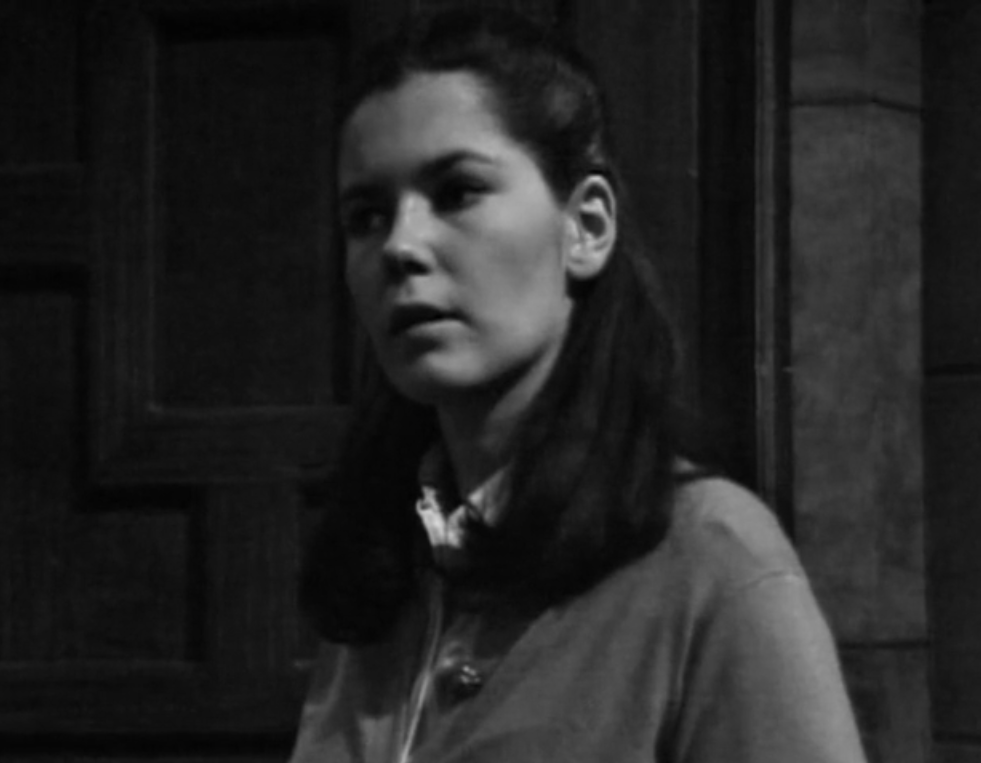
The scene that closed Friday’s episode and that is reprised in today’s opening is, I think, the first to include a recognizable allusion to the Christian story. In the Gospels, the first human being to learn that Jesus has been resurrected is Mary Magdalene. She learns this when Jesus interrupts her attempt to mourn his death and calls her by name, and that act of naming creates a new kind of relationship between them and a new place for her in the history of the cosmos. In Dark Shadows, the first person to find out that Barnabas Collins is a vampire otherwise than by becoming his victim is Dr Julia Hoffman. Barnabas learns that Julia has caught on to him when she interrupts his attempt to kill her and calls him by name, and that act of naming creates a new kind of relationship between them and a new place for her in the narrative arc of Dark Shadows.

Furthermore, Jesus had, before his death and resurrection, freed Mary of seven demons who possessed her. The memory of that past liberation was the original basis of her devotion to him. In this scene, Julia, as the anti-Mary Magdalene, promises that she will free Barnabas of the force that has made him a vampire. Hope for that future liberation is what stops Barnabas from murdering Julia, and will become the basis of their initial collaboration. Julia’s promise is not based in any claim of divine power, but in a lot of pseudo-scientific gibberish derived from the 1945 film The House of Dracula, in which a mad scientist tries to cure Dracula of vampirism by an experimental treatment that involves the participation of several other characters from Universal Studios’ existing intellectual property. The echo of the Mary Magdalene story also evokes the “meddling in God’s realm” theme of that and the other monster movies Universal made in the 1930s and 1940s.

Julia is not the first scientist on Dark Shadows to offer to help an undead menace to rejoin the world of the living. That was Dr Peter Guthrie, parapsychologist, who in #184 told blonde fire witch Laura Murdoch Collins that if she would stop trying to incinerate her son, strange and troubled boy David Collins, he would help her. Laura laughed at Guthrie’s offer, and when he said that his research into conditions like hers “has been my life,” she remarked that she found his choice of words strangely apt.

As a humanoid Phoenix, periodically burning herself and her sons to death and then reappearing in a living form, Laura was not part of any mythology as familiar and well-articulated as are the vampire stories from Bram Stoker, Universal Studios, or Hammer Films. The only really well-known thing about Phoenixes, beyond their rebirth from ashes, is their elusiveness. That the Fire Bird can be seen alive or not at all is a recurring theme of medieval and early modern literature based on Celtic and Germanic folklore, and a reason why the Phoenix is so often associated with the mysterious realms that figure in the legends of the Holy Grail. It is essential to Laura that we cannot understand what she is thinking, or even be sure if she has an inner mental life at all. Not only can Laura not give up her plan to burn David alive and retain a sense of menace. If we so much as catch her thinking about Guthrie’s offer, she will cease to be any kind of monster. So it is no surprise that she responds to Guthrie by killing him the moment opportunity presents itself.

Vampires, by contrast, combine decades of prominence in popular culture with a deep resonance for those who identify with their individual compulsions and social isolation. That gives storytellers a whole warehouse of resources to use when shaping a vampire into an image in which the audience can recognize themselves. So when Julia tells Barnabas that she has spent her whole life looking for someone like him to use as an experimental subject, he doesn’t have to make a snappy remark like that Laura made to Guthrie. He takes it in, and spends the rest of the episode weighing whether to cooperate with Julia or kill her.

Barnabas takes Julia back to his house. While she is in the basement picking out a room to use as a laboratory, Barnabas tells his sorely bedraggled blood thrall Willie that he has decided to kill her after all. Willie protests, and Barnabas goes back and forth on the question. When Julia comes back upstairs, Barnabas sends Willie away.

As Barnabas moves in to kill Julia, she tells him that her survival guarantees his. She explains that this is because his former victim, Maggie Evans, The Nicest Girl in Town, is not dead as everyone has been told, but alive and well-hidden. Maggie is suffering from amnesia covering her time with Barnabas. Julia is Maggie’s psychiatrist, and if Barnabas cooperates with her experiment she will see to it that Maggie does not recover her memory.

Julia betrays Maggie. Screenshot by Dark Shadows Before I Die.

From our first glimpse of Julia in #265, she has been a mysterious, forbidding figure, harsh with Maggie and indifferent to the usual norms of medical ethics. But she is, after all, a doctor, and so we’ve been willing to give her the benefit of the doubt. Now that we’ve heard her tell the vampire that she will abet his crimes by using her professional skills to ensure that Maggie’s psychological injury will not heal, we realize that she is not a maverick, but a mad scientist.

Again, the echo of the story of Mary Magdalene in the opening adds to the shock of Julia’s willingness to betray Maggie at the end. Mary was Jesus’ most faithful disciple, accompanying him to the cross when the men he had called were all busy denying him and looking for places to hide. It is also traditional among Eastern Orthodox, Oriental Orthodox, and Roman Catholics to name her in prayers for healing, because of old stories that she had healed people of blindness, mobility impairments, and leprosy, among other conditions. So Mary Magdalene is the most trustworthy of healers, and it is startlingly appropriate that Julia, as her exact opposite, is the least.

Episode 140: Some call it Paradise

On his blog Dark Shadows Every Day, Danny Horn discussed the soap opera term “supercouple”:

This is the thing that people miss when they talk about soap opera couples. Two characters don’t have to be in love with each other to be a “couple” — although they often are, which is why people think that’s the definition.

Two characters are a “couple” when a scene with them together is way more interesting than a scene with them apart. It makes absolutely no difference whether they love each other, or hate each other, or they’re partners, or best friends. Kirk and Spock are a couple. Ernie and Bert are a couple.

Dark Shadows Every Day, Episode 473: The Twin Dilemma

By Danny’s definition, Dark Shadows‘ first supercouple is well-meaning governess Vicki and her charge, strange and troubled boy David Collins. Most of the storylines the series started with- Vicki’s quest for her origins, dashing action hero Burke Devlin’s quest for revenge on high-born ne’er-do-well Roger, reclusive matriarch Liz’ insistence that certain parts of the house never be entered, the doomed romance between flighty heiress Carolyn and hardworking young fisherman Joe, etc- either dribble away to nothing or never really get started. But Vicki’s attempt to befriend David is interesting every time we see the two of them together on screen.

That is entirely down to the actors. The scripts give David the same viciously hostile lines of dialogue over and again, require Vicki to read aloud from textbooks about the geography of Maine, and lock Vicki up in windowless rooms for what seem like eons. But David Henesy and Alexandra Moltke Isles, with their facial expressions, tones of voice, gestures, use of space, etc, create the impression of a relationship steadily growing in emotional complexity and importance. When David finally looks up into Vicki’s eyes and declares “I love you, Miss Winters!” in #89, this body language gives us a context within which we can feel that a plot-line has moved forward. In the months since that statement, David and Vicki have grown closer, and now they are quite cozy.

So much so, in fact, that there is a danger that they might end up recreating the interpersonal dynamic that Liz and Roger model and that will become Dark Shadows’ signature- a relationship between a bossy big sister and her bratty little brother. Liz continually tries to control Roger’s behavior so that he will not be bad, and when her efforts fail, as they invariably do, she covers up for him and shields him from accountability. Earlier this week, as Vicki explained David to himself and he clutched at her for support after he had done shocking things, we could see how after a time they might fall into that pattern.

Today, they seem to put that danger behind them once and for all. David’s mother, the mysterious and long-absent Laura, has come back and wants to take David to live with her. David has wanted this for years, but in the days since Laura’s return has come to be deathly afraid of her. Vicki has met with Laura and arranged to cross paths with Laura when she and David take their afternoon walk. Vicki’s theory, which has quite a bit of evidence behind it, is that David is only afraid of rejection, and that if he can see his mother in a setting where nothing will be expected of him he will start to relax.

The first result of this encounter is that David slips off a high cliff, clinging for his life to a crumbling rock on its edge. This would seem to be a negative outcome. Vicki rescues him, embraces him, and talks him into going to his mother.

Vicki holds David and urges him to go to his mother

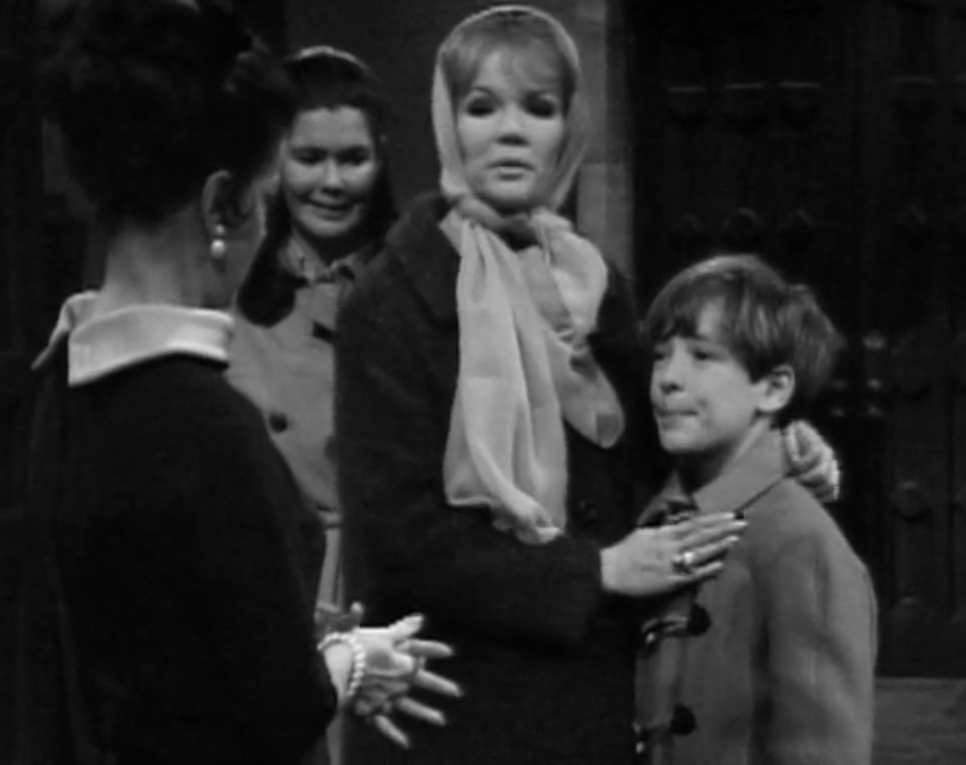
David sees that Laura is crying and apologizes to her. They embrace and warm to each other. David, Laura, and Vicki walk back to the house together. David’s father, Roger, and his aunt, Liz, are impressed with the progress Vicki has made.

Happy at home

Dark Shadows began on a sort of 14 week schedule. Coming at the end of the first 14 weeks, episode 70 gave us our first visit to the haunted Old House and our first unambiguous sighting of a ghost. At the end of the third 14 weeks, episode 210 will end with a hand darting out of a coffin and rebooting the show entirely. Today, the conclusion of the second 14 week period is perhaps less spectacular, but in its own way just as pivotal as those other milestone episodes.

With David’s apology for making his mother cry and his resolution to open up to her, he is becoming significantly less bratty. With her handing of David off to Laura, Vicki is renouncing her opportunity to be bossy, and indeed to become a surrogate sister to him. With that danger out of the way and an untroubled friendship established between them, the Vicki/ David arc seems to have reached a logical conclusion. The series will have to find a new supercouple, or a clutch of new storylines, if it is to hold our attention in the long term.

Perhaps Laura and David will be the new pair at the center of the show. They are together at the beginning and end of the second half of the episode, and in between Laura gets some information about David to which she gives an intriguing reaction.

At the beginning of that second half, the five characters in today’s episode share a meal in the kitchen at Collinwood. The richest people in town live in a huge mansion, and this is their dining room:

Family dinner

I suppose Liz and her daughter, flighty heiress Carolyn, lived alone in the house for 18 years, ending with Roger and David’s arrival sometime last spring. So perhaps there is a bigger dining room sealed off somewhere. Be that as it may, the smallness of the kitchen is one of its most valuable features as a set. Scenes there have an intimacy that makes it natural for characters to share important information with each other. Indeed, almost every time we’ve seen the kitchen, we’ve seen someone pick up information that led them to take action that advanced the plot.

Liz and Roger mention that Laura hasn’t eaten anything. Roger follows that with jokes about the cooking abilities of Mrs Johnson, Collinwood’s housekeeper. Laura not eating is a familiar theme to the audience. The first several times we saw Laura she was in the restaurant at the Collinsport Inn. Maggie Evans, keeper of that restaurant, remarked that Laura never ate during any of her visits there, and yesterday she didn’t touch the breakfast Vicki brought her. The emphasis they keep putting on this point is one of many signs they’ve offered that there is something uncanny about her.

After the others have left the little table, Liz exchanges a few words with Laura. She mentions that David is a highly imaginative child, who even supposes that he talks with the ghosts of Collinwood. At this, Laura opens her eyes wide, shifts in her seat, looks straight ahead, and says that that does sound like pure fantasy. Liz adds that he spends a lot of time with the ghosts. Laura glances back in Liz’ direction and says that perhaps now he will spend more time with her.

One might imagine that a long-absent mother, hearing that her son thinks he spends a lot of time in conversation with ghosts, would be concerned for his mental health. A reaction like the one Laura gives Liz might be a sign of such concern. But we’ve had so many hints that Laura is herself somehow connected to the supernatural that this does not seem to be a likely explanation. More probably, her discomfort is a sign that David’s sensitivity to the uncanny and his communication with the ghosts might lead him to learn something about her that she does not want him to know.

Laura and David sit by the fire in the drawing room. Vicki has scolded David for his habit of standing at the doors to the drawing room and eavesdropping on conversations taking place inside. Now, it’s Vicki’s turn to stand on the same spot and eavesdrop on a conversation involving David.

Vicki listens in

David has asked Laura to tell him about the place she comes from. “Some call it Paradise,” she says. She starts describing a hot, sunny place with palm trees. Her last known address before appearing in Collinsport was Phoenix, Arizona, so maybe that’s what she’s talking about. But as she goes on, the description sounds less and less like that city, and more and more like the places we hear about in the legends of the Holy Grail. The air is always fragrant with the flowers that bloom continually, and the trees are the proper nesting places of a creature that figures prominently in the Grail legends, the Phoenix. David has never heard of the Phoenix, and Laura tells him an elaborate version of its story.

In episode 128, Maggie sat at Laura’s table in the restaurant and Laura told her the story of the Phoenix. When Maggie told her father, drunken artist Sam, that a mysterious blonde woman who used to live in Collinsport had told her that tale, Sam had reacted as if he recognized the story as one Laura used to tell. The version she told Maggie, though, was a relatively brief one, and was by way of an etymology for the name of her most recent hometown. The version she tells David today is much more elaborate. It evokes a whole world, claims that world as her home and therefore as David’s, and invites David to take his rightful place under the sign of the Phoenix.

As Vicki hears Laura reach the climax of the story, a sudden wind blows the front doors open, and a fraction of a second later blows the drawing room doors open as well. Laura looks up and sees Vicki eavesdropping. She is a bit startled to see her, though not as startled as Vicki is to be seen:

Vicki caught eavesdropping

After a brief moment- less than a second- Laura turns from Vicki and to the fire. She and David peer into the flames.

Peering into the flames together

Laura turns from the flames and looks at David. The episode closes with her look of satisfaction as she sees her son fascinated by the fire.

Watching David watch the fire

The doors have blown open before when the show wanted us to think that supernatural forces are at work in the house. Laura herself may control some supernatural forces, but it seems unlikely that she is the author of this incident. It interrupts her story just as she is declaring that “The Phoenix is reborn!,” her reaction shows that she didn’t know or particularly care that Vicki was eavesdropping, and her turn to the fire would suggest that she is concerned the wind might have extinguished the flames. Perhaps we are supposed to think that Laura’s presence and her plans have stirred up one or more of the ghosts Liz mentioned to Laura after dinner, and that the gust of wind was a sign of their presence. That would in turn suggest that the weeks ahead will feature a conflict between Laura’s uncanny powers and those of the spirits lurking in the back-world implicit in the action of the show.

Dark Shadows and the legends of the Holy Grail

In 281 of the posts that follow, I link to comments I made on Danny Horn’s blog, “Dark Shadows Every Day.”

I added most of these comments in the months between the shutdown of live theater in March of 2020 and the completion of the blog in April of 2021. But I have added some comments since. Yesterday, I read Julius Evola’s The Mysteries of the Grail (translated by Guido Stucco; Rochester, Vermont, 1997.) Evola is not someone I agree with about things, to put it mildly, but that book describes dozens of moments from legends about the Quest for the Holy Grail that may have been in the minds of people making Dark Shadows.

In this long comment on Danny’s post about episode 559, I collect various moments in the medieval romances concerning the quest for the Holy Grail that may have inspired story points on Dark Shadows. The whole thing starts as a response to Danny’s exasperated remark about the apparently uncharacteristic infatuation of evil wizard Nicholas Blair for nice girl Maggie Evans, an infatuation that will lead to Nicholas’ downfall. I do not claim that the show does a good job of fitting this relationship into the story, but I do use it as a jumping-off point for a long catalog of similarities:

“Also, Nicholas is in love with Maggie.

“Sorry to spring it on you like that, but it’s that kind of storyline. Nicholas Blair is some kind of evil wizard man, and so far we haven’t had any indication that he’s looking for a girlfriend. In fact, he’s been mocking Angelique relentlessly for having human emotions. And yet, here we are.”

I think there’s a possible explanation for this. By the end of the 1960s, the legends of King Arthur, the Knights of the Round Table, and the Holy Grail had been in vogue for decades. New York theater people like those involved in Dark Shadows would of course have been keenly mindful of Lerner and Loewe’s CAMELOT, which was a hit on Broadway from 1960 to 1963 and which appeared as a feature film in 1967. As part of that fashion, bookstores generally would carry paperback translations of Thomas Malory’s 1453 LE MORTE D’ARTHUR and of selections from the romances about the Holy Grail written in the years 1175-1225 on which the legends of Arthur and his group were based.

Nicholas is a representative of the Devil. In Malory (especially Book 14, verses 9 and 10,) we see a theme that recurs in several of the Grail romances, that Lucifer fell from Heaven because he had conceived a passion for a mortal woman.

In fact, many of the themes of the Grail romances show up in DARK SHADOWS. The title of the novel on which the musical CAMELOT was based is THE ONCE AND FUTURE KING, harking back to a legend that King Arthur only appears to be dead- he is in suspended animation, confined to a coffin in a hidden tomb, awaiting a hero who will revive him and restore his dynasty. There are many many such figures in the Grail romances and in similar legends in Norse and Celtic myth. Obviously vampires like Dracula, Barnabas Collins, and Mamuwalde* represents a dark inversion of this legend, as do figures like The Mummy of the Universal and Hammer horror movies.

One of the more interesting of the Hidden Kings in the Grail romances is Amfortas. As the tale is told in Heinrich of Turlin’s THE CROWN, Amfortas was a king who was wounded, paralyzed and confined to a hidden coffin because of a wound he received from a sorceress he disappointed in love, the mighty Orgeluse. Sir Gawain found Amfortas and restored to him both his strength and his ability to die. Barnabas’ transformation into a vampire at the hands of Angelique recalls the wounding of Amfortas; his reemergence as a mortal man under the ministrations of Dr Lang recalls Amfortas’ restoration by Gawain.

After he is restored, Amfortas yields his kingdom to Sir Percival, marking the end of the original dynasty of the Grail. Barnabas’ attempt to replace himself with Adam, whether Adam has the face he actually has or Peter/Jeff’s face, an attempt which will eventually lead Adam to ask him “How can you hate yourself so much?,” brings this self-effacement to mind.

After his abdication, Amfortas’ wound reappears and seems to make him a leper. Again, Barnabas’ eventual return to vampirism, accompanied as it is by all the Grail-inflected imagery of the Leviathans, may have echoes of this story.

The dynasty of the Grail appears in several of the romances in connection with the figure of Joseph of Arimathea. This Joseph of Arimathea is very different from the man of the same name who appears in the New Testament. There he is a Jewish elder, a member of the Council, and a secret disciple of Jesus. In the Grail legends, Joseph is a pagan knight, who was never Jewish and is never quite Christian. He comes to be associated with Simon Peter and with Jesus’ other fisherman followers, and is known as The Rich Fisherman or the Fisher King. His dynasty rules over the Grail itself and all of its heads are known by these same titles. Again, that the Collinses are supposed to have derived their wealth from the Atlantic fisheries of Maine is not only historically plausible, since the first prosperity of upper New England came from the cod industry, but also mythically resonant, as it would make them a line of Rich Fishermen.

There is more. For a series of writings that appeared in northwestern Europe around the turn of the twelfth century, the Grail romances are startlingly cool to the whole idea of Christianity. There are no good guy priests, and the Christian imagery overlaid on the stories is so inconsistent with the traditions of the church that it must be deliberately opposed to it. Indeed, Sir Percival explicitly renounces the whole idea of serving God on his way to attain the highest honors. For its part, the church repaid the compliment by declaring that there was no such thing as the Holy Grail and denouncing the whole cycle of the romances. That the only identifiable representatives of organized Christianity in the show are the Reverends Trask, and that it is in general, as Danny says, “one of your more Satan-friendly TV shows,” is at least consistent with a connection to the Arthurian stories.

Also, when the various knights are initiated into the mysteries of the Grail, their first response is usually an overwhelming sense of nostalgia. Again, this connects us to DARK SHADOWS, where most of the characters seem to be torn between a desire to return to the past and a desire to reinvent it.

*Also known as “Blacula.”

I considered adding one more point. Throughout the Grail romances, there are moments when knights and kings fail in their missions because they fail to ask a crucial question- usually, “Where is the Grail?” Time and again watching Dark Shadows, we find ourselves frustrated with the characters for their failure to communicate with each other. This could be a sign that the writers, producers, and others were not reading the Grail romances while they were creating the show.

They may not have had to read them, or works derived from them, at all to achieve the similarities noted above. As I said, the stories were prominent enough in the English-speaking world in the twentieth century, and certainly in the New York theater world in the 1960s, that a group of creative people could be influenced by them at second-hand or third-hand. It’s a shame, though- if they’d read Wolfram of Eschenbach calling Sir Percival a tool of the Devil for his failure to ask the right question, they may have seen a way to convert the characters’ taciturnities into productive story points.