Episode 741: Death certificate follows

In its early months, Dark Shadows was set in contemporary times, and from December 1966 to March 1967 undead blonde fire witch Laura Murdoch Collins was its first supernatural menace. Now it is a costume drama set in 1897, and another version of Laura is on the show.

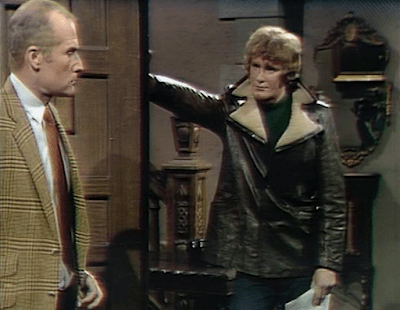
Well-meaning time-traveler/ bloodsucking ghoul Barnabas Collins recognized Laura from their acquaintance in the eighteenth century. Barnabas has taken it upon himself to engage Laura in battle, for no apparent reason. The scripts have also been hard to explain. At moments, they have dug deep into the old stories. So today, Laura orders ethnic stereotype Magda Rákóczi to take a portrait of her and burn it in the fireplace. Magda tells her to burn it herself, and Laura says she cannot. In her first tour of duty on the show, Laura was distressed to find herself depicted in a couple of portraits, which she was relieved to have burned. Late in the episode, a telegram comes from the authorities in Alexandria, Egypt, providing official documentation that Laura died there the year before. This echoes the police reports that kept coming to Collinsport from Phoenix, Arizona, substantiating a story that Laura had died in that city in 1966. And yesterday and today, we see Barnabas and his henchman Sandor on virtually the same set that Laura’s adversaries visited in 1967 when they looked for the tomb of her eighteenth century incarnation, and like them they open that tomb and find the coffin empty.

Laura spies on Barnabas and Sandor in the crypt. Screenshot by Dark Shadows Before I Die.

At other times, they deviate sharply from the old continuity. It was hugely important the first time that Laura’s previous dates of death were 1767 and 1867. Now they’ve changed that first date to 1785. That one is explicable as part of a doomed effort to pretend that actor Jonathan Frid was the age one would expect him to be, considering that he had somehow become a teen idol. Originally, Laura had married into a different prominent family in the Collinsport area with each incarnation. Now she always marries a Collins. That is also easy to explain. Dark Shadows has failed to develop any other prominent families, even as names of people we never see, so if she’s going to marry a rich guy the Collinses are the only game in town.

Another retcon is introduced today that is really hard to make sense of. The main thing about Laura in 1966 and 1967 was that each time she appeared, she had a son, named him David, and when he was about nine years old she incinerated herself with him so that she, but not he, would rise from the ashes as a humanoid Phoenix. In this episode, Barnabas declares that the Laura who died by fire in 1785 “had no children!”

This not only blows up the continuity completely, it also renders Barnabas’ insistence on making an enemy of Laura unintelligible. He has come to the past as part of an effort to prevent curses and hauntings that will make life impossible for everyone on the estate of Collinwood in 1969. The Laura of 1897 is the mother of Jamison Collins, a boy who will become the father of the adults at Collinwood in the 1960s. If Barnabas knew that Laura represented a danger to Jamison, we could understand his motive in undertaking this side-quest, even though his tactics would still be obviously self-defeating. But they kick that explanation away when Barnabas announces that the Laura he knew was childless. It seems they must have made a deliberate decision to deny any rational foundation for Barnabas’ behavior.

It’s true that they have established that Laura represents a danger, and that Barnabas is clearly the chief protagonist. Therefore, we expect the two of them to have a showdown sooner or later, and we might not notice if it isn’t really explained just how the two of them got on the path that leads to the climax. That would explain why they don’t wade into all the details they spent time on at the beginning of 1967. But there is no reason for them to do that. All they need are a few lines here and there affirming that the previous Lauras took their children into the flames with them, and it’s all settled. The decision to retcon David Stockbridge away really is bizarre.

Episode 740: A doll without pins in it. How unusual.

Laura Murdoch Collins, estranged wife of the stuffy Edward, is settling into the cottage on the estate of Collinwood. Broad ethnic stereotype Magda Rákóczi is acting as her servant. Laura talks quite openly with Magda about Edward’s rakish brother Quentin. When Quentin was banished from Collinwood the year before, that is to say in 1896, Laura followed him to Alexandria, Egypt. That occasioned her estrangement from Edward.

Laura knows that Quentin uses the cottage for rendezvous with the various women in his life, and has Magda go through the place looking for things of his to box up and send to him. They find a doll and a deck of tarot cards; Laura tells Magda that no one knows how thoroughly Quentin is obsessed with the occult. Magda is an expert tarot reader, and Laura asks her to read the cards for her.

Magda lays out the cards, and they keep indicating death. Laura is initially distressed by this, but brightens at the thought that they might mean that Quentin will soon die. When Magda says that the death to which the cards pertain is one that has already taken place, Laura loses all patience and dashes the cards from the table. We know that Laura is an undead fire witch who periodically incinerates herself and reemerges as a humanoid Phoenix, and so it would seem that she is upset that the cards are confirming Quentin’s story that he saw her burn to death the previous year in Alexandria.

A recently arrived, quite distant cousin of Edward’s, the mysterious Barnabas Collins, comes calling on Laura. Barnabas has come with a present. Laura at first believes that this means that her evening has taken a turn for the better, and tells Barnabas that she is glad to think they might become friends. When she unwraps the present and finds an eighteenth century oil painting that appears to be a portrait of her, she is caught off guard. She at first acknowledges the resemblance, saying that she might have sat for it herself; Barnabas agrees that she might have. When she tries to backtrack and asks Magda if her chin looks like the one in the portrait, Magda replies “They look the same to me.” After Barnabas leaves, Laura orders Magda to put the portrait in a closet.

We know that Barnabas is a vampire, who has traveled back in time to 1897 to prevent Quentin from dying and becoming a ghost who will ruin things for everyone at Collinwood in 1969. We also know that he was acquainted with Laura in the eighteenth century, when he was alive. In the early part of the episode, Magda reproached Barnabas with his carelessness, telling him he must want people to know about him. Showing Laura the portrait would seem to prove that Magda was right. It serves no purpose but to arouse her suspicions. All the more so since Barnabas’ own eighteenth century portrait hangs in the foyer of the great house at Collinwood. He has used it as evidence that he is a descendant of an ancient member of the family, and Laura has apparently accepted it as such. But now that he has confronted her with her own portrait from the same epoch, she has every reason to search for another explanation.

Laura was Dark Shadows‘ first supernatural menace, from December 1966 to March 1967. In those days a lot of details were established about her previous incarnations, many of which they have been retconning away with some violence over the last few episodes. We learned then that in each of her appearances, Laura’s maiden name was Murdoch. It is confirmed today that when Edward met her she was Laura Murdoch. We also learned then that in the eighteenth century Laura Murdoch married into the Stockbridge family, one of the most prominent in the area, and that she and her young son David Stockbridge died (by fire!) in 1767. We saw her tomb in a crypt belonging to the Stockbridges and still maintained, two centuries later, by an old caretaker.

Today, Barnabas and his blood thrall, Magda’s husband Sandor, go to the same set. But it does not represent a freestanding building, nor does it have a staff. It is in the basement of “the old meeting house.” And the stone panel sealing Laura’s tomb is quite different. The one we saw in #154 and #157 read “Here Lyes Buried The Body Of L. Murdoch Stockbridge, Born 1735, Died 1767.” Just the initial L because, as the Caretaker explained repeatedly, “The Stockbridges cared nothing for first names!” But this panel is inscribed “In Memory of Laura Stockbridge Collins, Who died in 1785.” The name “Collins” is because the show has neglected to develop any other elites in the Collinsport area, so if Laura is going to keep coming back and marrying into a leading family, she’s going to have to pick a Collins every time.

From #154. Screenshot by Dark Shadows Before I Die (picture quality modified for easier reading.)
From today’s episode. Screenshot by Dark Shadows Before I Die.

The date 1785 is just mystifying. Barnabas said yesterday that he was ten when Laura came along. In November 1968 we flashed back to the year 1795, when he was still human. Actor Jonathan Frid was just about to celebrate his 43rd birthday at that time; if Barnabas is the same age as his player, he would therefore have been born in 1752. That would make him 15 in 1767. That would give him five years to have known Laura before she took her son with her into the flames. It would also be plausible that she would not have been startled when she met Barnabas Wednesday, seeing only the resemblance to the person whom he claims was his ancestor. But if he were born in 1752 and she lived until 1785, she would certainly have realized she was looking at the same person.

It seems that the show really wants us to think that Barnabas was in his twenties in 1795. Of course life was hard back then, but the 43 year old Jonathan Frid was not going to pass for any age much less than his own.

Barnabas orders Sandor to open the wall. In the cottage, Laura can hear the chisel tapping at the stone. Magda can hear nothing. Barnabas orders Sandor to open the coffin; Laura rushes out of the cottage, leaving a bewildered Magda behind. Laura reacted when they messed with her tomb in 1967 as well, so they’ve preserved that much of the continuity, at least.

Episode 739: No one’s daughter

Well-meaning time traveler/ bloodsucking ghoul Barnabas Collins has met Laura Murdoch Collins in 1897, and has recognized her as the Laura Murdoch Stockbridge he knew when he was a ten year old boy in 1767. The audience knows that she is also the Laura Murdoch Radcliffe of 1867, and the Laura Murdoch Collins who was on Dark Shadows as its first supernatural menace from December 1966 to March 1967. We learned in that period that Laura is an undead blonde fire witch who incinerates herself and a young son of hers named David at intervals of exactly one hundred years so that she- but not the Davids- will rise from the ashes as a humanoid Phoenix.

We have already seen two major retcons of Laura’s story as it was told in 1966-1967. The precise regularity of her one hundred year cycle was stressed heavily in those days; it was not only the central piece of evidence that led the other characters to figure out what was going on and rise up against her, but was also the first instance of Dark Shadows using anniversaries as a way of creating suspense when the supernatural elements of the story meant that the usual patterns of cause and effect did not apply. Laura’s presence in 1897, thirty years off her established cycle, tosses all of that into a cocked hat.

Moreover, her identity as the wife of stuffy Edward Collins and mother of twelve year old Jamison and nine year old Nora Collins is also incompatible with the previous story. The Stockbridges were supposed to have been, in their day, among the most prominent families in the part of Maine where the great estate of Collinwood sits. But the fire in which Laura and David Stockbridge went up in smoke occurred two hundred years before. In the USA, that is a long enough interval for anything to be forgotten. Laura and David Radcliffe met their demise only half as long before, but the Radcliffes do not seem to have been quite as well-known or as close geographically to Collinwood as were the Stockbridges. So we could believe that when the twentieth century Laura Murdoch showed up in Collinsport in the 1940s or early 1950s, no one there would have remembered her namesakes. But we saw in #684 and #685 that there were still elderly people around Collinsport in the late 1960s who remembered 1897 quite well. And Jamison was himself the father of Elizabeth Collins Stoddard and Roger Collins, the adults at Collinwood in the 1960s. It is not plausible that no one would have said anything when in 1956 Roger, the only son of the family that owns the town, married a woman named Laura Murdoch who was the exact double of his grandmother who was also named Laura Murdoch.

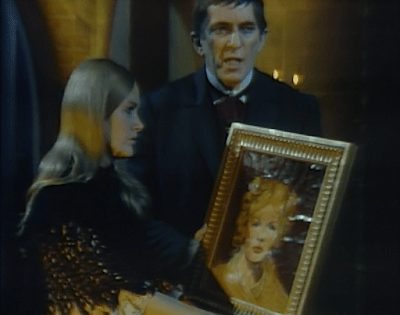
The show doubles down on that implausibility today, when Barnabas summons his blood thrall Charity Trask to look at a portrait he has found in the Old House at Collinwood. It shows Laura Stockbridge, and is a perfect match for the Laura they have met. Barnabas says that Laura was the first wife of his uncle Jeremiah, and that he himself was ten years old when she came to Collinwood.

Barnabas shows Charity the portrait of Laura Stockbridge. Screenshot by Dark Shadows Before I Die.

This gives us a Laura who does not marry into various leading families of the region, but into the Collinses over and again. That makes a kind of sense- the show has not developed any other leading families, not even as characters who are only mentioned but never appear. The Collinses now make up the entire local upper class. In #474, permanent houseguest Julia Hoffman called the Collinses “a very inbred family”; I don’t think she meant that in quite the sense which this new version of Laura is giving it, but as they move towards a dramatis personae that is all-Collins all the time there’s no escaping it.

It also represents a reverse retcon. When Barnabas talked about Jeremiah in his first months on the show, he said that when he was a young man Jeremiah was an old one, and that Jeremiah’s beautiful young wife fell in love with him. But when from November 1967 to March 1968 Dark Shadows became a costume drama set in the 1790s, we saw that Barnabas and Jeremiah, though nephew and uncle, were virtually the same age. With Jeremiah marrying Laura when Barnabas was ten, we return to the previous conception of their ages.

Barnabas’ first conversation about Laura today with Charity is interrupted when another undead blonde fire witch turns up. She is Angelique, who in the 1790s turned Barnabas into a vampire in the first place. She introduces herself to Charity as Barnabas’ fianceé, which prompts Charity to run away and go to bed. Angelique then tells Barnabas that he ought to leave Charity alone, because her father, the Rev’d Mr Gregory Trask, can make trouble that will defeat his mission. Barnabas starts to explain how bad Trask is, to which Angelique responds that he has one job and he’d better stick to it if he is to have any hope of success. She tells him that he will have to settle for blood slaves he selects from among the girls at the docks, girls who have nothing going for them “and above all no fathers.”

Charity, asleep in an upstairs bedroom in the great house of Collinwood, has a dream in which she is getting married. She is in fact engaged to marry a man named Tim, but in the dream Angelique tells her that she is not marrying Tim. She is, instead, to be the bride of Death. This is a very old image indeed; one of the main motifs that runs throughout Sophocles’ Antigone is that the heroine, engaged to marry Haemon, her first cousin (both simple and once removed- Antigone is the daughter of Oedipus and Jocasta, so she knows from inbred families) will instead be married to Death itself. At the climax of the dream, Barnabas bares his fangs at Charity.

Charity’s father comes to the great house. He meets Angelique, who identifies herself as Barnabas’ fiancée and charms him. She urges him to see to it that Charity marries Tim as soon as possible, and warns darkly that there are many kinds of flames burning around them.

The mistress of the house, spinster Judith Collins, then enters and explains to Trask that Charity is still in bed. Trask is shocked by this “sloth” (which he pronounces “slowth,”) but Judith explains that Charity is ill. Judith is sure Charity will be fine after a day of rest. Judith tells Trask that she is deeply saddened that his boarding school has burned down. She offers Trask a great deal of money to rebuild it, and the use of a house on the estate as temporary quarters for the school in the meantime. Trask is delighted. When Judith mentions that his wife Minerva had said that his health was poor, Trask says that it is in fact Minerva whose health is poor, and getting worse. The audience knows that Trask is evil, and many will interpret this remark as a sign that he plans to hasten the deterioration of Minerva’s physical condition.

Judith takes Trask to Charity’s bedroom. They are shocked to find her gone. Judith is sure that she wandered off in delirium, but the filthy-minded Trask raves that she must have set out on some errand of grievous sin. He’s right about the sinfulness, though wrong to focus the blame on Charity- she has answered Barnabas’ summons and is with him in the Old House.

Charity comes back to the great house. Her father is ranting at her when she collapses. He looks at her neck, and finds the bite marks. Perhaps Angelique’s warning to Barnabas came too late.

Episode 154: Died by fire!

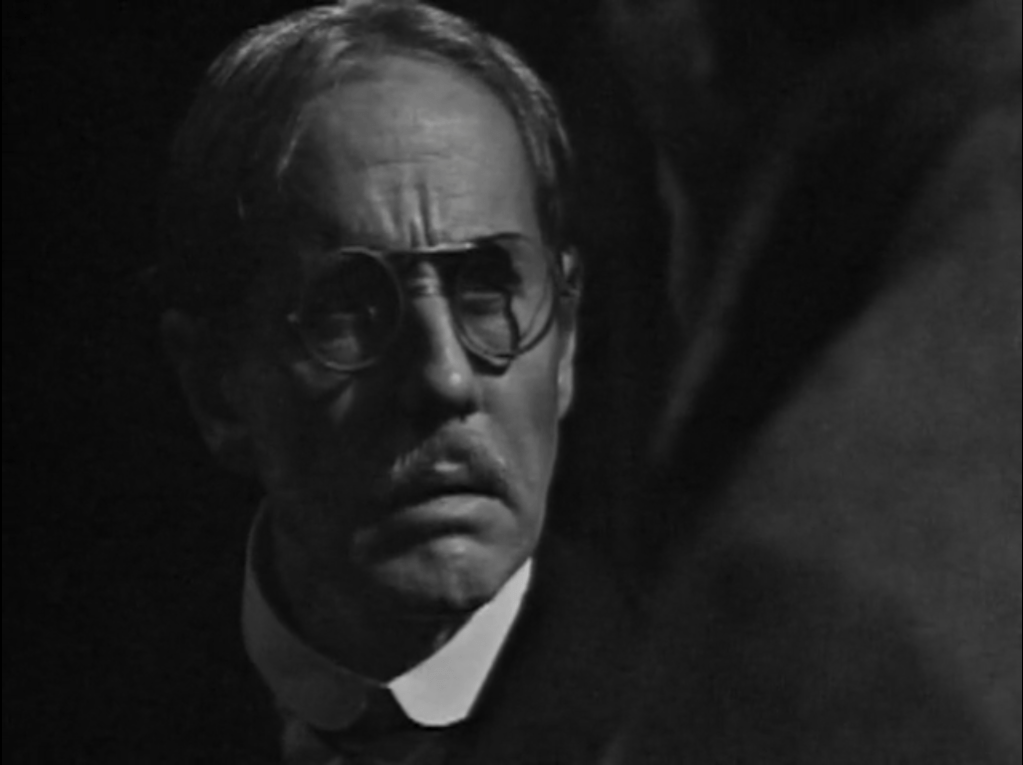
Eventually, Dark Shadows became the kind of pop culture phenomenon that even people who never saw the show couldn’t really avoid. Most such things spawn catchphrases that become widely familiar and remain so for years. Think of Star Trek with “Beam me up!” or “Warp speed.” To my knowledge, Dark Shadows was an exception to that, with no phrases or expressions spreading beyond its fans. But if it had already been a hit when today’s episode aired, I think a character we meet in it would have been the source of two catchphrases. That character is Cemetery Caretaker, played by Daniel F. Keyes.

Under the influence of the ghost of Josette Collins, well-meaning governess Vicki has ordered her boyfriend, instantly forgettable lawyer Frank, to take her to a graveyard out in the country someplace. Vicki knocks on the door of a building there, and at length an aged figure in a celluloid collar and wire-frame glasses opens the door. He stands mute for the first minute Vicki and Frank talk to him. When he finally starts speaking, he asks them if they are alive.

Guy’s got star quality

Frank doesn’t show any surprise at the question. You wouldn’t really expect him to- with his personality, he must get that a lot. He assures the caretaker that yes, he and Vicki are alive. The caretaker explains that he often hears knocking at the door, but it is usually the unquiet spirits of the dead.

Some months from now, the caretaker will introduce his second memorable phrase, “The dead must rest!” At this first appearance, we learn why they must. If the dead aren’t resting, they’re going to be keeping him awake all night, and he has things to do in the morning.

Frank tells the caretaker that they are lost. Vicki contradicts him and insists that this is where she is supposed to be. Frank apologizes for bothering him and tries to go; Vicki insists on staying. The caretaker lets them into the building.

Inside, Vicki and Frank find a strange combination of archive and mausoleum. By the standards of Dark Shadows, it’s a big, elaborate new set, a definite sign that something important is happening.

The front room of the caretaker’s building
Vicki examines one of the bookcases
Entering the archive area
In the archive area

Vicki keeps talking about how fresh the air is, and how full of the scent of jasmine. The caretaker is bewildered by her words, and Frank says the only scents he can detect are must and mold. The audience knows that the scent of jasmine is a sign that the ghost of Josette Collins is trying to attract a character’s attention.

Vicki declares that the source of the scent is in a connected room. The caretaker is reluctant to let Vicki and Frank into that room. He says that it is the final resting place of those members of the illustrious Stockbridge family* who died particularly gruesome deaths. Vicki pleads with him, and he gives in. He does insist that while in the crypt, they must be very quiet- “So quiet, even they can’t hear.”

Entering the crypt area
Examining a plaque

The caretaker talks in a not-particularly hushed stage voice the entire time they are in the crypt, so he must not think the dead have such great hearing after all. He tells the stories of the crimes and accidents that took the lives of each of the people whose remains lie behind the large stone plaques on the wall. When he comes to the last of them, L. Murdoch Stockbridge, Frank interrupts him. “L. Murdoch! I’ve seen that name on legal documents around the office a hundred times!” Frank is handling the divorce of high-born ne’er-do-well Roger Collins from his mysterious and long-absent wife, Laura Murdoch Collins.

Examining THE plaque

Frank asks about L. Murdoch Stockbridge. The caretaker doesn’t know what the L. stood for. He does know that she was a woman, and he can describe the circumstances of her death. One night in 1767, a candle set the curtains around her bed ablaze, and she burned to death. Such remains as are in the niche are little but ashes. He says, and then repeats, “L. Murdoch Stockbridge died by fire! L. Murdoch Stockbridge died by fire!” Once Vicki learns about L. Murdoch Stockbridge, the scent of jasmine disappears and she is in the same dank musty space as Frank and the caretaker.

I heard she died by fire

It’s been three years since Mrs Acilius and I first saw these episodes, and I can still make her laugh by putting on an old man voice and saying “Died by fire!” Sometimes we find ourselves in situations where everyone is being very serious, and someone mentions that a person “died by fire.” I glance at her, and find her biting her lip to keep from laughing out loud. That’s why I say that if Dark Shadows had been at the peak of its popularity in January of 1967, “Died by fire!” would have been one of the great pop culture catchphrases of the period.

Back at the great house of Collinwood, wildly indiscreet housekeeper Mrs Johnson comes into the drawing room while Roger is at his usual station, leaning on the cabinet where the brandy is kept and draining a snifter. She asks him if she can bring him anything. Those are the words, but the voice spells out a stern sermon about the evils of alcohol. Roger goes to sit down, saying nothing of consequence but saying it in a way that makes clear he dislikes and resents her.

Laura enters. Roger sends Mrs Johnson off to make coffee. Alone in the drawing room, Roger and Laura argue about all the things they have been arguing about since she returned from her long absence. There is no new information in the dialogue, but it is good to see another side of Roger. Lately we’ve seen him almost exclusively as the bratty little brother of reclusive matriarch Liz, and his interactions with other characters are dominated by the narcissism that is most fully expressed in his scenes with Liz. When he is the unloving father of strange and troubled boy David, the unsettlingly flirtatious uncle of flighty heiress Carolyn, the cowardly foe of dashing action hero Burke Devlin, or the malign co-conspirator of drunken artist Sam Evans, we see vices that we can trace back directly to his certainty that Liz will always shelter him from the consequences of his actions, whatever they may be. When he stands up to Laura in this scene, we see that there is a semi-functional adult somewhere inside Roger.

Roger and Laura realize that Mrs Johnson has been eavesdropping on their conversation. They are worried about what she might have heard. They do not know what regular viewers know, that she is a paid agent of Roger’s enemy Burke, placed in the house to spy on the Collinses. They do know that she has a big mouth, though, and since the last words they spoke were about a crime they want to keep covered up that’s enough to give them pause.

Frank brings Vicki home to Collinwood. Standing outside the front door, they remark on the caretaker’s frequent muttering of “died by fire! Died by fire!”

Reviewing their visit to the caretaker

Vicki reviews all of the strange occurrences that have taken place since Laura’s return. She sums up the whole course of any story about people investigating the supernatural- “It seems connected- and yet so unconnected.” By the laws of nature as science describes them, by the ordinary logic of waking life, none of the events she lists means anything. It’s only after you accept the idea that uncanny forces are at work that they form a pattern pointing to Laura. The audience can accept that, because we can hear the theremin on the soundtrack. Vicki and Frank have a harder time.

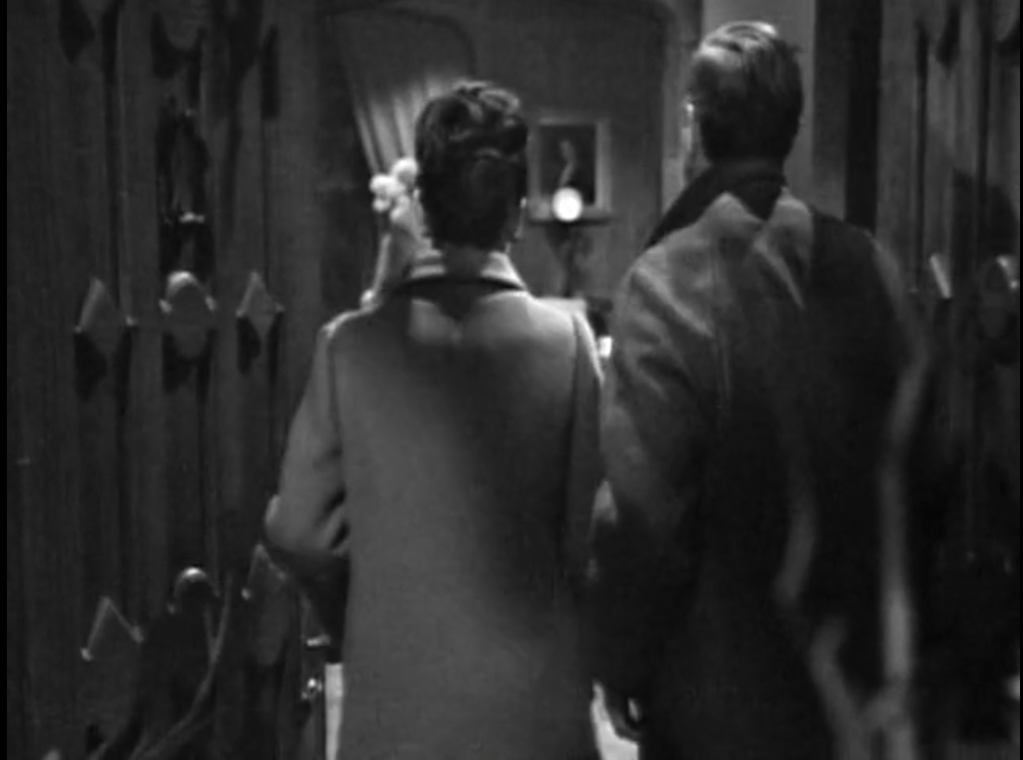
Frank tells Vicki he has to get home. She invites him in for a drink. He replies “You make it a stiff one, and you’re on!” That’s what you need before a long drive on dark, winding roads, to get tanked up on a lot of booze. They open the doors and walk into the house. The camera dwells on them as they make this procession. As they had gone through doors that led to L. Murdoch Stockbridge, now they go through the doors that lead to L. Murdoch Collins.

Entering the house

Vicki and Frank join Roger and Laura in the drawing room. The men drink brandy, the women sip coffee. Vicki asks Laura about her family background, claiming that David is curious about it. Laura responds merely that her family is a distinguished one and had been in the area for a long time.

Roger tells Frank that he will be hearing from Lieutenant Riley of the state police tomorrow. Laura objects that she doesn’t want to talk about Riley’s message, Roger says there won’t be any conversation- he will simply announce the lieutenant’s laughable news. The authorities in Phoenix, Arizona are convinced that a charred corpse found in Laura’s apartment there is hers, and that she died when the apartment building burned to the ground. Vicki looks at Laura, and with a strange smile says “Laura Murdoch Collins died by fire.”

“Laura Murdoch Collins died by fire”

*The caretaker was deeply versed in the lore of the Stockbridge family, and told Vicki and Frank that most of the graves in this eighteenth century cemetery were theirs. Yet he showed no glimmer of recognition when Vicki mentioned Josette Collins to him. That suggests that the Stockbridges were leading citizens of the area before the Collinses rose to prominence.

It might be interesting if someone would write a story in which the first Collinses were servants of the Stockbridges who got rich by doing their dirty work. Maybe the first and darkest shadow of all was that some colonial Collins scabbed on his fellow employees when they were trying to get a fair deal from the Stockbridges. I’m not up on Dark Shadows fanfic, for all I know there may be whole novels out there on this theme.