Episode 271: A secret you had no right to keep

A wedding is being held in the drawing room of the great house at Collinwood. Matriarch Liz is marrying seagoing con man Jason. Carolyn, Liz’s daughter by her first husband, Paul Stoddard, has a pistol in her purse, which she is planning to use to shoot Jason before the ceremony can be completed. Well-meaning governess Vicki is distressed, because Liz confided in her in #259 that she is marrying Jason only because he is blackmailing her. Liz killed Stoddard long ago and Jason buried the body in the basement, facts he will reveal if she does not comply with his demands. The other guests hate Jason, but they share neither Vicki’s understanding of the situation nor Carolyn’s sense of initiative, so they just stand around and scowl.

When the judge asks Liz if she takes Jason to be her lawful wedded husband, she exclaims that she cannot. She points to him and declares “I killed Paul Stoddard and that man was my accomplice.” Carolyn drops the gun, Vicki flashes a defiant look at Jason, and everyone else is stunned.

Vicki triumphant

The judge excuses himself. He claims that he might be required to act as a judicial officer in a case that could arise from what Liz is about to say. That may not make sense in terms of the laws or canons of judicial conduct actually in effect in the State of Maine in 1967, where what he has already heard would be far too much to avoid being called as a witness. But it fits nicely with the logic of Soap Opera Law, in which neither the police nor the courts may be notified of any criminal matter until the prime suspect has completed his or her own investigation.

Carolyn says “You killed my father.” Before Liz can say much in response, Carolyn announces that she was about to kill Jason. Vicki’s boyfriend, Fake Shemp Burke Devlin, finds Carolyn’s gun. For some reason, Burke holds the gun up. He points it at whomever he is facing. When Jason announces he will be leaving the room, Burke is pointing the gun at him and forbids him to go. Again, giving orders to a person on whom you have a deadly weapon trained may be a felony in our world, but it is all well and good under Soap Opera Law.

Liz mentions that Vicki already knows that she killed Stoddard and that Jason has been blackmailing her. This prompts Liz’ brother Roger to tell Vicki “That was a secret you had no right to keep.” Liz responds that, had Vicki told anyone, she would have denied it and sent her away. Liz then describes the events of the night eighteen years before when she and Stoddard had their final showdown. We see them in flashback, on this same set.

Stoddard told Liz he was leaving her, never to return. She replied that she did not object to his going, but that the suitcase full of bonds, jewels, and other valuable assets he was planning to take was Carolyn’s property and would have to stay.

When the show started, just over a year ago, Stoddard’s disappearance had been 18 years in the past. So it still is, moving its date from 1948 to 1949. At that time, Stoddard was last seen six months before Carolyn was born. Later, they would say she was a newborn when her father vanished. In the flashback today, he answers Liz’ assertion of Carolyn’s right to the contents of the suitcase by saying that he has been putting up with the child for two years. We saw her birth-date as 1946 the other day, so apparently they are planning to stick with the idea that she was a toddler when Stoddard was last seen.

Stoddard and Liz quarrel over the suitcase. He confirms that he and his friend Jason have a plan to convert its contents into a big bundle of cash. He is walking away from her when she takes a poker from the fireplace and hits him on the back of the head. This may be another deed entirely unjustifiable by real-world law, but under Soap Opera Law any act committed against a man who openly despises his two-year old daughter and tries to steal from her is outside the jurisdiction of the courts.

Stoddard fell to the floor, bled, and remained very still after Liz hit him. Shocked by what she had done, she reeled out of the drawing room and closed the doors behind her. As she stood in the foyer wishing she were dead, Jason entered the house. Liz sent him into the drawing room to look at Stoddard. He came out, told her Stoddard was dead, and offered to bury him for her. After all, everyone in town knew he was leaving- there need be no scandal to cloud Carolyn’s future.

Liz asks why Jason wants to help her- he was Stoddard’s friend, planning to help Stoddard steal from her. Jason explains that Stoddard is beyond help now. Liz goes along with his plan.

In this flashback, Jason’s Irish accent is convincingly realistic. It sounds like he’s from Antrim, or someplace else in Norn Iron. That’s a contrast with what we’ve heard so far, when he’s been more than a little reminiscent of this guy:

Hearts, moons, clo-o-overs

My in-universe, fanfic theory is that Jason hadn’t been home or spent much time with other Irishmen in the years between 1949 and 1967, and so his accent drifted into a music hall Oyrish. My out-of-universe theory is that Dennis Patrick spent some time with a dialect coach after joining the show, but by the time he had learned to sound plausible Jason’s silly accent was already such an established part of the character that he couldn’t change it.

When Jason was done with his work downstairs, he showed Liz the storage room where he buried Stoddard in the floor. We got a long, long look at that floor in #249, when it was clean and tidy and there were many boxes and crates on it. When Jason left it to Liz “18 years ago,” there was dirt piled up all over the floor, a shovel in the corner, and few boxes or crates. Evidently Liz cleaned it up herself and organized its contents at some point. That doesn’t fit with the idea she had before #249, that a person entering the room would immediately discover her secret. Since Liz had often gone into the room in the early months of the show, it never had made sense she would believe such a thing, but it is annoying to be reminded of it.

In voiceover, Liz tells us that when Jason left her with the key to the room she knew she would be a prisoner of the house forever. The episode then ends, after less than 18 minutes of scripted content. That’s the shortest installment so far. The closing credits roll slowly, so slowly that they run out of music. The names scroll by in silence for 25 seconds before ABC staff announcer Bob Lloyd says “Dark Shadows is a Dan Curtis production.”

That cannot have been Plan A. This episode has eight speaking parts, two segments of events set in different decades, voiceover narration, a costume change, etc. So there was plenty of stuff that might have proven impossible in dress rehearsal, requiring a quick rewrite that might have left them running a little short. But they’ve been ambitious before, and have never ended up like this. So I suspect that the late script change that got them into trouble was more complicated than that.

Art Wallace’s original story bible for Dark Shadows, titled Shadows on the Wall, called for the mystery of Vicki’s parentage to be resolved at the same time as the blackmail plot. Wallace’s first idea was that Vicki would be shown to be the illegitimate daughter of Paul Stoddard, and that Liz’ interest in her well-being began with guilt after she responded to the news of Vicki’s existence by attacking Stoddard. Wallace also said that if it were more story-productive, they could say that Vicki was Liz’ illegitimate daughter.

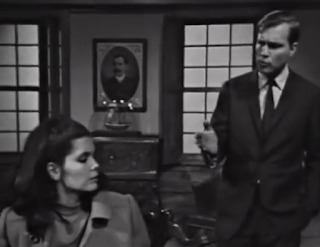
Casting Alexandra Moltke Isles as Vicki committed them to that second course of action. Famously, when Joan Bennett first saw Mrs Isles on set she mistook her for her daughter, and the show has often capitalized on their resemblance to present Vicki as a reflection of Liz. For example, notice how the two women stand in this shot from today’s episode:

Pay particular attention to their legs- it’s the same posture

Moreover, the ghost of Josette Collins took a lively interest in Vicki in the first 39 weeks of the show, and Josette is specifically a protector of members of the Collins family. If Vicki is Paul’s illegitimate daughter, she is not a Collins and not linked to Josette.

The only advantage we’ve ever seen of establishing Vicki as a non-Collins would be the possibility of a romance between her and Roger. Since Vicki the foundling-turned-governess is Jane Eyre and Roger the father of her charge is Mr Rochester, this is an obvious direction to go. The show took a few feints towards such a relationship in the early days, but those clearly led nowhere. Vicki came to town in #1 on the same train as Burke, so they are fated to get together. Roger and Burke openly hate each other and often seem to secretly love each other, making for a potentially explosive love triangle if Vicki comes between them, but neither Roger and Burke’s much-advertised enmity nor their barely concealed homoerotic connection ever developed into a very interesting story. The whole thing fizzled out completely months ago. So there doesn’t seem to be a point in resolving the question of Vicki’s parentage any other way than with Liz admitting maternity.

So the first question is, when did they decide that this episode would not include that admission? The short running time would seem to suggest that it was only a few days before taping.

The second question is, why did they make that decision? Liz’ line today that she would fire Vicki if she had betrayed her secret, coupled with all the remarks she has been making to Vicki in the last few weeks about how Carolyn is the one and only person she really cares about, would suggest that the producers and writers are thinking of moving away from the idea of Vicki as Liz’ natural daughter. But the directors are still committed to it, as are the actresses.

We begin to suspect that the producers and writers are hoping that the viewers who have joined the show since the vampire came on in April won’t care about Vicki’s origin, so that they can just drop the whole thing. Since the only storylines they have going are the blackmail arc, which Liz is bringing to its end with her confession today, and the vampire arc, in which nothing at all is happening at the moment, you might think they would be glad to fill some screen time with Vicki and the rest of them reorienting themselves around a newly revealed family relationship. But, maybe not!

Episode 148: A sane and adult level

Writer Ron Sproat stayed with Dark Shadows too long, and fans of Danny Horn’s great blog Dark Shadows Every Day will have fond memories of his frequent denunciations of Sproat. It is true Sproat had many glaring weaknesses. For example, he was pretty bad at inventing stories to tell, which you might think would get in the way of building a career as a fiction writer. But one strength Sproat undoubtedly had was a sense of structure. There might not be anything happening in one of his episodes, but you can count on him to make it clear why it isn’t happening, where it isn’t happening, to whom it isn’t happening, and who isn’t making it happen. Today there are some events, and between Sproat’s script and the work of the actors, it is plain to see what purpose each of those events serves in keeping the story on track.

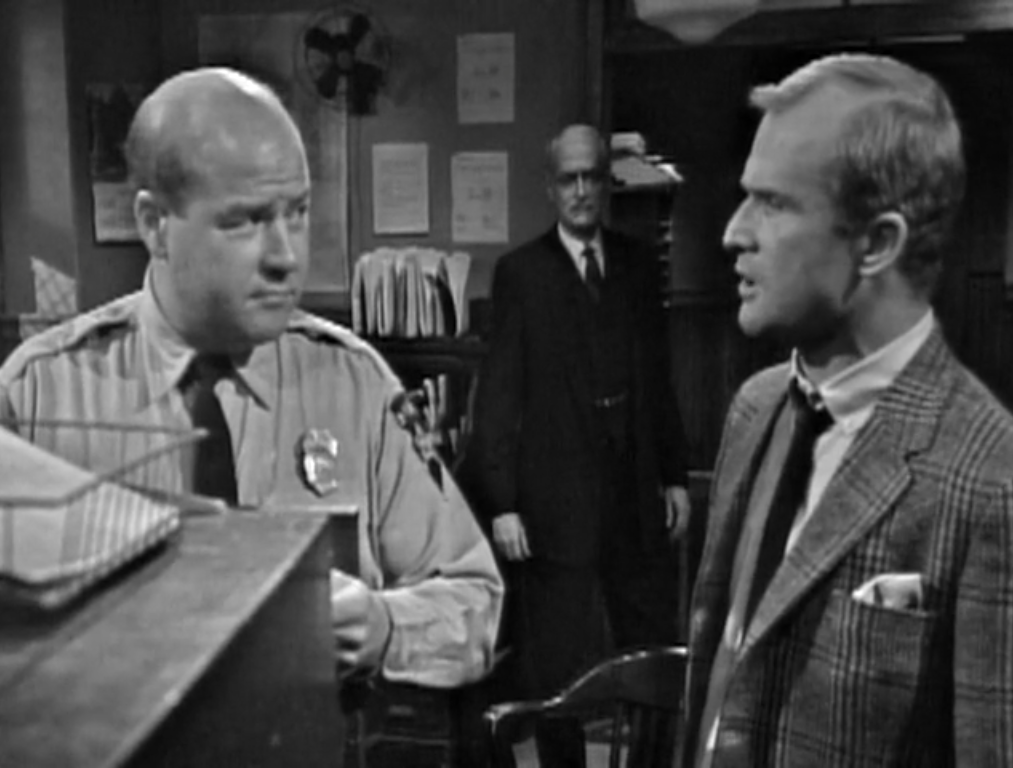
As the episode opens, Lieutenant Dan Riley of the Maine State Police is visiting instantly forgettable young lawyer Frank Garner in an office. Regular viewers will be confused; we’ve seen this set several times, with exactly these decorations, as high-born ne’er-do-well Roger Collins’ office at the headquarters of Collins Enterprises. We haven’t seen the set since #69, and Roger wasn’t there at that time. So apparently Frank has moved in.

Frank hasn’t even moved the portrait of the Mustache Man from the spot where Roger had it when he was in the office. Screenshot by Dark Shadows Before I Die

Lieutenant Riley wants to pass along to Frank the information that the Phoenix, Arizona police have given him about a fire in Laura Collins’ apartment in that city. Laura is Roger’s estranged wife, and Frank is representing Roger in their upcoming divorce. It isn’t clear why Riley wants to tell Roger’s lawyer what he has heard about Laura. Later in the episode, Frank will tell well-meaning governess Vicki that Riley came to him because he is a “lawyer for the Collins family.” Perhaps that means he believed that Frank represented Laura. Throughout their conversation, Frank repeatedly protests that no one has any grounds for accusing Laura of anything, encouraging Riley in such a belief. I suppose it’s a lawyer’s job to collect damaging information about the opposition, but Frank does seem to be pushing an ethical boundary here.

The charred body of a woman was found in what was left of Laura’s apartment. Since the woman appeared to be the same age, height, and build as Laura, the room was locked from the inside, and everyone associated with the building other than Laura was accounted for, the body was initially identified as hers. Riley now tells us that the police have determined that the fire started in Laura’s apartment, and that a witness claims to have seen Laura in the building the day of the fire.

Laura checked into the Collinsport Inn the day of the fire and has been in and around town ever since, as many witnesses can testify. Riley says that there is no indication that Laura has been on an airplane recently, and it would seem impossible to travel from Phoenix, Arizona to central Maine in a few hours any other way.

The lieutenant goes on to say that because the room was locked from the inside and the woman who died in the fire made no attempt to escape, the police suspect murder. This is nonsense. An attempt to escape might have been evidence of murder, not the lack of such an attempt. And if the room was locked from the inside, how did the murderer get out?

Frank doesn’t raise these objections, but just blusters through a lot of verbiage as he protests against any suggestion that Laura should be suspected of murder. The lieutenant keeps pointing out that Arizona isn’t his jurisdiction, so he doesn’t have anything to do with it. He’s just a messenger.

Some scholar of acting really ought to make a frame-by-frame study of Conard Fowkes portrayal of Frank in this scene. He has plenty of dialogue, he’s challenging statements made by a policeman, he raises his voice, makes gestures, moves around the room, looks down moodily and up excitedly. Yet he is still so bland that it is difficult to remember a word he says. It is far beyond my understanding of the actor’s craft to explain how Fowkes manages to be so consistently dull no matter what the character is doing.

When Frank is a small part of an episode, I think of his blandness as a note of pure realism. He is just the sort of person you would expect to meet in a small-town law office in 1967, and indeed it is reassuring to think that someone who has obviously never thought of putting himself in the spotlight would handle your sensitive legal affairs. The last person anyone should want as a lawyer is some guy who habitually makes himself interesting to watch on television.

Today, Frank is the leading man of the first half of the episode, and comes back with a key part in the second half. Giving that much time to a performer with such a bland screen presence does serve a purpose. None of the characters has really committed to the notion that they have to worry about crimes and physical danger, much less that they are facing a challenge from the realm of the supernatural. As far as they know, the whole story today is about a couple of romances and a child custody matter. That’s the right speed for dull, amiable Frank Garner.

That the characters don’t yet know the true dimensions of what they are facing in the storyline is one of the points this scene has to make. The other is that we will be hearing more about the investigation in Phoenix, and that it will advance the plot.

I think an acting problem muddies this second point. Today Vince O’Brien takes over the part of Lieutenant Dan Riley from John Connell, who played him in #143 and #144. As Connell played him, Riley was an out-of-town cop, not the least bit awed by the Collinses of Collinsport. His matter-of-fact speaking and impatient listening made it clear that the family’s connection to the case in Phoenix was not going to result in the discreet, abbreviated treatment that the local authorities have given them. But O’Brien’s version of the character is noticeably quick to agree when Frank makes a statement. When Frank does a TV lawyer “may I remind you” about the elements of a murder charge (elements which he gets wrong, but hey, it’s TV, not law school,) O’Brien’s Riley is agitated. He shows defiance by declaring “You don’t have to remind me” in a harrumphing voice, but his wide eyes and trembling legs show that he is intimidated to be in a discussion with the representative of the mighty Collinses. There’s no point in bringing in an out-of-town character if that’s what you’re going for- the residents of Collinsport can show you what it’s like to live under the thumb of the people in the big house on the hill. And it introduces a doubt as to whether anything will come of the investigation, a doubt which leaves us wondering why we just spent so much time watching these two guys talk to each other.

Meanwhile, Vicki is visiting dashing action hero Burke Devlin in his hotel suite. Burke has asked her to come. Yesterday, she told him that she was suspicious there was something sinister about Laura, and he had listened attentively. Later, he met with Laura and the love he once felt for her had flared back into life. So today, he wants to tell Vicki that Laura is A-OK and she should do everything she can to help her.

Like the scene with Frank and Lieutenant Riley in Roger’s office, this scene has two points to make. First is to establish Vicki as a credible protagonist for the rest of the storyline about the danger Laura presents to her son, strange and troubled boy David. Second is to show that Burke is so smitten with Laura that he won’t be much help in protecting David.

Burke guides Vicki into his kitchen, a cozy space where people can confide in each other. Last time they were in this space, she made coffee for him; this time, he makes coffee for her. He’s remarkably dainty about it, sifting cream and sugar in separate cups. He makes a pitch about how remarkable Laura is, how he’s rethought everything they said yesterday, and how a fine woman like her deserves Vicki’s trust and support.

Burke making coffee for Vicki. Screenshot by Dark Shadows Before I Die

Vicki is unimpressed. She was in the room when Laura telephoned Burke yesterday, and heard him agree to meet her at one of their old places. She presses him to explain what has changed his mind, and he won’t give a clear answer. She asks how well he really knows Laura, and he looks dreamily off into space and says that he knows her better than anyone else. She asks if his feelings for Laura might be clouding his judgment, and he demands she change the subject. When Burke urges her to persuade David to grow closer to his mother Laura, Vicki replies “I’ll do what I can for David.” Burke says “You’re hedging.” Vicki replies coolly, “I can’t help it.” When he repeats his urging, he tells her she doesn’t look convinced. She replies, “I can’t help how I look, either.”

Vicki’s strength and intelligence and Burke’s dreamy infatuation should impress anyone watching this scene, but especially viewers who just saw yesterday’s episode. When Vicki is asking Burke what happened between yesterday and today to change his mind, she is waiting for him to talk about the meeting he arranged with Laura while she was right next to him. He never mentions it, and his repeated statements that all he has done is think more deeply implies that he does not remember that Vicki heard him talking to Laura. He is so captivated with Laura that the sound of her voice erases his awareness of everyone else, even of someone he is trying hard to persuade of an important idea.

Shortly after Vicki leaves, Burke receives another visitor from the great house of Collinwood. Flighty heiress Carolyn shows up. Carolyn is pouting because Burke hasn’t been paying attention to her since her Aunt Laura showed up.

This scene has one major point to make, which is that the budding Burke/ Carolyn romance is not going to be blooming this winter. Nancy Barrett’s Carolyn bursts off the screen as she bounces from one extreme to another, trying to attract Burke by pushing her breasts at him, trying to anger him by suggesting that her mother Liz and her Uncle Roger were right when they said he was just using her to get at them, trying to embarrass him by bringing up the obstacles between him and Laura, trying to break through his reserve by flinging her arms around his neck and pleading with him to love her.

Carolyn flings herself at Burke. Screenshot by Dark Shadows Before I Die

Burke tries to let Carolyn down easy, smiling at her, caressing her face, hugging her, kissing her on the forehead. But signs of boredom and irritation keep slipping out. He tells her that the time has come for them not to see each other any more, and there can be no doubt he means it.

Burke, bored with Carolyn

Vicki goes to visit Frank. Frank blabs everything to her that the lieutenant had told him.

Vicki and Frank in Roger’s office. Screenshot by Dark Shadows Before I Die.

Vicki is deeply concerned about the idea that Laura might be a murderer. Frank keeps telling her that there’s probably nothing to that idea, but Vicki resolves at the end of the episode to do whatever she can to keep Laura away from David. Having established Vicki as a character strong enough and smart enough to square off with Laura in her previous scene, this scene shows us her decision to do just that.

Episode 106: Swann song

At the end of Friday’s episode, dashing action hero Burke Devlin and the sheriff caught high-born ne’er-do-well Roger Collins digging up a fountain pen from under a rock. It appears to be the fountain pen Roger had stolen from well-meaning governess Vicki. Some think that Roger stole the pen and hid it because it is evidence implicating him in the death of beloved local man Bill Malloy. Today, Roger is in the sheriff’s office.

Accompanied by Richard Garner, the Collins family’s lawyer, Roger talks and talks, admitting that he saw Bill that night, badly injured and face-down in the water. He jumped to the conclusion that Bill was dead, and left the scene without notifying anyone. He also admits that he concealed evidence that he believed the police would find relevant to the investigation. As if that weren’t enough, he admits that he lied to the police time and again, most recently the night before, and is caught in yet another lie when he gives a nonsensical explanation of his plan to meet Bill that night.

Roger begins his confess-a-thon

Garner makes only one feeble attempt to interrupt Roger’s torrent of self-incriminating remarks. When the sheriff questions Vicki, Garner takes the opportunity to ask her some questions of his own, questions which produce even more information that is adverse to his client’s interests. On their site Dark Shadows Before I Die, John and Christine Scoleri feature commentary on Garner’s performance from a lawyer friend of theirs. Setting aside the utter hopelessness of Garner’s work from a real-world perspective, this friend analyzes his conduct by contrast with the standards set by other TV lawyers:

This brief addendum will review the competence of Garner using a “TV Lawyer Competency Rating” (TVLCR) scale. This WAG scale is based on my estimation of how a general audience might rate a TV Lawyer’s performance. I have supplemented these TVLCR scores with some comments reflecting real-world practices.

http://dsb4idie.blogspot.com/2016/11/episode-106-112166.html

Even by those standards, Garner doesn’t come out very well:

Garner strikes me as the go-to civil attorney for the Collins family who got dragged into this murder case just because they are familiar with him. Based on Garner’s poor competency rating as a TV Lawyer, Roger Collins should fire him and instead reach out to Raymond Burr or Andy Griffith.

Soap operas typically generate suspense by sharing information with the audience that some, but not all, of the characters have. We wonder when the secrets will be revealed, and how those to whom they are revealed will react when they finally get the news.

By the end of today’s episode, all of the characters will know almost everything the audience knows. Even what the characters don’t know, they’ve heard of. For example, Roger and drunken artist Sam Evans have not confessed the guilty secrets they share to any of the other characters, but everyone seems to have figured out more or less what they’ve been up to. Not everyone believes in ghosts, but it’s all over town that Vicki and her charge, strange and troubled boy David Collins, have seen ghosts in and around the great house of Collinwood, and even the most skeptical are not in a hurry to hang around the place after dark.

This is the next-to-last episode credited to writer Francis Swann. Swann will fill in for the new writers a week from Wednesday, but today is really the end of the Art Wallace-Francis Swann era of the show. From tomorrow, the new team of Ron Sproat and Malcolm Marmorstein will be holding the reins. By bringing all the characters up to at least our level of knowledge about the ongoing storylines, Swann is clearing the decks for Sproat and Marmorstein to set up their own crises and dilemmas.

Swann’s great strength is his ability to give actors room to show what they can do. Today’s episode is a case in point. Just when Garner’s disastrous intervention in the sheriff’s questioning of Vicki has led us to wonder if he’s all there, he has a moment when he opens his eyes wide and looks out the window. As Hugh Franklin plays it, that’s enough to make us wonder what’s on Garner’s mind, and to think he might be about to do or say something interesting.

Of course stage veteran Louis Edmonds thunders delightfully as the wildly indiscreet Roger, and of course TV stalwart Dana Elcar does an expert job of presenting the sheriff as a skilled professional firmly in control of the situation. There might be a crying need for a defense attorney to intervene when a suspect is blabbing as freely to the police as Roger is to the sheriff, but there is no need for a third actor to get in the way of Edmonds’ and Elcar’s interplay. Standing in the background between those two, Franklin occasionally gives a slight facial expression that underlines some point or other, but never upstages them.

In the first half of the episode, Alexandra Moltke Isles’ Vicki has to give some long speeches full of recapping, and in those she takes the character through several distinct shades of discomfort. She begins with diffident nervousness, builds up to frightened indignation, and ends with pure sadness.

Later, flighty heiress Carolyn comes into the sheriff’s office and pleads with Vicki to say that her beloved Uncle Roger couldn’t be a criminal. In front of the sheriff and Garner, all Vicki will say is that the two of them should leave. As Carolyn, Nancy Barrett makes the most of the melodramatic turn, but Mrs Isles takes possession of the scene with her few words spoken in a quiet, husky voice we haven’t heard before. Those brief remarks cap the progression we saw her making in her speeches earlier, and define the mood she is still in during a conversation between Vicki and Carolyn in Collinwood later. Vicki’s feeling for the pity of it all holds the episode together, and leads us back into the texture of the life of the family at the center of the story.