
Certain People
Six weeks ago, old world gentleman Barnabas Collins was absorbed into a group serving supernatural beings known as the Leviathans. Also in the group is matriarch Elizabeth Collins Stoddard. Barnabas and Liz are worried that mad scientist Julia Hoffman, Barnabas’ sometime best friend and Liz’ permanent houseguest, is catching on to the truth about their group. They decide Julia must be absorbed into it.
Barnabas finds Julia on a couch in the drawing room, reading a book about lycanthropy. He strikes up a conversation about Chris Jennings, a young man who suffers from that condition. Julia replies bitterly that she still cares about Chris, unlike Barnabas. He tells her that he does care, and they quarrel a bit. He then strokes Julia’s cheek. He did the same thing with Chris’ little sister Amy in #912, at which point Amy fell asleep. Shortly after Amy woke up, she had become part of the Leviathan group. Julia gets a headache and goes to her room, where she does fall asleep.
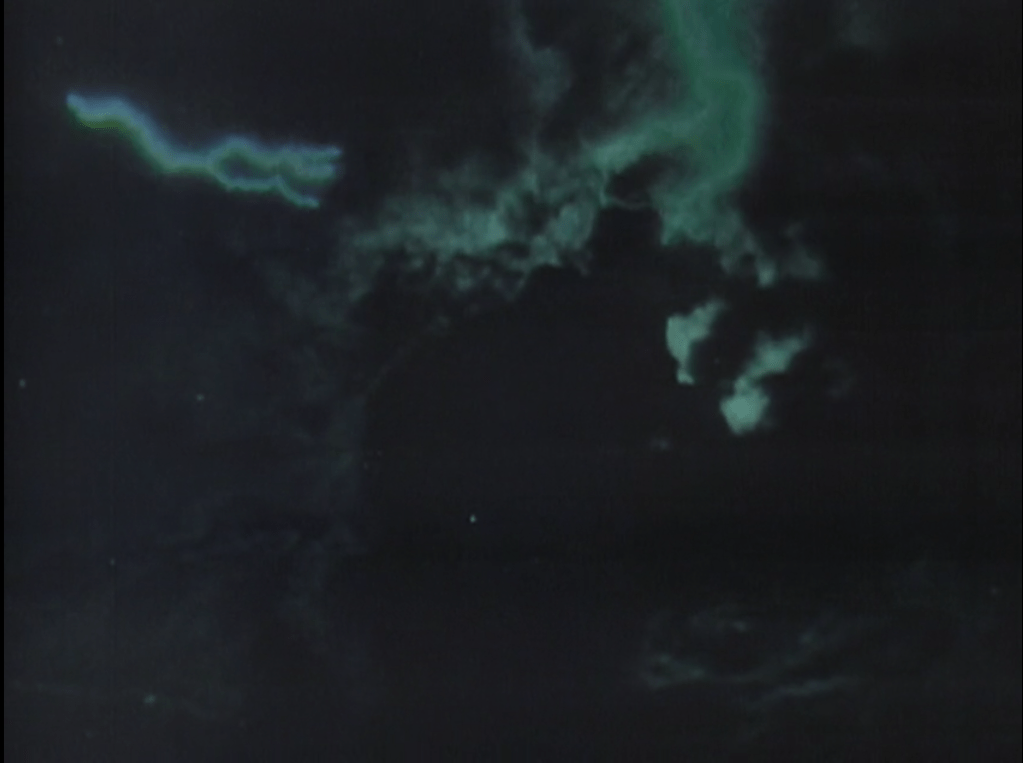
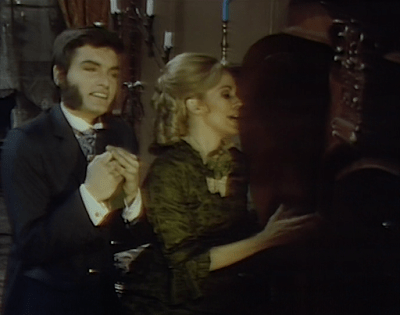
We didn’t see a dream sequence when Amy fell asleep, but do see one for Julia today. The visuals alternate between two stock clips of lightning flashes as we hear Jonathan Frid give a dramatic reading of some portentous nonsense, then give way to Julia finding Barnabas in the drawing room inviting her to open a wooden box. We saw a dream of Liz’ in #904; she woke from it already transformed into a faithful devotee of the Leviathans. But when Julia wakes up, she just has a worse headache.

Julia goes downstairs and find Liz holding the box from her dream. She is urging her to open it. Julia is confused by the situation. A knock comes at the door, and she rushes to answer it. It is Chris, saying that it is time for Julia to drive him to the institution where he is locked up on nights of the full moon. Julia calls back to Liz that she will be back later in the evening.
Barnabas enters and says that Julia will never be absorbed into the cult. If she were suited for absorption, the knock at the door would not have distracted her. He explains that “There are certain people, Elizabeth, whom we are not able to absorb. It has to do with their genetic structure. And Julia Hoffman is one of them.” As a former vampire who is now leading a cult that is trying to bring a race of Elder Gods back into the world where they will destroy and replace humankind, Barnabas is supposed to be strange and unnerving, but hearing him talk about “certain people” and their “genetic structure” is off-putting in a whole other way. Why not just say that she’s Jewish, we know you mean that she’s Jewish.
Barnabas then tells Liz that it is now up to her to handle Julia. So far as we know, Liz does not have any special powers like those Barnabas uses when he fondles people’s faces. Liz doesn’t even know what the cult is all about- today, she asks Barnabas what the goal is they are working for, and he tells her he isn’t at liberty to say. So when Barnabas tells her to deal with Julia, we can only remember the last time we saw Joan Bennett playing a character under the control of an uncanny force, when Judith Collins shot and killed neurotic intellectual Rachel Drummond on the orders of vampire Dirk Wilkins in #776.
In #915, one Leviathan ordered Barnabas to kill Julia. When he refused, another caused him to have nightmares, then told him it was OK to leave Julia alive if he could find another way to keep her under control. That episode was written hurriedly and rushed into production at the last minute, three full weeks after this one was in the can, in response to complaints from fans dissatisfied with the Leviathan story in general and Barnabas’ coldness to Julia in particular. It’s anybody’s guess what they were originally planning to do with #915, but today’s episode makes it clear that it did not include the reset of Barnabas’ character that we saw yesterday. He is still leading the Leviathans, and when he delegates the problem to Liz murdering Julia is pretty obviously the likeliest solution.
Not a Portrait of Quentin Collins
Julia’s plan for Chris is to persuade an artist named Charles Delaware Tate to paint a portrait of him. Tate painted a portrait of Chris’ great-grandfather, Quentin Collins, in 1897. That portrait had magical powers. Once it was painted, Quentin’s own werewolf curse went into abeyance. It was the portrait that transformed on nights of the full moon, while Quentin himself remained human. Indeed, the portrait also caused Quentin to remain young and healthy. He returned to Collinsport a couple of weeks ago, and though he is 99 years old he still looks just like he did when he was 28. In #913/ 914, Julia found that Tate, also, is alive, and still looks like he did in 1897.
Quentin and Tate are not the only emigrés from 1897 currently sheltering in Collinsport. Another of Tate’s magical portraits, a concept piece depicting his ideal woman, caused its subject to pop into existence. In 1897, she went by the name Amanda Harris, met Quentin, and fell in love with him. She, too, is unchanged in 1969, though she now calls herself Olivia Corey.
Amanda/ Olivia and Julia are both hunting for paintings by Tate, and met each other through that pursuit. They have also met Quentin, and vied with each other to decide which would be the one to keep him. He has amnesia and knows only that he was carrying papers identifying him as Grant Douglas. He is open to the idea that this is not his real name, but he finds Julia’s attempt to convince him that he is a 99 year old man ludicrous and is frustrated with Amanda/ Olivia’s unwillingness to tell him when and where they first met.
Amanda/ Olivia comes back to her suite at the Collinsport Inn and finds Quentin there, swilling her booze and enormously drunk. He tells her that he finds his room depressing, because it doesn’t have a bar. He says he can’t stand not knowing who he is. She points out that he has taken this in his stride up to now, and asks why today is different. He says he doesn’t know why it is different, but it very much is. When the show was a costume drama set in 1897 and we saw Amanda, she did not know about Quentin’s lycanthropy, and now that she calls herself Olivia she still does not think of the full moon when she sees him in anguish.
Later, Julia shows up at Amanda/ Olivia’s door. She has brought one of Tate’s portraits of Amanda Harris. Amanda/ Olivia staggers back at the sight of it. She composes herself and says that it is of no interest to her, since she already has several of Tate’s paintings of her “grandmother.” Julia tells Amanda/ Olivia that the real reason she is not interested in it is that it is not a portrait of Quentin Collins. She replies that Julia is the one who is fascinated by Quentin, not she. Julia says that she wants to show the portrait to Quentin. Amanda/ Olivia does not bother pretending that his name is “Grant Douglas” or that it might be something other than “Quentin Collins”; she simply tells Julia that he is in his room sleeping off an alcoholic binge. Julia adopts her most unmistakably Mad Scientist manner when she responds “Then this is definitely the right time to see him!” She marches out, and Amanda/ Olivia follows her.
Julia had told Chris that if Quentin’s portrait has been destroyed, his lycanthropy will be back in force. If that is so, she wants to be with him when he transforms. This was a doubly confusing thing to say. First, if the portrait had been destroyed, Quentin would not only be a werewolf, he would also look his age. She therefore knows it is not so. Second, she does not have anything with her to protect her against werewolves. If she is with Quentin when he transforms, he will kill her immediately.
When Julia and Amanda/ Olivia let themselves into Quentin’s room, they find that it is a shambles and he is gone. As a closing cliffhanger, this is supposed to leave us with the fear that a werewolf is stalking Collinsport. But since we know what the portrait does for Quentin, it only leaves us wondering if Amanda/ Olivia will have to pay an extra housekeeping charge because he trashed the room she was renting for him.
When Julia met Tate in #913/914, she could not get him to engage her in any kind of conversation, much less agree to paint a portrait of Chris. She did not mention Amanda/ Olivia. Since Tate was maniacally obsessed with Amanda in 1897, Julia should have known that her acquaintance with her was the strongest card she had to play. So when she goes to Amanda/ Olivia’s suite today, returning viewers were hoping that she was going to propose they team up to persuade Tate to paint Chris. Perhaps that will still happen. If it does, it might be a lot more interesting than is the revelation that Quentin doesn’t keep his hotel room clean.


 Dark Shadows Commentary