Early in the story of vampire Barnabas Collins, local physician Dave Woodard decided to call in an expert from out of town. Dr Julia Hoffman was doubly qualified as a specialist in psychiatry and hematology, and so she seemed to be ideally suited to make sense of the baffling occurrences taking place around Collinsport. Readers of Bram Stoker’s Dracula will recognize Woodard as the counterpart of Dr John Seward and Julia as Professor Abraham Van Helsing.
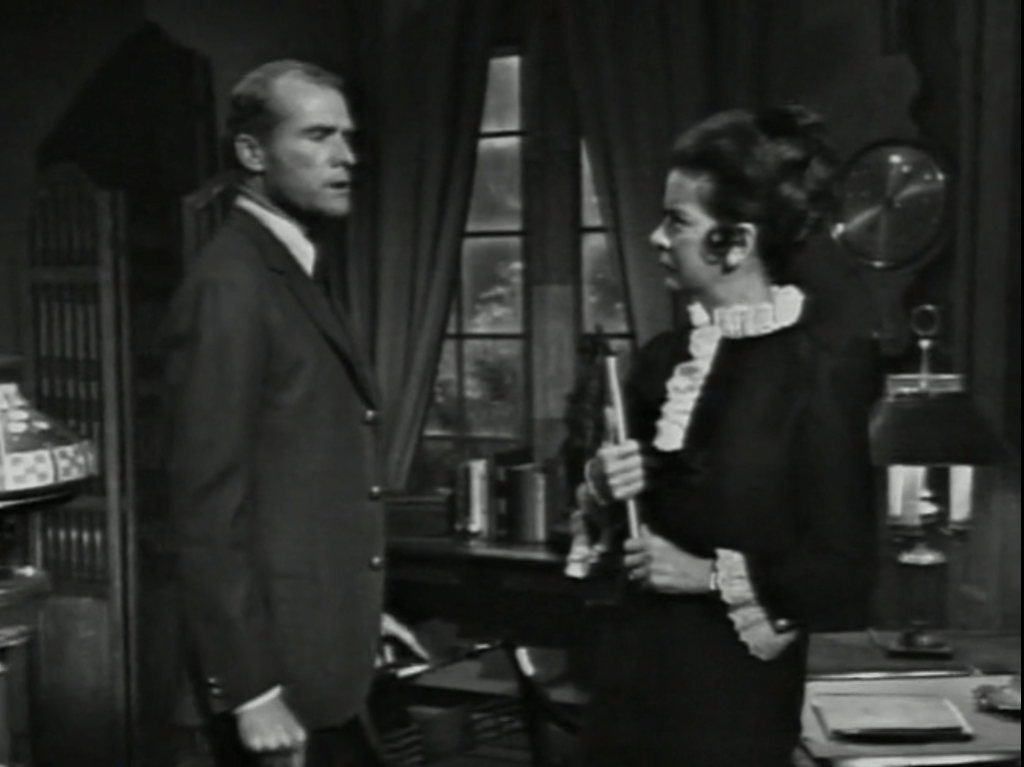
Now, Woodard realizes that Julia has gone over to Barnabas’ side. So, crafted to be the stolid Seward, he must try to do the work of Van Helsing. Today, he manages to meet and talk with the ghost of Barnabas’ little sister Sarah, persuades her to show him the secret chamber in the tomb where her body is buried, and confronts Julia.
Sarah complains that “People don’t keep secrets anymore.” She’s had it with this damn century.
All of this would have been very powerful had Woodard been played by Robert Gerringer. Gerringer played the part starting in May. For most of that time, Woodard had little information and no power to advance the plot. He was largely confined to scenes that groaned under the weight of recapping. Gerringer made this thankless role as interesting as anyone could, managing to shade Woodard’s internal life so that we could see how confusing it would be for a trained scientist to confront facts that could be explained only by reference to the supernatural.
Gerringer’s acting style stands apart from those of his cast-mates. Most of the cast of Dark Shadows knew nothing at all about daytime serials when they joined the show, and they don’t sound or move in ways that are typical of the genre. But Gerringer’s voice is that of every doctor in the soaps my mother watched when I was a kid. His presence on Dark Shadows is a constant reminder of the incongruity of a vampire as a regular character on a soap opera in 1967.
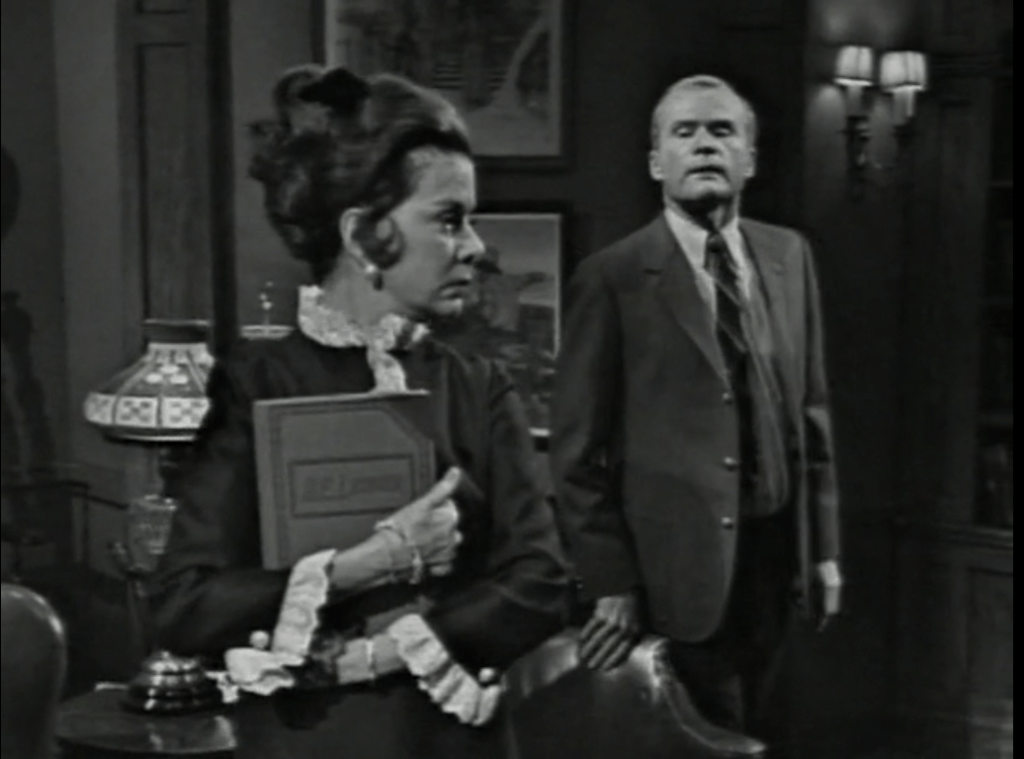
Unfortunately, Gerringer is not in this one. The National Association of Broadcast Engineers and Technicians were on strike when this episode was made, and Gerringer refused to cross their picket line. So his part is being played by someone else, and the intended effect of the whole thing is badly blunted.
There’s also a scene between well-meaning governess Vicki and her depressing boyfriend Burke. There was some talk a while ago about them buying a “house by the sea,” and they make it clear today that we won’t be hearing much more about that. That never really amounted to a story, and it’s something of a disappointment that it is a dead end.
Maggie Evans, The Nicest Girl in Town, has escaped from vampire Barnabas Collins, but not before Barnabas put the zap on her brains. She is being treated at Windcliff Sanitarium, under the care of Dr Julia Hoffman.
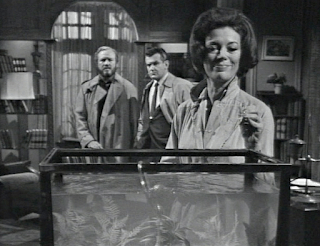
Dr Hoffman’s old acquaintance Dr Dave Woodard shows up with Maggie’s father Sam and boyfriend Joe. Woodard and Hoffman are Dark Shadows ‘ current versions of Bram Stoker’s Dr John Seward and Professor Abraham Van Helsing. As Seward called Van Helsing in when he needed help solving the mystery he encountered treating the victims of Count Dracula, so Woodard has called the expert Dr Hoffman in to help him solve the mystery he has encountered treating Barnabas’ victims. As Van Helsing refuses to answer any of Seward’s questions when they first start working together, so today Dr Hoffman refuses to answer any of Woodard’s questions about the case. There is one departure, in that Dr Hoffman combines Seward’s occupation as chief physician at a sanitarium with Van Helsing’s role as mysterious expert from out of town.
Dr Hoffman tells Dr Woodard that she believes it will be bad for Maggie to see Sam and Joe, but she consents to the visit as a way of discouraging them from trying to come back. When Sam and Joe join them in her office, she attends to her aquarium. In the post about this episode on Dark Shadows Before I Die, Christine Scoleri points out that this is a rather direct way of telling us that there is something fishy about Dr Hoffman.
When Sam and Joe go to Maggie’s room, she has a mad scene. She starts singing “London Bridge,” gets to an obscure verse running “Take the key and lock her up,” and starts screaming “Lock her up!” over and over. It’s magnificently terrifying.
In his post on Dark Shadows Every Day, Danny Horn raves about Grayson Hall’s performance as Julia Hoffman. Rightly so, she will quickly make herself indispensable to the series. He includes a lot of screenshots of her face, showing the wide variety of expressions she uses. I have a more complicated response to this aspect of her style.
As many screenshots as Danny gives of Grayson Hall’s face in his post, I presented even more screenshots of Lovelady Powell’s face in my post about #193, where Powell plays art dealer Portia Fitzsimmons. What impressed me about Powell’s performance is that she takes one of the most basic rules of screen acting- choose one of your eyes and look at your scene partner only with it- and builds a whole character around it. Her left eyelid is all she needs to command the stage and leave an indelible impression.
Hall was at the opposite extreme. She ignores the one-eye rule, and virtually every other piece of guidance professionals give about how to create a character on camera. She uses every muscle at every moment. Her broad, stagy approach works well for Dark Shadows, and the three actors with whom she shares her shots today stay out of her way. Still, she does make me miss Powell’s dominating simplicity.
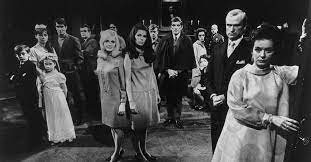
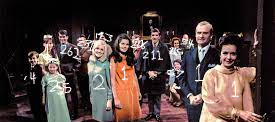
With Julia’s introduction, all of the actors in the photo I use as the header for this blog have joined the cast of Dark Shadows. There is also a version of the picture where the actors are frowning.
Gloom in the shadows
Here’s the smiley version. I’ve marked each player with the number of the first episode in which s/he appeared:
Maggie Evans, The Nicest Girl in Town, has been a prisoner of vampire Barnabas Collins for a long time now. Barnabas is planning to kill her tonight. We spend the opening scene with Barnabas’ sorely bedraggled blood thrall, Willie Loomis. We hear Willie’s thoughts as he does the housekeeping. Willie wishes he could save Maggie, but Barnabas has too much power over him. The most he can do is bring her a poisoned glass of milk and invite her to drink it if she wants to die an easy death.
Willie is not Maggie’s only friend. The ghost of Barnabas’ nine year old sister, Sarah, materializes in Maggie’s cell. Sarah asks Maggie why she is crying. Maggie tells her that if she doesn’t get out of the cell very soon, she will die. Sarah is distressed to hear this- “You mustn’t die- I don’t want you to die.”
Maggie hasn’t figured out that Sarah is a ghost, and keeps asking her how she manages to get in and out of the cell. Sarah usually evades this question, but now she says that there is a way. She came upon it accidentally, long ago, and her father ordered her not to tell anyone, not even her brother. She will be punished if she tells. If her father put her in the prison cell in their basement intentionally, Sarah’s fear of punishment is quite understandable.
Sarah overcomes her fear sufficiently to share a riddle with Maggie which she says will give her the answer:
One, two, away they flew.
Three, four, by the door.
Five, six, count the bricks.
Seven, eight, the clue is “grate.”
Nine, ten, home again.
Maggie asks Sarah to repeat the riddle, and she says she can only say it once. Maggie tells her where to find her own father, Sam Evans, and asks her to tell Sam that she has seen her. Sarah disappears.
Sarah’s fear of punishment will ring a bell for regular viewers. Strange and troubled boy David Collins is so intensely afraid that his father, high-born ne’er-do-well Roger, will punish him by sending him away to a boarding school or a jail that he tried to murder Roger. Later, David left his favorite person, well-meaning governess Vicki, to be decapitated by crazed handyman Matthew Morgan because he was afraid that if he helped Vicki his father would find out he had earlier defied him and would punish him. Now, Maggie is in mortal danger because another Collins child, one who lived in a previous century, has a similar fear of punishment. The cell in the basement of the Old House was there before slavery was abolished in the area in 1783; perhaps Sarah’s fear and David’s are a bequest from the slaves and indentured servants whom their forebears locked up in it.
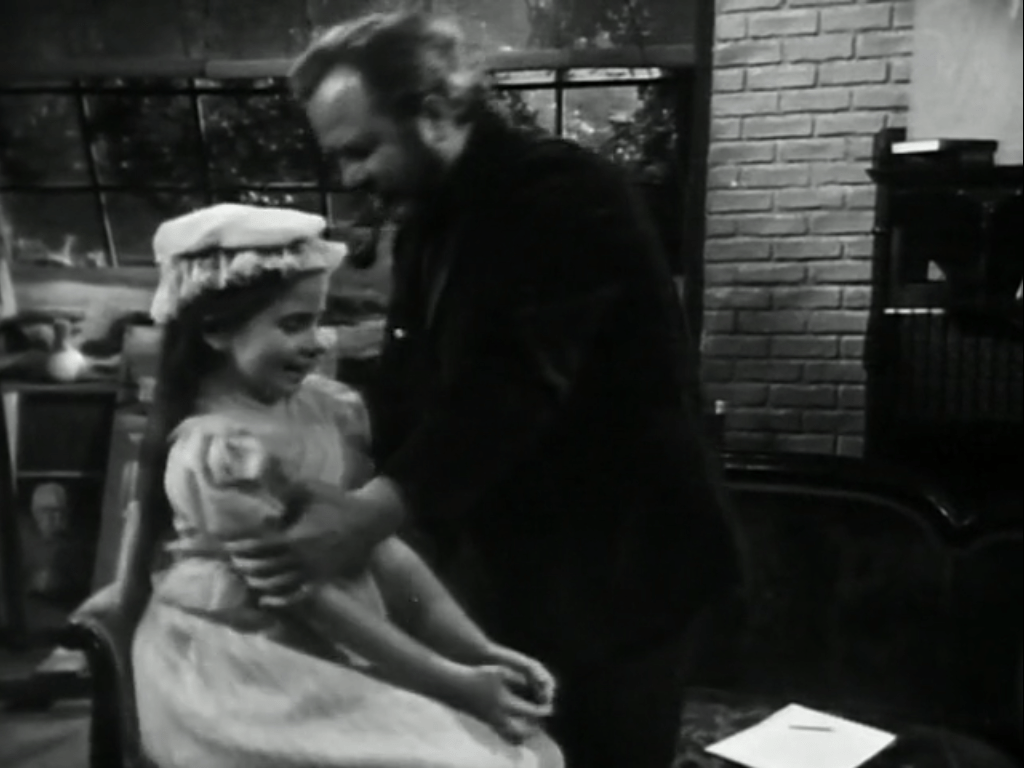
We cut to the Evans cottage. Sam is an artist, and is working. Sarah materializes in the living room. Sam had locked the door and Sarah won’t explain how she got in, but he seems to be delighted with her anyway. She is impressed with his paintings and asks him to paint a picture of her. He offers a drawing instead. When she agrees, he picks her up and sets her on a stool. She flashes a grin at being picked up. She asks if she can keep the drawing when he is done with it.
The most fun Sarah has had the whole time she’s been dead
Sam tells Sarah that her dress is very pretty. He then mentions that you don’t see many dresses in its style. She asks if that means he doesn’t like it. When Sam says that all he means is that it isn’t the sort of thing other little girls wear, she says she doesn’t play with other little girls so she doesn’t care what they wear. She seems to be getting worked up about this, so Sam calms her down with, “All right, all right, I see.” This little exchange gave my wife, Mrs Acilius, a laugh. Sarah may have been born in the same year as Jacob Grimm, but she is very much a nine year old girl.
While Sam draws Sarah, she steers the conversation to Maggie. She asks Sam if he looked for Maggie on the beach under Widow’s Hill. He says he’s looked everywhere he could. She repeats her suggestion that he look for her on the beach. He says he is sure he won’t find her there. She responds “You might, if you go there tonight.” Disturbed by this, Sam looks up, and finds that Sarah has vanished.
This surprises us almost as much as it surprises Sam. Sarah had made it clear that she very much wanted to keep the drawing, yet she disappears before Sam is finished. Evidently, it wasn’t within her power to stay.
Back in the cell, we see Maggie and hear her thoughts as she tries to remember Sarah’s riddle. Like Willie’s voiceover internal monologue in the opening scenes, Maggie’s goes on too long. We can see that Maggie is in an upsetting situation and understand why Sarah’s presence confuses and distracts her. That makes it clear she would have difficulty remembering the exact wording of the riddle, but we really don’t need to hear her go over every part of it.
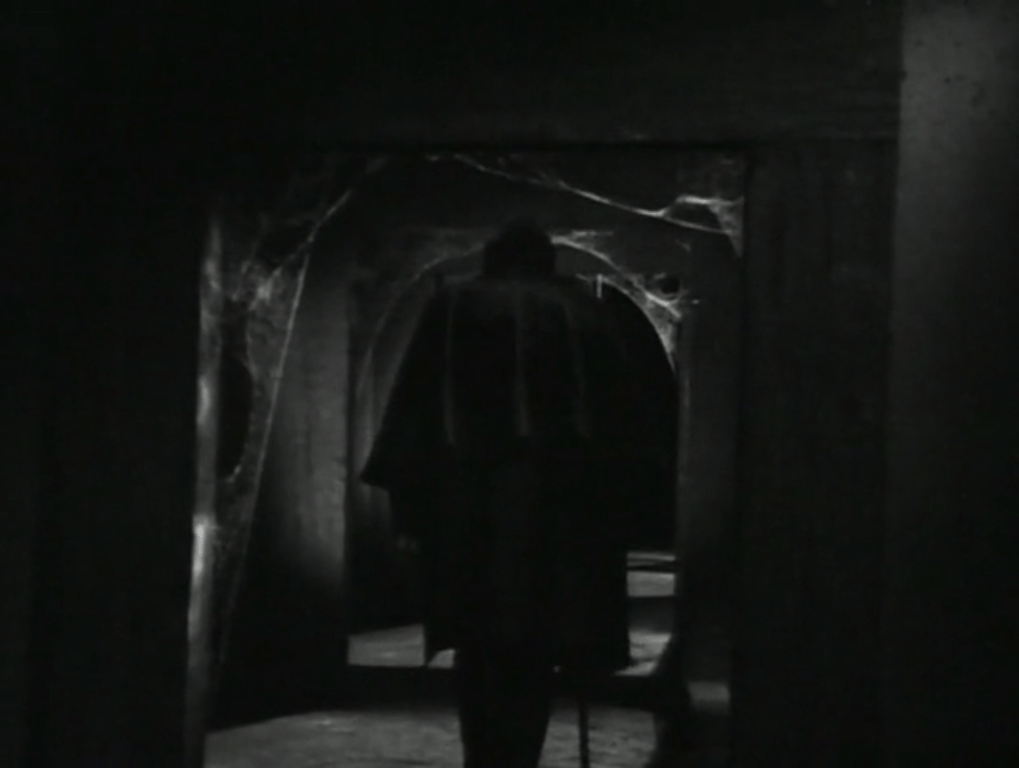
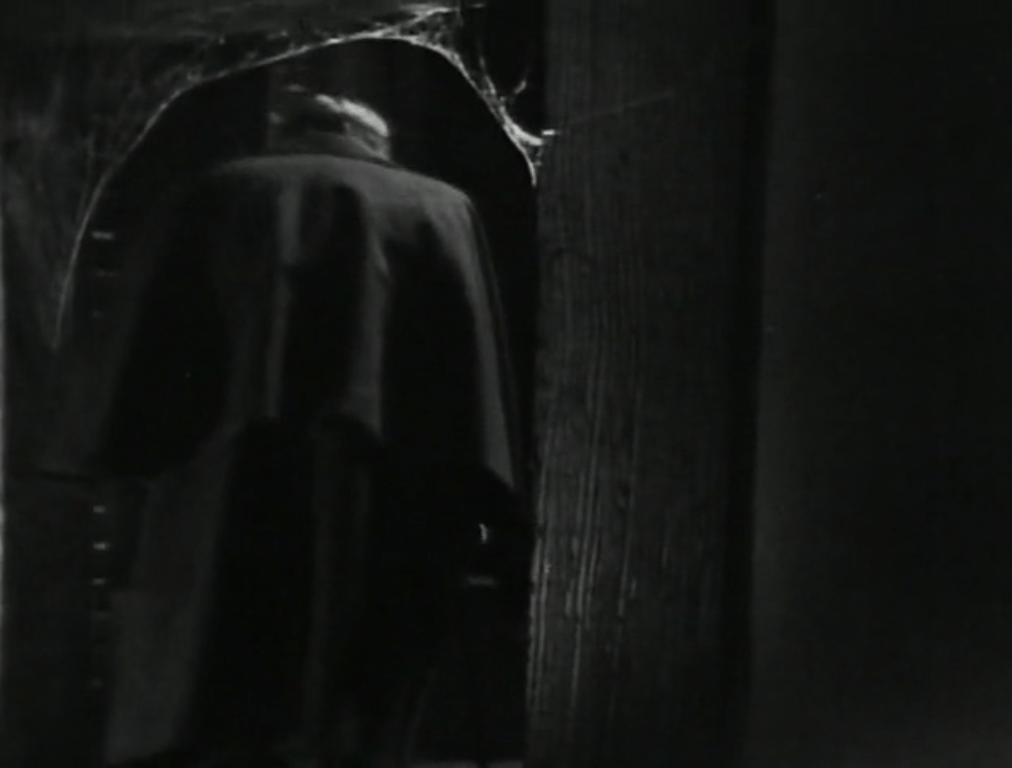
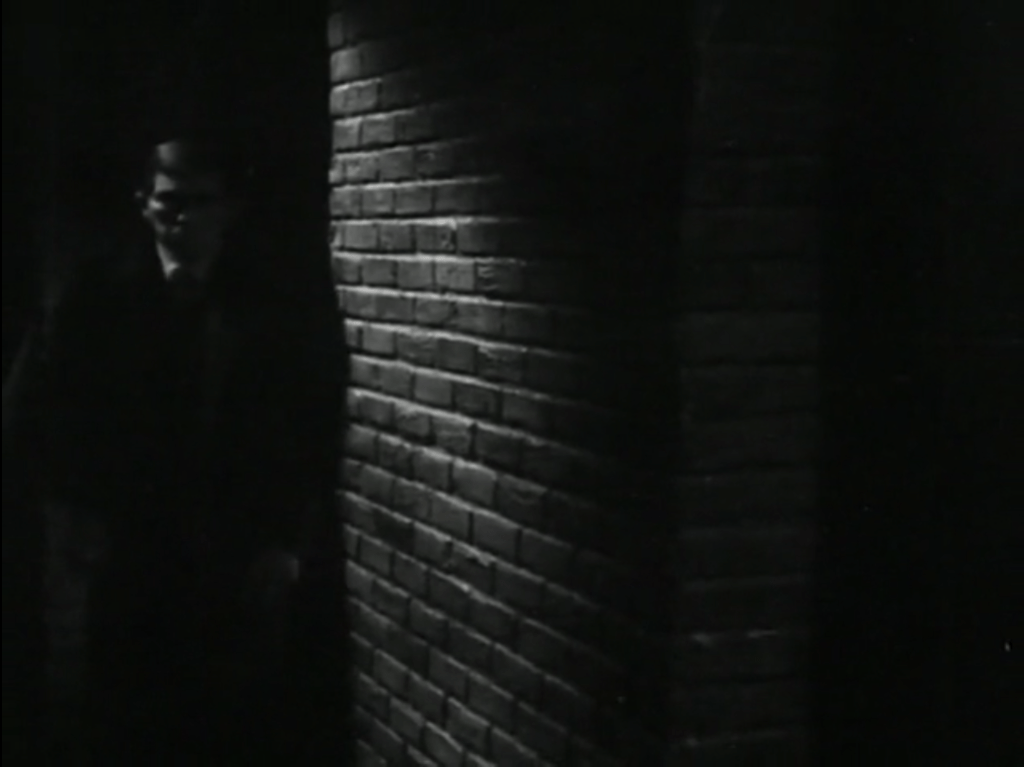
By the time Maggie finds the loose brick that triggers the opening of the secret panel, Barnabas is already rising from his coffin. We cut between Barnabas walking through the basement and Maggie struggling to open the panel. It may sound like we’re describing filler when we say that we see Barnabas traversing three distinct corridors between his coffin and Maggie’s cell, but it doesn’t feel that way. Not only do these shots build suspense as we wonder if Maggie will get out before he reaches her, but in Barnabas shown as a hunched, solitary figure in narrow spaces sketched in shades of gray we see the representative of a world bleak beyond endurance. We can see why the first serious feature film about a vampire, F. W. Murnau’s Nosferatu (1922), devoted so much screen time to showing Count Orlok skulking about the corridors of his castle.
First corridorSecond corridorThird corridor
Maggie crawls into the secret passage. She doesn’t close the panel behind her. Not only doesn’t Maggie know that Sarah is a ghost, she doesn’t know that Barnabas is Sarah’s brother. When Sarah says that not even her brother knows about the secret panel, she is telling us, but not Maggie, that Barnabas is unfamiliar with this way. We know that if Maggie had closed the panel, Barnabas wouldn’t have known where to look for her, and so we might yell at the screen urging her to do that. But since it is his house, she has to assume that he does know about the panel, and she knows that he might be at the door any second. So it is rational for her to forget the panel and use all of her time moving forward.
The gap between Maggie’s knowledge and ours again adds to the suspense as we watch her flee from Barnabas through the twisting passages beyond the panel. We only see one path, but the looks on the actors’ faces as they look from side to side tell us that there are several. Maggie is moving cautiously, choosing her way with care, the sensible thing to do if Barnabas is familiar with the passages. Since we know that it is new to him as it is to her, we want her simply to pick a path and run.
Maggie beholding the paths before her
Maggie finds two heavy doors, both of them apparently stuck. Barnabas looks around, seems bewildered, and takes a breath. He shouts a speech at Maggie, claiming that she has no chance of escape because he can hear her. He can’t hear much while he’s shouting, so we want her to take advantage of that and bash away at one of the doors during his speech.
Barnabas wondering at part of his house he never knew existedMaggie with two closed doors in front of her and an angry vampire behind her
This episode ends the 52nd week of Dark Shadows. When ABC* picked the series up in 1966, it gave executive producer Dan Curtis a 26 week commitment, carrying production to #130. After that, the network renewed it for the then-standard 13 week period. The first renewal carried them to #195, the second to this episode. Until just a couple of months ago, the ratings were so low that no one thought it was likely that it would get a third renewal. When the vampire was introduced in April, viewership started to pick up, preventing cancellation and requiring them to come up with a story that they could keep telling.
I do think we can see traces here and there of the original plan. The first part of the plan seems to have been to copy Bram Stoker’s Dracula far more thoroughly than they wound up doing.
The two female characters on the show who had or were about to have boyfriends when Barnabas was introduced were Maggie and Vicki, who are both seeing men who are cut out to be stout-hearted action heroes. The two female characters in Bram Stoker’s Dracula who had boyfriends were Lucy Westenra and Mina Murray, who were both seeing men who emerge as stout-hearted action heroes. Dracula feeds on Lucy, prompting several other people to band together to try to save her. Dr John Seward, MD, contacts his old Professor, the brilliant Abraham Van Helsing, to advise the group. Despite their best efforts, Lucy dies and rises as a vampire, the “Bloofer Lady” who feeds on the children of east London. Lucy’s boyfriend has to destroy her body to free her soul of the vampire curse.
If the show was about to be canceled, it would have been a favor to Kathryn Leigh Scott to have Maggie suffer Lucy’s fate. Going out with a splash like that would certainly have given her something to lead with as she looked for her next job. But once it was decided that the show would continue beyond #260, it was out of the question to lose a character as popular and versatile as Maggie. When the network ordered 65 more episodes, Maggie had to be saved.
The Van Helsing analogue was actually named on screen. In #242, the show’s equivalent of Dr John Seward, addled quack Dr Woodard, said that he was going to call in a specialist to consult on Maggie’s case, a Dr Hoffman, who is “one of the best men in the field.” We haven’t heard about this man since Dan Curtis found out the show was going to be renewed, suggesting that they’ve abandoned the idea to hew quite so closely to Dracula.
In Stoker’s novel, once Van Helsing has corrected the group’s knowledge deficits concerning vampires, Mina emerges as its leader. Attempting to be gallant, the men cut Mina out of their operations, with the result that Dracula escapes them and bites her. Mina is able to resist his influence so far that she can play a pivotal role in the Count’s final destruction.
The first time Dark Shadows modeled a storyline on Dracula, the menace was not a vampire, but undead fire witch Laura Murdoch Collins. In that arc, the men formed a group of stout-hearted heroes advised by Dr Peter Guthrie and led by well-meaning governess Vicki. Guthrie and Vicki were plainly Van Helsing and Mina. Laura killed Guthrie, so he can’t come back to help in the fight against Barnabas, but Vicki is still around, still the chief protagonist, and still the one likeliest to lead the opposition to a villain.
Indeed, Barnabas has expressed interest in Vicki as a replacement for Maggie, and in #233 he blurted out an obvious threat when he realized she was getting uncomfortably close to figuring out the truth about him. So, had Dark Shadows ended with this episode, it is likely that it would have ended with Vicki overcoming Barnabas’ power and driving a stake through his heart.
Of course, the vampire is the source of the ratings, and Vicki and Maggie are needed for future story development. So the makers of the show can’t use any of those plot elements. What in the world they can do is a question that does not, as yet, have a clear answer. So they have been stalling and stalling. Sooner or later, the stalling will have to end.
*The American Broadcasting Company, that is, not the Australian Broadcasting Corporation.
Maggie Evans, The Nicest Girl in Town, suffered from an ailment her doctor, Dave Woodard M. D., could not identify. She then vanished from her hospital room in a manner law enforcement, led by Sheriff George Patterson, could not explain. The opening voiceover says that Maggie’s troubles “mystify the finest minds.” This is the first and last time either Woodard or Patterson is classed with “the finest minds” even among the low-functioning characters who abound in the period when Dark Shadows is being written by Ron Sproat and Malcolm Marmorstein. Well-meaning governess Vicki is still the single smartest character on the show, and she turns into an absolute moron every two or three days.
In the opening teaser, dashing action hero Burke Devlin asks Dr Woodard if his studies of Maggie’s blood samples will help find her. He says that they won’t, but that if he can diagnose her he might be able to help her after she is found. Burke asks if he is about to make a diagnosis. He says that he might be making progress towards that goal. At that point, there is a dramatic musical sting, and we cut to the credits. That’s the hook, a statement that further study is needed.
Dr Woodard tells Burke that he has contacted “Hoffman, one of the best men in the field,” and that he hopes Hoffman will be able to get things moving. Under Burke’s questioning, he admits that he is pessimistic that Hoffman will see anything he has missed. This is the first mention of the name “Hoffman” on Dark Shadows. I believe it is only the second mention* of any surname that is not derived from Irish (as are such names as Collins, Devlin, Malloy, and McGuire,) English (as are names such as Woodard, Patterson, Loomis, Johnson, Stockbridge, and Garner,) Welsh (as are names such as Evans and Morgan,) Scottish (as are the names Adair and Murdoch,) or French (as are the names La Freniere, Bilodeau, and du Près.)** It is certainly the first name we have heard that suggests there might be Jewish people in the universe of Dark Shadows.
We then cut to the study in great house of Collinwood, where high-born ne’er-do-well Roger Collins has to confront his sister, reclusive matriarch Liz. The auditors have told Roger that the books are out of balance at the family business. Roger knows that the reason for this is that Liz is giving money to buy the silence of seagoing con man Jason McGuire. He reminds Liz that he himself was afraid of blackmail for the first 40 weeks of the show, so he knows from personal experience that it is no way to live. Liz refuses Roger’s plea that she tell him her secret. As he probes and she resists, they move around the room at times like fencers, at times like dancers performing a paso doble. Their movements are easily the most interesting element of the episode, a credit to director John Sedwick.
Roger’s first approach to the shielded LizLiz parries Roger’s thrustRoger’s second approach
Roger admits that he hasn’t been much help to Liz over the years, but begs her to let him help her now. Liz won’t tell him anything, but she is touched to see her bratty brother sincerely trying to step up.
Liz goes to the drawing room. The camera is behind her as she approaches the room. Jason is standing at the fireplace under the large portrait, the spot furthest from the camera. Not only does he look as small as possible, but at the moment we first see him he is turned away from us, his head tilted far back as he takes a drink. Jason’s smallness and obscurity, coming so soon after Roger’s speech about the dreariness of blackmail, feels like an acknowledgment that Jason doesn’t have much to offer the audience.***
Coming upon Jason
Liz tells Jason she can’t give him any more money without blowing the secret they share. He amazes her by accepting this information calmly, but she is sure he is not done tormenting her.
Liz returns to the study, where Roger is still sitting. She tells him that she has talked to the auditor and straightened out the books. That sounds like something that would take quite a while, even if you are sitting across from each other, and Liz and the auditor had to do it over the telephone. So how long has Roger been sitting there?
Then we rejoin Burke and Woodard in the doctor’s office, which someone has ransacked. The perpetrator wrenched the metal bars out of the window and stole Maggie’s blood samples. Dr Woodard says that the only way the bars could have been twisted was by someone with the “supernatural strength of madness.” I’m not an expert in mental health, but that does not sound like a conventional psychiatric opinion to me.
*After Lieutenant Costa of the Arizona State Police, whom we saw when Dark Shadows took us to Phoenix in #174.
**It is pretty weird that a show set in Maine has so few French-surnamed characters. We’ve only heard of one working-class Mainer with a French name, Amos Bilodeau. La Freniere was given in #45 as the maiden name of Josette, a grand lady who came from France to marry into the Collins family in a previous century; eventually, Josette’s birth name will be retconned to du Près.
***My wife, Mrs Acilius, was the one who really noticed the visual strategy both in Liz and Roger’s first scene in the study and in Liz’ entry into the drawing room.
Today is only the second time we hear a voice announce a recast over the opening title. The first time was in #35, when David Ford took over the part of drunken artist Sam Evans from wildly incompetent actor Mark Allen. This time Robert Gerringer is taking over the part of addled quack Dr Woodard from Richard Woods. Woods only played the role twice, and neither time could he find a way to distract the audience from the ignorance of medicine that the writers showed in their scripts.
Gerringer’s lines don’t make much more sense than did the ones they dumped on Woods, but he acts up a storm. Woodard is examining Sam’s daughter Maggie Evans, The Nicest Girl in Town. Unknown to Sam or Woodard, vampire Barnabas Collins has been sucking Maggie’s blood. Woodard is firm with Maggie when she resists his examination. He seems to be somewhat on edge, just enough that we wonder if there is more to it than the difficulties we can see Maggie giving him. Perhaps he is thinking something he isn’t saying. Woods never managed to make us wonder if his version of the doctor was doing that.
When Woodard and Sam leave Maggie’s room, Woodard assumes an alarmed tone. He tells Sam that Maggie is on the point of death and needs a blood transfusion at once. By showing us that Woodard was concealing the true nature of his concern when he was with Maggie, Gerringer gives substance to our hopes that the character’s nonsensical words and deeds will turn out to be a screen hiding something interesting.
Maggie’s boyfriend, hardworking young fisherman Joe, joins Sam and Woodard. Woodard asks if either Sam or Joe has blood type A. Joe does. Woodard doesn’t ask about Rh factors or Joe’s medical history or anything else, he simply marches Joe into Maggie’s room and the bodily fluids start pumping right away. Joe holds Maggie’s hand at first, but her violent protests force him to let go.
Transfusion
In Bram Stoker’s Dracula, Professor Van Helsing and Dr John Seward give blood transfusions to the vampire’s victims. That novel was written in 1897, and blood types weren’t discovered until 1900, so Van Helsing and Seward take blood indiscriminately from all the men cooperating in the effort to defeat Dracula. Van Helsing is particularly enthusiastic when he learns that Arthur Holmwood has given blood to Lucy Westenra, because Arthur “is the lover of her!” Van Helsing is Dutch, and speaks in a vaguely comical broken English. Woodard doesn’t seem particularly excited that Joe is “the lover of her,” but audiences who had read the book will recognize the allusion.
At this point in the production of Dark Shadows, the tentative plan was that Dr Woodard would become something like the expert on paranormal dangers that Dr Peter Guthrie had been during the Phoenix storyline, and that Barnabas would be destroyed in episode 275. Like Stoker’s Dracula, the Phoenix arc had featured a group of stout-hearted men and one valiant young woman coming together to do battle with an undead menace. Dr Guthrie had been their Van Helsing, an expert from out of town who leapfrogs over some weaknesses in the evidence actually available to the protagonists to get them to the same level of understanding that the audience has been given. Also like Van Helsing, Guthrie is the first to realize that the one female member of the team is the key to the success of their efforts, and so he insists on putting her in situations the other men regard as too dangerous for her. As Mina had been instrumental in the destruction of Dracula, so well-meaning governess Vicki is the person who finally thwarts the plans of the Phoenix.
If Woodard and Vicki are going to destroy Barnabas in #275, we have to wonder what story the show will have to tell in #276. The only other plotline going at the moment is the blackmail of reclusive matriarch Liz by seagoing con man Jason McGuire, and that can’t continue indefinitely. Not only will Liz run out of things for Jason to take away from her, but Dennis Patrick, the actor playing Jason, will leave the show no later than the end of June. Since the end of June is when #275 will be airing, we can hardly expect Jason to take the show over after that time.
In fact, Jason is an in-betweener brought on the show to clear away the last non-paranormal plot elements left over from the period before the show became a supernatural thriller in December 1966. By the time he leaves, both the reason for Liz’ long self-immuration in the great house of Collinwood and the identity of Vicki’s parents are supposed to be laid bare for all to see. Neither of those secrets ever generated an interesting story, but as long as they are around it is at least theoretically possible that the show will become a conventional daytime soap opera again. Without them, they are altogether committed to the spook show route. Destroy Barnabas, and you just have to come up with yet another menace from beyond the grave.
I remember Gerringer’s acting style from the first time I saw Dark Shadows. That was back in the 90s, when it was on what was then called the SciFi Channel. He so perfectly represented the doctor characters on the soaps my mother used to watch when I was a kid twenty years before that seeing him in the middle of a story about a vampire told me everything about the strangeness of a conventional daytime serial switching to a horror theme. If that guy is the one to drive the stake through Barnabas’ heart, or if he is even part of the team that finishes him off, it will be a statement that the makers of Dark Shadows have decided to stop being silly and start imitating The Guiding Light.
My wife, Mrs Acilius, was particularly frustrated with the dialogue in this episode. As Maggie, Kathryn Leigh Scott does a good job with nonverbal communication creating the image of a reluctant patient trying to get out of her skin, but her lines consist chiefly of repeating whatever is said to her. The other members of the cast are equally effective at projecting concern for a loved one whose grave illness they don’t understand and can’t help, but their lines too are so heavily loaded with repetition that we started to suspect that Malcolm Marmorstein was writing for a cast of myna birds. In particular, Woodard’s lines to Sam in the living room repeat the word “shock” so many times that they start to sound like he’s stuttering.
The original choices for the roles of Sam, Joe, Dr Woodard, and Maggie. Photo by Bird Ecology Study Group
In his post about this episode, Danny Horn complains that there is not a single interesting still image in it. I agree with that, though I would say that the actors’ movements tell a story. Granted, it is a story that could have been told in a tiny fraction of the actual running time, but they deserve credit for holding the show together when the script gave them zero support.
Danny says that the episode would have been just as good if it were a radio show. Mrs Acilius says that it would have been “a thousand times better” than it is if it were a silent movie. Maybe they could compromise, and it could be presented with neither audio nor video, and the audience could spend the 22 minutes doing something else.









 Dark Shadows Commentary