Well-meaning governess Vicki, fresh from imprisonment at the hands of strange and troubled boy David Collins, gets a few days off work to visit Bangor, Maine. Flighty heiress Carolyn had agreed to drive her to the bus station in the town of Collinsport. Carolyn doesn’t have a job, go to school, or seem to have anything else to do, so why she and Vicki don’t just take a road trip together is unclear.
They wait for the bus at the local restaurant. From there, Carolyn telephones dashing action hero Burke Devlin, her family’s arch-nemesis and the object of her own obsessive crush, and invites him to join the two of them at their table.
Carolyn tells Burke that Vicki has recently seen the ghost of beloved local man Bill Malloy. Vicki tries not to give Burke any additional information. When Burke learns of Vicki’s plans, he volunteers to take her to Bangor in his car. She declines, but he won’t take no for an answer. I don’t drive, and I admire the way this scene shows how hard it can be for a non-driver to decline a ride.
When Burke leaves to get Vicki’s bags, Carolyn blows up at her. Carolyn tells Vicki that she must have known she came to town hoping to see Burke and spend the evening with him. Vicki did not know any such thing. After all, Burke has openly declared his intention of forcing Carolyn’s entire family into bankruptcy and disgrace, and she has expressed remorse for her infatuation with him. When Carolyn makes it clear she is still chasing Burke, Vicki doesn’t know what to say.
The Collinsport Historical Society says that Carolyn spends this week alienating the audience, and her passive-aggressive behavior towards Vicki is indeed exasperating. Watching the scene in the restaurant, it makes perfect sense that Vicki would decide that escaping Carolyn is worth the risk of getting in trouble with her employers by spending an hour with Burke.
Back home at the great house of Collinwood, Carolyn hears her mother, reclusive matriarch Liz, playing the piano. She makes a lot of noise when she comes in, ensuring that her mother will call her into the drawing room. Once there, Carolyn puts on a great show of being upset. She gives partial, teasing answers to each of her mother’s questions, drawing her in as best she can. She finally declares that Vicki is not to be trusted. She reveals that Vicki is in a car with Burke, probably telling him everything she knows about the Collinses and Collinwood. We then cut to Vicki and Burke in the car, where she is telling him everything she knows about her recent sighting of Bill Malloy’s ghost in the house.
Again, the scene in the restaurant explains Vicki’s behavior. Carolyn had told Burke so much about it that it would be hard for Vicki or anyone else to see much point in trying to keep the rest of the story from him. When Burke wants her to say that the ghost accused someone in the house of murder, she insists that it only said it was someone in Collinsport, not Collinwood.
Carolyn has always been tempestuous, and Vicki has always been quick to forgive her. Perhaps now that the relationship between Vicki and David is about to enter a quieter, more complicated phase, the makers of the show wanted to ensure that there would be a continual source of conflict within the house. That might explain why they have chosen to feature Carolyn’s nastier side so heavily this week.
The one storyline in the first 42 weeks of Dark Shadows that has a satisfactory beginning, middle, and end is the transformation of strange and troubled boy David Collins from the deadly enemy of his governess, the well-meaning Victoria Winters, to her faithful friend. That storyline reaches a turning point in today’s episode.
Last Friday, David imprisoned Vicki in an abandoned room deep in the closed off section of the great house of Collinwood. From the other side of the locked door, he taunted her that she would remain trapped there until she died. After she was freed from the room, Vicki decided that she would leave her position unless she could see something new in David that would convince her she could reach him.
In today’s teaser, David visits Vicki in her bedroom and tries to deny that he wanted to kill her. She quotes several remarks he has made to her over the months she has been at Collinwood in which David indicated that he would very much like to kill her, leading up to his declaration that when she dies he won’t even go to her funeral. He retracts that one, explaining that “I like funerals.”
After a few more minutes of this charming conversation, Vicki mentions that, while trapped in the room, she saw the ghost of beloved local man Bill Malloy. David’s attitude changes abruptly. He pleads with her to continue as his governess.
David’s cousin, flighty heiress Carolyn, walks into Vicki’s room in time to hear David begging Vicki to stay in the house. Stunned, she asks what brought this reversal about. Vicki explains that she told David that she saw a ghost, and that “Any friend of a ghost’s is a friend of David’s.” Carolyn wants Vicki to stay, and tries to argue that what David has said is enough to prove that she can become his friend. Vicki is not at all persuaded of this, and is still inclined to go away.
Vicki’s skepticism about David’s sudden friendliness after so much extreme hostility is a sign of intelligence. Her next actions suggest that the Dumb Vicki of later years is not far away.
Gruff caretaker Matthew is replacing the lock on the door that separates the unused part of the house from the rest of it. Matthew leaves for a moment in the middle of this job to attend to other business. Vicki and Carolyn take advantage of his absence to slip through the lockless door and make their way to the room where Vicki was trapped.
While the girls are in the closed-off section, Matthew returns to work on the door. David asks him what would happen if someone were behind that door now- would they be able to get out once he finishes putting the new lock on? Matthew dismisses him without an answer. It would seem to be a question Vicki and Carolyn might have considered asking before they sneaked into the disused wing.
Once they are in the room, Vicki behaves even less sensibly. She tells Carolyn that while she was trapped there, she tried to use a piece of paper to slide the room key under the door. Carolyn asks her to explain what she means. So she recreates the situation. She puts the key in the lock on the outside of the door, closes the door, pushes a bobby pin into the keyhole from the inside so that the key falls onto the floor outside, then slides a piece of paper under the door. The paper slides under the key. To her surprise, this time she is able to fit it under the door. Evidently she had expected to imprison herself and Carolyn in the room.
Fortunately, the two of them are able to make their way back to the main part of the house. They find David waiting for them in Vicki’s room. He says that he was worried about Vicki. The girls wonder if his concern is genuine. He looks up at Vicki, stares into her eyes, and says “I love you, Miss Winters!” Then he rushes out of the room.
David declares his love for Vicki
Thunderstruck, Vicki asks Carolyn if David had ever said those words to anyone or anything before. Looking stiffly off into the distance, Carolyn tells her that he said them once, to a kitten he had. Vicki asks what happened to the kitten. Carolyn tells her that David drowned it.
In Wednesday’s episode, David’s father, high-born ne’er-do-well Roger Collins, had called his son an “incipient psychopath.” Carolyn’s closing line would seem to corroborate that diagnosis. Nor is it the only thing that deepens the sense of danger around David.
David has a couple of interactions with Matthew. David’s aunt, reclusive matriarch Liz, owns the house and has ordered Matthew to change the lock. David asks what reason she gave. Matthew says Liz told him that Vicki somehow made her way in the closed-off part of the house and got herself trapped there. Matthew takes it that Vicki was “snoopin’ around.” In Matthew’s scale of values, “snoopin’ around where you ain’t no call to be” is the cardinal sin. And Liz warned Vicki long ago that Matthew is a “strange and violent man” who might be dangerous to her if he thinks she is overly inquisitive.
We catch a glimpse of Matthew’s violent side today. When David tells him that Vicki saw the ghost of Bill Malloy, he becomes intensely agitated. He grabs the boy by the arm, shakes him, and struggles with himself before he can let go.
Liz is fond of Vicki and has a sense of responsibility for her. Yet given the choice between telling the truth about David’s terrible behavior or defaming Vicki and thereby exposing her to Matthew’s wrath, it’s under the bus for Vicki. That Liz tells the cover story she has devised to shield David from any consequences for his murderous actions to Matthew of all people is not only cruel to Vicki, but a sign of Liz’ extreme unwillingness to face unpleasant facts. Matthew is fanatically loyal to Liz and to the Collins family in general. He is the very last person in the world to use any information against them. Yet Liz can’t bring herself to tell even him the truth about David.
This is not the first time Liz has lied to Matthew to cover up a murder attempt by David. The first time we saw Thayer David in the role of Matthew was in episode 38. In that one, Liz told him to take the blame for an auto crash that might have killed Roger. He is to say that he failed to check the brakes. She refuses to tell him why she wants him to tell this lie. We know the truth- David tampered with the brakes in order to kill his father, and Liz has decided to conceal this fact. Since then, she has behaved as if she never knew of David’s crime.
Liz is not only protecting David- she is protecting herself from a fact she cannot bring herself to face. Liz has all the power in the family, Roger openly hates David, and Carolyn is too selfish to do much for her little cousin. We can see no prospect that anyone will rein David in before he does something Liz can’t hide from the police. Since attempted murder doesn’t qualify, I suppose we have to wonder whether David is on track to succeed in murder. Vicki’s efforts to make an emotional connection with her charge may be his last chance to avoid a hideous future.
In these early months of Dark Shadows, we hear that all the money made in the town of Collinsport finds its way to the old dark house on the top of the hill, where it does nobody any good.
The house itself is full of examples of wealth going to waste. Each of the last few episodes have involved long treks through abandoned corridors and visits to forgotten rooms. Everywhere you turn in these dank spaces, years of accumulated dust bury vases, paintings, antique furniture, oriental rugs, and other apparently valuable objects.
The Collins family is headed by a woman who hasn’t left the house in eighteen years. Reclusive matriarch Liz shares her home with her brother Roger, a spectacularly irresponsible man who squandered his entire inheritance and now holds a position in the family business which seems to involve little or no work. It is difficult to imagine that they run a dynamic enterprise that is taking advantage of the economic boom of the 1960s.
At the same time, Liz seems to have a vigilant concern for the security of her employees. Her only household servant, gruff caretaker Matthew, often brings up the fact that she gave him a cottage on the grounds of the great estate and assured him he would have it for the rest of his life. When plant manager Bill Malloy comes to the house to ask Liz to approve the acquisition of some new machinery for the cannery, her first question is how many men will lose their jobs as a result of it. Only when he assures her that the answer is zero does she agree to the purchase. So we might imagine that the attitude of local wage-earners towards the Collinses will be two-fold- on the one hand, gratitude that they go out of their way to ensure that the people working for them keep what they have, but on the other frustration with their failure to create opportunities for them to move ahead at a time when working people everywhere else in the USA were experiencing the fastest rise in real incomes in the nation’s history.
The relationship between hardworking young fisherman Joe and flighty heiress Carolyn occasionally seems like it will dramatize this situation. Joe is a local boy, and like everyone else in town, he works for the Collinses. Liz has taken a liking to him, and wants him to marry her daughter and have a career as an executive with the firm. He would be glad to marry Carolyn, but is not interested in that career- he wants to buy his own fishing boat and build his own business around it. Liz keeps trying to pull him deeper into her family’s firm, but he keeps insisting on his plan to go his own way. Joe mentions a friend with whom he wants to go into partnership. We never see this friend or anyone else who is working with Joe, and Carolyn doesn’t show the slightest interest in Joe’s plans. Since he doesn’t have anyone to talk to about his ideas, beyond a couple of scenes when he shakes his head at Liz and says “I’m sorry, Mrs Stoddard, but my mind’s made up,” the story of his attempt to diversify Collinsport’s economy doesn’t go anywhere. Earlier this week, the Joe/ Carolyn relationship met its long-awaited demise.
Joe has moved on to a relationship with Maggie Evans, The Nicest Girl in Town. The daughter of drunken artist Sam Evans, Maggie runs the restaurant in the Collinsport Inn. She and Joe are representatives of Collinsport’s working class. During their first date, Maggie demonstrated an encyclopedic knowledge of sail-rigging, which may not be the most useful thing for a commercial fisherman in the age of diesel, but her interest in the sea raises our hopes that she might be a partner to Joe in his ambitions. Together, they might show us what it has meant for the town that the Collinses control so much wealth and do so little with it.
In a comment on Danny Horn’s blog Dark Shadows Every Day, I mentioned another way the show could have done more with this theme. I imagined that they might have expanded the part played by the only African American actor to deliver lines on Dark Shadows, Beverly Hope Atkinson.
The opportunities they missed came into view in episode 563, when Beverly Hope Atkinson appears as the unnamed nurse who keeps Nicholas Blair out of Joe’s hospital room but lets Maggie in. Unnamed Nurse lights up when she sees Maggie and greets her by name; they seem to be old friends.
In the first 42 weeks of the show, when the supernatural was in the background and the stories were slow, it would have been easy to have a couple of tea party scenes at the Evans cottage where Maggie and her lifelong friend, Unnamed Nurse, recap whatever is going on. Those scenes could have led to a whole exploration of the tension between the working-class people in the village and the jerks in the big house on the hill. That in turn could have led to the introduction of Unnamed Nurse’s family, headed by Unnamed’s parents, Mr and Mrs Nurse, including her brothers, Young Mr Nurse and Master Nurse, and her sister, Miss Nurse. We could then have seen the ancestors of the Nurse family in each of the flashback segments and analogues of them in Parallel Time.
I try to keep my contributions to Dark Shadows fanfic modest, so I didn’t try to think up a new name for Unnamed Nurse. My point is that the makers of the show did not need any more sets or many more characters to create a much more spacious world in the imaginations of the audience. The Evans cottage by itself, as an instance of a working-class home in Collinsport, is almost enough to make us think of a whole town of people teeming with ambitions, resentments, plans, and frustrations. Just a few small scenes there shedding light on some underused themes could have got us the rest of the way.
Another character who brings the Collinses’ deficiencies as commercial leaders of Collinsport into view is dashing action hero Burke Devlin. Himself born into Collinsport’s poorest class, Burke has gone away and somehow made himself very rich. The whole time he was in Collinsport he was penniless. He left town when he was sent to prison. Only five years after his release from prison, he is a millionaire many times over, in a position to buy up the Collinses’ debts and claim all of their assets. The show has dwelt on this timeline often enough that they have started making awkward attempts to explain how he got so rich so quickly. But it seems that we are supposed to feel that it was simply getting clear of Collinsport that opened the doors to wealth for him. He went to South America, he went to New York, he went to an oil field, he went someplace, but all that really matters is that he went far from the stifling influence of the Collinses and their gloomy house.
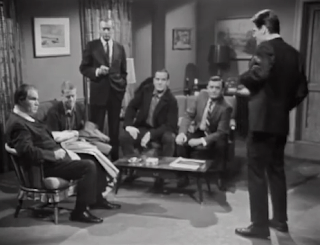
Now, Burke is moving to destroy the Collinses and supplant them at the head of local industry. Today, he and his lawyer meet with some of the key men from the Collins cannery and fishing fleet. He wants to recruit them to work for a competing firm he is buying. When the lawyer tells him the men may be too loyal to Liz to take his offer, Burke recites a list of the tired cliches that wealthy villains spout when boasting to their henchmen of the power their money gives them: “Money talks. Money buys loyalty. Everyone has their price. Name it and you can buy them. Some just come a little higher than others, that’s all, but everyone is for sale.” Too bad Cabaret didn’t get to Broadway until three weeks after this episode was broadcast, or he might have closed with a few bars of “Money Makes the World Go Around.”
The men are offended when Burke says he wants them to leave the Collinses and come to work for him. They pride themselves on their loyalty to the Collinses. If they feel that way, it’s a mystery why they agreed to come to a meeting with Burke in the first place- everyone in town knows about his vendetta against the Collinses. They start to leave, but stay long enough to hear Burke offer them higher wages than the Collinses can pay, and a profit-sharing plan.
The most senior of the men present, Amos Fitch, stops by the house to tell Liz and Roger about the meeting. Apparently the other men are more rational economic actors than Amos, and they are considering Burke’s offer.
After the meeting has broken up, Burke spends a few more minutes expounding to his lawyer on his theme that anyone will do anything if you dangle enough money in front of them. He interrupts himself before he can literally say that all people are whores and gives the lawyer a check, telling him that it’s always good to have some extra loyalty around. Apparently he decided that leaving a two-dollar bill on the night-stand might be too subtle. The lawyer reacts with distaste to Burke’s crassness, but takes the check.
Burke’s first attempt to buy someone’s loyalty took place all the way back in episode 3. He met Joe in the local tavern and offered him enough money to buy a fishing boat in return for information on the Collinses. When Joe refused, Burke told him that he himself got his start when a strange man approached him in a sleazy bar and offered him a lot of money to do something he wasn’t very specific about. He accepted, and that led him directly to great riches. That’s wonderful career advice, “A guy in a bar flashes some dough, you don’t ask no questions, honey, just leave with him.” Sounds like a guaranteed path to success. Anyway, it’s obvious in that one that Burke is trying to lure Joe into something dishonorable. We already care about Joe, so if he were to be tempted we would be in suspense until he proved his uprightness.
Contrast Burke’s attempt to buy Joe’s services back then with today’s attempt to hire this group. We’ve never seen or even heard of any of the men whom Burke is trying to lure. So if the conflict over control of the sardine-packing business is a test of their moral rectitude, it’s none of our concern. On the other hand, if it were a choice between a prosperous future for the town that does not include the Collins family or a stagnant future that does, there might be real suspense.
The Collinses are our point of view characters and the story cannot continue if they are thoroughly defeated, so if we enjoy watching the show we will root for them no matter how strong a case their antagonist may make for his position. On the other hand, we do care about Maggie and Joe, and are ready to care about characters who are friends of theirs. Therefore, if we see that a plan will be good for the working people in town, it won’t be easy for us to hope Liz and Roger will foil it. If the show can put us in that situation, we will feel suspense as we watch the events of the story and look for a way to resolve the tension that our mixed feelings have created. That’s how every thriller works- we may want the good guy to beat the bad guy eventually, but not until we’re done enjoying the contest between them.
Think again about Burke’s temptation of Joe in episode 3. Joe earns a few points with the audience by rejecting Burke’s offer out of hand. If he’d considered it, we would have paid attention to him until he made his decision, but only to him- a temptation story works only if the person or people being tempted find themselves isolated from everyone else. If he ultimately rejected the offer, the story ends and leads nowhere. If he’d accepted it, we would be disappointed in him and lose interest in his subsequent doings. He wouldn’t become interesting again until he either went through a redemption story, which would again tend to isolate him from the rest of the cast, or became a villain, which isn’t what they want the character for right now. But if, instead of a moral test, he had been presented with a plausible business decision, we could have had a story that would have given us a virtual tour of Collinsport and given us a feeling that we know the place, even if we didn’t actually see any new sets.
So that’s why I wish Dark Shadows had done more with the relationship between the Collinses and the rest of Collinsport. Not that I suppose the writers had deep political and sociological insights that I long to have heard, but that putting your characters in a bigger world allows you to tell bigger stories.
Well-meaning governess Vicki and flighty heiress Carolyn are in the drawing room at the great house of Collinwood, talking about Vicki’s recent experience of imprisonment. Vicki’s charge, strange, troubled boy David, lured her to a room in the abandoned west wing of the house and locked her in. As Vicki declares that she saw the ghost of beloved local man Bill Malloy in the room, reclusive matriarch Liz appears in the doorway and reacts with shock.
Liz protests that the idea of ghosts is nonsense. Vicki says she’d always believed that, but that what she saw has convinced her otherwise. Liz repeats to Vicki what her brother, high-born ne’er-do-well Roger, has told her. Roger found Vicki locked in a room in the west wing where David, his son, had left her as a kind of prank. Vicki protests that it was no prank, that she believes David wanted to kill her, and that the time has come for her to leave her position as his governess. Roger comes in, and heartily endorses Vicki’s plan to go away.
Liz sends Vicki and Carolyn out of the room, and quizzes Roger about how he found Vicki. In yesterday’s episode, it seemed that Carolyn does not know about the secret passage from the drawing room to the west wing. Today, Roger lies to Liz to conceal the fact that he used that passage. We’re left wondering if even Liz, who owns the house and has lived there all her life, might not know that it is there. Roger is clearly not inclined to build anything; it must be an old feature of the house that he somehow learned about. If, as Liz’ younger brother, he knows about it and she does not, he must have decided to keep it a secret from her. How he learned about the passage, why he decided to hide it from Liz, what use he may have made of it in the past, and what plans he may yet have for it in the future would all seem to be fruitful questions to build stories around.
Upstairs, Carolyn pleads with Vicki to stay. After Carolyn keeps steering the conversation back to her own problems and Vicki’s usefulness to her, Vicki asks in exasperation “Didn’t anybody miss me?” Less than a minute later, Carolyn is talking about her boyfriend troubles again, giving Vicki a clear answer to that question.
Liz asks Roger if he’s ever seen a ghost in Collinwood. Roger is startled by the question. He says he isn’t sure. He’s seen too many inexplicable things there to be sure that none of them were ghosts, and he tells Liz that he knows she can’t say anything different about her own experience. This is the most candid conversation the two of them have had up to this point, and by far the most candid either of them has been about the supernatural side of the household. We’d better enjoy it while it lasts- when Ron Sproat and Malcolm Marmorstein take over the writing duties in a few weeks, the idea of either Liz or Roger talking openly about ghosts will become unthinkable.
At Roger’s suggestion, he and Liz make their way to the room where David trapped Vicki. They find some things of David’s strewn about, confirming that he knew the room well and deliberately set out to confine Vicki there. Roger airily says that “I suppose it’s a horrible thing for a father to say about his own son, but I think that David is an incipient psychopath.” Roger has been saying equally horrible things about David from the first episode on, so this isn’t an especially dramatic thing for returning viewers to hear. Liz listens to him intently, asking if this is why he believes Vicki ought to leave the house. He says that yes, on the pattern of David’s previous behavior he expects him to continue to pose a danger to Vicki.
They also find evidence confirming Vicki’s story about the ghost of Bill Malloy. She had said that the spirit appeared dripping water and seaweed on the floor; Liz finds wet seaweed there, apparently convincing her that Vicki’s story is true and Bill’s spirit is roaming about trying to set an injustice right.
Back in the drawing room, Liz makes some general remarks about ghosts. Carolyn and Vicki come in. Carolyn asks Liz to talk Vicki into staying. Liz says that she would like for Vicki to stay, but that she won’t try to influence her decision. Roger urges her to go. Vicki says that she wants to know why David hates her, and that her decision depends on her next conversation with him.
Hardworking young fisherman Joe is spending the evening with Maggie, The Nicest Girl in Town. It’s their first date. Maggie impresses him with her knowledge of ships, and he sings a verse of “What Do You Do With a Drunken Sailor?” It may not sound like much, but the actors, Kathryn Leigh Scott and Joel Crothers, sell it so well that we’ll be rooting for Joe and Maggie for years to come. The final moment of the scene comes after Joe leaves. Maggie looks directly into the camera and says to the audience, “Goodnight, pal.”
Goodnight, pal
In the great house of Collinwood, high-born ne’er-do-well Roger Collins greets his niece, flighty heiress Carolyn, on her return home. Carolyn is upset because Joe has broken off their relationship and is having a date with Maggie. The story of Joe and Carolyn was a bore, largely because the two of them never had a scene with any fraction of the sweetness we see between Joe and Maggie today. There was nothing at stake in their quarrels, because they had nothing to lose if they simply gave up on each other.
Roger tells Carolyn that well-meaning governess Vicki hasn’t been seen for hours, and that he promised Carolyn’s mother, reclusive matriarch Liz, that he would sit up waiting for Vicki’s return. Carolyn is worried as well, and asks Roger why he isn’t actively searching for her. He says she’s probably fine. When Carolyn says that people don’t just disappear, he reminds her of family friend Bill Malloy, who disappeared not so long ago, but then turned up. Considering that Bill turned up in the form of a corpse washed ashore by the tide, it is perhaps unsurprising that Carolyn does not find Roger’s analogy particularly comforting.
After Roger persuades Carolyn to toddle off to bed, he makes sure he’s alone (well, alone except for the stagehand in the lower left-hand corner of the screen.)
Once assured that no one mentioned in the script can see him, Roger returns to the drawing room and opens a secret passage we’ve never seen before. After he disappears into it, Carolyn comes to the drawing room and is baffled at his absence.
The suggestion that Carolyn doesn’t know about the secret passage is characteristic of the show. From the beginning, Vicki has represented our point of view. She started off knowing nothing about the other characters, and everything had to be explained to her while she was on camera. If Vicki knows just what we know, Carolyn, who grew up in the house where most of the action is set, can be presumed to know a great deal we do not. When they reveal a secret to us, they can amplify its importance by showing that Carolyn isn’t in on it. They’ve done this several times, mostly in situations having to do with the murky origins of Roger’s feud with dashing action hero Burke Devlin. Carolyn’s ignorance of the secret passage is particularly effective- it’s right there in the most important room of the only house she’s ever lived in. If she doesn’t know about it, it must be a very well-kept secret indeed.
We go with Roger into the secret passage. He shines his flashlight directly into the camera, creating a halo of light around it. This would not seem to be a desirable visual effect, yet we will see it many, many times in the years to come. This is the second appearance of the effect. The first time came when Roger’s son, strange and troubled boy David, was leading Vicki into the abandoned Old House in episode 70. Now we see it when Roger himself is entering another abandoned space, one where he might meet Vicki.
Halo
It’s hard to believe that the repeated use of this effect was altogether unintentional.
All the more so because of what follows Roger’s entry into the passageway. His journey through it actually does seem to wind through a very large space. In the opening narration, Vicki had said that the house is made up of 80 rooms, retconning the total of 40 given in the second episode. Roger’s trek up one flight of stairs, down another, up a spiral staircase, around corners, past windows, etc etc, seems like it must take him past enough space for at least that many. Perhaps the sequence would be a bit more attractive with less time spent focused on Roger’s feet, but all in all it is as effective a creation of space as Dark Shadows would ever do. If there had been Daytime Emmy Awards in 1966, Lela Swift would have had every right to expect to win Best Director for conjuring up this illusion of vast, winding corridors without editing or going outside the tiny studio space available to her.
Roger does indeed discover Vicki’s whereabouts. He hears her calling for David from behind a locked door, promising David not to tell anyone he imprisoned her there if he will let her out now. Roger does not simply let Vicki out. Instead, he makes some loud noises, then puts on a ghostly, wavering voice and calls out to Vicki that she is in great danger as long as she stays in Collinwood. He seems to be having trouble keeping a straight face when he makes these spooky sounds. Vicki isn’t laughing, and returning viewers aren’t either- in Friday’s episode, she and we saw the ghost of Bill Malloy in the room, and heard that ghost warn her that she would be killed if she stayed in the house much longer.
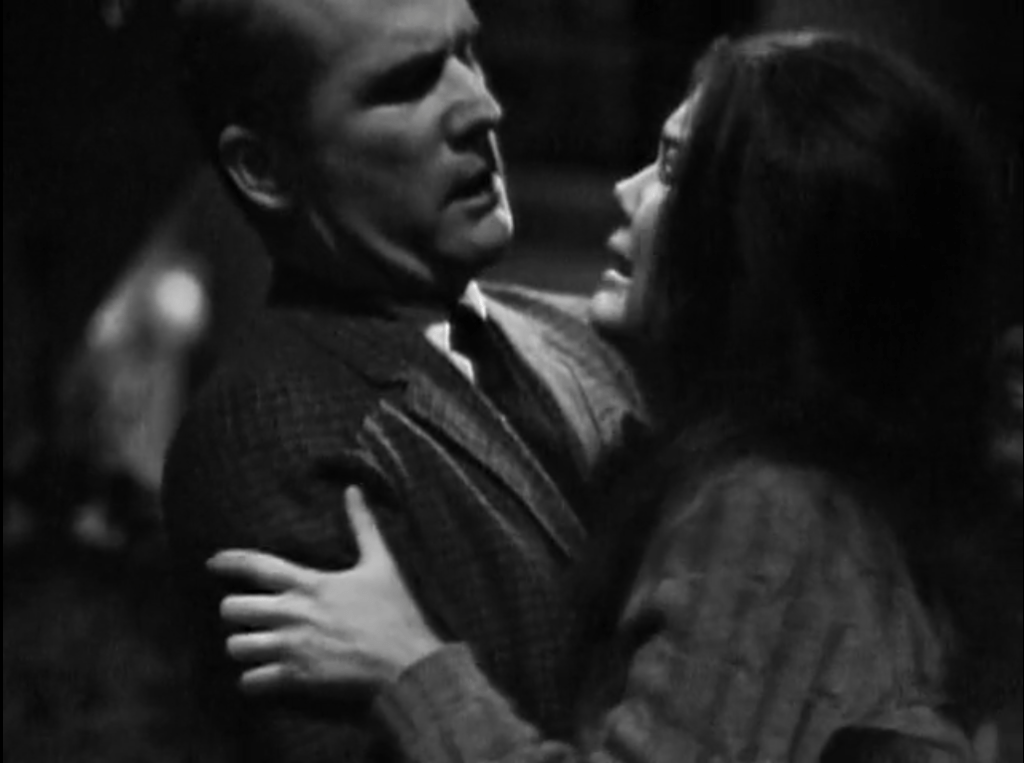
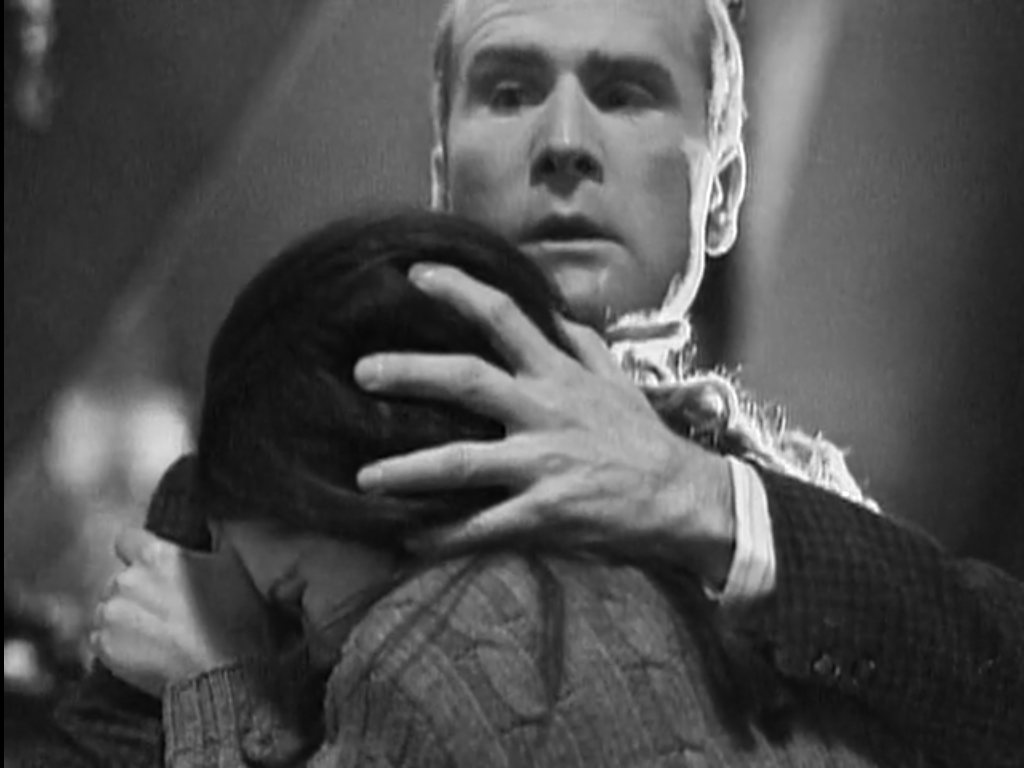
Once he’s had his fun, Roger opens the door. After another flashlight halo, Vicki recognizes him. Alexandra Moltke Isles gives us one of the finest moments of acting in the entire series, when Vicki throws her arms around Roger, her bodily movement as smooth as any ballet dancer’s but her voice jagged, and says that “David is a monster, you were right!” Up to this point, Roger has been brutally hostile to his son, Vicki heroically friendly to him. Her determination to befriend David has become so central to her character that hearing her make this declaration makes it seem that she is permanently broken.
Broken Vicki
Vicki struggles to hold back her sobbing long enough to tell Roger that she saw the ghost of Bill Malloy. That’s an episode-ending sting- Roger wants everyone to forget about Bill’s death, and if his ghost starts popping up he is unlikely to get that wish.
Stunned Roger
Mrs Isles was a “head actor,” one who found the character’s innermost psychological motivation and worked outward from that. That heavily interiorized style would be one of the things that left her in the dust, along with similar performers like Joel Crothers and Don Briscoe, in the period when Dark Shadows was a hyper-fast paced, wildly zany show about vampires and werewolves and time-travel and God knows what. But in the period when Art Wallace and Francis Swann were writing finely etched character studies, she consistently excelled. In this little turn, she shows that when it was logical for her character to go big, she could go as big as any of the stars of the show in those later days.
Strange and troubled boy David Collins has managed to lock his well-meaning governess, Vicki, in a room in the long-abandoned west wing of the great house of Collinwood. David’s father, high-born ne’er-do-well Roger and his aunt, reclusive matriarch Liz, have noticed that Vicki is missing and are beginning to make inquiries.
It is inexplicable that Vicki fell into David’s trap, and her efforts to escape are embarrassingly inept. Today, Liz also behaves inexplicably. In David’s room, she finds the key to the closed part of the house where David is keeping Vicki, and she confronts David with it. When he denies that he locked Vicki up, she says she believes him and drops the subject. I’m afraid this has to be classified as an instance of what Roger Ebert called “idiot plot,” a story that goes on only because the characters are dumber than the audience. It’s especially frustrating to see characters like Liz and Vicki, who up to now have used their intelligence to make plot points happen, suddenly do things that can be explained only by saying that the script told them to do it.
Roger doesn’t appear to be fooled, but neither is he in any hurry to rescue Vicki. He sees her as a threat to his evil plans, and wants her out of the way. We see him alone in the drawing room, smiling broadly and drinking a toast to “Miss Victoria Winters… wherever you are.” He’s so deliriously happy with Vicki’s absence that he’s standing around not wearing any pants.*
Southern exposure
Meanwhile, Liz’ daughter, flighty heiress Carolyn, is sharing a cozy moment with the family’s arch-nemesis, dashing action hero Burke Devlin. In Friday’s episode, the two of them crossed paths at the tavern, and today they are sitting cozily on the couch in Burke’s hotel room. Burke gives Carolyn alcoholic drinks she isn’t of legal age to have, charms her with stories of his time in Brazil, and kisses her goodbye. He seems to be drunk, but as soon as she leaves the room he looks into the camera and in a sober voice vows that his vengeance will destroy her along with the rest of the Collins family.
There is one moment when Carolyn is still in the room when Burke slips out of his drunk act and forgets his charm. Carolyn asks if he’s ever been in love. He springs up from the couch, his face contorted with rage, looks away from her, and spits out the word “Once!” Startled, Carolyn asks if it’s always so painful. Then he remembers himself and resumes the role of the marginally amorous drunk.
Dark Shadows is very literal in its cutting in these early months. They often use scene connectors in the dialogue, moments when the last word of a scene they cut away from is one of the first words of the scene they cut to. And a question at the end of a scene will often be answered by the visual to which the scene jumps- so if someone asks “Who tampered with the brakes on Roger’s car?,” we will cut to a shot of David. At the end of this little exchange about the single, painful, time Burke fell in love, we cut to… Roger.** It’s 1966, and it’s American television, so it is unlikely that the show will actually tell us that Burke and Roger were lovers. On the other hand, it’s 1966, and the actors, writers, and directors are from the New York theater, so it is all but certain that they wanted some segment of the audience to wonder about that.
There’s also a bit of trivia. The drawing room scene among David, Liz, and Roger marks the first time David refers to Vicki as “Vicki.” Up to now he has always called her “Miss Winters.”
*In fact, this is the scene that actor Louis Edmonds famously played without the lower part of his costume.
The final episode written by Art Wallace is the first to feature actors singing. It’s also the first to feature a talking ghost.
The song is “What Do You Do With A Drunken Sailor?” It is sung first in the tavern, where drunken artist Sam Evans and dashing action hero Burke Devlin are reminiscing about their late friend, beloved local man Bill Malloy. Bill worked on the fishing boats for many years, and sang that old shanty all the time. Sam and Burke croon a few of its more family-friendly lines.
We hear the song again, sung by the ghost of Bill Malloy. Well-meaning governess Vicki is, for reasons far too tedious to repeat, imprisoned in a disused room. Bill’s ghost manifests itself in the doorway, takes a step into the room, and begins singing. Draped in the wet seaweed that covered his body after it washed up on shore, he warns Vicki that she will be killed if she does not escape. He turns back towards the door and vanishes into thin air. Vicki tells herself that the apparition was a dream, but finds wet seaweed on the floor where Bill had stood.
As the representative of the business operations that support the ancient and esteemed Collins family in their old dark house on the hill, Bill Malloy had been central to the rational, daylight logic side of the show. He came to the house to keep reclusive matriarch Liz updated on the operations of the cannery and the fishing fleet, and he discussed financial affairs with her. There had been a couple of indications that he once had a crush on Liz, suggesting the possibility that they might fall in love, complicating their business relationship and giving rise to a rather tame soap opera romance. For the last couple of months a mystery story about his death and the investigation into it has kept us mindful of evidence and witnesses and the sheriff and other symbols of explainable, shared reality. When Art Wallace, who wrote the series bible and was credited with the first 40 episodes, moves Bill Malloy into the supernatural back-world of Josette and the Widows, he forecloses any possibility that Dark Shadows will be a conventional soap opera with plots about slightly inconvenient love affairs and struggles over the ownership of a sardine packing concern. We’re going to be seeing “ghosties and ghoulies and long-leggedy beasties and things that go bump in the night,” to repeat a quote Sam delivers today.
It’s also worth pointing out the type of ghost Bill is. He is mostly spirit, but there is a corporeal side to him as well. He enters the room at the closed door. Since he is insubstantial enough that wooden barriers won’t stop him, he isn’t a revenant or a zombie or any other kind of reanimated corpse. On the other hand, he is substantial enough that he moves from one location- somewhere on the other side of the door, apparently- to another. So he isn’t a pure phantom. Unlike a true revenant, he vanishes into thin air, but unlike a pure phantom he leaves behind clumps of the wet seaweed with which he was festooned. We will see more ghosts in the years ahead, and most of them will be a mixture of the spectral and the bodily.
Art Wallace’s name is on every episode of Dark Shadows under “Story Created and Written by,” but he had nothing to do with it after this episode. He will be missed. He wasn’t perfect- this week has been pretty grim, with the unwelcome story of Vicki’s confinement, and with Wednesday’s episode and Thursday’s having been utter stinkers- but he was usually quite good. He and Francis Swann both had a firm understanding of what actors can do and how writers can enable them to do it. After Swann leaves the show late next month, they won’t have another writer of whom that can be said until Joe Caldwell comes aboard next summer.
In the great house of Collinwood, strange and troubled boy David Collins tricks his well-meaning governess, Vicki, into a room where he locks her up. Hardworking young fisherman Joe comes to the house to tell his sometime girlfriend, flighty heiress Carolyn, that he can’t spend the evening with her because he has a date with someone else.
I suppose this is one of writer Art Wallace’s diptych episodes, in which the contrast between a pair of intercut scenes tells us more about the characters than we would gather watching either scene straight through. Most such episodes are powerful and engrossing. Unfortunately, both of today’s topics are deadly dull. The pointlessness of the one multiplies the tedium of the other.
Joe and Carolyn’s relationship has never been interesting for one second. Their scenes are divided between Carolyn’s flagrant displays of contempt for Joe, quarrels that begin when Joe objects to those displays, and the occasional conversation about how the two of them don’t have a future. Today’s conversation between them is a break-up scene. An actual breakup would be welcome, but they’ve raised our hopes that way before. Since the only emotion Carolyn and Joe have managed to arouse in the audience is impatience, we don’t have any of the mixed feelings that could make the scene poignant or exciting.
The contrast at the hinge of the diptych is between, on the one hand, David taunting the suddenly brainless Vicki with the prospect that she will be in her prison for the rest of her life and, on the other, Carolyn dismissing the suddenly self-assertive Joe with the prospect that they will never see each other again. Joe’s uncharacteristic strength is more appealing, and better grounded in what we’ve seen so far, than is the uncharacteristic stupidity that led Vicki into David’s trap. But even if the breakup is the real thing this time, it’s hard to feel much relief when we know that we’re going to be locked up and miserable with Vicki.
There is some trivia in this one that will appeal to confirmed fans of Dark Shadows. It’s the first time we go inside the west wing; we get a look at a corridor and at the room where Vicki will be confined. Vicki and David talk about the long, twisting way they have taken, suggesting that it is a very large place. Much larger than reclusive matriarch Liz suggested in episode 2, when she told Vicki that the whole house, including the closed-off portions, has a total of 40 rooms.
Also, Vicki mentions that the west wing has been closed for 50 years. David picks up on “50 years” in a story he tells to frighten Vicki, ensuring that it will stick in the audience’s mind. Yet Liz, who is supposed to be in her 40s, has a conversation with her daughter Carolyn in which she remembers a time when far “fewer rooms were closed off.” That suggests that there is not only a locked-up west wing, but perhaps an east wing as well. That won’t be confirmed for four years, but it is implicit here.
Reminiscing about the way the house used to be, Liz says “There’s nothing in those rooms now but ghosts and memories.” In fact, the rooms in the west wing, like the abandoned Old House and the basement, are stuffed to bursting, not only with antique furniture, books, trunks, vases, paintings, rugs, and other things that could be sold at a high enough price to finance a considerable amount of work on the house, but also with old newspapers, tattered clothing, helpless governesses, and other unsaleable items that should not be kept in storage. For his part, David tells us that the west wing is full of mice, and we see so many cobwebs that the air quality in the occupied parts of the house must be severely affected by its dust. The Collinses really ought to empty their disused spaces and hire a couple to keep them clean.
No abandoned corridor would be complete without a full-sized metal candelabra in front of a porcelain vase resting on a dedicated stand
Apparently executive producer Dan Curtis insisted as a point of visual style that abandoned buildings be shown crammed with stuff. Today, that means that Vicki’s failure to pick up any of the blunt objects surrounding her and start beating the door down makes her look like an even bigger idiot than she already does for falling into the trap in the first place. The window is too high for her to reach, but with so much furniture and so many other objects in the room it would be no trick for her to stack something up she could climb on. After all, animal behaviorists give intelligence tests in which they get baboons to pile one thing on top of another so that they can reach a piece of fruit dangling from the ceiling. Too bad Vicki doesn’t have a baboon with her to give her some guidance.
In the great house of Collinwood, well-meaning governess Vicki makes unsuccessful attempts to reason with strange, troubled boy David and with David’s father, high-born ne’er-do-well Roger. At the restaurant in the Collinsport Inn, it dawns on hardworking young fisherman Joe that Maggie, The Nicest Girl in Town, would like to date him.
A fancy fountain pen Vicki found on the beach has gone missing from David’s room. After the two of them have spent a few relaxed moments looking for it, David declares it isn’t in the room. He suggests a ghost might have taken it. Rejecting this possibility out of hand and seeing no other explanation, Vicki concludes that David must be hiding the pen from her. She calmly asks him to return it; he indignantly denies having taken it. Exasperated with him, she raises her voice.
We cut to an outdoor setting, where we see Roger burying the pen. The audience saw him steal the pen at the end of yesterday’s episode. Roger is afraid the pen will be a piece of physical evidence implicating him in a homicide, so he is desperate to get everyone to forget that it exists. Why he doesn’t throw it in the ocean, or in a trash can, is never explained.
Roger returns to the house and hears Vicki and David yelling at each other about the pen. He goes upstairs to make inquiries. He takes David’s side, leaving both David and Vicki staring at him in astonishment. Roger then talks privately to Vicki, and urges her to forget about the whole thing. She reluctantly agrees never to speak of the pen again, to anyone. Roger visits David in his room, extracting the same promise from him. David tells Roger that he will get even with Vicki for her false accusation against him. Roger, eager as ever to get Vicki out of the house, has no objection to that idea. David glares out the window, looking directly into the camera and muttering to the audience that he will settle his score with Vicki.
The B-plot is much friendlier. Joe and Maggie are nice, attractive young people who have known each other for a long time, have fun together, and share many interests. Maggie is single, and Joe is at the end of a dull and mismatched relationship with flighty heiress Carolyn. There is no reason why they shouldn’t become a couple.
In fact, that is their biggest problem. As soap opera characters, they can have a romance if and only if there is some obstacle between them they will have to overcome in a dramatic fashion. Maggie and Joe are so obviously well-matched that generating such an obstacle will require the writing staff either to dig deep into the characters’ psychology and to expound that psychology in a superlatively well-crafted plot, or, if that is beyond them, to do something dumb like have them get bitten by vampires.
Joe stops by Collinwood to see if he can talk to Carolyn. Vicki tells him that Carolyn isn’t around, but asks him to stay for a while anyway. Vicki is nervous. She explains that “You don’t know what it’s like to be alone in this house with David.” Joe asks Vicki if she thinks he is an idiot for trying to resuscitate his relationship with Carolyn. When she can’t say he isn’t, he announces that he’s resigning from the idiot’s union and leaving for a dinner date. We know that he’s going to Maggie’s house, but he doesn’t tell Vicki that.
Joe may be resigning from the idiot’s union, but it looks like Vicki is ready to fill his place. David looks at her with undisguised hostility and tells her that he has indeed hidden her pen. When she asks where it is, he points to the closed-off part of the house. Vicki tells him no one can get in there; he shows her a key, and says that no one but he can. She is clearly on edge throughout the whole scene. After some protest, she follows this person she has just said she fears into a locked area to which he has said only he has the key. All that’s missing is a gigantic sign made of electric lights spelling out the words THIS IS A TRAP.
Future writing teams will gradually transform Vicki from the intelligent, appealing young woman we have come to know into a fool who will get them from one story point to another by doing or saying something stupid. We’ve seen Dumb Vicki in one or two fleeting moments already, but those moments haven’t really damaged the character yet. She is just on screen so much of the time, and is so consistently the innocent party in whatever conflict is going on, that when the writers paint themselves into a corner she is the only person available to take some insufficiently motivated action that will solve their problems for them.
This time, though, the episode is credited to not to any of those future writing teams, but to Vicki’s creator, Art Wallace. And her inexplicable action is going to stick us with her in a frustrating situation for days to come. As Vicki, Alexandra Moltke Isles follows David into the place of confinement with slow steps and her neck bent, as if she has resigned herself to being sacrificed. That’s an intriguing acting choice, but there is nothing at all in the writing to suggest that her spirit has been broken in that way. My theory is that Wallace, who will be leaving the show in a few days, is losing interest in the work, and Mrs Isles is trying to salvage what she can from a weak script.
Vicki to the slaughter
Monday’s episode was so washed-out I thought it was a kinescope, and I said in my post that it was the first one of the series. Apparently it wasn’t- that episode is taken from a surviving videotape, just one that is in bad shape. This one really is the first episode to come down to us on kinescope. It really doesn’t look any worse than do prints like Monday’s.
PS- This is the only episode from the first 42 weeks that Danny Horn discussed on his tremendous blog Dark Shadows Every Day. He includes an analysis of it in the middle of a long riff about #1219, the “missing episode.” His remarks are hostile, unfair, misleading, and absolutely brilliant. I recommend it to everyone.
Last week’s episodes established that high-born ne’er-do-well Roger Collins and dashing action hero Burke Devlin are both unpredictable men capable of real cruelty, and that our point of view character, well-meaning governess Vicki Winters, is about to find herself in the middle of a conflict between them. Today, we see that Roger and Burke’s conflict will take the form of a lot of prattling about a fountain pen.
As we open, Vicki is starting a math lesson with her charge, “strange and troubled boy” David Collins. David, son of Roger, has been studying his crystal ball, hoping to find evidence implicating his hated father in murder. Unknown to either of them, Vicki may have stumbled upon just such evidence. While taking a walk on the beach at Lookout Point, she found a fountain pen that Roger may have left there during a homicide. All Vicki knows is that the pen looks nice. She is in a happy mood, and teases David with jokes about the pen. As usual, David refuses to laugh or to cheer up in any way, but he is impressed that the pen looks to be very pricey.
Vicki reclaiming the pen from David
In the restaurant at the Collinsport Inn, Burke invites himself to sit at the sheriff’s table. Perhaps Burke has a crystal ball of his own- he has somehow developed a theory that Roger left the pen on the beach at Lookout Point while killing beloved local man Bill Malloy. The sheriff is unimpressed with Burke’s theory and bored with the whole topic of the pen. In this, he is the voice of the audience. On his blog Dark Shadows Every Day, Danny Horn lists 21 episodes that are largely or entirely dedicated to talking about the pen. I believe it is uncontroversial among Dark Shadows fans to say that 21 episodes was too many for this theme.
Knowing that Vicki has the pen, Roger is close to panic. He succeeds in his second attempt to steal it from David’s room. Between the two attempts, he has offered Vicki thousands of dollars in cash if she will go away and take a job with friends of his in Florida. He has also complied with Burke’s telephoned demand that he go to town and participate in a confrontation about the pen. During this confrontation, the sheriff happens by and earns a cheer from all of us by telling Burke to find another topic.
As the Saga of the Pen begins, the idea that Roger will be exposed as a murderer generates a measure of excitement. Our desire to see justice triumph is in conflict with the fact that Roger is so much fun to watch that we don’t want him to face any consequences that will remove him from the core cast. That is the sort of conflict an audience experiences as suspense.
Today, though, the suspense is blunted. The coroner has ruled Bill Malloy’s death an accident, so the sheriff doesn’t have a case to investigate. Even if there were still a homicide case pending, there is no way of proving that the pen was left on the beach that night. Bill died many days before Vicki found the pen. In that interval, a person, an animal, or the tides could have moved the pen a great distance.
Roger’s conflict with Burke is similarly unconvincing. Burke has searched Lookout Point and knows the pen isn’t there now, and he has no reason to think that it ever was there. He had no reason to summon Roger to town, nor did Roger have any reason to come.
At times, the writing seems to be deliberately tedious. Both the word “pen” and images of the pen are repeated countless times. The sheriff’s exasperation with the topic gets a great deal of screen time, and Roger’s labeling of it as an “endless conversation” is the only memorable phrase in his whole scene with Burke.
The pen was first introduced in episode #42, the second episode written by Francis Swann. Episodes 1-40 were all credited to Art Wallace, who also wrote the original series bible, Shadows on the Wall. Neither the death of Bill Malloy nor the pen is in Shadows on the Wall; those may have been among Swann’s contributions. This is Wallace’s last week on the show. Swann will stick around for another month, leaving after episode #113. I wonder if the tedious parts of today’s script are Wallace’s refusal to try to make Swann’s inspiration interesting, or if they are a positive warning to Swann and the writers who are about to come on board that the Saga of the Pen is going to bore the audience silly unless they rethink it radically.








 Dark Shadows Commentary