Every character we see today is a trespasser at the great estate of Collinwood. Libertine Quentin Collins was banished from Collinwood the year before by his grandmother Edith, but came back shortly before Edith died and left the estate to his sister Judith. He then accepted $10,000 from Judith on condition that he would leave, but he did not keep his end of the bargain. Judith is too afraid of scandal to take Quentin to court for an eviction order, so he’s still living in his old room.
Judith fired maidservant Beth Chavez the other day. Beth never did leave, and now the family has given up and started giving her orders again.
Quentin and Judith’s distant cousin Barnabas was ordered to leave Collinwood forever by his father Joshua. That took place almost a hundred years before. Barnabas then became a vampire. Now he’s back, masquerading as his own imaginary great-grandson.
Quentin and Judith’s brother Edward is estranged from his wife Laura. Quentin and Laura had an affair, and she followed Quentin to Egypt upon his banishment. When she came back to Collinwood several weeks ago, Edward ordered her to leave. She threatened to make a scandal, and he caved in, agreeing to let her stay in the groundskeeper’s cottage on the property. Today she is in the great house, and Beth tells her that she has orders from Judith and Edward that she is to see to it that she leaves the house and does not come back. They quarrel, and Beth leaves her in the drawing room. Later, Laura comes back to the house and demands Beth let her back in the drawing room, and for some reason Beth feels she must comply.
The only person we see who has a legitimate reason to be in the great house is servant Dirk Wilkins. Dirk has been bewitched by Laura and now is her cat’s paw. She orders him to let himself into the Old House on the estate, where Barnabas is staying, and to steal any papers that might shed light on Barnabas. Dirk and Laura certainly know that neither Judith nor Barnabas would want them to do this, so Dirk winds up not only as a trespasser in that house, but as a burglar there.
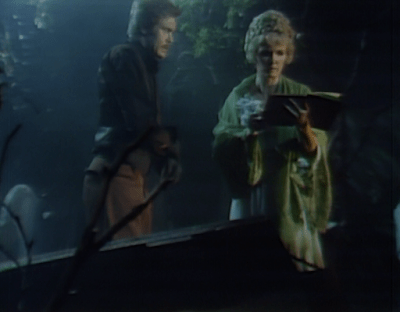
The end of the episode takes us to an old graveyard for an even more egregious example of trespass. Dirk found an old document written by the late Ben Stokes confirming that Barnabas has a secret, but ending with Ben’s vow to take that secret “to the grave.” Laura takes this expression literally, and orders Dirk to dig up Ben’s grave. Sure enough, they find more papers hidden in the coffin.
Diana Millay was a fine actress, capable of subtle psychological drama and unsurpassed at dry comedy. But her delivery of today’s opening voiceover is stunningly bad. Between her first tour of duty as Laura in December 1966-March 1967 and her current run, Dark Shadows changed from a Gothic drama aimed at adults to a supernatural thriller popular among preteens. This left little room for what she did best. She may well have been frustrated by the new situation. If so, that frustration might show in her decision to deliver the summary of the plot so far as if she were a nursery school teacher reading to a group of groggy three year olds.
Twelve year old Jamison Collins has run away from the unspeakably horrible boarding school where he has been imprisoned, and erstwhile lady’s maid Beth Chavez thinks he might be in the woods on the grounds of the great estate of Collinwood. Beth knows that her boyfriend, Jamison’s uncle Quentin, is in those woods. She also knows that Quentin is a werewolf, so she has gone out with a gun to protect Jamison from him. She does not know that the gun will stop a werewolf only if it fires silver bullets, so she is in trouble when she comes face to face with Quentin in his lupine form.
Luckily for Beth, Jamison’s father, the stuffy Edward, and his distant cousin, the mysterious and recently arrived Barnabas, happen by. They distract the werewolf, and Barnabas beats him with the silver head of his cane. The werewolf runs off, and Barnabas gives chase. Edward calls him back. Edward tells Barnabas he will need a gun to fight the werewolf, and Barnabas replies that the head of the cane will be enough. Edward demurs, saying that will work only once. Barnabas can’t very well tell the quotidian Edward that silver is the only weapon that is effective against werewolves, still less that he learned this while fighting a werewolf in the year 1969 and that he has traveled back in time to 1897 to stop the werewolf curse at its origin. Even if he somehow convinced Edward of this lunatic story, he would only increase the likelihood that a further uncanny truth would be revealed, namely that he himself is a vampire. So Barnabas helps Edward carry Beth back to the great house on the estate.
There, Barnabas decides that Jamison has probably gone to visit his mother Laura, who is staying in the groundskeeper’s cottage due to her estrangement from Edward. Indeed, we have seen Jamison there, talking with Laura about going away from Collinwood with her. Barnabas suspects what the audience is in a position to know, that Laura is an undead blonde fire witch who periodically incinerates herself and her children so that she, but not they, may rise and live again as a humanoid Phoenix. Another iteration of Laura was on Dark Shadows from December 1966 to March 1967, when the show took place in a contemporary setting. When Laura tells Jamison about the place to which she will take him, longtime viewers will hear echoes of what that other Laura told her son David in #140 about a land that “some call Paradise.”
A bat squeaks outside the window of the cottage, and Barnabas materializes inside. They haven’t tried this effect in quite a while. When they did it in #341, they superimposed the image of Barnabas in the wrong place on the screen, so that he looked like he was about four feet tall. That Mini-Bar was not very intimidating. But they get it right this time, and it makes for an effective moment.
Laura emerges from the bedroom, and is indignant to see Barnabas. He bluntly tells her that he knows she is a mortal threat to her children, Jamison and his sister Nora. He tells her he will take them from her. She says she is sure that he is capable of “tricks,” but says that she has some of her own. She causes him to suffer intense heat. He recovers, and a groggy Jamison comes staggering out of the bedroom. Barnabas grabs Jamison and sets out for the great house. When Laura again mentions her “tricks,” he replies menacingly that “You have not known mine!” Laura vows to have her revenge.
The original 1966-1967 Laura story was the first plot on Dark Shadows to be driven by a supernatural character from beginning to end, and it did involve some confrontations between Laura and the ghost of the gracious Josette. But it was nearly as slow-paced, understated, and heavily atmospheric as were the relatively naturalistic stories that preceded it. That other Laura was the right menace for a show like that. She did not come with the established imagery of familiar movie monsters like vampires and werewolves, nor was there any reason to expect her to generate a lot of violent confrontations or special effects. Despite her association with fire, Laura was a cool presence on screen. She fit with a sedate tone and appealed to an adult audience interested in the long arcs of character development. When the 1897 Laura zaps a vampire who himself just fought a werewolf, there is no coolness anywhere. The show is meant primarily for children now, and they want the heat action and imagery generate when they are packed tight into each minute. Diana Millay is certainly up to the job, though it is a shame she doesn’t have the same opportunities she had in early 1967 to display her gifts for dry comedy and subtle psychological drama.
Before Dark Shadows became a costume drama set in 1897, we learned about a number of things erstwhile lady’s maid Beth Chavez had done in that year, none of which she has yet had a chance to do. So when yesterday’s cliffhanger left Beth alone in a small room with her boyfriend Quentin Collins after he had turned into a werewolf, we could be fairly sure she would somehow escape. In today’s opening teaser, we see that she stumbles into the middle of a pentagram that was chalked onto a rug as part of an abortive effort to contain Quentin’s lycanthropy. The werewolf paws at the space above the pentagram, but cannot enter it. As a stunt performer, Alex Stevens must have had considerable occasion to practice miming, but I guess there’s only so much you can do with the old “I’m trapped in an invisible box!” routine. He gives up, goes to the door, turns the knob, and leaves.
After this comic start, the episode turns to the grimmest story they have going. Twelve year old Jamison Collins has been sent to a boarding school that the overwhelmingly evil Rev’d Gregory Trask operates as a dungeon for the torment of children and teachers alike. Jamison has been confined to a closet and kept on a diet of bread and water until he confesses to offenses Trask knows full well he did not commit. The closet adjoins the classroom where teacher Tim Shaw works. Trask’s daughter Charity, temporarily in charge of the school in her father’s absence, sees Tim in the room with some papers; she offers to help him grade them, but he says he needs to go through them himself to judge the students’ progress. When she leaves him there, he smuggles food to Jamison.
Charity catches on, and gives Jamison her father’s “favorite book of meditations” to read while in confinement. She tells him he will have “ample time to browse through it” before her father returns and decrees his additional punishment in the morning. Since the book is about 8 inches thick, it must be in very large print. It is a bit difficult to imagine speed-reading a book of meditations. (“Meditate faster!”)
Charity gives Jamison something to read during the night.
In fact, the book is so thick Jamison can use it as a step to reach a window through which he escapes. Charity is distraught when she realizes that he is gone, and Tim is gleeful to see that he used Trask’s Big Book o’ Meditations to get away.
Charity assumes that Jamison has run back home to the great house of Collinwood. She orders Tim to accompany her there. Beth lets them in and tells them she hasn’t seen Jamison. In her imperious manner, Charity demands that Beth let them search the house, and dismisses out of hand her reply that she does not have the authority to permit such a thing.
In fact, Jamison did come to the house, and Beth is covering for him. He knows the place well enough that even if Charity did have free rein to search for him she probably wouldn’t find him. Jamison went into the drawing room when Charity and Tim came. Charity insists Beth let them into the drawing room. She is disappointed that Jamison isn’t there, and says he must have gone out the window. Regular viewers know that there is a secret passage leading from the drawing room to the west wing, and that the west wing has a myriad of hiding places.
Evidently Beth is unaware of that passage, because she seems to believe Charity is right. She is afraid that Jamison is in the woods, where she knows the werewolf is roaming, and once Charity and Tim have left she goes out there with a gun. Again, those who have been watching the show know something Beth does not, that the gun is formidable to the werewolf only if it is loaded with silver bullets. When she finds the werewolf and points the gun at him, we again come to a cliffhanger ending that leaves Beth’s life in jeopardy.
Libertine Quentin Collins murdered his wife Jenny the other day, shortly after he learned that she was the sister of broad ethnic stereotype Magda Rákóczi. Since Quentin is convinced that Magda has magical powers, this would seem to suggest a low degree of impulse control on his part.
Magda did place a curse on Quentin, and she refuses to tell him what it is. Last night he doubled over in pain, lost consciousness, and disappeared from the great house on the estate of Collinwood. This morning he has shown up in the foyer, flat on his back, his clothing in shreds and blood all over him. His girlfriend, Jenny’s former maid Beth, found him and helped him to his room. Neither of them can figure out what happened to him overnight.
Meanwhile, Collins family attorney Evan Hanley has come to meet with Quentin’s sister Judith, who owns the estate and the Collins family’s businesses. Judith is enraged that Quentin took $10,000 from her in return for signing an agreement to leave the house and never come back, but has refused either to leave or to return the money. Evan assures Judith he will take care of the matter at once. While he is still in the drawing room, Judith answers the telephone. She learns that a young woman named Dorcas Trilling was brutally killed on the estate the night before, her body ripped apart as if by a wild animal of some kind.
Unknown to Judith, Evan and Quentin are members of a Satanist coven. Evan does call on Quentin and Beth in Quentin’s room, and he does deliver Judith’s message. He and Quentin both ask Beth to leave so they can discuss another matter. At first she resists, but finally she does go. Quentin tells him what happened the night before and that he believes Magda has cursed him. Evan sees the bloody clothing in a pile on the floor, and his face shows a grim surmise. Nonetheless, he does not tell Quentin about Dorcas.
Quentin asks Evan to help him with Magda. Evan says that he will do so, but cautions Quentin that his help will come at a very high price. Quentin asks what happened to their friendship. Evan tells him that “There is no such thing as a friend” and laughs. That must come as quite a nasty shock to Quentin. You spend time with a fellow conjuring up demons, forging wills, and working together to impoverish half your family and kill the other half, and you think you mean something to each other. But no, it just isn’t that way with Evan.
Evan calls on Magda at the Old House on the estate. Magda is coy and does not tell him anything he does not already know, but he does notice that she is wearing a pendant in the form of a pentagram. She says it is just a bit of Romani jewelry, worth only a few cents. He offers her a hundred dollars for it. She refuses, saying that it was a gift from her late mother, and offers to show him other pieces of the same type. Evan tells her that he knows the pentagram can protect against many supernatural menaces, and asks which one she is guarding against at the moment. She keeps mum.
Back in Quentin’s room, Evan chalks a pentagram all over his rug. He tells Quentin and Beth that at nightfall, they must set two black candles burning, one in each of two points of the pentagram, and Quentin must take up a position in the center of the pentagram. He must not move from this spot until daybreak.
The year is 1897, and the first vacuum cleaner wasn’t invented until 1901. It’s going to be quite a job to clean that rug. Screenshot by Dark Shadows Before I Die.
Quentin is having an anxiety attack, and refuses to cooperate with Evan’s plan. This is consistent with his character as we have seen it so far. In #710, he and Evan summoned a creature to rise from Hell and smite one of their enemies, and when a form actually started to take shape, he panicked and tried to run away. Quentin is obsessed with black magic and the occult, but when it turns out there is something to all of his spells and incantations, he cannot bring himself to face the reality of it.
Quentin declares that he wants a plan that “makes sense.” He then says they have to kill Magda. Evan replies that that is the worst thing they could possibly do. If they kill Magda, there will never be any way to lift the curse.
Later that night, Beth and Quentin are still in the room. The pains come on Quentin again. She hurriedly picks up the chalk and redraws the parts pentagram that Quentin had smudged, then sets a chair in the middle. She tries to get Quentin into that chair, but he is unable to get himself onto the seat. She turns to look for the black candles, then hears snarling and growling. She turns to the spot off camera where Quentin is, and reacts with horror. We know that Quentin is a werewolf; now she knows it, too. As the closing credits roll, it does not seem likely that she will have much chance to make use of that knowledge.
Libertine Quentin Collins presents himself as maidservant Beth Chavez’ great love. He wants her to run away with him and make a new life together, and to do so right now, before the curse he brought upon himself by murdering his wife in front of Beth kicks in. She is inclined to go along with him, but he collapses in agony before they can leave her room.
Teacher Dorcas Trilling presents herself as the most faithful devotee of the Rev’d Gregory Trask, keeper of a brutal dungeon for children disguised as a boarding school called Worthington Hall. Dorcas asks Trask why he keeps her disobedient colleague Rachel Drummond on the faculty. Trask tells Dorcas that he thinks of Rachel as a thorn in his flesh. She stirs up his basest impulses. Regular viewers know how true this is- in their scenes together, Trask has not only extorted Rachel to come to work for him, but has repeatedly made it clear that he wants to force her into a sexual relationship as well. But the base impulse he admits to in his conversation with Dorcas is anger at Rachel’s wickedness. He says that he keeps her around as a way of building his resistance to the sin of wrath. Dorcas takes the bait, and declares that it makes her admire Trask all the more.
Rachel presents herself as the protector of twelve year old Jamison Collins, heir presumptive to spinster Judith Collins as the owner of the great estate of Collinwood and the Collins family’s business enterprises. She slips out of Worthington Hall, which is currently operating from a house on the estate, in order to tell Judith that Trask has falsely accused Jamison of academic misconduct and is refusing to feed him until he confesses. As it happens, Trask confirmed to Dorcas that this is true, and said that by forcing Jamison to confess to something he did not do he will teach him humility. Dorcas is so far gone that this admission of loathsome injustice adds further to her admiration for Trask.
Beth presents herself as Quentin’s representative in a telephone call to the doctor. When she finds that the doctor is out, she urges his assistant to call back as soon as possible. She is about to go back to check on Quentin when Rachel comes to the great house looking for Judith or for Jamison’s father Edward. Beth tells her that they are out, and that there is an extreme emergency in progress. Rachel accompanies her to the room. They find that it is in a shambles and Quentin is gone. They return to the foyer, where the telephone rings. Beth is disappointed it is not the doctor. It is Trask, and he asks to speak to Rachel. Beth hands her the telephone.
Trask presents himself to Rachel as her “most concerned friend.” He also reminds her of his threat to frame her on charges of theft and murder, and demands she return to the school at once. As she has done before, she crumbles and rushes off. Beth watches her go with puzzlement, as others have done on those previous occasions.
Dorcas presents herself as a spy and enforcer for Trask. After Trask tells Rachel he has docked her a week’s pay for trying to feed Jamison against his orders, Rachel catches Dorcas listening at the door. Rachel leaves the room after their confrontation. We see Dorcas alone for a moment, then hear a window breaking and see her horrified reaction. We hear growling and snarling. Rachel comes in, Trask follows, and they see Dorcas’ mangled corpse. Returning viewers know that Quentin’s curse is that he has become a werewolf. Dorcas is his first victim.
Dorcas is played by Gail Strickland, who went on to have a huge career on TV in the 1970s and 1980s. Miss Strickland is a fine actress, and it is a terrible shame she wasn’t on the show more. Terrayne Crawford, who plays Beth, is good today, but she could really only project one emotion at a time. That is a grave weakness in this part of Dark Shadows, when most characters have complex motivations in almost every scene. In Miss Strickland’s hands, several scenes that were flat and tedious due to Miss Crawford’s literalist acting style would have been exciting and nuanced. Beth was originally seen as a ghost who did not speak but made an impression by her stark yet lovely features. Miss Strickland’s looks could have that effect as well as did Miss Crawford’s. Indeed, I suspect she must have attracted the producers’ attention when they were deciding between the two of them for the role of Beth.
As of this writing, every member of today’s cast is still alive. When you’re watching a show and posting about it on the 56th anniversary of its original airdate, that’s an unusual thing to see. I believe it is the first such episode we have come upon.
The name “Magda” was first mentioned on Dark Shadows in #642, broadcast and set in December 1968. At that time, the residents of the great house of Collinwood had noticed unaccountable goings-on, and as they often do they held a séance to appeal to the spirits of the dead for guidance. The spirit they reached in that one identified herself as Magda. She repeated two things- “My curse!” and “He must not return!” Magda said enough to suggest that she had cursed someone and regretted doing so, and that she knew that the Collinses were threatened by the return of someone from her own period, but that was all. Since the Collinses of 1968 had never heard of anyone associated with their house named Magda and could find no record of such a person, those suggestions remained vague and useless to them.
They meant a good deal more to regular viewers. We already knew that the malign ghost of Quentin Collins had appeared in a room in the long-deserted west wing of the great house, that children David Collins and Amy Jennings were falling under the ghost’s influence, and that Quentin lived at Collinwood near the end of the nineteenth century. We therefore assume that Quentin is the one who “must not return!,” and that Magda, whoever she was, must have known Quentin and therefore also have lived sometime in the 1890s.
Among the participants in the séance was Amy’s older brother, mysterious drifter Chris Jennings. Chris broke the séance off before Magda could go into enough detail to help the others. The show had long since established that the person who ends a séance prematurely is the one who harbors a dreadful secret that the voice from beyond might uncover. Even the characters have caught on to this pattern; they treat Chris with suspicion. They do not know what we do, that Chris is a werewolf. So he is indeed under a curse, and we can take it that his curse originated when Magda placed it on one of his ancestors.
Over the next few months, Quentin’s power steadily grew, and at the same time Chris’ periods in his animal form grew longer and more frequent. These two developments moved in such close tandem that we had to suspect that there was some causal relationship between them. This suspicion was reinforced when, in #683, another ghost associated with Quentin, that of a tall, thin, blonde woman named Beth, led Chris to what proved to be the unmarked grave of an infant. That infant was wearing an amulet meant to ward off werewolves. The records of the silversmith who made the amulet showed that it was commissioned and paid for in 1897 by Quentin Collins and Beth Chavez. Thus we learned that a werewolf was active in the area of Collinwood when Beth and Quentin were alive, and that they cared about a baby who died at that time. The logical inference would be that the curse under which Chris labors originated at that time, that Beth and Quentin had something to do with it, and that the baby was related to someone who became one of Chris’ ancestors.
Now, the show has become a costume drama set in 1897. Quentin and Beth are alive. Beth is a maidservant who first came to Collinwood in the train of Quentin’s estranged wife, Jenny. Quentin left Jenny and was banished from the house the previous year; word was put about that Jenny responded to the desertion by going away and leaving no forwarding address. When Quentin returned to Collinwood in #701, he was surprised to find Beth still on staff, and he set to work trying to seduce her.
In #720, Quentin discovered that Jenny had not in fact gone so far away as he and everyone else had been led to believe. She turned up and stabbed him. He then learned that Jenny had become violently insane when he left her and that his sister Judith and brother Edward had responded to her illness by locking her up in a room hidden inside the great house. They kept Beth in their employ because she was the one entrusted to care for Jenny.
Now, Beth has given in to Quentin’s charms. The other night Jenny was hiding in Beth’s room while Beth and Quentin shared a tender moment, and she reacted by coming at them with a knife. Quentin disarmed Jenny, restrained her, and then put his hands around her throat. While Beth pleaded with him to stop, he choked Jenny to death. He keeps protesting that, because Jenny at one point had a knife, this was an act of self defense, but the audience and Beth both saw what happened, and she won’t agree with him any more than we will.
Edward and Judith have decided to shield Quentin from the legal consequences of his actions, and in the village of Collinsport the will of the Collinses supersedes the laws of the state of Maine. But Quentin finds no comfort in his immunity from criminal prosecution. Just hours before he murdered Jenny, Quentin discovered that he knew nothing about her origins. He thought she was some kind of Anglo, but she was passing. She was actually a Romani woman. Her sister is one of the neighbors, broad ethnic stereotype Magda Rákóczi.
In Wednesday’s episode, Edward convinced Magda the police and courts would do nothing to punish Quentin, and so Magda threatened to place a curse on him to avenge Jenny’s death. Edward, a rational-minded modern man, dismissed Magda’s threat as “words.” But Beth and Quentin know things about the universe they occupy that Edward does not know. When Beth heard Magda’s threat, she looked wide-eyed at Quentin, walked backwards away from him, and ran off. Quentin, who is obsessed with the occult, was immediately terrified, and has been dissolving into a puddle ever since.
Yesterday, Quentin fell into a trap Magda set for him and brought a curse upon himself. Today, Magda stands with her husband Sandor by Jenny’s grave, watches the full Moon rise, and recites an incantation specifying that Quentin’s male descendants will suffer from the same curse he does. So far as Magda knows, Quentin does not yet have any descendants, male or female, and so that proviso is just an abstraction for her.
We know more than Magda does. Not only have returning viewers heard her spirit say that she regrets the curse and been led to the conclusion that it fell on Chris Jennings, but even those who are watching the show for the first time today know that Quentin and Jenny are the parents of twin infants whom Judith is paying a Mrs Fillmore to raise in her home in the village of Collinsport. Mrs Fillmore’s name was first mentioned in #707, and it comes up today when Judith is firing Beth.
Judith explains to Beth that, since Jenny is no longer around, she no longer has any work to do at Collinwood. She indicates her dissatisfaction with Beth, and says that it is only through Edward’s influence that she included a severance payment with her letter of dismissal. Beth mentions her task of taking money to Mrs Fillmore to pay her for taking care of Jenny and Quentin’s children; Judith does not see a need to retain an employee simply to carry an envelope full of cash to the village every now and then.
Beth objects that Judith is terminating her employment because she has become involved with Quentin; Judith takes that as an opportunity to castigate her for the impropriety of that relationship. Joan Bennett plays Judith’s reaction to Beth quite effectively; in a comment on Danny Horn’s post about the episode at Dark Shadows Every Day, “Rev Velveteen” writes:
I wanted to mention a Judith Collins, er, Joan Bennett acting moment I found particularly entertaining here. When she’s giving Beth the boot and the servant attempts to “innocently” inquire as to why she’s being let go, Judith turns around and gives her SUCH a look! Huge eyes, a stifled gasp, then bright pursed lips…Her expression goes from incredulous (Are you freaking KIDDING me?) to amused (Just how stupid does she think we are?) to triumphantly satisfied (Fine, we shall just both play out this little charade and I’ll soon be rid of you.) Her chin goes up as she turns away snarkily-“Let’s just say that now Jenny’s gone, your services are no longer needed,” which everyone on and off screen knows is a total lie. It’s such a sweet piece of work by Ms. Bennett, I need to keep an eye out to see if she repeats that expression because it just sums up the whole character of any Collins she plays when as the perpetual straight man, she’s faced with yet another absurd situation. And is also just stunning in that gorgeous green dress.
Comment left by “Rev Velveteen” at 12:43 am Pacific time, 25 June 2020, on Danny Horn, “Episode 750: Gypsy Ascendant,” 18 October 2015, Dark Shadows Every Day
Yesterday, Judith gave the penniless Quentin $10,000 on condition that he leave Collinwood forever and induce Sandor and Magda to do the same. Quentin had hoped to use the money to bribe them into forgoing Jenny’s vengeance, but they only pretended to take it to lure him into bringing the curse on himself. Magda contemptuously threw the cash at him after he did so.
Quentin has told Judith that Magda took the money and agreed to go. Today, Magda comes to the house to ask for Jenny’s things. Judith starts in with lecture about how she must go at once, since she and Sandor have been paid so well to leave, and Magda reveals that she did not take the money. Enraged at Quentin’s childish lie, Judith demands he return the $10,000. He tells her to sue him, and stalks off. Judith fumes, knowing that she has been cheated and that she cannot assert her rights without creating the public scandal that she fears above all else.
Quentin finds Beth packing Jenny’s things. He tells her he has to leave tonight, and announces that she will be coming with him. She responds in a mild tone that she doesn’t seem to have any say in the matter. She tells Quentin that she has lost her job, and says that she will give him her decision in the afternoon.
Sandor comes for Jenny’s things. Quentin offers him the $10,000 all for himself if he can lift the curse. He says he doesn’t know how. Quentin says he will give it all to him if only he will tell him what form the curse will take. Sandor shakes his head at Quentin’s desperation and says that knowing that would be of no benefit to him.
As night falls, Quentin goes to Beth’s room. She agrees to go with him, but insists on running a personal errand first. Even though she just told him that they have to be honest with each other, she will not tell him what it is. She is still honoring Judith and Edward’s decree that Quentin must not know that Jenny gave birth to his twin children after he left her, and that they are in Mrs Fillmore’s care.
Quentin keeps saying there is no time left to do anything but run. We might wonder why he didn’t stop by Beth’s room earlier. She is on her way out the door when Quentin cries out and collapses in severe pain. Regular viewers recognize Quentin’s pains as the same Chris had when he turned into a werewolf. When we see the rising moon and hear the baying of the hounds, we know who Chris’ forebears are, and why Magda came to regret her curse.
In the parts of Dark Shadows set in the 1960s, Louis Edmonds plays Roger Collins, younger brother of matriarch Elizabeth Collins Stoddard. In 1966 and 1967, we saw that Roger had squandered his entire inheritance. He was reduced to living as a guest in Liz’ house and working as an employee for her business. Roger was the show’s first villain. His villainy was confined to a storyline known as “The Revenge of Burke Devlin.” That story never really caught on, and by #201 even Burke Devlin had lost interest in it. Roger receded to the margins, and for the rest of the series Edmonds’ gift for sarcastic dialogue kept the character alive as occasional comic relief.
From November 1967 to March 1968, Dark Shadows was a costume drama set in the 1790s. Edmonds, a costume drama specialist in his years on Broadway, came into his own as haughty overlord Joshua Collins. Joshua’s focus on moneymaking and his determination to preserve the glamour of the Collins family name at all costs placed him at the opposite pole from Roger, a blithe spendthrift pathologically lacking in family feeling. Joshua used his power to cover up all of the tragic and horrible events we saw in the 1790s segment, and imposed a false history in its place.
Now, the show is set in 1897. Edmonds plays Edward, the stuffy eldest brother of the adult members of the Collinses of Collinsport. Edward has Joshua’s imperious demeanor and his determination to conceal the family’s disgraces, but like Roger he finds himself penniless, dependent on his sister’s largess. Yesterday he learned that his youngest brother, libertine Quentin, had killed his estranged wife Jenny. So far, Quentin has been a breezily amoral wastrel, easily recognizable to longtime viewers as a kindred spirit of his great-nephew Roger. But Quentin shocked himself when he murdered Jenny, and he had a terrified look on his face as he tried to sneak out of the house afterward.
Edward intercepted him then and forbade him to go. Edward had learned from Quentin’s girlfriend, Jenny’s former maid Beth, what happened. Edward was in a high dudgeon about the mess Quentin had made, but did not seem particularly surprised or at all grieved. He was quite confident he would be able to hush the whole thing up, and fabricated a story about Jenny falling down the stairs and dying shortly after from a head injury.
What did shock Edward was Quentin’s revelation that Jenny was the sister of one of the neighbors, Magda Rákóczi. Magda is a member of the Romani people, an ethnicity against whom Edward and the rest of the Collinses are violently prejudiced. “You married a Gypsy!” he exclaims in utter disgust. He remained convinced that he could keep the whole thing quiet, and drilled Beth and Quentin in the lies they were to tell Magda and her husband Sandor.
Magda did not give Edward a chance to direct the little play he had written. She found physical evidence indicating Quentin had murdered Jenny, and accused him. When she threatened to go to the police, Edward asked her what she imagined the authorities would do when asked to choose between the word of a Collins and the word of a “Gypsy.” At that, Magda dropped her plan to go to the police and vowed to place a curse on Quentin. Edward dismissed that as “words,” but Quentin is deeply involved in the occult. He is helpless with fear.
Today, Edward calls on Quentin in his room. He finds that Quentin has not slept all night. He continues to regard Quentin’s fear of Magda’s curse with total contempt, but perks up when Quentin says that he has thought of a way to escape it. Returning viewers already know that there is one way wide open to Quentin to escape the curse. He can go to the police and confess that he murdered Jenny.
This, of course, is not Quentin’s idea. He wants to offer Magda $10,000. Neither he nor Edward has that kind of money, but their sister Judith, whom their grandmother chose as her sole heiress, does. Edward says that he might be able to persuade Judith to give him that sum on one condition. Their grandmother’s will left Quentin no property or income, but it did guarantee him the right to live in the great house of Collinwood as long as he might wish. If he will sign documents renouncing that right, Judith might give him the money.
Quentin drifts off to sleep. He has a nightmare. Sandor and Magda show him Jenny’s body and tell him he can escape punishment if he blesses it. He does so, and Jenny comes back to life. She asks for a kiss. Quentin gives it, and Magda and Sandor laugh. They say that the kiss has sealed his fate- it is “the kiss of death!”
Edward returns with word that Judith will give him his $10,000, but that she has added a condition. Not only Quentin, but Sandor and Magda too, will have to leave the area forever. Quentin promises to make that happen, and signs the papers.
Meanwhile, Magda and Sandor are at home in the Old House on the grounds of the estate. Magda has mixed a potion and told Sandor that “a very old Gypsy woman” once used it to place a terrible curse on someone called “Count Petofi.” All they have to do is trick Quentin into drinking the potion, and the same curse will befall him. Sandor disdainfully replies that he had thought Magda might have come up with a plan that had a chance of working. He can’t imagine Quentin drinking anything they might give him.
They look out the window, and see Quentin coming to the house. They are pleasantly surprised that he is delivering himself. He knocks. They open the door, and he bursts in. Magda makes a great show of telling him he is not welcome and demanding he leave. He tells them about the nightmare, and says he knows that it is part of the curse. He offers them money to lift it. Magda is at first openly offended, while Sandor behaves as if he is tempted. Quentin shows them the money, and Magda plays the part of a woman succumbing to greed. She asks Jenny’s spirit to forgive her, and takes the envelope. She makes a gesture that Quentin takes to be an act of spellcasting. While she counts the money, Sandor says they will have to share a drink to complete the deal. Quentin happily agrees.
Once Quentin has taken the drink, Magda tells him that he has been fooled. The nightmare was not part of any curse, but was simply the voice of his own conscience. She tells him that the drink brought the curse on him, and that he will begin to suffer its effects tonight. She throws the money at him and tells him to take it. He reels away, dazzled by the horror of it all.
Magda’s curse shows the limits of the Collinses’ power. Their prestige and connections enable them to intimidate the authorities so that they need not worry about an insistent police investigation. But their freedom from that concern has allowed Quentin to travel so far into depravity that he has committed murder and brought a curse upon himself. When they encounter someone who will not be intimidated, their only recourse is to money. Magda’s unwillingness to sell her sister’s vengeance for any number of dollars means that the rich Judith would be as powerless against her as are the impecunious Edward and Quentin.
Not only has the Collinses’ station led Quentin to indulge himself in one vice after another until he is so far gone he cannot imagine good behavior, it has led him to assume that everyone assigned to a humbler place in the world can be bought. Sandor and Magda are quite good actors, almost as good as Thayer David and Grayson Hall, and they look very much like people who are tempted to take the bribe Quentin is offering. But even to make the offer shows a complete lack of perspicacity. Jenny has not been dead for twenty four hours, and he somehow supposes her sister is ready to bargain away her memory.
Quentin cannot say he wasn’t warned. His dream told him that Magda and Sandor would trick him into bringing the curse on himself by leading him to believe they were giving him a way to escape the curse. He is so far gone in the symptoms of his over-privileged background that he cannot even interpret this message. Thus we see that the real curse of the Collinses, the obstacle that blocks the sunlight and casts all the dark shadows that shroud them, is their wealth and power. The first ten months of the show made some feints towards developing a social drama about the relations between the Collinses in their house on the hill and the working people in the village below. The village is mentioned nowadays only as a source for victims of the various monsters bred at Collinwood, but the price everyone pays for the Collinses’ exalted position is always front and center.
Madwoman Jenny Collins is hiding in the quarters of her formerly devoted servant, Beth. Beth enters with Jenny’s estranged husband, libertine Quentin. Jenny eavesdrops as Beth tearfully tells Quentin that she was once very close to Jenny, but that now she wishes her ill, because she is in love with him. Quentin and Beth embrace, and Jenny lunges at them with a kitchen knife.
Quentin disarms Jenny and strangles her. We were introduced to Quentin as a murderous ghost haunting the great house of Collinwood in 1969, and when we first came to the year 1897 to meet him as a living being it was a matter of minutes before he was squeezing his grandmother’s throat and threatening to kill her. Quentin has been going around the house announcing for days and days that he plans to kill Jenny, so it comes as no surprise to the audience that he puts his hands around her neck even though she has already been disarmed, fights off Beth’s attempts to stop him, and keeps choking Jenny until some time after she has stopped moving. We have been well-prepared for this unambiguous image of intentional homicide.
Once Quentin has finished his work, he runs out of the room. Beth goes to the foyer and, between sobs, tells Quentin’s stuffy brother Edward that Jenny is in her room, dead.
In Beth’s room, Edward feels Jenny’s wrist and says that she is indeed dead. Once Beth has given him a few of the salient details of the murder, he declares that he has heard enough. He orders Beth to take the knife back to the kitchen and put it where it belongs. They talk briefly about Jenny and Quentin’s children, whose existence has previously only been hinted to the audience and has been denied to other characters as recently as yesterday.
We cut to the foyer. Quentin comes creeping down the stairs, holding a bag and looking from side to side. When Quentin reaches the foot of the stairs, Edward seizes the bag and orders him to stay in the house. In the drawing room, Edward tells Quentin and Beth what story they will put about to cover up the murder and save the family name. Beth is to say that she found Jenny lying at the foot of the stairs, stunned. She helped Jenny to her room, then left her there for a moment while she went to look for help. Finding no one, she came back and saw Jenny lying on the bed. When she could not wake her, she realized she had died of the injuries she sustained in her fall.
Quentin says that the story will not work. He tells Edward that earlier in the evening, Jenny’s presence at Collinwood was revealed to three more people, distant cousin Barnabas Collins and ethnic stereotypes Magda and Sandor Rákóczi. Edward says that as a member of the family, Barnabas will not question the story, and that as “Gypsies,” Sandor and Magda will do anything in return for money. Quentin says that Magda and Sandor will not be so easy to deal with. When they learned that Jenny was in the house, Magda told Quentin something which he tells Edward and Beth “None of us ever knew,” that Jenny was her sister.
Edward is thunderstruck, and exclaims “You married a Gypsy!” Yesterday it seemed that Edward and Quentin’s sister Judith, the owner of the house, had known Jenny’s origin for some time, and that it was why she locked Jenny up in the house when she went insane rather than sending her to a mental institution where Sandor and Magda might be among her visitors. And as far back as #701, it seemed likely that Beth knew secrets relating to Jenny, to Magda, and to Romani heritage. In that episode, Quentin marveled that Beth was still around Collinwood when Jenny, who had brought her to the house as her servant, had left, and Magda taunted Beth by bringing up a bit of Romani folklore and laughing “But you wouldn’t know anything about that, would you?” So while Jenny’s background is news to Quentin and Edward, it may not be true that “None of us” knew.
Magda and Sandor come to the house. On their previous visits to the great house, they have acted like servants or like stage Gypsies come to tell fortunes and sing songs. But now that the word is out about Jenny’s true identity, they come in with their heads up and look Edward in the eye. They say that they have come to see Jenny. Edward turns away from them, and says that there has been an accident. Jenny is dead. Horrified, Magda asks where she is. Edward says that she is in Beth’s room, and offers to have Beth show them the way. Magda says that she knows where it is, and that she and Sandor want to go by themselves. Edward says “Of course,” very much in the tone a gentleman uses with his equals.
In the room, Magda notices that Jenny is holding a button in her hand. She concludes that she pulled it off the coat of a man with whom she was fighting for her life. Sandor notices heavy bruising around her neck.
Meanwhile, Edward is drilling Beth and Quentin in the stories they are to tell. Beth recites the whole thing, and he tells her to remember every word. Quentin is less cooperative, but still seems to have learned his part. He tells them not to speak until they are spoken to.
Sandor and Magda enter. She asks some questions; Edward answers, and shows offense when she tries to direct them to Beth. Before he can proceed to the next act of the little drama he has prepared, letting first Beth and then Quentin corroborate his account with the stories he has given them, Magda looks at Quentin’s coat. She can see that a button is missing and that the ones that remain match the one she found in Jenny’s hand. She calls him a murderer, and says that the police will hear of it.
Edward says that Quentin might have lost the button anywhere at any time. He asks her what the authorities in the village of Collinsport would do if asked to choose between a Romani person’s word and that of a Collins. Magda drops the idea of going to the police, and tells Quentin that she will place a curse on him that will make him suffer as Jenny suffered, but that his suffering will not be subject to the release that death has brought Jenny. Quentin is terrified, Edward dismissive.
From the very beginning, one of the main themes of Dark Shadows has been denial, the psychological defense mechanism. In this one, we see that denial is, among other things, the wish that time would stop moving forward. Quentin says that he is not going to go to jail for something he did not mean to do. He obviously did mean to kill Jenny, but he does not want to accept any of the consequences that follow from that act. He wants to be frozen in his comfortable, carefree life, without punishment from the law or vengeance from Magda. Edward wants the family name to be frozen in the lofty regard in which it was held before Quentin murdered Jenny.
For her part, when Magda tells Quentin it will not be possible for him to die, she is promising to give him and Edward what they want, but not in the way they want it. A curse is a way of freezing time. The suffering it brings persists, unchanged, from year to year. It cannot be explained, it cannot be escaped, it falls on one person after another whatever their deserts. Its only logic is to renew itself endlessly.
Madwoman Jenny, estranged wife of libertine Quentin Collins, is on the loose again, and she is the object of a madcap search by Quentin’s sister, spinster Judith, his girlfriend, maidservant Beth, and his distant cousin, secret vampire Barnabas. Quentin makes two contributions to the process. The less important is to serve as the bait in a cockamamie trap Barnabas and Judith lay for Jenny. The more important is to keep up a running commentary mocking the other characters for the silliness of their activities.
The trap itself involves a moment of intentional humor. Barnabas has returned to the year 1897 to prevent Quentin becoming a ghost who will ruin things for everyone on the great estate of Collinwood in 1969. One of the things Quentin did in that year that terrified the characters and tried the patience of the audience was to cause the strains of a sickly little waltz continually to resound from the walls of the great house. When the show became a costume drama and we got to know the living Quentin, we found that he too played a gramophone record of that same tune incessantly, annoying all and sundry. The trap requires Quentin to play the recording over and again until Jenny hears it and comes. After it has been going for half an hour, Barnabas tells Quentin that the plan didn’t work and they should stop playing the waltz. Quentin asks “Are you tired of hearing this music?” Barnabas speaks for all of us when he replies “Frankly, yes.”
Not only is this a successful comedy, it also gives the cast an opportunity for some of their best dramatic acting. As Judith, Joan Bennett at one point stops, looks at Barnabas, and asks “Can we trust you? Really trust you?” She apologizes for the bluntness of that question, then admits that she has long been busy putting a prettier face on the Collins family than the dark secrets Barnabas has discovered make plausible. “I’m not really very trusting. I try to pretend we’re nicer than we really are.” In the parts of Dark Shadows set in the 1960s, Bennett plays matriarch Liz, whose whole personality is about denial and the pretense that the Collinses are nicer than they really are. Liz latched onto Barnabas as soon as she saw him, and refuses to see any evidence that he is not quite normal. Nor does she ever really face her own habits of concealment and their implications. In this little exchange, we see Bennett playing a character whose superficial similarities to Liz point up her profound differences from her.
“Can we trust you? Really trust you?”
Joan Bennett had one of the most distinguished careers of any American actress of the twentieth century. Terrayne Crawford stands at something of the opposite pole, and her performance as Beth leads most fans to declare that she is the weakest of all the members of the cast of the portion of Dark Shadows set in the year 1897. I don’t really disagree with that, but she is fine today. Miss Crawford’s great limitation was that she could play only one emotion at a time, and she was on the show in a period when the scripts gave every character complex motivations in almost every scene. But today, all Beth has to play is Anguish, and Miss Crawford does a fine job.
Beth took care of Jenny during the year Quentin was away from Collinwood, and became very close to her. In the nine and a half weeks since Quentin’s return, she has fallen in love with him. In a scene at the close of today’s episode, Beth tearfully admits to Quentin that she wishes something would happen to Jenny so that he would no longer have a wife. Beth collapses into Quentin’s arms. Jenny has been hiding in a corner, eavesdropping; she comes out, holding a knife. There have been occasions when we might have rooted for Jenny to succeed in killing Beth, just to spare us the embarrassment of Miss Crawford’s flat, tedious performances. But this time, we want to see more of her, and the prospect that Beth might die makes for an effective cliffhanger.
Vampire Barnabas Collins rises from his coffin in the basement of the Old House on the estate of Collinwood and calls for his unwilling sidekick, ethnic stereotype Magda Rákóczi. Magda has news for him. She has found madwoman Jenny Collins, estranged wife of libertine Quentin Collins, locked in an upstairs bedroom. Barnabas is not surprised about that. He was the one who locked Jenny there, and before dawn he left Magda a note telling her where Jenny was and instructing her to look after her until he came back to life. But Magda never saw the note. Quentin came to the house and read it before Magda came home. He tried to kill Jenny and was stopped by the timely intervention of his girlfriend, maidservant Beth Chavez. He came back later with another plan to kill Jenny, and that time Magda herself stopped him and threatened to place a curse on him unless he gave up.
Magda and her husband Sandor figured out that Quentin’s siblings, stuffy Edward and spinster Judith, have been keeping Jenny locked up in the great house ever since Quentin left her and she went mad over a year ago. They have also figured out that she escaped from the great house, made her way to the Old House, and that Barnabas saw that she was dangerous and trapped her in the room. They wanted to keep her there until they could make arrangements to take her to a Romani caravan where she could be taken care of. Magda and Sandor felt a responsibility to do this, because Jenny is Magda’s sister.
When Magda interrupted Quentin’s second attempt of the day to kill Jenny, she told him that Jenny was her sister. He was stunned. He had no more idea of this relationship than the audience did until we learned of it yesterday. He was so utterly shocked that his wife was a member of an ethnic group he despises that he went almost two full minutes before making a flip remark about it. That’s a record for Quentin.
Barnabas is also quite surprised to learn that Magda is connected to the Collins family by marriage, but it does nothing to change his plans. He has come to the year 1897 to prevent Quentin becoming a ghost who will ruin things for everyone at Collinwood in 1969, and he says that he dare not change anything that would prevent the events of the years in between from taking the shape they did originally.
This does not make much sense. Barnabas does not know why Quentin became a malevolent ghost, so he has no way of knowing how much history will have to change to prevent that outcome. Moreover, he has been quite reckless with the timeline in many other ways. In #704, Barnabas bit a girl named Sophie Baker, evidently killing her. Sophie wasn’t his only victim- in #740, Magda mentioned that Barnabas’ bite marks had been found on “girls”- plural- in the nearby village of Collinsport. Presumably those girls were dead when the marks were found. So he has already committed more than one homicide, ending the lives of people who would otherwise have worked, had children, and made who knows what other kinds of contributions to the history of central Maine. And he is continually picking fights with people and meddling in matters that don’t seem to have anything to do with Quentin’s future ability to rest in peace.
What Magda does not tell Barnabas is that Jenny at one point during the morning got away from her and Sandor, went downstairs, and saw him in his coffin. Magda frantically tried to persuade Jenny to keep this secret, but Jenny has so little contact with the world everyone else lives in that it would seem unlikely she will remember she promised not to talk about what she saw.
Barnabas is about to climb the stairs to go talk to Jenny when a knock comes at the door. It is Judith. Quentin has told her that Jenny and Magda are sisters. Judith and Magda have a testy exchange, ending when Barnabas orders Magda to go upstairs and see to her sister.
Judith probes to see what Barnabas knows and what he is planning to do. She says that he has seen the family at its worst, and knows all its most horrible secrets. He assures her that he is not interested in passing judgment. He mentions Jenny’s children; Judith tells him she has none, and he says that he thought she did only because she claims to have. The audience has known since #707 that Judith is sending money to a woman named Mrs Fillmore to take care of a problem relating to Jenny; it seems likely that this money is going to care for Jenny and Quentin’s twin children. After a few moments, it is clear to Judith that Barnabas has not penetrated very deeply into the secrets surrounding Jenny, and she begins to relax.
Joan Bennett plays Judith’s behavior very subtly. She is calm, quiet, a bit weary. She moves her eyes slightly from side to side, and occasionally purses her lips at the corners. Judith does not look like someone who has just learned shocking news, but like someone who is trying to figure out how to keep the rest of an old secret once part of it has leaked out. Bennett invites us to conclude that Judith has known of Jenny’s family background for a long time.
Judith getting her story straight.
Jenny bursts in, sees Barnabas, and declares that he is dead. She saw him in his coffin, she exclaims. This is not much of a cliffhanger ending. Jenny’s whole life is one long mad scene. If anyone starts to doubt whether Barnabas is quite what he seems, all he or Magda or anyone else who might be on his side now has to do is point out that the doubter is echoing Jenny, and they will be instantly discredited. This winds up as another in the long series of strokes of luck that have enabled Barnabas to keep operating for so long.







 Dark Shadows Commentary