Everything in this one is designed to induce a sense of claustrophobia.
Dangerously unstable ruffian Willie Loomis has presented himself at the great house of Collinwood as the guest of seagoing con man Jason McGuire. In the opening section, Willie and Jason go into the drawing room. Willie closes the doors of the drawing room, a gesture that had been reserved to reclusive matriarch Liz for the first 32 weeks of the show, and in the five weeks of Liz’ absence was something well-meaning governess Vicki occasionally did when she was effectively in charge of the house. On Monday, dashing action hero Burke Devlin briefly seized control of Collinwood, and he began his fifteen-minute reign by closing the drawing room doors. Regular viewers who see Willie casually assuming this right within minutes of bluffing his way into the house will therefore shudder at the suggestion that he is taking charge of the place.
Willie threatens to wreck Jason’s evil schemes unless he can stay in Collinwood. James Hall has too much trouble with his lines for Willie to be really effective in this scene, but Dennis Patrick has enough tricks up his sleeve that Jason holds our attention throughout.
Jason tries to ease Willie’s way in by lying to housekeeper Mrs Johnson, claiming that Liz wanted her to make up a room for Willie. Hall is still shaky with the dialogue, introducing himself to Mrs Johnson (as he introduced himself to flighty heiress Carolyn yesterday) as “Willie Lomez.”
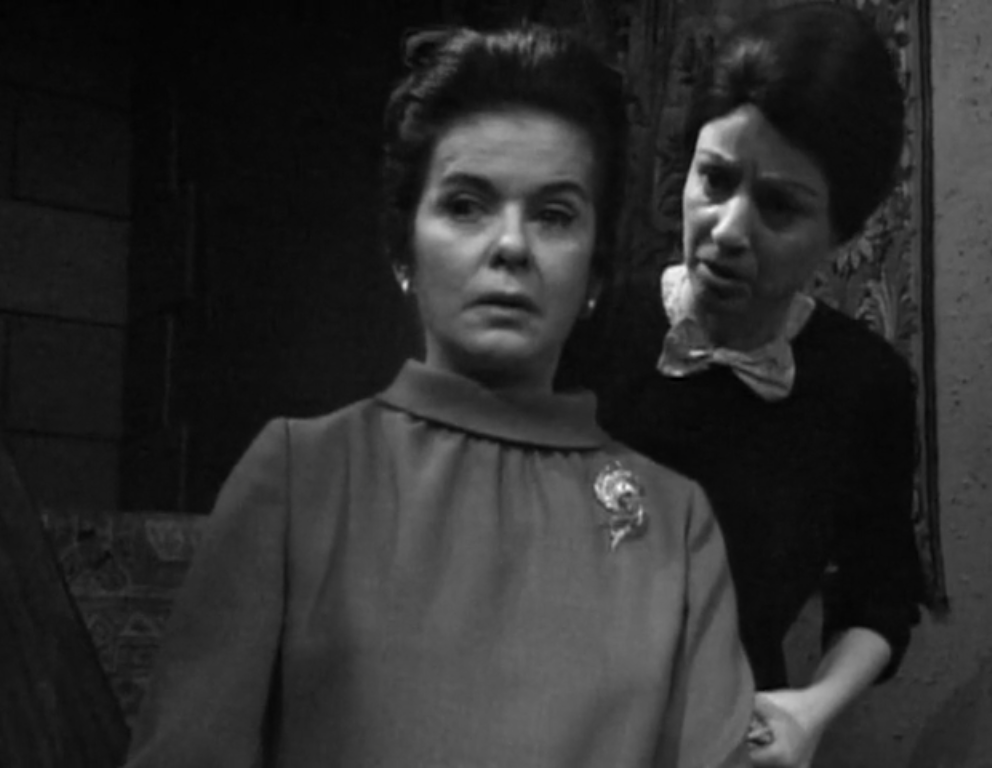
Later, Mrs Johnson meets Liz on the stairs. She tells her what Jason said, and asks Liz what she wants. This conversation is upsetting to Liz, and taking place between the two women as they try to maneuver around each other in the confined space of the staircase it adds to the claustrophobic feeling.
Close quarters
In the drawing room, Liz and Jason discuss Willie. For the seventh time, Jason makes a demand, Liz resists it, he threatens to expose her terrible secret, and she capitulates. They’d added some variations to this pattern in recent days, but this one is indistinguishable from iterations one, two, and three. The repetition is not only tedious, but confining.
Vicki runs into Willie in the study. Hall and Alexandra Moltke Isles are both on top of their form in this scene, and the result is deeply disturbing. Willie presses into her personal space, forcing her to reach under his arm for a book she needs. She tries to leave, and he repeatedly blocks her exit. She objects, and he traps her between two pieces of furniture. She objects more loudly, and he leans deeper into her space. If they had cut away at this moment, we would have assumed that Willie raped Vicki.
Willie ready to strike
Liz hears what is happening and comes into the study. She tells Willie to go. Jason enters, and she tells him to take Willie away. Jason questions Vicki, who agrees that Willie didn’t touch her, that they talked to each other, and that she supposes he didn’t really do anything. Vicki’s words come as a shock, but it is a shock of recognition- we could see what Willie did, and we know how hard it would be to put a complaint about his behavior into words while you were standing right there being questioned. Since Vicki does not know what Jason and Willie are trying to do or what Liz is facing, it is easy to imagine her deciding to take a pass on fighting this particular battle.
As Vicki backs down, Liz’ resolution to stand up to Jason and Willie crumbles. When the two men have left the room, Vicki asks Liz who they are and why they are staying at Collinwood. Liz says that they are her friends, and that she invited them. At Vicki’s disbelieving reaction, she repeats this statement and hastens away, leaving Vicki alone in the study.
Liz’ resolution to throw Willie and Jason out when she sees what Willie is doing thrills us, both because we care about Vicki and because it promises the end of this jail cell of a storyline. We know that Jason’s threats are hollow, because on Monday we heard him on the telephone telling Willie that if Liz called the police they would have to flee right away. All she has to do is stand her ground, and we will all be free to go. But she doesn’t know that. So the heartbreaking conclusion comes to us as all too familiar a reality.
There is only one ongoing story on Dark Shadows right now, and it doesn’t seem to have much of a future. Seagoing con man Jason McGuire is blackmailing reclusive matriarch Liz, threatening to reveal that she killed her husband Paul Stoddard eighteen years ago and that he buried Stoddard’s body in the basement of the great house of Collinwood. Not only was all of that clear when Liz and Jason had their first conversation several days ago, but yesterday we heard Jason on the telephone making it clear that he is bluffing. If Liz calls the police, he will get out of town as fast as he can. So whatever Liz does in response to Jason’s so-frequently repeated threat, the story can go only so far before it reaches a dead end.
Looking at Jason, audiences at the time would have recognized actor Dennis Patrick as a frequent guest star on prime time television shows and might have suspected that he was too big a name to stay on a daytime soap opera for very long. They would not have known that Patrick always made it a point to have an end date in place anytime he agreed to guest on a soap or that when he played Jason he did not have a contract, and was free to walk away any time he wanted. Seeing him share so many scenes with Joan Bennett, who had been a major movie star for a number of years, they might have thought it was possible he could stick around, but the show so quickly burned through what little story the two of them had that it wouldn’t have seemed likely.
So, what comes next? Alexandra Moltke Isles’ opening voiceover, delivered as always in character as well-meaning governess Vicki, gives us a hint:
My name is Victoria Winters. The foundations of Collinwood house a frightful secret, a secret that has lain dormant for eighteen years, a secret awakened by a stranger. But there is another stranger, one who is to awaken and unleash a force that will affect the lives of everyone.
This other stranger is Jason’s henchman, dangerously unstable ruffian Willie Loomis. At the beginning of this episode, Willie is drinking at the bar in Collinsport’s only night spot, The Blue Whale. There are three other customers in the tavern, an old man at the bar and a young couple in the background* bowing to each other at irregular intervals. If we assume, as I suppose we must, that these movements represent an attempt at dancing, we might wonder if the force Willie is destined to awaken and unleash is choreography.
Maggie Evans, The Nicest Girl in Town, enters. She looks around for a long moment, then slowly makes her way to a table. Willie tells Bob the bartender he wants to buy Maggie a drink. Bob goes to her table, and we see them have a conversation in the course of which Bob gestures to Willie and Maggie shakes her head no. When Bob returns to the bar, Willie tells him that “A good bartender wouldn’t have asked any questions!” Not even what kind of drink the lady would like, apparently. So maybe he’s going to awaken and unleash the force of unconsumed beverages.
Willie goes to Maggie’s table and sits down. When she protests that she’s waiting for someone, he sneers that no one tells him where to sit.** As Willie, James Hall is doing a great job of establishing himself as a clear and present danger to everyone he meets. Maybe Willie was right about one thing- a good bartender would notice Maggie’s discomfort and order Willie out of the bar. It’s obvious that Willie wants to awaken and unleash the force of sexual assault.
Maggie’s boyfriend, hardworking young fisherman Joe, enters. Willie refuses to leave the table and tells Joe to go wait at the bar. Joe squares up for a fight. He and Willie are about to start throwing punches when Jason comes into the bar and commands Willie to back off. At that, Willie awakens and unleashes the force of doing as he is told.
Jason apologizes to Maggie and Joe for Willie’s behavior and tells Bob he wants to treat everyone to a round of drinks. Joe mentions that Maggie’s father, drunken artist Sam, will be sad he missed a free drink. Maggie says that Sam won’t be drinking tonight, because New York art dealer Portia Fitzsimmons is pressing him for more paintings. Evidently Sam will be working more and drinking less now that he is no longer connected to any ongoing storyline.
At the bar, Willie complains to Jason that he’s come to help him, but hasn’t got any money out of the operation yet. Jason gives him some cash and tells him to be patient. The time has not yet come for Willie’s brawn to complement Jason’s brains.
Hall’s Willie does not spend any time processing his emotions or any energy concealing them. When he is getting ready to fight, he displays unfiltered rage; the instant he has to forgo the idea of beating up Joe and raping Maggie, he lowers his eyes and a look of deepest despair comes over him. Much as we hate Willie when he is menacing our friends, the transparency and intensity of his feelings makes it easy to watch him when he is feeling sorry for himself. Why is this strange, horrible man the way he is, and what will he do next? So when he awakens and unleashes the force of whining, it proves to be a strong enough force to keep us watching for a few minutes.
Those are good minutes for Dennis Patrick as well. Monotonous as Patrick’s scenes with Joan Bennett were, his scenes with other members of the cast usually had some element of unpredictability. We don’t know what is going on between Jason and Willie, and Jason himself doesn’t really know what Willie is going to do from one moment to the next. So it’s fun to watch Jason scramble to keep his associate in line. Also, we have a chance to root for Jason, at least for the duration of his two shots with Willie, since his control over Willie is what prevents violence against characters we care about.
Jason’s remark about Willie’s brawn raises the question of what exactly he wants Willie for. Liz is giving Jason everything she has, bit by bit, in response to his blackmail. If that is the whole plan, there doesn’t seem to be any need for brawn at all. Of course, Hall is a short, slender man, so much so that only his well-realized portrait of a violent felon keeps Willie’s confrontation with the substantially taller and more muscular Joe from looking ridiculous. Only Jason’s intervention prevented Willie from awakening and unleashing the force of badly losing a bar fight. Still, we keep wondering what the next phase of Jason’s evil plan will be.
Back at Collinwood, Jason is in the study, smoking a fine cigar. Flighty heiress Carolyn enters, and remarks that the cigar is one of her Uncle Roger’s favorites. Jason says that he knows of even finer cigars, and says that his whole philosophy of life is finding the good things and squeezing whatever he can out of them. Carolyn agrees that he has described himself well, neither hiding her disgust nor disturbing his complacent attitude.
Jason has identified himself as a friend of Carolyn’s father, the long-missing Paul Stoddard. Carolyn explains that she knows very little about her father, and asks Jason to tell her about him. He doesn’t really tell her anything she doesn’t already know, but does remark that “Paul Stoddard and I were very much alike.” He delivers that line in a way that suggests it might become significant. Once Carolyn gets up to go, Jason assures her that he does have stories about Stoddard to tell her some other time. Once she is gone and we are wondering if he really knew Stoddard at all, he steals three more of Roger’s cigars.
When we were watching this episode, my wife, Mrs Acilius, surmised that Carolyn asked Jason about her father less because she wanted to learn about him than because she wanted to figure Jason out. It is strange that she follows her obvious disapproval of Jason’s “philosophy of life” with “I never knew my father…,” unless it is a ploy to get Jason to talk about himself. And indeed, he does tell her far more about himself than about Stoddard. So that may well have been on Nancy Barrett’s mind when she was playing the scene.
A knock comes at the front door. Carolyn opens it to find Willie, identifying himself as a friend of Jason’s and announcing that he has decided to accept Jason’s invitation to stay at Collinwood. Jason is crestfallen to see that he has lost his control over Willie, and we are appalled to see Maggie’s would-be assailant moving into Carolyn’s house.
*This is the man in that couple. He would be a very familiar face on TV for a long time after this. He isn’t listed on either the Dark Shadows wiki or the imdb entry for this episode, and I can’t quite place him.
Hey look, it’s that guy! The one who was on those cop shows, you remember.
UPDATED 7 February 2024: I just spotted him in an episode of Columbo! His name is Paul Jenkins.
Paul R. Jenkins as Sergeant Douglas and Peter Falk as Lieutenant Columbo in The Most Dangerous Match (1973)
Jenkins appeared in a number of feature films, among them Rosemary’s Baby, Chinatown, and Network, and did guest spots on dozens of TV shows, among them the Dark Shadows-adjacent Falcon Crest. Evidently he was friends with Sidney Poitier, the two of them worked together on multiple projects, including Poitier’s 1992 film Sneakers. Most of the images of Jenkins I can find online come from a 1972 episode of M*A*S*H where he played an American NCO who keeps a Korean woman as a slave. This still from The Secrets of Isis illustrates his Wikipedia entry, and the civilian clothing from the 1970s is more typical of his on-screen appearance than was the 1950s Army uniform he wore on M*A*S*H:
Paul R. Jenkins, 1975.
**For some reason, Willie addresses Maggie as “Speedball.” “Listen, Speedball!” he commands. I wonder if Vladimir Nabokov considered Listen, Speedball as the title for a sequel to his Speak, Memory.
The first shot of the first episode of Dark Shadows featured well-meaning governess Vicki sitting on a train next to a window in which we saw the reflection of dashing action hero Burke Devlin. Vicki was on her way to the great estate of Collinwood, where she hoped to learn who her birth parents were. Burke was on his way to the village of Collinsport, where he hoped to exact revenge on high-born ne’er-do-well Roger Collins and other residents of Collinwood.
Vicki’s quest to learn her origins never took off, and hasn’t been mentioned for months. Burke’s pursuit of revenge drove a lot of action in the first twenty-one weeks of the show, but has been fading ever further into the background in the nineteen weeks since. Today, it fizzles out altogether.
In his original story bible for Dark Shadows, titled Shadows on the Wall, Art Wallace had proposed that Burke’s pressure on Roger would culminate in Roger’s death. Roger was to inadvertently reveal to Vicki that he was guilty of the crime that sent Burke to prison long ago. Roger would then try to push Vicki off the cliff at Widow’s Hill, but would miss her and go over the edge himself. The show discarded this resolution when Roger’s relationships with several other characters proved to be consistently interesting, particularly the Bossy Big Sister/ Bratty Little Brother dynamic between him and reclusive matriarch Liz. Besides, Louis Edmonds had such a gift for comic dialogue that he could get a laugh out of even the lines in which Malcolm Marmorstein attempted to be funny. So they couldn’t afford to kill Roger off.
Further, they have gone over Roger’s crime so frequently and made all the details so clear to everyone concerned that a trial wouldn’t give the audience any new information about what happened or show us any characters reacting to shocking news. It would be like a real trial, where all the evidence has gone through a discovery process and there are no surprise witnesses. No one is going to put that on commercial television in 1967.
So when Burke shows up at the great house of Collinwood with drunken artist Sam Evans, who has finally admitted that he saw what happened and took Roger’s bribe to keep quiet about it, the only real question is how Burke can leave the status quo in place.
Burke demands that Roger and Liz meet with him and Sam in the drawing room. Burke demonstrates his mastery by closing the drawing room doors, something that Liz, the mistress of Collinwood, usually does, and that Vicki did several times during the weeks when Liz was away and she was effectively in charge of the place.*
Roger of course tries out a series of lies in his attempts to deny Burke and Sam’s charges, but Liz is convinced. When she picks up the telephone and calls the sheriff, Burke reaches in and disconnects her. He says that she doesn’t have to turn Roger in- it is enough for him to know that she really would do it. She declares that she won’t let Burke keep coming back and using Roger’s guilt to blackmail the family, apparently intending to place another call. Burke says that he will never bring it up again, provided Roger confesses here and now in front of the three of them. He does. Burke tells Roger that he used to want to see him rot in jail but that now he realizes that “People like you rot wherever they are.” Burke and Sam leave, and that’s that as far as they are concerned.
During a few scenes scattered throughout the first forty weeks of Dark Shadows, Burke had considered relenting from his quest for vengeance. Those scenes hadn’t been developed in any great depth, and hadn’t been connected to each other. Only in the climactic week of the “Phoenix” storyline, when Burke and Roger briefly joined forces to save Roger’s young son David from death at the hands of his mother, blonde fire witch Laura Murdoch Collins, did we have a sustained glimpse of something other than all-consuming enmity between the two men. That was such an extreme situation, and was followed so quickly by a renewal of their hostilities, that Burke’s decision to peace out cannot be said to have any foundation in what we have seen the characters do so far. It is simply a convenient way of discarding a story element that has outlived its usefulness.
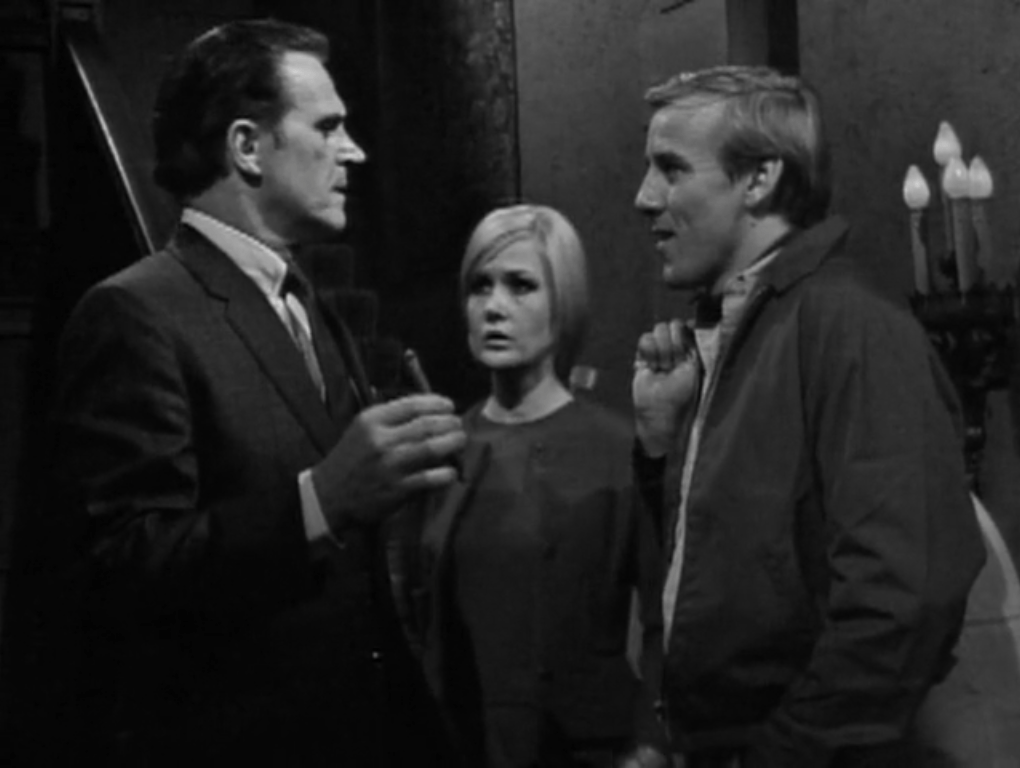
Most episodes of Dark Shadows have a cast of five actors. The rest are almost evenly divided between casts of six and casts of four. Today is a rarity with eight on screen. Six of these eight have been deeply involved in the Revenge of Burke Devlin storyline, and are at loose ends now that it has reached its abrupt conclusion. Burke, Roger, and Sam suddenly find themselves with nothing in particular to do. Also, flighty heiress Carolyn had a mad crush on Burke that alarmed her mother Liz and terrified her uncle Roger; that ended months ago, and she’s been a utility player ever since. Vicki is starting to date Burke; if Burke is no longer a threat to the family, there’s no obvious drama in that relationship, and she doesn’t have much else going on. David was as fascinated by Burke as Carolyn was; now that Laura is gone and he is happy with Vicki as his substitute mother, he’s pretty well settled in too.
We don’t see wildly indiscreet housekeeper Mrs Johnson today. She had come to Collinwood as Burke’s secret agent. Now that Burke is satisfied, presumably that’s over. Nor does Sam’s daughter Maggie, The Nicest Girl in Town, appear. She’s been dating hardworking young fisherman Joe, rebuffing his suggestions that they think about marriage because she is worried about what is going on with her Pop. Now that Sam’s conflict with Roger has come to its conclusion, there isn’t any reason the two of them shouldn’t get married, or stay unmarried, or whatever. So today’s episode leaves nine of the eleven major characters with no specific connection to any unresolved storyline.
Indeed, there is only one ongoing narrative arc. Long before he wrote Shadows on the Wall, Art Wallace wrote “The House,” a 1954 episode of The Web, an anthology series produced for CBS by Mark Goodson and Bill Todman.** Wallace recycled the story of “The House” for a 1957 installment of an hourlong anthology, Goodyear Playhouse, on NBC. Alternating with Alcoa Theatre in a window known collectively as A Turn of Fate, Goodyear Playhouse featured many pilots. The only one that seems to have been picked up was My World and Welcome to It, which went to series after an interval of more than a decade. I haven’t seen Wallace’s Goodyear Playhouse episode, but the 1954 version is too thin to fill a half hour, so I can’t see that an hourlong reworking would have been likely to catch the eyes of networks that passed on so many other pilots presented in that series, including teleplays by Rod Serling and Paddy Chayefsky. Wallace incorporated the story of “The House” in Shadows on the Wall, and a couple of weeks ago Dark Shadows dredged it up.
Seagoing con man Jason McGuire presented himself at Collinwood, to Liz’ great dismay. So far, they have had five conversations, two of them in Friday’s episode. All have followed the same pattern. Jason and Liz meet in the drawing room; he makes a demand of her; she resists; he threatens to expose her terrible secret; she capitulates. It’s true that on Friday they varied this a bit. Roger was with them during the first session, so that they had to veil their meanings, and in the second session Jason finds that Liz is unable to meet his initial demand, so that he shifts to a second one. In the first scene, they have a lot to show us as Liz and Jason manage to communicate their usual messages without letting Roger in on anything, and in the second they show us that Jason puts a higher priority on keeping Liz under his control than on any particular item he might want her to give him, so they managed to be interesting that day.
Today, Jason and Liz have their sixth conversation. It isn’t in the drawing room this time, but in the basement. While looking for David, Vicki had caught Jason listening at the doors of the drawing room at the moment when Liz was talking about going to the police, and he had rushed up to his room and telephoned*** his associate Willie, telling him they should be ready to get out of town fast. This conversation lets the audience know that Jason’s threat to Liz is a bluff. David had then caught Jason trying to get into the locked room in the basement. David told Liz what he saw Jason doing. Liz then goes down to the basement herself and shines a flashlight directly into the camera. We can see her in the halo, but Jason cannot. He seems helpless while she shines the light at him.
Jason blinded by the light
Jason scrambles a bit to regain control of the situation. Liz tells him he must leave the house immediately. He finally puts into words what the audience has long since figured out is on Liz’ mind, that she killed her husband Paul Stoddard eighteen years ago, that Jason buried him in the room, and that Jason will take this information to the police if she does not comply with his demands. She yields.
Liz’ reaction is interesting in the light of her scenes with Roger. When Burke was in the room, she explained her determination to call the police by saying that blackmail is no life for anyone to live. After Burke and Sam have gone, Roger starts begging Liz to let him and David keep living in her house. She doesn’t seem to know what he is talking about. She says that “Everyone does terrible things,” a remark she had also made to Burke and that is certainly true of characters who last on soap operas. He wants to go on pleading with her, but she just walks off, deep in thought about something else.
Remembering those scenes, we see Liz not simply giving in to Jason, but making a decision to keep going along with him. That makes today’s iteration of Jason Threatens Liz a bit more worthwhile than were the first three, if not quite as lively as the two we saw Friday. We can see something going on in her mind that raises the possibility she might do something different next time.
Two actors have bad trouble with lines today. When Burke is supposed to be saying something very dramatic and powerful about “hypocrites,” Mitch Ryan is actually blabbering about “hippie-crippie… er… hippie-crizz.” And when David Collins meets his Aunt Liz on the stairs and tells her he saw Jason in the basement, David Henesy stumbles over so many lines he falls out of character. Eventually he gets enough of the words out that you can tell what he’s trying to say, but he never really recaptures David Collins’ rhythm and intonations.
This latter slip-up leads to a reminder that there are always people in the audience checking in to a series for the first time with any given episode, so that actors are subject to judgments that don’t take into account what they have done before. At the bottom of their post on this episode, John and Christine Scoleri transcribe a conversation with a friend of theirs who hadn’t seen any of the episodes before this one. He says “Those who think the kid playing David went to any kind of acting school, raise your hand. Now leave the auditorium, please.”
In fact, David Henesy had been working steadily as a professional actor for four years before joining the cast of Dark Shadows at the age of nine. During that time, he had studied under many teachers, among them Uta Hagen. Usually, that background shows through, even when a particular script gives him problems. For example, he had a lot of difficulty with his lines in #191, and I rated that one as one of his weaker efforts. But here’s what Patrick McCray said about it on his Dark Shadows Daybook:
The success of this installment rests on the narrow shoulders of David Henesy. At the end of a big Henesy episode or scene, it’s common to announce that the kid nailed it, and this episode is no exception. His scene partners have it easy. They have straightforward, high stakes objectives to pursue. Either David goes into the fire or he doesn’t. There are only so many ways that people can implore the kid to come to them. On the other hand, Henesy has to stretch out indecision and keep it fresh for twenty minutes… with the help of an “ancient legend” that he recites. Not only does he succeed like a champ, but he concludes one of his better Hagen Days with a tearful catharsis that reads as properly-uncomfortably authentic.
Patrick McCray, Dark Shadows Daybook, 7 March 2018
I disagree with McCray overall about #191- I think Henesy’s line troubles in that one are bad enough that he doesn’t “succeed like a champ,” but I do agree that there are also some good things in his performance, particularly the way he uses his eyes and his posture. And there is no doubt that the last two minutes are very good.
Not even McCray comes to Henesy’s defense regarding #201, though the scene in the basement is all right. David Collins has a pleasant little conversation with Jason, and David Henesy gives sufficient support to Dennis Patrick that we can see just how badly wasted that talented actor is in all of those scenes where Jason repeats his threat to Liz.
*When we were watching the episode, my wife, Mrs Acilius, noticed the significance of Burke’s closing the drawing room doors. She had a lot to say about it, I wish she could remember her WordPress password and write her observations here.
**Later to become game show specialists, Goodson and Todman would be the producers of Match Game, which in the 1960s was on CBS 4:00-4:30 PM Monday through Friday opposite Dark Shadows, and of Password, a version of which would replace Dark Shadows on ABC in that timeslot when the show was canceled in April 1971.
***Just a few weeks ago, Laura nearly succeeded in killing David because there were no telephones upstairs. Apparently that has led Liz to have some new lines installed.
Maggie Evans, The Nicest Girl in Town, wants to be proud of her father, drunken artist Sam. That’s been difficult these last ten years, which he has spent establishing himself as the town drunk. It’s especially difficult this week, when Sam has admitted to her that he started drinking after he took a bribe from high-born ne’er-do-well Roger Collins to withhold evidence that might have kept dashing action hero Burke Devlin from going to prison.
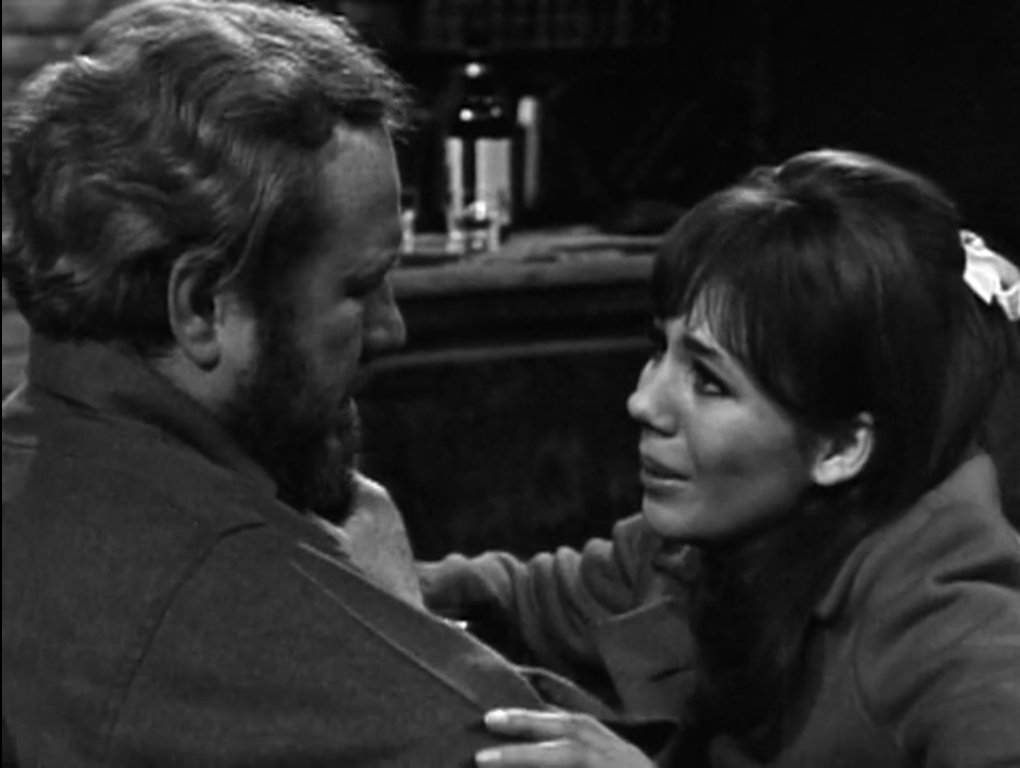
Maggie comes home today to find Sam and Burke together. She bends down to Sam and asks if he told Burke. “Everything,” Sam replies. Maggie hugs him and says “I’m proud of you, Papa.” Her initial reaction is a flash of joy that the lying is over, but fear of what Burke will do with the information comes on immediately. There is one marvelous moment when we can see the smile on her lips and the fear in her eyes simultaneously. Maggie’s complex affect while telling Sam that she is proud of him fits the occasion. A confession of the sort Sam has made is an unusual thing for a daughter to be proud of, but as an Adult Child of an Alcoholic Maggie has learned to take pride where she can.
Maggie, happy and afraid
She turns to Burke and tries to convince him that Sam has punished himself enough already. Burke believes he spent five years in prison because of what Sam did, and is not impressed by Maggie’s pleas. He says that he wants to take his time before he decides what he will do to Sam and Roger.
At the great house of Collinwood, Roger is quarreling with seagoing con man Jason McGuire. Jason is blackmailing Roger’s sister, reclusive matriarch Liz, and forcing her to let him stay in the house. Roger finds Jason’s presence intolerable. When Roger tells Jason that he is a guest in the house, Jason tells Roger that it is Liz’ house, bringing up the fact that Roger is Liz’ guest as well. Humiliated by the reminder that he squandered his inheritance and reduced himself to a footing of equality with Jason, Roger adopts an even haughtier than usual manner.
Liz enters, and Roger and Jason present their cases to her. Jason’s first three conversations with Liz were iterations of the same dismal scene. The two of them are alone in the drawing room, he makes demands on her, she resists, he threatens to expose the secret he knows about her, she capitulates. Today, they are still in the drawing room, and the formal structure is the same. Still, Roger is with them. So the demands, the resistance, and the threat are expressed in more subtle language, and we see Liz struggling to conceal her emotions from Roger. So Round Four offers the audience a bit more dramatic interest than did Rounds Two and Three.
Liz and Jason do have a two-scene in the drawing room after Roger droops away towards bed. Jason demands that Liz stop Roger challenging him. Jason doesn’t quite threaten Liz over this, and she doesn’t capitulate. He insists that she say good night to him. She is looking away from him, her face in full view of the camera, showing us that the last thing she wants to do is say anything pleasant. At length, she gives in and says it. Her yielding on this apparently small point hits the audience as hard as did her bigger concessions in the first three confrontations. When he leaves her alone in the room, she slumps down, looking utterly defeated.
A knock comes at the door. Liz wearily trudges to answer it. When the caller identifies himself as Sam Evans having urgent business with Roger, she protests that it is the middle of the night and any business can wait until a decent hour. Sam insists, and she opens the door to implore him to go away and let her rest. Startled to see Burke, she takes a half step back, and Burke takes a step forward. She tries to close the doors on them, and Burke holds them open. She surrenders, letting them into the foyer, but continues to tell them they should make an appointment to see Roger in town tomorrow. Roger comes out to see what the noise is, and is shocked to see Burke and Sam together.
Yesterday’s episode ended with a powerful scene in which Maggie Evans, The Nicest Girl in Town, learned the terrible secret her father, drunken artist Sam Evans, has been keeping for the last ten years. Today begins with a reprise of that scene.
Sam has admitted that one night he saw a car barreling down the highway, swerving wildly from lane to lane. It hit and killed a man, then sped off. Sam could see the driver, high-born ne’er-do-well Roger Collins. Dashing action hero Burke Devlin was passed out in the back seat, and Roger’s future wife, blonde fire witch Laura Murdoch, was also in the car. The night after the collision, Roger showed up at the Evans cottage and offered Sam $15,000 for some paintings.*
Sam tells Maggie that he knew this was a bribe to secure his silence. He explains that at that time, Maggie’s mother was very sick with the illness that would ultimately take her life, and that he had no way of earning enough money to meet even the family’s basic expenses. With the money from Roger, he was able to give Maggie’s mother everything he had always wanted her to have. The more Sam explains that he traded his conscience for money, the more Maggie looks down at herself and sees her waitress’ uniform. Apparently she can’t help thinking about where the household income has been coming from in the years since Sam’s big sale, and assessing Sam’s current contribution to their balance of expenses.
Maggie talks slowly, choosing her words with care and her themes with tact. She acknowledges that it would have been hard to refuse Roger’s money under the circumstances, and Sam exclaims that it would have been impossible. Maggie turns away with a look of distress, as if she suspects that another sort of person might have found it entirely possible to say no to Roger. She leaves that topic alone, and focuses on how shocked she is that Sam kept quiet when Burke was tried, convicted, and sentenced to five years in prison on the premise that he had been the driver.
Sam asks Maggie what he can do or say to regain her respect. She suggests he go to Burke and confess to him. Sam asks if she wants him to go to jail; she says no, of course she doesn’t want that. He swears he will quit drinking; wearily, she tells him she hopes he sticks with it this time. Eventually she stops responding to what he says, and just answers his pleas by announcing that she has a date to get ready for.
This exchange is divided into two scenes. The second begins with some repetition of points from the first, but that actually works to strengthen the drama- it shows us that Sam is desperate to find some way of making things right with Maggie that doesn’t involve volunteering for a prison sentence.** When Maggie has left for her date, we see Sam stew around for a moment. Finally, he picks up the telephone and calls Burke. By that time, we can see that he really has exhausted every possible alternative.
In between the two Sam/ Maggie scenes, we see Burke having dinner with well-meaning governess Vicki at Collinsport’s only night spot, The Blue Whale. Vicki is telling Burke everything she knows about the current doings at the great house of Collinwood. She is worried about reclusive matriarch Liz, who hasn’t been herself lately, and uncomfortable around Liz’ houseguest, seagoing con man Jason McGuire. Burke has never heard of Jason. As the Collins family’s sworn enemy, Burke of course listens attentively to all the intelligence Vicki has gathered. One does wonder what the Collinses think of their governess blabbing so much to Burke, who casually mentions in response to one of Vicki’s expressions of concern for Liz that he is trying to drive her out of business.
Jason shows up in the tavern and approaches Vicki. She introduces him to Burke. While they are exchanging pleasantries, a young man enters and smiles. He calls to Jason, who hastens away from Burke and Vicki to talk alone with him.
The young man leers at Vicki. Burke gets up and says he wants to confront the young man, but Vicki insists he sit back down. The young man continues leering at Vicki, and Jason pleads with him to stop. The man’s tone and bearing are threatening, and his habit of referring to himself in the third person while talking about the things to which “Willie” is entitled emphasizes the note of menace. When another customer brushes against him, Willie jumps up. Three men, Jason, Bob the bartender, and a background player*** restrain him from punching the guy. Burke and Vicki comment on Jason’s choice of friends.
Willie forlornly watches a man leave, taking with him his chance to beat him up
Actor James Hall does a fine job of showing Willie as a dangerously unstable man. His staring at Vicki unsettles everyone, a fact which seems to please him. As soon as he stops talking, the airy manner he adopts when he declares that his current lodgings are “not Willie’s style” or that “Willie is not a patient man,” disappears and his face settles into a look of depression. The brush that sets him off into his spasm of violence is so light and so brief as to be noticeable only in a prison laundry. When Jason, Bob, and the man from the background hold him and he realizes he has missed his chance to beat someone up, his rage at once gives way to a hollow look of yearning and sorrow, as if he is in mourning for the violence that might have been. He would be right at home on a cross-country killing spree, but it’s hard to see what use Jason would have for him. Jason is a con man and blackmailer, two forms of criminality that require the ability to gain some measure of trust from a victim, and no one would trust Hall’s Willie for even a fraction of a second.
If it turns out that Jason has more than one piece of compromising information on Liz, Willie might make sense. Let’s say that, when she and her long-absent husband lived together, they found themselves implicated in a number of Jason’s crimes, and some of those involved hyper-violent hoodlums. Then when Liz sees Willie, she might find herself falling back into an old trap and try to figure out a new way to free herself from it. But if all Jason knows about Liz is what he has threatened to reveal in his three conversations with her so far, Willie would seem to be an unsolvable puzzle.
Burke shows up at the Evans cottage and tells Sam that he received his message. Since Sam had told the clerk at Burke’s hotel that he was calling in connection with an emergency, Burke keeps pressing him to explain what he wanted to say. Sam keeps stalling. Despite his promise to Maggie a few minutes ago to quit drinking, his stalling involves a couple of shots of booze. Finally Sam screws up his courage and tells Burke everything. Burke declares “I knew it!”
**I am curious as to what Sam’s legal position would actually have been. He tells Maggie that neither he nor Roger said anything about the accident when he gave him the money; Sam simply assumed he was taking a bribe. Since Roger did receive the paintings, and famed art dealer Portia Fitzsimmons has told Sam that the paintings would now be worth a great deal of money, only Sam’s confession of his corrupt motive would suggest that he did anything ten years ago that it might be possible to prosecute him for. Besides, he never committed perjury or lied to law enforcement- he never said anything at all. It would seem the most they could have got him on at the time would have been failure to report an accident, and surely the statute of limitations on that misdemeanor would have expired after ten years.
His more recent behavior would seem to present a more serious problem. Ever since Burke came back to town in episode 1, Sam and Roger have been talking to each other about the accident and its aftermath, meeting in public places and confirming over and over that the money was a bribe. Moreover, Sam has spent the last few days blackmailing Roger, threatening to go to Burke unless Roger produces the paintings in time for him to have Portia Fitzsimmons show them in her gallery. Roger has not been able to find the paintings. So going to Burke, or even to the police, could be interpreted as an act in furtherance of Sam’s blackmail scheme, and therefore as itself felonious. It is no wonder that when Sam went to the telephone, my wife, Mrs Acilius, was shouting at the screen “Call a lawyer!”
***Who according to the Dark Shadows wiki worked under the name “Frank Reich.” Since “Frankreich” is the German name for France, I assumed that “Frank Reich” was an obvious pseudonym. But it turns out there are a number of people in the world whose actual given name is “Frank Reich,” some of them well-known, so who can say.
In the drawing room of the great house of Collinwood, seagoing con man Jason McGuire has his third conversation with reclusive matriarch Liz. It is identical in form and content to their first two conversations. He makes a demand, she resists, he threatens to expose her one and only secret, and she gives in.
Liz’ brother, high-born ne’er-do-well Roger, is also being blackmailed. His blackmailer is drunken artist Sam Evans. Unlike Jason, Sam is someone we know and have reason to like. And unlike Jason and Liz, Sam and Roger do not repeat the same conversation every time we see them.
Moreover, Jason is acting against the interests of the audience, while Sam is trying to achieve something we might like. Jason is working to isolate Liz and to drain her funds. Those goals reduce the range of stories the show can tell, limiting a major character’s interactions with the rest of the cast and cutting back on the power of the family at the center of the series from making things happen in town. Sam wants to get hold of some old paintings of his, which will give him a chance at making a big splash in New York. If Sam succeeds, future episodes will be set at least partly in the midtown Manhattan art world. That would be a radical departure from the show we’ve been watching, but a radical departure of some kind is inevitable if Dark Shadows is to keep going at all. Dark Shadows 1.0 finished its liveliest stories when blonde fire witch Laura Murdoch Collins vanished two weeks ago, and if Dark Shadows 2.0 is going to hold our attention it is going to have to come up with something very fresh.
Ten years ago, Roger paid Sam $15,000 and received from him ten paintings. These paintings have suddenly become fashionable, and a prominent art dealer has come to Sam asking about them. The real reason Roger gave Sam the money was nothing to do with the paintings, but to bribe him. The paintings changed hands only to cover the bribe.
Sam had seen a fatal hit and run accident, and knew that Roger, not dashing action hero Burke Devlin, was the driver. Burke went to prison for the crime, and has been trying ever since to prove that Roger was responsible. Now Sam threatens to go to Burke unless Roger produces the paintings. Roger has been searching Collinwood for the paintings, but he cannot find them.
The highlights of the episode are two scenes between Sam and his daughter Maggie. In the first, we see Sam drinking and talking to himself while Maggie is in the room getting ready to go to work. Maggie knows that her father has a great opportunity and that the man who has the paintings is keeping him from realizing it. She doesn’t know who that man is. She keeps asking questions, and he keeps getting upset. He shouts “Are you going to work or aren’t you!?” Then he apologizes and tells her he didn’t mean to raise his voice. She says bitterly that she should be used to it by now. He tells her that what he’s doing, he’s doing for her, that if he succeeds she will get everything she has coming to her. She isn’t impressed, and doesn’t have much to say.
As Maggie, Kathryn Leigh Scott does a fine job of showing an Adult Child of an Alcoholic trying to distinguish between the challenges the outside world is presenting to her father and those he has brought on himself. She’s looking for a way to simultaneously be Sam’s ally against the man who is keeping the paintings from him and to stand firm as an opponent of his drinking. Above all, she is trying not to let her pity for him harden into contempt. As Sam, David Ford is alternately so self-absorbed he apparently forgets Maggie is in the room, so angry he doesn’t care what he says to her, and so hopelessly dependent on her that he all but transforms into a baby. When he is looking up at Maggie and telling her all he hopes to do for her, Sam looks for all the world like a toddler trying to keep his mommy from being angry with him. It’s a heartbreaking finish.
Their second scene is even more powerful. Maggie comes home from work to find a groggy Sam slumped in a low chair. Once he has come back to life, Sam tells her that the man was in the house while she was at work, and that he can’t find the paintings. He lets slip that the man lives in Collinwood. Maggie realizes that it must be Roger. Sam tries to deny it, but since Roger is the only man who lives there he is stuck. He can hardly claim that well-meaning governess Vicki, a 20 year old woman, was a man ten years ago, or that she paid $15,000 for ten paintings to put on display in her cubicle at the Hammond Foundling Home. He briefly claims that “Collinwood” was a slip of the tongue, but can’t keep that lie up.
Sam finally admits that Roger is the man. Maggie asks why Roger bought the paintings. Sam asks if she really wants to hear him say it. When she says she does, he starts to speak, but falls abruptly silent in the middle of a sentence. While he looks down in shame, she blurts out that he took the money as a bribe to keep silent about Roger’s crime and to consign Burke to prison. She has suspected this for some time, but is devastated to say the words and see her father’s face.
Of all the questions the two blackmail plots might prompt the show to answer, how Maggie and Sam’s relationship will change as the result of the disclosure of his secrets is the most interesting. So it should be no surprise these two scenes are among the strongest we’ve seen in months.
Closing miscellany:
At one point in the episode, we see Jason talking on the telephone to someone named “Willie.” This marks the first time we hear this name on Dark Shadows.
During a conversation with Roger, Jason sits at the piano and pokes at a few keys. This is the first time since flighty heiress Carolyn tried her hand at “Chopsticks” in #119 that a member of the cast makes use of the instrument.
Roger and Liz have a scene in the basement of Collinwood. Roger’s fear of blackmail leads him to hope that he might find Sam’s paintings in a locked room there, while Liz’ fear of blackmail leads her to forbid that anyone ever go into that room. When Roger asks Liz what is in there, she refers to her long-absent husband, Paul Stoddard: “They are… ah… old things of Paul’s. Yes, that’s it! I put his things in there.” This is so obviously a lie she is making up on the spot that we laughed out loud. Joan Bennett must have meant to elicit this reaction.
The two most senior members of the ancient and esteemed Collins family, reclusive matriarch Liz and her brother, high-born ne’er-do-well Roger, are both being blackmailed. At rise, Liz and her blackmailer, seagoing con man Jason McGuire, are having another version of the same conversation that took up most of yesterday, in which he makes demands, she resists, he threatens to expose her secret, and she gives in. Jason is a new character, connected to no one but Liz, and this is all we’ve seen him do. The actor is appealing, but not enough to make us want to see that scene a third time. When Liz and Jason summarize their relationship by telling each other “We’re stuck with it,” they give voice to a sinking feeling in the pit of the audience’s stomach.
Roger’s blackmailer is someone we know and care about. He is drunken artist Sam Evans. Sam took money from Roger years ago in exchange for keeping silent about evidence that Roger was responsible for a fatal hit-and-run, and to make the transaction look legitimate gave Roger some of his paintings. Now a powerful New York art dealer has told Sam that she can make him rich and famous if she shows those paintings in her gallery, and Sam is desperate to get them back. He threatens to take his information to dashing action hero Burke Devlin, who went to prison over the incident, unless Roger produces the paintings.
Roger spends today’s episode trying to find the paintings. His search takes him to the basement. There, he shines a flashlight directly into the camera.
Roger enters the basement with a halo
Shortly after, Jason comes to the basement, and Roger catches him fiddling with the lock on a room Liz insists no one ever enter. Roger shines his flashlight in Jason’s eyes. When Jason complains about that, we again see Roger shining the flashlight directly into the camera. We’ve seen actors shine flashlights into the camera so many times that it must be in some way intentional, but this is the first time there is dialogue to give the show an intelligible reason to do it.
Roger shining the light into Jason’s eyes, from Jason’s point of view
Jason won’t tell Roger what he is doing, but does say that he saw Liz’ husband, the never-seen Paul Stoddard, in that basement the night he disappeared. He then throws around some hints that there may have something untoward about Stoddard’s disappearance and that Liz may be hiding something about it. Later, he mentions to Liz that Roger doesn’t seem to know anything about the situation, suggesting that the hints were his attempt to test Roger.
Roger meets with Sam at the Blue Whale, the working-class bar where Sam spends his time (and, presumably, his daughter’s paychecks.) Roger can see that Sam is serious about his threat to go to Burke if the paintings do not materialize. Roger tells him that there is only one place he hasn’t searched. At the end of the episode, we see Roger back in the basement, trying to open the locked door.
These two blackmail stories have the potential to clear out all of the unresolved questions left over from Dark Shadows 1.0. Why is Liz a recluse, what happened the night Stoddard disappeared, what’s with the locked room in the basement, and what is the connection between Liz and the origins of well-meaning governess Vicki? Jason’s demands on Liz might answer all of these questions. How will Burke react when he learns what Sam knows, and what will the consequences be for Roger, for Sam, and for Sam’s relationship with his daughter Maggie? Sam’s threat to Roger might bring all of those answers to light.
The problem is that those questions have been around for thirty nine weeks and have yet to drive much of a story. It’s hard to believe they will suddenly become exciting now. Perhaps when they do clear them out of the way, they will find something different to put front and center in Dark Shadows 2.0. Let’s hope they do, and that they find a way to keep things interesting until then.
Seagoing con man Jason McGuire has talked his way into the drawing room of the great house at Collinwood. Reclusive matriarch Liz is dismayed to see him. Their conversation builds to his threat that the secret they share about something that happened one night eighteen years ago will not be safe unless she lets him stay at the house. She capitulates to this threat.
Jason invades Liz’ spaceLiz trapped under Jason
Liz’ husband, the never-seen Paul Stoddard, disappeared eighteen years ago, and she hasn’t left Collinwood since. Jason makes it clear to more than one character that he knew Stoddard, and implies to Liz that the terrible secret they share explains Stoddard’s absence. She is very uncomfortable any time anyone goes into the basement of the house. After Jason goes to get his luggage today, Liz tells well-meaning governess Vicki that it is more important than ever that no one know she saw her coming out of the locked room in the basement the other night. The obvious conclusion would seem to be that Liz and Jason killed Stoddard and hid his corpse in the locked room, though perhaps there might be some twist coming up that will lead us to a different conclusion.
Looking at today’s episode, I think we can see several routes they might take to add interest to the tale. Vicki is eager to help Liz in any way she can, and both Liz’ daughter Carolyn and her brother Roger show themselves more than ready to stand with her against Jason. If she accepts their help and tells them any part of the truth, their reactions to what she tells them and their attempts to work together against Jason might change the relationships among them in exciting ways.
Carolyn wonders if Jason is an old flame of Liz’. If there is an attraction between Liz and Jason, then we might see that Carolyn inherited her tendency to fall for the worst possible man from her mother, and there might be conflict between mother and daughter mirroring the tension when Carolyn was chasing after the family’s nemesis, dashing action hero Burke Devlin. Jason is mysterious enough, and actor Dennis Patrick is charismatic enough, that a romance that begins with Liz disregarding her better judgment and falling for Jason in spite of everything could lead to any number of interesting places.
Jason’s threat to Liz today, and indeed all of his talk when they are alone in the drawing room, is in terms of a single incident- “the most important incident of your life,” as Jason describes it to Liz. If his only leverage over her comes from one isolated event, then all he can do is repeat the same threat every time he wants her to make another concession. That would get to be unbearably monotonous very quickly. On the other hand, Liz’ reaction to him shows that when she and Stoddard knew him eighteen years ago, he was just as smooth-talking and untrustworthy as he is now. So it might be that Liz and Stoddard involved themselves in a series of his scams, and that she has a long list of secrets she is afraid he will expose. If that turns out to be the case, there might be a long list of pressure points where he can place his finger depending on just how outrageous his demand might be.
Failing any of those twists, the Jason storyline could be pretty dreary. Art Wallace, who was the sole credited writer for the first 40 episodes of Dark Shadows and stayed with show until #85, wrote a 30 minute episode of a CBS anthology series called The Web in 1954 under the title “The House.” You can see the whole thing here:
That version features a retired sailor coming to a coastal town. He finds out that a local woman whom he knew years before hasn’t left her house since he was around, which was at the same time her husband disappeared. He goes to her house and threatens that he will expose the hideous secret in her basement unless she lets him stay with her. His demands mount. When he insists that she marry him, she finally admits that she killed her husband and the sailor hid his body in the basement. The basement is dug up, revealing that there never was a body there. Indeed, she never killed anyone. The husband tricked her into thinking she had killed him, and the sailor tricked her into thinking he had buried him. When this truth comes out, the sailor flees and the woman lives happily ever after.
That may sound like enough story to fill a 30 minute time-slot, but The House has a number of slow parts. That thinness bodes ill for the narrative arc now starting. This is already Jason’s third episode, and the themes of Stoddard’s absence, Liz’ seclusion, and the locked room in the basement were dealt with over and again in the first weeks of Dark Shadows. Art Wallace’s original story bible for the series, Shadows on the Wall, included a straight retelling of the plot of The House, with no fresh complications until the very end. Today, when Jason tells Liz that as a houseguest he won’t require much entertaining, she replies “I don’t intend to entertain you at all!” If they stick to Wallace’s idea, the same might be the epigram for Jason’s whole storyline.
In Dark Shadows Version 1.0, well-meaning governess Vicki represents our point-of-view. In the 1930s and 40s, radio soap operas would often have a character to whom they would assign that role, one person to whom everything has to be explained so that the audience can be brought into the story. That may have worked on a show in a 15 minute time slot, but it’s a stretch to build a 30 minute daily drama around one character, and today’s hour-long daytime serials couldn’t possibly keep one person on the spot the whole time. In part, that’s because you’d wear the actor out. More importantly, it’s because soap operas are usually about abruptly disclosing secrets to the audience and gradually leaking them out to the characters. A character who has no secrets from the audience can’t generate that kind of action, and will sooner or later turn into dead wood.
Today, we start with reclusive matriarch Liz recruiting Vicki to help her keep one of her secrets. Vicki found Liz in the basement late last night, a fact which Liz has made her promise she will not share with anyone. Vicki does not see why anyone should care whether Liz goes into the basement of her own house at night or any other time, and indeed no one does care. But Liz insists she keep quiet about it, and when Liz’ daughter Carolyn mentions having heard her up in the middle of the night, she makes Vicki lie and say that she was the one who was up.
Since Vicki can have no secrets from us, she cannot be particularly good at keeping secrets from the other characters. If she were able to tell a convincing lie, a person just tuning in to the show might be deceived by Vicki. She has tried her hand at lying a few times so far, always with disastrous results when the lie immediately collapsed. This time, Carolyn doesn’t catch on, and there don’t seem to be any ill effects, but that’s just because it’s a topic Carolyn doesn’t care about. Vicki changes her whole demeanor when she’s getting ready to tell these lies, stiffening her spine, plastering on a smile, and speaking a little bit too loudly. On previous occasions she had different tells, looking down and taking a breath before she speaks, or looking around and stammering while she speaks, etc. A supercut of those scenes might serve as a catalog of the various types of inept liars. Alexandra Moltke Isles renders each type convincingly enough that such a video could be useful to students of acting, of psychology, and of poker. But it would also show why Vicki is facing a limited future as a soap opera character.
We’re supposed to be saddened that Vicki has had to damage her friendship with Carolyn by lying to her, but I was on Liz’ side, rooting for the lie to work and Carolyn to stop asking questions. Otherwise, we’ll have to hear more about Liz’ attitude towards her basement, and that is such a stupefyingly dull topic it makes us yearn for the days when they spent 21 episodes showing people wondering where Burke Devlin’s fountain pen might be. Besides, Liz is an accomplished liar. If Vicki can study under her and learn her skills, she might be able to continue as a major character.
While Vicki is struggling with the rules of the genre in which she exists, another character is comfortably embodying one of the most familiar stock figures of soapdom. That’s Jason McGuire, a con man who has a history with the matriarch of the powerful family. He’s in the restaurant at the Collinsport Inn having a breezy chat across the counter with Maggie, The Nicest Girl in Town, who is impressed by his habit of putting lemon peel in his coffee. Hey, you work for tips, you find ways to be impressed by the customers.
Vicki comes into the restaurant and chats with Maggie about Liz’ recovery from the mysterious illness that recently put her in the hospital. Overhearing Liz’ name, Jason sidles up to Vicki and questions her about the residents of the great house at Collinwood. He won’t give Vicki his name, but gets her to tell him about everyone who lives there. She describes her own duties as “governess… companion… tutor,” to which Jason replies that she sounds busy.
Coupled with the fact that we first saw her today sorting Liz’ mail, the word “companion” suggests that the show is changing Vicki’s job so that she will be the first involved, not only in stories that center on strange and troubled boy David, but also in those centering on Liz. That’s promising- not only would it give Vicki a chance to learn how to lie, but it also suggests that they might have figured out how to mirror the one consistently interesting relationship on the show so far, that between Vicki and David. Perhaps it will be as much fun to watch Vicki as Liz’ pupil as it has been to watch David as Vicki’s.
After Jason questions her, he tells Vicki that he will definitely be seeing her again soon. He then leaves, still not having told her his name. Vicki asks Maggie who he is. She tells Maggie that Jason made her uncomfortable with his questions about the residents of Collinwood, and that the theme of those questions was “not so much how they are… as where they are.” Dark Shadows has been heavy with recapping, but this may be the first example of a conversation in which two characters recap the conversation immediately preceding it, without even a commercial break in between.
Back at Collinwood, a knock sounds at the front door. Carolyn comes downstairs to answer it. As she does so, we see a mirror in a spot by the door. For some time, the mirror has been alternating on that spot with a metallic decoration. We saw the metallic decoration most recently, but now the mirror is back.
Carolyn opens the door to find Jason. He claims to be an old acquaintance of the family, but refuses to give his name. Carolyn eventually gives in and admits him to the house. While Jason is saying that nothing in the house has changed in many years, the mirror is filled with the reflection of a portrait. When we were watching the episode, this brief glimpse led us to believe that the mirror had been replaced with a portrait. We haven’t seen this effect before, and it is so striking that it is hard to believe it was an accident. Indeed, precisely the same image will be used under the closing credits of an episode coming up four years from now, suggesting that it is something they’ve given a great deal of thought.
The portrait by the door
In the drawing room, Jason continues to withhold his name, telling Carolyn that he doesn’t want to spoil the surprise he has in store for her mother. He charms Carolyn with his claims to have gone ten times each to Hong Kong, Naples, Madagascar,* and every other place that pleased him the first nine times he visited.
When Liz comes downstairs, Carolyn tells her that an old acquaintance of hers is waiting to see her. Liz smiles at this news, but when she sees Jason her expression turns to one of utter despair.
*In 139, David’s mother, blonde fire witch Laura Murdoch Collins, mentioned that when he was a little boy he was interested in Madagascar. When Carolyn brings up Madagascar today, we wonder if the Collinses have some connection to the island.
The residents of the great house of Collinwood stand around recapping the series so far. The only unanswered question that comes up is matriarch Liz’ extreme reluctance to leave the house.
Regular viewers could probably explain that to the characters. She has nowhere to go. She conducts the family’s enterprises from the drawing room, doing paperwork on a coffee table and holding meetings on the couch. The only room we’ve seen in the headquarters of the company is the office assigned to her brother Roger, and no work is done there. Since dashing action hero Burke Devlin is supposed to be a major corporate raider and he runs his business from his hotel room, the show takes a firm stand in favor of remote work.
The only spaces for socializing that we’ve seen are the Blue Whale tavern, a downscale hangout which wouldn’t have much to attract Liz, who is such a grand lady that she is played by Joan Bennett, and the restaurant at the Collinsport Inn, which is part of her adversary Burke’s territory. The only private home that has appeared is the cottage occupied by drunken artist Sam Evans and his daughter Maggie, The Nicest Girl in Town, who represent the working class in Collinsport and upon whom the head of the Collins family decidedly does not call. We’ve also paid two visits to the Pine Hotel in Bangor, Maine, whence hapless fountain pens are launched on endless journeys. That leaves the sheriff’s office, the crypt at the old cemetery, and the waterfront as the only places not on the grounds of the estate we’ve seen more than once. There doesn’t seem to be any reason why Liz, or anyone like her, would ever want to go to any of those places.
So if they are going to launch a storyline built around the question of why Liz is a recluse, they are going to have to show us someplace she might like to go. If we know that she doesn’t have anywhere to go, we won’t be in suspense as to why she isn’t going there.
Related to Liz’ reclusiveness is her concern that no one go into certain parts of the house. This is such a dead end that not even the other characters take an interest in it. When she asks if, during her recent absence in the hospital, the late and much-missed parapsychologist Dr Guthrie went into the basement, well-meaning governess Vicki almost yawns while responding “Oh, sure, he went down there.” The show didn’t bother putting Guthrie’s explorations of the house on screen, and the audience never heard him talk about anything he found there. Vicki makes it clear to Liz that he never talked about it to her, and regular viewers will remember that she was his chief contact.
Today, we learn that Liz has been wearing a chain around her neck with a key at the end for years, and that it hasn’t occurred to anyone to ask what the key unlocks. When Roger casually puts that question to her today, she angrily tells him that they shouldn’t question each other. Later, we see her use the key to open the door to a locked room in the basement. When Vicki finds Liz coming out of that room at 2:40 AM, Liz explains that she went there because she was having trouble sleeping. Evidently it is such a dull place that going there can cure insomnia. With scenes like these, they are signaling that only Liz ever thinks about the basement, and that when she takes note of the attitudes of the people around her not even she believes that there is anything there worth paying attention to. Since Liz’ interest in the basement is the only plot point we get all day, that is not a recipe for excitement.
Vicki finds Liz trying to cure her insomnia
In their post about this episode, John and Christine Scoleri pick up on Vicki’s remark that Guthrie explored the great house of Collinwood very thoroughly. John mentions that the show didn’t put any of that exploration on screen, and Christine responds with a series of images with Guthrie inserted into various rooms of the house. It’s hilarious, you should take a look.






 Dark Shadows Commentary