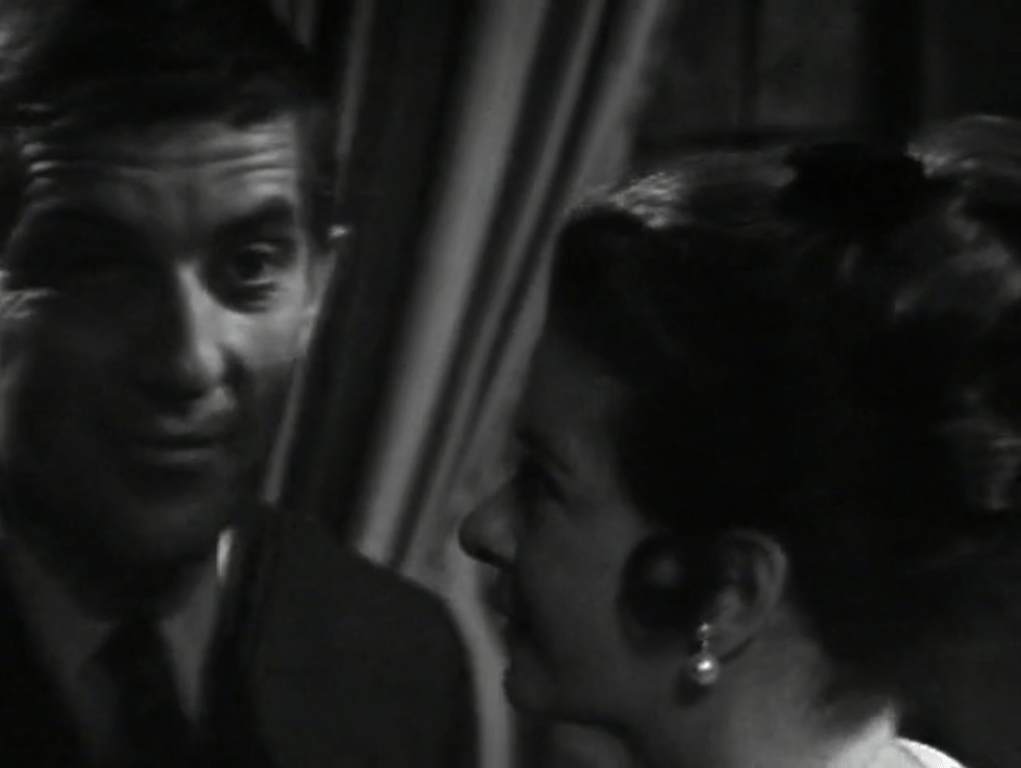
We begin in the drawing room of the great house of Collinwood, where reclusive matriarch Liz and seagoing con man Jason are shouting at each other. Jason showed up and started blackmailing Liz when the last interesting storyline ended four weeks ago, and she is so fed up with the whole thing she doesn’t even bother to close the door when they’re yelling about her terrible secret. Liz’ daughter, flighty heiress Carolyn, comes in and overhears a chunk of the quarrel. She demands to know what it’s all about. Liz tries to fob her off with an obvious lie. Carolyn stalks off, frustrated that her mother won’t tell her what is happening.
Carolyn tries to figure out what’s going on with her mother and Jason
Carolyn goes to the local tavern, The Blue Whale. There, she meets two other characters who don’t have any particular reason to be on the show right now. One of them is dashing action hero Burke Devlin, whose quest to avenge himself on Carolyn’s family drove much of the action in the early months of the show, gradually fizzled out, and came to an abrupt conclusion in #201.
With Burke is hardworking young fisherman Joe. When Dark Shadows started, Joe and Carolyn were dating, and there were a bunch of scenes about how their relationship wasn’t working. Since they were already terminally bored with each other the first time we saw them, this was never much of a story. Now Joe is seeing Maggie, The Nicest Girl in Town. Joe and Maggie are relaxed and happy together, and they want to get married. During the Revenge of Burke Devlin story, there was the prospect that Maggie’s father’s connection with Burke’s plans would get in their way. Now that’s all over, and nobody’s stopping them from getting on with their lives.
Burke, Joe, and Carolyn hang around the tavern for most of the episode and apologize to each other for what they did and said back in the days when they were principals in ongoing narrative threads. Meanwhile, the jukebox keeps going, playing a wider assortment of music than we’ve ever heard from it. In addition to several pieces by Robert Cobert, including an orchestral bit I don’t think we’ve heard before, we hear Les and Larry Elgart’s versions of a tune by Gerry and the Pacemakers and of “Brazil.” This latter is something of a signature of Burke’s. He has often talked about his business interests in South America, and “Brazil” usually plays when a scene at The Blue Whale focuses on him. In his conversation with Carolyn, he behaves as if he is at home and she is his guest, even escorting her to the door when she leaves. As he shows her out, “Brazil” swells on the soundtrack.
Carolyn returns to Collinwood. The drawing room doors are closed now, but Liz and Jason are so loud that she can tell they are still having the same quarrel they were having when she left. Carolyn goes into the room and tells her what she couldn’t help overhearing. Liz tells another transparent lie, then leaves.
Liz is still visible on the stairs when Carolyn asks Jason what they were really talking about. When she presses him for answers, Jason tells Carolyn that if she doesn’t stop asking questions, her mother could get into serious trouble. We’ve seen Jason threaten Liz many, many times, but this is the first time he has shown his nasty side to another member of the family.
We’ve spent over 42 weeks with the ancient and esteemed Collins family of Collinsport, Maine- reclusive matriarch Liz, high-born ne’er-do-well Roger, flighty heiress Carolyn, strange and troubled boy David, and David’s well-meaning governess Vicki. Liz owns all the biggest things in and around the town, but the family is isolated and embattled. Someone bought up Liz’ debts and tried strip her of all her assets, her only servant went on a killing spree and was stopped only by the intervention of ghosts, Roger’s ex-wife showed up and turned out to be a murderous fire witch from beyond the grave, and now Liz herself is being blackmailed by seagoing con man Jason McGuire. Jason even forced Liz to share her home with his rapey henchman, dangerously unstable ruffian Willie Loomis.
Today, an unexpected visitor comes to call on Liz at the great house of Collinwood. He identifies himself as her distant cousin, Barnabas Collins, the last survivor of the English branch of the family. This is the first Liz has heard of the existence of such a branch, but Barnabas’ resemblance to an eighteenth century portrait that hangs in the foyer is strong enough to make his claim plausible. He charms her with his old world manners. Regular viewers, knowing how lonely Liz must be, are not surprised that she is delighted with him.
Liz taking in in the information about her previously unknown relativeLiz warming to Barnabas’ companyLiz falling a little bit in love with Barnabas
Many commentators think it strange that this cousin from England does not have an English accent. I don’t see why. The last character on Dark Shadows to speak with an accent that had anything to do with the show’s setting in central Maine was killed off in #186, and Barnabas has the same mid-Atlantic accent Liz and Roger use. Since he goes on at length about himself as a typical member of the Collins family, we might assume they’ve all been talking like that for hundreds of years.
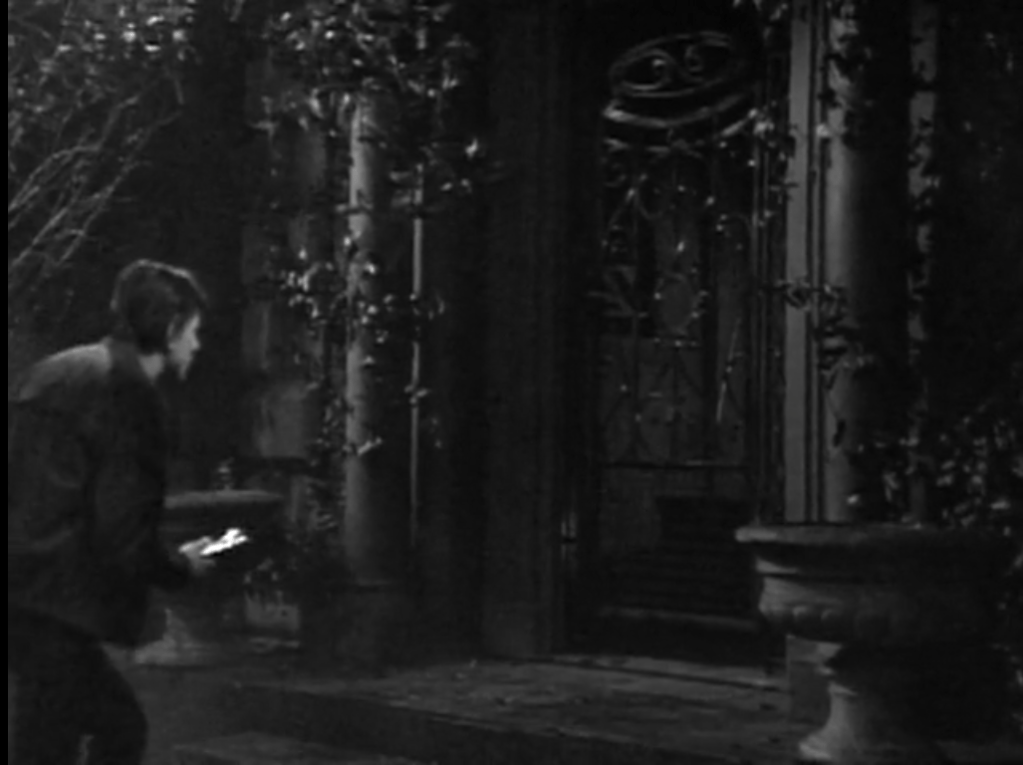
David plays in the long-abandoned Old House on the grounds of the estate. He sees Barnabas silhouetted in the doorway and greets him. Barnabas enters only after David has spoken to him.
David sees Barnabas
David thinks that Barnabas is the ghost of the man in the portrait. When David tells him that he is on intimate terms with several ghosts, Barnabas gives him a hard look and takes a step towards him.
David thinks Barnabas is a ghost
Barnabas reacts to David’s remarks with such a stiffly attentive face and such a deliberate movement of the body that we might sense menace. A man preparing a deadly attack might look like this. But David does not pick up on any danger. He chatters happily away about his ghost friends. As he does, Barnabas relaxes.
David chatters happily to Barnabas
Returning viewers know that Barnabas is not in fact from England, but that Willie released him from a coffin where he had been confined for many years. He resembles the portrait painted in the eighteenth century because he sat for it. He embodies a malign supernatural force that we heard calling to Willie through the portrait and that the caretaker of the old cemetery has said creates a palpable aura of evil that emanates from the tomb where, unknown to him or anyone else, Barnabas’ coffin lay hidden.
None of the characters in today’s episode knows these things, but when David goes back to the great house he shows that he is onto something. He tells Liz and Vicki that he thinks “there’s something funny” about Barnabas. After Liz leaves, David explains to Vicki that Barnabas does not seem angry, as does the man in the portrait, but sad, terribly sad, as if he were “haunting the rooms” of the Old House. Evidently David is rehearsing the part of Captain Shotover in Shaw’s Heartbreak House, with his famous speech about how “We don’t live in this house, we haunt it.”
Vicki functions as an internal audience in her scenes today. She is the recipient of some flowery gibberish from Barnabas about the loveliness of the syllables in her name, and afterward agrees with Liz that Barnabas is very charming. She has a conversation with Liz about whatever is happening in the Jason/ Willie story, and reacts with alarm when Liz says things we are supposed to find alarming. Finally, she is someone in front of whom David can speak freely enough to tell the audience that we’re going to wind up feeling sorry for Barnabas.
Passive as Vicki is in her time on screen today, her opening voiceover is a bit more intriguing. The first 270 episodes of Dark Shadows open with brief monologues by Alexandra Moltke Isles in character as Vicki. Usually, these monologues allude to events in the story. The implication would seem to be that Vicki either knows what is going on or will eventually find out, and that she is speaking to us from the future, where she is looking back on the events we are about to see. This has very much included the advent of Barnabas. In the opening of #202, Vicki told us that Willie was destined “to awaken and unleash a force that will affect the lives of everyone”; in #209, she said that he had “stumbled onto the darkest and strangest secret of all”; and in #210 and #211, she again referred to his grave-robbing expedition and its fell consequences.
We’ve had two major breaks so far from the pattern that establishes Vicki the speaker of the opening voiceover as the person who already knows what we are in the process of finding out. Vicki opened #15 by saying that she had at that point in the story befriended David, something she was in fact months from doing. She opened #102 telling us that Roger was the only person she had to fear, when in fact Roger was the least of her problems. Now, we break from it a third time.
Today’s opening voiceover runs thus:
My name is Victoria Winters. Night is drawing nearer and nearer to Collinwood, and the man who disappeared into another night has not been found. But out of the falling dusk, another man has come, a stranger who is not a stranger, a man with a face long familiar to those who live at Collinwood, a man who has come a great distance but who still bears deep within him a soul shaped by the far country from which he came.
Some may argue (as the Dark Shadows wiki does) that “the far country” might be a reference to death, and so this monologue might be delivered by someone who knows that Barnabas has risen from the grave. But if you know that, you aren’t likely to say that he “bears deep within him a soul,” since we usually hear that vampires don’t have souls.
Vicki has been, not only the narrator, but the point of view character and the chief protagonist of Dark Shadows up to this point. So when we ask whether her voiceover suggests that she might remain unaware of Barnabas’ nature, we are asking if she will continue in that role.
The blackmail storyline was the only one going on Dark Shadows between #201 and the arrival of Barnabas. It has an expiration date, not only because Liz will eventually run out of stuff to surrender to Jason, but also because actor Dennis Patrick agreed to play Jason on condition that he be allowed to leave whenever he wanted, but in no case later than the end of June. The show has been trending heavily toward the supernatural thriller/ horror story genre since December. Indeed, Jason’s first entry into Collinwood in #195 comes with a hint of the portrait of Barnabas, suggesting that his purpose was to introduce Barnabas to the show.
So, while they could not possibly have foreseen that Barnabas would be the hit he actually became or how they would go about rebuilding the show around him, it was likely that if ABC renewed Dark Shadows and it continued beyond #260, Barnabas would have to be a presence in one way or another.
This might offer Vicki a way back in. The previous deadly threats, crazed handyman Matthew Morgan and blonde fire witch Laura Murdoch Collins, were both thwarted by Vicki’s relationship with the ghost of Josette Collins. Josette’s portrait hangs at the Old House, and her spirit is strongest there. Since Barnabas is already at the Old House, perhaps we should expect Josette to help Vicki defeat him as she helped her defeat Laura.
The first question that expectation brings to mind is whether Barnabas is also connected to Josette, and if so how. Today, he identifies Josette to David as “our ancestor.” It has been established that Barnabas is the son of Joshua and Naomi Collins, that Joshua and Naomi continued to live in the Old House after David’s ancestor Jeremiah Collins built the great house, that Jeremiah was not the son of Joshua and Naomi, and that Josette was married to Jeremiah. In the closing scene today, Barnabas makes a speech to the portrait of Josette, telling her that he claims the Old House for himself and that she and Joshua no longer have power there.
Barnabas’ bracketing of his father and Josette as the two relatives who thwarted him would suggest that those two were closely related. I think the likeliest explanation at this point is that Jeremiah and Josette were the parents of Joshua and Naomi, and that Barnabas’ grandmother took his father’s side against him in their climactic battle. All of that is subject to change, of course- Jeremiah, Joshua, and Naomi are only names, and for all the heavy lifting Josette’s ghost has done in the story since December of 1966 she has spoken only a few words and barely shown her face. So even a drastic retcon wouldn’t require explaining any memorable images away.
If Josette is Barnabas’ grandmother, it would seem that he would know a lot more about her than even her friends Vicki and David do. So Vicki is going to have to be on her toes to recruit Josette and deploy her in a battle against Barnabas as effectively as she did in her showdown with Laura. If, as the opening voiceover suggests, Vicki is going to remain oblivious to what Barnabas is all about, Barnabas’ declaration that Josette’s power is ended will prove correct. In that case, Vicki’s future on the show would appear to be sharply limited.
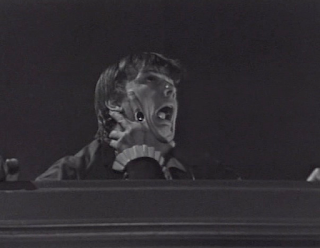
The opening voiceover complains about “a frightening and violent man.” We then see a fellow with a crazed look on his face trying to break into a coffin. Assuming that he is the frightening and violent man, a first time viewer might not be especially upset when a hand darts from the coffin and chokes him, even though something like that can’t be altogether a good sign.
At a mansion identified as the great house of Collinwood, an aristocratic lady is demanding that a man in a captain’s hat account for the whereabouts of someone called Willie. The man answers to the name of Jason and calls the lady Liz. Liz has had all she can take of Willie, whoever he might be, and is not at all happy that Willie’s things are still in her house. Jason does a lot of fast talking, but cannot satisfy Liz either that Willie is really leaving or that he himself does not know where Willie is.
Jason talks with the housekeeper, a woman named Mrs Johnson. He asks her a series of questions about what she knows about Willie and she asks why he wants to know. Even though Mrs Johnson was in the room when Liz was insisting that Jason find Willie and get rid of him, for some unaccountable reason he will not tell her that he is looking for Willie.
Despite Jason’s inexplicable reticence, Mrs Johnson does tell him that Willie was preoccupied with the portrait of an eighteenth century figure named Barnabas Collins, that he was also interested in a legend that another eighteenth century personage, someone named Naomi Collins, was buried with a fortune in jewels, that Naomi Collins is buried in a tomb in a cemetery five miles north of town, and that the night before she saw Willie hanging around the toolshed. Returning viewers will recall that in yesterday’s episode, well-meaning governess Vicki had also told Jason that she had seen Willie in the vicinity of the toolshed, carrying a bag. There doesn’t seem to be a television set in the house, so everyone spends the evenings looking out the windows at the toolshed.
We see a cemetery. It soon becomes clear that it is the same cemetery we saw in the opening teaser. The gate of the tomb in which the frightening and violent man did his sinister work is swinging in the breeze. An old man in a three piece suit and celluloid collar comes upon it. He shows alarm and mutters that he can feel evil in the air.
Jason arrives at the cemetery and meets the old man. Jason says that he is looking for a friend of his, a young man. The old man identifies himself as the caretaker of the cemetery and laments the fact that a young man meeting the description Jason gives was there last night and broke the lock on the gate to the tomb. A first-time viewer’s suspicion that Willie and the frightening and violent man from the teaser are one and the same finds confirmation.
The caretaker can’t believe that Jason is unable to sense the palpable evil that emanates from the tomb. Jason overcomes the caretaker’s attempts to keep him out and makes his way into the tomb. The caretaker keeps warning Jason of the perceptible evil and Jason keeps failing to perceive it. Jason does find a cigarette on the edge of a casket in the tomb, and in closeup gives a look that can only be his recognition of a trace of Willie’s presence.
Jason finds Willie’s cigarette
Jason returns to the great house. Liz is exasperated that he still can’t tell her where Willie is, and Mrs Johnson is irritated he doesn’t put his hat and coat where they belong. After Jason and Liz have left her alone in the foyer, Mrs Johnson takes Jason’s things to the coat closet.
We see Mrs Johnson fussing with the hat and coat from inside the coat closet, an unusual perspective that has in the past been used during shots when characters have stumbled onto important evidence about whatever mystery they were puzzling over at the moment. The shot goes on long enough to lead us to wonder if Mrs Johnson is about to find something important. My wife, Mrs Acilius, mentions that each time she has seen this shot she expected Mrs Johnson to find Willie’s cigarette in Jason’s pocket and to recognize it.
Mrs Johnson fussing with Jason’s coat
That expectation is thwarted when there comes a knock at the door. Mrs Johnson answers and greets the visitor.
The next shot is from the perspective of the visitor. We see a look of astonishment on Mrs Johnson’s face as a man in a fedora and an overcoat asks to be announced to “the mistress of this house, Mrs Elizabeth Collins Stoddard.” He identifies himself as Mrs Stoddard’s cousin from England. Mrs Johnson invites the man in. He hastens across the threshold.
We cut back to the interior, and see the man and Mrs Johnson facing each other. As she bustles up the stairs, the camera tracks around to show him standing next to the portrait of Barnabas Collins, a portrait he resembles strongly. He says, “Oh, madam! If you would, you may tell her that it is Barnabas Collins.”
For regular viewers, it is refreshing to see Jason on the defensive. Ten times in the first eight episodes where they appeared together, he and Liz had a conversation in which he made a demand of her, she resisted, he threatened to expose her terrible secret, and she capitulated. Today is the second episode in which they have interacted without reenacting this drab ritual. Liz is driving the action, Jason is thinking fast, and they are each in their element. For a first time viewer wondering about the hand that came out of the coffin, it’s a lot of filler, but for those of us who have been suffering through the tedium of the blackmail plot it is a fun change of pace.
Regular viewers will also be glad to see the return of the caretaker. He appeared four times* in the storyline of Laura Murdoch Collins, the humanoid Phoenix, and managed to be simultaneously eerie and funny. His catchphrases “Died by fire!” and “The dead must rest!” are all it takes to make Mrs Acilius laugh out loud. His return in #209 moved Patrick McCray to label him a refugee from the EC comics universe, and in my post about that episode I pointed to a shot that looks so much like a panel from an EC comic book that I wonder if the similarity might have been intentional.
While first time viewers may be confused or impatient with the caretaker’s oft-repeated attempts to alert Jason to the nimbus of evil that hangs in the air around him, regular viewers know that the caretaker is the one who understands the show he is on. Jason thinks that he’s on a noir crime drama, and indeed there had been a period when Dark Shadows just about met that description.
But for months now, all the action has been pointing towards the supernatural back-world behind the visible setting. Jason’s own storyline was introduced the very day Laura’s ended, and it is a means for wrapping up all the non-supernatural narrative elements still lying around. Jason’s insensibility to the evil in the tomb is not only a sign that he is himself too corrupt to tell the difference between a wholesome space and a cursed one, but also that he doesn’t fit into the genre where Dark Shadows will be from now on. The audience in 1967 wouldn’t have known that actor Dennis Patrick always insisted on fixing a date for his departure when he joined the cast of a daytime soap, but this scene should give them a strong indication that Jason McGuire is not to be with us indefinitely.
Patrick McCray’s commentary on this episode includes an analysis of director John Sedwick’s visual strategy in the last two shots, those in which Jonathan Frid first appears as Barnabas Collins. McCray confines himself to the first thing photography students are usually taught, the “Rule of Thirds.” But that’s all it takes to get us to look closely at the imagery and to see how Sedwick tells his story with pictures:
Two clear and subtly clever images with a bridge. His introduction comes from his own perspective, rather than Mrs. Johnson’s. It’s an exterior shot of the entrance, looking in.
The grid helps us divide the image. People in the west read from left to right, and tend to circle in our gaze back to the left. Sedwick uses this model of composition in all three shots. In image 1, we see someone — him? — through the eyes of Mrs. Johnson as the camera hangs over his shoulder, minimizing her (1.1). Why is she so transfixed? We follow her gaze up to the towering figure (1.2). Following the slope of his collar, we come back to Mrs. Johnson… specifically, her throat (1.3). After that, we circle back up to her gaze, even more worried. For what reason?
Then he enters with purpose, and we next see him again from the back, divesting himself of his cane and hat, getting a glimpse of his strangely antique cloak. His voice is rich with a uniquely tentative sense of authority. We still don’t see his face, just bits of his profile. These moments tease us, and yet they put us in the position of a confidant of the vampire’s. The composition mirrors what we saw outside. Within, Mrs. Johnson (2.1) is minimized, and the turn in the figure shows him looming, ready to pounce. Again, we begin with her, following her gaze from left to right. The mystery of what bedevils her, bedevils us, as well. The man towers (2.2) in the right, blocking the exit. Instead of following a sloping collar, we follow its larger, expanding offspring in the cape, which takes us circling to the left again where we stop on the poor, miniscule shield of his hat and then, like a wolf pulling her away, his feral looking cane (2.3).
Situated so close to the predator, with his gaze elsewhere, we have a strange safety. We don’t see him from the eyes of his prey. Instead, we are a quietly unacknowledged friend. Finally, as Mrs. Johnson goes to summon Elizabeth, the figure turns to face the portrait, rotating upstage to let us see him from profile to profile. As she exits, and we are alone with him, the chiseled face comes into focus from the side. It is alien. It is familiar. We think we know why, but then we see why. They are only face to face for a moment before the camera takes us away from him and uncomfortably close to the painting from 1795, cold and haughty and haggard and sad. He then steps even uncomfortably closer to it and spins to give his inevitable name. We see the two men in mutual relief.
The painting of Barnabas is a prisoner in a four-sided frame on the wall, disapproving and distant as the first thing our eyes rest on (3.1). Is the painting gazing at the man? No. The more we look, the more the painting is gazing at us, as if we’ve been caught looking. It’s natural to avert our eyes from this, and by comparison, section 3.2 is practically benevolent. His impossible doppelganger is standing before it in three dimensions on our 2D screen. Liberated, he smiles, and there is something optimistic about it. He’s gazing upward to the landing, yes, but it’s also to the future. Gazing left, he’s anticipating the next image rather than look for one that has passed. Subtly, our eyes wander down to 3.3, his medal, a subtle reminder that, despite his strange warmth, he’s a soldier as well, and a force to be reckoned with.
Dangerously unstable ruffian Willie Loomis is under the impression that Dark Shadows is still the show ABC originally bought, a Gothic romance. So when he hears a tale of a grand lady in a manor house who fell in love with a pirate and is buried with a fortune in jewels that he gave her, he takes the story at face value and sets out to find and rob her grave.
Willie’s associate, seagoing con man Jason McGuire, believes that Dark Shadows is now the crime drama it more or less became for a couple of months after the Gothic romance approach petered out. He is blackmailing reclusive matriarch Liz, and refers to his incessant threats against her in their first conversation today.
Yesterday, the Caretaker of Eagle Hill cemetery tried to warn Willie that Dark Shadows has changed direction, and has been developing as a supernatural thriller/ horror show since December. Willie wouldn’t listen to him, but regular viewers know that all the old storylines are finished, and even people tuning in for the first time today will notice that the emphasis is on the uncanny.
At the end of today’s episode, Willie finds a hidden coffin and forces it open. It doesn’t have the jewels he was seeking, but something is in there that will bring great wealth to ABC and Dan Curtis Productions.
This is the first episode of Dark Shadows most people see. Posting commentary on episodes 1-209 is a bit like driving down a quiet, picturesque country road. By contrast, googling “Dark Shadows episode 210” is like merging onto a busy highway. I want to respond to two of the many, many commentators on this one, Patrick McCray and Danny Horn.
Elizabeth calls Jason into the drawing room and throws an envelope of money at him — she’s paying Willie to leave town. She tells Jason to count it, but he turns on the charm, assuring her, “It’s all there. I can tell by the feel of it.” She barks at him that his friend should leave the house immediately. He apologizes: “I wanted this to be kept quiet. You know, the same way you wanted something kept quiet?” She walks out, and as soon as her back is turned, he opens the envelope and counts the money. Jason is funny. We like Jason.
Danny Horn, Dark Shadows Every Day, “Episode 210: Opening the Box,” 2 September 2013
Danny makes a point of ignoring the first 42 weeks of the show, often claiming never to have seen most of it. As his blog goes on, it becomes clear that he has seen a lot more than he wants to let on, but he is consistent enough about writing from the point of view of someone who started from this episode that I could always find a place in his comment section to add remarks about the connections to the early months.
And indeed, it is easy to see how someone tuning in for the first time today could say “We like Jason.” He is trying to keep control of the situation when he doesn’t understand what’s going on and he can’t afford to tell anyone the truth, so he has to keep coming up with fresh lies that will keep the ladies of the house from calling his bluff and new ways of pretending to be scary that will keep Willie from laughing at him. That’s a winning formula for a character, as witness the history of theater all the way back to the Greek New Comedy. Actor Dennis Patrick has the craft and the charisma to sell it beautifully.
Returning viewers may well have a far less enthusiastic response to Jason. His conversations with Liz today are the first time the two of them talk without falling into a pattern where Jason makes a demand, Liz resists, he threatens to expose her terrible secret, and she capitulates. They’ve enacted that depressing ritual ten times in the weeks Jason has been on the show, sometimes twice in a single episode. In Jason’s scenes with Willie and some of the other characters, we’ve had hints of the breezy charm Dennis Patrick exudes today. But the Jason/ Liz exchanges are so deadly that we get a sinking feeling every time either of them appears. Since blackmail has been the only active storyline going for the last two weeks and the two of them are the only full participants in it, that’s a lot of sinking feelings.
Jason is harassing Willie. The big one is abusing the little one, demanding that he account for his whereabouts and doing so violently. David and Goliath. Shrill and meek. Had we started earlier, it would be tougher to be on Willie’s side. Starting here? Jason is the villain. He accuses the bruised kid of having a scheme, and the kid obviously lies to the Irish galoot, gazing at the portrait conspiratorially. It’s as if he and the man in the painting already have a relationship. Cut to opening credits.
A lovable weasel. A bully. A silent and stern third party, hanging on the wall like a watchful ally, holding his action. Only a few lines, but resonantly human to anyone who’s been victimized by a know-it-all lout. Somehow, we know this power dynamic is bound to change, and that, for once, the know-it-all knows zip.
Patrick McCray, The Collinsport Historical Society, “Dark Shadows Daybook: April 13,” 13 April 2018
Willie has been a frantically violent character, showing every intention of raping every woman he meets and picking fights with every man. Some of Willie’s attempted rape scenes, especially in his first five appearances when he was played by Mississippian method actor James Hall, were so intense that they were very difficult to watch. Nor has Willie become less menacing since John Karlen took the part over. Just yesterday, Jason had to pounce on Willie as he was creeping up on well-meaning governess Vicki. It is indeed tough for anyone who has seen the previous episodes to be “on Willie’s side” in the sense of hoping that he will be the victor, even if we find him interesting enough that we want him to stay on the show.
But I think Patrick McCray overstates the degree of sympathy Willie is likely to gain from an audience watching Jason’s attempt to bully him today. At no point does Willie seem the least bit intimidated by Jason. He chuckles at him throughout the whole scene, and keeps his head up and his eyes open. The bruise Willie still has around his eye from a bar fight he lost the other day is faint enough that it does not give him any particular look of vulnerability. It’s true Willie is smaller than Jason, but he’s also younger and in good shape, so there is no reason to suppose he would be at a significant disadvantage were they to come to blows.
Returning viewers will also notice that the carpenters have been busy. Today we get a look inside the Tomb of the Collinses, a new set introduced yesterday. We also see a much more modest structural addition for the first time, a second panel of wall space downstage from the doors to the great house of Collinwood.
During the first weeks of the show, the foyer set ended right by the doors. When they added a panel to represent a bit more wall space, they decorated it at first with a metal contrivance that looked like a miniature suit of armor, then with a mirror, then alternated between these decorations for a while. When Jason first entered the house in #195, the mirror reflected a portrait, creating the illusion that a portrait was hanging by the door.
Episode 195
By #204, a portrait was in fact there, one we hadn’t seen before, but that they must have been painting when Jason first came on the show.
Episode 204
In #205, the portrait is identified as that of Barnabas Collins, and it is accompanied by special audio and video effects. Sharp-eyed viewers remembering #195 may then suspect that the point of Jason and Willie is to clear out the last remnants of the old storylines and to introduce Barnabas Collins.
Today, a second panel is added to the wall next to the portrait, and the mirror is mounted on it. Liz and Vicki are reflected in the mirror. The split screen effect not only puts the painting in the same shot as their reactions to it, but also establishes a visual contrast between the present-day inhabitants of the house and another generation of Collinses.
Dangerously unstable ruffian Willie Loomis stares at the portrait of Barnabas Collins hanging in the foyer of the great house of Collinwood. The portrait’s eyes glow and the sound of a heartbeat fills the space. Willie’s fellow unwelcome house-guest, seagoing con man Jason McGuire, comes into the room. Willie is surprised Jason can’t hear the heartbeat.
After consulting the Collins family histories, Willie goes to an old cemetery where legend has it a woman was interred with many fine jewels. The Caretaker of the cemetery stops Willie before he can break into her tomb. Willie hears the heartbeat coming from the tomb, but, again to his amazement, the Caretaker cannot hear it.
Yesterday, strange and troubled boy David Collins had told Willie that in some previous century, a pirate fell in love with Abigail Collins, gave her jewels, and that Abigail took those jewels to her grave. Today, Willie repeats this story to wildly indiscreet housekeeper Mrs Johnson, only he identifies the woman as Naomi Collins. Fandom likes to seize on this kind of thing, presenting it either as an error or as a sign of retcons in progress, but I suspect that it is just a clumsy way of suggesting that the characters are hazy on the details of the legend.
The legend itself is very much the sort of thing that inspired Dark Shadows in its first months. ABC executive Leonard Goldberg explained that he greenlighted production of the show when he saw that Gothic romance novels were prominently featured everywhere books were sold. The idea of a grand lady in a manor house somehow meeting and having a secret romance with a pirate is a perfect Gothic romance plot, as for example in Daphne du Maurier’s Frenchman’s Creek. Willie’s fascination with the tale might reflect an accurate assessment of the situation if Dark Shadows were still a Gothic romance, but the show left that genre behind as the Laura Collins storyline developed from #126 to #193. If Willie had been watching the show, he would know that the story David told him is not the one that is going to shape his future as a character on it.
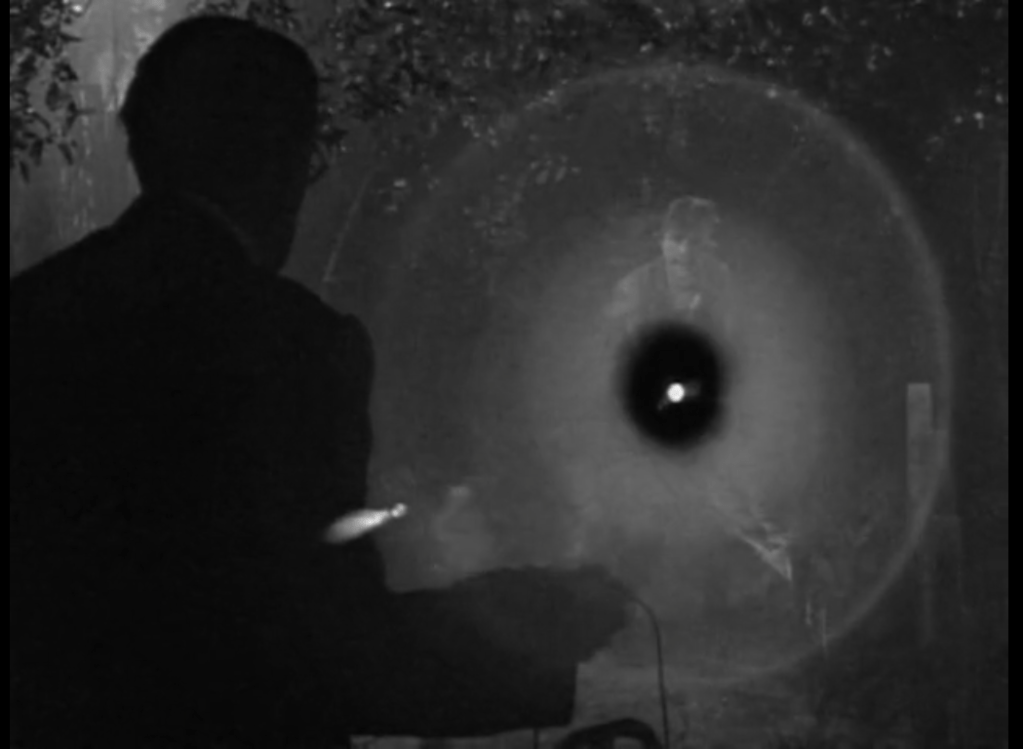
When Willie is wandering around the old cemetery, he twice shines a flashlight directly into the camera and creates a halo effect. The first time might have been an accident on the actor’s part, but the second time the halo frames the Caretaker in a way that is obviously intentional. Patrick McCray’s entry on this episode in his Dark Shadows Daybook describes the Caretaker as “a refugee from the EC universe.” Indeed, Willie’s crouching posture and angry facial expression, the halo filling so much of the screen, the tombstones in the background, and the Caretaker’s silhouetted figure carrying a lantern add up to a composition so much like a panel from an EC comic book that it may well be a conscious homage:
Beware the Vault of Horror!
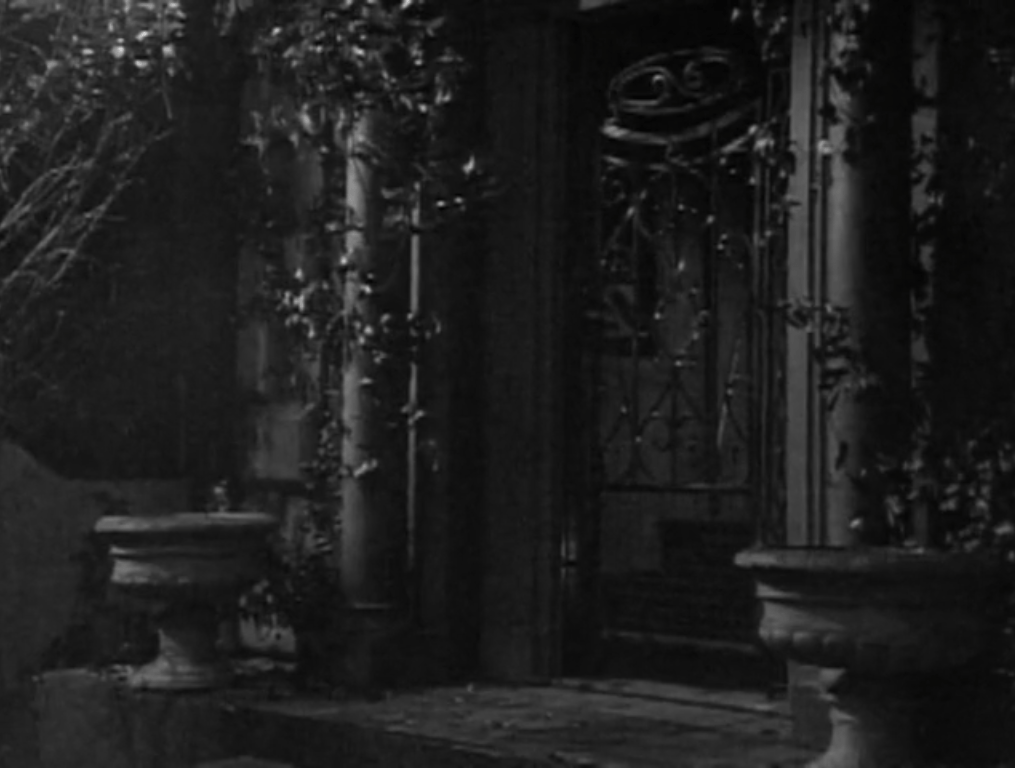
This is our first look at the Tomb of the Collinses.
Introducing the Tomb of the CollinsesWillie sneaks up to the Tomb
It’s also the first time we are told the name of the cemetery five miles north of Collinsport in which the Tomb is situated. Mrs Johnson calls it “Eagle’s Hill Cemetery,” though later it will be called “Eagle Hill.” Mrs Johnson also mentions the Collinsport cemetery two miles south of town, and the Collins’ family’s private cemetery located in some other place. They won’t stick with any of this geography for long, though it all fits very neatly with everything we heard about burial grounds in the Collinsport area during the Laura story.
Friday’s episode ended with an important scene. Strange and troubled boy David Collins cheerfully escorted dangerously unstable ruffian Willie Loomis around the great house of Collinwood, giving him little lectures about the portraits of the Collins ancestors. David pointed to a portrait in the foyer and spoke a name we hadn’t heard before, identifying it as Barnabas Collins. Willie, then played by frenzied Mississippian James Hall, became fascinated with the jewels Barnabas wore, so much so that for the first time on Dark Shadows his thoughts became audible as a recording playing on the soundtrack. After Willie left the house, we heard a heartbeat coming from the painting and saw Barnabas’ eyes glow.
When Willie’s associate, seagoing con man Jason McGuire, first entered Collinwood in #196, an optical trick made it look like a portrait was hanging on the spot where Barnabas’ portrait is now. While the face on the painting would have to wait until the actor was cast, the rest of the work on it was already done at that point, so that trick, inconspicuous as it would have been to the audience, was a sign that the production staff had decided that Jason’s role on the show would be to precipitate the introduction of Barnabas. And the opening voiceover of #2o2, the episode in which Willie joins Jason as a houseguest at Collinwood, referred to Willie as “one who is to awaken and unleash a force that will affect the lives of everyone.” The special effects surrounding Willie’s first encounter with the portrait would suggest that Barnabas represents that force, and that the portrait is a means by which that force is expressed.
Today’s episode begins with Willie taking another look at the portrait, and will end with him staring at it again. In between these two sessions, we learn that among the many impulses Willie is unable to control is a fascination with shiny objects.
We also see the ninth and tenth iterations of Dark Shadows’ dreariest ritual, in which seagoing con man Jason McGuire makes a demand of reclusive matriarch Liz, Liz resists, Jason threatens to expose her terrible secret, and Liz gives in. The first time comes after the opening credits. In the pre-credits teaser, they raised our hopes that we might see a conversation between them which does not conform to this pattern. Liz tells Jason that Willie can no longer be a guest in the house, and Jason agrees. But as soon as we return, he demands that she give Willie a parting gift in the form of $1000 cash. She refuses, and says she will call the police rather than bribe Willie to leave her home. After Jason threatens to send her to prison and lowers his demand to $500, she capitulates.
When Jason breaks the news to Willie that he is to leave immediately and take $500 with him, Willie notices a diamond-encrusted emerald pin and slips it in his pocket. Minutes later, Liz finds the pin missing and tells Jason she will have to call the insurance company. Jason confronts Willie in the kitchen and demands he hand the pin over. After a tense moment, Willie admits that he took the pin, not because he thought he could get away with stealing it, but because it was so pretty. He goes on about how supremely beautiful fine jewels are, saying that he can judge the beauty of a gem simply by touching it. He begs Jason to let him touch the emerald again. After Jason leaves him alone in the kitchen, Willie looks like he has had a new idea and is resolved to act on it.
Willie’s compulsion to touch the emerald creeps Jason out
Willie starts the scene with angry defiance, proceeds to humiliated dependence, and ends with a look of brisk resolve. John Karlen takes Willie through all of these emotions without any apparent discontinuity of feeling. He is still the defiant man even while he is begging, and still the begging man even while he is making up his mind to follow his new plan. That is as different as can be from Hall’s interpretation of Willie, who frightened us largely because of his extremely mercurial temperament. His moods shifted so wildly from second to second that you had no idea what he might do. It is remarkable that two performances can be so utterly unlike each other in every way, yet be equally effective at conveying menace and equally exciting to the audience wondering what comes next.
Jason tries to convince Liz that Willie didn’t take the pin, but that it simply fell to the floor. This effort collapses immediately. Liz is no longer disposed to give Willie any money; she is planning to call the police and let the chips fall where they may. Jason does not believe Willie will go quietly unless he gets a substantial sum of cash, and is afraid of the trouble Willie can make. So he again threatens Liz, this time focusing on the effect of a potential scandal on her daughter Carolyn and on David. Liz looks away in despair, unable to refuse Jason’s demand.
Willie depresses some characters and enrages others. The only exception is David, who brightens and chatters gladly when he sees Willie. David leads Willie into the study, where he shows him pictures of the Collins family’s eighteenth century ancestors and goes on about their fabulous jewels. He identifies one ancestor as his “great-great-grand-uncle.” “Grand-uncle” is a bit of Collinsport English that we will hear again later in the series. David suggests that some very valuable items might be found buried in out of the way places around town. David’s tales send Willie back into the foyer to stare longingly at the jewels in Barnabas’ portrait.
As we heard Willie’s interior monologue on the soundtrack while he stared at the portrait Friday, so today we hear a recording of Willie’s speech to Jason about his love of jewels while he studies the jewelry in the portrait. As his words come to an end, the heartbeat plays again and the eyes glow again. This time, Willie sees and hears and reacts. He has found his destiny.
Today we’re in Collinsport’s night spot, The Blue Whale tavern. Seagoing con man Jason McGuire is at the bar, trying to convince his henchman, dangerously unstable Willie Loomis, to stop acting like he’s about to rape every woman he meets before they get thrown out of town.
A party comes in consisting of artist Sam Evans, Sam’s daughter Maggie, and Maggie’s boyfriend Joe. Dashing action hero Burke Devlin enters and joins Sam, Maggie, and Joe at their table. Burke has confronted Willie a couple of times, and Willie tells Jason that they are fated to have it out sooner or later. Jason tries to persuade him to abandon this idea, telling him that Burke would be a useful friend and a formidable enemy.
Jason delights Willie by telling him that Burke is an ex-convict. John Karlen brings such enormous joy to Willie’s reaction to this news that it lightens the whole atmosphere of the episode.
Jason buys Burke a drink and tells him that Willie is secretly a nice person. He and Burke find that they both have a high opinion of psychoanalysis, of all things, but their shared admiration of the Freudian school does not lead them to agree about Willie.
Sam goes to the bar, leaving Maggie and Joe to themselves. A bit later, Joe has to leave Maggie alone for a few minutes while he makes a telephone call to check in with a situation at work. He urges her to stay at the table and avoid Willie. She notices that Willie is talking to her father, and is alarmed. Joe tells her not to worry- from what they’ve seen, it appears that Willie only likes to hurt girls.
At first, Willie and Sam’s conversation is cheery enough. Willie is impressed with Sam’s beard, and even more impressed that Sam is a professional painter. For a moment, we catch a glimpse of Willie, not as an explosively violent felon, but as an awkward guy who is trying to make a friend. This passes when the idea of nude models pops into Willie’s head, and he asks again and again where Sam keeps the naked ladies. Sam tells Willie that he doesn’t use live models, at first politely, then with irritation. Willie responds with his usual vicious menace.
Maggie goes up to intercede. This would seem to be an odd choice. Jason is at the next table, and when Willie was harassing her and picking a fight with Joe last week she saw Jason rein Willie in. She knows that Jason is eager to smooth things over with the people Willie has already alienated, so it would be logical to appeal to him. Burke and Joe are nearby as well, and have both made it clear that they are ready to fight Willie. If either of them goes to Willie, he will be distracted and Sam will have a clear avenue of escape. And of course Bob the bartender really ought to have thrown Willie out of the tavern long ago. Maggie, on the other hand, will attract Willie’s leering attentions and complicate her father’s attempt to get away from Willie by making him feel he has to defend her.
From his first appearance in #5, Sam was a heavy-drinking sad-sack. Today, Sam seems to have become a social drinker. He’s gone out with friends for a couple of rounds, and is pleasant and calm the whole time. Soap operas are allowed to reinvent characters as often as they like. If Sam’s alcoholism isn’t story-productive anymore, they are free to forget about it.
The problem with this scene is that Maggie hasn’t forgotten. Maggie’s whole character is that of an Adult Child of an Alcoholic. It makes sense that an ACoA, seeing her father in trouble, would cast aside all rational calculations and rush up to protect him. But if Sam isn’t an alcoholic anymore, Maggie is just a very nice girl who laughs at inappropriate times.
Burke comes to Maggie and Sam’s rescue. Willie draws a knife on Burke, they circle, Burke disarms Willie and knocks him to the floor.
We’ve seen many couples move about on the floor of The Blue Whale while music was playing, and usually their movements have been so awkward and irregular that it is not clear that what they are doing ought to be called “dancing.” But Burke and Willie’s fight is a remarkably well-executed bit of choreography. At one point Willie brushes against the bar, and it wobbles, showing that it is a plywood construction that weighs about eight pounds. But it doesn’t wobble again, even though the fighters both make a lot of very dynamic movements within inches of it, and at the end of the fight Willie looks like he is being smashed into it.
After the fight, Willie and Jason meet in a back alley, the first time we have seen that set. Jason assures Willie that he will eventually get his cut of the proceeds of Jason’s evil scheme, but tells him he will have to leave town right away. Willie vows to kill Burke.
The jukebox at The Blue Whale plays throughout the episode. In addition to Robert Cobert’s usual “Blue Whale” compositions, we hear Les and Larry Elgart’s versions of a couple of Beatles tunes and of a Glenn Miller number.
Villains on soap operas can never be quite as destructive as they at first seem they will be, and heroes can never be quite as effective. To catch on, villains and heroes have to seem like they are about to take swift action that will have far-reaching and permanent effects on many characters and storylines. Yet the genre requires stories that go on indefinitely, so that no soap can long accommodate a truly dynamic character.
This point was dramatized in Friday’s episode. The chief villain of the moment, seagoing con man Jason McGuire, stood in front of some candles, placed to make him look like he was the Devil with long, fiery horns. Seconds after this image of Jason, his henchman Willie loses interest in him and wanders off, first listening to a lecture from a nine year old boy, then becoming obsessed with an oil painting. They aren’t making Devils the way they used to.
Jason and Willie look at the portrait of Jeremiah Collins
Today, dashing action hero Burke Devlin goes to the great house of Collinwood and confronts Willie. Well-meaning governess Vicki asks Burke why he wants to defend the ancient and esteemed Collins family from Willie and Jason if the Collinses are his enemies. He gives a flip answer to her, and is equally unable to explain himself to reclusive matriarch Liz. Regular viewers remember that the “Revenge of Burke Devlin” storyline never really led to anything very interesting, and that last week the show formally gave up on it. Without it, Burke has nothing to do. So, if the character can’t keep busy as the Collinses’ nemesis, he may as well try to justify his place in the cast with a turn as their protector.
In the foyer of Collinwood, Burke orders Willie to leave Vicki alone. Willie taunts him, and Burke picks him up and holds him with his back against the great clock. Vicki and Liz become upset, demanding that Burke let Willie go. Willie himself remains collected. After Burke releases him, Willie goes to his room, and the ladies scold Burke further. He doesn’t appear to have accomplished a thing.
Willie, off his feet but undisturbed
This is John Karlen’s first episode as Willie Loomis. His interpretation of the character is poles apart from that of James Hall, who played Willie in his previous five appearances. When I was trying to get screenshots to illustrate the moods of Hall’s Willie, I found that I had an extremely difficult task on my hands. His face would fluctuate wildly, showing a mask of calculated menace for a few seconds, then a flash of white-hot rage for a tenth of a second, then sinking into utter depression for a moment before turning to a nasty sneer. These expressions followed each other in such rapid succession it was almost impossible to catch the one I set out to get. The overall impression Hall creates is of a man driven by desperate, unreasoning emotions, lashing out in violence at everyone around him because of the chaos inside himself.
Karlen’s Willie is just as dangerous as Hall’s, but he is as composed as Hall’s Willie was frantic. At rise, he is staring at the portrait of Barnabas Collins, studying the baubles Barnabas is wearing. When housekeeper Mrs Johnson enters, Willie asks her about the Collins family jewels. When she uncharacteristically manages to be less than totally indiscreet, he shows considerably more cleverness and infinitely more calmness than Hall’s Willie ever did in maneuvering her to the subject again. If Hall’s Willie was a rabid dog charging heedless in every direction, Karlen’s is a deliberate hunter, acting coolly and undaunted by resistance.
Hall played Willie with a lighter Mississippi accent than he uses in real life, while the Brooklyn-born Karlen assumes a vaguely Southern accent in parts of this episode. That trace of Hall’s influence will remain for some months- eventually Willie will become a Brooklynite, but between now and then Karlen’s accent will go to some pretty weird places.
This was also the first episode of Dark Shadows which ABC suggested its affiliates broadcast at 3:30 PM. It would not return to 4:00 until 15 July 1968. When the core demographic of the show’s audience shifts from housewives and the chronically ill to school-age kids, as will happen quite soon, this earlier time slot will present a major problem. Those kids are now in their 60s, and they usually begin their reminiscences of Dark Shadows with “I used to run home from school to see it!” If school let out at 3:00 and the TV set at home took as long to warm up as most of them did in those days, you’d have to run pretty fast to be sure to catch the opening teaser even if you lived nearby.
Flighty heiress Carolyn tells her mother, reclusive matriarch Liz, that she has had a problem with one of Liz’ houseguests. Last night, dangerously unstable ruffian Willie Loomis was about to rape Carolyn, who fended him off only by pointing a loaded pistol and telling him she would blow his brains out.
Liz confronts the person who insisted she take Willie into the house, seagoing con man Jason McGuire. She demands that Jason send Willie away at once. This leads to the eighth iteration of the only conversation Liz and Jason have. He makes a demand, she resists, he threatens to expose her terrible secret, she capitulates.
The script varies the ritual slightly this time. It is prefaced with Liz’ demand that Jason evict Willie, and Liz’ final capitulation is delayed by having her stand her ground until Jason says he will get Willie out soon. Later in the episode, Liz walks in on Willie grabbing at Carolyn, and even then settles for Jason’s promise that he will get his henchman out within the week.
The show has given us some scenes of friction between Carolyn and Liz, but has spent a lot more time on Carolyn talking about how strong her mother is. Now that Carolyn realizes that her mother will let an explosively violent hoodlum stay in their house indefinitely after he has twice assaulted her, we are primed to expect that sharper conflicts between Carolyn and Liz will feature in upcoming storylines.
We get another preview at the end of the episode. Strange and troubled boy David Collins shows Willie a couple of portraits of Collins ancestors and talks about the history of the family. One of these portraits is new to us, having made its debut during the closing credits of yesterday’s episode. David identifies it as someone called Barnabas Collins. David has been pivotal to each of the major plot developments on Dark Shadows so far, so when he is the first character to speak a name on screen, we might expect to hear that name again.
The portrait of Barnabas has such a strong effect on Willie that he adds an element to the show’s format. For the first time on Dark Shadows, a character’s internal monologue plays as a voiceover. While we watch Willie study the portrait, we hear his recorded voice going on about the wealth it suggests. Willie walks off. The portrait fills the screen, its eyes start to glow, and we hear a heartbeat.
The portrait of Josette Collins that hangs at the long-abandoned Old House glows when Josette’s ghost is active, and the eyes of a portrait of Laura Murdoch Collins glowed on several occasions when Laura was on the show. So regular viewers are used to seeing the visual effects that accompany Barnabas’ portrait. But the heartbeat is new. Josette’s portrait and Laura’s are silent pictures, Barnabas’ is the first talkie.
This is the last episode in which we will see James Hall as Willie. These episodes were shot out of sequence, so this one was made on 23 March 1967 and yesterday’s was made on 24 March. Most episodes were shot in a single take, as is obvious from the bloopers and production faults that run through them. Yesterday’s- the one produced on Friday, 24 March- was the first since #1 that went to three takes. That evening they called actor John Karlen and asked him to come in on Monday the 27th and take over the part of Willie. So, while Hall may never have been told why he was let go and to this day doesn’t seem to know what happened, it’s hard not to suspect that the producers blamed him for that third take.
Karlen would bring so much to the show that I can’t really regret losing Hall, excellent as he was. Years ago, I was chatting with an old friend of mine about ways that the original Star Trek might have been improved. We agreed that we couldn’t give up the actual show, and that what we were really wishing for was access to an alternate universe where they had made those changes. So that’s how I feel about Dark Shadows. I still want all of John Karlen’s performances, but would like an antenna that I could tune to receive broadcasts from a parallel timeband where he and James Hall swapped careers.
Dangerously unstable ruffian Willie Loomis is staying at the great house of Collinwood, much to everyone’s dismay. Yesterday’s episode ended with a scene in which he appeared to be trying to rape well-meaning governess Vicki in the study. She resisted him pretty vigorously, especially after he trapped her in front of some furniture. When reclusive matriarch Liz interrupted the confrontation and demanded Willie leave the house, Vicki ultimately let Willie off the hook, saying that he didn’t really do anything.
Today, Vicki sees flighty heiress Carolyn in the kitchen and warns her about Willie’s violent ways. After Willie has insulted everyone in the house, Vicki and dashing action hero Burke Devlin run into him while on a date at Collinsport’s night spot, The Blue Whale. Willie enrages Burke, and the two men are about to fight. Vicki urges Burke not to fight, leading him to pause. She shouts at Willie, demanding that he go away. He does. This leads me to wonder if the reason Vicki didn’t back Liz up is that she wants to fight her own battles.
Willie returns to Collinwood. He finds Carolyn alone in the drawing room. He blocks her exit from the room. He grabs at her hair, and tells her that she is, unknown to herself, attracted to him. When she says she wants to leave the room, he orders her to stay until he dismisses her. He closes the doors and approaches her, responding to her protests by saying that he can’t hear her. If they had cut away at this moment, it would have been a fully realized rape scene. There is nothing left to show by putting the actual assault on screen.
But they don’t end it there. Carolyn reaches into the desk drawer and pulls a loaded gun on Willie. Willie does stand there and keeps talking for a moment, but eventually he takes “If you don’t leave me alone I’ll blow your head off” for an answer. He backs out of the room and goes upstairs. Evidently Carolyn doesn’t need rescuing either.
The closing credits run over an image including the spot on the wall to the left of the main doors to Collinwood. That spot has alternately been decorated with a mirror and a metallic device resembling a miniature suit of armor. Lately it has been the mirror; when Jason first entered the house, that mirror reflected a portrait. Now, the spot is decorated with a portrait. It is one we haven’t seen before.
We also see something that hasn’t happened since episode #1. The production slate tells us that this episode went to a Take 3. Considering what they left in for broadcast, it always boggles the mind what might have led them to stop tape.









 Dark Shadows Commentary