Episode 13: Worst thing that ever happened to this house, him comin’ back

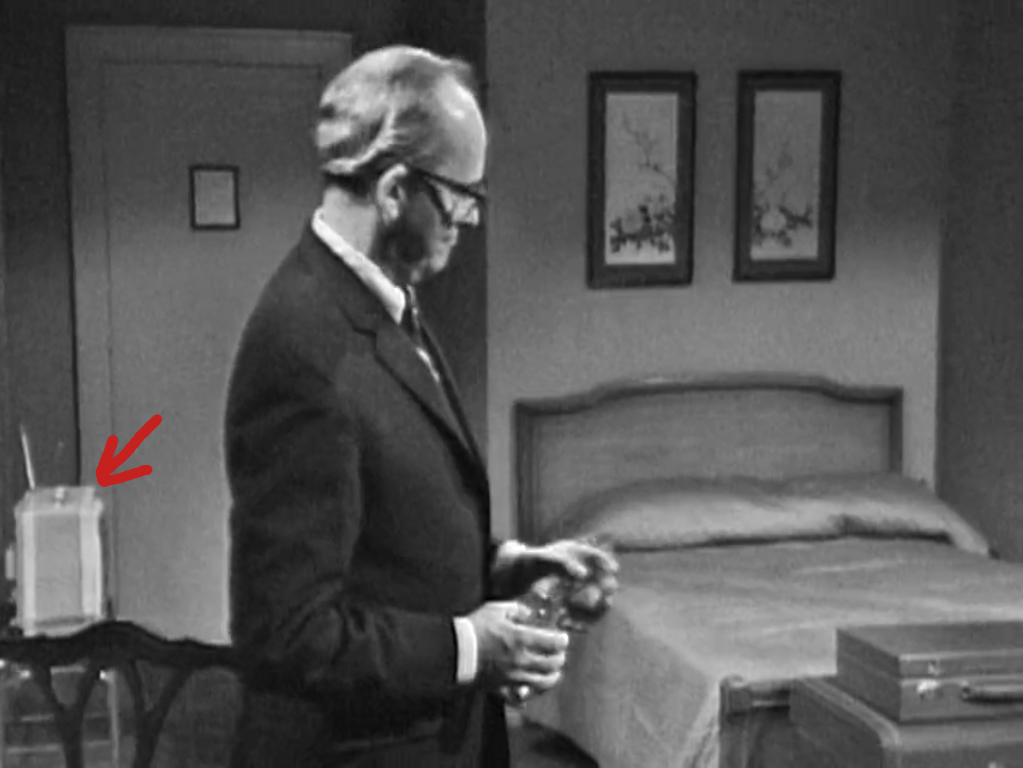
Vicki visits Matthew in his cottage, the first time we’ve seen that set. She hopes that he will tell him something about her past. He doesn’t, but he does go on about the Burke Devlin trial. After he has brought up the Devlin trial he asks her why she’s interested in it. She says she isn’t, he scowlingly demands she stop talking about it. She’s bewildered. That might have been meant to be a joke, but if so it doesn’t land- George Mitchell’s Matthew is just too intense, too tortured, for that kind of joke to work.

Vicki’s effort to befriend Matthew fails as completely as does her attempt to get information about her origins, but the cottage set goes a long way towards making it seem that it might succeed. We see Matthew cooking and sharing a meal with Vicki in an intimate setting, and for all his strange ferocity he is very talkative. When she answers a question of his with a lie that is sure to anger him violently if he discovers it, we are in high suspense, hoping against hope that she will not be found out.

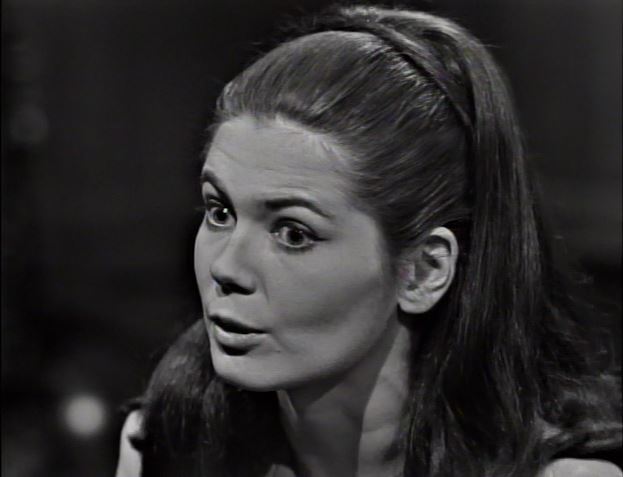
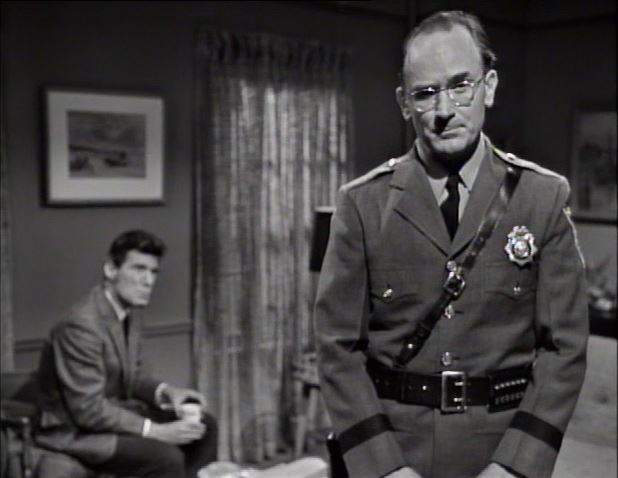
The caretaker’s cottage isn’t the only set we see for the first time in this one. We also follow Vicki into the garage at Collinwood. She finds Burke there with a wrench in his hand, standing next to the open door of Roger’s car. Burke explains this odd situation by claiming that he had been thinking of buying a similar car and wanted to look Roger’s over. Vicki is suspicious, and says that Mr Collins wouldn’t like his being there. Burke asks her to keep it secret, an invitation she pointedly refuses to accept.

Unlike the caretaker’s cottage, which is a staple set of the series almost up to the very end, we only see the garage a few more times. That’s a shame, I think. The show is so much about the house that the stories would all be richer if they gave us more of a sense of the physical realities of the house and its functioning. Simply placing a scene in the garage, where people are handling tools and standing in front of machinery while they talk about whatever it is that’s going on in the story, can accomplish that without the need to dwell on anything technical or mundane.

Also, the garage is where cars are kept. A scene there can establish a connection with the outside world. Often the show intentionally builds a claustrophobic sense in the audience, but sometimes they simply have a long string of episodes set entirely in the house and get us feeling more confined than we have any need to do. In those periods, a scene set in the garage could let just enough air in to keep us from being distracted by the closeness of the quarters.

Episode 12: You can still hear the widows

Roger and Vicki encounter each other on the peak of Widow’s Hill. Roger remarks it is the highest point in the area. At the end of their conversation, Vicki will call to Carolyn, inviting her to join them “down here.” This may seem to be a blooper, but since we hear “down” used to mean “up” in a later episode, I speculate that it’s a peculiarity of Collinsport English.

Little happens to advance the plot in this episode, but between Roger’s announcement that he and Vicki are standing on the highest point in the area and Vicki’s invitation to come “down here,” we hear a lot about the ghostly legends of the place. After the scene in episode 11 where the ghosts are troubling Elizabeth while David is doing something mysterious involving motor grease and little pieces of metal, it seems that the show is using the ghosts as a sign that something big is happening. Certainly the “Widow’s Wail” is a striking sound effect, and Louis Edmonds does a good job of selling the idea that Roger really does believe in all the legends about the house that his social position might require him and Elizabeth to ridicule publicly.

It’s a bit jarring that Carolyn drifts into the scene asking what Vicki and Roger are doing- “planning a suicide pact?” She had just told Vicki about the legend that a third governess would die by jumping off the cliff, and the series story bible still calls for Roger to throw himself to his death from it. So you might think it would be in questionable taste to bring that particular topic up just now.

There’s also a scene in the Evans cottage where Maggie (Kathryn Leigh Scott) tries to get Sam (Mark Allen) to tell her what’s been bothering him. In episode 11, Conrad Bain had triumphed over a weak script and Mark Allen’s relentless whine to turn what might have been a lot of tedious recapping into a compulsively watchable scene. At the beginning of this scene, Kathryn Leigh Scott is mustering such powerful emotions that it looks like she might be about to accomplish the same feat, but Allen has switched from whining all his lines to bellowing them. So the scene is a dead loss.

Episode 11: “‘Straight from the bean to you!’ I wonder who writes that junk.”

One of the great challenges of writing a serial is fitting enough recap of previous story points into each installment that new viewers can catch up without putting so much in that you bore the regulars. A time will come when Dark Shadows gives up recapping altogether, but in these early weeks they are scrupulous about soapcraft.

In episode 11, much of the recapping takes place in a scene between innkeeper Mr Wells (Conrad Bain) and drunken artist Sam Evans (Mark Allen.) The story justification for Mr Wells telling Sam everything the audience might need to know about Burke Devlin and the Collinses is that Sam’s daughter Maggie, who runs the restaurant in the inn, is about to return to work, and Mr Wells doesn’t want her to see her father drunk. He knows that as long as Sam thinks he might have something new to tell him about Burke, he will sit there and drink coffee.

The scene between Mr Wells and Sam is an example of something that becomes ever more important to Dark Shadows as it goes on: good acting trumping not-so-good writing. And good acting trumping bad acting- while Mark Allen is the worst actor on the show, Conrad Bain is phenomenally good. He single-handedly takes what must have looked in the script to be a terribly dull scene and makes it completely absorbing. I can imagine a show entirely composed of him looking into the camera and telling stories, and that show would be great. No wonder he went on to have such a big career in television!

Episode 10: To the death of the monster

Carolyn is in Burke’s hotel room, where he charms her and tricks her into believing that he’s planning to leave town soon. I suppose the definition of “dashing” would be a charming fellow who makes things happen, things you wouldn’t have predicted and of which you aren’t sure you can approve. Burke is at his most dashing in scenes where he’s trying to enlist the women and children of Collinwood to his side. With Carolyn here, with Vicki back in episode 7, most of all with David in episode 30, we wonder what exactly he’s trying to do. He’s not so good with the men- when he tries to recruit Joe Haskell to his intelligence-gathering operation in episode 3, he ends up baldly offering him a bribe.

Liz and Roger are in the drawing room, where she demands he be less openly hostile to his son David. Unknown to them, David and his toy robot (a Horikawa “Attacking Martian,” which sold for $4.22 in 1966, not including two D batteries) are hiding behind a chair listening to Roger’s brutal denunciations of the boy. Unknown, that is, until Roger goes to the brandy bottle for his second drink, when the Attacking Martian starts attacking Roger.

Roger all but assaults David in response. David flees his father’s rage. He runs out of the house, telling Roger he hopes Burke Devlin gets even with him. Roger is as bleak and maladroit in these interactions as Burke is glittering and skillful in his handling of Carolyn. Again we see Art Wallace’s use of intercut scenes to bring out a comparison between characters.

After the second part of the scene in Burke’s room, David slips back into the house to find his Aunt Elizabeth asleep in a chair, muttering about ghosts. After all the talk about ghosts in the first two weeks, Elizabeth’s muttering about them seems significant- perhaps we are to think that her dream is a message from the ghosts who linger about the house, a sign that something is happening that will stir them up. Elizabeth awakes, and sees that David is in front of her, smeared with grease and holding a small object. He won’t answer any questions or let her see what he has in his hand. Before she can pursue the matter, Carolyn appears in the foyer, bringing an unexpected guest- Burke Devlin. Confronted with this shocking sight, she forgets all about David.

Episode 9: There are no ghosts here

The episode begins with Bill Malloy at the front desk of the Collinsport Inn, using the telephone to call Burke Devlin’s room. Burke hangs up on him. It ends with Carolyn Stoddard standing on the same spot, making the same call. Burke invites her up. Marc Masse has a nice discussion on his blog of what this pair of scenes means within the formal structure of the show at this point.

Carolyn tells Vicki about Josette and the two governesses who fell to their deaths from Widow’s Hill, and about the legend that a third governess will follow. Liz declares “There are no ghosts here,” but uses the word “Poltergeist” in a little speech about ghosts, a sufficiently sophisticated term in 1966 to suggest that someone using it has done serious reading about the supernatural. Coupling these lines with Burke’s statement in episode 7 that there are literal ghosts at Collinwood and other remarks that Roger and Carolyn have made in other episodes, the show is going out of way to keep the possibility open that there will be literal ghost stories.

Episode 8: The famous ghosts of Collinwood

Vicki calls the Hammond Foundling Home in an attempt to verify Liz’s claim that someone there recommended her for the job. We see Ms Hopewell, director of the home, in her office. The office is a nice glimpse of the world Vicki left to come to the house, and of the show’s idea of what was going on in the buildings around the NYC studio where it was produced.

Liz frets over Carolyn’s reluctance to marry Joe, Joe frets over the idea that his recent promotion was arranged to ease that reluctance, and everyone frets over Burke’s latest doings. Liz blames Carolyn’s hesitancy, and perhaps all the rest of her woes, on “the famous ghosts of Collinwood.” Like everyone else in these early episodes, she uses the word “ghost” figuratively, but with the door conspicuously open to the possibility that we will be hearing literal ghost stories later on.

Episode 7: Nowhere- Everywhere- Perhaps I was here.

Vicki and Burke run into each other at the Collinsport Inn where Maggie serves them coffee, Roger lets himself into the Evans cottage where he makes demands of Sam, Maggie tells Roger that Burke and Vicki are sharing a table and he runs away.

In these interactions, we see Burke using his considerable charm to try to get information out of Vicki, Roger using his social position to try to bully Evans the father while Evans the daughter exposes his cowardice, Sam wallowing in self-pity, Maggie letting information out indiscriminately, and Vicki taking it all in, cautiously.

Marc Masse’s post about this episode on his Dark Shadows from the Beginning has some interesting stuff. Both Mitch Ryan as Burke and Mark Allen as Sam are required to talk with their mouths full; both of them have mishaps, which he records with gifs showing matter falling out of their mouths. He also has these intriguing paragraphs about the character of Sam Evans:

One thing about the Evans cottage you notice in this episode is that when Sam walks in the door you can see houses across the street, a setting that would suggest a quiet, cozy cul-de-sac near the waterfront. Sam has neighbors, but none ever come calling. One gets the impression that Sam is troubled about something and just wants to be left alone, but time and again unwanted trespassers will just keep barging in, like this nervous, frightened man who lives in a mansion on the hill who busts in to order him around and warn him to keep certain information secret that might be damaging to the both of them. There will at one point be a cannery plant manager who just walks in without knocking while he and Roger are arguing about Burke Devlin, the plant manager telling Sam that if he wants privacy he should keep his door locked. But even that wouldn’t work, because as time goes on the trespassers will only become more aggressive: a fire goddess who, by staring into a blazing fireplace miles away, can make Sam fall asleep on the sofa with a lit cigarette to ignite a nearby newspaper so that he burns his hands badly enough that he can no longer paint; a newly risen vampire who sneaks in through the French windows to make a blood bank of his daughter; a Frankenstein monster who lets himself in for food and shelter and who knows where the cutlery is kept; a werewolf that doesn’t even bother with locked doors and just crashes in through the nearby window. The Evans cottage is a hub of activity for invasive beings with criminal intent.

But now, in the relatively sane and quiet summer of sixty-six, all Sam Evans has to do for a little peace of mind is assure his unwanted patrician visitor that he will not do or say nothing to jeopardize the agreement the two apparently made that ties them together like conspirators – because that’s what they represent to the viewer, two people who keep information away from others, information the viewer at this point is also not fully privy to.

But the one salvation for Sam Evans is that, unlike Roger Collins, he does seem to have some remnant of a conscience about whatever unsavory information ties these two unlikely co-conspirators together, and therefore a soul that may be worth saving.

Marc Masse has more use for Mark Allen’s acting than I do- I would say that he tends to be monotonous, his voice either a constant whine or a series of bellows. So I find it difficult to think of Sam Evans #1 as a soul worth saving. But this is a most insightful passage.

Episode 6: “Winters! Victoria Winters!”

Looking for David in the basement of Collinwood, Vicki encounters caretaker Matthew Morgan. No one has bothered to tell Matthew that a new person will be coming to the house, so he assumes she is a burglar and confronts her accordingly. Liz shows up, telling Matthew that Vicki belongs in the house and telling Vicki that she doesn’t belong in the basement.

In week one, Liz refused all requests for information about who Vicki was and why she hired her to be David’s governess. But at least she had told the other members of the household that Vicki would be coming. She hasn’t told even that to Matthew, notwithstanding the fact that, as she will explain to Vicki in this episode 13, Matthew is a “strange and violent man.” By taking the job and living in the house, Vicki, our point of view character, has made herself dependent on Liz; we the audience are also dependent on Liz, in that the stories in these first months all revolve around actions Liz will or won’t take. So it’s doubly unnerving that she is so very stingy with information.

George Mitchell, who plays Matthew here and in his next few appearances, is the sort of actor we often see in the first 42 weeks of the show. He is essentially a miniaturist, who builds a character one finely etched mannerism at a time. His successor in the role, Thayer David, worked at the opposite extreme, becoming the first exponent of the Dark Shadows house style of acting (often called “Go Back to Your Grave!” because of Lara Parker’s explanation of it.) Without that style, the show wouldn’t have become what it did in the period which people remember, so I can’t regret the recasting. But I do wish we could somehow see what it would have been like had George Mitchell carried the character through his whole arc of development. He could have played something I think Art Wallace could have written, a closely observed, sensitively explored psychological study.

There’s another what-might-have-been moment when Vicki tries to make friends with Matthew. He introduces himself to her with a gruff “Morgan! Matthew Morgan!” To which she replies, mimicking his down-east accent, “Wintahs! Victoria Wintahs!” It isn’t much of a joke, and Matthew isn’t amused. But it’s hard not to wonder what Vicki might have become if she’d been allowed to make the occasional joke as the series went on.

Episode 5: Good morning, you lovely people

This episode features the first appearance of one of my favorite sets, the kitchen at Collinwood. There’s an intimacy to hanging out in the kitchen, whether you’re actually sharing a meal or not, that makes it a natural place for people to exchange information.

Vicki and Carolyn do share a great deal of information with each other during their breakfast. By the end of it, we know everything Vicki knows about her origins, and enough about what was happening at Collinwood during her infancy to see the possible resolutions to the mystery about her.

David Henesy also has a heavy load of acting to do in this one as David Collins packs Vicki’s bags and calls for his mother. The script doesn’t give him much help in making these actions compelling, but Henesy’s face projects such intense emotions that his scenes move the audience powerfully.

Episode 4: Frightening a new friend

Here’s the comment I left on the Scoleris’ Dark Shadows Before I Die blog entry about this episode:

Interesting how the early episodes tiptoe towards the supernatural. Burke, Roger, and Carolyn all use the word “ghost” metaphorically, to refer to unresolved conflicts from the past that are still causing problems in the present. Liz and Vicki, each in her turn, responds by saying there are no such things as literal ghosts, only to hear the first person assert that there absolutely are. Giving this same little conversation to both Liz and Vicki is one of the ways the show tries to establish Liz and Vicki as mirrors of each other, of presenting Liz’s current life as a possible future for Vicki and of Vicki as a revenant of Liz’s past.

The sobbing sounds Vicki hears in this one are the first occurrences that would have to be explained as the act either of a ghost or of someone trying to make Vicki believe there are ghosts. The next such moment will come in episode 14, and there will be several more in the weeks and months ahead. This tiptoeing is what the Dark Shadows wiki on fandom tracks as “Ghostwatch.”

In view of the near-sexlessness of the later years of the show, it’s striking how frank this one is. Roger’s aggressiveness towards Victoria is plainly sexual. Liz catches him trying to sneak into Victoria’s bedroom, he derides her attempt to regulate his “morals.” He offers Victoria a drink, they talk about pleasure and pain in words that so clearly about sex that they barely qualify as sens double. Indeed, that is the only moment in the whole series when Victoria seems like what she’s supposed to be, a street kid from NYC. And the flirtation between Uncle Roger and his niece Carolyn is so blatant that it’s a wonder how Louis Edmonds and Nancy Barrett keep the scene from making the audience either laugh or feel ill.