For most of 1969, Dark Shadows was a costume drama set in the year 1897. In that year, we got to know rakish libertine Quentin Collins, who brought upon himself and his male descendants the curse of the werewolf. For reasons of his own, sorcerer Count Petofi ordered one of his underlings, a repellent little man named Charles Delaware Tate, to paint a portrait of Quentin. As long as the portrait is intact, Quentin is immune from the effects both of the curse and of aging.
Now the show has returned to a contemporary setting. Quentin has come back to the village of Collinsport, still alive, still youthful, still human on nights of the full moon. However, he suffers from total amnesia, and is unwilling to listen to anyone who tells him that he is 99 years old and is enmeshed in a long line of supernatural occurrences.
Mad scientist Julia Hoffman, MD, knows all about Quentin, in part because she traveled back in time from September 1969 to September 1897 and befriended him then. Julia has been trying to help Quentin’s great-grandson Chris Jennings to overcome his own lycanthropy, and when a couple of weeks ago she learned that Tate was still alive she hoped he would be able to paint a portrait that would do for Chris what Quentin’s portrait did for him. Tate refused. Chris subsequently went to Tate’s house on a day when the moon was full enough to turn him into the wolf. He locked himself in a room with Tate and ordered him to start painting. If he finished the painting before sunset, perhaps Chris would not become the animal and Tate would escape the murder he is threatening to commit.
When the 1897 segment ended in #884, Petofi appeared to have died. It was unclear what this meant for the spells he had cast. That his portrait has continued to protect Quentin would suggest that at least some of his powers have lived after him. Perhaps Tate, too, will prove to have kept the ability Petofi gave him to work magic by painting portraits.
But this turned out not to have been so. At the end of yesterday’s episode, Tate had completed a picture of Chris, but come nightfall Chris turned into the wolf and slashed him. Today, Quentin comes into Tate’s studio, finding the artist bleeding to death and the beast still in the room. Looking for a weapon, he turns from a heavy bronze statue to a small silver candlestick. The wolf runs away.
Tate calls Quentin by name and pleads with him for help. Tate doesn’t want him to leave, but Quentin points out that he cannot do anything for him himself. Since Tate has no telephone, he will have to go to a neighbor and call a doctor from there.
Quentin was not the only beneficiary of Tate’s magical paintings whom we met in 1897. Tate had painted many pictures of his ideal woman. Unknown to him, these paintings had caused the woman to pop into existence one day in 1895. The woman took the name Amanda Harris and found her way to Collinsport shortly after Tate took up residence there. When he met Amanda, Tate became obsessed with her and kept shouting in her face that she was his property and must come away with him. Amanda also met Quentin, who is not all that great a person but who is a lot easier to take than Tate, and she fell in love with him. The two of them were going to run off together to New York City, but when Quentin could not find his portrait he had to stay in Collinsport. In #884, we saw a brief encounter between Quentin and Amanda in NYC, during which he told them they could not be together until he found the portrait.
Now Amanda, too, has come back to Collinsport. She has been using the name Olivia Corey, and has become a big star on Broadway. Amusingly, she is played by Donna McKechnie, who would a few years later actually become a big star on Broadway. One wonders if Miss McKechnie felt she had to model herself on Amanda/ Olivia when she achieved that success.
Julia and Amanda met because they have both been collecting paintings by Tate in hopes that they will lead them to Quentin. Julia recognized Olivia as Amanda right off when she met her, rather oddly since they never met when they were both in 1897. We see Julia visiting Amanda in her suite at the Collinsport Inn, getting impatient with her continued refusal to admit her identity, when the phone rings. It is Quentin, asking Julia to come to Tate’s. Amanda volunteers to go along with her, which Julia says is a very good idea. Julia pauses to tell Amanda the alias Tate has been using in recent years, Harrison Monroe.
When Julia and Amanda arrive at Tate’s, Julia takes Quentin aside and very ostentatiously whispers in his ear. He replies that he does not understand what she has in mind, but that he will follow her directions anyway.
Julia goes to Tate. She asks him to tell her where Quentin’s portrait is; he says he will do so only if she saves his life. She looks sad, and he says that if she cannot do that, she has nothing to offer him in exchange for what she wants. She then calls Amanda in, and tells her to address “Harrison Monroe” by his first name- Charles. When he hears her voice and sees her face, he calls her Amanda, and says that she has come back to him. Before he can turn his attention back to Julia, he loses consciousness.
Julia pronounces Tate dead. Julia is in some ways the ablest doctor who ever lived- she has built Frankenstein’s monsters, cured vampirism, etc. But her death pronouncements are so often inaccurate that longtime viewers will expect Tate to spring up and contradict her. Only the fact that the opening voiceover said in so many words that Tate “has no future” allows us to believe that we really won’t be seeing him again.
Overwhelmed by emotion, Amanda bolts out Tate’s door and wanders into the woods. The werewolf comes at her; for some reason that is apparently none of the audience’s business, he decides not to attack her.
Back in Amanda’s suite, Quentin tells Julia that he reached for the small silver candlestick rather than the heavy piece of metal when confronted with the wolf. Julia declares that this proves his identity. Somewhere in his mind, beneath the amnesia, he knows that werewolves are averse to silver. He can’t disagree.
Later, Amanda returns to the suite and gives a soliloquy. Julia emerges from the bedroom where she has been eavesdropping. Amanda briefly protests at the invasion of her privacy, then admits her identity. She tells Julia a story about the last time she and Quentin saw each other in the nineteenth century.
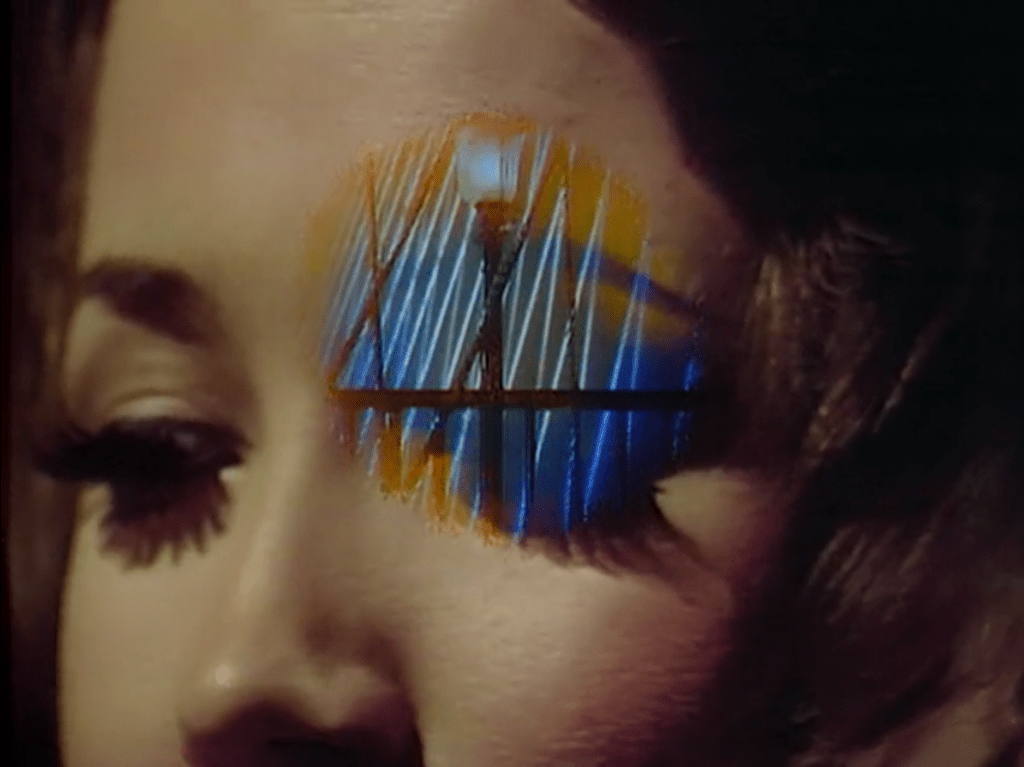
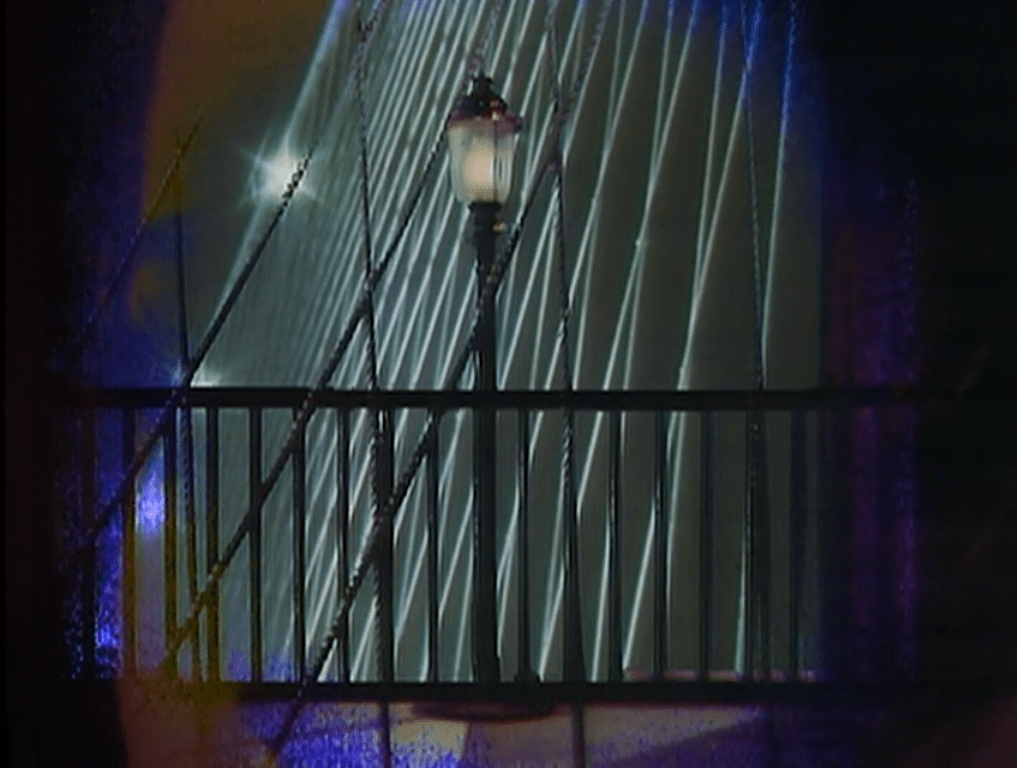
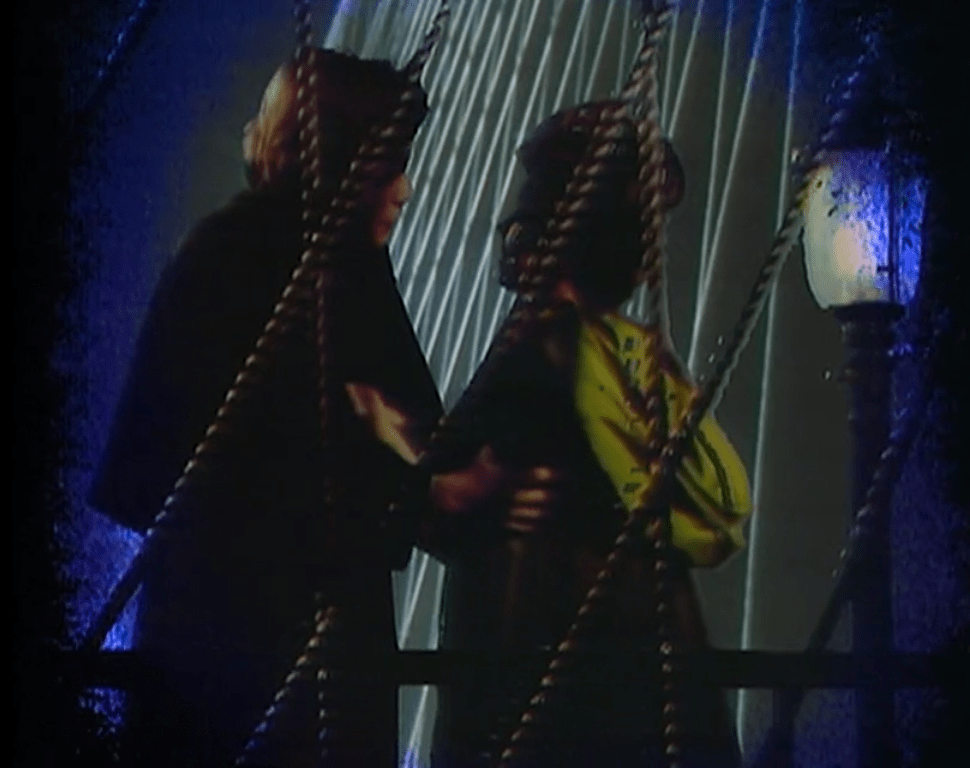
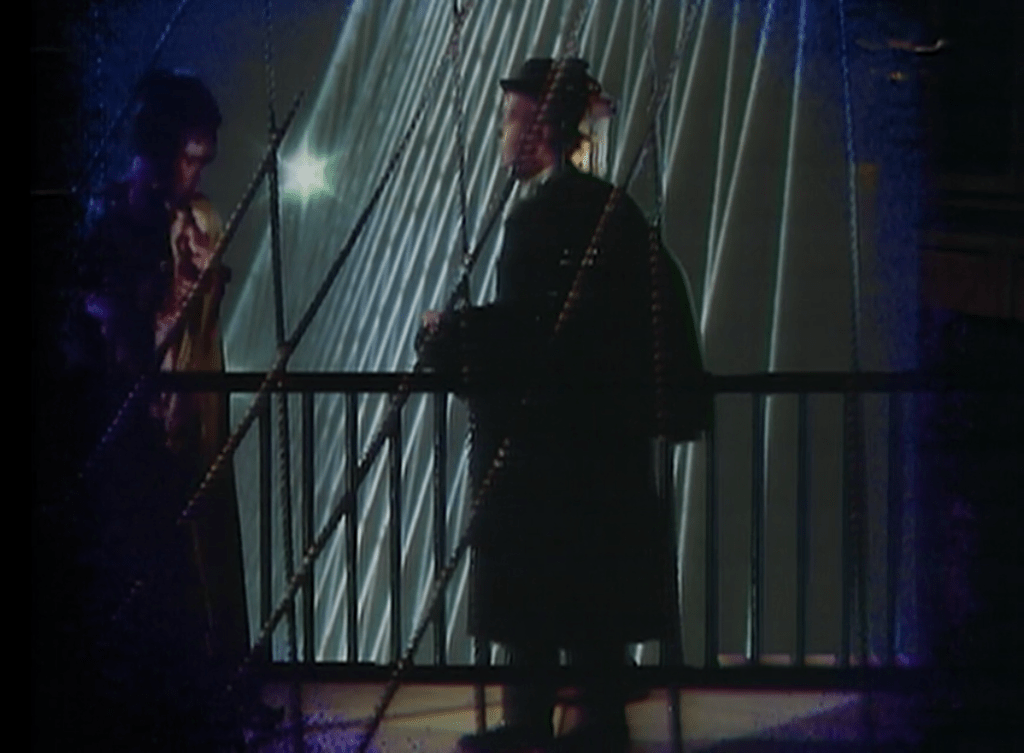
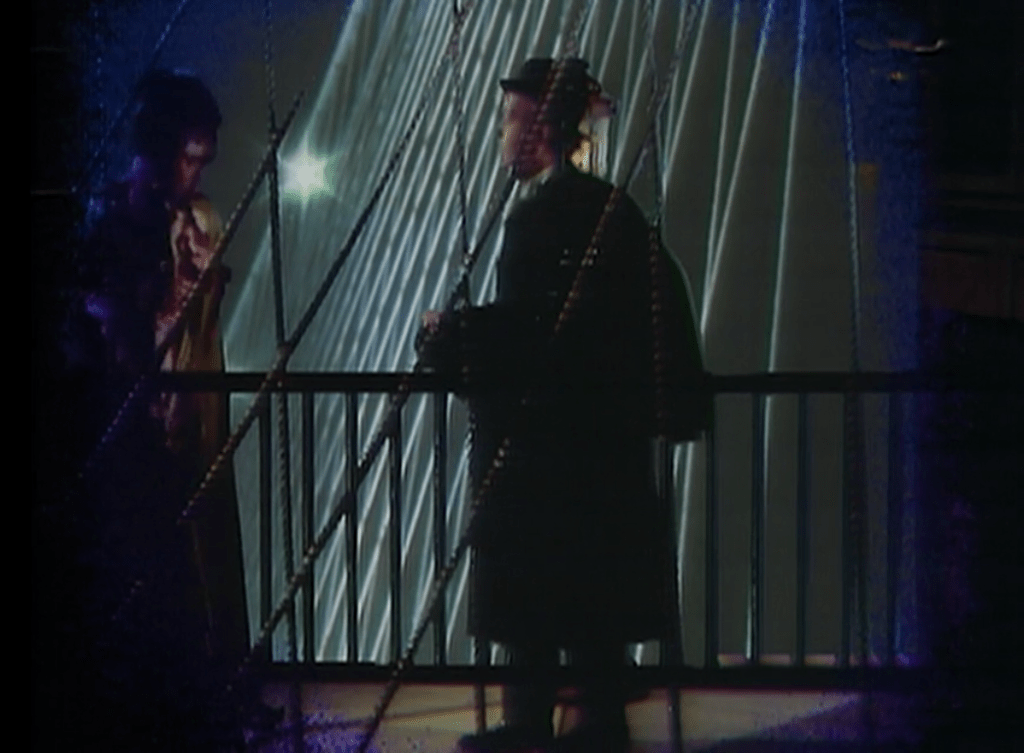
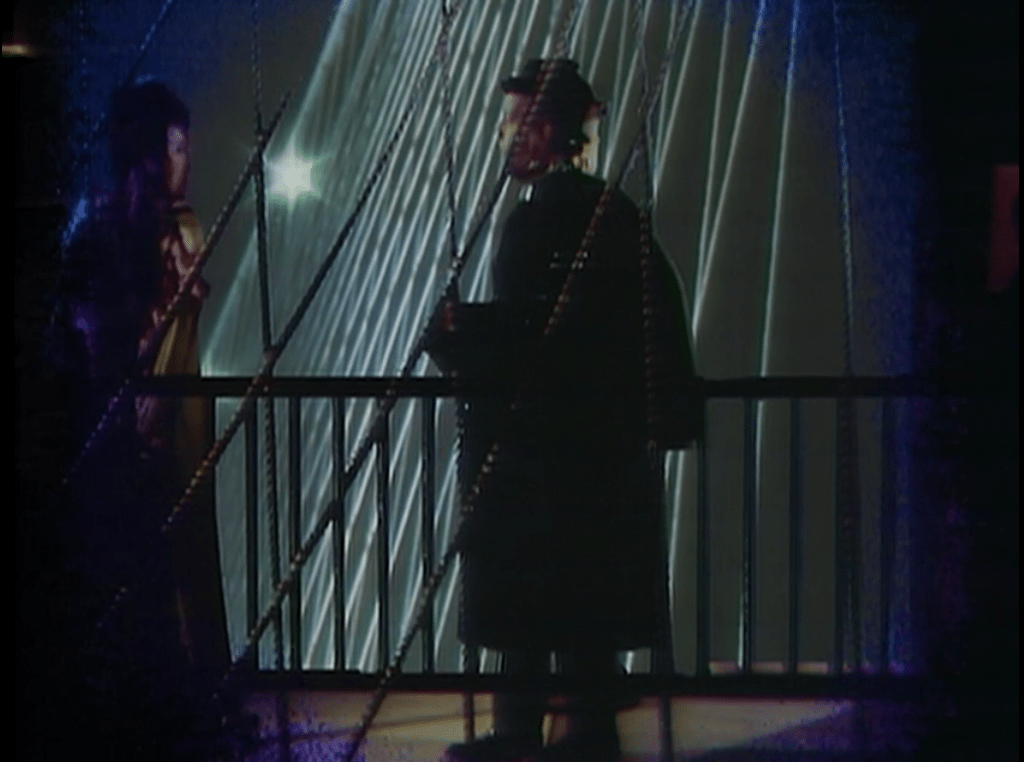
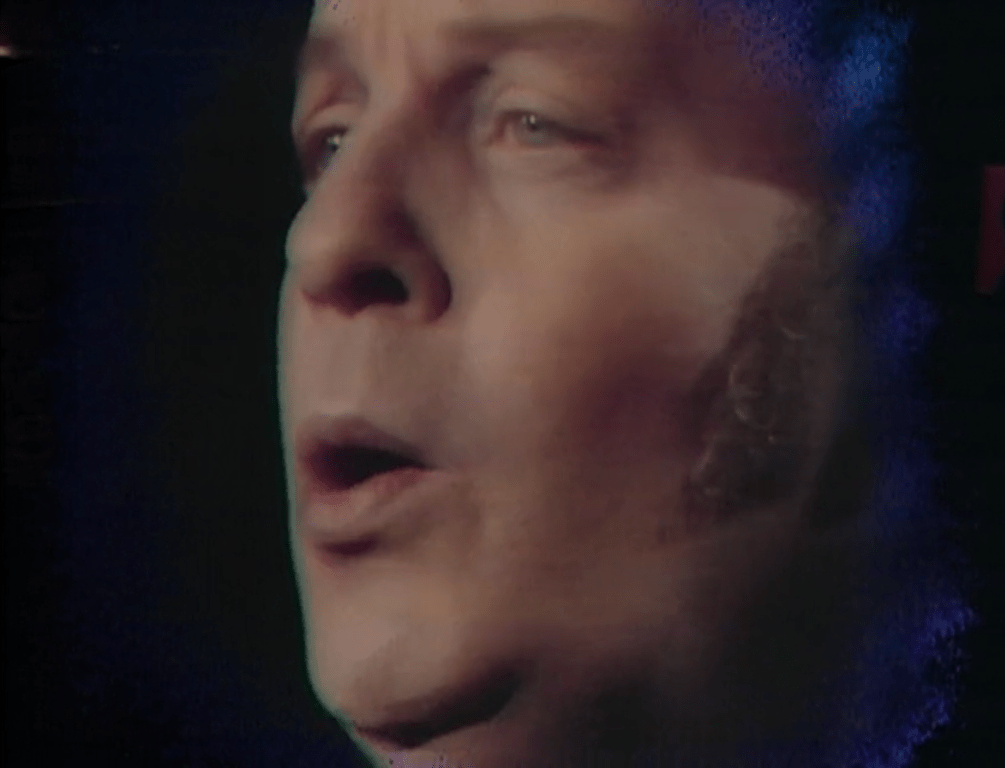
When Amanda gets to the meat of her story, we zoom in on her face for an extreme closeup. An iris wipe starts from her left eyelid, growing into a stage set representing a bridge in New York City. She and Quentin have a conversation that covers the same ground as the one we saw in #884, and he leaves her alone on the bridge.
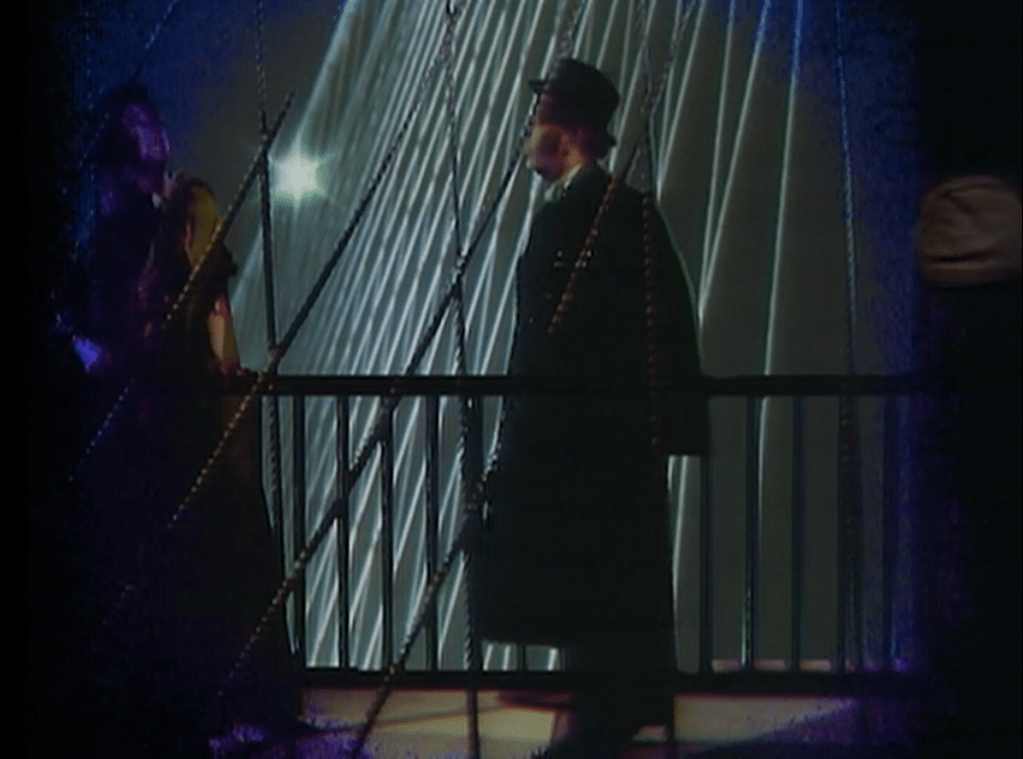
A man we have not seen before enters and tells Amanda that she ought not to jump from the bridge. He says that she is very beautiful, and that other men will love her. He says that “If I were… different… I’d love you myself.” The words of this kindly confirmed bachelor mean nothing to Amanda, who throws herself off the bridge.
The wipe does not fill the entire screen; the edges of the main image are covered with flickering little blue squares, and we can make out an image of Amanda’s suite on the right-hand side of the screen. This effect becomes distracting while the confirmed bachelor is talking to Amanda, when they are adjusting the camera for the shot that will follow the end of the insert. Not only does the image of the suite wobble jerkily, but it continues as we cut from the two shot to a closeup on the man, taking our attention away from his face at a crucial moment.
Amanda tells Julia that after she jumped off the bridge, she found herself in a hotel lobby. The confirmed bachelor, whom she calls “Mr Best,” met her there and explained that he wants her to live out the long life that she was originally destined to have. He says that she will have all of those years, and will remain young throughout them. If she can find Quentin again before she reaches the time she was meant to die, the two of them will go on living forever. If not, he will return for her at the appointed time. Julia leaves, determined to cure Quentin of his amnesia and return him to Amanda. A moment later, a knock comes at the door. It is Mr Best, telling Amanda her time is up.
A few days ago, Julia brought Amanda one of Tate’s portraits of her. She made no effort to buy it, saying it was of no interest to her. The story of Mr Best explains this indifference. Amanda believes that her supernatural youth is due to his intervention, not to the portrait. She does not know why Quentin has remained young, and has no reason to connect her situation with Tate’s works.
Mr Best is played by Emory Bass, who was at this time playing James Wilson in the original Broadway production of 1776. That cast, to be reunited in the 1972 film version of the musical, also featured Dark Shadows alums David Ford (Sam Evans #2, Andre DuPrés) as John Hancock, Daniel F. Keyes (Cemetery Caretaker) as Josiah Bartlett, Peter Lombard (Oberon) as a stage manager and understudy for the parts of Thomas Jefferson and Stephen Hopkins, and Virginia Vestoff (whom we will see several months from now as Samantha Collins) in the major role of Abigail Adams. With all that overlap, I tend to think of the whole cast of 1776 as having been available for parts on Dark Shadows, and vice versa. Whenever I get unhappy with a cast member, I wonder who from 1776 could have done a better job. Bass was great in 1776, and his arrestingly deliberate phrasing is perfectly suited to an angel of death, especially one like Mr Best who has far more discretion and a more idiosyncratic personality than do the angels described in the orthodox theological statements of the great monotheistic traditions.
In #701, broadcast at the beginning of March 1969, recovering vampire-turned-bumbling protagonist Barnabas Collins was trying to solve some problems his distant cousins were having, and inadvertently came unstuck in time. He found himself in the year 1897, where his vampirism was once more in full force. Barnabas spent the next eight months in that year, precipitating one disaster after another around the estate of Collinwood and the village of Collinsport.
As summer gave way to fall of 1897, Barnabas’ friends managed to put his vampirism back into remission. In #844, he met Kitty Soames, the dowager countess of Hampshire. Despite what her title would suggest, Kitty was an American woman in her twenties. Barnabas recognized her as the reincarnation of his lost love Josette. In February of 1796, Josette found out that Barnabas had become a vampire and that he wanted to kill her and raise her from the dead as his vampire bride. She flung herself to her death from the cliff on Widows’ Hill rather than let him do that to her.
In the eight weeks following Kitty’s first appearance, Josette’s personality irrupted into her conscious mind more and more frequently. Josette wanted to live again and to be with Barnabas. By last week, Kitty could hear Josette’s voice talking to her through the portrait of her that hangs in the Old House on the grounds of Collinwood. Josette suggested that if Kitty stopped resisting her, the two of them could both live, resolving themselves into a composite being.
In Thursday’s episode, the boundary between Kitty and Josette had become very indistinct. As Kitty, she agreed to marry Barnabas that night, later to wonder why she had done so. She was holding Josette’s white dress in her hand and struggling with the idea of putting it on when she abruptly found herself wearing it. Barnabas entered the room just in time to see her bodily assumed into the portrait. He reached up to the moving image of Kitty overlaid on the painted likeness of Josette, and both he and Kitty vanished at the same instant.
In Friday’s episode, Barnabas found himself lying on the ground, wearing clothes he had last put on in 1796. He learned that it was the night of Josette’s death. He is a vampire in this period, but he is confident he can again be free of the effects of the curse. He does not want to kill Josette, but to take her back to 1897 with him. His efforts to that end were not at all successful, and Friday ended with her on the edge of the cliff. She hears footsteps, which she and the audience have every reason to think are Barnabas’. If she sees him, she is prepared to jump.
Neither Kitty’s assumption into the portrait nor his own translation to 1796 prompt Barnabas to ask a single question about what forces are at work around him. Regular viewers would not expect him to. He lives in a universe where time travel is easy. Not only did he travel from March 1969 to 1897 without even trying to do so, but in #661 he managed to get from January 1969 to 1796 by standing in a graveyard at night and shouting for one of the residents to give him a ride. And in #365, he was present at a séance where the ghost of his little sister Sarah, speaking through well-meaning governess Vicki Winters, said that she would “tell the story from the beginning.” Vicki then vanished from the circle and Sarah’s governess, Phyllis Wick, materialized in her place. For the next four months the show was a costume drama set in the 1790s, where Vicki flailed about helplessly while Barnabas became a vampire, Sarah died of exposure, and Josette jumped off Widows’ Hill.
Barnabas and we also know that portraits are powerful in the universe of Dark Shadows. When he is in full vampire-mode, he communicates with his victims and potential victims through a portrait of him that hangs in the foyer of the great house of Collinwood. Much of the action in the 1897 segment had to do with a magical portrait that keeps Barnabas’ distant cousin Quentin from turning into a werewolf. Quentin had a romance with Amanda Harris, a woman who came to life when another magical portrait was painted.
Barnabas knows, not only that portraits in general have power, but also that Josette’s portrait in particular is powerful. In his second episode, #212, he went to the Old House and talked with strange and troubled boy David Collins, who often communed with Josette through her portrait. After David left him alone there, Barnabas addressed the portrait and told Josette that she would no longer function as the tutelary spirit of the Collins family. At that point Josette was supposed to be Barnabas’ grandmother who sided against him in a fateful family battle, but even after she was retconned as his lost love he felt the portrait’s power. So in #287, Vicki had invited herself to spend the night at Barnabas’ house. While she slept, Barnabas entered the room, intending to bite her. But he looked at the portrait of Josette and found that something was stopping him from doing so.
Barnabas would not have any way of knowing it, but in #70 Dark Shadows‘ first major special effect came when we saw Josette’s ghost take shape in front of her portrait and take three steps down from it to the floor of the room where it was hanging then, the front parlor of the Old House. She then turned, looked at the portrait, and went outside, where she danced among the columns of the portico. Longtime viewers will see Kitty’s assumption into the portrait as a reversal of this momentous little journey.
Most people nowadays who have been watching the show for some time will therefore take the strange goings-on as much in stride as Barnabas does. But viewers at the time may have had a different reaction. Friday’s episode and today’s originally ended with announcements over the closing credits. These announcements were not on the original master videotapes from which Amazon Prime Video and Tubi and the other streaming apps take their copies of the episodes, and so most viewers these days don’t hear them. But evidently one of the DVD releases reproduces them as they were preserved on some kinescopes. One promises that in Tuesday’s episode “one of the most terrifying tales ever told” will begin; the other, that it will be “one of the most unusual tales ever told.”
A terrifying tale suggests a mighty villain. By the end of the 1897 segment, all the villains have either turned into protagonists, as Barnabas, Quentin, and wicked witch Angelique had done; been heavily defeated, as sorcerer Count Petofi had been; or were dead and forgotten. So “one of the most terrifying tales ever told” would seem to require a new villain, or perhaps a new group of villains. And if it is also “one of the most unusual tales ever told,” those villains will have to be strikingly different from anything we have seen before.
So, having heard those announcements, we will be less inclined to chalk Barnabas’ latest adventure in anachronism up to the usual way things are on Dark Shadows. We will be looking for signs that some previously unknown and hugely formidable malevolent force is luring him into a trap.
At first, no such signs seem to be forthcoming. The footsteps that alarm Josette turn out not to be Barnabas’, but those of her aunt, the Countess DuPrés. The countess talks Josette down and takes her back to the great house of Collinwood. Having saved Josette’s life, the countess takes her to a room occupied by fluttery heiress Millicent Collins. The countess asks Millicent to sit with Josette while she runs an errand.
Millicent means well, but always makes everything hilariously worse. Seeing that Josette is shaking, she observes that she is suffering a shock. She asks very earnestly “Was your shock a romantic one?” Josette responds by wailing. Millicent keeps talking about the dangers of love, causing Josette to get more and more upset. Longtime viewers will remember that Millicent will turn from a comic figure to a tragic one soon after this, when she falls in love with an evil man. That tinges our reaction with sadness, but Millicent’s total insensitivity to the effect she is having on Josette makes for an effective comedy scene. No matter how much the oblivious Millicent is worsening Josette’s mood, this hardly seems likely to be part of a grand evil scheme.
It turns out that the errand the countess had to run was a visit to Barnabas, who is waiting in Josette’s room. This time Barnabas has actually had a sensible idea. Rather than go to Josette on top of the cliff as he did the first time through these events, he asked the countess to go. The countess confronts him about his status as a walking dead man. Barnabas will not explain- how could he? He asks the countess if she thinks he is a ghost; she does not answer. He insists on seeing Josette; she says she will not allow it. He says he does not want to force her to help him; she declares that he cannot force her. Finally, he ends the exchange by biting her.
The countess goes to Millicent’s room and tells Josette to go back to her own room. Millicent is surprised the countess doesn’t go with her, protesting that Josette is in no condition to be left alone. The countess responds numbly.
The countess is one of three characters we have so far seen Grayson Hall play. The first, mad scientist Julia Hoffman, offered herself to Barnabas as a victim in #350; he declined the offer. Julia was motivated by a mixture of despair over the failure of her first attempt to cure Barnabas’ vampirism, an obligation to prevent him harming others, and her own unrequited love for him, so she was disappointed when he said no. The other, broad ethnic stereotype Magda Rákóczi, told Barnabas to “Bite me!” when they were at the grave of her husband, his onetime blood thrall. He refused to do that, too. Magda was angry and defiant, wanting to get something horrible over with, so her reaction was more ambiguous. The countess didn’t know Barnabas was a vampire until his fangs were in her neck, so she is just dazed.
That Hall’s other characters expected Barnabas to bite them, and in Julia’s case hoped he would do so, shows that no new force is needed to explain why he bites the countess. And bad as a vampire’s bite is, from what we have seen in previous segments of the show we can be sure that the countess will forget all about her experience as Barnabas’ victim once he leaves. Besides, when he came back in time in January Barnabas triggered a chain of events that led to the countess’ death- we can assume that whatever he has put in motion this time will have a different outcome for her. So while the bite still has its echoes of rape and is therefore a horror, it in no way shows the presence of any fresh villain that is about to set off “one of the most terrifying tales ever told.”
Josette is in her room. The secret panel opens, and Barnabas enters. She is shocked to see him. He assures her that he does not want to kill her and raise her as his vampire bride; after a bit of prodding, she gets him to admit that this was, at one point, his plan. He starts explaining to her that he has come to her after a sojourn in the 1890s. She reacts with disbelief and confusion. He keeps talking. He asks her if she remembers Kitty Soames. At first the name does not ring a bell, but as he goes on she recognizes what she had thought to be a dream in which she was talking with her portrait. He tells her that it was no dream, but that just a few hours before they were together in that other century.
Finally, Barnabas persuades Josette to meet him at the Old House. He says they must go separately, since he has to go to his friend Ben Stokes and ask him to stand guard for them while they disappear into the portrait. She wants to say goodbye to her aunt the countess, and Barnabas tells her to write a note. They kiss passionately. One wonders if Josette notices the taste of her aunt’s blood on Barnabas’ lips.
Barnabas’ decision to go to Ben and send Josette to the house on her own doesn’t make much sense. This is the first we have heard they need someone to stand guard, and there is no apparent reason why they should. Moreover, the countess is right there in the house with them, and she is under Barnabas’ power. The three of them can go to the house together, Josette can say goodbye to her there, and if they need someone to stand guard she can do it. Afterward she can tell Ben what she saw and tell lies to anyone else who has questions about where Josette went. Besides, regular viewers of Dark Shadows know that when two people are supposed to go to a place separately, they never actually meet there. A smart character who understood how things work in this universe would know that Barnabas’ decree that he and Josette must take their own paths to the house means that they are doomed. But contrary to the glimmers of brainpower Barnabas showed earlier, he has never been that smart. He is so much a creature of habit that his decision to send Josette to the Old House by herself bears no traces at all of any outside influence, least of all the influence of the new villain we are looking for.
Barnabas is on his way across the grounds of Collinwood to meet Ben when it dawns on him that he is lost. This is the first thing he has done today that is out of character. He has been on the estate for centuries, and knows it surpassingly well. He looks around and sees a cairn, a large stone structure. The cairn has a flat surface in the middle and is flanked with torches and decorated with carvings resembling coiled serpents. Though he does not know where he is, he knows he has been following the same path he used shortly before, and that no such thing was there at that time or in the area ever before. Hooded figures approach, a man and a woman. They make gestures that he cannot understand. He cannot see or feel anything binding him, but neither can he move his feet or use his vampire powers to dematerialize. At last we have encountered the new presence that is supposed to deliver “one of the most terrifying tales ever told.”
Back in the great house, Millicent and the countess discover that Josette is gone. They read the note. When Millicent reads that Josette has gone to be with Barnabas, she is puzzled. All she knows is that Barnabas is dead. As a visitor from light comedy, she assumes that death is a full-time occupation. She tells the countess that to be with Barnabas, Josette will have to die. The countess replies that “Many have died for love.” Millicent is shocked by the countess’ resigned tone, and declares that she will not give up on Josette even if the countess does.
It would have been impossible for Barnabas to explain the situation to the countess while she was actively opposing him, but one might have thought that after he had bitten her and broken her will he might have tried to reassure her that his plans for Josette were now benevolent. The utter hopelessness in her voice when she says that no one can help Josette suggests he didn’t even try. Again, it wouldn’t have taken the influence of any outside force to cause Barnabas to skip this. As a vampire, he is a metaphor for extreme selfishness, and when he is pressed for time he is especially unlikely to take other people’s feelings into account in any way. Though it is a bit of a shame he didn’t try to smooth things over with the countess, there is nothing in his behavior that needs explaining, and too little at stake here for us to imagine that the mysterious forces launching “one of the most terrifying tales ever told” would care much about it.
In the Old House, Josette is looking at her portrait and wondering why Barnabas is late. She talks herself into believing that he was lying when he told her the story about 1897. She jumps to the conclusion that he really is going to turn her into a vampire, and declares she has nothing left to live for. She takes out a vial she had with her when she was with Millicent and drinks it. It is poison, and she dies.
Back in the mysterious clearing in the woods, Barnabas loses consciousness. The hooded figures say some prayers to Mother Earth, then lay him on the cairn. They place some foliage on him. This action recalls the sprinkling of grain on the necks of animals led to altars in ancient Indo-European paganism, an act known in Latin as sacrificium- it was this ritual act, not the killing of the animal, that made the animal sacer, that is, set aside for the gods. The man declares that when Barnabas awakens he will recognize him and the woman, and that he will then lead them “to a new and everlasting life.” My wife, Mrs Acilius, and I reacted to the idea of Barnabas as a guide to enlightenment the same way every regular viewer of Dark Shadows would, viz. with gales of laughter.
If the hooded figures represent the force that has directed the events of this episode and Friday’s, the force that we have been promised will bring us “one of the most terrifying tales ever told,” then something that happened in them must have been a necessary precondition for the sacrifice of Barnabas. After all, that force had him under its power when he disappeared from 1897 and found himself lying on the ground. He could just as easily have materialized on the cairn, accompanied by the hooded figures with their foliage.
The only development in these two installments that would seem to be significant enough to qualify as such a precondition is Josette’s poisoning of herself. That Josette jumped to her death from Widows’ Hill is one of the most firmly established parts of the show’s continuity. Artist Sam Evans told Vicki about it in #5. In #185, a very different version of Sam saw Josette’s portrait for the first time and identified her as “the lady who went over the cliff.” In #233, Barnabas gave a vivid and rather indiscreet account of Josette’s death to Vicki and heiress Carolyn. We saw Josette make her leap in #425, and in #876 the leap was reenacted with maidservant Beth Chavez in Josette’s role and Quentin in Barnabas’. So having Josette poison herself instead of taking the jump is an example of something Dark Shadows did several times in the later phases of the 1897 segment, making a retcon into a self-conscious plot point. That leaves us with a puzzle. Why does it matter so much just how Josette went about killing herself?
Josette’s original death was a desperate flight from vampirism. It barely qualified as a suicide at all. Josette was cornered at the edge of the cliff, seeing no way but a mortal leap to escape transformation into a bloodsucking fiend. She went over the cliff in a spontaneous act that prevented the killings and enslavements that she would have inflicted on others had Barnabas succeeded in making her into the same kind of monster he was. This time, she has been keeping a vial of poison with her, so that her suicide is a premeditated act. Moreover, she drinks it when she is still alone, motivated not by a clear and present danger but by her purely intellectual, and as it so happens faulty, analysis of the situation. She still has options, and she is helping no one. So it could be that “one of the most terrifying tales ever told” is supposed to begin with the audience disapproving of Josette’s suicide on moral grounds.
This doesn’t seem very promising, but we should mention that writer Sam Hall probably did not approve of suicide. He was a churchgoer, serious enough about his Lutheran faith that he insisted Shirley Grossman convert from Judaism before they married and she became Grayson Hall. Christians have traditionally regarded despair as a sinful state and suicide as a religious offense. And Hall does seem to have been in a religious mood at this period. Lately his episodes have shown evidence that he was reading the novels of George MacDonald, a nineteenth century Congregationalist minister whose works of fantastic fiction were enormously popular in their day, but which are suffused with such a heavily Christian atmosphere that by the late 1960s their readership was a subset of that of such self-consciously Christian fans of MacDonald’s as C. S. Lewis, J. R. R. Tolkien, and W. H. Auden. Indeed, the three priests who hosted the podcast God and Comics admitted in a 2022 installment of their show that MacDonald’s novels reminded them a little too strongly of their day jobs to count as fun reading for them.
If Hall was feeling pious enough to keep reading MacDonald, he may well have seen Josette’s intentional and unnecessary self-poisoning as a prelude to “one of the most terrifying tales ever told.” Still, nothing we have seen so far explains just how that would work. Maybe we will find out later that Josette’s soul is in need of some kind of intervention from the other characters to avoid damnation. Lutherans aren’t supposed to think in those terms, but not even MacDonald, churchy as he was, ever let any kind of orthodoxy get between him and a good story.
Today marks the final appearance of both Millicent and the countess. It is also the last time we will visit the 1790s.
The hooded figures Barnabas meets today are identified in the credits as Oberon and Haza. Oberon, King of the Fairies, was a figure in medieval and Renaissance folklore whom Shakespeare used as a character in A Midsummer Night’s Dream. Also, MacDonald mentioned Oberon occasionally in his novels. I don’t know where Hall came up with “Haza.” Bookish people pick up vocabulary items all the time, so any of the various words in the world that take that form might have popped into his head when he was writing this episode.
Oberon is played by Peter Kirk Lombard, Haza by Robin Lane. Miss Lane’s acting career seems to have peaked with her turn as Haza, but for the last six years she has been releasing videos on various platforms under the title Badass Women 50+. As of this writing, her bio on YouTube says that she is 89 years old. Until 2022, her videos ran on a cable TV service in NYC, where she was still living then and for all I can tell is still living now.
Peter Lombard died in 2015. He worked steadily on Broadway for a couple of decades. From the point of view of a Dark Shadows enthusiast, the most interesting work he did there was in the original production of 1776, a cast which also included Dark Shadows alums David Ford, Daniel F. Keyes, Emory Bass, and Virginia Vestoff. Those four were all principal members of the cast, while Lombard was a stage manager and Ken Howard’s understudy in the role of Thomas Jefferson. When the cast appeared on The Ed Sullivan Show, Howard was absent, but the part of Jefferson was played not by Lombard, but by Roy Poole. I think I can spot Lombard in the background in the costume worn by Poole’s main character, Stephen Hopkins of Rhode Island.*
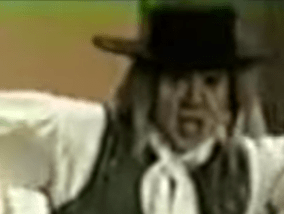
The old age makeup makes it impossible to be sure, but I suspect this is Lombard as Stephen Hopkins.
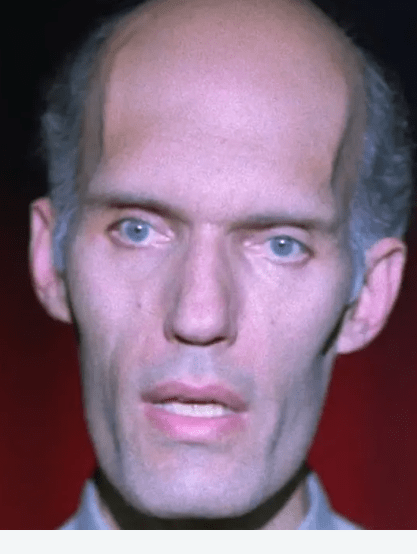
Lombard bore a resemblance to Carel Struycken, the actor who played the very tall man in Twin Peaks. So much so that when I first saw this episode I was certain he was the same person. But they aren’t related. I do wonder if David Lynch or Mark Frost or casting director Johanna Ray saw this episode and had Lombard in mind when they cast Mr Struycken as “The Fireman,” who like Oberon appears unexpectedly and represents a remote and mysterious world.
*Stephen Hopkins is not only a character in 1776, but also figures in H. P. Lovecraft’s “The Strange Case of Charles Dexter Ward.” Lovecraft says that (the fictional) Joseph Curwen had been a friend and supporter of his when (the historical) Hopkins was first governor of Rhode Island, but that when Curwen was exposed as a menace Hopkins personally took part in the raid on Curwen’s place. Since the story beginning today is based on another of Lovecraft’s tales, a connection between Lombard and Stephen Hopkins qualifies as a mildly amusing coincidence.
In the eighteenth century, wicked witch Angelique loved scion Barnabas Collins. He betrayed her in those days, rejecting her in favor of the gracious Josette, and ever since she has been casting deadly spells on him and everyone close to him. Today she encounters him in the woods. After a brief confrontation, she is left thinking about the feelings of love for him that still linger in her and undermine her killing power.
A few months ago, Frankenstein’s monster Adam imprinted on Barnabas when he saw him at the moment he came to life. Barnabas betrayed Adam’s filial love time and again, chaining him to a wall in a windowless basement cell, leaving him alone for all but a few minutes a day, and entrusting his care to his abusive servant Willie. When Barnabas beat Adam with his cane to stop him retaliating against Willie, Adam’s love turned to hate and he adopted “Kill Barnabas!” as his motto.
Today, well-meaning governess Vicki stops by Barnabas’ house to update him on the progress of Angelique’s latest attempt to destroy him. Vicki is to be the next to have a nightmare that Angelique has sent to a series of people, and after she has it she will pass it to Barnabas. Vicki doesn’t know that Barnabas was a vampire from the 1790s until 1968, much less that Angelique is trying to turn him back into one, but she does know that if Barnabas has the nightmare he is supposed to die as a result.
While Barnabas and Vicki confer, Angelique raises the ghost of Sam Evans from his grave. Sam was supposed to tell Vicki the nightmare, causing her to have it, but died before he could do so. Sam resists Angelique’s commands, but finds that Angelique can prevent him from returning to his grave. His soul needs rest, so he complies.
Back at Barnabas’ house, the sound of a gunshot interrupts the conversation. Barnabas goes out to investigate while Vicki waits in the parlor. Sam materializes there. Evidently his need to rest is quite urgent, since he sits down in an armchair while he talks to Vicki. The dead must rest! Or at least take a load off, it’s very tiring being dead apparently.
Vicki pleads with Sam not to tell her the dream, since she does not want to bring death to Barnabas. Sam says that in Barnabas’ case, death might come as a welcome relief. He declines to explain to Vicki what he means, but longtime viewers will be intrigued. Sam now knows about Angelique, so presumably he knows about Barnabas’ vampirism as well. Sam was the father of Maggie, The Nicest Girl in Town, whom Barnabas attacked, imprisoned, tried to brainwash into thinking she was Josette, and set out to kill when his brainwashing plan failed. If Sam knows about that part of Barnabas’ career, you’d think he would be a bit more peeved with him than he seems to be. At any rate, Vicki can’t stop Sam telling her the dream. When Barnabas comes back, she tells him what happened, and tells him she is already tempted to tell him the dream. She must go far away for his sake.
Many people have already had the dream, and none of them had the compulsion to tell it until they awoke from it. Vicki’s relationship to Barnabas is an odd one; shortly after his attempt to Josettify Maggie failed, he decided to repeat the experiment with her. Yet he never made much of an effort to get close to her, even though she time and again went out of her way to present him with opportunities to have his way with her. She even invited herself to his house for a sleepover in #285, only to have him back off the opportunity to suck her blood. He finally bit her in #462, only for his vampirism to be put into remission less than a week later. In this scene, Vicki keeps looking at Barnabas with wide, longing eyes, while he reacts coolly. So perhaps Vicki’s compulsion suggests that her attachment to Barnabas causes the Dream Curse to affect her differently.
Back at the grave, Angelique asks Sam’s ghost whether he told Vicki the dream. He said he did. She heaves a sigh of relief and exclaims “Excellent!,” and lets him go back to his grave. She doesn’t ask any follow-up questions or require any evidence. Clearly she couldn’t read Sam’s mind, or she wouldn’t have had to ask the question in the first place. So he could just as easily have gone off to haunt someone else, then lie to her.
We cut back to Barnabas’ house. Evidently he went somewhere after Vicki left, because he is walking in the front door. He looks around, apparently sensing a presence. He calls for Willie and gets no response. He opens a closet door, and hardworking young fisherman Joe falls out, unconscious. He hears a loud dirty laugh and sees Adam at the window, jeering at him.
This episode marks the final appearance of Sam Evans and of actor David Ford. Ford brought a fresh energy to the show when he took over the part of Sam from the execrable Mark Allen in #35, prompting blogger Marc Masse to discern what he called “The David Ford Effect” in the brightened performances of all the cast in the weeks that followed. But ever since the major storyline he was part of fizzled out in #201, Sam has been at the outer fringes of the plotlines, and Ford has been coasting. He inhabits his characters comfortably enough that he is always pleasant to watch, but it’s easy to forget the verve he originally brought to the show.
A few months after leaving Dark Shadows, Ford would join many other Dark Shadows alumni in the original Broadway cast of the musical 1776. He played John Hancock on Broadway and in the 1972 movie, and John Dickinson in the national touring company. I’ve been in the habit of watching the movie every year on or around the Fourth of July since the 1980s, and so it’s oddly fitting that Ford should depart Dark Shadows early in July. Fitting too that Sam Evans’ grave should be decorated with what looks to be a red, white, and blue floral wreath.
In a room at the Collinsport Hospital, very loud physician Eric Lang (Addison Powell) opens the curtains to show his patient, old world gentleman Barnabas Collins, that it is a sunny afternoon. It takes Barnabas a moment to realize that this is Lang’s way of showing him that he has cured him of his longstanding affliction, vampirism. Once he figures it out, Barnabas is very happy to be human again.
Barnabas talks with Lang about the origins of his vampirism. At one point Lang says “Ah, so a curse was responsible.” You know how doctors are, always coming out with the same cliches. Lang does say something novel when he remarks on Barnabas’ “pulsebeat.” That specimen of Collinsport English will be back.
In the great house of Collinwood, Barnabas’ distant cousins Roger and Liz are at odds. Roger keeps having conversations with a portrait, in the course of which he loses track of the time. The correct time is 1968, and he keeps thinking it is 1795. When he does that, he mistakes himself for his collateral ancestor Joshua Collins and his sister Liz for Joshua’s wife Naomi. Today, Liz has to slap Roger to get him back to himself. Louis Edmonds’ alternation between Joshua and Roger is masterful, one of the outstanding moments of acting in the whole series.
The portrait is of Angelique, the wicked witch who made Barnabas into a vampire in the first place. At the hospital, it becomes clear that Angelique’s spirit is controlling Roger through it. He is cold and distant, staring out the window when Barnabas tells Liz he wants to take up gardening, refusing to say a word when Lang enters the room. When he takes his leave, Roger looks at Barnabas and declares “It’s not this easy.” We realize that he is a puppet for Angelique. Roger steals Lang’s cartoonish mirror-bearing headpiece.
We cut back and forth between Barnabas’ hospital room and the drawing room at Collinwood. At Collinwood, Roger shows the headpiece to the portrait and explains that it was Lang’s. He starts to twist it. In the hospital, Lang suddenly leaps up with a splitting headache. Roger stops twisting, and Lang says he’s better. He resumes twisting, and Lang resumes suffering. Roger tells the portrait he cannot obey its command to put the headpiece in the fire, and throws it across the room. In the hospital, Lang suddenly recovers from his headache. Barnabas tells him it was Angelique’s doing, and says that he will have to become a vampire again to spare Lang her attentions.
On his blog Dark Shadows Every Day, Danny Horn identified Addison Powell as “THE WORST ACTOR EVER TO APPEAR ON DARK SHADOWS.” I don’t agree with that. In yesterday’s episode, for example, Powell attained a level that could fairly be described as “competent,” a label that forever eluded figures like Mark Allen (Sam Evans #1,) Michael Currie (Constable/ Sheriff Carter,) and Craig Slocum (Noah Gifford and, later, Harry Johnson.) And there will be times when his ludicrous overacting lends just the note of camp that turns a scene from a tedious misfire to an occasion for chuckling. But he is pretty bad today. When an actor gets to be depressing to watch, I sometimes make his scenes bearable by trying to imagine what it might have been like if, instead of casting him, they had chosen someone else who might have been available.
So many members of the original Broadway cast of the musical 1776 appeared on Dark Shadows at one time or another that I tend to assume that any of them would have accepted any part on the show. Howard da Silva played Benjamin Franklin in 1776, and he is my imaginary Dr Lang.
You can see da Silva’s Franklin in the 1972 movie version of 1776, where he plays the Sage of Philadelphia with frequent chortles that suggest a mad scientist gleefully working to release a murderous nightmare on the world, which is more or less the show’s vision of the founding of the USA. That isn’t Franklin’s only note- he has occasion to speak earnestly about the British Empire’s mismanagement of its North American possessions, and sorrowfully about the need to leave slavery alone while concentrating on the fight for independence. Those who have seen da Silva play subtle and powerfully compassionate men in his other work, for example as the psychiatrist in the 1962 film David and Lisa and as the defense attorney in the 1964 Outer Limits episode adapting Isaac Asimov’s story “I, Robot,” will hardly be surprised that he could be effective in those moments.
So when Powell overdoes the shouting, I imagine da Silva in his place, going through his bag of tricks to show us a man who might be taking a maniacal satisfaction in his blasphemous labors, who might be profoundly devoted to the relief of suffering, and who might be both at once. Sometimes I get a pretty clear image of what that would have been like, and when that happens the show in my head is hard to beat.
David Ford joins the cast as Sam Evans, replacing the woeful Mark Allen. Ford was always one of my favorites. He was one of the reasons I started watching the show when it was on the Sci-Fi channel in the 90s- I remembered him from one of my favorite movies, the musical 1776, where he plays John Hancock.
Marc Masse made a point in his Dark Shadows from the Beginning that I hadn’t thought of before. I’d always thought of Thayer David as the founder of the Dark Shadows house style of acting (“Go back to your grave!”) That isn’t wrong, as we will see when Thayer David joins the cast next week. But David Ford made a much bigger contribution than I realized. Several members of the cast, especially Louis Edmonds and Nancy Barrett,* tend to play their roles in a big, stagy manner, but Ford represents a step beyond them.
Masse writes:
To this point Dark Shadows has been written, directed, and acted solely as a vehicle for television.
Here in episode 35, the style of acting on Dark Shadows takes a theatrical turn with the debut of David Ford, who, with one grand and sweeping wave of the arm and eloquent turn of phrase, will single-handedly transform the acting approach from that of a standard television show to that of a teleplay:
“A façade, my dear boy!”
You have to wonder if that line was an ad lib; it fit in perfectly with the gesture, and thus far Art Wallace has never written with such a fanciful flourish.
Masse also gives some very interesting information about what Ford was doing when he landed the role of Sam Evans, information that points towards an approach to casting that will become a marked feature of the show in the years ahead:
In the year preceding Dark Shadows, Ford was performing on the Hartford Stage in a successful production of the Tennessee Williams play Cat on a Hot Tin Roof in the role of Big Daddy. That’s why when he first appears on Dark Shadows he has that half a beard type style, having fashioned his performance of Big Daddy after the one made famous in the 1958 motion picture adaptation, especially the way he scrunches up his eyes for the effect of dramatic intensity, giving it his best Burl Ives.
There is indeed a good deal of Burl Ives in today’s iteration of Sam, enough that we can assume that Ford was hired in part as a Burl Ives imitator. In future years, we’ll see Jonathan Frid, who looks like Bela Lugosi and walks and talks like Boris Karloff, playing a character who is a mashup of Lugosi’s Dracula and Karloff’s Imhotep.** And Jerry Lacy, who was most famous for his Humphrey Bogart imitation, and whose first role on the show was as a Bogart-inflected lawyer. And David Selby, who, if you listen to him with your eyes closed, you’d swear was Joseph Cotten. And Roger Davis, who Joan Bennett famously described as show business’ answer to the question “What would Henry Fonda be like if he had had no talent?” Ford is the first of that company of mimics, and among the best.
This is also the first episode where Carolyn and David have a scene together, rather odd considering we’ve had 34 episodes mostly set in the house where they are two of the five residents. Carolyn can’t stand the boy to start with, and in this one she’s just found out he tried to murder his father, her beloved uncle Roger. Besides, she’s in a bad mood because Joe called her up and told her he found Vicki in Burke’s hotel room. So they have a shoving match, she tells him he’s a monster, etc. Nancy Barrett and David Henesy ham these scenes up so grandly that it’s hard to imagine why they haven’t been on camera together before, it’s tremendous fun.
This is a bad episode for Alexandra Moltke Isles. Carolyn is nasty to Vicki about Burke, then apologizes and gets mad at herself, all while Vicki stands perfectly still with a smile plastered on her face. Vicki’s own lines are patronizing and inappropriate, starting with “Carolyn, you idiot” and going downhill from there. When Carolyn makes the painful admission that she has a tendency to grab for everything, Vicki delivers a smugly sanctimonious “That’s a good way to end up with nothing.” At the end of the episode, Vicki has a brief confrontation with David, which Mrs Isles plays well enough, but there isn’t much to it.
I think Mrs Isles’ technique was to start with the emotions the character was supposed to be feeling and to project those through whatever dialogue she is given. That’s served her well so far. Dark Shadows was her first professional acting job, and she fits right in with old pros like Joan Bennett and Broadway up-and-comers like Mitch Ryan. But she’s just awful in these scenes. My guess is that she couldn’t figure out what Vicki was feeling or thinking, since no one would do or say the things she does or says in today’s show, and so she just tried to stay out of Nancy Barrett’s way. Or maybe she read the script, thought Vicki was being an ass, and decided to play the character in the most asinine way possible. Either way, I winced to see it.
*Both natives of Louisiana. I doubt that means anything, but as the series goes on and gradually loses all interest in creating an illusion of being Down East someplace near Bar Harbor, I get more and more interested in the geographical origins of the actors. I’ll try to confine that topic to footnotes for the next three years, but when we hear David Selby’s voice we’re going to talk about the idea of a New England Brahmin with a West Virginia accent.
**Imhotep is the title character from The Mummy. Originally I was going to say that Frid moves and sounds “like Boris Karloff’s Mummy,” but that rather overstates the feminine side of his role.
During the slow moments, I recast the show in my head. Harvey Keitel was a background player on the show once, a dancer at the Blue Whale in #33. So I imagine him in Roger Davis’ place. And several Dark Shadows cast members (David Ford, Virginia Vestoff, and Daniel Keyes*) were in the original Broadway cast of 1776. So other members of that cast would have been available for parts on DS. I imagine Howard Da Silva in place of Addison Powell. With those changes, the version of the Jaff Clark**-Dr Lang scenes that plays in my head is quite good!
For the game to be fun enough to keep me going through the dire bits, it has to be plausible to me that the makers of Dark Shadows could actually have landed the actor in question. No doubt Laurence Olivier or Bette Davis or whoever would have been a valuable addition to the cast, but they were so unlikely to take such a part that I can’t make myself believe in the scenario strongly enough to distract from whatever it is I don’t like about what I’m actually watching.
The categories from which I draw imaginary cast members, then, include sometime non-speaking players like Keitel. In that group are also to be found Fredric Forrest, David Groh, Henry Judd Baker, and Susan Sullivan. A second category is people who appeared on the show in speaking parts but only briefly, such as Marsha Mason, Gail Strickland, Cavada Humphrey, Beverly Hope Atkinson, and Philip R. Allen. It’s easy enough to believe that people who accepted small parts on the show would also have taken bigger ones.
There are also several people who appeared on the show in major parts, but not enough for my liking. Among these I often mention Clarice Blackburn, Jerry Lacy, Alexandra Moltke Isles, Virginia Vestoff, and Robert Rodan.
There are also three categories of people who didn’t actually appear on the show, but who might well have. The first of these is the one I mention above, the cast of 1776. In addition to da Silva, I also mention Ken Howard, who was Thomas Jefferson in 1776 and who would have been an interesting choice for Morgan Collins in the dying days of Dark Shadows.
The other two categories each include just one person. If they could get Harvey Keitel and Fredric Forrest to dance in The Blue Whale, surely they could also have landed Robert de Niro to play a speaking role. I’m just as glad they didn’t- had he been cast as Carolyn’s motorcycle-riding boyfriend Buzz, the character might have been a big enough hit they would never have got round to making the spook show we all know and love.
The second one-person category is actors whom we know series creator Dan Curtis wanted to have in particular parts. The one person in that category is Bert Convy, Curtis’ first choice for the part of Barnabas Collins. I am glad Jonathan Frid was cast instead, but I do try to imagine what the show might have been like with Convy. I also try to imagine how Jonathan Frid might have done in Convy’s place as a game show host:
Which raises the further question of how Jonathan Frid would have done as the host of Tattletales. “Ladies, suppose you your fella, you- the two of you! Suppose you went to a kind of, well, a resort, a vacation place. And the beaches- multiple beaches, one of them as it happens a nude beach. A beach of nudeness! Suppose further that it was your choice and only yours- what I mean is, you must choose which beach to visit! The nude, or the other! Don’t give me your answer, you must not! But when I call for it, then, you will tell me which beach you choose!”
*I should also have mentioned Emory Bass and Peter Lombard
**For “Jaff,” read “Jeff,” not that it really helps
In which I say that by imagining Howard da Silva in Addison Powell’s place and Harvey Keitel in Roger Davis’, I was able to sit through the whole Dr Lang/ Jeff scene without throwing up.
In which I say that watching Dark Shadows always of necessity involves rewriting Dark Shadows. I also list cast members in common with 1776, so it’s not all fancy-pants theory.
I notice a portrait of Thomas Jefferson on display in the Collinwood of 1841 Parallel Time. That starts me on a tangent about the overlap of the cast of Dark Shadows with that of 1776 which ends with me imagining what the 1841 PT segment might have been like with Ken Howard instead of Keith Prentice as Morgan Collins.





 Dark Shadows Commentary