Vampire Barnabas Collins enters the bedroom of Maggie Evans, The Nicest Girl in Town. We see a closeup of him in profile, his mouth open to expose his fangs. This shot might have been effective if it had flashed on the screen for a fifth of a second or less and been followed by some kind of action, but we linger on it for a couple of seconds and cut to the opening credits. The result is laugh-out-loud funny. It makes him look like he’s pretending to be a dog in a cartoon. It’s bad enough when Barnabas reminds us of a Scooby-Doo villain without pushing him over the line into imitating Scooby-Doo.
The rest of the episode is composed of scenes that go on too long, though none quite as disastrously as this. In the morning, Maggie’s father, artist and former alcoholic Sam, wakes her. She is ill and moody. Kathryn Leigh Scott maintains just the right level of intensity, and David Ford plays Sam quietly enough to stay out of her way. But they make all their points in the first minute or two, and it just keeps going.
Later, Maggie is sitting at the counter at her place of employment in the restaurant at the Collinsport Inn.* She’s wearing a scarf and feeling awful. Her boyfriend, hardworking young fisherman Joe, comes in. He teasingly asks her how a paying customer can get a cup of coffee. She tells him to pour it himself. He’s about to do it when she drags herself to her feet. She drops the cup. He makes a little joke about seeing her use a broom and she says she’ll sweep it up later. He is shocked, and she snaps at him.
She continues to have trouble with basic tasks, and Joe grows concerned. Sam comes in and reminds her that he told her she shouldn’t have gone to work. He says he’ll call the doctor, and she yells at him. Then, she faints.
That’s probably the best scene in the episode. Miss Scott holds on at the level she had established in the previous scene, while Joel Crothers matches Ford’s steady, understated support. With three actors, there’s enough action to keep us interested. My wife, Mrs Acilius, praised the choreography that allowed Miss Scott to make such a memorable turn unencumbered by Malcolm Marmorstein’s dialogue. Still, they could have done all that in about half the time and we wouldn’t have missed a thing.
Then Maggie’s back in her room, this time with Joe sitting on the side of the bed while she lies in it. The body language between them is affectionate, but after about a minute and a half you can’t help but notice them complying with the requirements of the Standards and Practices office. Sick as Maggie is, it is jarring to see Joe keep his distance from her quite so scrupulously.
Night falls, and we see Barnabas in his house. He peers out his window, and we cut to Maggie. She’s still in her room, but now she is out of bed, brushing her hair, and grinning. Sam enters and is surprised at the change in her.
After a meandering conversation, Maggie volunteers to drive Sam to Barnabas’ house where Sam will be working on a portrait of Barnabas. Evidently Sam agrees, because the two of them enter there together.
Maggie and Barnabas exchange looks and conversation loaded with double meanings while Sam sets up. Jonathan Frid plays Barnabas’ part in this so heavily that it is laughable Sam doesn’t notice something is going on between him and Maggie.
I’m always reluctant to complain about Frid’s acting. It’s so hard to explain just what it was that made Barnabas such an enormous hit that you can never rule out the possibility that any given thing might have been indispensable to it. Still, seeing him ham it up so shamelessly today, especially after the other three members of the cast have shown such strict discipline, I did have to wonder what he was thinking. It’s hard to imagine anyone would have directed him to play the part that way.
I can see one advantage to Frid’s overacting. Maggie sticks around his house a couple of minutes after the point of the sequence has been made, and the time is filled with repetitious dialogue about her illness. When Barnabas says that the house is an unhealthy place for someone in her condition, Frid leans so hard on the line and makes himself look so silly that you don’t really notice that there is no reason for the scene still to be going on.
After Maggie has gone home and got back into bed, Sam tells Barnabas he’s tired and thinks it’s time to stop for the night.** Barnabas wants him to keep going for a while and to take the next night off. They discuss this fascinating topic at length. Sam decides to spend an hour working on the background. Their conversation has already taken so long that we fear they might show that hour of painting in real time, and it is a relief when Barnabas says he will go outside while Sam paints. We can assume he’s going to pop into Maggie’s room for a snack.
*The last appearance of this set, alas.
**Barnabas’ sorely bedraggled blood-thrall, Willie Loomis, will be driving Sam home. At this point they’ve settled on the idea that Willie has a car.
Three locations on the great estate of Collinwood have featured prominently in two or more storylines on Dark Shadows: the great house, the long-abandoned Old House, and the cottage. The great house is the only permanent set, and is the site of most of the action. The cottage has been vacant since blonde fire witch Laura left the show in March, and came to be so strongly associated with her that it will likely remain vacant until the audience doesn’t expect her to come back. As the abode of ghosts and ghouls, the Old House is likely to become central to the show as it takes its turn to the paranormal. And indeed, in his first full episode, the mysterious Barnabas Collins had gone to the Old House and announced to its invisible occupants that he was claiming it as his own.
The physical condition of the Old House evokes an extinct storyline. When the series began, the Collinses were running out of money, and their vengeful foe Burke Devlin had vowed to use his own great wealth to ruin them completely. Now Burke has lost interest in vengeance, and the business stories have vanished altogether. If we aren’t going to be hearing about the Collinses’ precarious financial position, we won’t be able to explain why they have let a huge mansion on their property go completely to ruin. Even if the locals are too afraid of the place to do any work there, a family rich enough to have a secure grip on the assets we hear about would be rich enough to hire an out-of-town crew to fix the place up, or tear it down, or at least clear it out and seal it off. So the Old House is going to have to be transformed to get the last of the narrative clutter left over from the first 39 weeks out of the way.
Today, Barnabas asks reclusive matriarch Liz and her brother, high-born ne-er-do-well Roger, if they will let him live in the Old House and use his own funds to rehabilitate it. Liz is stunned by the idea and doesn’t know what to say. When Barnabas offers to pay whatever rent they might wish to charge, Roger exclaims that they wouldn’t dream of charging him anything at all. At that, they cut to a startled reaction shot from Liz. Regular viewers will find this reaction hilarious. Liz owns the place; Roger owns nothing and is staying there as her guest. Liz is quite surprised at Roger’s generosity with her property.
Liz reacts to Roger’s generosity with her property
Jonathan Frid is excellent in this scene. Barnabas is at once faultlessly well-mannered and entirely relaxed, gentle with Liz’ unease and warm to Roger’s enthusiasm. Everything they can see suggests to Liz and Roger that Barnabas would be a valuable addition to any household.
We, of course, know that Barnabas is an undead creature released from a coffin to prey upon the living. Watching the scene with that knowledge, we are in suspense as to Barnabas’ intentions. It seems clear that he wants Liz and Roger to like him now and to voluntarily give him what he wants. We do not know if he will go on wanting that for any length of time, nor do we know how he will respond if they oppose him in any substantial way. Because Barnabas stays entirely in character as the human he is pretending to be, we have no clue as to how far the act he is putting on diverges from his true motives. For all we know, Liz and Roger’s oh-so-courtly, oh-so-amiable cousin may be planning their deaths at this very moment.
Before he leaves the house, Barnabas has a conversation with seagoing con man Jason McGuire. Jason is blackmailing Liz, and has forced her to accept him as her house-guest. He is a throwback to an earlier period of the show, an in-betweener brought on the day after Laura left to clear away the last non-paranormal plot elements and to help introduce Barnabas.
Jason is clueless that the show changed its genre from the noirish crime drama it more or less was in the fall of 1966 to the supernatural thriller/ horror story it has been since. That cluelessness was illustrated in the opening of the episode, when he has followed his friend and sometime henchman, the sorely bedraggled Willie Loomis, to the Tomb of the Collinses. He has figured out that Willie tried to rob the graves in the tomb, but cannot imagine what he actually found there. Today, Jason looks around the interior of the tomb, baffled that Willie seems to have disappeared, and wanders off helplessly. Barnabas then appears and watches him go, the future of the show seeing off an emissary from its past.
Jason wants to know more about the legends that Barnabas’ relatives were buried with their jewels, the legends that gave Willie the idea of robbing their graves and thereby led to Barnabas’ release from his coffin. Barnabas tells Jason those legends are false, and rehearses his whole “cousin from England” bit. Not much happens. Still, the conversation is fun to watch, because the actors are both on top of their game and the characters represent different directions Dark Shadows might have taken at different points in its development.
In episode 1 of Dark Shadows, dashing action hero Burke Devlin returned to his home town, the isolated fishing village of Collinsport, Maine. He’d left Collinsport in poverty and disgrace, and returned as a millionaire many times over, the master of a financial empire. He had vowed to use his great wealth to exact vengeance on the ancient and esteemed Collins family. In #201, he gave up his quest for revenge, which had never been very interesting to watch anyway, and now is unconnected to any storyline. He’s still in town though, spending his evenings in The Blue Whale, a waterfront tavern where he has appointed himself to act as bouncer.
In #207, dangerously unstable ruffian Willie Loomis was rude to some other patrons at the Blue Whale. Burke defeated Willie in a fight and ordered him to leave town. Today, Burke comes back to the tavern. No one has seen Willie for a week or so, but neither is it clear that he has left Collinsport for good. Burke is looking for Willie, planning to beat him up again if he finds him.
When Burke enters, he sees Maggie Evans, The Nicest Girl in Town, sitting alone at a table. While she waits for her boyfriend, hardworking young fisherman Joe, Maggie talks with Burke about not knowing where Willie is.
Willie’s associate, seagoing con man Jason McGuire, comes into the tavern. Burke goes up to him. They also talk about not knowing where Willie is.
Joe shows up. He’s been helping his uncle search, not for Willie, but for a missing calf. They found remains of the little guy, far from the farm and completely drained of blood by some mysterious process. They are baffled by this development.
Willie drifts in. He sits down at the bar and starts drinking. Burke goes up to confront him, but is confounded by Willie’s broken demeanor. After a few moments, his hostility gives way to compassion, and he speaks gently to Willie.
Jason returns, and Burke tells him he’s worried that Willie seems to be very ill. Jason then confronts Willie, and is astounded when Willie tells him he doesn’t want the $500 in cash Jason is holding for him. Jason also notices that Willie has some bloodstains on his sleeve.
I like this one. Sure, the writing has its flaws, and there are a couple of shots where it’s hard to tell what the visual composition was supposed to be. And Mitch Ryan is obviously drunk. But they rise beyond all that.
Kathryn Leigh Scott plays Maggie throughout as an understated version of her original wised-up conception, very apt for the barroom setting and a fine offset to the intensity all the male characters have to show this time. She doesn’t have many lines, but she has everything she needs to keep the show on track.
Dennis Patrick’s face and voice show at least two emotions in every shot, and he and Mitch Ryan do a terrific job as two men who don’t like each other but can’t help getting absorbed in a puzzle that fascinates them both. The music that builds throughout that scene and reaches its crescendo as Jason leaves the bar matches the complex emotional palette with which the actors are working; it doesn’t sound anything like the usual Dark Shadows music, and I don’t think we ever hear it again.
Joel Crothers’ turn as the messenger announcing the tragedy of the calves is as tense as the dialogue between Patrick and Ryan, but his studiousness and deliberation change the pace sufficiently to keep the scenes from blurring together. Ryan and Scott deliver their responses to him with a calm intelligence that emphasizes those qualities and makes Willie’s stumbling entrance a real surprise.
Ryan’s scene with John Karlen is a turning point in the series. Burke’s shift from a menacing demand that Willie leave town to an alarmed concern for his well-being marks the end of Scary Violent Willie and the arrival of Wretched Broken Willie, and his conference with Jason confirms that change. Everything Karlen does on the show from this point on, right up to his performance as Kendrick, begins with this scene.
If that looks familiar, it may be because I linked to it on tumblr.
I should also link to a characteristically insightful post in which Patrick McCray explains how this episode, in which Barnabas Collins is neither seen nor mentioned, contributes substantially to the sense of danger surrounding him. The story Joe tells about his uncle’s calf is the show’s first reference to blood-sucking, and it comes after we’ve started to wonder whether Barnabas really is a vampire, or is some less familiar type of hobgoblin.
For the first 20 weeks of its run, Dark Shadows developed its story at a stately pace. When writers Art Wallace and Francis Swann were replaced by Ron Sproat and Malcolm Marmorstein, stately became glacial, and at times ground to a halt altogether. For the last few months, Joe Caldwell has been making uncredited contributions to the writing. While Caldwell is probably responsible for some of the glittering moments of witty dialogue and intriguing characterization that have cropped up, everything is still taking a very long time. And this is the second episode in a row in which nothing at all happens to advance the plot.
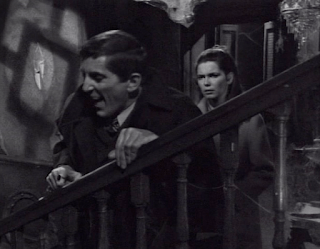
There are a few interesting moments. We begin with well-meaning governess Vicki entering the long-abandoned Old House on the grounds of the estate of Collinwood in search of her charge, strange and troubled boy David Collins. The doors swing shut, and she cannot open them. The recently arrived Barnabas Collins comes down the stairs, startling her. He opens the doors easily.
This may not sound like a big thrill, but regular viewers will remember that doors swung open at the approach of the previous supernatural menace, blonde fire witch Laura Murdoch Collins. When characters who did not know that Laura was anything other than a woman saw that happen, they didn’t react- it was a small enough thing that they could fail to notice it, and a weird enough thing that it didn’t register. So we have been prepared to watch for tricks with doors as a sign of the uncanny.
Barnabas’ big challenge today is a job of acting. He has to convince the residents of Collinwood that he is a living man from the twentieth century, not a reanimated corpse come to prey upon the living. He has trouble staying in character. When he tells Vicki that once, centuries ago, a father and son had a quarrel in the Old House that led to the son’s death, he starts laughing and repeats the word “death.” Vicki looks at him like he’s a lunatic. He gets it back together fairly quickly, but when Vicki goes back to the great house on the estate she will tell flighty heiress Carolyn that Barnabas is kind of strange.
Barnabas gives Vicki a long, flowery speech about the building of the house, one with no apparent motivation and many logical stopping places. Marmorstein has been giving these overheated orations to actor after actor, defeating them all. As Vicki, Alexandra Moltke Isles came the closest to selling one of them, at the beginning of #167, but she needed maximum support from the director in the form of close-up shots and lighting effects, and even then it was a relief when it was over.
Barnabas’ entire part consists of such speeches. Jonathan Frid stumbles over his lines quite a bit today, as he will do henceforth. No wonder- not only was he dyslexic, but at this point they were shooting seven days a week to make up for production time they lost in a strike late in March. That left him with precious little time to memorize the pages and pages of purple prose they kept dumping on him.
Listening to Frid struggle through his dialogue today, we discover the first reason why Barnabas became such a hit. In his voice, through his mannerisms, Marmorstein’s gibberish sounds gorgeous. Sometimes Frid’s struggle to remember what he’s supposed to say is a problem for the character. Since Barnabas is himself an actor essaying a demanding role, it gets confusing to see Frid’s own difficulties laid on top of his. But even at those times the sound of his voice is so appealing that we root for him to recover and deliver more of his ridiculous lines.
In his speech to Vicki about the building of the Old House, Barnabas mentions that the foundations were made of rocks deposited by glaciers. Any reference at all to glaciers is pretty brave, considering the rate at which the story has been moving in the Sproat/ Marmorstein era. It also raises a question about Barnabas. He is the man who posed for a portrait done in an eighteenth century style, and David told dangerously unstable ruffian Willie Loomis stories about Barnabas’ mother Naomi that would place her towards the middle of the eighteenth century. We’ve also glimpsed a plaque on Naomi’s tomb that gives her dates as 1761-1821, but that prop hasn’t received anything like the screen time the portrait of Barnabas has had, and must have been made long before David’s lines to Willie were finalized. So the trend is to regard Barnabas as someone who was confined to a coffin from the eighteenth century until Monday night. When he starts talking about the rocks laid down during the Ice Age, an event unknown until the mid-nineteenth century, we wonder which night this week he spent updating his understanding of geology.
In the great house, high-born ne-er-do-well Roger comes home from a business trip to Boston. Before updating him and the audience on recent plot developments, Carolyn reminisces about her childhood, when he used to bring gifts to her when he would come home from business trips. She tells him he was the only father she knew. This is a retcon- up to this point, they’ve taken pains to make it clear that Roger and David only moved into the house a few weeks before Vicki’s arrival in episode 1.
Vicki and Barnabas enter the great house. She introduces him to Carolyn and Roger. Roger quickly escorts Barnabas to the study where the two of them talk alone. Roger mentions that a vineyard in Spain that had been in the family in the eighteenth century was still theirs until shortly before World War Two. Barnabas does not react to the phrase “World War Two” at all. Whether this is because he has been studying history as well as geology, or because he was simply overwhelmed with so much new information, is not explained.
While Roger and Barnabas are in the study, Vicki tries to explain to Carolyn why she thinks Barnabas is a bit odd. Carolyn doesn’t want to hear it. She explains the basis of the Collins family’s attitude towards Barnabas when she says it’s a relief just to meet someone friendly after the rough time they’ve had lately. Viewers who have been watching from the beginning will understand how strong that sense of relief must be, and will know that Barnabas is in a position to ride it right into a permanent billet on the estate.
Barnabas leaves, and Roger shows Vicki and Carolyn the portrait. He points out that Barnabas is wearing the same ring as its subject. He does not point out that he is also carrying the even more distinctive wolf’s-head cane.
While those three talk about the wealthy and genial visitor from England Barnabas appears to be, we wonder what he really is. Barnabas first appeared as a hand darting out of a coffin, he has shown up only at night, he lived hundreds of years ago, and he is played by an actor who bears a noticeable resemblance to Bela Lugosi. So we assume that he is a vampire. But so far, there hasn’t been any direct evidence of blood-sucking. During the months Laura was on the show, they made a point of not assimilating her to any familiar mythology. So for all we know, he might be something we’ve never heard of.
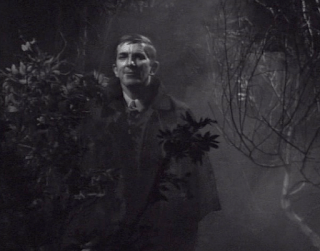
The final shot before the credits roll is in the outdoors, where Barnabas is standing perfectly still, surrounded by shrubbery, and with a big smile on his face. Perhaps that shot is telling us that Barnabas is not the vampire we might assume he is, but that he is in fact an undead garden gnome.
Friday’s episode ended with an important scene. Strange and troubled boy David Collins cheerfully escorted dangerously unstable ruffian Willie Loomis around the great house of Collinwood, giving him little lectures about the portraits of the Collins ancestors. David pointed to a portrait in the foyer and spoke a name we hadn’t heard before, identifying it as Barnabas Collins. Willie, then played by frenzied Mississippian James Hall, became fascinated with the jewels Barnabas wore, so much so that for the first time on Dark Shadows his thoughts became audible as a recording playing on the soundtrack. After Willie left the house, we heard a heartbeat coming from the painting and saw Barnabas’ eyes glow.
When Willie’s associate, seagoing con man Jason McGuire, first entered Collinwood in #196, an optical trick made it look like a portrait was hanging on the spot where Barnabas’ portrait is now. While the face on the painting would have to wait until the actor was cast, the rest of the work on it was already done at that point, so that trick, inconspicuous as it would have been to the audience, was a sign that the production staff had decided that Jason’s role on the show would be to precipitate the introduction of Barnabas. And the opening voiceover of #2o2, the episode in which Willie joins Jason as a houseguest at Collinwood, referred to Willie as “one who is to awaken and unleash a force that will affect the lives of everyone.” The special effects surrounding Willie’s first encounter with the portrait would suggest that Barnabas represents that force, and that the portrait is a means by which that force is expressed.
Today’s episode begins with Willie taking another look at the portrait, and will end with him staring at it again. In between these two sessions, we learn that among the many impulses Willie is unable to control is a fascination with shiny objects.
We also see the ninth and tenth iterations of Dark Shadows’ dreariest ritual, in which seagoing con man Jason McGuire makes a demand of reclusive matriarch Liz, Liz resists, Jason threatens to expose her terrible secret, and Liz gives in. The first time comes after the opening credits. In the pre-credits teaser, they raised our hopes that we might see a conversation between them which does not conform to this pattern. Liz tells Jason that Willie can no longer be a guest in the house, and Jason agrees. But as soon as we return, he demands that she give Willie a parting gift in the form of $1000 cash. She refuses, and says she will call the police rather than bribe Willie to leave her home. After Jason threatens to send her to prison and lowers his demand to $500, she capitulates.
When Jason breaks the news to Willie that he is to leave immediately and take $500 with him, Willie notices a diamond-encrusted emerald pin and slips it in his pocket. Minutes later, Liz finds the pin missing and tells Jason she will have to call the insurance company. Jason confronts Willie in the kitchen and demands he hand the pin over. After a tense moment, Willie admits that he took the pin, not because he thought he could get away with stealing it, but because it was so pretty. He goes on about how supremely beautiful fine jewels are, saying that he can judge the beauty of a gem simply by touching it. He begs Jason to let him touch the emerald again. After Jason leaves him alone in the kitchen, Willie looks like he has had a new idea and is resolved to act on it.
Willie’s compulsion to touch the emerald creeps Jason out
Willie starts the scene with angry defiance, proceeds to humiliated dependence, and ends with a look of brisk resolve. John Karlen takes Willie through all of these emotions without any apparent discontinuity of feeling. He is still the defiant man even while he is begging, and still the begging man even while he is making up his mind to follow his new plan. That is as different as can be from Hall’s interpretation of Willie, who frightened us largely because of his extremely mercurial temperament. His moods shifted so wildly from second to second that you had no idea what he might do. It is remarkable that two performances can be so utterly unlike each other in every way, yet be equally effective at conveying menace and equally exciting to the audience wondering what comes next.
Jason tries to convince Liz that Willie didn’t take the pin, but that it simply fell to the floor. This effort collapses immediately. Liz is no longer disposed to give Willie any money; she is planning to call the police and let the chips fall where they may. Jason does not believe Willie will go quietly unless he gets a substantial sum of cash, and is afraid of the trouble Willie can make. So he again threatens Liz, this time focusing on the effect of a potential scandal on her daughter Carolyn and on David. Liz looks away in despair, unable to refuse Jason’s demand.
Willie depresses some characters and enrages others. The only exception is David, who brightens and chatters gladly when he sees Willie. David leads Willie into the study, where he shows him pictures of the Collins family’s eighteenth century ancestors and goes on about their fabulous jewels. He identifies one ancestor as his “great-great-grand-uncle.” “Grand-uncle” is a bit of Collinsport English that we will hear again later in the series. David suggests that some very valuable items might be found buried in out of the way places around town. David’s tales send Willie back into the foyer to stare longingly at the jewels in Barnabas’ portrait.
As we heard Willie’s interior monologue on the soundtrack while he stared at the portrait Friday, so today we hear a recording of Willie’s speech to Jason about his love of jewels while he studies the jewelry in the portrait. As his words come to an end, the heartbeat plays again and the eyes glow again. This time, Willie sees and hears and reacts. He has found his destiny.
Drunken artist Sam Evans receives an unexpected visitor to his cottage. She is famed art dealer Portia Fitzsimmons, and she is magnificent.
Mrs Fitzsimmons, as she insists on being addressed, was in a junk shop earlier this week, where she found two of Sam’s paintings available to buyers of the frames they were in. The paintings were done ten or twelve years ago, and she declares that they are in a style that will soon become fashionable. If Sam can come up with a dozen more canvases from that period, he will have a one-man show at her gallery, and he will become famous. With that fame, he may even be able to sell some of his newer paintings, countless of which have been collecting dust around the cottage for years on end.
This was the very first scene of Dark Shadows I ever saw. I’d heard of the show when I was a boy in the late 70s and my mother was watching whatever daytime soap she was into. I heard her say something like, “Ooh, they’re going to turn into Dark Shadows.” I asked her what Dark Shadows was, and she explained that it was a soap opera that had been on about ten years before which introduced a vampire as one of the regular characters. At that age, I thought of soaps as the dullest thing in the world. I wasn’t particularly into vampires, but they were obviously too interesting for the televised sleeping pills that beamed into our living room for an hour every afternoon, so I followed up with some more questions. She had never watched the show, so all she could tell me was that it started as a more or less conventional daytime serial, added a vampire, and became a hit.
When the 90s came along and I got cable TV in my apartment, that was still all I knew about it. So when I saw that the Sci-Fi Channel* was showing Dark Shadows, I decided to take a look. There is no suggestion of vampires in this one, but Portia Fitzsimmons is such a dynamic character that I could see that the show was capable of being pretty lively without them.
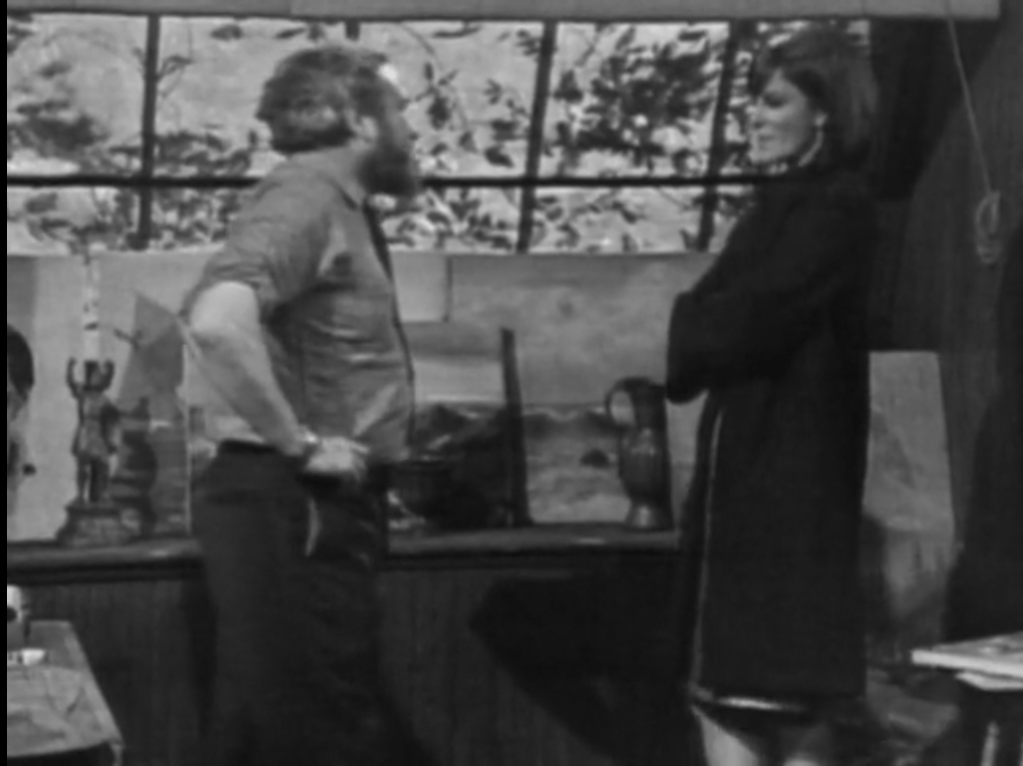
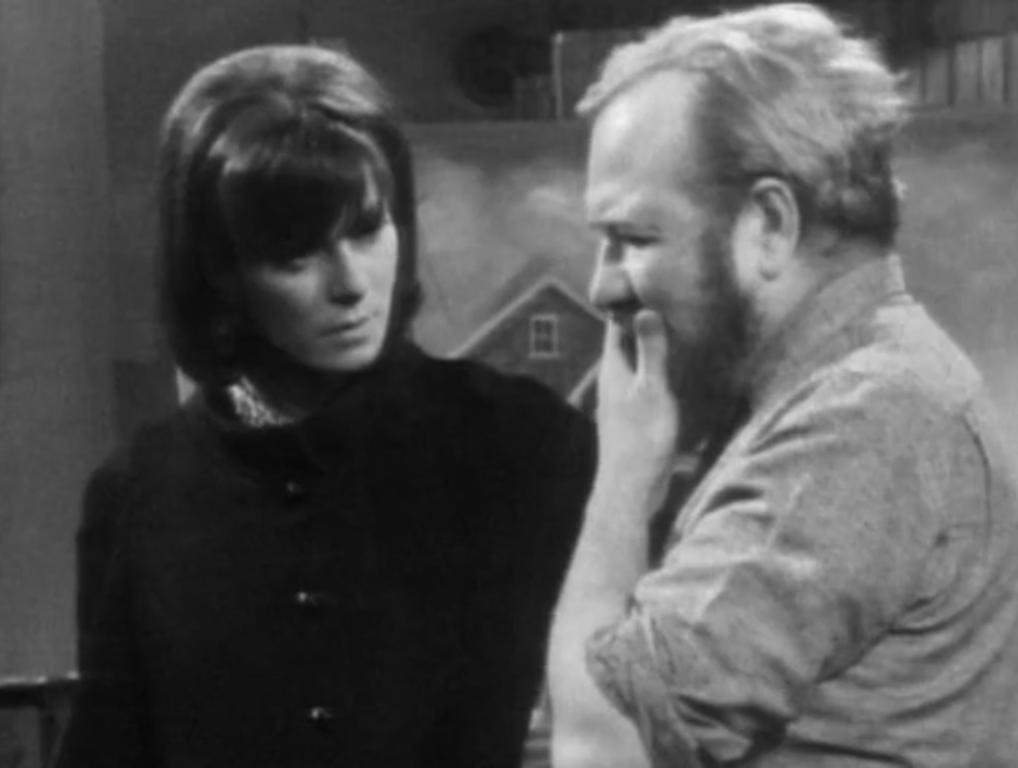
Actress Lovelady Powell has two physical abilities that enable her to give us something fresh to look at every second the camera is on her. First is her remarkably mobile face. Her left eyelid alone is capable of a wider variety of expressions than most performers can produce with their entire physiognomy. Since it is her left eye that is focused on Sam throughout the scene, that eyelid is going to be the crucial body part in her delineation of their relationship, but she uses it with remarkable facility. Focus on her left eyelid in these three images, and see how it does most of the work in taking her in a few seconds from delighted to dismayed to dismissive:
DelightedDismayedDismissive
Those three images show a major shift in mood. The same eyelid can also modulate finer shades of feeling. In this sequence a few moments later, the left eye is partially obscured, but still shows precisely what is going on when Mrs Fitzsimmons gives Sam his marching orders:
Laying down the lawLetting it sink inAdding emphasisObserving Sam’s reactionConfirming Sam in his reactionMaking up her mind about Sam
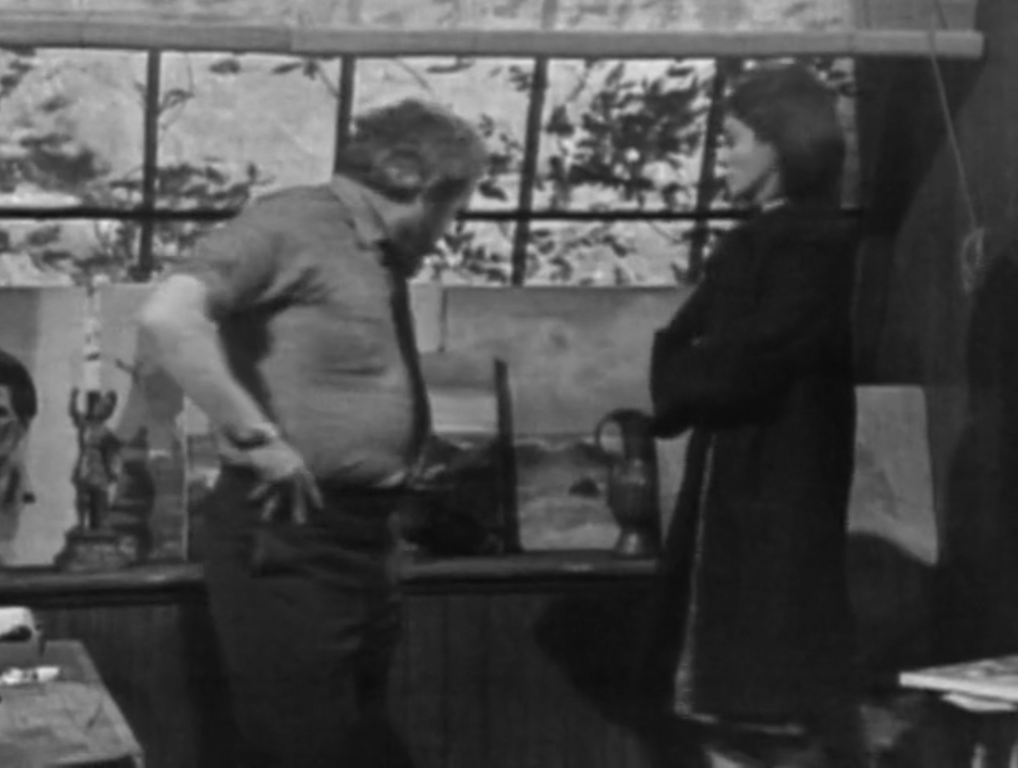
Powell not only made excellent use of the fine muscles of her face, but of her limbs as well. So her second strength is her style of movement. She walks around the set continually, making many wide, sweeping gestures. If those seemed to be a number of distinct motions, she would be a hectic, distracting presence. But in fact, it all comes together as an uninterrupted flow, and defines the entire performance space in terms of her action and her presence. This is difficult to illustrate with still images, but if you look at how she uses her elbows in this sequence I think you’ll get the idea:
Maximum distanceApproachingArrivalStarting to unbend
I think an actor could watch this scene a dozen times and learn new things from every viewing.
All these techniques for establishing visual dominance pay off in the scene. Sam is an artist who has so utterly despaired of finding an audience for his art that it simply does not register with him that a famous art dealer has come calling. Returning viewers will remember that Sam has been moping around feeling sorry for himself since his first appearance in episode 5. Two weeks ago, in #184, he told his daughter Maggie that it was too late for him ever to have a one-man show and that all he could ever hope for was to sell a few paintings to tourists every summer. Within minutes, Mrs Fitzsimmons has changed all of that. She watches Sam’s reactions as she turns his life upside down, and visibly calculates the particular sort of flourish with which she will deliver each of her lines. When he tells her that he thinks he will be able to assemble enough paintings within a week, she stands in the doorway and replies that she is sure he will be able to do it then, “if you can do it at all.” She then pirouettes away and wafts off whence she came.
When I first saw the scene, I wondered how big a part Mrs Fitzsimmons would play in the storylines to come. I still remember seeing the name “Lovelady Powell” in the closing credits. With my work schedule at the time, I didn’t have a chance to see another episode for months, and when I did join it again there was no sign of Portia Fitzsimmons. I assumed she’d been written out, perhaps to return in some later narrative arc, perhaps because Lovelady Powell had gone on to bigger things. It came as quite a surprise to learn that this was her only appearance on Dark Shadows, and that her acting career never really took off.
Now that I’m on my second complete viewing of the series, it’s an even bigger surprise. The portraits of the ancestors of the ancient and esteemed Collins family are among the most prominent visual features of the chief sets, those representing the great house of Collinwood. Portraits there and elsewhere, including in the long-abandoned Old House at Collinwood and in the Evans cottage, have repeatedly been shown to have supernatural power, representing a bridge between the world of the living and that of the dead.
Further, every storyline that has been resolved so far has centered on strange and troubled boy David Collins. The show has gone out of its way to show that David has promise as an artist. David Collins is nine, and actor David Henesy turned ten in October of 1966, but the character is unusual enough and the actor is sophisticated enough that it would be interesting to see David interact with the grand dame of the New York art world.
An art connoisseur is therefore as well-positioned as anyone to act as a guide to the uncanny realms into which the show will be venturing from now on. Combining Portia Fitzsimmons’ claim to expertise with her imperious personality and Lovelady Powell’s sophisticated acting style, you’d have a character who could carry us right through the whole series. The producers will be hard-pressed to find another actress who can play as worldly and forceful a Vergil to the various Dantes who will be exploring Collinwood’s weird infernos.
Sam’s reaction to Portia Fitzsimmons’ command that he bring her a dozen canvases that he painted ten or twelve years ago puzzled me on my first viewing, and puzzles me in a different way now. The only group of works that fill that bill are in the possession of high-born ne’er-do-well Roger Collins. Sam sold them to Roger ten years ago for $15,000. Roger likes money, a point made clear in his scene with Sam today. If Sam simply telephoned Roger and told him that the famous Portia Fitzsimmons wants to show the paintings in her gallery and sell them at a great profit to Roger, no doubt he would be eager to find them and make the deal.
Sam does not do anything so straightforward. Instead, he visits Roger at Collinwood. Roger responds to his presence by railing at him, declaring that he never wants to see him in the house and wants him to leave immediately. Sam then insists that Roger give him the paintings. When Roger asks why, Sam denies that any part of the $15,000 was a payment for the paintings. He starts to explain that it was hush money Roger gave Sam to ensure he kept a secret Roger wants withheld from dashing action hero Burke Devlin.** Roger looks around in terror when Sam starts talking about the secret, then orders him never to speak of the matter again. Sam says he will tell Burke all about it unless Roger produces the paintings. Roger dismisses Sam’s threat, but does offer to sell him the paintings for $50,000, unless it turns out that he destroyed them or lost them somewhere along the way.
Now that I’ve seen episodes 1-192 a couple of times, I know that Sam hates Roger, hates himself for taking Roger’s money and betraying Burke, and wants to start a new life in which Roger will have no part. But his undisguised attempt to blackmail Roger into handing over the paintings isn’t really in character for Sam. His tortured conscience has hobbled Sam time and again in his attempts to stand up to Roger. Besides, Sam just had a harrowing encounter with the supernatural in the form of Roger’s estranged wife, blonde fire witch Laura Collins, and that experience seemed like it would make him a kinder and more thoughtful man. That his first act after emerging from it is to commit an out-and-out felony is a disappointment to me.
My wife, Mrs Acilius, wasn’t disappointed. She likes the scenes when Sam is sober enough to stand up to Roger, and she sees this as one of the strongest of those. While she acknowledges that Sam is not being rational, she cheers for his desire to press to the hilt his advantage over the rich so-and-so who has been a blight on his existence for so long.
In the local tavern, The Blue Whale, Maggie Evans is having a drink with her boyfriend, hardworking young fisherman Joe. The camera focuses on a man in a seaman’s coat and captain’s hat sitting at the bar, eavesdropping on their conversation. When they mention Collinwood and reclusive matriarch Liz, the sailor perks up and approaches them.
He apologizes for listening to their conversation, but goes on to ask a series of questions about its content. When Joe makes it clear he does not welcome the intrusion, he apologizes again, while in the act of sitting down with them. When they are finally getting rid of him, he says that it is terribly sad that Liz never leaves her home, and while speaking of that terrible sadness flashes a huge grin. He gives his name as Jason McGuire.
So we are introduced to a second new character in this episode. This one is apparently going to get some kind of storyline started. The actor is talented and the scene has some good things in it, but Jason McGuire is no Portia Fitzsimmons.
*As it then was known.
**A sketch of Burke is on display in Sam’s cottage today. The Dark Shadows wiki speaks with the voice of fans everywhere when it says that Sam tore up a sketch of Burke in #41 and therefore should not have this item now. But Sam made that sketch as part of his preparation for painting a full portrait of Burke. Artists make more than one sketch when they are getting ready for a major painting, so the fact that Sam tore up one sketch doesn’t mean that he doesn’t have any number of others lying around.
Yesterday, we saw four men visiting a crypt. They are parapsychologist Dr Guthrie, hardworking young fisherman Joe, instantly forgettable young lawyer Frank, and the unnamed Caretaker of the old cemetery. They witnessed an uncanny event when the ghost of Josette Collins opened the coffin of Laura Murdoch Stockbridge, who died (by fire!) in 1767.
The ghostly intervention was disturbing enough in itself, but when the four men saw that the coffin was absolutely empty they had to change their ideas. Before Josette took action, the Caretaker had vowed that he would die rather than let a grave be disturbed. After they have seen the empty interior of the coffin, Guthrie asks him about another grave he wants to dig up and the Caretaker gives him directions. Frank had shouted at Joe and Guthrie that they would go to jail if they didn’t immediately stop disturbing the crypt, but now he agrees to go to the other grave and help dig. Joe had joined Guthrie only with utmost reluctance and had wanted to stop when the Caretaker first showed up, but now he is the one who points out a toolshed from which he volunteers to grab some shovels.
The second grave is that of Laura Murdoch Radcliffe. In 1867, just one hundred years after the fire that killed Laura Murdoch Stockbridge, Laura Murdoch Radcliffe died the same way. What’s more, a woman initially identified as Laura Murdoch Collins died (by fire!) in Phoenix, Arizona earlier in 1967 and her body inexplicably disappeared from the morgue some weeks after her death. Evidently Guthrie’s hypothesis is that graves will both be empty, because the body of each Laura Murdoch disappeared after death. He also surmises an otherworldly connection between these three dead and vanished Laura Murdochs and the apparently alive Laura Murdoch Collins who has been hanging around the great estate of Collinwood for a couple of months.
Back in the crypt, the Caretaker is delivering a soliloquy. He thinks Guthrie, Joe, and Frank are wasting their time trying to learn secrets from the dead. He has information he could share if they would stay and listen to him. He remembers that there was something strange about the death of Laura Murdoch Radcliffe, and that a book about the Radcliffes is on the shelves in the crypt. He looks through the book and finds the information. “The child!” he exclaims.
Laura Murdoch Collins materializes in a dark corner and strikes up a conversation with the Caretaker. As her talk grows more and more mystifying, the Caretaker looks confused, as if he has never before been the least weird person in any room.
Laura’s appearance gave us (Mrs Acilius and I) two grounds for fear. Our first fear was that Laura might kill the Caretaker. We could easily imagine Guthrie, Joe, and Frank coming back to the crypt to find it in flames, the records kept there in ashes, and the Caretaker dead (by fire!) We like the Caretaker, and want to see him in future episodes.
Our second fear was that Laura would go to the grave of Laura Murdoch Radcliffe and interrupt the exhumation. What we dreaded about that prospect was that it would slow the story down. Yesterday’s show moved at a nice clip, and while today does not match it, at least some things are happening to advance the plot. In the last several weeks, the pace has alternated between glacial and dead stop. So the idea of yet another delay is well worth a shudder.
Laura Murdoch Collins examines the coffin of Laura Murdoch Stockbridge
There is a moment when it seems that Laura will go to stop the men. The Caretaker tells her that they have gone to the grave of Laura Murdoch Radcliffe, and starts to give her directions. She tells him not to bother explaining where it is. Laura doesn’t speak the line “I’ve been there before,” but Diana Millay’s eyes communicate the thought to the audience. Having already seen her inspecting the inside of Laura Murdoch Stockbridge’s empty coffin, we know that she is on a tour of her old neighborhood.
Laura Murdoch Collins doesn’t need directions to the grave of Laura Murdoch Radcliffe
For whatever reason, Laura does not interfere with Guthrie, Joe, and Frank. They dig up the coffin of Laura Murdoch Radcliffe. They open it and look inside. Guthrie asks “What do you see?” Frank replies “What you thought we’d see.” There it is, a bullfrog in a top hat singing “Hello, My Baby.” Oh no wait, I changed the channel there for a second. On Dark Shadows, the answer is “Nothing. Absolutely nothing. An empty box. It’s almost like it’s always been empty.” No wonder we’re still watching the show after all these years, where else can you find thrills like that.
Hello, my ragtime gal
The Caretaker is talking to Laura and looks down for a second. When he looks up, he is baffled. We cut back to the spot where she had been standing, and it is vacant.
Guthrie, Joe, and Frank return to the crypt. They apologize for having been away for so long. The Caretaker tells them they have only been gone for a minute or two. They are puzzled. They find the book about the Radcliffes, and discover that a portion of a newspaper clipping containing an account of Laura Murdoch Radcliffe’s death has been erased, as by an intense light generated by a fire. This leaves us wondering why Laura erased only that section of the clipping, calling attention to it, when she could just as easily have set fire to the book and destroyed the whole thing.
It’s a relief that the Caretaker survives to dodder another day, and a relief that Guthrie, Joe, and Frank complete their business in the cemetery and free us to move on to the next story point. As Guthrie, John Lasell was visibly bored yesterday; today his part is smaller, but he is back on his game, and the others are good too.
Daniel F. Keyes has some particularly good moments as the Caretaker. Yesterday he struck the heroic note when he told Guthrie and Joe that they would have to kill him before they could open the graves, and he made that a powerful moment. Today, he shows us both how lonely the Caretaker is, and why he cannot escape that loneliness. The feeling is painfully raw in his soliloquy about the information he could give if only the others would listen, and his exaggeratedly careful movements and other mimicries of a fragile old age give that rendition of helpless, desperate loneliness an extra punch. His interaction with Laura is even more interesting- while he lives too much in the world of ghosts and taboos to be at home with the living, he is too much a part of the this-world institution of the cemetery and of its rational, bureaucratic routines to know what to do when he encounters an otherworldly being face to face. He is entirely alone, caught in the interstices between the natural and the supernatural, unable to communicate with the denizens of either realm.
Today is the last time we will see actor Conard Fowkes and his character, Frank. I call him “instantly forgettable young lawyer Frank” because, while Fowkes consistently does an excellent job of embodying whatever Frank supposed to be at any given moment, he never gives the feeling that there is anything else under the surface. I keep wishing Frederic Forrest, who danced at the Blue Whale in #137, had been cast as Frank. Forrest could have created a convincing character while also giving a sense of a goofy, engaging personality inside whatever Frank is in any given scene, so that you not only appreciate each turn but also wonder what is coming next. Each time you see Fowkes, you can recognize that he presented exactly what he was supposed to present, but he never drops a hint that anything different might be coming. Still less does he leave you wanting more.
Today, Frank is supposed to be chastened by the sight of what Josette did and willing to join Guthrie and Joe in their exhumation. He is the very image of “Chastened.” Yesterday, he was indignant about Guthrie and Joe’s lawless behavior. A still of him from that episode would have been a fine illustration for a dictionary definition of “Indignant.” In #169, he was haggard and concerned about the mysterious illness gripping reclusive matriarch Liz. Again, he was a faultless model for “Haggard and Concerned.” When we first saw him in the offices of his firm in #92, he was so much the fellow you would expect to meet in a law office in Bangor, Maine in 1966 that you felt like you were reading a writ of replevin.
In a way, Fowkes was an excellent actor. Unfortunately, it wasn’t the way in which a regular member of the cast of a scripted television series ought to excel. The proper medium for him would be something more static, such as filmstrips or View Master reels, in which we could stop and look at him as he demonstrated various moods and personality types. I suppose he might also have been an outstanding mime. Fowkes was always pleasant, and in her scenes with him Alexandra Moltke Isles has a chance to show aspects of the personality of well-meaning governess Vicki that we never see in any other setting. So I’ll miss him, but I’d have missed Forrest a whole lot more.
Reclusive matriarch Liz is in a catatonic state, and her doctor is at a loss to explain why. Well-meaning governess Vicki has confided in her boyfriend, instantly forgettable young lawyer Frank, that she thinks Liz is the victim of blonde fire witch Laura. Frank has sent for a Dartmouth psychology professor, Dr Peter Guthrie, whose research concentrates on reports of paranormal phenomena.
Keeping vigil in Liz’ room, Vicki tells Liz’ daughter, flighty heiress Carolyn, that she and Frank have sent for another doctor. When Carolyn asks what Dr Guthrie specializes in, Vicki claims not to know. A few minutes later, Dr Guthrie shows up and has a brief conversation alone with Vicki. He asks her if she knows what he specializes in, and she immediately gives the correct answer. Now that the audience knows without doubt that Vicki was lying to Carolyn, she asks Dr Guthrie what she should tell the others in the house if they ask about him. He says that he is in fact a psychologist who studies psychosomatic ailments, so she can tell them that. When he says that he is uncomfortable with secrecy, Vicki asks him if he understands why absolute secrecy is necessary in this case. She doesn’t leave him much choice but to agree.
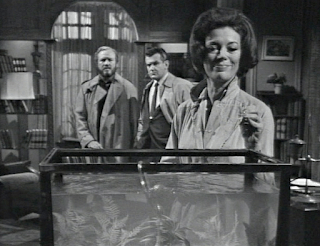
Dr Guthrie takes his first look at the drawing room
The whole episode is very awkwardly written. There’s so much repetition, unnecessary dialogue, and unexplained change of attitude from scene to scene* that it’s hard to avoid the conclusion that it could have been five minutes long. But the actors make me glad it went the full twenty-two minutes. It’s interesting to see Vicki manage Dr Guthrie in the same way Liz manages everyone- at first she is understated and demure, and before you know it she is so fully in command that you would feel like a ruffian if you were to disobey her.
John Lasell’s performance as Dr Guthrie is tremendous. He disappears into the character- I’ve never had a harder time recognizing the same actor in two roles than when I found out that the same man who played the quiet, methodical, entirely trustworthy scientist from upper New England in Dark Shadows also played the floridly romantic, flamboyantly sinister, and emphatically Southern John Wilkes Booth in the Twilight Zone episode “Back There.” Every fine muscle of his face and eyes represents a well-thought-out acting choice. When it is Lasell’s turn to take the spotlight, he not only commands the screen, but creates a whole new atmosphere- when he’s on, the show suddenly feels like a primetime broadcast or a feature film. And when he’s around, the whole cast, even Joan Bennett who spends the entire episode being absolutely still, is obviously having fun giving a performance.
*For example, a few minutes after acquiescing in Vicki’s insistence on secrecy, Guthrie demands of the apparently reluctant Vicki and Carolyn that they maintain secrecy. In the interval, we saw Guthrie so absorbed in his examination of Liz and the young women so distraught about her condition that it doesn’t feel like a contradiction, but that’s a credit to the actors, not to the script.
Writer Ron Sproat stayed with Dark Shadows too long, and fans of Danny Horn’s great blog Dark Shadows Every Day will have fond memories of his frequent denunciations of Sproat. It is true Sproat had many glaring weaknesses. For example, he was pretty bad at inventing stories to tell, which you might think would get in the way of building a career as a fiction writer. But one strength Sproat undoubtedly had was a sense of structure. There might not be anything happening in one of his episodes, but you can count on him to make it clear why it isn’t happening, where it isn’t happening, to whom it isn’t happening, and who isn’t making it happen. Today there are some events, and between Sproat’s script and the work of the actors, it is plain to see what purpose each of those events serves in keeping the story on track.
As the episode opens, Lieutenant Dan Riley of the Maine State Police is visiting instantly forgettable young lawyer Frank Garner in an office. Regular viewers will be confused; we’ve seen this set several times, with exactly these decorations, as high-born ne’er-do-well Roger Collins’ office at the headquarters of Collins Enterprises. We haven’t seen the set since #69, and Roger wasn’t there at that time. So apparently Frank has moved in.
Frank hasn’t even moved the portrait of the Mustache Man from the spot where Roger had it when he was in the office. Screenshot by Dark Shadows Before I Die
Lieutenant Riley wants to pass along to Frank the information that the Phoenix, Arizona police have given him about a fire in Laura Collins’ apartment in that city. Laura is Roger’s estranged wife, and Frank is representing Roger in their upcoming divorce. It isn’t clear why Riley wants to tell Roger’s lawyer what he has heard about Laura. Later in the episode, Frank will tell well-meaning governess Vicki that Riley came to him because he is a “lawyer for the Collins family.” Perhaps that means he believed that Frank represented Laura. Throughout their conversation, Frank repeatedly protests that no one has any grounds for accusing Laura of anything, encouraging Riley in such a belief. I suppose it’s a lawyer’s job to collect damaging information about the opposition, but Frank does seem to be pushing an ethical boundary here.
The charred body of a woman was found in what was left of Laura’s apartment. Since the woman appeared to be the same age, height, and build as Laura, the room was locked from the inside, and everyone associated with the building other than Laura was accounted for, the body was initially identified as hers. Riley now tells us that the police have determined that the fire started in Laura’s apartment, and that a witness claims to have seen Laura in the building the day of the fire.
Laura checked into the Collinsport Inn the day of the fire and has been in and around town ever since, as many witnesses can testify. Riley says that there is no indication that Laura has been on an airplane recently, and it would seem impossible to travel from Phoenix, Arizona to central Maine in a few hours any other way.
The lieutenant goes on to say that because the room was locked from the inside and the woman who died in the fire made no attempt to escape, the police suspect murder. This is nonsense. An attempt to escape might have been evidence of murder, not the lack of such an attempt. And if the room was locked from the inside, how did the murderer get out?
Frank doesn’t raise these objections, but just blusters through a lot of verbiage as he protests against any suggestion that Laura should be suspected of murder. The lieutenant keeps pointing out that Arizona isn’t his jurisdiction, so he doesn’t have anything to do with it. He’s just a messenger.
Some scholar of acting really ought to make a frame-by-frame study of Conard Fowkes portrayal of Frank in this scene. He has plenty of dialogue, he’s challenging statements made by a policeman, he raises his voice, makes gestures, moves around the room, looks down moodily and up excitedly. Yet he is still so bland that it is difficult to remember a word he says. It is far beyond my understanding of the actor’s craft to explain how Fowkes manages to be so consistently dull no matter what the character is doing.
When Frank is a small part of an episode, I think of his blandness as a note of pure realism. He is just the sort of person you would expect to meet in a small-town law office in 1967, and indeed it is reassuring to think that someone who has obviously never thought of putting himself in the spotlight would handle your sensitive legal affairs. The last person anyone should want as a lawyer is some guy who habitually makes himself interesting to watch on television.
Today, Frank is the leading man of the first half of the episode, and comes back with a key part in the second half. Giving that much time to a performer with such a bland screen presence does serve a purpose. None of the characters has really committed to the notion that they have to worry about crimes and physical danger, much less that they are facing a challenge from the realm of the supernatural. As far as they know, the whole story today is about a couple of romances and a child custody matter. That’s the right speed for dull, amiable Frank Garner.
That the characters don’t yet know the true dimensions of what they are facing in the storyline is one of the points this scene has to make. The other is that we will be hearing more about the investigation in Phoenix, and that it will advance the plot.
I think an acting problem muddies this second point. Today Vince O’Brien takes over the part of Lieutenant Dan Riley from John Connell, who played him in #143 and #144. As Connell played him, Riley was an out-of-town cop, not the least bit awed by the Collinses of Collinsport. His matter-of-fact speaking and impatient listening made it clear that the family’s connection to the case in Phoenix was not going to result in the discreet, abbreviated treatment that the local authorities have given them. But O’Brien’s version of the character is noticeably quick to agree when Frank makes a statement. When Frank does a TV lawyer “may I remind you” about the elements of a murder charge (elements which he gets wrong, but hey, it’s TV, not law school,) O’Brien’s Riley is agitated. He shows defiance by declaring “You don’t have to remind me” in a harrumphing voice, but his wide eyes and trembling legs show that he is intimidated to be in a discussion with the representative of the mighty Collinses. There’s no point in bringing in an out-of-town character if that’s what you’re going for- the residents of Collinsport can show you what it’s like to live under the thumb of the people in the big house on the hill. And it introduces a doubt as to whether anything will come of the investigation, a doubt which leaves us wondering why we just spent so much time watching these two guys talk to each other.
Meanwhile, Vicki is visiting dashing action hero Burke Devlin in his hotel suite. Burke has asked her to come. Yesterday, she told him that she was suspicious there was something sinister about Laura, and he had listened attentively. Later, he met with Laura and the love he once felt for her had flared back into life. So today, he wants to tell Vicki that Laura is A-OK and she should do everything she can to help her.
Like the scene with Frank and Lieutenant Riley in Roger’s office, this scene has two points to make. First is to establish Vicki as a credible protagonist for the rest of the storyline about the danger Laura presents to her son, strange and troubled boy David. Second is to show that Burke is so smitten with Laura that he won’t be much help in protecting David.
Burke guides Vicki into his kitchen, a cozy space where people can confide in each other. Last time they were in this space, she made coffee for him; this time, he makes coffee for her. He’s remarkably dainty about it, sifting cream and sugar in separate cups. He makes a pitch about how remarkable Laura is, how he’s rethought everything they said yesterday, and how a fine woman like her deserves Vicki’s trust and support.
Vicki is unimpressed. She was in the room when Laura telephoned Burke yesterday, and heard him agree to meet her at one of their old places. She presses him to explain what has changed his mind, and he won’t give a clear answer. She asks how well he really knows Laura, and he looks dreamily off into space and says that he knows her better than anyone else. She asks if his feelings for Laura might be clouding his judgment, and he demands she change the subject. When Burke urges her to persuade David to grow closer to his mother Laura, Vicki replies “I’ll do what I can for David.” Burke says “You’re hedging.” Vicki replies coolly, “I can’t help it.” When he repeats his urging, he tells her she doesn’t look convinced. She replies, “I can’t help how I look, either.”
Vicki’s strength and intelligence and Burke’s dreamy infatuation should impress anyone watching this scene, but especially viewers who just saw yesterday’s episode. When Vicki is asking Burke what happened between yesterday and today to change his mind, she is waiting for him to talk about the meeting he arranged with Laura while she was right next to him. He never mentions it, and his repeated statements that all he has done is think more deeply implies that he does not remember that Vicki heard him talking to Laura. He is so captivated with Laura that the sound of her voice erases his awareness of everyone else, even of someone he is trying hard to persuade of an important idea.
Shortly after Vicki leaves, Burke receives another visitor from the great house of Collinwood. Flighty heiress Carolyn shows up. Carolyn is pouting because Burke hasn’t been paying attention to her since her Aunt Laura showed up.
This scene has one major point to make, which is that the budding Burke/ Carolyn romance is not going to be blooming this winter. Nancy Barrett’s Carolyn bursts off the screen as she bounces from one extreme to another, trying to attract Burke by pushing her breasts at him, trying to anger him by suggesting that her mother Liz and her Uncle Roger were right when they said he was just using her to get at them, trying to embarrass him by bringing up the obstacles between him and Laura, trying to break through his reserve by flinging her arms around his neck and pleading with him to love her.
Burke tries to let Carolyn down easy, smiling at her, caressing her face, hugging her, kissing her on the forehead. But signs of boredom and irritation keep slipping out. He tells her that the time has come for them not to see each other any more, and there can be no doubt he means it.
Burke, bored with Carolyn
Vicki goes to visit Frank. Frank blabs everything to her that the lieutenant had told him.
Vicki is deeply concerned about the idea that Laura might be a murderer. Frank keeps telling her that there’s probably nothing to that idea, but Vicki resolves at the end of the episode to do whatever she can to keep Laura away from David. Having established Vicki as a character strong enough and smart enough to square off with Laura in her previous scene, this scene shows us her decision to do just that.
Sheriff Patterson is at the mansion on the estate of Collinwood, talking with reclusive matriarch Liz and Liz’ ne’er-do-well brother Roger about the mysterious death of plant manager Bill Malloy. Liz listens as Roger answers the sheriff’s questions, seeming every bit the trusting sister. The minute the sheriff leaves, she turns to Roger and asks in an icy voice “How much of what you told him was the truth?” She confronts Roger with the differences between what he told the sheriff and what he’d told her. Roger is upset, and finally tells Liz she has to trust him. Liz looks sadly off into the distance and says that yes, she does have to do that.
“Yes, I do have to do that.”
I’m always interested to watch actors play characters who are themselves acting. When she’s concealing her doubts about Roger from the sheriff, Joan Bennett has her first chance to show us what sort of actress she thinks Liz would be. She’s a skillful one- she does have some subtle reactions to Roger’s evolving story when the sheriff isn’t looking at her, but her abrupt, contemptuous turn to Roger is the removal of a convincing enough mask that it shocks the audience. And her statement that she does have to believe Roger, coming after she has made it clear that she knows he has been lying to her and is likely to go on lying, is a performer’s resolution to go on playing a part, however unpromising that part may be.
Intercut with the scenes at Collinwood are scenes in the restaurant at the Collinsport Inn. Waitress Maggie Evans is serving one customer, her father Sam Evans. Sam wants Maggie to return a sealed envelope he gave her some time ago. He won’t tell her what’s in the envelope, why he wants it back, or why he gave it to her in the first place. She won’t give it back to him without answers to at least some of those questions.
Francis Swann is the writer credited with today’s script, but the contrast between the scenes at Collinwood and those in the restaurant form a diptych of the sort Art Wallace specialized in. Sister Liz demands information which brother Roger won’t give; Roger is a fountain of lies and evasions, and finally tells Liz that her idea of family loyalty requires her to behave as if he were telling her the truth. Daughter Maggie demands information which father Sam won’t give; Sam mutters little lies, stonewalls, and begs her to forget about the whole thing.
The two family pairs are both unhappy, but in different ways. The Evanses aren’t having any fun, but you can imagine them reopening communication and re-establishing trust, if only Sam can get off the hook in this crisis. Liz and Roger don’t seem ever to have trusted each other, but they are so much fun to watch that you can see how they might choose to go on fighting these battles indefinitely.
No one has told Maggie or Sam or anyone else that Bill Malloy is dead. When Maggie wonders if Bill might be able to help Sam with whatever troubles he’s refusing to tell her about, Sam replies that yes, Bill might be the only one who can help him. Dashing action hero Burke Devlin telephones the restaurant to order delivery of a meal; he asks if Maggie has seen Bill. Maggie tells Sam that everyone has been asking about Bill.
The sheriff comes in to the restaurant. Roger had told him that he was with Sam and Burke the night Bill disappeared, and the sheriff mentioned then that he’d be talking to both of them. The sheriff reacts strongly when he sees Sam, and tries to strike up a friendly conversation with him. Before the sheriff can elicit much of a response, he gets a telephone call. He rushes out of the restaurant as soon as he’s hung up. On his way out, he casually mentions to the Evanses that it was the Coast Guard calling to say they’d found Bill Malloy’s corpse. They are shocked at the news.
The sheriff doesn’t seem to be watching Sam’s reaction to the news about Bill’s death. That’s odd- while viewers know that Roger is the show’s principal villain at this point, Sam seems to be an equally likely suspect in the case of Bill Malloy. Casually mentioning such a terrible piece of news would seem to be a tactic that a policeman might use to gauge a suspect’s emotional state. Unless it is a tactic of some kind, it would be a spectacularly unprofessional way of announcing to the people of a small town that a highly respected local man was dead. Up to that point the sheriff hadn’t been presented as a blundering fool, so I wonder what they were saying by having him do that.
Miscellaneous:
Marc Masse’s blog posts about the first 54 episodes of Dark Shadows include promotions for Kathryn Leigh Scott’s novel Dark Passages. His post for episode 55 is the first that doesn’t include one of those, and is also the first in which he refers to Miss Scott as “the actress who plays Maggie Evans.” As in “scenes like this emphasize the great and natural chemistry for the father-daughter relationship being portrayed as embodied by David Ford and the actress who plays Maggie Evans.” I wonder if Miss Scott was alienated by “The Dan and Lela Show,” the dialogues between executive producer Dan Curtis and director Lela Swift that he claims to have heard in the background of the episodes. Many Dark Shadows fans were indignant about these, and I’m sure they let Miss Scott know about their objections. Perhaps she pulled her ads from Masse’s blog, and he couldn’t bring himself to mention her name afterward.
Sam Evans is starting to regret writing his Get Into Jail Card that confesses his role in Devlin’s railroading. He tries to get Maggie to return it to him, but she’s not stupid. Maggie is probably a better avatar for the show’s audience than Victoria, and if there’s anything we like more than a mystery, it’s learning the solution to said mystery. While there’s genuine concern for her father’s latest alcohol, caffeine and tobacco binge, she suspects she’s in possession of the final few pages in the mystery novel the whole town is talking about. And she’s running out of reasons not to take a peek and see how things end.
Sam is doing his usual “I’m not looking suspicious by trying not to look suspicious, am I?” thing at the restaurant when Patterson arrives. There’s something of a performer in Sam, who brings his sketchiest A-game when he sees the sheriff, and gets twitchier than Peter Lorre with a pocket full of letters of transit. Luckily for him, the sheriff has other things on his mind. The Coast Guard has found Bill Malloy. Dead.
I’m beginning to lose track of how often we’ve been given the news that Malloy is dead.