The opening voiceover tells us that “Evil reaches deeply into man’s soul, turning his heart to stone, transforming him into a vile monstrosity, and it is horrible to observe this process in an innocent and not be able to recognize it or prevent it.” Without that introduction, first-time viewers would have no reason to assume that Maggie Evans, The Nicest Girl in Town, is going through anything other than an ordinary sickness that has her looking bad and snapping at people.
Kathryn Leigh Scott does play Maggie’s moodiness very well. She does an especially admirable job in the scene where she yells at her boyfriend, hardworking young fisherman Joe, and orders him out of the house. After Joe goes, Maggie looks directly into the camera, and returning viewers will recognize that she is well on her her way to becoming the undead.
Bloofer lady
Meanwhile, well-meaning governess Vicki and dashing action hero Burke are dressed up and having dinner in Collinsport’s only night spot, The Blue Whale. Most of the time, The Blue Whale is a waterfront dive with frequent bar fights. But when Burke and Vicki dine there in their good clothes, the place transforms into a respectable restaurant, as it did in #189.
Burke and Vicki recap some plot points surrounding the great estate of Collinwood. Later, Maggie’s father Sam comes in and tells them of her condition. Vicki replies to Sam’s description with “Now let me see if I understand this. You said that yesterday she was sick and she collapsed, and last night she was up and around, and this morning she was sick again?”
In his post about this episode on his great blog Dark Shadows Every Day, Danny Horn’s response to this line is “IT IS NOT OKAY TO SUMMARIZE A RECAP THAT HE JUST SAID ONE SENTENCE AGO.” It’s true that the episode is heavy on recapping. A defter writer than Malcolm Marmorstein probably would have started the scene with Vicki putting this question to Sam, leaving out the recap that it re-recaps. But Vicki’s question itself is a good moment. As she delivers it, Alexandra Moltke Isles uses her face to show Vicki coming to a realization that has so far eluded everyone else.
The moment of recognition
Vicki recognizes that Maggie’s symptoms are identical to those which sorely bedraggled blood-thrall Willie Loomis displayed a couple of weeks ago. As she explains this, we see Burke gradually catch on and Sam absorb the information. Up to this point, everyone has been remarkably obtuse in failing to make this connection- the same doctor who examined Willie examined Maggie today, and doesn’t give any sign of recognizing it, or for that matter of understanding anything else relating to medicine.
As Vicki was the only character yesterday who escaped the long-running Idiot Plot that goes on because everyone fails to notice the abundant evidence that reclusive matriarch Liz killed her husband and buried him in the basement, so she is the only character today who spots the obvious similarity between the cases of the two victims of the vampire. The show is still sputtering along, but in a Smart Vicki turn like this we can find a glimmer of hope that it will start moving soon.
John Lasell is a tremendous actor, and was electrifying when he first appeared on Dark Shadows as parapsychologist Peter Guthrie in episode 160. But four weeks of endless recapping has taken its toll on him. In today’s pre-credits sequence, recreating yesterday’s final scene, we see what it looks like when John Lasell is bored.
Dr Guthrie and hardworking young fisherman Joe have arrived at the door to a mausoleum which houses a grave they plan to break into. Finding that he cannot turn the knob to the building’s front door, Guthrie says “It’s locked.” More precisely, he whines “It’s laaaakt.” The character has several sides, but this is the first time we’ve seen him as a cranky five-year old. As the two of them fumble about, Guthrie at one point lifts Joe’s tool box, gestures towards the inside of it, and says “Try this.” Try what, all of his tools simultaneously? When the door mysteriously opens, Guthrie takes a beat before he turns to look at it, and he never does get around to looking surprised.
They enter the crypt. Guthrie shines a flashlight directly into the camera. Characters on Dark Shadows do this so often that it must be intentional, at least to the extent that the directors resigned themselves to letting actors get away with it, but it always looks like a mistake. It’s especially jarring here, when John Lasell is himself looking into the camera when he shines the light in our eyes.
Hey Guthrie, are you a doctor of optometry?
Once Guthrie and Joe have found the vault housing the coffin of Laura Murdoch Stockbridge, they quarrel about whether to go through with their plan. They go through the same arguments they used in their scene in the drawing room of the great house of Collinwood yesterday. As yesterday, Joel Crothers manages to put enough verve into Joe’s mixed emotions that he is interesting to watch, but Lasell simply cannot bring himself to commit to another tired rehash. The only thought his performance in this scene brings to mind is puzzlement as to what happened to Guthrie’s glasses.
Back at Collinwood, instantly forgettable young lawyer Frank charges into the drawing room and demands that flighty heiress Carolyn tell him where Guthrie is. She replies that Guthrie swore her to secrecy. Frank says that Guthrie had called him shortly before to ask about a plan that might get him sent to jail. Frank asks Carolyn if Guthrie has gone to the crypt at the old cemetery. Faced with the prospect that Guthrie and Joe might land in jail, Carolyn admits that they are both there.
Guthrie and Joe try to pry Laura Murdoch Stockbridge’s nameplate off the wall of the crypt. They keep talking about how the whole thing might as well be a single block of stone. The actual wall keeps springing back in a way that only cheap grades of plywood do, undercutting this dialogue and requiring the actors to put more and more effort into keeping it from falling down. By the end of the sequence, both of Joel Crothers’ arms and one of John Lasell’s are holding the wall up, so that Dr Guthrie has to remove the supposedly massive nameplate with one hand. Even the blocking isn’t up to director Lela Swift’s usual standards- most of what we see in this sequence is the back of John Lasell’s coat. Considering what’s going on with the set, that may not be such a bad thing.
After Joe and Guthrie get the nameplate off the wall, Crothers flashes a look at Lasell that shows he is struggling to keep a straight face. Lasell’s boredom saves the take- if he had been intellectually available enough to notice Crothers’ twitching lips, he would have burst out laughing:
Straight face
The coffin is quite large and apparently very heavy. Guthrie and Joe put all their strength into carrying it a few feet. They then place it on a miniature tea stand.
Sure, that’ll hold, why not.
Guthrie fits a wedge under the lid and holds it while Joe swings a hammer. The elderly Caretaker enters and orders them to stop. If only for the sake of the tea stand, this command comes as a great relief.
The Caretaker tells Guthrie and Joe that they won’t open the coffin unless they kill him first. That doesn’t stop Guthrie’s efforts to win him over, but it is enough for Joe. Frank shows up. He apologizes to the Caretaker and yells at Guthrie.
Guthrie tries to explain himself to Frank. When Frank tells him that a court would likely respond to his hypotheses by committing him to a psych ward, Guthrie responds “Well, doesn’t that prove my point halfway?” When Frank asks how, Guthrie says “Wouldn’t a court… um… would a court be more sympathetic… uh… before the point? My reasons? Than after?” I’m sure that was not how it was phrased in the script, but I can’t imagine that whatever was written there made any more sense. Guthrie’s behavior is so preposterous today that it is understandable John Lasell didn’t bother to put in much of a performance. Still terribly disappointing, and quite unusual to see him as the weakest member of the cast. The rest of them all do very well in this well-paced, if not particularly well-mounted, episode.
The three men are about to leave the crypt when Joe says he detects a flowery scent. Guthrie asks if it is the scent of jasmine- the sign that the ghost of Josette Collins is near. Joe doesn’t know what jasmine smells like. The Caretaker can just about make out the scent of jasmine, far away, as if it were wafting in from the sea. In a reprise of a moment from #154, when the Caretaker told Vicki the same thing, Joe protests that the scent is not far away at all. It is flooding the room, is overpowering, is coming from behind an obstacle in the crypt.
The coffin opens itself, evidently the result of Josette’s action. The men gather round and look inside. It is empty- no bones, no dust, no sign that there ever was a body inside. Guthrie’s hypothesis, that the body of Laura Murdoch Stockbridge vanished after burial, is confirmed.
Hardworking young fisherman Joe is spending the evening with Maggie, The Nicest Girl in Town. It’s their first date. Maggie impresses him with her knowledge of ships, and he sings a verse of “What Do You Do With a Drunken Sailor?” It may not sound like much, but the actors, Kathryn Leigh Scott and Joel Crothers, sell it so well that we’ll be rooting for Joe and Maggie for years to come. The final moment of the scene comes after Joe leaves. Maggie looks directly into the camera and says to the audience, “Goodnight, pal.”
Goodnight, pal
In the great house of Collinwood, high-born ne’er-do-well Roger Collins greets his niece, flighty heiress Carolyn, on her return home. Carolyn is upset because Joe has broken off their relationship and is having a date with Maggie. The story of Joe and Carolyn was a bore, largely because the two of them never had a scene with any fraction of the sweetness we see between Joe and Maggie today. There was nothing at stake in their quarrels, because they had nothing to lose if they simply gave up on each other.
Roger tells Carolyn that well-meaning governess Vicki hasn’t been seen for hours, and that he promised Carolyn’s mother, reclusive matriarch Liz, that he would sit up waiting for Vicki’s return. Carolyn is worried as well, and asks Roger why he isn’t actively searching for her. He says she’s probably fine. When Carolyn says that people don’t just disappear, he reminds her of family friend Bill Malloy, who disappeared not so long ago, but then turned up. Considering that Bill turned up in the form of a corpse washed ashore by the tide, it is perhaps unsurprising that Carolyn does not find Roger’s analogy particularly comforting.
After Roger persuades Carolyn to toddle off to bed, he makes sure he’s alone (well, alone except for the stagehand in the lower left-hand corner of the screen.)
Once assured that no one mentioned in the script can see him, Roger returns to the drawing room and opens a secret passage we’ve never seen before. After he disappears into it, Carolyn comes to the drawing room and is baffled at his absence.
The suggestion that Carolyn doesn’t know about the secret passage is characteristic of the show. From the beginning, Vicki has represented our point of view. She started off knowing nothing about the other characters, and everything had to be explained to her while she was on camera. If Vicki knows just what we know, Carolyn, who grew up in the house where most of the action is set, can be presumed to know a great deal we do not. When they reveal a secret to us, they can amplify its importance by showing that Carolyn isn’t in on it. They’ve done this several times, mostly in situations having to do with the murky origins of Roger’s feud with dashing action hero Burke Devlin. Carolyn’s ignorance of the secret passage is particularly effective- it’s right there in the most important room of the only house she’s ever lived in. If she doesn’t know about it, it must be a very well-kept secret indeed.
We go with Roger into the secret passage. He shines his flashlight directly into the camera, creating a halo of light around it. This would not seem to be a desirable visual effect, yet we will see it many, many times in the years to come. This is the second appearance of the effect. The first time came when Roger’s son, strange and troubled boy David, was leading Vicki into the abandoned Old House in episode 70. Now we see it when Roger himself is entering another abandoned space, one where he might meet Vicki.
Halo
It’s hard to believe that the repeated use of this effect was altogether unintentional.
All the more so because of what follows Roger’s entry into the passageway. His journey through it actually does seem to wind through a very large space. In the opening narration, Vicki had said that the house is made up of 80 rooms, retconning the total of 40 given in the second episode. Roger’s trek up one flight of stairs, down another, up a spiral staircase, around corners, past windows, etc etc, seems like it must take him past enough space for at least that many. Perhaps the sequence would be a bit more attractive with less time spent focused on Roger’s feet, but all in all it is as effective a creation of space as Dark Shadows would ever do. If there had been Daytime Emmy Awards in 1966, Lela Swift would have had every right to expect to win Best Director for conjuring up this illusion of vast, winding corridors without editing or going outside the tiny studio space available to her.
Roger does indeed discover Vicki’s whereabouts. He hears her calling for David from behind a locked door, promising David not to tell anyone he imprisoned her there if he will let her out now. Roger does not simply let Vicki out. Instead, he makes some loud noises, then puts on a ghostly, wavering voice and calls out to Vicki that she is in great danger as long as she stays in Collinwood. He seems to be having trouble keeping a straight face when he makes these spooky sounds. Vicki isn’t laughing, and returning viewers aren’t either- in Friday’s episode, she and we saw the ghost of Bill Malloy in the room, and heard that ghost warn her that she would be killed if she stayed in the house much longer.
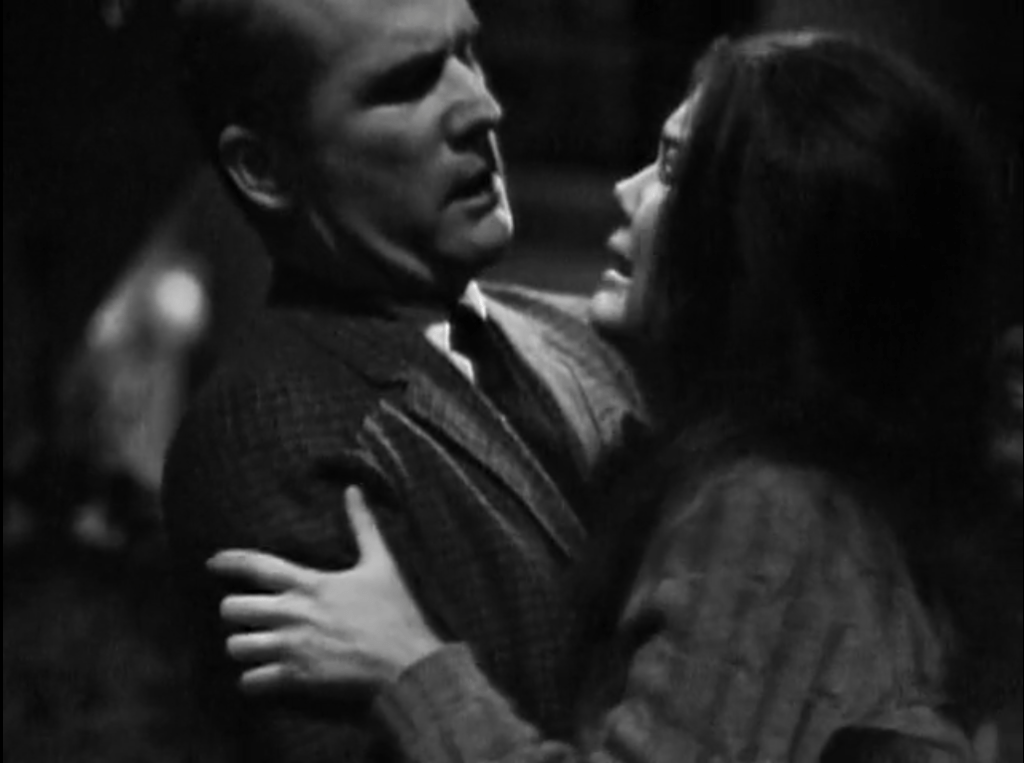
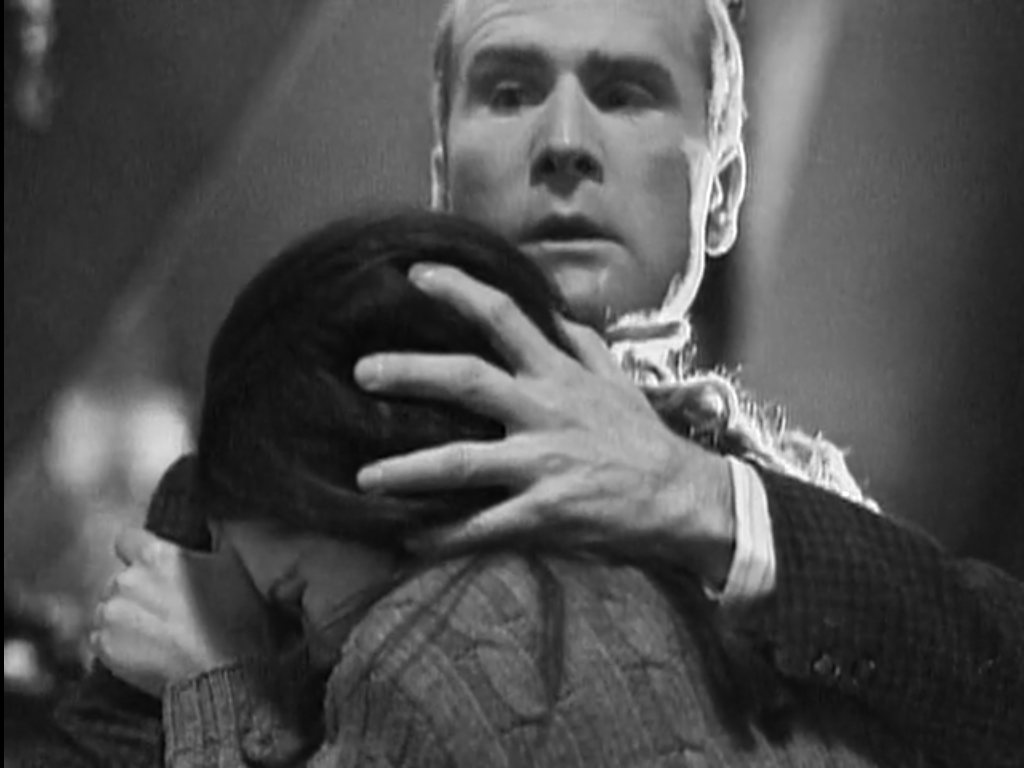
Once he’s had his fun, Roger opens the door. After another flashlight halo, Vicki recognizes him. Alexandra Moltke Isles gives us one of the finest moments of acting in the entire series, when Vicki throws her arms around Roger, her bodily movement as smooth as any ballet dancer’s but her voice jagged, and says that “David is a monster, you were right!” Up to this point, Roger has been brutally hostile to his son, Vicki heroically friendly to him. Her determination to befriend David has become so central to her character that hearing her make this declaration makes it seem that she is permanently broken.
Broken Vicki
Vicki struggles to hold back her sobbing long enough to tell Roger that she saw the ghost of Bill Malloy. That’s an episode-ending sting- Roger wants everyone to forget about Bill’s death, and if his ghost starts popping up he is unlikely to get that wish.
Stunned Roger
Mrs Isles was a “head actor,” one who found the character’s innermost psychological motivation and worked outward from that. That heavily interiorized style would be one of the things that left her in the dust, along with similar performers like Joel Crothers and Don Briscoe, in the period when Dark Shadows was a hyper-fast paced, wildly zany show about vampires and werewolves and time-travel and God knows what. But in the period when Art Wallace and Francis Swann were writing finely etched character studies, she consistently excelled. In this little turn, she shows that when it was logical for her character to go big, she could go as big as any of the stars of the show in those later days.
Strange and troubled boy David Collins has managed to lock his well-meaning governess, Vicki, in a room in the long-abandoned west wing of the great house of Collinwood. David’s father, high-born ne’er-do-well Roger and his aunt, reclusive matriarch Liz, have noticed that Vicki is missing and are beginning to make inquiries.
It is inexplicable that Vicki fell into David’s trap, and her efforts to escape are embarrassingly inept. Today, Liz also behaves inexplicably. In David’s room, she finds the key to the closed part of the house where David is keeping Vicki, and she confronts David with it. When he denies that he locked Vicki up, she says she believes him and drops the subject. I’m afraid this has to be classified as an instance of what Roger Ebert called “idiot plot,” a story that goes on only because the characters are dumber than the audience. It’s especially frustrating to see characters like Liz and Vicki, who up to now have used their intelligence to make plot points happen, suddenly do things that can be explained only by saying that the script told them to do it.
Roger doesn’t appear to be fooled, but neither is he in any hurry to rescue Vicki. He sees her as a threat to his evil plans, and wants her out of the way. We see him alone in the drawing room, smiling broadly and drinking a toast to “Miss Victoria Winters… wherever you are.” He’s so deliriously happy with Vicki’s absence that he’s standing around not wearing any pants.*
Southern exposure
Meanwhile, Liz’ daughter, flighty heiress Carolyn, is sharing a cozy moment with the family’s arch-nemesis, dashing action hero Burke Devlin. In Friday’s episode, the two of them crossed paths at the tavern, and today they are sitting cozily on the couch in Burke’s hotel room. Burke gives Carolyn alcoholic drinks she isn’t of legal age to have, charms her with stories of his time in Brazil, and kisses her goodbye. He seems to be drunk, but as soon as she leaves the room he looks into the camera and in a sober voice vows that his vengeance will destroy her along with the rest of the Collins family.
There is one moment when Carolyn is still in the room when Burke slips out of his drunk act and forgets his charm. Carolyn asks if he’s ever been in love. He springs up from the couch, his face contorted with rage, looks away from her, and spits out the word “Once!” Startled, Carolyn asks if it’s always so painful. Then he remembers himself and resumes the role of the marginally amorous drunk.
Dark Shadows is very literal in its cutting in these early months. They often use scene connectors in the dialogue, moments when the last word of a scene they cut away from is one of the first words of the scene they cut to. And a question at the end of a scene will often be answered by the visual to which the scene jumps- so if someone asks “Who tampered with the brakes on Roger’s car?,” we will cut to a shot of David. At the end of this little exchange about the single, painful, time Burke fell in love, we cut to… Roger.** It’s 1966, and it’s American television, so it is unlikely that the show will actually tell us that Burke and Roger were lovers. On the other hand, it’s 1966, and the actors, writers, and directors are from the New York theater, so it is all but certain that they wanted some segment of the audience to wonder about that.
There’s also a bit of trivia. The drawing room scene among David, Liz, and Roger marks the first time David refers to Vicki as “Vicki.” Up to now he has always called her “Miss Winters.”
*In fact, this is the scene that actor Louis Edmonds famously played without the lower part of his costume.
In the great house of Collinwood, well-meaning governess Vicki makes unsuccessful attempts to reason with strange, troubled boy David and with David’s father, high-born ne’er-do-well Roger. At the restaurant in the Collinsport Inn, it dawns on hardworking young fisherman Joe that Maggie, The Nicest Girl in Town, would like to date him.
A fancy fountain pen Vicki found on the beach has gone missing from David’s room. After the two of them have spent a few relaxed moments looking for it, David declares it isn’t in the room. He suggests a ghost might have taken it. Rejecting this possibility out of hand and seeing no other explanation, Vicki concludes that David must be hiding the pen from her. She calmly asks him to return it; he indignantly denies having taken it. Exasperated with him, she raises her voice.
We cut to an outdoor setting, where we see Roger burying the pen. The audience saw him steal the pen at the end of yesterday’s episode. Roger is afraid the pen will be a piece of physical evidence implicating him in a homicide, so he is desperate to get everyone to forget that it exists. Why he doesn’t throw it in the ocean, or in a trash can, is never explained.
Roger returns to the house and hears Vicki and David yelling at each other about the pen. He goes upstairs to make inquiries. He takes David’s side, leaving both David and Vicki staring at him in astonishment. Roger then talks privately to Vicki, and urges her to forget about the whole thing. She reluctantly agrees never to speak of the pen again, to anyone. Roger visits David in his room, extracting the same promise from him. David tells Roger that he will get even with Vicki for her false accusation against him. Roger, eager as ever to get Vicki out of the house, has no objection to that idea. David glares out the window, looking directly into the camera and muttering to the audience that he will settle his score with Vicki.
The B-plot is much friendlier. Joe and Maggie are nice, attractive young people who have known each other for a long time, have fun together, and share many interests. Maggie is single, and Joe is at the end of a dull and mismatched relationship with flighty heiress Carolyn. There is no reason why they shouldn’t become a couple.
In fact, that is their biggest problem. As soap opera characters, they can have a romance if and only if there is some obstacle between them they will have to overcome in a dramatic fashion. Maggie and Joe are so obviously well-matched that generating such an obstacle will require the writing staff either to dig deep into the characters’ psychology and to expound that psychology in a superlatively well-crafted plot, or, if that is beyond them, to do something dumb like have them get bitten by vampires.
Joe stops by Collinwood to see if he can talk to Carolyn. Vicki tells him that Carolyn isn’t around, but asks him to stay for a while anyway. Vicki is nervous. She explains that “You don’t know what it’s like to be alone in this house with David.” Joe asks Vicki if she thinks he is an idiot for trying to resuscitate his relationship with Carolyn. When she can’t say he isn’t, he announces that he’s resigning from the idiot’s union and leaving for a dinner date. We know that he’s going to Maggie’s house, but he doesn’t tell Vicki that.
Joe may be resigning from the idiot’s union, but it looks like Vicki is ready to fill his place. David looks at her with undisguised hostility and tells her that he has indeed hidden her pen. When she asks where it is, he points to the closed-off part of the house. Vicki tells him no one can get in there; he shows her a key, and says that no one but he can. She is clearly on edge throughout the whole scene. After some protest, she follows this person she has just said she fears into a locked area to which he has said only he has the key. All that’s missing is a gigantic sign made of electric lights spelling out the words THIS IS A TRAP.
Future writing teams will gradually transform Vicki from the intelligent, appealing young woman we have come to know into a fool who will get them from one story point to another by doing or saying something stupid. We’ve seen Dumb Vicki in one or two fleeting moments already, but those moments haven’t really damaged the character yet. She is just on screen so much of the time, and is so consistently the innocent party in whatever conflict is going on, that when the writers paint themselves into a corner she is the only person available to take some insufficiently motivated action that will solve their problems for them.
This time, though, the episode is credited to not to any of those future writing teams, but to Vicki’s creator, Art Wallace. And her inexplicable action is going to stick us with her in a frustrating situation for days to come. As Vicki, Alexandra Moltke Isles follows David into the place of confinement with slow steps and her neck bent, as if she has resigned herself to being sacrificed. That’s an intriguing acting choice, but there is nothing at all in the writing to suggest that her spirit has been broken in that way. My theory is that Wallace, who will be leaving the show in a few days, is losing interest in the work, and Mrs Isles is trying to salvage what she can from a weak script.
Vicki to the slaughter
Monday’s episode was so washed-out I thought it was a kinescope, and I said in my post that it was the first one of the series. Apparently it wasn’t- that episode is taken from a surviving videotape, just one that is in bad shape. This one really is the first episode to come down to us on kinescope. It really doesn’t look any worse than do prints like Monday’s.
PS- This is the only episode from the first 42 weeks that Danny Horn discussed on his tremendous blog Dark Shadows Every Day. He includes an analysis of it in the middle of a long riff about #1219, the “missing episode.” His remarks are hostile, unfair, misleading, and absolutely brilliant. I recommend it to everyone.
Bill Malloy’s investigation into the manslaughter case that sent Burke Devlin to prison ten years ago is coming to a head. Bill tells Burke, Sam Evans and Roger Collins to meet him to discuss the case in Roger’s office at 11 PM. When Bill leaves the Evans cottage, Sam mutters something about stopping him and looks directly into the camera.
Roger is no happier at the idea of the meeting. Louis Edmonds’ performance ever so subtly hints at Roger’s reluctance to attend:
Roger gives a speech to Vicki about how David is better off than he was at nine, since he already knows that the world is a horrible place. The speech is vague, rambling, and high-flown. That’s suitable for the occasion, since Vicki isn’t supposed to know what the hell he’s talking about, but Louis Edmonds struggles with it. In a future period such speeches will become a hallmark of the show. Malcolm Marmorstein is credited as the writer of 82 episodes in all, from 115 (broadcast 2 December 1966) to 309 (broadcast 31 August 1967,) and often as not speeches just like that crop up in them. Marmorstein’s flowery gibberish will defeat actor after actor, until Jonathan Frid joins the cast as Barnabas Collins. In Frid’s voice, the speeches sound so gorgeous you barely notice that they don’t make a lick of sense. After a while, Marmorstein stops giving them to other actors, and they become the way Barnabas talks. I wonder if Marmorstein did some uncredited work on this episode. Art Wallace, sole credited writer of episodes 1-40, is listed on screen again as the author of this teleplay, but at many points it sounds more like Marmorstein than it does like Wallace.
This one also has a key moment in one of the aspects of the show that most saddens me, the decline and fall of Vicki. In the drawing room, Roger is in a panic about Bill’s investigation. Vicki sees this and asks if the investigation has something to do with her quest to learn her origins. Roger laughs in her face. Of course it doesn’t have anything to do with that story-line- nothing happening on the show does. As long as she’s chained to that rotting corpse of a narrative element, Vicki is going to be of limited relevance.
Roger has finally deigned to notify the police of his suspicion that Burke Devlin tampered with his brakes in an attempt to kill him. In story time, that was twelve hours ago. In the interim, both Roger and Bill Malloy have gone to Burke’s room and told him everything they know and think they know. Roger presented Burke with Vicki and her testimony. The newspaper has run a front-page story about it.
The sheriff is peeved that Roger is bringing him into it only now. Roger explains that his goal in giving Burke all the evidence in advance of any investigation was to persuade him to leave town, but that he never had the opportunity to present that idea to Burke.
Upstairs, Vicki is trying to teach David a lesson about the history of Maine. Considering that we learned in episode 13 that Vicki has never heard of Augusta, the capital of the state, it’s difficult to be optimistic about that instruction. But every scene between David and Vicki in his room is worth watching. No matter what lines they may be required to say, David Henesy and Alexandra Moltke Isles always use body language, facial expression, tone of voice, and spatial position to convey the emotions appropriate to their characters. As episode follows episode, those emotions shift from wild hostility on David’s part and patient solicitude on Vicki’s to genuine affection and trust. It’s the one story-line that really works in the first 42 weeks of the show.
David made some incriminating remarks to Vicki and his aunt the night of his father’s wreck; they both thought he was simply expressing his guilt over his hostility to his father. In this one, he asks Vicki if she ever tried to kill anyone. She tells a story of some fist-fighting she did at the Hammond Foundling Home, and says that’s as close as she got. She looks happy telling David that story, not because it’s a happy story, but because it’s a chance to make a connection.
She isn’t happy at the end of the episode- when David grabs at the bleeder valve and the other adults ignore his action, we see it dawn on her that he is the culprit.
I don’t agree that Constable Carter seems intelligent. He greets David by asking his name. If a cop has been on the job for over ten years in Collinsport, a town under the shadow of a big house called Collinwood, home of the the Collins Cannery and the Collins Fishing Fleet, and he still doesn’t know the four members of the Collins family, he’s an idiot.
Of course, he is sensible when he’s demanding to know why Roger waited twelve hours before coming to him and expressing incredulity at Roger’s visit to Devlin. Characters in soaps and suchlike productions are always declaring they have to do their own investigations before they can go to the police, and often this is treated in the story as if it were a reasonable thing to do. But every step of the way they’ve lampshaded the preposterousness of it. Vicki kept telling him it was a bad idea before he did it, last episode Sam reacted scornfully when he told him what he repeats to the constable here, that he wanted to give Devlin a chance to leave town and never come back. And the constable shows the same scorn for the idea today.
Those scenes make Vicki, Sam, and the constable look smarter than Roger, but we’ve seen enough of Roger to know that he isn’t a fool. Something is clouding his judgment, something more complicated and slipperier than the stories that have been suggested to us so far. Roger is hiding more than one thing, and he doesn’t trust himself with his own secrets.
David looks at the camera again today, when he’s eavesdropping on the conversation with the constable. An effective tactic- we the audience know what he knows, and he seems to be pleading with us to keep quiet.
Another meaningful look at the end of the episode. When the constable, who is an idiot, says cheerfully that now we’ll know how David’s fingerprints got on the wrench, Vicki gives David a grim little glance. Just for a second- but not only is it the last moment of the episode and therefore emphatic, it is also the second time we’ve seen her give David that look. The first time was in his room, when he was betraying himself with some remarks about how terrible it would be to go to prison. We can see a terrible idea starting to form in the back of Vicki’s mind.
Another of the diptych episodes in which Art Wallace excels. This time we have two pair of contrasting scenes.
David, thinking he has succeeded in his attempt to murder his father by tampering with the brakes on his car, awakes from a nightmare and walk out through a feature no nine-year-old boy’s bedroom should be without, a full window that opens on a ledge above a two hundred foot drop to the sea. Elizabeth stops him before he can jump. David is hysterical, Elizabeth frantic to console him.
Juxtaposed with the wrenching scene between David and Elizabeth is a very light scene between Roger and his doctor. Roger is in the doctor’s office, pitying himself for his minor injuries. The doctor is overly friendly and relentlessly makes little jokes at which he himself seems to be quite amused. Roger is annoyed with the doctor’s manner and impatient with his work. The self-contained, self-satisfied, ultimately trivial Roger seems to live in a different world than the one where his son is suffering so grievously.
Then we have two scenes of teacher and student. Bill Malloy explains hydraulic braking systems to Roger and a scene in the drawing room where Elizabeth tells stories from family history to David. Since Malloy’s explanation advances the mystery story that is the main thread of the show at the moment, it is fascinating, and since the early history of the family is not (yet!) relevant, Elizabeth’s stories are intentionally presented as tedious. Here’s how I put it in the comments on John and Christine Scoleri’s Dark Shadows Before I Die:
Bill Malloy was a talented guy. His explanation of a hydraulic braking system, supplemented by that admirably drawn schematic, was not only crystal clear, but genuinely interesting.
There’s a structural justification for it- Liz’s lecture to David about Isaac Collins in front of Isaac’s portrait is deliberately presented as boring. So including another lecture supported by a single illustration and making it urgently interesting shows that what’s boring isn’t the format, but the relevance of the content to the story.
That venture into educational programming is a fine example of the freewheeling experimentation the series was doing in these early weeks. Some of those experiments come up again. The final 2 seconds of the episode is the first time a character looks directly into the camera, a trick they will use to advantage many times down the line.
Also, the date 1690 is interesting, not only because the portrait is ludicrously anachronistic- the man is wearing clothes from and is painted in a style that date from 200 years after that date- but also because we will hear about that period again, near the end of the series. Most likely that’s a coincidence, but I suppose it’s possible someone connected to the show in its final months remembered that the 1690s were supposed to be important in the history of the family.






 Dark Shadows Commentary