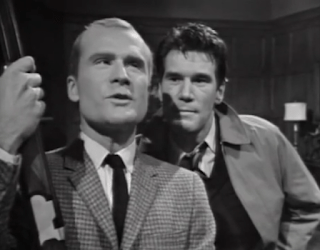
Episode 860: I just say things

Edward Collins isn’t what he seems. His stuffy manner is real enough, as are his kind impulses when he sees people in distress. But he allows those who meet him to believe that he is the heir to the vast Collins family fortune, which in fact belongs in its entirety to his sister Judith. Judith is currently an inmate in a mental hospital. During her absence, her husband, the odious Gregory Trask, exercises control of all the family’s assets. Edward hopes to get out from under Trask’s thumb by marrying the dowager countess of Hampshire, a young American woman named Kitty Soames. He befriended Kitty while a houseguest of the late Earl’s, and now that she is widowed and is his guest at the great house of Collinwood he sees an opportunity to take over the Hampshire interests.

Kitty isn’t what she seems. The Earl was bankrupt when he died. He had lost all his wealth and been driven to suicide by sorcerer Count Petofi. Kitty wrote a letter to her mother the other day saying that unless she marries Edward and becomes the mistress of Collinwood she didn’t think she could raise train fare from central Maine to her home in Pennsylvania. Nor is this all. If Kitty were simply without funds, she and Edward would be on an even footing. But she is not what she seems in a metaphysical sense as well as a financial one. She is intermittently possessed by the ghost of the late Josette Collins. Regular viewers have reason to believe that she is Josette’s reincarnation, and that the fits of possession are part of the process by which Josette is reuniting her spirit with her body. But the characters don’t know what we know. As far as they are concerned, Kitty seems to be a plain lunatic.

At rise, Edward catches Kitty in his brother Quentin’s room. She is rummaging through an armoire, apparently looking for something. He asks her what she is doing, and she feigns one of her fits. Kitty is not nearly as good an actress as Kathryn Leigh Scott; she doesn’t fool us for a minute. But Edward believes her. He gently escorts her out of the room. As they leave, we see a face peering at them from the shadows. It is Quentin’s face.

Downstairs, we hear Kitty’s thoughts as she takes satisfaction in having fooled Edward into thinking she was having a fit. Mental health professionals often talk about how people learn to use the resources they have, so that patients who carry diagnoses of major disturbances will sometimes find ways to exaggerate their symptoms for effect. It’s true that psychotic episodes are not usually an asset in the husband-hunting business, but everyone in the segment of Dark Shadows set in 1897 has some issue or other, and Edward really does have a soft spot for mentally ill women (unless they are married to Quentin, but that’s another thing altogether.) So Kitty may as well play up her particular case of dissociative identity disorder.

Kitty was in Quentin’s room trying to steal a portrait of him. She was doing this from her fear of Petofi, whom she believed to have ordered her to bring him the portrait before 9 PM lest he use his magical powers and make her vanish. It is almost that time now, and she has no idea how to find the portrait, let alone get it to him before the deadline. While she is worrying about this situation, a woman named Angelique enters.

Angelique isn’t what she seems. She is one of Quentin’s fiancées, and Edward takes her to be an innocent woman, about 30 years old, who has been hard done by in the course of the supernatural doings of the last several months. In fact, she is a wicked witch who wrought immense destruction the first time she was at Collinwood, in the 1790s, and again the second time, in 1968. She has traveled back in time to 1897, and has been one of the most powerful participants in all of the strange goings-on.

Kitty tells Angelique that she saw Petofi in the vacant rectory on Pine Road, and that he told her the woman who had been squatting there vanished into thin air before his eyes. At this, Angelique turns and rushes off to investigate. It dawns on Kitty that Angelique knows more than she is saying. We cut to the drawing room, where Edward is bracing for a conversation with Quentin.

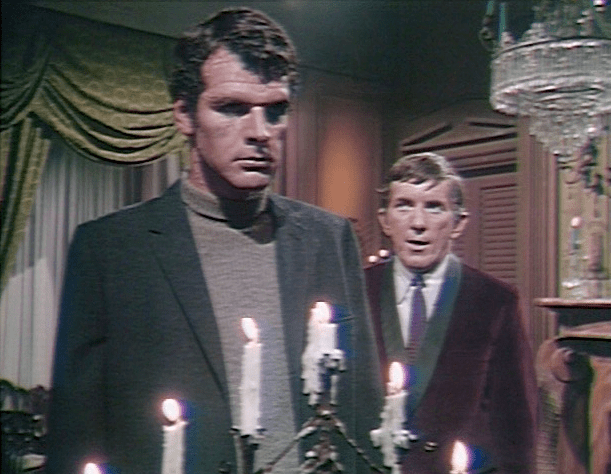
Quentin isn’t what he seems. In fact, he isn’t Quentin at all. Petofi forcibly swapped bodies with him a few days ago. It is Petofi, using Quentin’s body as a disguise, who confronts Edward and demands to know what he and Kitty were doing in the room. I refer to this form of Petofi as Q-Petofi, and the Quentin who looks like Petofi as P-Quentin.

Q-Petofi confronts Edward. Screenshot by Dark Shadows Before I Die.

Edward tells Q-Petofi that Kitty had had a “seizure.” Q-Petofi expresses skepticism about this claim. He proceeds to tell Edward that Kitty’s late husband died in poverty, shortly after being released from prison for a jewel theft. Edward is thunderstruck. He calls the story a lie, and forbids Q-Petofi from repeating it to anyone.

Kitty goes to the village of Collinsport, and pays a visit to The Blue Whale, the local tavern. She wants to see the entertainer, Miss Pansy Faye.

Pansy isn’t what she seems. She has met the Collinses twice. Miss Charity Trask, daughter of Gregory and enforcer in his operation, came to the great house in #727 and took up residence when her father married Judith. Pansy Faye, mentalist and Cockney showgirl, came to the estate in #771 as the coldly cynical fiancée of the childlike Carl Collins. Pansy was killed the night she arrived. A few weeks later, Pansy started to take possession of Charity, and in #819 Petofi erased Charity’s personality altogether and gave her body over to Pansy.

When Kitty enters, Pansy is alone in the bar. She is picking out her theme song on the piano. When Petofi was in the process of switching bodies with Quentin, Quentin was with Pansy in this room. Petofi took control of him briefly and played the same song on this piano. He played it very impressively.

Kitty is desperate to find out what is happening to her, and she knows that Pansy has powers. Once Pansy assures her that she doesn’t work for Count Petofi, Kitty offers her a diamond-encrusted brooch in return for information. Pansy is offended. She says that she will take a gift in return for her services after she has rendered them, but that she does not accept payment in advance. She tells Kitty that there is one way to find out what is happening to her, which is to have a séance. Kitty gets up to leave, and Pansy presses the brooch on her.

The diamond brooch is a puzzle. Perhaps Kitty was lying to her mother when she said that she couldn’t buy a train ticket to Pennsylvania? Or perhaps the brooch is part of the late Earl’s ill-gotten gains, and Kitty doesn’t want to show it to anyone more reputable than Pansy.

Nancy Barrett’s approach to all her roles on Dark Shadows was to throw herself completely into whatever the character was doing at any given moment. That isn’t to say that her performances lacked nuance or that she didn’t support her scene partners, but that her method was to take her part from the outside in, letting the action supply the motivation. As Kitty, Miss Scott has opportunities to take this same approach. But in Kitty and Pansy’s scene in the Blue Whale, she deliberately lets Miss Barrett drive the action. Since Pansy has already completed a process of possession and transformation like that into which Kitty is now entering, Miss Scott can convey a great deal of information about Kitty’s state of mind by giving rather subtle reactions to Pansy’s behavior.

Back at Collinwood, Edward and Q-Petofi are drinking. Edward shakes his head at his brother’s ability alternately to enrage him and charm him. Q-Petofi asks him to be the best man at his wedding to Angelique; Edward agrees at once. Angelique enters, and Edward exits.

Angelique says that she doesn’t want to get married after all. Q-Petofi insists they go ahead. She points out that it was her idea, and he was extremely reluctant to agree to it. This is true- the engagement was part of Angelique’s price for invoking the power of Satan to break spells Petofi had cast on Edward and his son Jamison. While Q-Petofi has managed to copy Quentin’s behavior towards Edward almost exactly, his behavior towards Angelique has been radically different than was Quentin’s. We don’t know what Angelique has made of this.

Edward finds Kitty and Pansy preparing the séance. After an initial protest, he declares he will join them. It ends with a visual quote from Dark Shadows‘ first séance, back in #170. As in that episode, a hooded figure appears in the doorway.
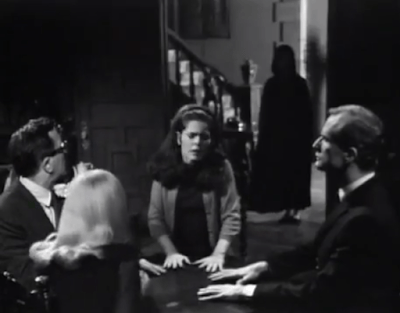
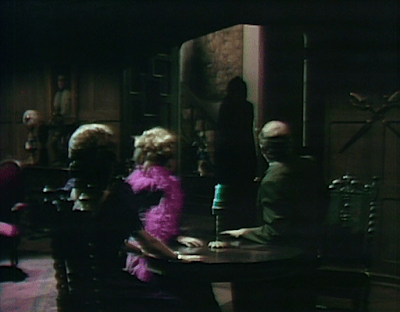
The hooded figure in #170 turned out to be undead blonde fire witch Laura Murdoch Collins. Another iteration of Laura was on the show as Edward’s estranged wife in April and May. It seems unlikely she is coming back, so longtime viewers are in suspense as to the significance of the allusion.

The hooded figure today is Natalie Norwick, making the last of her seven appearances as an uncredited stand-in on Dark Shadows. Norwick was in many plays on Broadway, as the lead in more than one, appeared in three feature films, and worked steadily in television from 1945 until the mid 1960s. She retired from acting in 1982, returning to the Broadway stage as understudy to her friend Julie Harris in 145 performances of The Gin Game from 1997 and 1998 when she was in her mid-70s. When Harris had a fall in 1999, Norwick took over the part, playing it in Florida and Washington, DC. She was chiefly based in Los Angeles in the late 1960s; perhaps she took the stand-in work to pay some bills during visits back east.

Norwick is best remembered for a single supporting performance on television in 1966. She appeared in “The Conscience of the King,” an episode of the original Star Trek, as Martha Leighton, the wife of Captain Kirk’s troubled friend Tom. She didn’t get much screen time, but she made the most of it. After Tom is murdered, she plays Martha’s understated reaction with a quietness that startles you no matter how many times you’ve seen it. Norwick is another of the significant talents one wishes Dark Shadows had found more to do with.
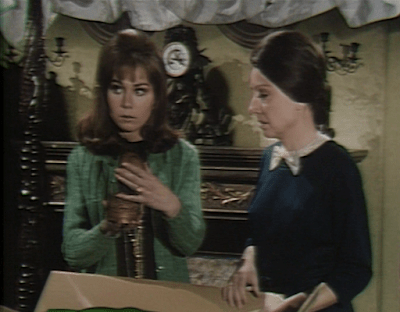
Episode 676: Scared of the funniest things

Chris Jennings turns into a werewolf when the moon is full, which it is about half the time in the universe of Dark Shadows. Old world gentleman Barnabas Collins has learned of Chris’ plight and decided to help him. As they make their way through an old cemetery to the hidden chamber where Barnabas will lock Chris up so that he doesn’t hurt anyone tonight, Barnabas asks Chris to confirm that he doesn’t remember anything he does in his lupine form. Chris does, saying that waking up and not knowing what he did the night before “is the most agonizing part of the whole thing.” You might think that he would find it even more agonizing to know that he has been killing one or two random human beings a month for the last seven years, but different things bother different people.

Chris asks how Barnabas knew that he didn’t remember what he did as the werewolf. Barnabas replies “Well, it’s obvious you’ve forgotten that you attacked me in this graveyard the night before last.” Chris says that “It’s a wonder you’re still alive.” To which Barnabas replies “No, it’s a wonder YOU’RE still alive!” For a moment we wonder how long this will go on, but Barnabas explains that werewolves can be killed by silver weapons. The head of the cane he carries is silver, and he struck him with it.

Barnabas shows Chris to the hidden room in the back of the old Collins family mausoleum. Barnabas himself was kept in a chained coffin in this room for over 170 years, when he was a vampire. He tells Chris that the room was originally constructed to hide ammunition from the British during the Revolution, which we have heard before. The coffin is still there; he tells him it is empty, and denies knowing anything about it. He says that the walls of the tomb are solid granite a foot thick; this is the first we’ve heard this detail. When Chris asks if anyone else knows about the room, Barnabas concedes that “A few” do. He assures him that none of them will be around tonight. Regular viewers will start making up a list of all the characters currently on the show who know about the room; Barnabas’s friend Julia Hoffman and his servant Willie Loomis know about it, as does strange and troubled boy David Collins. Barnabas can tell Julia and Willie to stay clear, and David has no reason to come to the cemetery tonight.

Barnabas explains that he will not show Chris the mechanism that unlocks the door from the inside, but promises to come back to release him after dawn. Chris urges Barnabas to leave at once; Barnabas insists on sticking around and asking more questions, saying that the moon isn’t up yet. Chris tells him that he first transformed shortly after he graduated from architecture school. “Oh, I was going to be an architect to be reckoned with, bold, imaginative, revolutionary. I thought nothing could stand in my way. Then something did.”

After Chris delivers a monologue about what a soulful and remorseful serial killer he is, Barnabas finally does close the secret panel. He sticks around until he hears the sounds of the werewolf snarling in the hidden room.

Chris’ nine year old sister Amy is staying at the great house of Collinwood. David finds her standing outside the front door, staring at the moon. She tells him that the moon scares her sometimes. His response is “Well, then don’t look at it,” which does seem logical. But she tells him that she can’t help it. David complains about how odd she is. We will hear more of this grumbling; it makes them seem like an old married couple, and is hilarious.

Amy and David are coming under the influence of the evil spirit of the late Quentin Collins. Quentin keeps trying to get them to set various members of the Collins family up for lethal traps; they haven’t succeeded yet in killing anyone, but housekeeper Mrs Johnson has caught on that there is something peculiar going on with the two of them, and she is frightened.

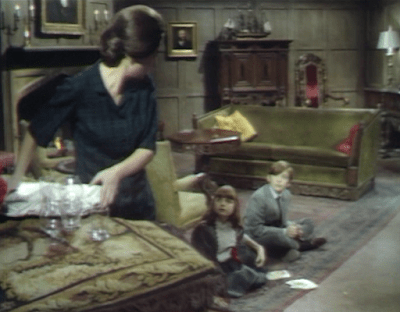
Mrs Johnson enters the drawing room to do some straightening up and finds the children playing a game with a deck of stage magician’s oversized cards. She and they stare silently at each other for a minute or two, and she protests. They say they were just watching her work, and she orders them to go to bed. They object that it isn’t bedtime yet. Of course it isn’t, Mrs Johnson doesn’t work around the clock. They get even more intensely on her nerves by bringing up a recent incident when she saw Quentin’s ghost, and in her exasperation she chases them out of the room.

Amy and David irritate Mrs Johnson. Screenshot by Dark Shadows Before I Die.

There isn’t anything about Quentin in the episode prior to that scene, so I cannot imagine what viewers would make of it. It’s late in the day, a domestic is tired, and a couple of kids are trying to annoy her. That is a relatable situation, but it doesn’t match with the heavy, melodramatic Dark Shadows music and the terrified affect with which Clarice Blackburn plays Mrs Johnson. I suppose that by January 1969, Dark Shadows was so widely known as a supernatural thriller that most people tuning in for the first time would assume that something paranormal was going on, but if they turned the television on after the opening titles and didn’t realize what show they were watching, they could only have concluded that they were witnessing an utterly ludicrous case of exaggerated seriousness. After David and Amy are out of Mrs Johnson’s sight, we see them go upstairs laughing, but that proves only that they are trying to upset her, not that they are connected to a malign power greater than themselves.

Barnabas enters and sees that Mrs Johnson is upset. She begins to tell him why, but interrupts herself to declare that he won’t believe her. He assures her that he will, and keeps asking her to go on. After she has told him everything she and the audience both know, he asks her to start over. The scene cuts out, suggesting that Barnabas is taking pains to get as much information from Mrs Johnson as he possibly can.

The children go to the little room in the long-deserted west wing of the house where they first met Quentin. Quentin is there when they arrive. This is the first time we have seen Quentin waiting for them; previously, they have had to summon him. Quentin does not speak; David can sense that he wants Amy to go back to the main part of the house so that they can talk privately.

Alone with Quentin, David asks where “the bottle” is. Quentin opens a rolltop desk, and David sees a bottle. He is shocked to find that the bottle is labeled “strychnine.” He declares that he won’t hurt Chris, and he runs out of the room.

Downstairs, Amy is in the drawing room, where she presses a few keys of the piano. We heard her play “London Bridge” in #656, but this doesn’t seem to be a part of any song. She is just idly pecking at the keyboard. When David comes, Amy complains about how long he was gone. He is distant, refusing to maintain eye contact or to answer any of her questions. He says they won’t be playing tonight.

We cut back upstairs, where Quentin is picking up the bottle of strychnine. Mrs Johnson saw Quentin in Chris’ cottage, so we know that he can go there. If David won’t poison Chris, perhaps Quentin will do it himself.

Episode 656: Mister Jonathan

The residents of the estate of Collinwood are under the impression that the mistress of the great house, Elizabeth Collins Stoddard, is dead. Her brother, Roger Collins, is on a business trip to London, and cannot be reached, even by the executives of the business he is there to represent. Liz’ daughter Carolyn is her heir, but she is apparently too doped up on sedatives prescribed by permanent houseguest Julia Hoffman, MD, to take any part in the action of today’s episode. So it falls to Barnabas Collins, Liz’ distant cousin and the master of the Old House on the estate, to move in and start making decisions.

Barnabas is the show’s chief protagonist and its main attraction, and he ran out of story three and a half weeks ago. The ongoing plot-lines both involve Amy Jennings, a nine year old girl who is staying at the great house as Liz’ guest. Amy’s brother Chris is a werewolf, and she and strange and troubled boy David Collins are under the power of the evil ghost of Quentin Collins. The urgent thing is to make Barnabas responsible for Amy so that he can take the lead in addressing both Chris’ lycanthropy and Quentin’s haunting. To that end, it is key that he should be in charge of the great house for a while.

A stranger comes to the door and asks housekeeper Mrs Johnson if he can speak to “Mister Jonathan.” Without batting an eye, she leads him to Barnabas. This proves that Barnabas has become such a breakout hit that even the other characters know that he is played by Jonathan Frid. Perhaps we are to imagine them reading about him in the fan magazines.

The stranger is a mortician who received a telephone call about Liz’ death. Barnabas informs him that they have made other arrangements, and his services will not be needed. Barnabas and Mrs Johnson are puzzled as to who made the call. It turns out that David did it at Quentin’s bidding; how this advances Quentin’s purposes is not clear.

Amy and David’s governess, the well-meaning Victoria Winters, vanished into a gap in the space-time continuum the other day and is not expected to return. Liz hired Maggie Evans, The Nicest Girl in Town, to replace her. Barnabas sticks up for Maggie when Mrs Johnson makes an unflattering comparison of her with Vicki, but he has evidently decided to eliminate her position almost immediately. He wants her to accompany him and the children on a trip to Boston where he will choose boarding schools for them to attend.

Barnabas has not spoken with Roger, who is David’s father. It is not clear who Amy’s legal guardian is. Her parents are dead, and her brother Tom was taking care of her before he died (the first time- he became a vampire and kept coming back.) Chris was away spending the nights of the full moon in the woods at that time, so Amy was sent to Windcliff, a sanitarium a hundred miles north of town. Julia is the nominal head of Windcliff and is Amy’s doctor, so it is possible she is Amy’s legal guardian. Julia is also Barnabas’ closest friend and most frequent accomplice, so it is possible she has agreed to his plan.

Even though Maggie’s job may not last for more than another week, she still needs a place to stay. So she, Mrs Johnson, and Barnabas clear Vicki’s stuff out of her room. Barnabas was hung up on the idea that he and Vicki might someday fall in love, an idea he did remarkably little to put into practice, and so he finds it distressing to be around her clothes. He demands that Mrs Johnson destroy them all. This shocks her. She finds an antique music box, and asks what to do with that. Barnabas orders her to destroy that too. Maggie takes the music box, listens to it for a second, grows wide-eyed, then hurriedly hands it to Mrs Johnson.

I can name that tune in three tinkles. Screenshot by Dark Shadows Before I Die.

This moment amounts to a programmatic statement. In May and June of 1967, Barnabas was a vampire and Maggie was his victim. He forced her to listen to the music box for hours on end, believing that it had a hypnotic power that would erase her personality and replace it with that of his lost love Josette. Several times it has seemed that her memory of what Barnabas was and what he did to her would come back, only for her to be subjected to one magical mind-wipe after another. That she is so quick to give Mrs Johnson the box when Barnabas has ordered her to destroy it, and that her relaxed and friendly attitude towards Barnabas does not change for one second, is a sign that the question “Will Maggie’s memory come back?” will not be coming up in Dark Shadows version 5.0.

Maggie looks for David and Amy and finds them in the drawing room. Amy is playing “London Bridge” on the piano. We have seen David interact with only one other child, the ghost of Barnabas’ nine year old sister Sarah. Sarah sang and played the recorder, and the only song she seemed to know was “London Bridge.” Evidently, David has a type.

Mrs Johnson can’t bring herself to destroy Vicki’s clothes. She tells Maggie she has closed them up in a storeroom in the basement. The only room we have heard referred to this way is the one that was kept locked for the first 54 weeks of the show because Liz was under the mistaken impression that the corpse of her husband Paul was buried there, so that must be the room she means. Longtime viewers will appreciate the reference; Vicki herself was intrigued by the room in the early days of the show, and now her things have found a home there.

They don’t stay there for long. Maggie goes to hang up her own clothes, only to find that Vicki’s are back in the closet. She asks Mrs Johnson what could have happened. In #69, her second appearance, Mrs Johnson declared that “I believe in signs and omens!” Ever since, she has shown an attitude that might be called superstitious in our world, but that in the universe of Dark Shadows is just plain common sense. She ends the episode with a monologue about how “no human hand” had moved the clothes, that it must have been some supernatural force announcing that Vicki will be coming back.

This is disappointing for a couple of reasons. First, the character of Vicki was played out at the end of #192, and the show refused to find anything interesting for her to do for the 90 weeks that followed. Alexandra Moltke Isles finally gave up and used her pregnancy as grounds to get out of her contract early, but they recast the part to continue wasting screen time on this exhausted figure. The second Vicki, Betsy Durkin, was condemned to be a fake Shemp, moping her way through utterly pointless activities unconnected with anything the audience could care about. It was a great relief when she finally vanished.

Second, the show has a poor record of using objects to evoke its themes. The music box was an exception, but most have been pretty bad. The most famous example is Burke Devlin’s filigreed fountain pen, which was the main focus of 21 episodes spread from August through November of 1966. It was supposed to be evidence in a homicide investigation and to suggest a number of things about Roger’s feelings towards his friend-turned-nemesis Burke, but at the end it was just a bunch of people looking for a pen. The most recent at this point was a wristwatch that fake Vicki gave to her husband shortly before his disappearance. It turned up after he was gone and would occasionally start ticking when his spirit was near. Miss Durkin had to play scene after scene with that watch as her main partner, and it is no reflection on her acting ability that the results were so uniformly dismal. There’s a definite sinking feeling when we see Vicki’s wardrobe presented as another symbolic object.

Episode 551: Different like me

Craig Slocum tops many fans’ lists of Dark Shadows‘ worst actors, so I would be remiss in my duty as a commentator if I did not mention that he does a genuinely good job today as unlovely ex-convict Harry Johnson. Harry brings a tray of food to the very tall, very strong Adam, who is in a dusty room in the long deserted west wing of the great house of Collinwood, hiding from the police as the guest of heiress Carolyn Collins Stoddard. Harry finds that Adam is trying to stab himself to death, and calmly talks him into giving up the effort and handing over his knife.

Harry goes to the drawing room in search of Carolyn, and finds the suave and mysterious Nicholas Blair. Nicholas tells him that Carolyn is out. He shocks Harry by asking if Adam is in trouble. Harry had no idea anyone but he and Carolyn knew Adam was in the house, and Carolyn has scared him out of his few wits with her orders to keep the secret.

Nicholas takes command of the situation. He insists Harry tell him what happened, and posts him in the foyer to wait for Carolyn to return while he goes up to talk to Adam. When Carolyn comes back, Harry tells her about Adam’s suicide attempt and about his encounter with Nicholas. She angrily reminds Harry that Collinwood is her house, not Nicholas’, and Harry had damn well better remember to take his orders from her and no one else. Harry is left with nothing to say but a meek “Yes, ma’am.”

Slocum is convincing as someone who is not intimidated by a physically imposing man with a knife, but who is entirely out of his league when confronted with people who outrank him in social class. So far as I can tell, none of the other fansites mentions his good work today. Dark Shadows fans are accustomed to ghosts and witches and vampires and Frankensteins and time travel, but a good performance by Craig Slocum is such an unexpected sight that they cannot bring themselves to admit that they have seen it.

Nicholas is a middle manager in Satan’s terrestrial operations, a member of Hell’s bourgeoisie.* He knows that Adam is a Frankenstein’s monster. The other day, he persuaded Adam to try to rape Carolyn. Adam’s attempt doesn’t seem to have got very far, but it has convinced Carolyn that she can no longer harbor Adam in her house. The audience knows that Nicholas has plans for Adam; presumably he knew that if Adam attacked Carolyn, she would want him to leave Collinwood, paving the way for him to take the big guy into his own house where he would have unlimited access to him. While Carolyn is downstairs chewing Harry out, Nicholas is up in Adam’s hiding place adding to the evil ideas he has planted in his impressionable mind.

Carolyn goes up to Adam’s room and finds Nicholas still there. Nicholas tells her that the crisis is past, then leaves the room. Carolyn finds that Adam is perfectly composed and looking forward to some improvement in his circumstances, but is unwilling to talk to her about anything substantial.

Carolyn goes down to the drawing room, where Nicholas is playing the piano. This is the first time we have seen anyone play the piano since #330, when sarcastic dandy Roger Collins banged out a few notes. Carolyn has been suspicious of Nicholas since she met him and was angry with him when she first learned he had gone into the west wing and found Adam, but can only thank him when she sees that he has talked the big guy out of suicidal despair.

Later, we see that Adam has left the great house of Collinwood and gone to the Old House on the same estate. The Old House is home to old world gentleman Barnabas Collins. Adam knows that Barnabas was present when he first awoke, in a laboratory, ten weeks ago, and that he spent the first weeks of his life as a prisoner in Barnabas’ dungeon. When he learned yesterday that he was an artificially constructed man, he jumped to the conclusion that it was Barnabas who created him.

Adam knocks on Barnabas’ door. Barnabas is astonished to see that Adam has returned. Adam announces that they will talk and walks in.

Barnabas marvels at Adam’s fluent speech. When last they saw each other, he could speak only a few words, such as “music!,” “food!,” “friend,” and, most importantly, “kill Barnabas!” Now, he tells Barnabas that he no longer plans to kill him, but says that he is right to be afraid of him. He has come for what he is entitled to. He wants Barnabas to make another creature like himself so that he will no longer be alone.

Barnabas asks questions Adam will not answer. Screenshot by Dark Shadows Before I Die.

Barnabas tries to explain that he did not create Adam, that Dr Eric Lang did. Adam has never heard of Lang, and dismisses Barnabas’ statement as a lie. Barnabas goes on saying that he isn’t even a doctor, but Adam won’t listen. He will be provided with a mate, or he will take his revenge.

My wife, Mrs Acilius, pointed out that Adam’s demand for a woman who shares his nature should sound familiar to Barnabas. When Barnabas first came on the show in the spring and summer of 1967, he was a vampire, and was obsessed with turning a living woman into a vampiric replica of his lost love Josette. Adam, who came to life by an infusion of Barnabas’ “life force,” shares his longing for a female counterpart.

In 1973, Dark Shadows creator Dan Curtis produced an adaptation of Mary Wollstonecraft Shelley’s Frankenstein for ABC-TV. The second half of that long movie was devoted to the creature’s demand that Frankenstein build him a mate, and the terrible vengeance he exacted when the scientist refused to comply. The original audience of this episode can’t have known that that production was in the future, but they would have been aware of the 1935 Universal film Bride of Frankenstein and Hammer’s 1967 Frankenstein Created Woman. It seems likely they had assumed that Adam would sooner or later set aside his bachelor ways, and were waiting for a development such as this.

*Mrs Acilius has an advanced degree in sociology, and she coined the phrase “Hell’s bourgeoisie.”

Episode 330: bat by Bil Baird

Dangerously unstable ruffian Willie Loomis spent a week staring at the eighteenth century portrait of Barnabas Collins in the foyer of the great house of Collinwood back in April, then tried to rob Barnabas’ grave. That turned out to be an awkward situation when Willie found that Barnabas wasn’t entirely dead. Barnabas was a vampire who bit Willie, turned him into his sorely bedraggled blood thrall, and had lots of conversations with him. Yesterday, Willie was written out of the show.

Today we open with strange and troubled boy David Collins staring at the same portrait. As Willie was obsessed with the idea that there were jewels hidden in the Collins mausoleum in the old cemetery north of town, where in fact Barnabas’ coffin was hidden, so David is preoccupied with the idea that Barnabas has something terrible stashed in the basement of the Old House on the estate, where in fact his new coffin is hidden. As Willie sneaked off to the cemetery on his ill-starred expedition, David will sneak off to the Old House today and try to search Barnabas’ basement.

Unlike Willie, David is not driven by greed. He is afraid of Barnabas, and his friend, the ten year old ghost of Barnabas’ sister Sarah, has told him that he must not go to the Old House. But his aunt Liz and his father Roger dismiss his attempts to warn them about Barnabas, and he thinks it is his duty to provide them with evidence. So he screws up his courage and makes his way across the property.

David lets himself into the Old House by opening the parlor window. Not only have we seen David do this before, but Willie’s sometime friend, seagoing con man Jason McGuire, got into the house the same way in #274. Barnabas would kill Jason when he reached the basement in #275, so you might think he’d have put a lock on that window by now.

Jason’s fate is certainly on the minds of returning viewers when David tries to open the basement door. It comes as a relief when he finds the door locked. Barnabas’ co-conspirator, mad scientist Julia Hoffman, catches him there.

Julia demands to know what David is doing in the house, and he tries to brazen it out. He claims that he has a right to be there, since it belongs to his Aunt Liz. This is a bit of a murky point- we never see Liz transfer title to Barnabas, but she and others act as if he owns the place and its contents. Julia doesn’t clarify it when she responds that Liz gave the house to Barnabas- she doesn’t deny that it still belongs to Liz, only says that it also belongs to Barnabas.

Back in the great house, Roger is banging away at the piano. We saw Liz play the piano in #47 and #91, a reference to the conception of her character writer Art Wallace developed in his original story bible, titled Shadows on the Wall, in which she, like similar characters in a couple of TV plays he wrote in the 1950s under the title “The House,” gave piano lessons. Since then, Liz’ daughter Carolyn tried her hand at “Chopsticks” in #119 and used the piano as a prop in a teen rebel scene in #258, and Jason poked at a few keys in #198. Roger isn’t exactly Vladimir Horowitz, but he’s the first one we’ve seen who actually achieves a melody.

Liz comes in and tells Roger that David isn’t in his room. They fret over David’s attitude towards Barnabas. Julia brings David home and tells Liz and Roger where she found him. After an angry scene between father and son, David goes upstairs, and Liz scolds Roger for his inept parenting. In these as in all of Liz and Roger’s scenes together, we see a bossy big sister who tries to govern her bratty little brother, but who ultimately abets all of his worst behavior.

In the Old House, Barnabas notices that Julia is troubled. He keeps asking what’s on her mind, and she has difficulty deflecting his questions. This is odd- Julia has been established as a master of deception, and Barnabas is the most selfish creature in the universe. All she has to do is start talking about something that does not affect him directly, and he will lose interest at once. Rather than talk about her personal finances, or the job from which she is apparently on an indefinite leave of absence, or some ache or pain she might have, or how sad she is to miss her Aunt Zelda’s birthday, she brings up Willie. That does get Barnabas’ mind off her tension, but it also reminds him of David. He thinks David knows too much about him, and is thinking of murdering him. Julia assures him that the boy doesn’t know so very much, that whatever he does know he hasn’t told anyone, and that if he does say something his reputation as an overly imaginative child will lead the adults to ignore him.

From the beginning of the series, we’ve heard people say that David is “imaginative.” The audience finds an irony in this, since we have never seen David show any imagination whatsoever. All his stories of ghosts are strictly literal accounts of apparitions he has seen. We’ve seen some drawings he has done and heard quotes from some essays he has written. Some of these are technically accomplished for a person his age, but they are just as literal as his ghost stories. And when he tells lies to cover his various misdeeds, he tells simple little tales that fall apart at once.

In #327, well-meaning governess Vicki became the first character to dissent from the “David is a highly imaginative child” orthodoxy. Liz and local man Burke Devlin were dismissing David’s laboriously accurate account of his latest encounter with Sarah as a sign of his “imagination,” and Vicki interrupted with “I don’t think it has anything to do with his imagination.” Now, Barnabas goes a step further. After pronouncing the word “imaginative” in a truly marvelous way that makes it sound like something I’ve never heard before, he tells Julia that she has given him an idea. Frightened, she asks what he means. All he will say is “You’ll see.”

Roger goes to David’s room and has a friendly talk with his son. Throughout the conversation and afterward, David is thinking intensely, trying hard to figure out what his next step should be.

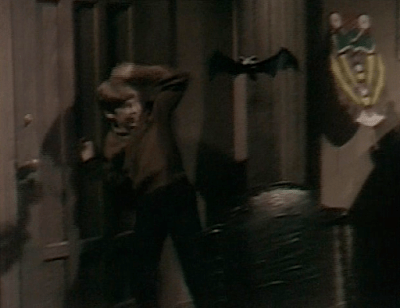
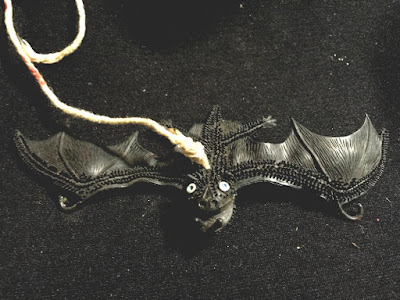
Once he is alone in the room, the window blows open and a bat enters. More precisely, a bat-shaped marionette is brought in on clearly visible strings by a pole that casts a shadow we can see the entire time, but no one who has been watching the show up to this point will doubt for a second that David’s fear, as depicted by David Henesy, is fully justified. David tries to flee from the bat, but he cannot open the door to escape from his room. His back against the door, David slides onto the floor and screams as the bat comes near him.

David finds that he cannot escape. Screenshot by Dark Shadows Before I Die.
David helpless before the bat. Screenshot by Dark Shadows Before I Die.

When Barnabas is about to attack someone, dogs start howling. Sometimes this works to his advantage, but it so often puts his intended victims on their guard that it doesn’t really seem to be something he is doing on purpose. So this bat represents something new. Perhaps Barnabas is using magic to control a bat- if so, it marks the first time we have seen Barnabas use magic to project influence over something other than a human mind. Or perhaps he himself has assumed the form of a bat. If so, that is the first indication we’ve had that he has shape shifting powers. In either case, Barnabas’ powers have just gone up a level.

Closing Miscellany

The bat was created by famed puppeteer Bil Baird. Most famous today for the puppets he created for “The Lonely Goatherd” sequence in The Sound of Music, Baird was a frequent guest on television programs like The Ed Sullivan Show, and Jim Henson cited Baird’s own TV series, the short lived Life with Snarky Parker, as a major influence on the Muppets. In December 1966, Baird opened a marionette theater in New York City, at 59 Barrow Street in Greenwich Village; it operated until 1978, and many leading puppeteers, including dozens who would go on to work with Henson, were members of its company in those years.

Bil Baird’s bat-credit. Screenshot by Dark Shadows Before I Die.
The original string wasn’t quite so conspicuous. Screenshot by Dark Shadows Before I Die.

This is the last episode to end with ABC staff announcer Bob Lloyd saying “Dark Shadows is a Dan Curtis production.” We do hear the announcement again in February of 1969, but that won’t be because Lloyd has returned- they used an old recording for the music under the closing credits that day, and they picked one with him on it.

Fans of Dark Shadows will often talk about “the early episodes” which ended with Lloyd making that announcement. So I suppose #330 is the last of “the early episodes.”

Danny Horn’s post about this one on Dark Shadows Every Day includes a morphology of episode endings. He divides them into five categories, Haiku,* Restatement of Threat, ** New Information,*** Crisis Point,**** and Spectacle.***** It’s an intriguing scheme, and he makes a good case for it.

*Danny explains that “Haiku” “aren’t necessarily recognizable as endings in the traditional sense, because nothing is resolved and no progress is made. It’s just a little moment when a character pauses, and possibly has a feeling about something… In some extreme cases, the audience may not realize that the episode is over until halfway through The Dating Game.”

**Restatement of Threat, at this period of Dark Shadows, usually means Barnabas looking at us through his window and saying that someone or other “must die!” Which of course means that you can safely sell a million dollar life insurance policy to that character.

***”A New Information ending provides an actual plot point, which either advances the story another step, or tells us something that we didn’t know.”

****”The Crisis Point cliffhanger is the big game-changer, and for best effect, it should come at the end of a sequence that’s been building up for a while. This is a big turn in the story, and it should feel satisfying and thrilling… The defining feature of a Crisis Point ending is that the resolution marks a change in the status quo, ending one chapter and setting up the next.”

***** “Obviously, plot advancement is always welcome, but every once in a while the show needs to set its sights a little higher. These are the moments when the show goes above and beyond, in order to surprise and dazzle you… The point of a Spectacle is: You can’t take your eyes off the screen. Housewives in the audience have put down the iron, and switched off the vacuum. Teenagers have stopped swatting at their siblings… A Crisis Point cliffhanger will bring you back for the next episode, because you want to see what happens next. But a Spectacle cliffhanger is bigger than that — you’ll be coming back for the next episode, but it’s because you can’t believe what you’re seeing, and maybe tomorrow they’ll do it again.”

Episode 257: If you feel it, sit it

For almost 13 weeks, seagoing con man Jason McGuire (Dennis Patrick) has been blackmailing reclusive matriarch Liz (Joan Bennett.) Time and again, Liz has capitulated to Jason’s demands lest he reveal that she murdered her husband Paul Stoddard 18 years ago and he buried Stoddard in the basement. When Liz gave in to Jason’s demand that she marry him, her daughter Carolyn (Nancy Barrett) vowed to prevent the marriage.

Today, it looks like Carolyn may have found a way to fulfill that vow. She has announced her engagement to motorcycle enthusiast Buzz (Michael Hadge,) whom Liz cannot stand. Liz considers going to the police to keep from gaining Buzz as a son-in-law.

We spend the first half of the episode in the great house of Collinwood. Buzz has come to see Carolyn. The opening sets up a charge of comic energy that raises our hopes for another installment as funny as Buzz’ first star turn in #254. Buzz knocks on the front door, Liz opens it, and greets him with a disgusted “Oh.” She closes the door in his face, then goes inside to tell Carolyn that he is there. Carolyn goes out to meet Buzz, who is smoking a large cigar.* They kiss, and Carolyn lets Buzz in. He takes a seat on the staircase.

Buzz on the stairs

Instead of building on the comic potential Buzz brings with him, we then grind to a halt with a Buzzless scene in the drawing room. Carolyn recites teen-rebel cliches at Liz, punctuating her dreary lines with a few random pokes at the piano. Nancy Barrett’s all-in style of acting often exposes values that another performer might have left buried in the script, but when the writing is as tired as this not even she can dig up anything interesting.

Carolyn chose Buzz to mock her mother’s relationship with Jason. She defies Liz to find a reason for regarding Buzz as an unsuitable partner for her that would not cut at least as strongly against Jason. Buzz mirrors Jason in another way so far as the audience is concerned. Dennis Patrick was a gifted comic actor, and Jason is appealing when he gets to be a comedy villain. But most of the time he is stuck repeating the same deadly dull threat to Liz time and again.

Buzz is a villain only in Liz’ imagination, but he is funny all the time. His incongruity with everything else on Dark Shadows automatically produces a laugh whenever he is on screen. Michael Hadge’s near-total incompetence as an actor limits Buzz’ future on the show sharply, but within those limits he’s irresistible.

Jason comes down the stairs and finds Buzz blocking his way. They have a little confrontation which Jason wins by threatening to break Buzz’ shin. Not even Dennis Patrick can make that funny.

We are subjected to a second Buzzless scene in the drawing room. Liz tells Jason that she has yielded to his demands because she was afraid the truth would ruin Carolyn’s life. If Carolyn’s life is going to be ruined anyway, there is no point- she will just go to the sheriff and have done with it. Joan Bennett does have a couple of moments in this scene when she seems like she is about to get some comedy going, but the somber Dark Shadows musical cues ring out and darken the mood before Patrick has a chance to respond.

Jason goes to Carolyn’s room to try to talk her out of marrying Buzz. Since Carolyn’s whole motivation is her hatred for Jason, we may wonder what influence he has that will enable him to do this. It quickly becomes clear that he has none. This is followed by another scene between Liz and Jason in the drawing room. Liz tells Jason that it was obvious to her all along that his talk with Carolyn would produce no results. That is to say, we have a scene the point of which is to explicitly acknowledge that the preceding scene was a waste of time.

The second half is set in the Blue Whale tavern. Buzz and Carolyn are there on a date, and Jason comes to try to bribe Buzz into leaving her. The musical score behind this part comes from the jukebox. That music is much more suitable for comedy than is the heavily melodramatic stuff we hear when the action is taking place at Collinwood.

When we get to the tavern, Carolyn and Buzz are dancing. As a true Collinsporter, Carolyn’s style of dance consists of thrashing about as if she’d had a brain injury. Buzz, by contrast, moves quite gracefully. He must be from out of town.

Carolyn does the Collinsport Convulsion, while Buzz executes a fine Beer Stein Shuffle

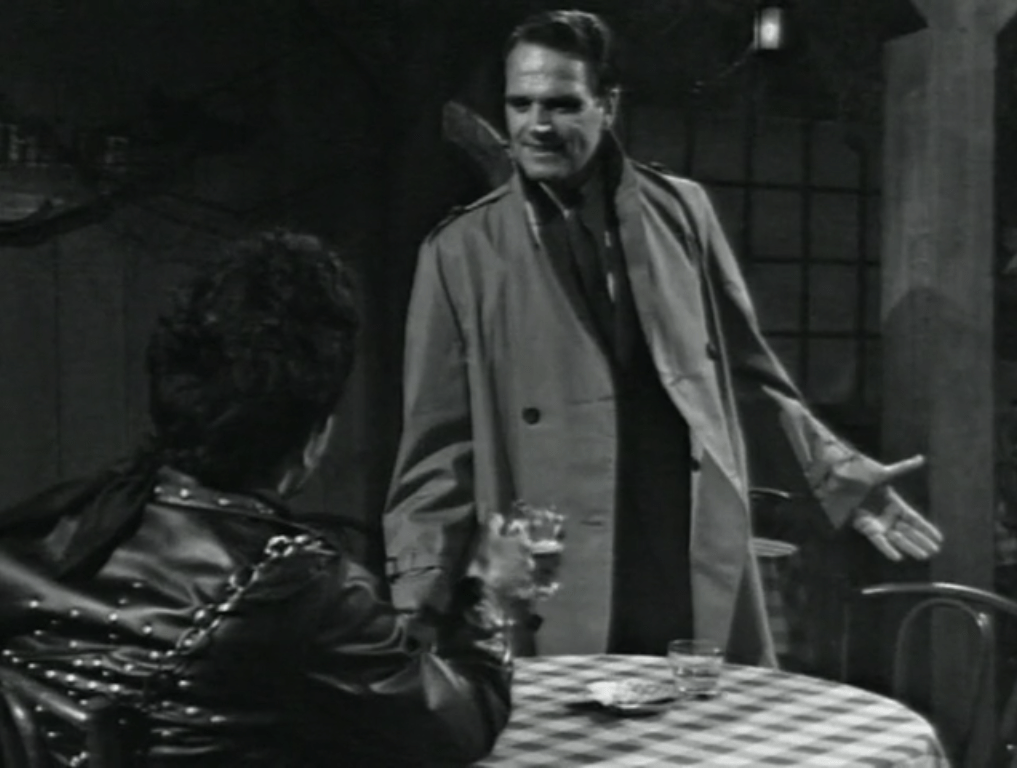
Carolyn is in the ladies’ room when Jason shows up. He asks to join Buzz at their table. Buzz replies with that rallying cry of the 60s counterculture, “If you feel it… sit it!” I can only wish that had been the title of a spinoff of Dark Shadows featuring Buzz, it would have been great.

Buzz’ back is to the camera while he delivers his immortal line

Buzz tells Jason that Carolyn is from a family that “makes a lot of noise,” while he is from a family that “makes a lot of money.” Then he laughs. Buzz was credited as “Buzz Hackett” in his first appearance in #252, and is credited that way again today; in #254, he was credited simply as “Buzz.” We never hear him called “Hackett.” In #223, we’d heard about an unscrupulous local businessman called Hackett, but Buzz made a laughing reference to his lifelong poverty in #252, so I don’t think we can suppose he really is from a family that makes a lot of money. In view of Buzz’ laugh, the likeliest explanation is that this is a joke of some kind. A confusing joke, poorly told, but considering that it is a line written by Malcolm Marmorstein and delivered by Michael Hadge, that is to be expected.

Jason tells Buzz that Carolyn is using him to get back at her mother. Buzz blandly replies that Carolyn has told him all about that, and he’s having a great time with her whatever her intentions. This is reminiscent of the relationship between Carolyn and dashing action hero Burke Devlin in the early months of the show. Carolyn continued seeing Burke even after he tacitly admitted that he was using her to pursue revenge on her family. After Burke renounced his revenge, they met at this same table and had a soulful conversation about what they had been to each other (#213.)

Jason offers to buy Buzz a new motorcycle if he will stop seeing Carolyn. Buzz flatly refuses the offer, declaring “I like the bike I got, and the chick I got!” Carolyn returns to the table, and Buzz tells her about Jason’s attempt to bribe him. They laugh at Jason and leave the tavern. He staggers into a corner, looking bitter.

Laughing at Jason

This also harks back to an incident involving Burke in the early days of the show. In #3, Burke met hardworking young fisherman Joe in the tavern. Joe was at that point dating Carolyn. Burke offered to buy a fishing boat for Joe if he would spy on her family. Joe refused, and reported the contact to Liz. While Buzz is Joe’s opposite in many ways, regular viewers will see that the two men are equally honest.

*It appears to be a robusto, though it could be a corona gorda.

Buzz and his stogie

Episode 198: Only up to a point

In the drawing room of the great house of Collinwood, seagoing con man Jason McGuire has his third conversation with reclusive matriarch Liz. It is identical in form and content to their first two conversations. He makes a demand, she resists, he threatens to expose her one and only secret, and she gives in.

Liz’ brother, high-born ne’er-do-well Roger, is also being blackmailed. His blackmailer is drunken artist Sam Evans. Unlike Jason, Sam is someone we know and have reason to like. And unlike Jason and Liz, Sam and Roger do not repeat the same conversation every time we see them.

Moreover, Jason is acting against the interests of the audience, while Sam is trying to achieve something we might like. Jason is working to isolate Liz and to drain her funds. Those goals reduce the range of stories the show can tell, limiting a major character’s interactions with the rest of the cast and cutting back on the power of the family at the center of the series from making things happen in town. Sam wants to get hold of some old paintings of his, which will give him a chance at making a big splash in New York. If Sam succeeds, future episodes will be set at least partly in the midtown Manhattan art world. That would be a radical departure from the show we’ve been watching, but a radical departure of some kind is inevitable if Dark Shadows is to keep going at all. Dark Shadows 1.0 finished its liveliest stories when blonde fire witch Laura Murdoch Collins vanished two weeks ago, and if Dark Shadows 2.0 is going to hold our attention it is going to have to come up with something very fresh.

Ten years ago, Roger paid Sam $15,000 and received from him ten paintings. These paintings have suddenly become fashionable, and a prominent art dealer has come to Sam asking about them. The real reason Roger gave Sam the money was nothing to do with the paintings, but to bribe him. The paintings changed hands only to cover the bribe.

Sam had seen a fatal hit and run accident, and knew that Roger, not dashing action hero Burke Devlin, was the driver. Burke went to prison for the crime, and has been trying ever since to prove that Roger was responsible. Now Sam threatens to go to Burke unless Roger produces the paintings. Roger has been searching Collinwood for the paintings, but he cannot find them.

The highlights of the episode are two scenes between Sam and his daughter Maggie. In the first, we see Sam drinking and talking to himself while Maggie is in the room getting ready to go to work. Maggie knows that her father has a great opportunity and that the man who has the paintings is keeping him from realizing it. She doesn’t know who that man is. She keeps asking questions, and he keeps getting upset. He shouts “Are you going to work or aren’t you!?” Then he apologizes and tells her he didn’t mean to raise his voice. She says bitterly that she should be used to it by now. He tells her that what he’s doing, he’s doing for her, that if he succeeds she will get everything she has coming to her. She isn’t impressed, and doesn’t have much to say.

As Maggie, Kathryn Leigh Scott does a fine job of showing an Adult Child of an Alcoholic trying to distinguish between the challenges the outside world is presenting to her father and those he has brought on himself. She’s looking for a way to simultaneously be Sam’s ally against the man who is keeping the paintings from him and to stand firm as an opponent of his drinking. Above all, she is trying not to let her pity for him harden into contempt. As Sam, David Ford is alternately so self-absorbed he apparently forgets Maggie is in the room, so angry he doesn’t care what he says to her, and so hopelessly dependent on her that he all but transforms into a baby. When he is looking up at Maggie and telling her all he hopes to do for her, Sam looks for all the world like a toddler trying to keep his mommy from being angry with him. It’s a heartbreaking finish.

Sam telling Maggie his hopes. Screenshot by Dark Shadows Before I Die

Their second scene is even more powerful. Maggie comes home from work to find a groggy Sam slumped in a low chair. Once he has come back to life, Sam tells her that the man was in the house while she was at work, and that he can’t find the paintings. He lets slip that the man lives in Collinwood. Maggie realizes that it must be Roger. Sam tries to deny it, but since Roger is the only man who lives there he is stuck. He can hardly claim that well-meaning governess Vicki, a 20 year old woman, was a man ten years ago, or that she paid $15,000 for ten paintings to put on display in her cubicle at the Hammond Foundling Home. He briefly claims that “Collinwood” was a slip of the tongue, but can’t keep that lie up.

Sam finally admits that Roger is the man. Maggie asks why Roger bought the paintings. Sam asks if she really wants to hear him say it. When she says she does, he starts to speak, but falls abruptly silent in the middle of a sentence. While he looks down in shame, she blurts out that he took the money as a bribe to keep silent about Roger’s crime and to consign Burke to prison. She has suspected this for some time, but is devastated to say the words and see her father’s face.

Of all the questions the two blackmail plots might prompt the show to answer, how Maggie and Sam’s relationship will change as the result of the disclosure of his secrets is the most interesting. So it should be no surprise these two scenes are among the strongest we’ve seen in months.

Closing miscellany:

At one point in the episode, we see Jason talking on the telephone to someone named “Willie.” This marks the first time we hear this name on Dark Shadows.

During a conversation with Roger, Jason sits at the piano and pokes at a few keys. This is the first time since flighty heiress Carolyn tried her hand at “Chopsticks” in #119 that a member of the cast makes use of the instrument.

Roger and Liz have a scene in the basement of Collinwood. Roger’s fear of blackmail leads him to hope that he might find Sam’s paintings in a locked room there, while Liz’ fear of blackmail leads her to forbid that anyone ever go into that room. When Roger asks Liz what is in there, she refers to her long-absent husband, Paul Stoddard: “They are… ah… old things of Paul’s. Yes, that’s it! I put his things in there.” This is so obviously a lie she is making up on the spot that we laughed out loud. Joan Bennett must have meant to elicit this reaction.

Episode 119: We criss-crossed paths a dozen times

Nothing today but recapping.

The actors do what they can to hold it together, and there are a couple of memorable lines. Reclusive matriarch Liz calls her daughter, flighty heiress Carolyn, a “young girl” during yet another conversation pleading with her to stop dating the family’s arch-nemesis, dashing action hero Burke Devlin. Carolyn asks when her mother will admit that she is a woman. “When it is a fact,” Liz replies. Carolyn declares that “It won’t be a woman who bestows that title on me, but a man- Burke Devlin!” Everyone in Collinsport seems to be living according to a rule of chastity, so Carolyn’s open declaration that she plans to have sex with Burke is rather startling.

Liz’ brother, high-born ne’er-do-well Roger, comes home. Liz tells Roger that well-meaning governess Vicki is missing and may be in danger. Roger refuses to take an interest in the matter. When Liz is shocked by his indifference, he says that she sometimes expects too much of him. Considering that Burke and hardworking young fisherman Joe are searching the grounds of the estate for Vicki, and that the sheriff’s department has been involved in the search as well, Roger’s disregard for Vicki is not merely cavalier, but childish in the extreme.

When Roger finds out that Carolyn had been on a date with Burke, he tries to take the authoritative tone that her mother had taken with her earlier. Neither Carolyn nor Liz is impressed with the attempt this boy-man is making to impersonate a paterfamilias. Liz and Roger are the prototype for Dark Shadows‘ most characteristic relationship, that between a bossy big sister and her bratty little brother. She tries to correct his behavior, and when he disappoints her she shields him from accountability. In this scene, she sees yet again how useless he really is.

Burke and Joe come to the house to report that their search for well-meaning governess Vicki has been fruitless. Roger makes one sarcastic remark after another to Burke. Louis Edmonds is so skilled at delivering acerbic dialogue that these lines are fun to listen to, even though they don’t advance the plot or add to our understanding of the characters in any way.

Burke and Roger having words. Screenshot by Dark Shadows Before I Die

It’s a shame the scene isn’t better written. During the nineteen weeks when Art Wallace and Francis Swann were in charge of writing the show, they hinted that there may have been some kind of sexual relationship between Burke and Roger. This time, Burke has borrowed Roger’s shotgun, and Roger very conspicuously handles the gun after Burke returns it to him. He unloads it, and for no reason that we can see reloads it. As directed by Lela Swift, the actors are uncomfortably close to each other, and can’t keep themselves from getting closer as they exchange their wildly bitter remarks. In the hands of Wallace or Swann, or for that matter of almost any moderately competent writer, that scene would have made sense as a Freudian interlude. But today belongs to Malcolm Marmorstein, and the evidence of repressed sexuality doesn’t add up to much.

Carolyn tries to break the tension in the drawing room by playing “Chopsticks” on the piano. All she gets for her trouble is an irritated look from her mother.

Joe and Carolyn were dating when the series started. All we saw of their relationship was one breakup scene after another. They have a nice loud one today. If there had ever been anything between them, it would be a dramatic moment.

Earlier in the episode, Burke had told Joe he didn’t think he would ever really put his attachment to Carolyn behind him. We’ve seen Joe have a couple of happy dates with Maggie Evans, The Nicest Girl in Town, and are hoping the two of them will have a storyline together. The prospect that Burke may be right and we may be sentenced to sit through yet more bickering between Joe and Carolyn is too dreary for words.