Episode 645: We’ll go downstairs and be ourselves again

The ghost of the mysterious Quentin Collins has trapped children David Collins and Amy Jennings in a storeroom in the long-deserted west wing of the great house of Collinwood. Unable to open the door to the corridor, David and Amy have found another room hidden behind a panel in the storeroom. A room inside another room is often referred to as a “closet,” and this is the perfect soap opera closet- there is literally a skeleton in it.

On Dark Shadows, a fashion-conscious skeleton is never seen without a wig. This one is no exception. It is seated in a chair that swivels towards the children, revealing its face. This swivel reminds us of one of the most famous reveals of a bewigged skeleton in cinema, that of Norman Bates’ mother in Alfred Hitchcock’s Psycho.

Amy and David conclude that the skeleton in the closet must be Quentin’s. The skeleton sits beside an antique gramophone that plays a sickly old waltz over and over; Amy wonders how it started playing. David has been living in the house for two and a half years, so his experience with ghosts is already very extensive, and the gramophone is the least of his concerns.

The adults in the great house have noticed David and Amy’s absence and have gone looking for them. Matriarch Elizabeth Collins Stoddard calls at the other residence on the estate, the home of her distant cousin Barnabas Collins. She tells Barnabas that she wonders if they may have slipped in while he was sleeping. Barnabas tells Liz that he locked all the doors before going to bed, to which she responds “Barnabas, a locked door never kept David Collins out.” In 1967, Barnabas was a vampire and David kept endangering himself by sneaking into his house. In those days, David’s father Roger once made a similar remark. Barnabas isn’t a vampire anymore, but everyone other than Dark Shadows‘ hardcore fans will always think of him as one. David’s inability to get out of the room where Quentin kept him and Amy would suggest that he too has changed, and is now at a loss before locked doors. But for Liz, her nephew will always be a master burglar.

Barnabas searches his house and does not find the children. He and Liz leave for the great house. Hiding nearby, the children see them go and sneak in. As per Quentin’s orders, they go upstairs and take a wooden cradle. Later, we will see them put the cradle in the room with the skeleton and interact with Quentin’s ghost there. Their activities in the room don’t make any sense to the audience; they clearly are not meant to. They come after Amy and David have agreed to “play the game,” using a phrase we hear for the first time today. Those familiar with the mysterious atmosphere of ghost stories can assume it will be some time before we will get enough information even to guess what sort of game it is.

For longtime viewers, the highlight of today’s episode comes when Amy meets Barnabas and gives him a hug. Amy has dominated the show since her first appearance in #632; Barnabas has been its undisputed star since he joined the cast in #211. It turns out that the two of them became friends when they were both patients at Windcliff, a mental hospital a hundred miles north of town.
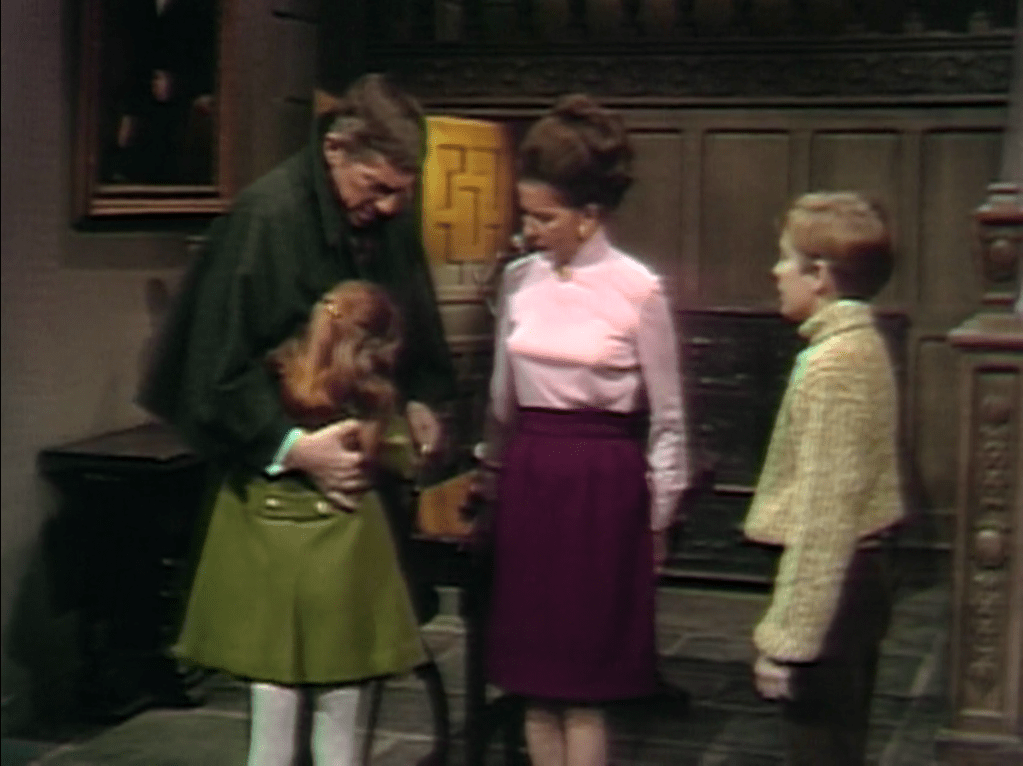
Amy hugs Barnabas while Liz and David look on.

The director of Windcliff is Julia Hoffman, MD. For almost a year and a half, Julia has been a permanent houseguest at Collinwood; as 1968 has gone on, she has become Barnabas’ inseparable friend. She hugged Barnabas for the first time in #635, to his evident discomfort. But as we saw when he interacted with the ghost of his little sister Sarah in #364 and again when we saw him with the living Sarah in the extended flashback to the 1790s that ran from November 1967 to March 1968, Barnabas gets along well with little girls, so it isn’t such a surprise that he returns Amy’s embrace.

In #629, Liz told Julia that Barnabas was miserable at Windcliff. If Barnabas were still a vampire, it would be easy to imagine his evil overwhelming the scientific rationality at the heart of a psychiatric facility, as it has long since overwhelmed Julia’s professional ethics. But his curse is in abeyance now. They’ve had to work to keep us thinking that he is exotic and uncanny and dangerous; one look at him in a group therapy session would undo all that work so abruptly that we would never stop laughing. Of course we never see him as a patient there. It was daring of them even to include Liz’ line, inviting us to imagine him in such a mundane setting.

In a comment on Danny Horn’s great Dark Shadows Every Day, Stephen E. Robinson wonders about the image Amy conjures up when she says that she and Barnabas spent time together as patients at Windcliff:

There’s an implication that Barnabas and Amy hung out at Windcliff, because apparently exposing small children, in shock over the deaths of family members, to middle-aged mental patients is part of the healing process. The Barnabas/Amy scene makes me laugh at loud because it’s as if the writers think Windcliff is a vacation resort and Barnabas and Amy met by the pool.

Stephen E. Robinson, comment left 11 May 2015 at 6:59 AM Pacific time, on Danny Horn, “Episode 645: Spirited Away,” 10 May 2015, Dark Shadows Every Day.

Stephen is being generous- Barnabas was in the hospital because he had himself been the victim of a vampire, and Amy was there because her brother Tom had died. She did not know, but Julia did, that Tom had also come back as a vampire, and it was Barnabas who destroyed him, first by driving a stake through his heart, later by forcing him into the sunlight. I’m no psychiatrist, but with that history of closely related but non-discussable traumas I wouldn’t think the two of them ought to spend much time together.

But of course none of that matters. Barnabas and Julia are the show’s principal protagonists, and they ran out of story two weeks ago. Ever since Amy took over, we’ve been waiting to see how she will connect with them. Now that we know she is Barnabas’ substitute sister and Julia’s sometime patient, they are ready to rejoin the action.

Episode 76: His own shadow

Dashing action hero Burke Devlin pays yet another visit to the great house of Collinwood. He announces to its residents, the ancient and esteemed Collins family, that he intends to take control of all their properties, including the house. He is buying up their debts and will use them to seize their businesses. He offers to pay them for the house, though. He even offers to pay for it at higher than the market value.

Screen capture by Dark Shadows from the Beginning

Ne’er-do-well Roger Collins urges his sister, reclusive matriarch Liz, to take Burke’s offer for the house. It’s a huge, gloomy, impractical place, and they would be better off without it. He doesn’t mention that the cash might come in handy when Burke starts calling in all the notes they have no way of meeting. Liz won’t hear of it, and vows to fight.

Flighty heiress Carolyn and well-meaning governess Vicki process their feelings about the matter. Carolyn is wounded by the evidence that Burke never really wanted to be her boyfriend- not that he ever said he did, but she kept hoping. Vicki wonders what Burke is thinking, and whether he understands his own motives. He admits that he may not- after all, if he’s trying to avenge the wrongs the Collinses have done him by bankrupting them and collecting their assets, why not just watch their house fall into his lap with the cannery, the fishing boats, and whatever else they may have, leaving them with nothing?

With this post we say goodbye to one of the bloggers who has kept us company. This was the last episode Marc Masse discussed on his blog Dark Shadows from the Beginning. His posts usually include stimulating insights, sometimes remarkable scholarship, and occasionally material that is in one way or another frustrating. Still, he is always well worth reading.

Among his most extraordinary contributions was about the story of the sabotaging of Roger’s car, a.k.a. The Saga of the Bleeder Valve. That story began when we, accompanying Vicki, saw Burke standing by Roger’s car in episode 13.

Burke and Vicki in the garage, from Dark Shadows from the Beginning

Burke tells Vicki that he was looking at Roger’s car because he was thinking of buying one like it, an explanation she finds unconvincing.

In his post about episode 46, Masse includes a long section about similarities between the Saga of the Bleeder Valve and a particular episode of The Alfred Hitchcock Hour. He convinces me that Art Wallace and Lela Swift had studied that episode. You’ll notice from his screenshots that that John Cassavetes even had the same haircut that Mitch Ryan wore as Burke:

Source material for the missing brake valve storyline on Dark Shadows can also be found in The Alfred Hitchcock Hour anthology series. In the episode Murder Case (season 2, episode 19; aired March 6, 1964), Gena Rowlands plays an actress (Diana Justin) in London married to a rich diamond merchant (Charles Justin) played by Murray Matheson. Diana isn’t really in love with her much older husband Charles, but since he is the main financial backer of a play she is starring in, her success is ensured… that is until the boyfriend she dropped so she could run off to England and start a production company with her rich husband, a struggling actor named Lee Griffin (played by John Cassavetes), manages to wangle his way through an audition and secure a part in the play by getting Diana to pass a good word along to the author and director of the production. Lee gets Diana to agree to resume their former relationship, and in no time the pair are in cahoots to relieve Diana of her marital obligations and in the process secure a huge windfall by plotting to have the old man bumped off. To accomplish this, they arrange for Charles to have an automobile accident; this is where the similarities to the missing brake valve story on Dark Shadows come into play.

One afternoon, on a visit up to the country home where Diana and Charles live, which is situated high up on a hilly area, Lee gets an idea when he comments on how the type of car that Charles drives is famous for its brakes.

Alfred Hitchcock Hour_Murder Case_Lee comments on the brakes for Charles' car_ep46

To compromise the functioning of the car’s brake system, Lee first uses a wrench to loosen something, probably the bleeder valve…

Alfred Hitchcock Hour_Murder Case_Lee uses a wrench to loosen the brake system_ep46

…after which he pumps the brake pedal several times so there won’t be any hydraulic fluid left for when Charles next gets behind the wheel.

Alfred Hitchcock Hour_Murder Case_Lee pumps the brakes free of hydraulic fluid_ep46

Just after completing the task, and with the wrench still in his back pocket, Charles walks in to find Lee there standing by his car, just like in Dark Shadows episode 13 when Victoria Winters walks into the Collinwood garage to find Burke near Roger’s car. To diffuse the situation, Lee explains to Charles: “I was, uh, just admiring your car. It’s, uh, fabulous!”

Alfred Hitchcock Hour_Murder Case_Lee and Charles chatting in the garage_ep46

That night Lee and Diana have a performance in London; to set the plan in motion, Lee phones Charles from backstage while the play is still on and concocts a story about nearly having gotten into an accident on their drive into London due to a careless young motorist, which left Diana shaken up, and suggesting to Charles that he drive down to London to take his wife home…

Alfred Hitchcock Hour_Murder Case_Lee phones Charles from London_ep46

…which he agrees to, just like in Dark Shadows episode 15 when Roger agrees to drive into town to meet with Burke at the Blue Whale.

Alfred Hitchcock Hour_Murder Case_Charles in the garage getting set for the drive to London_ep46

Similar to how Roger in episode 17 is shown to have miraculously escaped with just a sprained arm and a few stitches to the forehead, Charles winds up crashing head on into a tractor that was just starting up the hill; despite that the car ended up a total loss, Charles was extremely lucky in having sustained only a couple of cracked ribs and a slight concussion.

Alfred Hitchcock Hour_Murder Case_Charles escaped the accident with only minor injuries_ep46

The missing brake valve story on Dark Shadows never really did feel like something that would ordinarily be presented on a daytime serial drama. Instead, thus far Dark Shadows has taken its cue from 1940s film noir for atmosphere, Broadway theater style for acting performances, and nighttime mystery suspense anthology programs for subject matter. Is it any wonder that Dark Shadows would go on to evolve into the cultural phenomenon it would later become? A truly one of a kind blend of widely varying influences.

Marc Masse, Dark Shadows from the Beginning, “Episode 46: Destroy Me, Pt.1,” 3 February 2019

In his post for episode 76, Masse includes the audio of Joan Bennett singing “Sentimental Moments” in the 1955 film We’re No Angels. I’d never heard of the song, and had no idea she sang. Indeed she was not a Singer with a capital S, but her gentle, precise phrasing is perfect for this strange, sad little tune. I think of it as a farewell to Masse and his blog.

Episode 52: The very atmosphere

We intercut between two contrasting scenes: in the mansion at Collinwood, Vicki the governess and Carolyn the heiress pour their hearts out to each other, while in the Evans cottage drunken artist Sam refuses to answer any of the questions his adult daughter Maggie puts to him.

The disappearance of doughty plant manager Bill Malloy looms over both conversations. Vicki and Carolyn can’t avoid the conclusion that the body they saw face-down on the beach at the end of Friday’s episode was Malloy’s. Sam tells Maggie that the reason he can’t sleep is that he’s worried about Malloy.

The two settings connect when Sam telephones Collinwood in hopes the dastardly Roger will answer. The call prompts Vicki and Carolyn to break up their slumber party in Vicki’s room and come to the telephone outside the drawing room.

Vicki answers the telephone. Sam says “Collins,” Vicki asks to whom she is speaking, he hangs up. They then hear a noise from inside the drawing room. They go in and search to see if anyone is hiding there. Vicki goes directly to the window and pays special attention to the area behind the curtain on her right, a spot that will become a frequent hiding place much later in the series. I suppose it makes sense that people would eventually start hiding there- the camera has a great angle on it. Smart of Vicki to know that’s the first place to look.

Vicki knows where to look

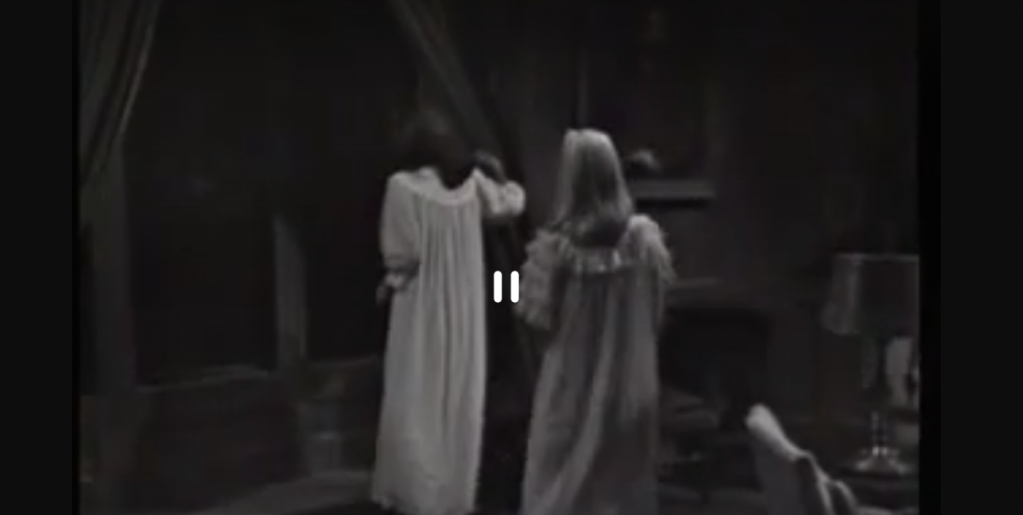
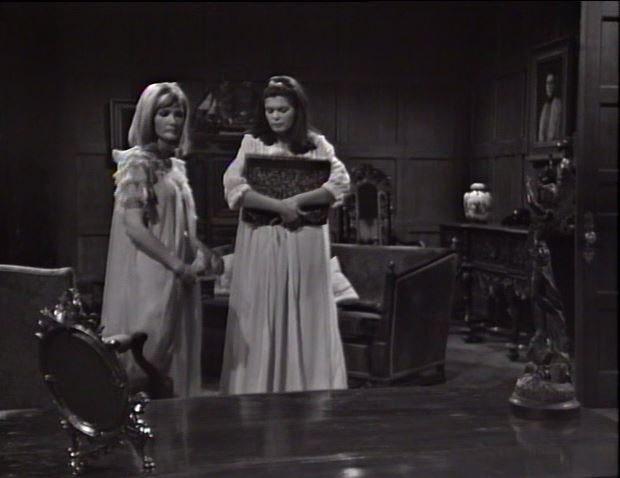
The girls find a book open on the floor. Vicki demonstrates that the noise they heard was the sound of the book falling, but she cannot explain how it moved several feet from the table where it was kept to the spot where she and Carolyn found it. Carolyn insists that they consider the possibility that a ghost put it there. Since they had heard the same sound at least once while they were still in Vicki’s room, it would make sense to consider that someone or something must have been involved in picking it up and dropping it again.

Vicki holds the book several feet from the table
Screenshot by Dark Shadows from the Beginning

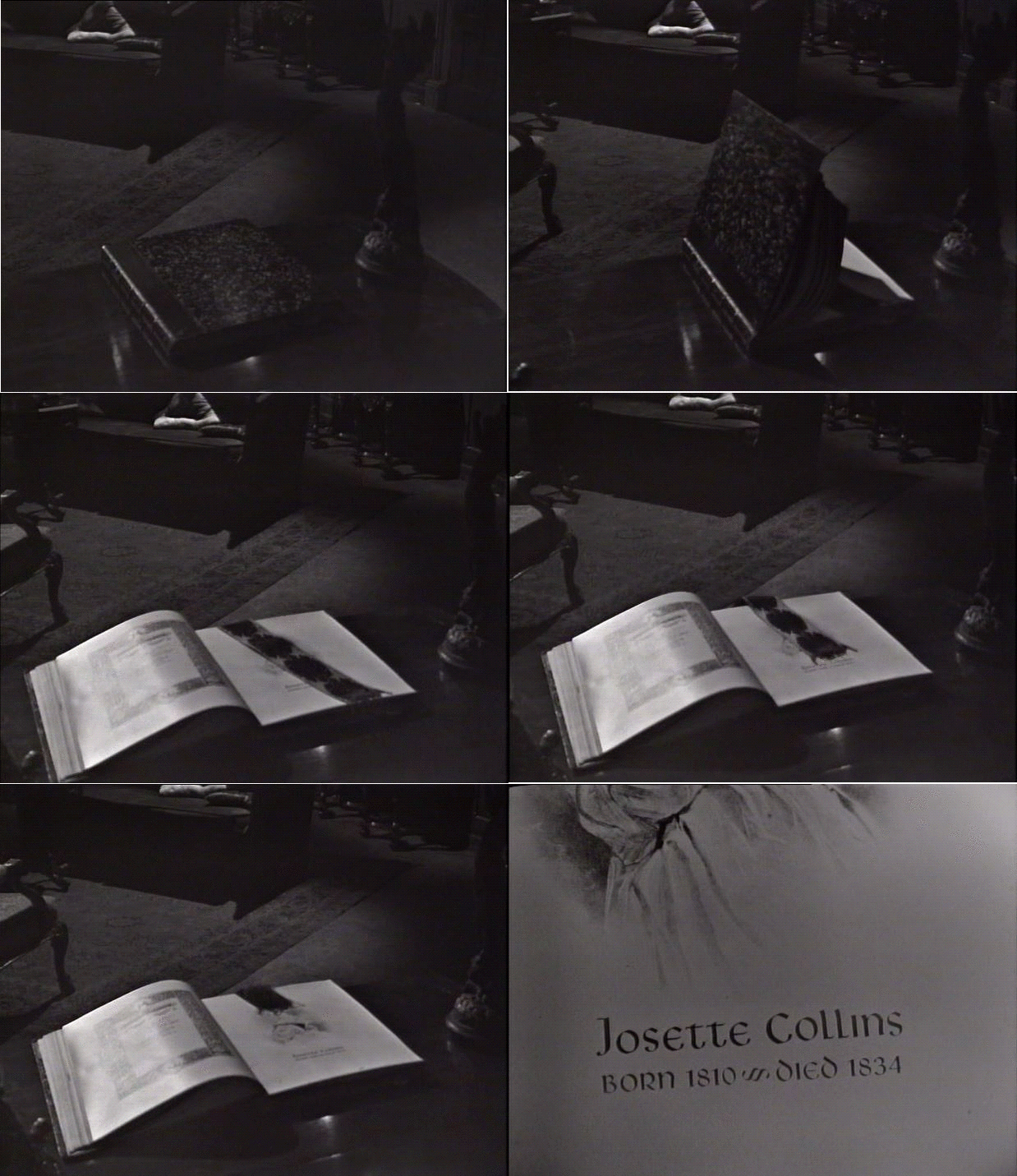
Vicki and Carolyn leave the drawing room, and we see the book reopen itself to the same page. The camera zooms in, and we see that the page bears the name and likeness of Josette Collins. This is the first supernatural manifestation that the audience sees when no character is looking. We’ve been hearing about the ghost of Josette Collins from week one; we have to assume that she is leaving us her carte de visite.

The book opens by itself
Screen capture by Dark Shadows from the Beginning

Each of the previous supernatural manifestations had marked a moment when off-screen events were stirring up the spirits that inhabit the back-world behind the universe the characters inhabit. When troubled rich boy David had tampered with the brakes on his father Roger’s car in an attempt at patricide, reclusive matriarch Liz was asleep and ghosts were trying to reach her in her dreams. That same night, Vicki saw a door open and close itself inexplicably, and saw a shrouded figure on the threshold of the drawing room. At the beginning of this episode, Carolyn admitted to Vicki that while Collinwood has always been a strange place, it was only when she and Burke came to town that the really weird stuff started happening. So we have to take it that Vicki’s presence in the house is itself a matter of concern to Josette and the other ghosts, and that what is happening off-screen in connection with the body on the beach and the secrets Sam refuses to share with Maggie are going to bring the phantoms out of the back-world into the foreground.

It’s also interesting that the first character we see after the ghost of Josette announces herself is Maggie. At this point and for some months to come, the show will be developing a connection between Vicki and the ghost of Josette. But later on, both Maggie the character and Kathryn Leigh Scott the actress will be very much involved with Josette. The series involved very little advance planning, nothing at all like daytime serials of the present day that have their stories sketched out in detail months in advance, so that is probably just something you’d expect to happen when you only have four actors in the studio. Still it’s an eldritch moment for repeat viewers.

Within the context of the show as it actually was at this period, I think there is a point to the juxtaposition of the ghost of Josette with the scene between Maggie and Sam in the Evans cottage. Vicki and Carolyn are girls at a slumber party scaring each other with ghost stories. Even when the slumber party takes place in a mansion on a great estate belonging to the family that gave the town its name, that’s a silly situation. When the ghost stories turn out to be true, though, you’re suddenly vaulted into an elevated realm of fantasy. Turn to a small house where the adult child of an alcoholic is wearing her late mother’s night-gown and trying fruitlessly to prise some useful information out of her drunken parent, and you land back in the real world with a thud. Nothing here seems to be either silly or fantastic. Sam’s association with Roger’s secret, and therefore with the unknown events that are roiling the supernatural world, suggests that the mundane struggles of the Evanses and the fantastic doings at Collinwood will sooner or later collapse into each other.

I should mention Marc Masse’s post about this episode on his always intriguing, usually inaccessible blog Dark Shadows from the Beginning. Masse meticulously demonstrates the influence of the 1944 film The Uninvited on the show in general and this episode in particular with close analysis and multiple screenshots, and then does the same thing with an episode of Alfred Hitchcock Presents called “The Gentleman from America.” It’s a very impressive and thoroughly convincing work of scholarship.

Masse’s blog is infamous among many Dark Shadows fans because of what he presents as transcripts of conversations between director Lela Swift, executive producer Dan Curtis, and others that he claims were picked up by the control room microphone and that he has recovered by some more or less magical technique unknown to other audio technicians. In this one he includes such a “transcript,” in which Swift (who didn’t direct this episode, but is supposed to be in the control room anyway) tells Curtis that she thinks it’s a terrible idea to do a ghost story or a Hitchcock story on daytime TV.

That installment of “The Dan and Lela Show” is pretty tedious to read, but in a way it’s a relief. In previous posts Masse has presented Swift as maniacally driven by lust for the female cast members, a presentation that her husband and their children might have found surprising. His post for episode 48 brings that presentation to a sort of crescendo. Since this one includes two shots of Vicki and Carolyn in bed together, I braced myself for Masse to outdo himself in that line, but there isn’t a bit of it there.