One evening in 1796, time traveler Barnabas Collins has stumbled into a clearing in the woods where he finds a cairn and two hooded figures. He finds himself unable to resist the figures while they put him on the cairn. He loses consciousness. When he comes to, he suddenly knows everything about them and the religion they represent, and they hail him as their leader. He says that he will be leaving soon, and that they will accompany him only in spirit. The only thing he will take with him is “the Leviathan box.” This is the first time we have heard the word “Leviathan” on Dark Shadows. Barnabas also talks about a book that will be important, though apparently it will get to wherever he is going on its own.
The show is starting a new storyline this week; for the last few days, the episodes have ended with an announcement alternately promising that today would mark the beginning of “one of the most terrifying tales ever told” or at least “one of the most unusual tales ever told.” Dark Shadows often marks the beginning of a new story with the opening of a box. Barnabas was a vampire when he first joined the show; his story began in #210, when a would-be grave robber opened his coffin and got a nasty surprise. The story we just concluded kicked into high gear in #778, when broad ethnic stereotype Magda Rákóczi brought a box containing the severed hand of sorcerer Count Petofi to the estate of Collinwood. Books have also been important. The show’s first costume drama segment, when from November 1967 to March 1968 it was set in the 1790s, involved well-meaning governess Vicki Winters toting around a copy of the Collins family history. That volume was crucial to many subsequent plot developments. Apparently this time there will be both a box and a book.
We cut to 1969. Barnabas’ friend Julia Hoffman is moping around his house, the Old House at Collinwood. She does not know that he is in 1796, but does know that he has been traveling through time. He has spent the last eight months in the year 1897. Julia visited him there for a couple of weeks, but snapped back to 1969 over a month ago and has been waiting for him to come back. She has heard voices from the past occasionally, but not for the last couple of nights, and she is afraid she is losing touch with the rupture in space-time that stands between her and Barnabas. To take her mind off things, she goes to the great house on the estate and hangs out with heiress Carolyn Collins Stoddard.
We keep getting glimpses of a man strolling around the estate. We see him only from the back. He has silver-gray hair and is wearing a hat and coat we haven’t seen before. He peeks at Julia through the window of Barnabas’ house, then wanders off to the woods. The cairn materializes in a clearing while he watches. He looks at it calmly, then walks away. He must have expected to see it take shape before him. Presumably he has some connection with the cult represented by the hooded figures and now to be led by Barnabas.
In the great house, Julia hears the voices of two characters from the 1897 segment. They are Magda and Cockney showgirl/ mentalist Pansy Faye. Julia did not meet Magda during her trip to 1897; it would have required special effects for her to do so, since they are both played by Grayson Hall. Julia was once in the same room as Pansy, but would not remember her- she was unconscious at the time. So it is odd that she recognizes their voices.
Julia hears Pansy telling Magda that Barnabas and Kitty Soames, the dowager countess of Hampshire, went into the Old House the night before and haven’t been seen since. She goes on to say that stuffy but lovable Edward Collins searched the house, and could find no trace of either Barnabas or Kitty. They seem to have vanished.
Returning viewers know that they did indeed vanish. Kitty was assumed bodily into the portrait of the late Josette Collins that hangs in the Old House, and when Barnabas saw that this was happening he and she both disappeared completely. They were both transferred to 1796, Barnabas as he was when he was around in those days, Kitty in the form of a distant memory in Josette’s mind.
Knowing that, we will not be confused by Pansy and Magda’s conversation. Other knowledge of ours will have the opposite effect. When Magda says that the story of Barnabas and Kitty’s disappearance from the Old House has nothing to do with her, Pansy challenges her with “You live in the Old House, don’t you?” Magda admits she does. While Magda did live there when Barnabas first arrived in 1897 in #701, she wasn’t on the show much in the last couple of months of the 1897 segment, and in the last weeks of it characters were saying that no one lived in the Old House. She must have gone away. Moreover, she would have been most unlikely to return. Several mortal enemies of hers were already in the area, and she knew that kinsmen of late Rroma chieftain/ organized crime boss King Johnny Romana were on their way to Collinwood, seeking, among other things, to kill her. Clearly the makers of the show just wanted to use the voices of Grayson Hall and Nancy Barrett because Julia and Carolyn were already in the episode, but the result really is pretty sloppy.
Julia decides that the conversation between Pansy and Magda means that Barnabas is on his way back to the 1960s, and she hastens to the Old House to meet him. As she arrives there, she meets the gray-haired man in the hat and coat. She looks him in the face and asks who he is.
Julia knows virtually everything the audience knows about the parts of the show set in the late 1960s, so when she does not recognize him we wonder who he could be. Perhaps he is someone we met when the show was set in the 1790s or in the parts of the 1897 segment before or after Julia’s time in that year, or he could be someone who was on the show before she joined the cast in the summer of 1967. The only gray-haired men we saw in any of those periods were some doctors, lawyers, judges, and clergymen who appeared in one or two episodes, and we aren’t expecting to see any of them again. So either this man is a new character, or he is a character who has aged considerably since we last saw him. The trouble they took to hide his face suggests that they expect us to react when it is revealed to us. So even if he is a new character, he is probably going to be played by an actor we have seen before.
In #701, broadcast at the beginning of March 1969, recovering vampire-turned-bumbling protagonist Barnabas Collins was trying to solve some problems his distant cousins were having, and inadvertently came unstuck in time. He found himself in the year 1897, where his vampirism was once more in full force. Barnabas spent the next eight months in that year, precipitating one disaster after another around the estate of Collinwood and the village of Collinsport.
As summer gave way to fall of 1897, Barnabas’ friends managed to put his vampirism back into remission. In #844, he met Kitty Soames, the dowager countess of Hampshire. Despite what her title would suggest, Kitty was an American woman in her twenties. Barnabas recognized her as the reincarnation of his lost love Josette. In February of 1796, Josette found out that Barnabas had become a vampire and that he wanted to kill her and raise her from the dead as his vampire bride. She flung herself to her death from the cliff on Widows’ Hill rather than let him do that to her.
In the eight weeks following Kitty’s first appearance, Josette’s personality irrupted into her conscious mind more and more frequently. Josette wanted to live again and to be with Barnabas. By last week, Kitty could hear Josette’s voice talking to her through the portrait of her that hangs in the Old House on the grounds of Collinwood. Josette suggested that if Kitty stopped resisting her, the two of them could both live, resolving themselves into a composite being.
In Thursday’s episode, the boundary between Kitty and Josette had become very indistinct. As Kitty, she agreed to marry Barnabas that night, later to wonder why she had done so. She was holding Josette’s white dress in her hand and struggling with the idea of putting it on when she abruptly found herself wearing it. Barnabas entered the room just in time to see her bodily assumed into the portrait. He reached up to the moving image of Kitty overlaid on the painted likeness of Josette, and both he and Kitty vanished at the same instant.
In Friday’s episode, Barnabas found himself lying on the ground, wearing clothes he had last put on in 1796. He learned that it was the night of Josette’s death. He is a vampire in this period, but he is confident he can again be free of the effects of the curse. He does not want to kill Josette, but to take her back to 1897 with him. His efforts to that end were not at all successful, and Friday ended with her on the edge of the cliff. She hears footsteps, which she and the audience have every reason to think are Barnabas’. If she sees him, she is prepared to jump.
Neither Kitty’s assumption into the portrait nor his own translation to 1796 prompt Barnabas to ask a single question about what forces are at work around him. Regular viewers would not expect him to. He lives in a universe where time travel is easy. Not only did he travel from March 1969 to 1897 without even trying to do so, but in #661 he managed to get from January 1969 to 1796 by standing in a graveyard at night and shouting for one of the residents to give him a ride. And in #365, he was present at a séance where the ghost of his little sister Sarah, speaking through well-meaning governess Vicki Winters, said that she would “tell the story from the beginning.” Vicki then vanished from the circle and Sarah’s governess, Phyllis Wick, materialized in her place. For the next four months the show was a costume drama set in the 1790s, where Vicki flailed about helplessly while Barnabas became a vampire, Sarah died of exposure, and Josette jumped off Widows’ Hill.
Barnabas and we also know that portraits are powerful in the universe of Dark Shadows. When he is in full vampire-mode, he communicates with his victims and potential victims through a portrait of him that hangs in the foyer of the great house of Collinwood. Much of the action in the 1897 segment had to do with a magical portrait that keeps Barnabas’ distant cousin Quentin from turning into a werewolf. Quentin had a romance with Amanda Harris, a woman who came to life when another magical portrait was painted.
Barnabas knows, not only that portraits in general have power, but also that Josette’s portrait in particular is powerful. In his second episode, #212, he went to the Old House and talked with strange and troubled boy David Collins, who often communed with Josette through her portrait. After David left him alone there, Barnabas addressed the portrait and told Josette that she would no longer function as the tutelary spirit of the Collins family. At that point Josette was supposed to be Barnabas’ grandmother who sided against him in a fateful family battle, but even after she was retconned as his lost love he felt the portrait’s power. So in #287, Vicki had invited herself to spend the night at Barnabas’ house. While she slept, Barnabas entered the room, intending to bite her. But he looked at the portrait of Josette and found that something was stopping him from doing so.
Barnabas would not have any way of knowing it, but in #70 Dark Shadows‘ first major special effect came when we saw Josette’s ghost take shape in front of her portrait and take three steps down from it to the floor of the room where it was hanging then, the front parlor of the Old House. She then turned, looked at the portrait, and went outside, where she danced among the columns of the portico. Longtime viewers will see Kitty’s assumption into the portrait as a reversal of this momentous little journey.
Most people nowadays who have been watching the show for some time will therefore take the strange goings-on as much in stride as Barnabas does. But viewers at the time may have had a different reaction. Friday’s episode and today’s originally ended with announcements over the closing credits. These announcements were not on the original master videotapes from which Amazon Prime Video and Tubi and the other streaming apps take their copies of the episodes, and so most viewers these days don’t hear them. But evidently one of the DVD releases reproduces them as they were preserved on some kinescopes. One promises that in Tuesday’s episode “one of the most terrifying tales ever told” will begin; the other, that it will be “one of the most unusual tales ever told.”
A terrifying tale suggests a mighty villain. By the end of the 1897 segment, all the villains have either turned into protagonists, as Barnabas, Quentin, and wicked witch Angelique had done; been heavily defeated, as sorcerer Count Petofi had been; or were dead and forgotten. So “one of the most terrifying tales ever told” would seem to require a new villain, or perhaps a new group of villains. And if it is also “one of the most unusual tales ever told,” those villains will have to be strikingly different from anything we have seen before.
So, having heard those announcements, we will be less inclined to chalk Barnabas’ latest adventure in anachronism up to the usual way things are on Dark Shadows. We will be looking for signs that some previously unknown and hugely formidable malevolent force is luring him into a trap.
At first, no such signs seem to be forthcoming. The footsteps that alarm Josette turn out not to be Barnabas’, but those of her aunt, the Countess DuPrés. The countess talks Josette down and takes her back to the great house of Collinwood. Having saved Josette’s life, the countess takes her to a room occupied by fluttery heiress Millicent Collins. The countess asks Millicent to sit with Josette while she runs an errand.
Millicent means well, but always makes everything hilariously worse. Seeing that Josette is shaking, she observes that she is suffering a shock. She asks very earnestly “Was your shock a romantic one?” Josette responds by wailing. Millicent keeps talking about the dangers of love, causing Josette to get more and more upset. Longtime viewers will remember that Millicent will turn from a comic figure to a tragic one soon after this, when she falls in love with an evil man. That tinges our reaction with sadness, but Millicent’s total insensitivity to the effect she is having on Josette makes for an effective comedy scene. No matter how much the oblivious Millicent is worsening Josette’s mood, this hardly seems likely to be part of a grand evil scheme.
It turns out that the errand the countess had to run was a visit to Barnabas, who is waiting in Josette’s room. This time Barnabas has actually had a sensible idea. Rather than go to Josette on top of the cliff as he did the first time through these events, he asked the countess to go. The countess confronts him about his status as a walking dead man. Barnabas will not explain- how could he? He asks the countess if she thinks he is a ghost; she does not answer. He insists on seeing Josette; she says she will not allow it. He says he does not want to force her to help him; she declares that he cannot force her. Finally, he ends the exchange by biting her.
The countess goes to Millicent’s room and tells Josette to go back to her own room. Millicent is surprised the countess doesn’t go with her, protesting that Josette is in no condition to be left alone. The countess responds numbly.
The countess is one of three characters we have so far seen Grayson Hall play. The first, mad scientist Julia Hoffman, offered herself to Barnabas as a victim in #350; he declined the offer. Julia was motivated by a mixture of despair over the failure of her first attempt to cure Barnabas’ vampirism, an obligation to prevent him harming others, and her own unrequited love for him, so she was disappointed when he said no. The other, broad ethnic stereotype Magda Rákóczi, told Barnabas to “Bite me!” when they were at the grave of her husband, his onetime blood thrall. He refused to do that, too. Magda was angry and defiant, wanting to get something horrible over with, so her reaction was more ambiguous. The countess didn’t know Barnabas was a vampire until his fangs were in her neck, so she is just dazed.
That Hall’s other characters expected Barnabas to bite them, and in Julia’s case hoped he would do so, shows that no new force is needed to explain why he bites the countess. And bad as a vampire’s bite is, from what we have seen in previous segments of the show we can be sure that the countess will forget all about her experience as Barnabas’ victim once he leaves. Besides, when he came back in time in January Barnabas triggered a chain of events that led to the countess’ death- we can assume that whatever he has put in motion this time will have a different outcome for her. So while the bite still has its echoes of rape and is therefore a horror, it in no way shows the presence of any fresh villain that is about to set off “one of the most terrifying tales ever told.”
Josette is in her room. The secret panel opens, and Barnabas enters. She is shocked to see him. He assures her that he does not want to kill her and raise her as his vampire bride; after a bit of prodding, she gets him to admit that this was, at one point, his plan. He starts explaining to her that he has come to her after a sojourn in the 1890s. She reacts with disbelief and confusion. He keeps talking. He asks her if she remembers Kitty Soames. At first the name does not ring a bell, but as he goes on she recognizes what she had thought to be a dream in which she was talking with her portrait. He tells her that it was no dream, but that just a few hours before they were together in that other century.
Finally, Barnabas persuades Josette to meet him at the Old House. He says they must go separately, since he has to go to his friend Ben Stokes and ask him to stand guard for them while they disappear into the portrait. She wants to say goodbye to her aunt the countess, and Barnabas tells her to write a note. They kiss passionately. One wonders if Josette notices the taste of her aunt’s blood on Barnabas’ lips.
Barnabas’ decision to go to Ben and send Josette to the house on her own doesn’t make much sense. This is the first we have heard they need someone to stand guard, and there is no apparent reason why they should. Moreover, the countess is right there in the house with them, and she is under Barnabas’ power. The three of them can go to the house together, Josette can say goodbye to her there, and if they need someone to stand guard she can do it. Afterward she can tell Ben what she saw and tell lies to anyone else who has questions about where Josette went. Besides, regular viewers of Dark Shadows know that when two people are supposed to go to a place separately, they never actually meet there. A smart character who understood how things work in this universe would know that Barnabas’ decree that he and Josette must take their own paths to the house means that they are doomed. But contrary to the glimmers of brainpower Barnabas showed earlier, he has never been that smart. He is so much a creature of habit that his decision to send Josette to the Old House by herself bears no traces at all of any outside influence, least of all the influence of the new villain we are looking for.
Barnabas is on his way across the grounds of Collinwood to meet Ben when it dawns on him that he is lost. This is the first thing he has done today that is out of character. He has been on the estate for centuries, and knows it surpassingly well. He looks around and sees a cairn, a large stone structure. The cairn has a flat surface in the middle and is flanked with torches and decorated with carvings resembling coiled serpents. Though he does not know where he is, he knows he has been following the same path he used shortly before, and that no such thing was there at that time or in the area ever before. Hooded figures approach, a man and a woman. They make gestures that he cannot understand. He cannot see or feel anything binding him, but neither can he move his feet or use his vampire powers to dematerialize. At last we have encountered the new presence that is supposed to deliver “one of the most terrifying tales ever told.”
Back in the great house, Millicent and the countess discover that Josette is gone. They read the note. When Millicent reads that Josette has gone to be with Barnabas, she is puzzled. All she knows is that Barnabas is dead. As a visitor from light comedy, she assumes that death is a full-time occupation. She tells the countess that to be with Barnabas, Josette will have to die. The countess replies that “Many have died for love.” Millicent is shocked by the countess’ resigned tone, and declares that she will not give up on Josette even if the countess does.
It would have been impossible for Barnabas to explain the situation to the countess while she was actively opposing him, but one might have thought that after he had bitten her and broken her will he might have tried to reassure her that his plans for Josette were now benevolent. The utter hopelessness in her voice when she says that no one can help Josette suggests he didn’t even try. Again, it wouldn’t have taken the influence of any outside force to cause Barnabas to skip this. As a vampire, he is a metaphor for extreme selfishness, and when he is pressed for time he is especially unlikely to take other people’s feelings into account in any way. Though it is a bit of a shame he didn’t try to smooth things over with the countess, there is nothing in his behavior that needs explaining, and too little at stake here for us to imagine that the mysterious forces launching “one of the most terrifying tales ever told” would care much about it.
In the Old House, Josette is looking at her portrait and wondering why Barnabas is late. She talks herself into believing that he was lying when he told her the story about 1897. She jumps to the conclusion that he really is going to turn her into a vampire, and declares she has nothing left to live for. She takes out a vial she had with her when she was with Millicent and drinks it. It is poison, and she dies.
Back in the mysterious clearing in the woods, Barnabas loses consciousness. The hooded figures say some prayers to Mother Earth, then lay him on the cairn. They place some foliage on him. This action recalls the sprinkling of grain on the necks of animals led to altars in ancient Indo-European paganism, an act known in Latin as sacrificium- it was this ritual act, not the killing of the animal, that made the animal sacer, that is, set aside for the gods. The man declares that when Barnabas awakens he will recognize him and the woman, and that he will then lead them “to a new and everlasting life.” My wife, Mrs Acilius, and I reacted to the idea of Barnabas as a guide to enlightenment the same way every regular viewer of Dark Shadows would, viz. with gales of laughter.
If the hooded figures represent the force that has directed the events of this episode and Friday’s, the force that we have been promised will bring us “one of the most terrifying tales ever told,” then something that happened in them must have been a necessary precondition for the sacrifice of Barnabas. After all, that force had him under its power when he disappeared from 1897 and found himself lying on the ground. He could just as easily have materialized on the cairn, accompanied by the hooded figures with their foliage.
The only development in these two installments that would seem to be significant enough to qualify as such a precondition is Josette’s poisoning of herself. That Josette jumped to her death from Widows’ Hill is one of the most firmly established parts of the show’s continuity. Artist Sam Evans told Vicki about it in #5. In #185, a very different version of Sam saw Josette’s portrait for the first time and identified her as “the lady who went over the cliff.” In #233, Barnabas gave a vivid and rather indiscreet account of Josette’s death to Vicki and heiress Carolyn. We saw Josette make her leap in #425, and in #876 the leap was reenacted with maidservant Beth Chavez in Josette’s role and Quentin in Barnabas’. So having Josette poison herself instead of taking the jump is an example of something Dark Shadows did several times in the later phases of the 1897 segment, making a retcon into a self-conscious plot point. That leaves us with a puzzle. Why does it matter so much just how Josette went about killing herself?
Josette’s original death was a desperate flight from vampirism. It barely qualified as a suicide at all. Josette was cornered at the edge of the cliff, seeing no way but a mortal leap to escape transformation into a bloodsucking fiend. She went over the cliff in a spontaneous act that prevented the killings and enslavements that she would have inflicted on others had Barnabas succeeded in making her into the same kind of monster he was. This time, she has been keeping a vial of poison with her, so that her suicide is a premeditated act. Moreover, she drinks it when she is still alone, motivated not by a clear and present danger but by her purely intellectual, and as it so happens faulty, analysis of the situation. She still has options, and she is helping no one. So it could be that “one of the most terrifying tales ever told” is supposed to begin with the audience disapproving of Josette’s suicide on moral grounds.
This doesn’t seem very promising, but we should mention that writer Sam Hall probably did not approve of suicide. He was a churchgoer, serious enough about his Lutheran faith that he insisted Shirley Grossman convert from Judaism before they married and she became Grayson Hall. Christians have traditionally regarded despair as a sinful state and suicide as a religious offense. And Hall does seem to have been in a religious mood at this period. Lately his episodes have shown evidence that he was reading the novels of George MacDonald, a nineteenth century Congregationalist minister whose works of fantastic fiction were enormously popular in their day, but which are suffused with such a heavily Christian atmosphere that by the late 1960s their readership was a subset of that of such self-consciously Christian fans of MacDonald’s as C. S. Lewis, J. R. R. Tolkien, and W. H. Auden. Indeed, the three priests who hosted the podcast God and Comics admitted in a 2022 installment of their show that MacDonald’s novels reminded them a little too strongly of their day jobs to count as fun reading for them.
If Hall was feeling pious enough to keep reading MacDonald, he may well have seen Josette’s intentional and unnecessary self-poisoning as a prelude to “one of the most terrifying tales ever told.” Still, nothing we have seen so far explains just how that would work. Maybe we will find out later that Josette’s soul is in need of some kind of intervention from the other characters to avoid damnation. Lutherans aren’t supposed to think in those terms, but not even MacDonald, churchy as he was, ever let any kind of orthodoxy get between him and a good story.
Today marks the final appearance of both Millicent and the countess. It is also the last time we will visit the 1790s.
The hooded figures Barnabas meets today are identified in the credits as Oberon and Haza. Oberon, King of the Fairies, was a figure in medieval and Renaissance folklore whom Shakespeare used as a character in A Midsummer Night’s Dream. Also, MacDonald mentioned Oberon occasionally in his novels. I don’t know where Hall came up with “Haza.” Bookish people pick up vocabulary items all the time, so any of the various words in the world that take that form might have popped into his head when he was writing this episode.
Oberon is played by Peter Kirk Lombard, Haza by Robin Lane. Miss Lane’s acting career seems to have peaked with her turn as Haza, but for the last six years she has been releasing videos on various platforms under the title Badass Women 50+. As of this writing, her bio on YouTube says that she is 89 years old. Until 2022, her videos ran on a cable TV service in NYC, where she was still living then and for all I can tell is still living now.
Peter Lombard died in 2015. He worked steadily on Broadway for a couple of decades. From the point of view of a Dark Shadows enthusiast, the most interesting work he did there was in the original production of 1776, a cast which also included Dark Shadows alums David Ford, Daniel F. Keyes, Emory Bass, and Virginia Vestoff. Those four were all principal members of the cast, while Lombard was a stage manager and Ken Howard’s understudy in the role of Thomas Jefferson. When the cast appeared on The Ed Sullivan Show, Howard was absent, but the part of Jefferson was played not by Lombard, but by Roy Poole. I think I can spot Lombard in the background in the costume worn by Poole’s main character, Stephen Hopkins of Rhode Island.*
The old age makeup makes it impossible to be sure, but I suspect this is Lombard as Stephen Hopkins.
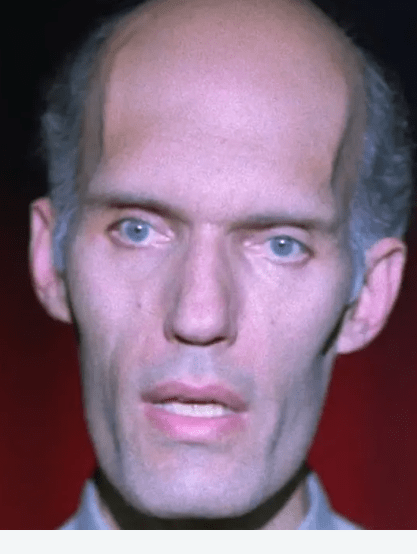
Lombard bore a resemblance to Carel Struycken, the actor who played the very tall man in Twin Peaks. So much so that when I first saw this episode I was certain he was the same person. But they aren’t related. I do wonder if David Lynch or Mark Frost or casting director Johanna Ray saw this episode and had Lombard in mind when they cast Mr Struycken as “The Fireman,” who like Oberon appears unexpectedly and represents a remote and mysterious world.
*Stephen Hopkins is not only a character in 1776, but also figures in H. P. Lovecraft’s “The Strange Case of Charles Dexter Ward.” Lovecraft says that (the fictional) Joseph Curwen had been a friend and supporter of his when (the historical) Hopkins was first governor of Rhode Island, but that when Curwen was exposed as a menace Hopkins personally took part in the raid on Curwen’s place. Since the story beginning today is based on another of Lovecraft’s tales, a connection between Lombard and Stephen Hopkins qualifies as a mildly amusing coincidence.
Strange and troubled boy David Collins stands outside the drawing room at the great house of Collinwood and overhears his father, Roger, talking with permanent house-guest Julia Hoffman. Roger and Julia are discussing David’s fear of his cousin, old world gentleman Barnabas Collins, and his belief that Barnabas is hiding something terrible in the basement of his home in the Old House on the estate. Roger takes it for granted that Barnabas is above reproach, and has therefore concluded that David is suffering from some sort of mental disorder. Julia encourages Roger in this conclusion, and urges him to send David away to boarding school. Roger is amenable to this idea, but tells Julia that his sister, matriarch Liz, will never allow it.
The last time David overheard his father in the drawing room saying he wanted to send him away to school, he attempted to murder him. But that was in episode #10, almost fifteen months ago. Since then, David has been through a lot, and has decided he wants to align himself with good against evil. So he doesn’t try to kill Roger this time. Instead, he steals a set of keys to Barnabas’ house that Liz keeps in her study and sets off to gather evidence with which he can prove himself right.
Returning viewers will recall that David’s friend, the ghost of ten year old Sarah, has repeatedly warned him not to go near the Old House, and especially to stay away from the basement. David remembers her words, but makes his way into Barnabas’ basement regardless. There, he sees an open coffin. While David is looking the other way, Barnabas comes up behind the lid and slams it shut. David turns, and Barnabas glares at him. Since Barnabas is a vampire who has spent quite a bit of time thinking of killing David, this would seem to leave the boy in something of a pickle.
There are three firsts in this episode, all relating to voice acting. This is the first time Alexandra Moltke Isles appears in an episode but does not read the opening voiceover. Sharon Smyth appears only through the pre-recorded voice of Sarah; her name does appear in the closing credits, the first time a performer is credited for something other than an on-camera appearance. And the closing titles end with Grayson Hall saying “Dark Shadows is a Dan Curtis Production,” the first time someone other than an ABC staff announcer* has delivered that line.
*Usually Bob Lloyd, though someone else filled in for Lloyd in #156 and #167.
Dangerously unstable ruffian Willie Loomis spent a week staring at the eighteenth century portrait of Barnabas Collins in the foyer of the great house of Collinwood back in April, then tried to rob Barnabas’ grave. That turned out to be an awkward situation when Willie found that Barnabas wasn’t entirely dead. Barnabas was a vampire who bit Willie, turned him into his sorely bedraggled blood thrall, and had lots of conversations with him. Yesterday, Willie was written out of the show.
Today we open with strange and troubled boy David Collins staring at the same portrait. As Willie was obsessed with the idea that there were jewels hidden in the Collins mausoleum in the old cemetery north of town, where in fact Barnabas’ coffin was hidden, so David is preoccupied with the idea that Barnabas has something terrible stashed in the basement of the Old House on the estate, where in fact his new coffin is hidden. As Willie sneaked off to the cemetery on his ill-starred expedition, David will sneak off to the Old House today and try to search Barnabas’ basement.
Unlike Willie, David is not driven by greed. He is afraid of Barnabas, and his friend, the ten year old ghost of Barnabas’ sister Sarah, has told him that he must not go to the Old House. But his aunt Liz and his father Roger dismiss his attempts to warn them about Barnabas, and he thinks it is his duty to provide them with evidence. So he screws up his courage and makes his way across the property.
David lets himself into the Old House by opening the parlor window. Not only have we seen David do this before, but Willie’s sometime friend, seagoing con man Jason McGuire, got into the house the same way in #274. Barnabas would kill Jason when he reached the basement in #275, so you might think he’d have put a lock on that window by now.
Jason’s fate is certainly on the minds of returning viewers when David tries to open the basement door. It comes as a relief when he finds the door locked. Barnabas’ co-conspirator, mad scientist Julia Hoffman, catches him there.
Julia demands to know what David is doing in the house, and he tries to brazen it out. He claims that he has a right to be there, since it belongs to his Aunt Liz. This is a bit of a murky point- we never see Liz transfer title to Barnabas, but she and others act as if he owns the place and its contents. Julia doesn’t clarify it when she responds that Liz gave the house to Barnabas- she doesn’t deny that it still belongs to Liz, only says that it also belongs to Barnabas.
Back in the great house, Roger is banging away at the piano. We saw Liz play the piano in #47 and #91, a reference to the conception of her character writer Art Wallace developed in his original story bible, titled Shadows on the Wall, in which she, like similar characters in a couple of TV plays he wrote in the 1950s under the title “The House,” gave piano lessons. Since then, Liz’ daughter Carolyn tried her hand at “Chopsticks” in #119 and used the piano as a prop in a teen rebel scene in #258, and Jason poked at a few keys in #198. Roger isn’t exactly Vladimir Horowitz, but he’s the first one we’ve seen who actually achieves a melody.
Liz comes in and tells Roger that David isn’t in his room. They fret over David’s attitude towards Barnabas. Julia brings David home and tells Liz and Roger where she found him. After an angry scene between father and son, David goes upstairs, and Liz scolds Roger for his inept parenting. In these as in all of Liz and Roger’s scenes together, we see a bossy big sister who tries to govern her bratty little brother, but who ultimately abets all of his worst behavior.
In the Old House, Barnabas notices that Julia is troubled. He keeps asking what’s on her mind, and she has difficulty deflecting his questions. This is odd- Julia has been established as a master of deception, and Barnabas is the most selfish creature in the universe. All she has to do is start talking about something that does not affect him directly, and he will lose interest at once. Rather than talk about her personal finances, or the job from which she is apparently on an indefinite leave of absence, or some ache or pain she might have, or how sad she is to miss her Aunt Zelda’s birthday, she brings up Willie. That does get Barnabas’ mind off her tension, but it also reminds him of David. He thinks David knows too much about him, and is thinking of murdering him. Julia assures him that the boy doesn’t know so very much, that whatever he does know he hasn’t told anyone, and that if he does say something his reputation as an overly imaginative child will lead the adults to ignore him.
From the beginning of the series, we’ve heard people say that David is “imaginative.” The audience finds an irony in this, since we have never seen David show any imagination whatsoever. All his stories of ghosts are strictly literal accounts of apparitions he has seen. We’ve seen some drawings he has done and heard quotes from some essays he has written. Some of these are technically accomplished for a person his age, but they are just as literal as his ghost stories. And when he tells lies to cover his various misdeeds, he tells simple little tales that fall apart at once.
In #327, well-meaning governess Vicki became the first character to dissent from the “David is a highly imaginative child” orthodoxy. Liz and local man Burke Devlin were dismissing David’s laboriously accurate account of his latest encounter with Sarah as a sign of his “imagination,” and Vicki interrupted with “I don’t think it has anything to do with his imagination.” Now, Barnabas goes a step further. After pronouncing the word “imaginative” in a truly marvelous way that makes it sound like something I’ve never heard before, he tells Julia that she has given him an idea. Frightened, she asks what he means. All he will say is “You’ll see.”
Roger goes to David’s room and has a friendly talk with his son. Throughout the conversation and afterward, David is thinking intensely, trying hard to figure out what his next step should be.
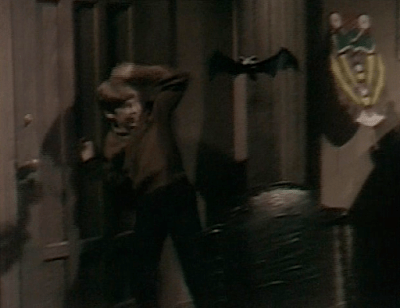
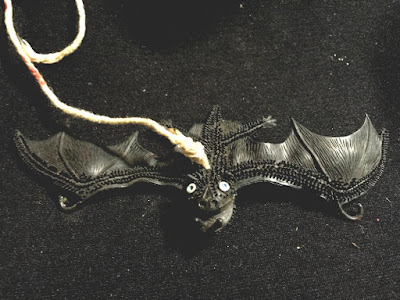
Once he is alone in the room, the window blows open and a bat enters. More precisely, a bat-shaped marionette is brought in on clearly visible strings by a pole that casts a shadow we can see the entire time, but no one who has been watching the show up to this point will doubt for a second that David’s fear, as depicted by David Henesy, is fully justified. David tries to flee from the bat, but he cannot open the door to escape from his room. His back against the door, David slides onto the floor and screams as the bat comes near him.
When Barnabas is about to attack someone, dogs start howling. Sometimes this works to his advantage, but it so often puts his intended victims on their guard that it doesn’t really seem to be something he is doing on purpose. So this bat represents something new. Perhaps Barnabas is using magic to control a bat- if so, it marks the first time we have seen Barnabas use magic to project influence over something other than a human mind. Or perhaps he himself has assumed the form of a bat. If so, that is the first indication we’ve had that he has shape shifting powers. In either case, Barnabas’ powers have just gone up a level.
Closing Miscellany
The bat was created by famed puppeteer Bil Baird. Most famous today for the puppets he created for “The Lonely Goatherd” sequence in The Sound of Music, Baird was a frequent guest on television programs like The Ed Sullivan Show, and Jim Henson cited Baird’s own TV series, the short lived Life with Snarky Parker, as a major influence on the Muppets. In December 1966, Baird opened a marionette theater in New York City, at 59 Barrow Street in Greenwich Village; it operated until 1978, and many leading puppeteers, including dozens who would go on to work with Henson, were members of its company in those years.
This is the last episode to end with ABC staff announcer Bob Lloyd saying “Dark Shadows is a Dan Curtis production.” We do hear the announcement again in February of 1969, but that won’t be because Lloyd has returned- they used an old recording for the music under the closing credits that day, and they picked one with him on it.
Fans of Dark Shadows will often talk about “the early episodes” which ended with Lloyd making that announcement. So I suppose #330 is the last of “the early episodes.”
Danny Horn’s post about this one on Dark Shadows Every Dayincludes a morphology of episode endings. He divides them into five categories, Haiku,* Restatement of Threat, ** New Information,*** Crisis Point,**** and Spectacle.***** It’s an intriguing scheme, and he makes a good case for it.
*Danny explains that “Haiku” “aren’t necessarily recognizable as endings in the traditional sense, because nothing is resolved and no progress is made. It’s just a little moment when a character pauses, and possibly has a feeling about something… In some extreme cases, the audience may not realize that the episode is over until halfway through The Dating Game.”
**Restatement of Threat, at this period of Dark Shadows, usually means Barnabas looking at us through his window and saying that someone or other “must die!” Which of course means that you can safely sell a million dollar life insurance policy to that character.
***”A New Information ending provides an actual plot point, which either advances the story another step, or tells us something that we didn’t know.”
****”The Crisis Point cliffhanger is the big game-changer, and for best effect, it should come at the end of a sequence that’s been building up for a while. This is a big turn in the story, and it should feel satisfying and thrilling… The defining feature of a Crisis Point ending is that the resolution marks a change in the status quo, ending one chapter and setting up the next.”
***** “Obviously, plot advancement is always welcome, but every once in a while the show needs to set its sights a little higher. These are the moments when the show goes above and beyond, in order to surprise and dazzle you… The point of a Spectacle is: You can’t take your eyes off the screen. Housewives in the audience have put down the iron, and switched off the vacuum. Teenagers have stopped swatting at their siblings… A Crisis Point cliffhanger will bring you back for the next episode, because you want to see what happens next. But a Spectacle cliffhanger is bigger than that — you’ll be coming back for the next episode, but it’s because you can’t believe what you’re seeing, and maybe tomorrow they’ll do it again.”
Maggie Evans, The Nicest Girl in Town, has come back to Collinsport. This is a surprise to everyone. Months ago, Maggie had escaped from an unknown captor who drained her blood and deranged her mind. Maggie’s family doctor, addled quack Dave Woodard, had persuaded her father and her fiancé to join him in telling everyone that she was dead and to lock her up in a mental hospital a hundred miles north of town. Evidently, Woodard thought that if the captor believed he had got away with his crimes, he would turn into a solid citizen and a good neighbor.
The mental hospital where Woodard sent Maggie was administered by Dr Julia Hoffman, an MD whose specialties in psychiatry and hematology made her seem like the perfect person to oversee Maggie’s care. Unfortunately for Maggie, Julia is also a mad scientist. She has for years dreamed of finding a vampire on whom she can try an experimental treatment that will turn him back into a human. Julia quickly recognized Maggie’s condition as a symptom of vampire attacks, and eventually identified Barnabas Collins as the vampire who held Maggie prisoner. She has now met Barnabas and promised to keep Maggie in a state of amnesia so long as he cooperates with her experiments.
Yesterday, the ghost of Barnabas’ nine year old sister Sarah liberated Maggie from Julia’s hospital and transported her back to Collinsport. This had such a great effect on everyone that the show is now in color.
Barnabas goes to the great house of Collinwood and tells Julia that Maggie has come back. He declares that he will have to kill her. Julia forbids him to kill Maggie, on the grounds that doing so would ruin years of her work. Talented a liar as Julia is, she comes up with this so quickly and in such a tense situation that it is hard to believe it is not her true reason for wanting to leave Maggie alive.
Barnabas clarifies the matter further when he says that he will kill Julia first. He follows Julia around the drawing room, apparently thinking of strangling her then and there. She keeps talking, and he can’t resist responding. The telephone rings, and she answers. It is Woodard, calling her to come to his office and take over treatment of Maggie. Julia triumphantly assures Barnabas that once she has done her work, Maggie will never remember what he did to her.
In Woodard’s office, Maggie’s memory is rushing back. She tells her friend Vicki that when she was being held prisoner she spent time in a special room where she smelled a sweet, powerful fragrance and heard a special kind of music. She had told Julia about those sense impressions in a session in #282, and when in #289 Vicki told Julia about a special room in Barnabas’ house where there was a jar of jasmine perfume and an antique music box, Julia had reconstructed Barnabas’ entire plan. When she hinted to Vicki that Barnabas was trying to recreate the late Josette Collins, Vicki had become defensive and stormed off, indicating that Julia is casting an unflattering light on something Vicki has been looking at through a romantic lens.
The camera is tight on Vicki’s face when Maggie mentions the room, the fragrance, and the music. Vicki’s face darkens in response to each point, a little bit more each time. She seizes on the key word of each statement, rephrasing it as a question- “Special room?… Special scent?… Special music?” So far on Dark Shadows, every plot has come to its climax as a result of Vicki figuring out what’s going on. So each of these reactions generates its own little jolt of suspense.
Special room?Special scent?Special music?
By the time Julia gets there, Maggie is saying that she remembers everything. Julia hustles Woodard out of the room, and is alone with Maggie when Maggie says that Barnabas Collins was her captor. She describes him as a creature from the world of the dead. She allows that this description is difficult to believe, but Julia assures her that she believes everything she tells her. Julia then tells her that they must stabilize her memory so that she will not regress to the miserable state she was in when first they met. She takes out a jeweled medallion and hypnotizes Maggie.
Woodard waits outside his office while Julia works on Maggie. Finally, Julia opens the door and asks if he would like to see the change in her. Woodard eagerly goes into his office.
He asks Maggie how she is. As she answers, she sounds just like she did before she fell into Barnabas’ clutches. She has regained her Adult Child of an Alcoholic habits of advertising her happiness by starting every utterance with a laugh in her voice and putting exaggerated stress on almost every syllable with a rising pitch. She tells him that “Apparently, there was something wrong with my memory, but I’m fine now.” He asks what happened to her when she was gone, and she has no idea what he means. She remembers falling asleep in her own bed, and then she found herself here with Dr Hoffman. If he could just tell her what happened in between, she’s sure she will be just fine.
Woodard is shocked, but Julia flashes a look of glee. She does remember to put on her worried face after Woodard looks at her, but the smile never really leaves her eyes.
That Julia was able to achieve so precise and extensive a mutilation of Maggie’s memory in so short a time would suggest that she spent the whole period Maggie was under her care laying the groundwork for it. That would in turn tend to confirm that her only interest in Maggie is as a tool to gain access to Barnabas as a subject for her experiment.
Closing Miscellany
As the opening title sequence begins, an ABC staff announcer says he brings “Good news! This program, Dark Shadows, is now being presented in color.”
Opinions may vary as to how good this news was. In the 1960s and 1970s, most television sets in the USA did not receive in color. So even programming that was made in color had to be composed first to look good in black and white. It took a big budget and a relaxed production schedule to make a show that would also benefit from color, and Dark Shadows never had either of those things. When a sense of atmosphere is especially important, as it usually is early in a storyline, it is best to watch the show with the color turned off.
Still, directors Lela Swift and John Sedwick were ambitious visual artists, and before long there will be some moments when they find ways to turn the muddy, cruddy TV colors of the era to their advantage. The camera operators will learn their craft even more quickly. Today, only a few closeups really meet broadcast standards, while every other shot is badly out of focus. There aren’t many other episodes like that, at least not until the woeful Henry Kaplan becomes one of the directors in December 1968.
This is not only the first color episode, but also the first one where the words “Dark Shadows” swoop and swirl around on the screen during the opening titles. I’m sure that was a very impressive effect in 1967.
When we saw Julia hypnotize Maggie in their sessions in the hospital, she shone a penlight in her eyes. This is the first time she uses the medallion. That is an example of the use of color- the medallion wouldn’t have been anything special in black and white.
We reprise the final scene of Friday’s episode, in which vampire Barnabas Collins catches his prisoner Maggie Evans trying to stab him. He flashes his fangs at her.
Doctor Teeth and the Electric Mayhem
The first time around, this had been the climax of a number of powerfully realized scenes, so it still carried a punch despite the silliness of the fangs. From a standing start, though, the result is a bad laugh.
In the 45 seconds following the first commercial, ABC staff announcer Bill Rice* summarizes the action of the previous week’s episodes.** This recap comes so close to exhausting every event we saw in those 110 minutes of scripted drama that regular viewers will have another unintended laugh.
The recap was inserted because many ABC stations preempted Dark Shadows to cover a United Nations debate about the Vietnam War. The show was about as resolutely disengaged from contemporary politics as it was possible to be, but conjoining US policy in Vietnam with a character like Barnabas, who combines a vast capacity for killing with a desperate need to be loved, does bring certain thoughts to mind.
Barnabas and Maggie have a conversation about his inclination to kill her. Barnabas’ sorely bedraggled blood-thrall Willie Loomis joins in, saying that Barnabas will have to kill him first. This would not seem to present Barnabas with any difficulty at all. Willie wouldn’t be missed- everyone else on the show remembers Willie from the days before he met Barnabas, when he was dangerously unstable ruffian Willie Loomis, and has been urging Barnabas to get rid of him. Nor would it be especially difficult for Barnabas to replace Willie- he just has to bite someone else, and that other person will become his new slave. But Barnabas stands around arguing with Willie and Maggie. When someone knocks on the front door, he scolds Willie for failing to keep it locked, such a humdrum complaint under the circumstances as to bring another bad laugh. Barnabas leaves Willie and Maggie in the basement while he answers the door. Before he goes, he sticks out his lower lip, a facial expression known as “pouting.”
Barnabas pouts
The visitor is well-meaning governess Vicki, who tells Barnabas that the sheriff has ordered that no woman go out alone at night. Some think it strange to send a woman out alone at night to carry this message to a man who is indoors, but considering what we’ve seen of the sheriff, doing the exact opposite of what he commands would seem always to be the wisest course.
Vicki notices an antique music box on a table in Barnabas’ front parlor. Vicki admires its tune and makes a few not-very-coherent remarks about “the past” while it is playing. Barnabas has been using this music box as a tool to hypnotize Maggie into believing that she is his long-lost love Josette. After Vicki leaves, he opens it again, then looks at the door through which she left. He turns his head and smiles, looking very much like someone who has just had an exciting new idea.
Lightbulb moment
Meanwhile, Maggie and Willie talk to each other in the basement. The two of them had one of the most electrifying scenes of the entire series down there Friday. The last traces of that energy have been piddled away by the time Barnabas comes back downstairs and resumes his conversation with them.
Willie urges Barnabas to look at Maggie and see how beautiful she is. Barnabas says “No” and looks away. Coming at a moment of high dramatic tension, this might have been powerful. When we sit down as an audience, we enter into a sort of agreement that if the show includes something worth seeing, we will look at it. So when we see a character refusing to look at a sight as well worth contemplating as was the young Kathryn Leigh Scott,*** we might be shocked. But there has been too much idle chatter, and the memory of Barnabas’ pout is so fresh, that all we can think of is a petulant child saying “I don’t wanna look at her!”
Barnabas announces that he will not kill Maggie right away. He tells her that he will make her suffer torments worse than anyone has ever known so that death will finally come as a blessed relief, then locks her up in the prison cell in the basement of the house. What, your house doesn’t have a prison cell in its basement? It’s a standard feature of homes in Collinsport, as we will come to see in future episodes.
Barnabas goes to the great house of Collinwood and talks to Vicki. He brings a handkerchief that, legend has it, was a gift from the queen of France to Josette. They babble about “the past” and Barnabas invites her to drop in at his house “some day.” He says “day,” even though he’s busy being dead every day until sunset. And doesn’t specify when- any old time, if she hears screams coming from the basement she’ll probably just ignore them.
Evidently Barnabas is thinking of Vicki as a backup Josette in case Maggie doesn’t come around. This marks a retreat from #240 and #241, when strange and troubled boy David Collins, who has seen Josette’s ghost many times, saw Maggie in the gown Barnabas gave her and said that she must have been Josette because she looked “exactly the same” as he had seen her before. That suggested, not only that Barnabas chose Maggie because of her looks, but also that he might be right in thinking that she is Josette’s reincarnation. This storyline is modeled on the 1932 Universal film The Mummy, in which Imhotep’s idea that Helen Grosvenor is the reincarnation of his lost love Princess Ankh-esen-amun is substantiated when Zita Johann plays both roles. If Vicki and Maggie are interchangeable, then all of that goes by the boards.
*Presumably no relation to the main character of Gene Roddenberry’s 1963-4 CBS TV series The Lieutenant, one episode of which was written by Art Wallace.
For those who have missed the last few episodes of Dark Shadows: Elizabeth Collins [Stoddard,] at Jason McGuire’s insistence, has taken Vicki, Carolyn, and Roger into the basement room and convinces them that it holds no mystery. They don’t realize that beneath the flagstones on the floor is concealed the room’s secret—the body of Elizabeth’s husband, Paul. Elizabeth, now realizing that the secret can never be told, announces to the family that she and Jason will be married. Maggie Evans escaped from Barnabas and attempted to get to her father, but was recaptured and told by Barnabas that unless she assumes the identity of Josette Collins, she will die. Realizing that she can never escape, Maggie attempts to destroy Barnabas.
The title card shown during the recap
***Or for that matter as is the not-so-young Miss Scott of today, she’s one of the best looking octogenarians around.











 Dark Shadows Commentary